Free Walking Tour San Gimignano: Towers and Frescoes

Through the pilgrims' gate, across the cistern square and up the tallest tower in town: a short walk through San Gimignano's medieval heart, with the GPS route free.

6 Stops 0.7 km ~12 min walking
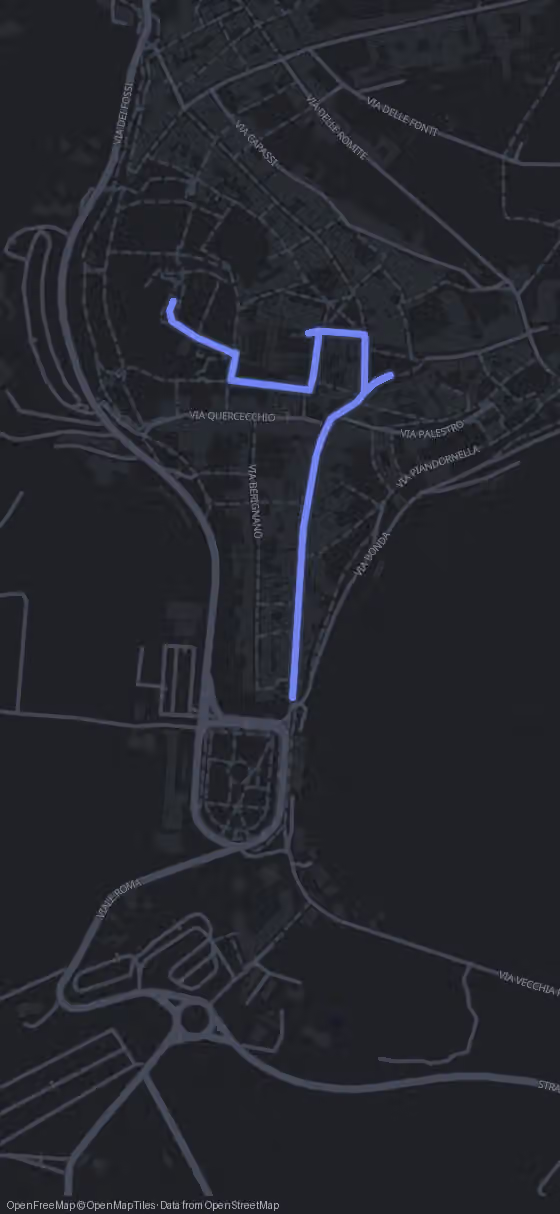
Route map for the San Gimignano walking tour
Stop 1 of 6
320 m·4 min
Porta San Giovanni
Head north up Via San Giovanni toward Piazza della Cisterna
Ciao, welcome to San Gimignano. I'm Alex, and one plain stone church here saves all its color for the inside.
Try this tour with Alex

This San Gimignano route at a glance

Six stops lead from Porta San Giovanni through Piazza della Cisterna, the Palazzo Comunale (Palazzo del Popolo), the Collegiate Church of Santa Maria Assunta (Duomo) and Torre Grossa to the Rocca di Montestaffoli: 0.7 km and 12 min of pure walking, about one hour seen from outside, around three hours with the interiors.

The gate, the squares and the Rocca are free; the Civic Museum with the tower and the Duomo charge entry. The GPS route runs free in your browser, the AI Tour Guide is optional.

Open free GPS & optional AI Tour Guide
View of San Gimignano

The Route

Walking Map of San Gimignano, Gate to Fortress

6 stops 0.7 km 12 min walking
Tap to load interactive map

The 6 stops along this route

  1. Porta San Giovanni in San Gimignano, stop 1 on the self-guided walking tour
    1Porta San Giovanni
  2. Piazza della Cisterna in San Gimignano, stop 2 on the self-guided walking tour
    2Piazza della Cisterna
  3. Palazzo Comunale (Palazzo del Popolo) in San Gimignano, stop 3 on the self-guided walking tour
    3Palazzo Comunale (Palazzo del Popolo)
  4. Collegiate Church of Santa Maria Assunta (Duomo) in San Gimignano, stop 4 on the self-guided walking tour
    4Collegiate Church of Santa Maria Assunta (Duomo)
  5. Torre Grossa in San Gimignano, stop 5 on the self-guided walking tour
    5Torre Grossa
  6. Rocca di Montestaffoli in San Gimignano, stop 6 on the self-guided walking tour
    6Rocca di Montestaffoli
  7. That's the full route.

    Walk it with an AI Tour Guide talking you through every one of these streets.

    Start free in your browser
    You made it

San Gimignano Walking Tour Stops, From Pilgrims' Gate to Rocca

  1. 1

    Porta San Giovanni

    Porta San Giovanni in San Gimignano, stop 1 on the self-guided walking tour

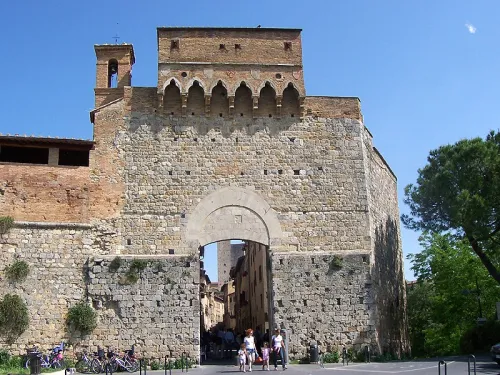
    Porta San Giovanni is the most important gate in San Gimignano's walls, and also the grandest. It sits at the town's southernmost point, which is why it was the way in for anyone coming up from Siena along the branch of the Via Francigena that passed through San Gimignano. Pilgrims, merchants and messengers all funnelled through this arch.

    Look at the shape of the opening: a low, flattened arch in the Sienese style. Above it, the guardhouse juts out from the wall, carried on a row of stone brackets decorated with small hanging trefoil arches. The gate was completed in 1262, at a time when the town needed to show both wealth and the ability to defend it.

    Right beside the gate once stood the little church of the Madonna dei Lumi, built in 1601 and leaning against the gate. Its aisles partly blocked the street, so in 1922 they were demolished to clear the way. The bell tower survived, and you can still see it from outside the gate.

    The open space in front of the gate is the Piazzale dei Martiri di Montemaggio. Where it lies today stood the convent of San Francesco, long since destroyed. It costs nothing to linger here, so take a moment outside before you pass under the arch.

    From here it is 320 m and about 5 min into the centre to Piazza della Cisterna; on the way you pass the spot where the San Gimignano Thursday Market sets up.
    Hours
    Open 24/7
    Price
    Free
  2. 2

    Piazza della Cisterna

    Piazza della Cisterna in San Gimignano, stop 2 on the self-guided walking tour

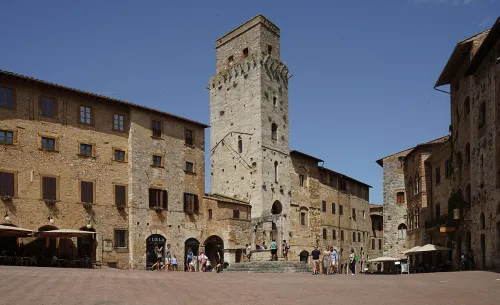
    Piazza della Cisterna is a triangle of brick paving on a gentle natural slope, with the cistern that gives it its name in the middle. It is free and always open, and it rewards a slow turn on the spot, because almost every wall around you is medieval. An open passage connects it to the neighbouring Piazza del Duomo.

    Count the towers: five stand on the square or right beside it, and the stumps of five more are visible in the facades of the palaces. One of the missing ones is the Ridolfi tower, which collapsed in 1646 onto the family's own palace. That palace and its tower once split the space in two: Piazza dell'Olmo in the lower western part and Piazza delle Taverne to the east, with the cistern in between.

    In the south-west corner you see the Arco dei Becci, an old town gate from an earlier ring of walls, flanked by the massive rectangular towers of the Becci on the left and the Cugnanesi on the right. The north side belongs to the Renaissance Palazzo Cortesi, which reached as far as the Torre del Diavolo; in its facade you can make out the remains of two towers from the older houses of the Cattani family. To the west rise the twin Ardinghelli towers, and the tower of Palazzo Pellari shows above the roofs.

    The square owes its life to geography. Here the Via Francigena, running north to south, crossed the road between Pisa and Siena, running east to west. So this was the market, the stage for festivals and tournaments, and, so the story goes, the regular pitch of Picansichado Ghezzi, a merchant and horse trader.

    Through the passage it is 110 m and 2 min to the Palazzo Comunale; you walk past Gelateria Dondoli on the way.

    Hours
    Open 24/7
    Price
    Free
  3. 3

    Palazzo Comunale (Palazzo del Popolo)

    Palazzo Comunale (Palazzo del Popolo) in San Gimignano, stop 3 on the self-guided walking tour

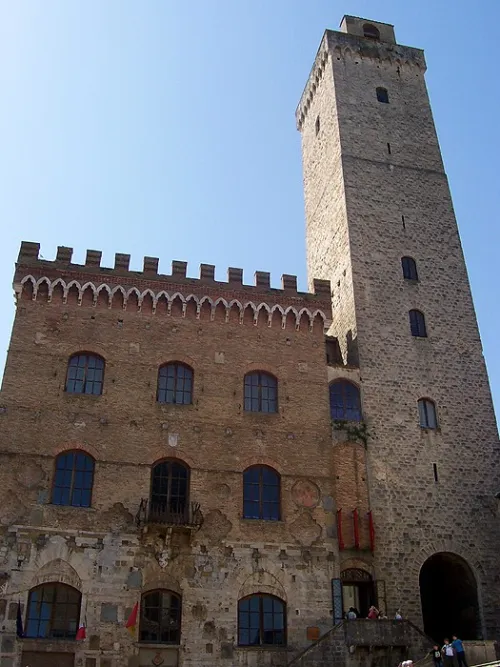
    You are now on Piazza del Duomo, and the building with the arched windows is the Palazzo Comunale, also called the Palazzo del Popolo, the people's palace. Look at the frontage: the lower half is built of stone, the upper part of brick. The battlements that make it look so warlike are younger than they seem; they come from the restoration Giuseppe Partini carried out between 1878 and 1881.

    The palace went up between 1289 and 1298 on the ruins of an earlier building and was enlarged in the 14th century. From 1337 the town government moved here from the nearby Palazzo Vecchio del Podestà, and it never left: the town council's offices are still on the ground floor. Their courtyard dates from 1323 and is covered with the coats of arms of the men who held public office. On the first floor is a gallery from which dignitaries addressed the crowd gathered in the square.

    Since 1852 the palace has also housed the Civic Museum. Inside are frescoes by Memmo di Filippuccio and Lippo Memmi, and a gallery of Florentine and Sienese painting with works by Coppo di Marcovaldo, Benozzo Gozzoli, Filippino Lippi, Il Sodoma and Pinturicchio. The museum charges entry, and it is worth it if Tuscan painting interests you even a little, because the same ticket also takes you up the Torre Grossa. Keep it for later in the walk.

    Together with the Duomo, this palace forms the heart of the medieval town and of the UNESCO World Heritage Site of the Historic Centre of San Gimignano. The Duomo is only 20 m away, a minute across the square.

    Hours
    Apr 1-Oct 31 daily 10:00–19:30; Nov 1-Mar 31 daily 11:00–17:30; Dec 26-Jan 6 daily 10:30–18:30. Last admission 30 minutes before closing. Closed Dec 25 and Jan 11-Feb 28 2027 (including Torre Grossa).
    Price
    10 EUR full, 8 EUR reduced
  4. 4

    Collegiate Church of Santa Maria Assunta (Duomo)

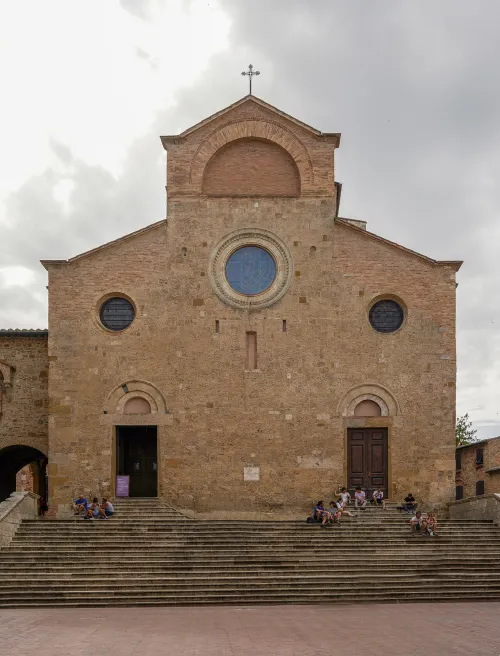
    Collegiate Church of Santa Maria Assunta (Duomo) in San Gimignano, stop 4 on the self-guided walking tour

    The Collegiate Church of Santa Maria Assunta, simply the Duomo to locals, looks plain from the square, but look for the plaque on the facade. It records the day the present church was consecrated, 21 November 1148, in the presence of Pope Eugenius III and 14 prelates, and dedicated to Saint Geminianus, the bishop who became the town's patron and whose relics are kept here. His feast falls on 31 January.

    A first church stood here from the 10th century. It grew in importance in the 12th century because the town lay on the Via Francigena, and pilgrims meant money and prestige. The church held land and privileges confirmed by papal bulls and became a collegiate church on 20 September 1471. Between 1466 and 1468 Giuliano da Maiano extended the far end of the building, adding vestries, the Chapel of the Conception and the Chapel of Saint Fina.

    The real reason to go in is the walls. Fresco cycles by Domenico Ghirlandaio, Benozzo Gozzoli, Taddeo di Bartolo, Lippo Memmi and Bartolo di Fredi cover the interior, and UNESCO describes them as works of outstanding beauty. The Duomo charges its own entry; if you only have time for one interior on this walk and you care about painting more than views, choose this one.

    The building has a few surprises. After damage in the Second World War, restorers in 1951 found the three apses of the earlier church lying beneath the nave of the present one. And in 1497 the fiery friar Girolamo Savonarola preached from the pulpit here.

    Back outside, the Torre Grossa is 20 m and a minute away.

    Hours
    Apr 1 – Oct 31: Mon–Fri 10:00–19:30, Sat 10:00–16:30, Sun & holidays 12:30–19:30; Nov 1 2026-Mar 31 2027: Mon–Sat 10:00–17:00, Sun and holidays 12:30–17:00; last admission 16:30. Closed Jan 16-Feb 15, Mar 12, Dec 25. Current winter operator schedule supersedes legacy November closure.
    Price
    7 EUR full, 4 EUR reduced, 6 EUR groups (min. 20)
  5. 5

    Torre Grossa

    Torre Grossa in San Gimignano, stop 5 on the self-guided walking tour

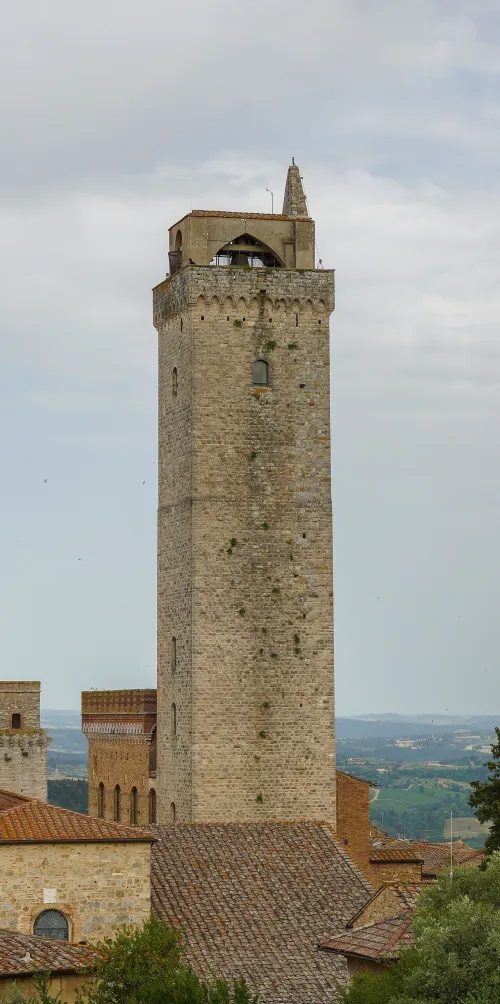
    The Torre Grossa, the big tower, crowns the Palazzo Comunale and is the tallest tower in San Gimignano at 54 metres, hence its name. Its start can be dated to the day: work began on 21 August 1300, four months after Dante Alighieri had come to town on 8 May 1300 as ambassador of the Guelph League in Tuscany. It was finished in 1311.

    Like every tower in town it has a square base, and it rests on a vaulted passage. The visible face is stone, cut into neat, regular blocks. At the top sits a bell chamber, ringed by a walkway behind a parapet carried on small hanging arches, under a pyramid roof that echoes the one on the nearby Torre Rognosa.

    Most of San Gimignano's towers are closed to visitors. Only three can be entered: this one, the larger of the twin Salvucci towers on Piazza delle Erbe, and Torre Campatelli on Via San Giovanni. From the top of the Torre Grossa the view opens over the whole town and the countryside around it, which is why it is worth going up if you bought the Civic Museum ticket; entry is included in it.

    When you are back on the square, the last leg takes you 230 m and about 4 min to the Rocca di Montestaffoli.

    Hours
    Apr 1-Oct 31 daily 10:00–19:30; Nov 1-Mar 31 daily 11:00–17:30; Dec 26-Jan 6 daily 10:30–18:30. Last admission 30 minutes before closing. Closed Dec 25 and Jan 11-Feb 28 2027 (including Torre Grossa).
    Price
    10 EUR full, 8 EUR reduced
  6. 6

    Rocca di Montestaffoli

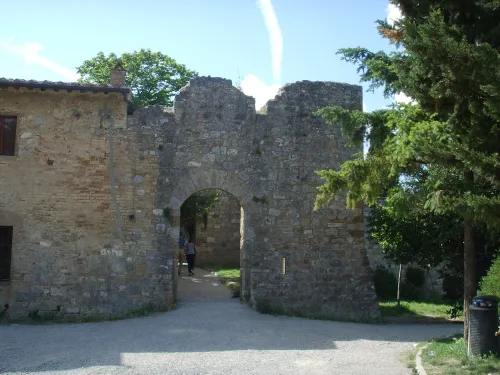
    Rocca di Montestaffoli in San Gimignano, stop 6 on the self-guided walking tour

    The Rocca di Montestaffoli is a free, open space enclosed by old fortress walls, a calm place to end the walk. What you see are only the walls; every room the fortress once had is gone.

    The hill of Montestaffoli had a fortress long before this one. In the early Middle Ages it belonged to a bishop who held political power over the settlement, and a market flourished here, fed by trade with neighbouring towns at the crossing of the Via Francigena and the road between Pisa and Siena.

    The fortress you are standing in tells a harder story. After the plague, the famine of 1348 and endless feuds between rival families, the people of San Gimignano offered their town to Florence in exchange for protection. In 1353 the Florentines built this Rocca, a clear sign of who was now in charge. Under the Grand Duchy of Tuscany it fell into ruin and was only restored in the 20th century.

    Today the Rocca is used for performances and concerts in summer, and a few works of contemporary art have recently been placed inside. Take your time here: after the towers and frescoes, it is a quiet finish to the walk.

    Hours
    Open 24/7
    Price
    Free
Walking tour route map of San Gimignano Route loaded
Porta San GiovanniPiazza della CisternaPalazzo Comunale (Palazzo del Popolo)Collegiate Church of Santa Maria Assunta (Duomo)+2
All 6 stops are already on the map.
You just press start.
AI Tour Guide

You know the route now. Walk San Gimignano's towers with a guide in your ear.

Press start wherever you are, even hundreds of kilometres from San Gimignano, and the guide begins telling its stories right away. In the city, pick any of the 6 stops to start from: it leads you there, then talks with you the whole route, asking, listening, remembering, and shaping the tour around your answers.

6stops 0.7km 12 minwalking 13languages
▶Start the tour free

Free to start · Runs in your browser · No app, no download

Three ways to shape your San Gimignano walk

The full route is short, so the real choice is how many doors you go through and whether you start at the gate or already inside the walls.

The free outside walk

Stops: 1, 2, 3, 4, 5, 6

For anyone who wants the town itself rather than its museums. You follow the whole route, 12 min of pure walking, and look at the Palazzo Comunale, the Duomo and the Torre Grossa from the square. No tickets needed, and about an hour is enough.

Starting inside the walls

Stops: 2, 3, 4, 5, 6

If you are already in the centre, begin at Piazza della Cisterna and skip the gate. That leaves 380 m and 8 min of walking. Add the Civic Museum ticket for the palace and the tower, and the Duomo ticket if frescoes are your thing.

Art and the tower only

Stops: 2, 3, 4, 5

For art lovers short on time or energy: the four stops around the two squares lie just 150 m and 4 min of walking apart. You need the Civic Museum ticket, which also opens the Torre Grossa, and the separate Duomo ticket.

How Long the San Gimignano Walk Takes

The walking itself takes 12 min over 0.7 km, almost all of it in the first leg from the gate to Piazza della Cisterna and the last one up to the Rocca. Everything in between sits around Piazza del Duomo, a minute or two apart.

Seen from outside, the walk fills about an hour with time to look around the squares. With the Civic Museum, the tower and the Duomo, plan around three hours: roughly an hour and a quarter for museum and tower together, and about 45 minutes for the frescoes in the Duomo. Starting inside the walls saves a few minutes; the compact art loop around the two squares takes about two and a half hours with both tickets.

Before you set off in San Gimignano

  • Start and finish: The recommended start is Porta San Giovanni, the old entrance for travellers from the south, and the walk ends at the Rocca di Montestaffoli. You can join at any stop; the order here simply follows the town from gate to fortress.
  • Tickets: The Palazzo Comunale with its Civic Museum and the Torre Grossa share one ticket. The Duomo has its own ticket. The gate, Piazza della Cisterna and the Rocca are free.
  • Time of day: If you want the interiors, walk during museum and church visiting hours, which differ between the two and between seasons. The open-air stops work at any time of day.
Walking tour route map of San Gimignano
AI Tour Guide

Your San Gimignano guide is ready when you are.

Press start and a voice AI Tour Guide takes it from here: leading the route through San Gimignano, telling the stories, and turning your walk into a real back-and-forth conversation. No app or download is needed; it runs in your browser.

6stops 0.7km 12 minwalking 13languages
▶Start the tour free

Free to start · Runs in your browser · No app, no download

What the AI Tour Guide adds in San Gimignano

On a route this compact the stories stack up within a few metres, and the AI Tour Guide keeps them in order as a conversation. It greets you at Porta San Giovanni, tells the story of each place, asks what draws you in and remembers it, so a fresco lover hears more about the painters and a history fan more about the feuding families. Ask it who Saint Fina was, whose chapel stands in the Duomo, or why the town ended up with so many towers, and interrupt whenever you like. You start with 100 free credits; after that, this tour costs €19.99 all-inclusive with no time limit, or you use credits at €5 per hour.

A Real Conversation A voice AI Tour Guide greets you, leads the whole route, and tells the stories and facts as you walk, asking what you want to see and keeping a real conversation going. Not a recording you press play on.
Map Navigation Follow the route on the map and walk at your own pace. You choose where to start and when to move to the next stop.
Ask Anything Curious about a building you pass? Ask your AI Tour Guide on the spot and the conversation carries on.
13 Languages Switch language anytime. No separate tour needed.
Start free in your browser

Common Questions about San Gimignano

Can I combine San Gimignano with Siena or Florence in one day?

Yes. The walk itself takes 12 min on foot and about three hours with all interiors, which leaves room for a second town. Siena is 29 km away and Florence 38 km.

If I only pay for one ticket, which should it be?

For views and civic history, the Civic Museum ticket, because it covers both the Palazzo Comunale and the Torre Grossa. For Renaissance painting, the Duomo with its fresco cycles by Ghirlandaio, Gozzoli and others.

What is the Via Francigena and why does it matter here?

It was the pilgrimage road running north to south through the town. Pilgrims entered through Porta San Giovanni, it crossed the road between Pisa and Siena at Piazza della Cisterna, and the traffic it brought made the main church and the markets of San Gimignano grow.

Is the tour really free?

Yes. The whole tour is free: the route, the interactive map and the navigation cost you nothing. Only the voice AI Tour Guide is optional and paid: you test it with 100 free credits, then you pay either €5 per hour or €19.99 for this whole tour, with no time limit. Admission to 3 of the 6 stops is not included: Palazzo Comunale (Palazzo del Popolo), Collegiate Church of Santa Maria Assunta (Duomo) and Torre Grossa charge their own entry fees.

Do I need to download an app?

No. Everything runs in your phone browser. Open the route and start walking, no download and no sign-up required.

Do I need to book the walking tour in advance?

No booking needed. This self-guided tour is available anytime. Open the route in your browser and start walking. The AI Tour Guide works instantly, no app, no reservation required.

What languages is the AI Tour Guide available in?

The AI Tour Guide speaks 13 languages, so you take the tour in your own language and can switch at any time.

Can I skip stops or change the route?

Yes. Skip any stop, spend extra time at places you like, or start the route from any point. It is your walk, you set the pace.
Image credits
▶ Start free in your browser Runs in your browser, no app, no download