Free Walking Tour Pisa: Tower, Haring and the Arno

Begin among the marble giants of the Piazza dei Miracoli, then follow Pisa's streets to a Keith Haring mural and a tiny Gothic church by the Arno.

7 Stops 2.7 km ~37 min walking
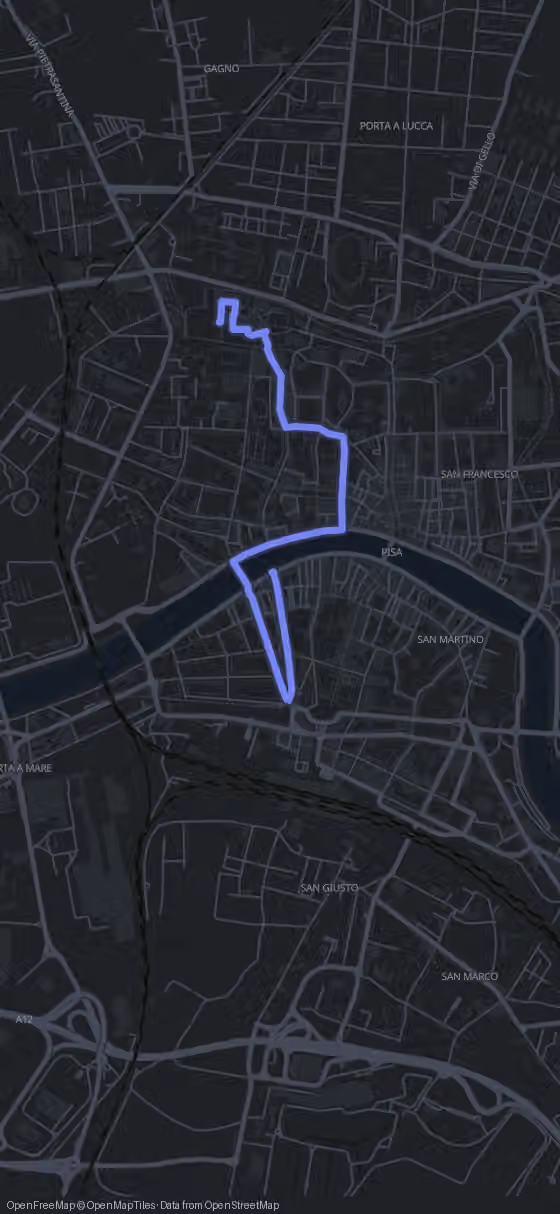
Route map for the Pisa walking tour
Stop 1 of 7
110 m·1 min
Baptistery of Pisa
Head north-east toward the Camposanto Monumentale
Ciao, welcome to Pisa. I'm Alex, and inside one marble dome here, a single human voice can turn itself into harmony.
Try this tour with Alex

Seven stops, one easy morning in Pisa

Seven stops lead from the Baptistery of Pisa past the Camposanto Monumentale, Pisa Cathedral and the Leaning Tower of Pisa to Piazza dei Cavalieri, Tuttomondo and Santa Maria della Spina by the Arno. It is 2.7 km with 37 minutes of pure walking; plan about three and a half hours with the inside visits worth making.

The cathedral, the knights' square, the mural and the little church are free; the baptistery, the cemetery and the tower charge entry. Route, map and GPS navigation are free in your browser, and the AI Tour Guide is optional.

Open free GPS & optional AI Tour Guide
View of Pisa

The Route

Walking Map of Pisa, from the Miracoli to the Arno

7 stops 2.7 km 37 min walking
Tap to load interactive map

The 7 stops along this route

  1. Baptistery of Pisa, stop 1 on the self-guided walking tour
    1Baptistery of Pisa
  2. Camposanto Monumentale in Pisa, stop 2 on the self-guided walking tour
    2Camposanto Monumentale
  3. Pisa Cathedral, stop 3 on the self-guided walking tour
    3Pisa Cathedral
  4. Leaning Tower of Pisa, stop 4 on the self-guided walking tour
    4Leaning Tower of Pisa
  5. Piazza dei Cavalieri in Pisa, stop 5 on the self-guided walking tour
    5Piazza dei Cavalieri
  6. Tuttomondo in Pisa, stop 6 on the self-guided walking tour
    6Tuttomondo
  7. Santa Maria della Spina in Pisa, stop 7 on the self-guided walking tour
    7Santa Maria della Spina
  8. That's the full route.

    Walk it with an AI Tour Guide talking you through every one of these streets.

    Start free in your browser
    You made it

Your Pisa Walking Tour: Seven Stops in Detail

  1. 1

    Baptistery of Pisa

    Baptistery of Pisa, stop 1 on the self-guided walking tour

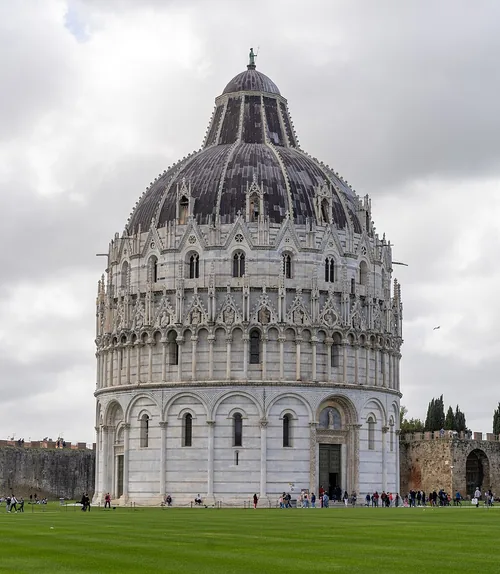
    Stand back a little and take in the round drum in front of you: 54.86 metres high and 34.13 metres across, this is the largest baptistery in Italy. It was begun in 1152 to replace an older baptistery, and its first architect, Diotisalvi, did something unusual for his time: he signed and dated his work.

    Look from the bottom up and you read two centuries of changing taste. The lower part is Romanesque, with round arches and fairly plain figures. Higher up the style turns Gothic, with pointed gables and a far richer crowd of sculpture. The building was only completed in 1363. Like the cathedral and the tower it is built of white Carrara marble striped with bluish grey stone, a trademark of Pisa's great churches; Florence and Pistoia used a dark green marble from Prato instead.

    Now walk to the east portal, the one facing the cathedral façade, probably carved around 1200. Two columns with leafy decoration, copied directly from a classical model, frame the door. On the inner jambs you find eleven reliefs on each side in Byzantine style. On the left the months of the year climb upwards from January at the bottom; look for the panel where September and October share one scene. On the right the story runs downwards: the Ascension at the top, then angels, Mary with raised hands, the Apostles in pairs gazing up, the Harrowing of Hell and, at the very bottom, King David.

    Going inside costs a ticket. If you love architecture and want to feel the size of that drum from within, it is worth it; if your budget is for one paid sight only, the portal outside already gives you the best of the stone storytelling. From here the Camposanto is just 110 metres away, 2 minutes on foot.
    Local name
    Battistero di San Giovanni
  2. 2

    Camposanto Monumentale

    Camposanto Monumentale in Pisa, stop 2 on the self-guided walking tour

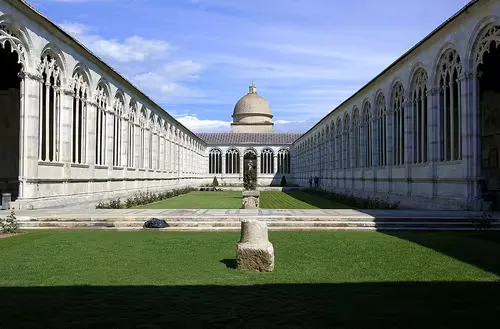
    The long, closed wall at the northern edge of the square hides Pisa's monumental cemetery. Its name means “holy field”, and the story behind it is remarkable: Archbishop Ubaldo Lanfranchi is said to have brought a shipload of sacred soil from Golgotha back from the Third Crusade in the 12th century. Legend claimed that bodies laid in that earth would decompose within 24 hours.

    The building itself came about a century later, the fourth and last to rise on the square. Giovanni di Simone began this huge oblong Gothic cloister in 1278, over an older burial ground and over the ruins of the old baptistery of Santa Reparata. He did not live to see much of it: he died in 1284, when Pisa lost the naval battle of Meloria to Genoa. The work dragged on until 1464, and it may first have been planned as a church dedicated to the Holy Trinity before the project changed.

    Count the 43 blind arches along the outer wall and look at the two doorways. The right one, crowned by a graceful Gothic tabernacle with the Virgin and Child among four saints, was the original entrance; the sculpture dates from the second half of the 14th century, by a follower of Giovanni Pisano.

    Entry is paid. Inside, most tombs lie under the arcades and a few on the central lawn, framed by round arches with slender mullions and lobed tracery, plus three chapels. Go in if quiet cloisters and funerary art draw you. Then cross the Piazza dei Miracoli to the cathedral, 160 metres and 2 minutes away.

    Hours
    Daily: 09:00–20:00
  3. 3

    Pisa Cathedral

    Pisa Cathedral, stop 3 on the self-guided walking tour

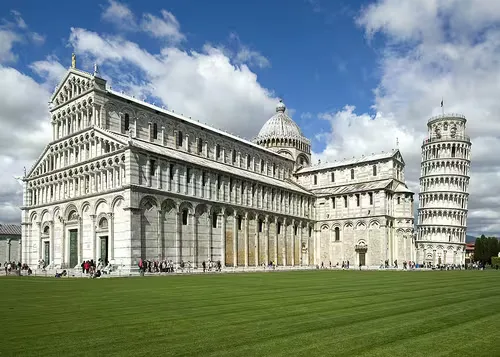
    This is where the whole square began. Pisa Cathedral is the oldest of its great buildings, started in 1064 by the architect Buscheto and paid for with the spoils of Pisa's fighting against the Muslims in Sicily and Ifriqiya that year. The main work was done by 1092, the church was consecrated in 1118, and in the 12th century it was enlarged and given a new façade.

    Look closely at the façade and walls and you see a city of merchants showing off its reach: classical, Lombard, Byzantine and Islamic elements mixed into what became known as Pisan Romanesque. The timing was no accident. In the same year Venice started rebuilding St Mark's Basilica, and the two maritime republics competed over who could raise the more splendid church.

    There was a message in the location too. The cathedral was built outside Pisa's early medieval walls, a statement that the city had no fear of attack. The ground had served as a Lombard burial site, and an unfinished church meant to be called Santa Maria already stood here; excavations in the early 2000s brought its remains to light. Buscheto's church was first called Santa Maria Maggiore before taking its official name of Santa Maria Assunta. In 1092 it became a primatial church when Pope Urban II gave Archbishop Dagobert the title of Primate. A fire in 1595 destroyed the roof, which was then replaced.

    Entry is free, so this is the one interior on the square everyone should see. The tower, the cathedral's own bell tower, stands just 100 metres away, a minute's walk.

    Local name
    Duomo di Pisa
    Hours
    Daily: 10:00–18:00
    Price
    Free
  4. 4

    Leaning Tower of Pisa

    Leaning Tower of Pisa, stop 4 on the self-guided walking tour

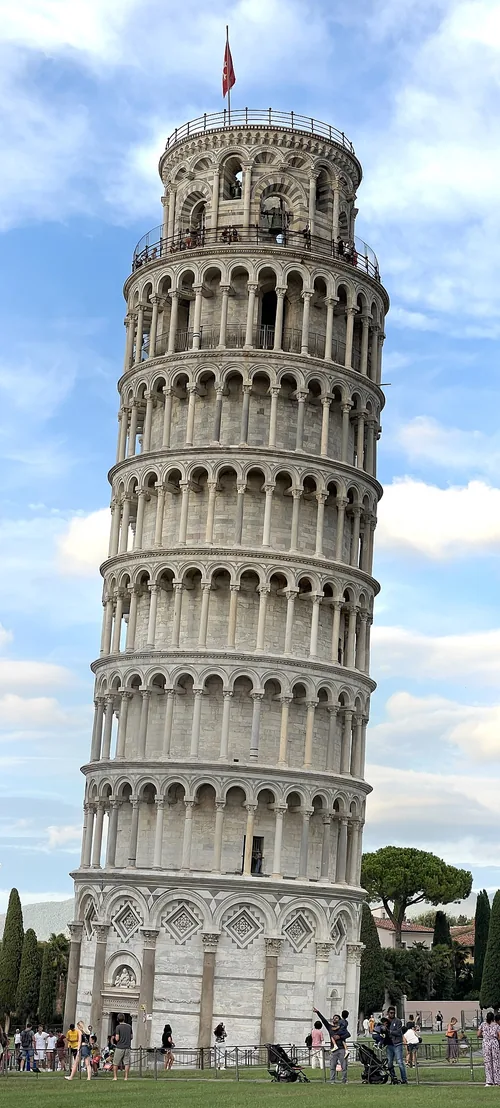
    Here it is: the bell tower of the cathedral, leaning by nearly four degrees and drawing over 5 million visitors a year. Notice that it is slightly taller on one side than the other, 55.86 metres from the ground on the low side and 56.67 metres on the high side. At the base the walls are 2.44 metres thick, and the whole structure is estimated to weigh 14,500 tonnes.

    The problem started early. The soft ground could not carry the weight, so the tower began to lean while it was still being built in the 12th century, and the tilt grew until it was finished in the 14th. Construction ran in three stages over 199 years. By 1990 the lean had reached 5.5 degrees; stabilisation work between 1993 and 2001 brought it back to 3.97 degrees.

    Who designed it is still debated. For a long time it was credited to a man named Guglielmo and to Bonanno Pisano, a bronze caster who worked on the cathedral, left for Monreale in Sicily in 1185 and later came home to die in Pisa. In 1820 a cast fragment bearing his name turned up at the foot of the tower, though it may come from the cathedral's bronze door lost in the 1595 fire. A 2001 study points instead to Diotisalvi, the man behind the baptistery you saw first.

    Going inside costs a ticket. It is for you if you want to feel the lean in your own body; the view of the tilt from the lawn costs nothing. Next, leave the square for the city: 600 metres, 8 minutes, passing the Museo dell'Opera del Duomo on the way to Piazza dei Cavalieri.

    Local name
    Torre di Pisa
    Hours
    Daily: 09:00–20:00
    Price
    20 EUR (no reduced tickets)
  5. 5

    Piazza dei Cavalieri

    Piazza dei Cavalieri in Pisa, stop 5 on the self-guided walking tour

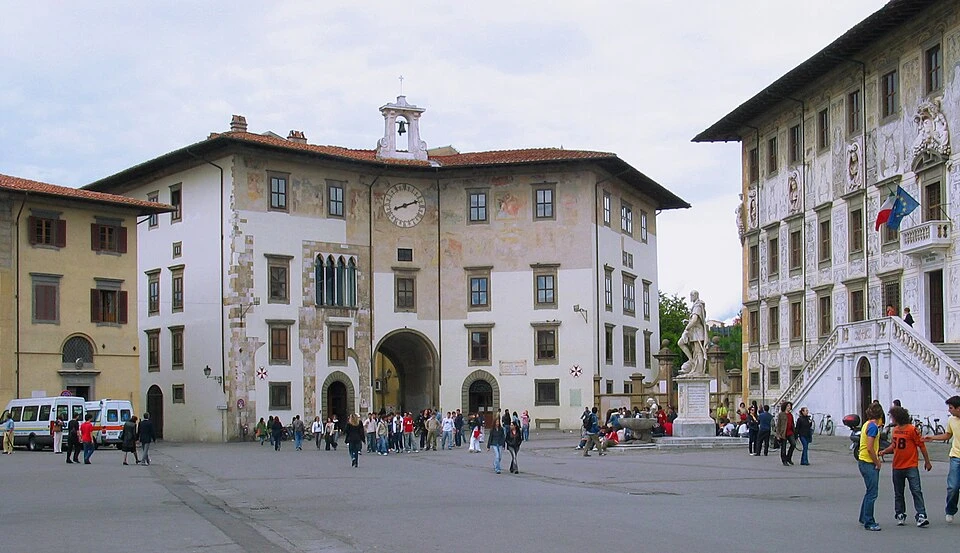
    You have reached Pisa's second main square, and for centuries its political heart. It was once called the Square of the Seven Streets, the place where Pisans argued over their problems and celebrated their victories. People long believed the forum of Roman Pisa's harbour lay here, though no excavation has ever proved it.

    From 1140 the square became the seat of the city government. After the victory of the People of Pisa in 1254, several existing buildings were joined into the Palace of the People and the Elders, and from 1357 the Captain of the People sat in the nearby Clock Palace, built around older towers. The southern side held offices, law courts and the residence of the Podestà, and a church named after the blacksmiths who worked in the area stood here from at least 1074.

    Then came the turning point. In 1406 an envoy of Florence stood on this square and declared the end of Pisa's independence. In 1558 Giorgio Vasari, architect to Grand Duke Cosimo I de' Medici, rebuilt the whole square in Renaissance style, demolishing the blacksmiths' church in the process. From the middle of the 16th century it was the headquarters of the Order of the Knights of St Stephen, which gave the square its name.

    Today it belongs to students: the Scuola Normale di Pisa, part of the university, has its main house here. The square is free and open at any hour. Ahead lies the longest leg of the walk, 1270 metres and 17 minutes, to a very different kind of art.

    Hours
    Open 24/7
    Price
    Free
  6. 6

    Tuttomondo

    Tuttomondo in Pisa, stop 6 on the self-guided walking tour

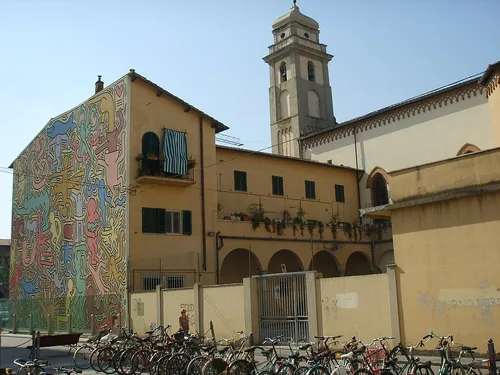
    Turn to the rear wall of the church of Sant'Antonio Abate and you meet Keith Haring. Tuttomondo, “All World”, covers 180 square metres with 30 figures in his bold, cartoon-like style, painted in 1989, the year before he died of AIDS-related complications. It is one of his last public murals and one of the few outdoor works he made to stay permanently.

    It happened by chance. In 1988 an Italian student, Piergiorgio Castellani, ran into Haring on the streets of Manhattan's East Village during his winter break and invited him to create something powerful in Pisa. They started planning in Haring's studio the very next day, and Castellani's family arranged the wall with the city. Haring later called it one of his most important projects.

    He painted it in June 1989 in a single week, with more onlookers every day. When he finished, he said it all felt Felliniesque, unreal beyond anything he had known. Read the wall as a message of peace and harmony: human figures forming a pair of scissors stand for people uniting to defeat the serpent of evil, which is already biting the arm of the figure beside it; a woman with a baby stands for motherhood; two men holding up a dolphin show our bond with nature.

    One myth to correct: this is often called Haring's last public work, but he painted another mural in Pasadena that November. As thanks, he gave the Castellanis, who owned a vineyard, a drawing they could use as a wine label. The mural is free to see at any time. From here it is 480 metres, 7 minutes, to the river and the final stop.

    Hours
    Open 24/7
    Price
    Free
  7. 7

    Santa Maria della Spina

    Santa Maria della Spina in Pisa, stop 7 on the self-guided walking tour

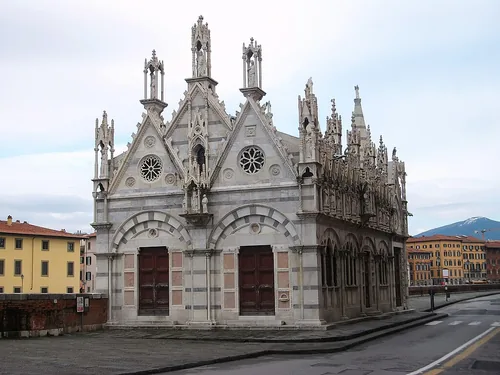
    The walk ends with something small and exquisite. This little church, built around 1230 in Pisan Gothic style and enlarged after 1325, is covered in pinnacles, gables, tabernacles, rose windows and statues, its marble laid in coloured bands. It counts as a gem of Gothic architecture in Italy.

    It first took its name from a newer bridge nearby, Santa Maria di Pontenovo; the bridge collapsed in the 15th century and was never rebuilt. The name della Spina, “of the thorn”, came with a relic brought here in 1333, said to be a thorn from Christ's crown. The thorn has since moved: it is now shown in the Chiesa di Santa Chiara on Via Roma.

    The church you see is not quite where it began. Water from the Arno kept seeping in, so in 1871 it was taken apart and rebuilt on higher ground. The rebuild changed it, and John Ruskin, visiting in 1872, was furious. Throughout its history the city has run the church, apart from short spells in the 17th and 18th centuries when the local hospital was in charge.

    Take time over the sculpture by Pisa's leading artists of the early 14th century: Giovanni Pisano, Lupo di Francesco, Andrea Pisano with his sons Nino and Tommaso, and Giovanni di Balduccio. Between the two doors on the façade sits a tabernacle with the Madonna and Child and two angels, attributed to Giovanni Pisano; on the street side, thirteen statues of Christ and the Apostles come from Lupo's workshop. Entry is free when it is open, but its hours are short. If you need to get back to the start, the GPS navigation will take you there.

    Hours
    Mon–Tue: Closed | Wed–Fri: 15:00–18:00 | Sat–Sun: 10:00–13:00, 15:00–18:00
    Price
    Free
Walking tour route map of Pisa Route loaded
Baptistery of PisaCamposanto MonumentalePisa CathedralLeaning Tower of Pisa+3
All 7 stops are already on the map.
You just press start.
AI Tour Guide

You know the route now. Walk it with a guide talking you through Pisa.

Press start wherever you are, even hundreds of kilometres from Pisa, and the guide begins telling its stories right away. In the city, pick any of the 7 stops to start from: it leads you there, then talks with you the whole route, asking, listening, remembering, and shaping the tour around your answers.

7stops 2.7km 37 minwalking 13languages
▶Start the tour free

Free to start · Runs in your browser · No app, no download

Shorter ways to walk Pisa

Not everyone has half a day. These cuts keep the route's order and simply drop what you do not need.

Piazza dei Miracoli only

Stops: 1, 2, 3, 4

For a short stopover or a first visit focused on the famous square. Only 5 minutes of walking in total. The cathedral is free; the baptistery, the Camposanto and the tower each need a ticket. With the cathedral, baptistery and Camposanto inside, allow about two hours.

Free from start to finish

Stops: 1, 2, 3, 4, 5, 6, 7

For travellers on a tight budget. Walk the whole route, 37 minutes on foot, see the baptistery, Camposanto and tower from outside and go inside only where it costs nothing: the cathedral and, when it is open, Santa Maria della Spina. Count on about two and a half hours.

Pisa beyond the tower

Stops: 5, 6, 7

For a second visit or anyone who has already seen the Miracoli. From Piazza dei Cavalieri to Tuttomondo and on to Santa Maria della Spina is 24 minutes of walking, and all three are free. About one hour is enough.

How Long This Pisa Tour Takes, With and Without Tickets

The first four stops sit almost wall to wall: 5 minutes of walking takes you from the baptistery to the tower. Then the route opens up into the city with 8 minutes to Piazza dei Cavalieri, the longest leg of 17 minutes to Tuttomondo and a final 7 minutes to the river. Altogether that is 37 minutes of pure walking.

Seen only from outside, the seven stops take about two hours. Going inside the cathedral, the baptistery and the Camposanto brings you to about three and a half hours; add extra time if you also buy a ticket for the tower. The free variant takes about two and a half hours, the Miracoli-only cut about two, the city loop about one.

Before you set off in Pisa

  • Start and finish: The recommended start is the Baptistery of Pisa; the route ends at Santa Maria della Spina. You can join at any stop, and the GPS navigation will lead you back to the start from the last stop if you want.
  • Time of day: Start early in the day so the inside visits on the square do not crowd out the walk into town. Santa Maria della Spina keeps short opening hours, so check them before you leave if you want to see the inside.
  • Tickets: The Baptistery of Pisa, the Camposanto Monumentale and the Leaning Tower of Pisa charge entry. Pisa Cathedral, Piazza dei Cavalieri, Tuttomondo and Santa Maria della Spina are free.

Day trips from Pisa: Lucca, Florence and the Cinque Terre

Out in the morning, back by night. Every route here fits in one full day.

Walking tour route map of Pisa
AI Tour Guide

Your guide is waiting at the Baptistery whenever you are.

Press start and a voice AI Tour Guide takes it from here: leading the route through Pisa, telling the stories, and turning your walk into a real back-and-forth conversation. No app or download is needed; it runs in your browser.

7stops 2.7km 37 minwalking 13languages
▶Start the tour free

Free to start · Runs in your browser · No app, no download

What the AI Tour Guide adds in Pisa

The AI Tour Guide walks this route with you as a conversation. It greets you at the baptistery, tells the stories of each place, asks what caught your eye and remembers it, so the talk at Piazza dei Cavalieri can pick up a thread from the cathedral. Curious what the Knights of St Stephen actually did, or how Pisa's sea power faded after Meloria? Just interrupt and ask. You start with 100 free credits; after that, unlock this tour all-inclusive for €19.99 with no time limit, or pay €5 per hour.

A Real Conversation A voice AI Tour Guide greets you, leads the whole route, and tells the stories and facts as you walk, asking what you want to see and keeping a real conversation going. Not a recording you press play on.
Map Navigation Follow the route on the map and walk at your own pace. You choose where to start and when to move to the next stop.
Ask Anything Curious about a building you pass? Ask your AI Tour Guide on the spot and the conversation carries on.
13 Languages Switch language anytime. No separate tour needed.
Start free in your browser

Common Questions about Walking Pisa

Are there reduced tickets for the Leaning Tower of Pisa?

No. The tower has one ticket price for everyone, with no reductions.

Does the walk end back at the Leaning Tower?

No, it finishes at Santa Maria della Spina by the Arno. If you need to get back to the Piazza dei Miracoli, the GPS navigation in your browser leads you there from the last stop.

Can I combine Pisa with Lucca or Florence on the same day?

Yes, the full walk with inside visits fills about half a day. Lucca is only 16 km away and pairs naturally; Florence makes a longer but rewarding second half.

If I only pay for one sight on the square, which should it be?

Choose the tower if you want to stand inside the famous lean, the baptistery for the sheer scale of Italy's largest baptistery, and the Camposanto if quiet arcades and tomb sculpture appeal to you. The cathedral costs nothing either way.

Is the tour really free?

Yes. The whole tour is free: the route, the interactive map and the navigation cost you nothing. Only the voice AI Tour Guide is optional and paid: you test it with 100 free credits, then you pay either €5 per hour or €19.99 for this whole tour, with no time limit. Admission to 3 of the 7 stops is not included: Baptistery of Pisa, Camposanto Monumentale and Leaning Tower of Pisa charge their own entry fees.

Do I need to download an app?

No. Everything runs in your phone browser. Open the route and start walking, no download and no sign-up required.

Do I need to book the walking tour in advance?

No booking needed. This self-guided tour is available anytime. Open the route in your browser and start walking. The AI Tour Guide works instantly, no app, no reservation required.

What languages is the AI Tour Guide available in?

The AI Tour Guide speaks 13 languages, so you take the tour in your own language and can switch at any time.

Can I skip stops or change the route?

Yes. Skip any stop, spend extra time at places you like, or start the route from any point. It is your walk, you set the pace.
Image credits
▶ Start free in your browser Runs in your browser, no app, no download