Free Walking Tour La Paz: Plazas, Markets, Killi Killi

From the square where Bolivia's power struggles were fought, through witches' stalls and market halls, up to a 360° view of La Paz and Huayna Potosí.

9 Stops 6.8 km ~1 h 48 min walking
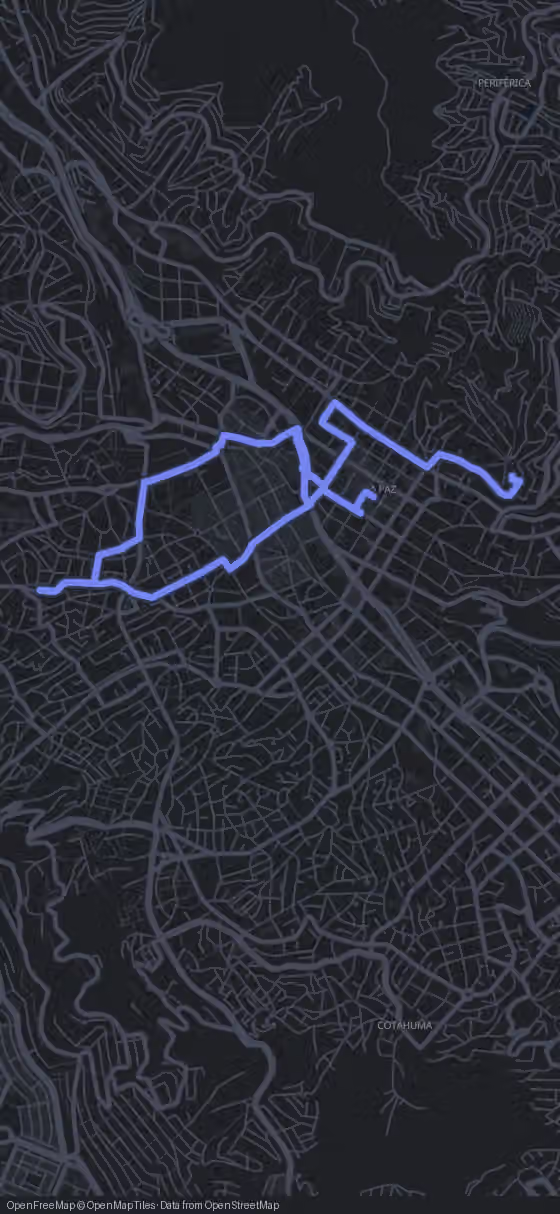
Route map for the La Paz walking tour
Stop 1 of 9
180 m·2 min
Plaza Murillo
Head south-west across the plaza toward the Catedral Basílica de Nuestra Señora de La Paz.
Hola, welcome to La Paz. I'm Alex, and one market here keeps an ancient offering alive beneath modern homes.
Try this tour with Alex

This Walk at a Glance

Nine stops lead from Plaza Murillo, the political heart of Bolivia, to the Mirador de Killi Killi: 6.8 km and 1 h 48 min of pure walking, about five hours with visits. Squares, churches, markets and the viewpoint are free; the one fixed admission is the museum at the Basílica de San Francisco (Bs 20 for foreigners).

Route, map and GPS navigation run free in your browser and lead you from stop to stop. The AI Tour Guide is optional: it tells the stories of each place as a conversation, asks what interests you and lets you interrupt at any moment.

Open free GPS & optional AI Tour Guide
View of La Paz

The Route

Walking Map of La Paz From Plaza Murillo to Killi Killi

9 stops 6.8 km 1 h 48 min walking
Tap to load interactive map

The 9 stops along this route

  1. Plaza Murillo in La Paz, stop 1 on the self-guided walking tour
    1Plaza Murillo
  2. Catedral Basílica de Nuestra Señora de La Paz, stop 2 on the self-guided walking tour
    2Catedral Basílica de Nuestra Señora de La Paz
  3. Plaza Mayor de San Francisco in La Paz, stop 3 on the self-guided walking tour
    3Plaza Mayor de San Francisco
  4. Basílica de San Francisco in La Paz, stop 4 on the self-guided walking tour
    4Basílica de San Francisco
  5. Calle Sagárnaga in La Paz, stop 5 on the self-guided walking tour
    5Calle Sagárnaga
  6. Mercado de las Brujas (Witches' Market) in La Paz, stop 6 on the self-guided walking tour
    6Mercado de las Brujas (Witches' Market)
  7. Mercado Lanza in La Paz, stop 7 on the self-guided walking tour
    7Mercado Lanza
  8. Calle Jaén in La Paz, stop 8 on the self-guided walking tour
    8Calle Jaén
  9. Mirador de Killi Killi in La Paz, stop 9 on the self-guided walking tour
    9Mirador de Killi Killi
  10. That's the full route.

    Walk it with an AI Tour Guide talking you through every one of these streets.

    Start free in your browser
    You made it

Your La Paz Walking Tour, Stop by Stop: Old Town, Markets, Viewpoint

  1. 1

    Plaza Murillo

    Plaza Murillo in La Paz, stop 1 on the self-guided walking tour

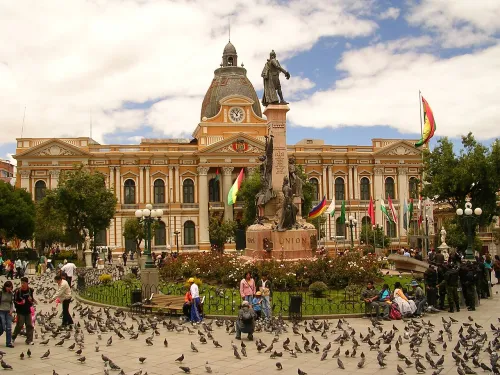
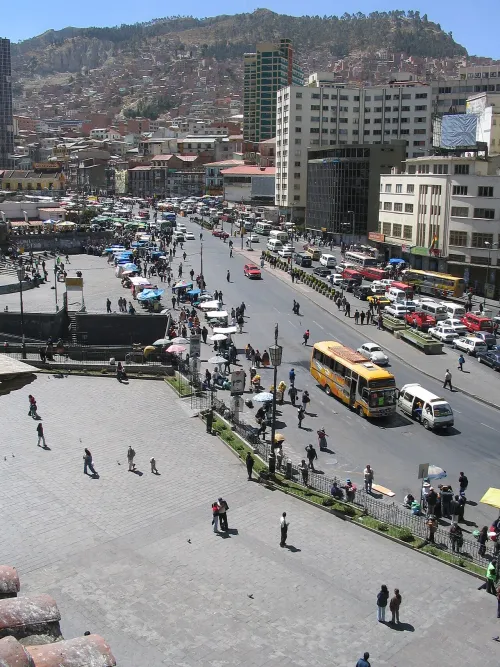
    Stand in the middle of Plaza Murillo and turn slowly: this is the open space most closely tied to Bolivia's political life. Around you rise the Palacio Quemado, the Casa Grande del Pueblo, the Plurinational Legislative Assembly and the cathedral. The square lies in the Casco Viejo, the old town, framed by Socabaya, Ayacucho and Comercio streets and the continuation of Ingavi Street.

    It began in 1558, when Juan Gutiérrez Paniagua, appointed by Corregidor Ignacio de Aranda, laid out the straight grid of La Paz on the north bank of the Choqueyapu River. Across the river stood the existing Spanish settlement of about 200 Spaniards and some 5,000 tributary indigenous residents, and its older square, today's Plaza Alonso de Mendoza, quickly lost its role to this new Plaza Mayor. Around it went up the Cabildo with its jail, a Jesuit building, the cathedral, the Royal Treasury and the Bishop's Residence.

    The name changed with the rulers: Plaza Mayor, then Plaza de Armas in colonial times, and after independence the name of Pedro Domingo Murillo, captured and hanged by Spanish troops in January 1810. He was not the only one. Juan Antonio Figueroa, Basilio Catacora, Buenaventura Bueno, Melchor Jiménez, Mariano Graneros, Apolinar Jaén, Gregorio García Lanza, Juan Bautista Sagárnaga, Juan Cordero and Simona Manzaneda were all killed on or near this square. Two of them, Sagárnaga and Jaén, give their names to streets on this walk.

    Power was fought over here again and again: in 1809, 1811, 1814, 1862, 1865, 1871, 1898, 1946, 1952 and 2002. The square is free and open around the clock, so take your time with the facades. Then cross 180 m, about 3 minutes, to the cathedral, passing the Museo Nacional de Arte on the way.
    Hours
    Open 24/7
    Price
    Free
  2. 2

    Catedral Basílica de Nuestra Señora de La Paz

    Catedral Basílica de Nuestra Señora de La Paz, stop 2 on the self-guided walking tour

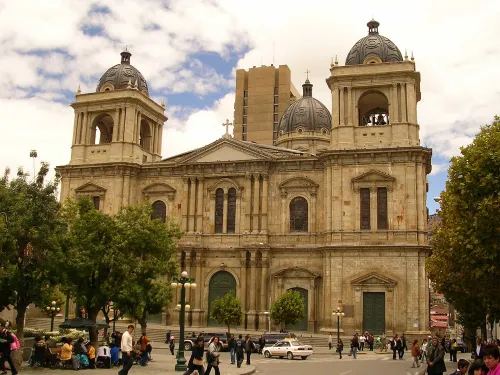
    The Catedral Basílica de Nuestra Señora de La Paz looks like a temple from antiquity: a neoclassical front in which a large green metal door, flanked by two smaller ones, is framed by Corinthian columns. It is the seat of the Archdiocese of La Paz and shares the square with the Bishop's Residence, the government palace and Congress. Notice how it sits on the edge of the hill: the ground falls 12 metres from the entrance on the square to the end of the choir.

    This is the second cathedral on the site. Work on its predecessor began in 1622 and took 70 years; by the early 19th century the cracks in its walls had grown so wide that it was closed in 1831 and torn down completely. The new building was begun on 24 March 1835 under President Andrés de Santa Cruz, who now lies buried in one of its chapels. To pay for it, the department raised special taxes of 30,000 pesos a year.

    Progress was slow. The cathedral was consecrated in 1925 for the hundredth anniversary of the Republic, the furnishings took until 1932, and Pope Pius XII named it a minor basilica in 1948. The two side towers with their domes were only finished in 1989, prompted by the visit of Pope John Paul II in 1988. Pope Francis came in 2015.

    Inside you find five naves, a high crossing dome, thick columns, massive walls and tall ceilings. The decoration is rather plain and the main altar of Italian marble is modest, so go in for the scale and the calm rather than for treasures. It is an active church with no admission fee, and a quarter of an hour is enough for most visitors. From here it is 930 m, about 13 minutes, to the Plaza Mayor de San Francisco.

    Hours
    Daily: 08:00–20:00
    Price
    Free (active religious temple, no admission)
  3. 3

    Plaza Mayor de San Francisco

    Plaza Mayor de San Francisco in La Paz, stop 3 on the self-guided walking tour

    The Plaza Mayor de San Francisco is really an urban atrium, the open forecourt spread out in front of the Basílica de San Francisco and the Centro Cultural Museo San Francisco. It is free and open at all hours, and it ties the second part of the walk together: church, museum and market quarter all meet here.

    The ground is older than the church. When the foundations for the current Mercado Lanza were dug, pottery fragments turned up, and given how close the spot lay to the houses of the cacique Quirquinchu, to pre-Hispanic settlements and to the river, this is believed to have been an Aymara ritual space. As was the custom of the time, the Catholic church was built on top of it.

    The square goes back to 1549 and grew up with the church whose name it carries. Some historians date it a year after Captain Alonso de Mendoza founded La Paz; others think it was a religious site set up even earlier by the first Spanish families living here. Either way, it was the first or second church of the city. The Franciscan complex once covered two full city blocks, with a seminary, today's museum and its crypt, the Colegio San Francisco and other buildings of the order.

    This was the district called the Pueblo de Indios, and for centuries many Aymara followed Mass from the atrium rather than inside. Over time the square was reshaped, sometimes on purpose, sometimes as a side effect of the city growing around it. The basilica's door is only 110 m away, a two minute walk.

    Hours
    Open 24/7
    Price
    Free
  4. 4

    Basílica de San Francisco

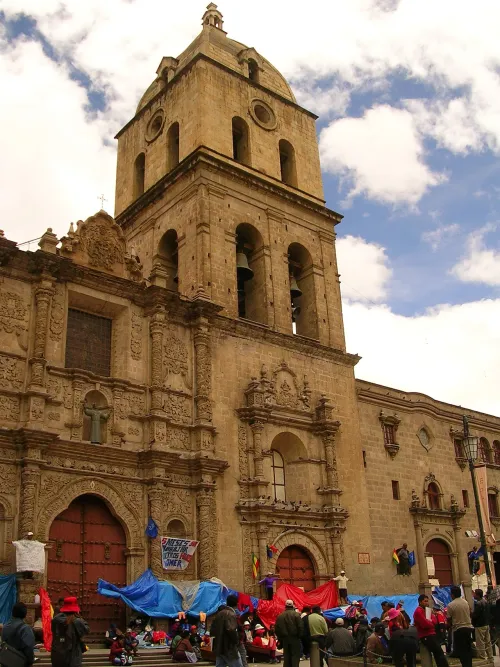
    Basílica de San Francisco in La Paz, stop 4 on the self-guided walking tour

    The Basílica de San Francisco is the building to look at closely in this part of town. Dedicated to Saint Francis of Assisi, it was built between the 16th and 18th centuries in the style known as mestizo baroque. The carving of its facade was finished in 1790; its single tower only began to rise in 1885.

    The Franciscan convent is the oldest religious house recorded in the city, mentioned in 1547, before La Paz was founded in 1548, though most texts settle on 1548. In 1549 Fray Francisco de Morales, said to be one of the first twelve friars in the region, and Fray Alcocer founded it as the Convento de Nuestra Señora de los Ángeles, outside the Spanish grid. Its land reached from today's square to the Choqueyapu River, the line that divided the Spanish city from the indigenous one, and to the present streets Illampu, Sagárnaga and Graneros.

    The first church, begun in August 1549 and completed in 1581, collapsed sometime between 1608 and 1612 under a heavy snowfall. The church you see was started in 1743 or 1744, and its crossing dome was closed and roofed in 1753, with the corregidor Vicente Lafita among the main benefactors. Bishop Campos consecrated it on 23 April 1784, and it became a minor basilica in 1948. Between 1950 and 1960 part of the convent was demolished for Avenida Mariscal Santa Cruz and the atrium was redrawn.

    Is it worth going in? If you pay for one visit on this walk, make it this one, especially if colonial art and history draw you. The Centro Cultural Museo San Francisco charges admission. The church itself opens for worship during services. Allow about 45 minutes, then walk 220 m, about 5 minutes, to Calle Sagárnaga, passing the Museo de la Coca.

    Hours
    Mon–Sat 09:00–18:00, Sun closed (Museum); Church open for worship during services
    Price
    Bs 20 foreigners / Bs 10 nationals / Bs 5 children & seniors; under-14 free (Centro Cultural Museo San Francisco)
  5. 5

    Calle Sagárnaga

    Calle Sagárnaga in La Paz, stop 5 on the self-guided walking tour

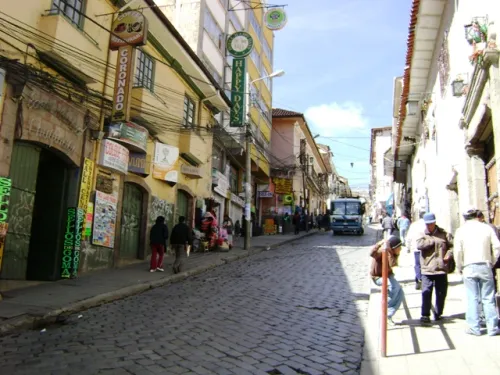
    Calle Sagárnaga is a public market street in the San Sebastián neighbourhood of the central district, free to walk at any hour. It carries the name of Juan Bautista Sagárnaga, a hero of the La Paz revolution whom you already met among the martyrs of Plaza Murillo. The street belongs to the first European-style grid laid out after the city's founding, the chessboard pattern the Spaniards used for their planned towns in the Americas.

    Its first chapter is a hospital. On 25 May 1555 the Cabildo under Corregidor Juan Remón decided to found a hospital and cemetery on a plot beside the San Francisco convent, between the houses of Juan de Lorenza and of Teresa de Tapia y de La Cerda. Neighbours contributed generously, and the hospital was placed under Saint John the Evangelist. The city ran it until 1629, when the first Brothers Hospitallers of San Juan de Dios arrived and took charge, with the Cabildo paying 2,000 pesos a year for medicines and upkeep. So the street became known as the calle del hospital.

    By the early 1660s hospital and cemetery were too small for the growing town. On 5 July 1663 the brothers bought a new plot from Gonzales de Vega for 860 pesos, and Vega donated the one next to it. There they built the new hospital and cemetery, a convent and the church of San Juan de Dios, which still stands on today's Calle Loayza.

    As you walk, look past the stalls at the line of the street itself: it is one of the original strands of that colonial grid. From here the route runs 1,260 m, about 23 minutes, to the Witches' Market.

    Hours
    Open 24/7 (public market street)
    Price
    Free
  6. 6

    Mercado de las Brujas (Witches' Market)

    Mercado de las Brujas (Witches' Market) in La Paz, stop 6 on the self-guided walking tour

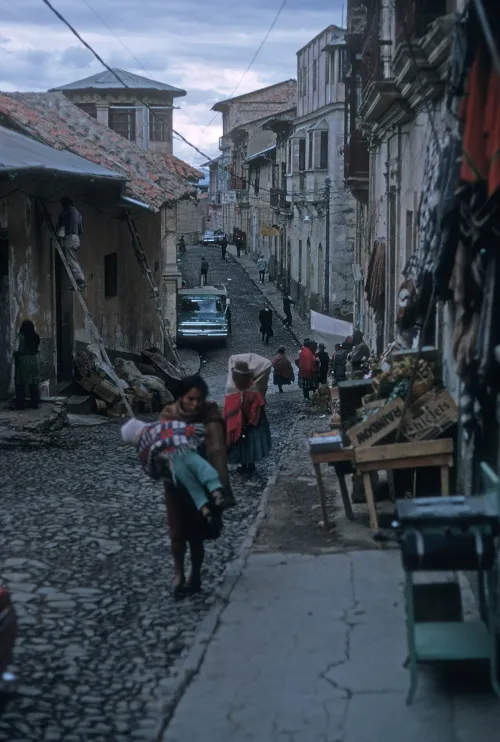
    At the Mercado de las Brujas (Witches' Market), centred on Calle Linares in the El Rosario neighbourhood and spilling into Jiménez, Santa Cruz and Illampu streets, the stalls hold potions, dried frogs, medicinal plants such as retama and armadillos used in Bolivian rituals. The name itself was chosen so that the many foreign visitors could recognise the place; it is also called La Hechicería.

    Most of the goods are sold by Aymara women known as chifreras, while the market is run by yatiri, local healers who also tell fortunes and work love magic and curses. You recognise a yatiri by the black hat and the coca pouch holding amulets, talismans and powders that promise luck, beauty and fertility.

    The item everyone stares at is the sullu, a dried llama fetus. Sullus are buried under the foundations of many Bolivian houses as a sacred offering to the goddess Pachamama. These rituals mostly take place in October, the market's busiest month, when locals say around 60 percent of the year's sales are made; February, with Carnival, is the other big month. Most rituals have been adapted to city life, a legacy of colonialism in Bolivia.

    In 2019 the market was declared Intangible Cultural Heritage of La Paz. Walking through is free and buying is up to you. The next leg is the longest of the tour, 2,000 m and about 28 minutes to Mercado Lanza, passing Plaza Alonso de Mendoza, the Spaniards' first main square, and the Museo Tambo Quirquincho.

    Hours
    Open 24/7 (street accessible 24/7; market stalls typically open daily approx. 09:00–19:00)
    Price
    Free
  7. 7

    Mercado Lanza

    Mercado Lanza in La Paz, stop 7 on the self-guided walking tour

    Mercado Lanza is where La Paz shops and meets: a modern hall near the corner of Calle Lanza and Avenida Mariscal Santa Cruz, the avenue that cost the Franciscans part of their convent. It has four entrances, one of them raised, reached over the Pasarela Pérez Velasco footbridge, another from Calle Evaristo Valle and one from Calle Figueroa.

    Its roots go back to the tambos that worked around the San Francisco church in colonial times. The first market building opened in 1937, paid for by selling hides that the meat traders handed over to the city. The name honours the Lanza regiment, in which several of the vendors served during the Chaco War.

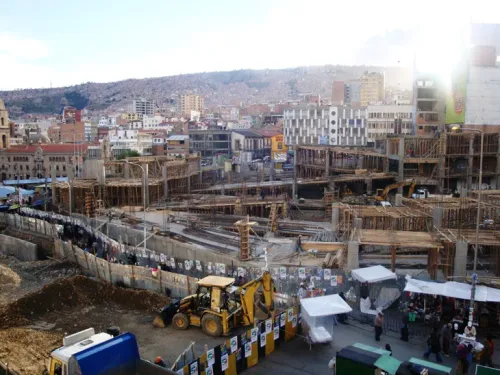
    The building you enter today went up between 2008 and 2010 to house more than 1,000 traders from the old market and the streets around it. In January 2008 the city agreed with the last groups of vendors to move into temporary stalls on nearby streets during construction. Handover was planned for November 2009, slipped to February 2010 for extra works and services, and the market finally opened in July 2010 under mayor Luis Revilla. It has four levels and 1,050 stalls.

    Entry is free, though each stall keeps its own hours; you pay only for the food or goods you buy, which makes it a good point on the route for something to eat. Continue 870 m, about 15 minutes, to Calle Jaén, passing the Museo Nacional de Etnografía y Folklore, the Teatro municipal Alberto Saavedra Pérez and the Museo de Instrumentos Musicales.

    Hours
    Daily 06:00–20:00 (varies by stall)
    Price
    Free entry (food and goods for purchase)
  8. 8

    Calle Jaén

    Calle Jaén in La Paz, stop 8 on the self-guided walking tour

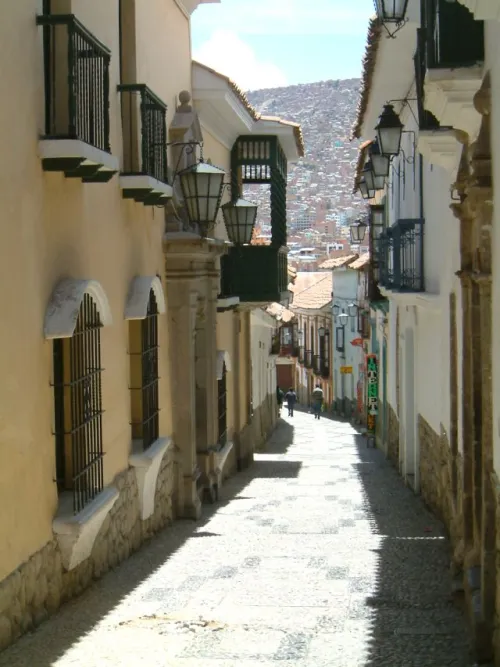
    Calle Jaén is only 100 metres long, yet no street in La Paz holds more museums, municipal and private, among them the house of Pedro Domingo Murillo. It runs from Avenida Sucre to Calle Indaburo, with cobblestones and balconied colonial houses, and between the museums you find bars, cafés and shops. The city has declared it historic, architectural and urban heritage.

    In the 16th century this was a market for buying and selling camelids, which is why it was once called Cabracancha. Today it honours Apolinar Jaén, one of the first martyrs of the 1809 revolution in La Paz and another of the men killed around Plaza Murillo. Being so close to the main square, it was one of the first streets traced in the grid, and it is marked on the city's first official plan of 1796, drawn up for street lighting.

    In 1781, during the siege of La Paz, the Spanish city built the Fuerte San Miguel half a block from here, along with a bridge over the Humauaca river. A painting of the siege by Florentino Olivares shows how the city defended itself against the Aymara attacks: walls along the edge of the slope in the north and towards the Mejahuira river, backed by small artillery forts on the main streets leading to the indigenous parishes.

    The street is free at any hour; the museums keep their own opening times and charge their own admission, so check at each door if one tempts you. Then comes the last leg, 1,250 m and about 20 minutes up to the Mirador de Killi Killi, past the Museo de Metales Preciosos Precolombinos, the Museo casa de Murillo, the Museo Litoral Boliviano and the Museo costumbrista Juan de Vargas.

    Hours
    Open 24/7 (street; individual museums keep their own hours)
    Price
    Free (public street; museums charge separately)
  9. 9

    Mirador de Killi Killi

    Mirador de Killi Killi in La Paz, stop 9 on the self-guided walking tour

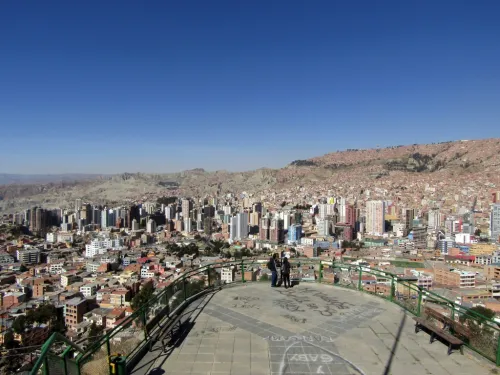
    The Mirador de Killi Killi, known locally as Mirador Kili Kili, crowns the Villa Pabón neighbourhood on Cerro Santa Bárbara. From here you get a 360° panorama over La Paz and the mountain Huayna Potosí. The name comes from the local word for the American kestrel, Falco sparverius, the small bird of prey that lives in the area.

    Like many hills around the city, Cerro Santa Bárbara has been a ceremonial place since pre-Hispanic times, one of the wakas and apachetas where people make wajt'as, offerings to the deities of the Andes. It is the same world of belief you met at the Witches' Market, here in the open air.

    In 1781 the hill served as headquarters for the indigenous forces led by Tupac Katari during the siege of the city, the same siege the Fuerte San Miguel near Calle Jaén was built against. After his sentence, part of Katari's quartered body was displayed here, a warning from the colonial authorities about the price of rebellion.

    Look for the carved stone arch: Agustín Callizaya cut it in the early 1920s for a house near Plaza Isabel la Católica in Sopocachi, and it was moved here when that house was demolished. The park is free and open around the clock. This is where the walk ends; if you want to return to Plaza Murillo, the GPS navigation in your browser leads you back.

    Local name
    Mirador Kili Kili
    Hours
    Open 24/7
    Price
    Free
Walking tour route map of La Paz Route loaded
Plaza MurilloCatedral Basílica de Nuestra Señora de La PazPlaza Mayor de San FranciscoBasílica de San Francisco+5
All 9 stops are already on the map.
You just press start.
AI Tour Guide

Now Walk La Paz With a Guide in Your Ear

Press start wherever you are, even hundreds of kilometres from La Paz, and the guide begins telling its stories right away. In the city, pick any of the 9 stops to start from: it leads you there, then talks with you the whole route, asking, listening, remembering, and shaping the tour around your answers.

9stops 6.8km 1 h 48 minwalking 13languages
▶Start the tour free

Free to start · Runs in your browser · No app, no download

Shorter Ways to Walk La Paz

Every stop works as a starting point. If your time is limited, these three sections stand on their own.

Old town and San Francisco

Stops: 1, 2, 3, 4, 5

For a first morning in the city: the political square, the cathedral and the Franciscan quarter, ending on Calle Sagárnaga. Walking time is 23 minutes. The only admission is the San Francisco museum, so choose a day when it is open.

Markets and rituals

Stops: 3, 4, 5, 6, 7

For travellers drawn to living traditions: from the old Aymara ritual ground in front of San Francisco through the market street and the Witches' Market to Mercado Lanza. Walking time is 58 minutes; everything is free unless you add the San Francisco museum.

Museum street and viewpoint

Stops: 7, 8, 9

For an afternoon: from Mercado Lanza to Calle Jaén and up to the Mirador de Killi Killi. Walking time is 35 minutes. The walk and the viewpoint are free; the museums on Calle Jaén charge their own admission.

How Long Does the La Paz Walk Take With Museum and Markets?

Pure walking time is 1 h 48 min. Add about 45 minutes for the museum at San Francisco, a quarter of an hour each for Plaza Murillo and the cathedral, half an hour at Mercado Lanza and twenty minutes each at the Witches' Market, Calle Jaén and the viewpoint, and you arrive at roughly five hours.

A sample day: start at Plaza Murillo at 09:30, step into the cathedral just before 10:00, reach the Basílica de San Francisco around 10:25 and leave the museum shortly after 11:00. You are at the Witches' Market before noon, at Mercado Lanza around 12:35 for something to eat, on Calle Jaén around 13:20 and at Killi Killi at about 14:00.

With the same pace for the visits, the old town section takes about two hours, the markets section just under three hours and the museum street with the viewpoint about an hour and three quarters.

Before You Set Off in La Paz

  • Start and finish: The recommended start is Plaza Murillo, the finish is the Mirador de Killi Killi. You can join at any stop. From the viewpoint, the GPS navigation in your browser leads you back to Plaza Murillo if you wish.
  • Best day and time: Walk on a day when the San Francisco museum is open. A morning start brings you to the museum after it opens and to the Witches' Market while the stalls are trading.
  • What it costs: Squares, streets, the cathedral, both markets and the viewpoint are free. You pay for the San Francisco museum and, if you choose, the museums on Calle Jaén. The GPS route is free; the AI Tour Guide starts with 100 free credits, after which you choose between this tour all-inclusive for €19.99 with no time limit or credits at €5 per hour.
Walking tour route map of La Paz
AI Tour Guide

Your La Paz Guide Is Ready When You Are

Press start and a voice AI Tour Guide takes it from here: leading the route through La Paz, telling the stories, and turning your walk into a real back-and-forth conversation. No app or download is needed; it runs in your browser.

9stops 6.8km 1 h 48 minwalking 13languages
▶Start the tour free

Free to start · Runs in your browser · No app, no download

What the AI Tour Guide Adds on This Route

La Paz tells its story in threads: the martyrs of 1809 who return as street names, the siege of 1781 that links Calle Jaén to Killi Killi, the Aymara ritual ground under San Francisco that lives on in the Witches' Market. The AI Tour Guide follows these threads as a conversation while you walk, notices which ones you care about and goes deeper there. Bring it the questions this text leaves open, such as what a wajt'a offering involves or how the Chaco War shaped the vendors of the Lanza regiment, and cut in whenever something catches your eye.

A Real Conversation A voice AI Tour Guide greets you, leads the whole route, and tells the stories and facts as you walk, asking what you want to see and keeping a real conversation going. Not a recording you press play on.
Map Navigation Follow the route on the map and walk at your own pace. You choose where to start and when to move to the next stop.
Ask Anything Curious about a building you pass? Ask your AI Tour Guide on the spot and the conversation carries on.
13 Languages Switch language anytime. No separate tour needed.
Start free in your browser

Common Questions About Walking La Paz

Do children pay at the San Francisco museum?

Visitors under 14 get in free, and there is a reduced Bs 5 ticket for children and seniors. Bolivian nationals pay Bs 10.

Can I visit the Witches' Market in the evening?

The street is open around the clock, but the stalls trade during the day. Come before evening if you want to see the wares.

Can I see the inside of the Basílica de San Francisco on a Sunday?

The museum is closed, but the church opens for worship during services. Come for a service and respect the people praying.

Can I reach Mercado Lanza directly from San Francisco?

Yes. One of its four entrances opens onto Plaza Mayor de San Francisco, so you can drop in right after the museum and skip the market later.

Is the tour really free?

Yes. The whole tour is free: the route, the interactive map and the navigation cost you nothing. Only the voice AI Tour Guide is optional and paid: you test it with 100 free credits, then you pay either €5 per hour or €19.99 for this whole tour, with no time limit.

Do I need to download an app?

No. Everything runs in your phone browser. Open the route and start walking, no download and no sign-up required.

Do I need to book the walking tour in advance?

No booking needed. This self-guided tour is available anytime. Open the route in your browser and start walking. The AI Tour Guide works instantly, no app, no reservation required.

What languages is the AI Tour Guide available in?

The AI Tour Guide speaks 13 languages, so you take the tour in your own language and can switch at any time.

Can I skip stops or change the route?

Yes. Skip any stop, spend extra time at places you like, or start the route from any point. It is your walk, you set the pace.
Image credits
▶ Start free in your browser Runs in your browser, no app, no download