Basílica de Nuestra Señora de Copacabana
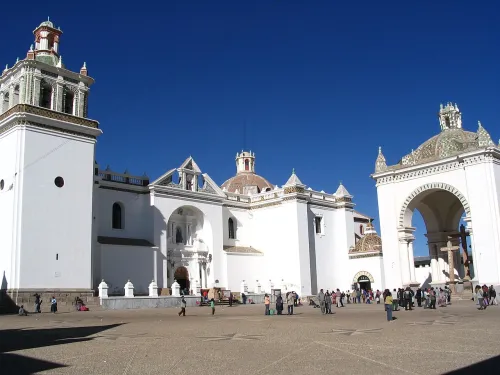
The white basilica in its Moorish style is why most people come to Copacabana. A first church stood here from 1550. The one you see was raised in the early 1600s by the architect Francisco Jiménez de Siguenza, completed with its atrium and the small corner chapels, the posas, around 1640, and enlarged in 1651, when the main chapel became the present nave and the sacristy and towers were in place. The pilgrims had simply outgrown the older building.
Inside, everything turns on one figure: the Virgen de la Candelaria, known as the Virgen Morena and crowned Queen of Bolivia. She was carved around 1580 by Francisco Tito Yupanqui, an indigenous artist and grandson of the Inca Túpac Yupanqui. Altars and retables were reworked as the building grew, and the Franciscans built the present Camarín de la Virgen, the chamber that holds her, between 1910 and 1913. Repairs and repainting went on until 1971.
Now look for something easy to miss. Attached to the nave is the Capilla Abierta, the open chapel or Chapel of the Indians, where Mass was held outdoors for crowds too large for any church and for indigenous worshippers used to ceremonies under the open sky. Historians José de Mesa and Teresa Gisbert considered it the most remarkable part of the whole complex. Today its arches are walled up and modern buildings crowd it, but you can still make it out from its west side.
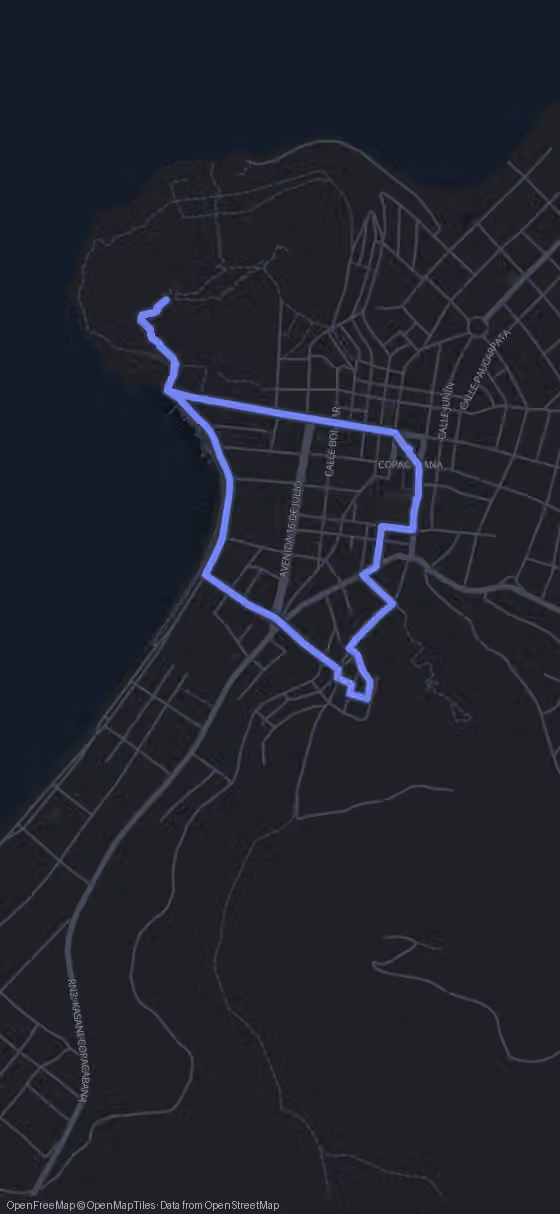
Entry to the basilica is free. The attached museum and camarín keep more limited hours and ask a small donation or modest fee. If the Virgin is your reason for coming, it is worth it. From the basilica it is 1220 m and about 24 minutes to Cerro Calvario, the hill where the pilgrimage continues.
- Hours
- Mon–Fri 07:00–18:00, Sat–Sun 07:00–19:00 (museum: weekends 08:30–12:00 and 14:30–18:00)
- Price
- Free (basílica); small voluntary donation or modest fee for the attached museum/camarín