Free Walking Tour Ferrara: Castle, Diamonds and Ghetto

Nine stops on foot, from a moated castle born of a riot to a palace faced with marble diamonds, along the Este walls and back through arched medieval lanes.

9 Stops 6.4 km ~1 h 28 min walking
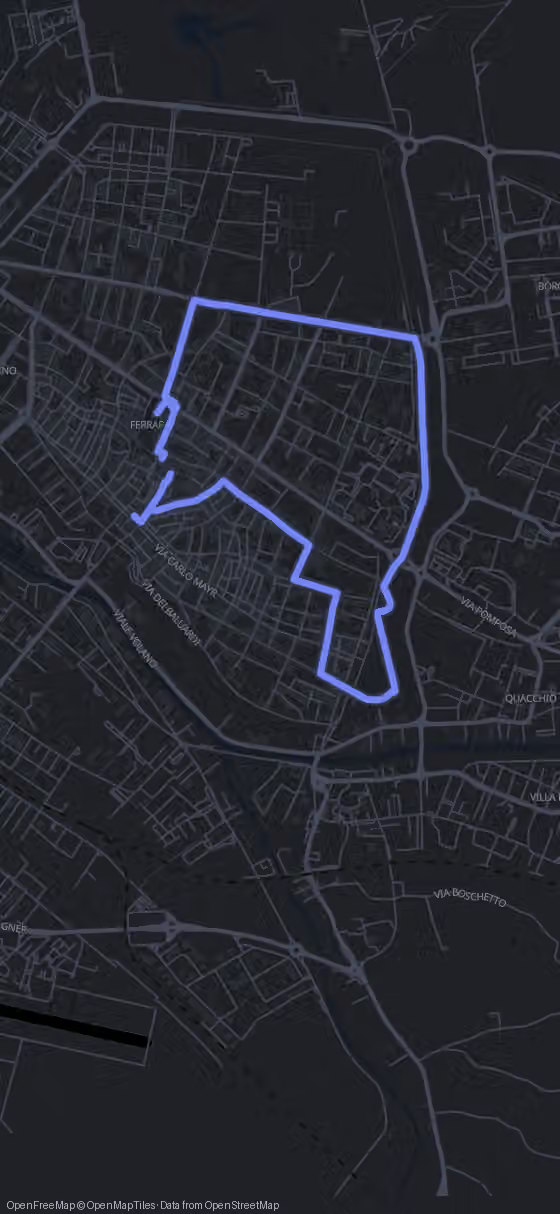
Route map for the Ferrara walking tour
Stop 1 of 9
280 m·3 min
Castello Estense
Head north-west toward the Cathedral of Ferrara
Ciao, welcome to Ferrara. I'm Alex, and one Renaissance palace here turns changing daylight into architecture.
Try this tour with Alex

What This Ferrara Walk Covers

The route links nine stops over 6.4 km, from Castello Estense to Piazza Trento e Trieste. Pure walking time is 1 h 28 min; with three museum visits, plan about five and a half hours, or about two and a half if you stay outside.

The Cathedral of Ferrara, the City Walls of Ferrara, the Jewish Ghetto of Ferrara and Via delle Volte are free. Tickets apply at Palazzo dei Diamanti and Palazzo Schifanoia as well as the castle; Casa Romei is currently closed. The GPS route runs free in your browser, and the AI Tour Guide is optional.

Open free GPS & optional AI Tour Guide
This short shows highlights of the route. All 9 stops follow below.

The Route

Walking Map of Ferrara, from the Castle to the Piazza

9 stops 6.4 km 1 h 28 min walking
Tap to load interactive map

The 9 stops along this route

  1. Castello Estense in Ferrara, stop 1 on the self-guided walking tour
    1Castello Estense
  2. Cathedral of Ferrara, stop 2 on the self-guided walking tour
    2Cathedral of Ferrara
  3. Palazzo dei Diamanti in Ferrara, stop 3 on the self-guided walking tour
    3Palazzo dei Diamanti
  4. City Walls of Ferrara, stop 4 on the self-guided walking tour
    4City Walls of Ferrara
  5. Palazzo Schifanoia in Ferrara, stop 5 on the self-guided walking tour
    5Palazzo Schifanoia
  6. Casa Romei in Ferrara, stop 6 on the self-guided walking tour
    6Casa Romei
  7. Jewish Ghetto of Ferrara, stop 7 on the self-guided walking tour
    7Jewish Ghetto of Ferrara
  8. Via delle Volte in Ferrara, stop 8 on the self-guided walking tour
    8Via delle Volte
  9. Piazza Trento e Trieste in Ferrara, stop 9 on the self-guided walking tour
    9Piazza Trento e Trieste
  10. That's the full route.

    Walk it with an AI Tour Guide talking you through every one of these streets.

    Start free in your browser
    You made it

Nine Stops on Your Ferrara Walking Tour

  1. 1

    Castello Estense

    Castello Estense in Ferrara, stop 1 on the self-guided walking tour

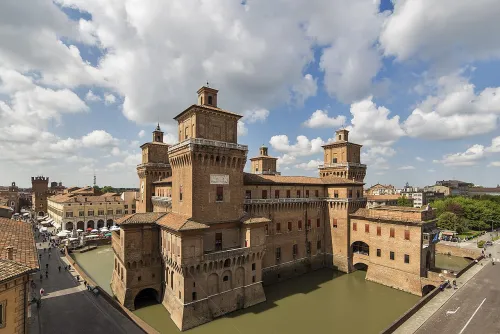
    You start at a real moated castle in the middle of the city: one big brick block with a tower at each of its four corners, water all around. It looks like it was built to keep enemies out, and it was, but the enemy the Este family feared most was their own people.

    On 3 May 1385, the Ferrarese, crushed by taxes and ruined by floods, marched on the palace of Marquis Niccolò II d'Este to confront Tommaso da Tortona, the official they blamed. Niccolò tried all day to calm them. By evening the family itself seemed in danger, so Tommaso was given confession and communion and then handed to the crowd, who tore him to pieces. The revolt's leaders were later put to death, and Niccolò drew his own conclusion: the family palace, today's Palazzo Comunale, was not safe enough.

    He had the architect Bartolino da Novara build a fortress on the palace's north side. Bartolino reused an existing tower of the old city wall, the Torre dei Leoni, and joined it with curtain walls to three new towers. An aerial walkway, perhaps of wood, linked palace and fortress so the family could flee from one to the other.

    As Ferrara grew and its walls moved outwards, the castle lost its military role and filled with apartments. From Ercole I onward the rooms kept expanding, and after a fire in 1544 Ercole II ordered the final transformation into a residence. Going inside costs an entry fee and is worth it if you want to feel how the family lived.

    From the castle it is 400 m, about 5 minutes, to the cathedral, the other pole of medieval Ferrara.
    Hours
    Wed–Mon 10:00–18:00, Tue closed
    Price
    12 EUR full, 10 EUR reduced
  2. 2

    Cathedral of Ferrara

    Cathedral of Ferrara, stop 2 on the self-guided walking tour

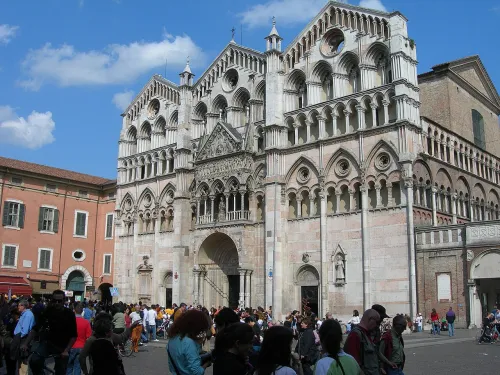
    The Duomo di Ferrara is dedicated to Saint George, the city's patron, and it is the largest religious building in Ferrara. Work began in 1135, when the city was spreading along the left bank of the Po di Volano, and the main altar was consecrated on 8 May 1177, a fast pace for a church of this size. The older cathedral, also for Saint George, still stands outside the walls as San Giorgio fuori le mura.

    Stand back and read the white marble facade from bottom to top. The lower part is Romanesque, with loggias, small arcades, rose windows and reliefs. Higher up, unlike the purely Romanesque fronts of Modena and Parma, Gothic pointed arches take over, so you are looking at two eras stacked on one wall.

    In the centre, the porch rests on two columns whose bases show seated Atlas figures riding on lions. Above sits a Last Judgement by an unknown master and a later Gothic loggia with a Madonna and Child. The Romanesque portal is by the sculptor Nicholaus, a pupil of Wiligelmus. Look also for the statue of Alberto d'Este on one side and the bronze bust of Pope Clement VIII above an inscription recalling his capture of the city.

    Entry is free, so step inside even for a few minutes. A covered passage still links the church to the Archbishop's Palace.

    Next comes a 730 m walk, about 10 minutes, into the Renaissance quarter the Este laid out north of the old town.

    Local name
    Duomo di Ferrara
    Hours
    Mon–Sat 07:30–12:00, 15:30–19:00; Sun and holidays 08:00–13:00, 16:00–20:00
    Price
    Free
  3. 3

    Palazzo dei Diamanti

    Palazzo dei Diamanti in Ferrara, stop 3 on the self-guided walking tour

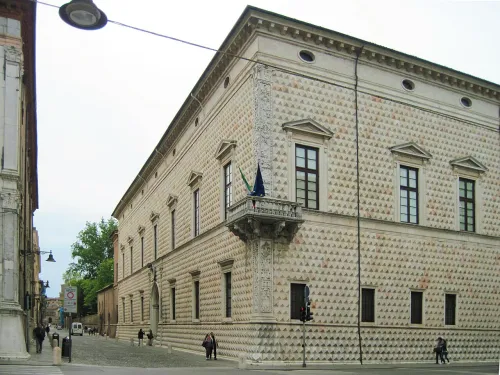
    In 1492 Duke Ercole I d'Este tore down the medieval walls on the north side and had his court architect Biagio Rossetti plan a whole new district, the Addizione Erculea. At its most prestigious crossing, where the two main axes of the new town meet, Rossetti built this palace for the duke's brother Sigismondo between 1493 and 1503.

    What stops everyone is the facade: about 8,500 blocks of white marble with pink veins, each carved into a pointed diamond. The diamonds are not all angled the same way; their positions shift to catch and throw back as much light as possible, so the wall changes as you walk past. Look at the corners too, with their carved candelabra and plant motifs.

    The Este used it as a residence, then from 1641 the Villa marquises. In 1832 the city bought it to house the art gallery and the university. Inside is a classic Renaissance courtyard with a cloister and a marble well, and on the main floor the Pinacoteca Nazionale with Ferrarese painting from the Middle Ages to the 18th century: frescoes by Serafino da Modena, a gold-ground Madonna and Child by Gentile da Fabriano, and works by Cosmè Tura and Ercole de' Roberti.

    The palace opens to visitors only while an exhibition is running, and then charges for tickets. If one is on and you like Renaissance painting, go in; if not, the facade alone justifies the walk.

    The next leg is the longest: 2,420 m, about 33 minutes, out to the walls, through the streets of the Addizione Erculea and past the green of Parco Massari.

    Hours
    Daily 09:30–19:30 during exhibitions
    Price
    16 EUR full, 14 EUR reduced
  4. 4

    City Walls of Ferrara

    City Walls of Ferrara, stop 4 on the self-guided walking tour

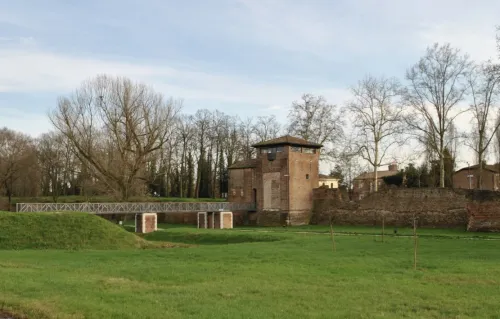
    Ferrara is one of the cities that kept its walls. Originally the ring ran for about 13 km around the Este capital; much of it still stands, and here you walk on the fortifications that shaped the city for a thousand years.

    The story starts small: the Byzantines built the first defences around the 6th century to protect a river ferry, and in the 10th century Tedaldo di Canossa added walls for a second one. When the new cathedral rose, the walls took their first organised shape north of the new centre. By 1314 they took in the Borgo Vado quarter, and the first brick sections of the circuit appeared. In the 15th and 16th centuries the walls were rebuilt for an age of gunpowder.

    The grandest gate in the late 15th century was the Porta degli Angeli on the northern side, used by honoured guests and by the dukes themselves. Through it, in 1598, Cesare d'Este left Ferrara for good, moving his capital to Modena and handing the city back to the Papal States. Other gates included Porta Paola to the south and Porta San Giovanni to the east.

    Along the ring you can still pick out bastions, many with the shape of a spur or a pike point. They were built to withstand sieges with firearms, fitted with gun loops and once ringed by ditches that are no longer visible. Most of them are on the southern part of the circuit.

    From the walls it is 1,280 m, about 17 minutes, back into town to the Este pleasure palace.

    Local name
    Mura di Ferrara
    Hours
    Open 24/7
    Price
    Free
  5. 5

    Palazzo Schifanoia

    Palazzo Schifanoia in Ferrara, stop 5 on the self-guided walking tour

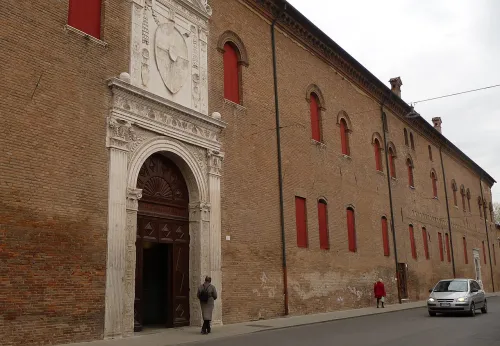
    The name says it all: "schifare la noia", to escape boredom. This was one of the Este family's delizie, the retreats where the court went to relax. It began in 1385 as a single-storey house without wings for Alberto V d'Este, built purely for suppers and entertainment, a kind of banqueting house with one front to the street and one to the garden. It predates by decades the first such suburban villa in Renaissance Rome.

    Its fame rests on the frescoes painted around 1469 and 1470 by or after Francesco del Cossa and Cosmè Tura, a cycle that is a unique survival from its time. Borso d'Este commissioned it for his expected investiture as Duke of Ferrara by Pope Paul II in 1471. Look for the message beneath the festive scenes: mankind and nature in their right order under the good rule of the duke, who guarantees peace and plenty.

    For Borso, the architect Pietro Benvenuto degli Ordini added a ducal apartment on an upper level with a great hall for receiving ambassadors, a counterpart to the government seat in the Palazzo della Ragione, which was destroyed in World War II.

    If you go into only one museum on this walk and painting matters to you, make it this one; the frescoes are well worth the ticket.

    Casa Romei is 510 m away, about 7 minutes on foot.

    Hours
    Tue–Sun 10:00–19:00, Mon closed
    Price
    12 EUR full, 9 EUR reduced
  6. 6

    Casa Romei

    Casa Romei in Ferrara, stop 6 on the self-guided walking tour

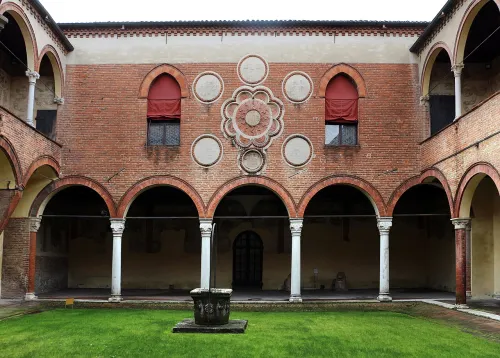
    Casa Romei is currently closed, so this is a stop from the street at Via Savonarola 30. It is still worth pausing, because the house is a rare mix of medieval and Renaissance Ferrara in one building.

    The merchant Giovanni Romei built it in the middle of the 15th century and enlarged and decorated it around his second marriage, to Polissena d'Este, shortly before 1468. Marrying into the ruling family was the peak of a merchant's career, and the house was meant to show it. After his death in 1483 it passed to the neighbouring Corpus Domini convent.

    In the second half of the 16th century Cardinal Ippolito II d'Este had the main floor enlarged and its new vaults painted with frescoes and grotesques attributed to the Filippi workshop. Inside, when it reopens, wait a late Gothic courtyard with a large terracotta monogram of Christ, the Hall of the Sibyls with prophets holding scrolls against a green hedge, and a small lapidarium. The state bought the house in 1898 and it became a museum in 1952.

    From here it is 500 m, about 7 minutes, to the old Jewish quarter.

    Status
    Currently closed
  7. 7

    Jewish Ghetto of Ferrara

    Jewish Ghetto of Ferrara, stop 7 on the self-guided walking tour

    Jews lived in Ferrara for centuries before Cardinal Cennini's edict of 23 August 1624 confined them to a ghetto in one of the oldest parts of the city, close to the cathedral and the castle. About 1,500 Jews lived in Ferrara when it was imposed. The French occupation opened the gates in 1796; they were shut again in 1826, under looser rules, and the ghetto stayed closed for decades more.

    The quarter has kept its shape. Its main street is Via Mazzini, once Via Sabbioni, which runs from the cathedral square and was known until World War II for its old shops. One of the five gates stood at its entrance, recalled by a plaque on the former San Crispino Oratory, where Jews were forced to gather for sermons. Another stood at the far end, where the street meets Via delle Scienze.

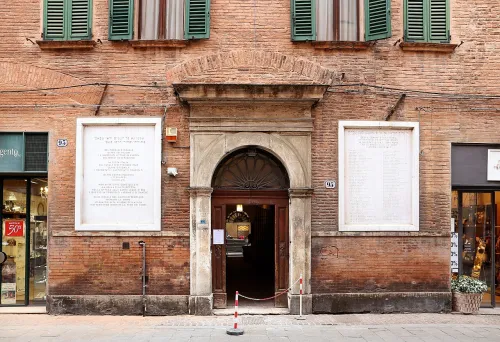
    At Via Mazzini 95, in a building the community has used since 1485, are the city's three synagogues, the only ones that survive from the ghetto, together with the Jewish Museum. From Via Mazzini, turn into Via Vignatagliata with its 14th-century houses; at number 33, two plaques honour the physician and philosopher Isacco Lampronti.

    Even after the gates fell, this stayed the heart of Jewish Ferrara, the world Giorgio Bassani wrote into The Garden of the Finzi-Contini and Five Stories of Ferrara. After the racial laws of 1938, Jews from other provinces still came here, hoping for a safer place thanks to Italo Balbo, a friend of Renzo Ravenna; instead, denunciations began and the ghetto in effect returned. Walk it slowly and read the plaques.

    Via delle Volte is only 280 m away, about 4 minutes.

    Local name
    Ghetto di Ferrara
    Hours
    Open 24/7
    Price
    Free
  8. 8

    Via delle Volte

    Via delle Volte in Ferrara, stop 8 on the self-guided walking tour

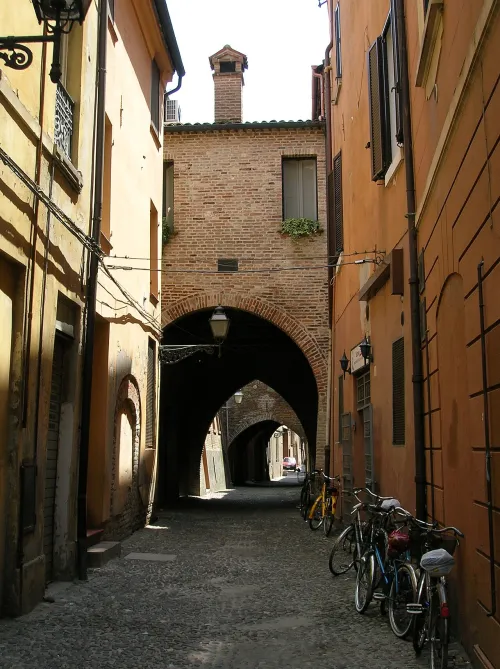
    This is the street that gives medieval Ferrara its face: a long, almost straight lane crossed again and again by arches and hanging passages, the volte that give it its name. Most of the arches date from the 13th and 14th centuries, but the line of the street is older still. It follows the earliest town, which grew along the old course of the Po before the river shifted away in 1152.

    Underfoot are rough river-stone cobbles, typical of the medieval city, restored along many stretches. Many small passages link it to the parallel Via Carlo Mayr, so it is easy to duck through and look back at the arches from a different angle.

    Not so long ago this was also known as the street of prostitutes, and a few local sayings still remember it. Nothing of that trade is left, but the narrow, shadowed lane keeps an atmosphere that lets you imagine it. It is free and always open, so take your time with photos.

    The last leg is 310 m, about 4 minutes, to the main square.

    Hours
    Open 24/7
    Price
    Free
  9. 9

    Piazza Trento e Trieste

    Piazza Trento e Trieste in Ferrara, stop 9 on the self-guided walking tour

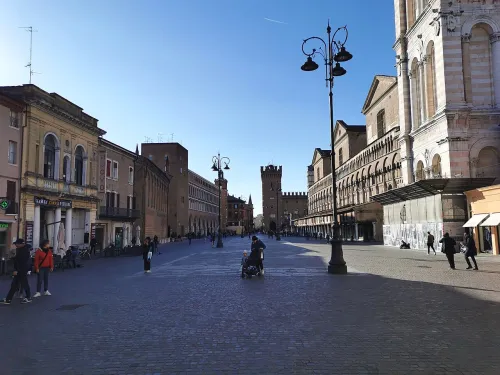
    You finish in Ferrara's main square, the old Piazza delle Erbe, named after the market once held here. It grew up together with the cathedral and has been the centre of the city ever since, ringed by the seats of political, economic and religious power.

    Along one side runs the listone, a raised walkway 120 m long and 12 m wide where the town has always strolled. On the north side the cathedral's flank carries the Loggia dei Merciai, a row of shops that has served merchants for centuries and still holds stores today. Above it rises the cathedral's bell tower, left unfinished and attributed to Leon Battista Alberti.

    On the east side stands Palazzo San Crispino, once the shoemakers' guild house, where the ghetto's first gate was remembered. The south side holds the Teatro Nuovo, once also a cinema, the cathedral museum in the former church of San Romano, and the building that replaced the Palazzo della Ragione, with the Galleria Matteotti underneath. Look for the clock tower by Giovan Battista Aleotti, and to the west the Torre della Vittoria and the Palazzo Municipale.

    Here the circle closes: the castle you started at was born from that town hall's need for safety. If you want to return to the start, the GPS navigation leads you back to Castello Estense on request.

    Hours
    Open 24/7
    Price
    Free
Walking tour route map of Ferrara Route loaded
Castello EstenseCathedral of FerraraPalazzo dei DiamantiCity Walls of Ferrara+5
All 9 stops are already on the map.
You just press start.
AI Tour Guide

You've read the Ferrara route. Now walk it with a guide in your ear.

Press start wherever you are, even hundreds of kilometres from Ferrara, and the guide begins telling its stories right away. In the city, pick any of the 9 stops to start from: it leads you there, then talks with you the whole route, asking, listening, remembering, and shaping the tour around your answers.

9stops 6.4km 1 h 28 minwalking 13languages
▶Start the tour free

Free to start · Runs in your browser · No app, no download

Shorter Ways to Walk Ferrara

The long leg out to the walls splits this route neatly in two. If you only have a morning or an afternoon, pick the half that suits you.

Este Ferrara in a morning

Stops: 1, 2, 3

For anyone who wants the power and the art of the Este court: the castle, the cathedral and the diamond palace, linked by 1,130 m and 15 minutes of walking. Tickets at the castle and, when an exhibition is on, at Palazzo dei Diamanti; the cathedral is free. Start in the morning so the cathedral comes early in your day.

Medieval lanes and the ghetto

Stops: 5, 6, 7, 8, 9

For those who prefer atmosphere to big museums: Schifanoia's frescoes, the closed but handsome Casa Romei, the ghetto, the arched Via delle Volte and the main square. Only 1,600 m and 22 minutes on foot, with a single ticket at Palazzo Schifanoia.

How Long the Ferrara Tour Takes, With and Without Museums

The full route is 6.4 km with 1 h 28 min of pure walking, and the longest leg by far is the 33 minutes from Palazzo dei Diamanti out to the walls. The order follows the city's story: the Este fortress and the medieval cathedral first, then the Renaissance expansion, the defences, the court's pleasure palace and finally the old medieval core.

If you go inside the castle, Palazzo dei Diamanti and Palazzo Schifanoia for about an hour each, the day runs like this: castle at 10:00, cathedral around 11:05, Diamanti around 11:30, the walls around 13:00, Schifanoia around 13:35, the ghetto around 15:00 and Piazza Trento e Trieste around 15:40. That is about five and a half hours, plus whatever time you give to lunch. Seen only from outside, the same loop takes about two and a half hours.

The morning half (castle, cathedral, Diamanti) needs about three hours with both museums; the afternoon half from Schifanoia to the piazza fits into about two hours with the frescoes.

Before You Set Off from the Castle

  • Start and finish: The recommended start is Castello Estense and the walk ends at Piazza Trento e Trieste. You can join at any stop; on request the GPS navigation leads you from the piazza back to the castle.
  • Best days: Not every museum on the route opens every day, so pick your day with the castle and Palazzo Schifanoia in mind. Palazzo dei Diamanti only opens while an exhibition is running.
  • Time of day: Start in the morning, once the castle has opened, so that you reach the cathedral before lunch.
  • Costs: Route, map and GPS navigation are free. Tickets are charged at the castle, the Diamanti exhibition and Schifanoia. The AI Tour Guide starts with 100 free credits; after that you choose this tour all-inclusive for €19.99 with no time limit, or credits at €5 per hour.
Walking tour route map of Ferrara
AI Tour Guide

Your Ferrara guide is ready when you are.

Press start and a voice AI Tour Guide takes it from here: leading the route through Ferrara, telling the stories, and turning your walk into a real back-and-forth conversation. No app or download is needed; it runs in your browser.

9stops 6.4km 1 h 28 minwalking 13languages
▶Start the tour free

Free to start · Runs in your browser · No app, no download

What the AI Tour Guide Adds in Ferrara

Ferrara is a city of one family, and the AI Tour Guide tells it that way: it greets you at the castle, picks up the Este story at every stop and asks whether court intrigue, Renaissance painting or Jewish Ferrara pulls you in more. It remembers your answer and shapes the rest of the walk around it, which makes the 33 minutes out to the walls feel short. You can interrupt at any point, for instance to ask how Bassani's Ferrara compares with the streets you are walking, or what life inside the Pinacoteca's paintings tells you about the court.

A Real Conversation A voice AI Tour Guide greets you, leads the whole route, and tells the stories and facts as you walk, asking what you want to see and keeping a real conversation going. Not a recording you press play on.
Map Navigation Follow the route on the map and walk at your own pace. You choose where to start and when to move to the next stop.
Ask Anything Curious about a building you pass? Ask your AI Tour Guide on the spot and the conversation carries on.
13 Languages Switch language anytime. No separate tour needed.
Start free in your browser

Common Questions About Walking Ferrara

Is Palazzo dei Diamanti always open?

No. It only opens while an exhibition is on. Outside those periods you still see the famous facade from the street, which is the main reason most people come.

Can I go inside the synagogues in the ghetto?

The three surviving synagogues and the Jewish Museum share the building at Via Mazzini 95, used by the community since 1485. Ask at the entrance about visits on the day.

Can I walk the whole ring of walls?

The walls still run for about 9 km around the city, so a full circuit is a separate outing. The route touches one stretch and then turns back towards the centre.

What can I combine with Ferrara?

Bologna is 44 km away and makes a natural second day; Ravenna and Padua are also within reach, each with its own free walking route.

Is the tour really free?

Yes. The whole tour is free: the route, the interactive map and the navigation cost you nothing. Only the voice AI Tour Guide is optional and paid: you test it with 100 free credits, then you pay either €5 per hour or €19.99 for this whole tour, with no time limit. Admission to 3 of the 9 stops is not included: Castello Estense, Palazzo dei Diamanti and Palazzo Schifanoia charge their own entry fees.

Do I need to download an app?

No. Everything runs in your phone browser. Open the route and start walking, no download and no sign-up required.

Do I need to book the walking tour in advance?

No booking needed. This self-guided tour is available anytime. Open the route in your browser and start walking. The AI Tour Guide works instantly, no app, no reservation required.

What languages is the AI Tour Guide available in?

The AI Tour Guide speaks 13 languages, so you take the tour in your own language and can switch at any time.

Can I skip stops or change the route?

Yes. Skip any stop, spend extra time at places you like, or start the route from any point. It is your walk, you set the pace.
Image credits
▶ Start free in your browser Runs in your browser, no app, no download