Free Walking Tour Barcelona: Park Güell to Columbus

This free walking tour of Barcelona runs from Gaudí's hillside park through the Eixample and the Gothic Quarter to Columbus on his column.

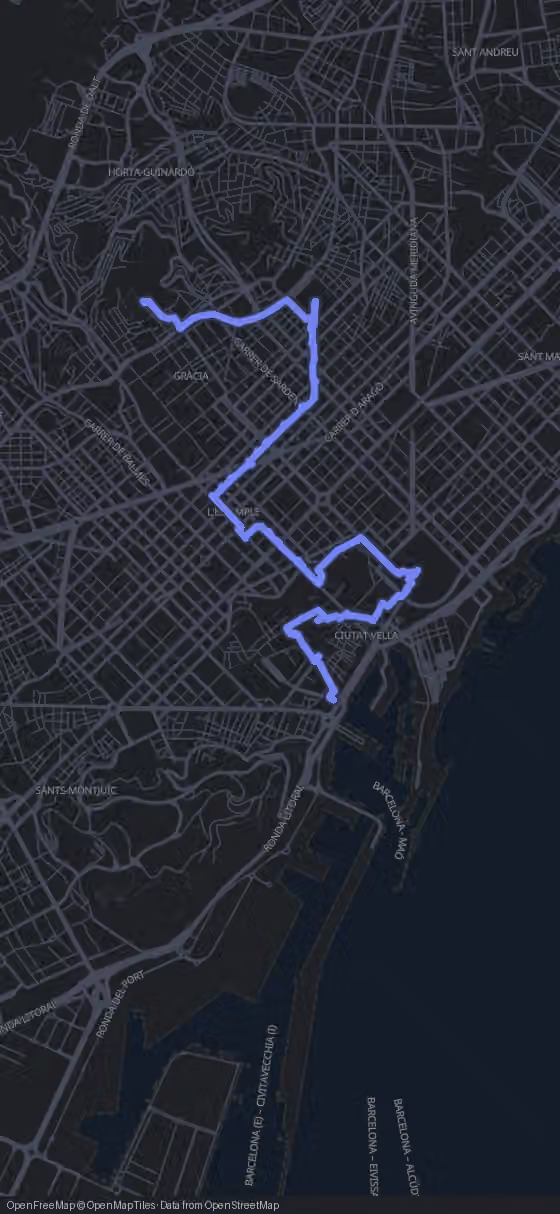
14 Stops 11.7 km ~2 h 39 min walking
Route map for the Barcelona walking tour
Stop 1 of 14
2.5 km·32 min
Park Güell
Head east and downhill toward Hospital de Sant Pau
Hola, welcome to Barcelona. I'm Alex, and our first story begins with one of Antoni Gaudí's biggest failures.
Try this tour with Alex

This Route at a Glance

This self-guided walk links 14 stops from Park Güell to the Columbus Monument: 11.7 km and 2 h 39 min of pure walking. With two big interiors and a lunch break, plan about eight hours.

The route, map and GPS navigation from stop to stop are free in your browser, and Arc de Triomf, Parc de la Ciutadella, Plaça Sant Felip Neri, La Boqueria and Plaça Reial cost nothing to visit. Park Güell and every interior you choose need a ticket. The AI Tour Guide is optional and leads the walk as a conversation.

Open free GPS & optional AI Tour Guide
This short shows highlights of the route. All 14 stops follow below.

The Route

Walking Map of Barcelona from Park Güell to the Waterfront Column

14 stops 11.7 km 2 h 39 min walking
Tap to load interactive map

The 14 stops along this route

  1. Park Güell in Barcelona, stop 1 on the self-guided walking tour
    1Park Güell
  2. Hospital de Sant Pau in Barcelona, stop 2 on the self-guided walking tour
    2Hospital de Sant Pau
  3. Sagrada Família in Barcelona, stop 3 on the self-guided walking tour
    3Sagrada Família
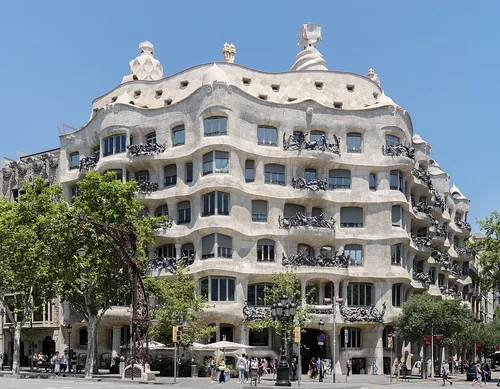
  4. Casa Milà in Barcelona, stop 4 on the self-guided walking tour
    4Casa Milà
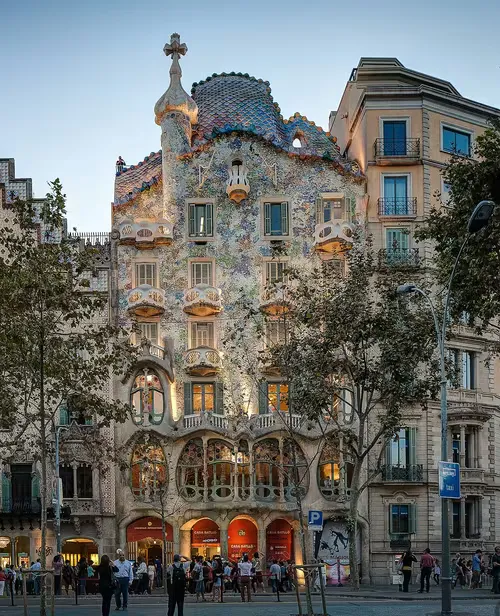
  5. Casa Batlló in Barcelona, stop 5 on the self-guided walking tour
    5Casa Batlló
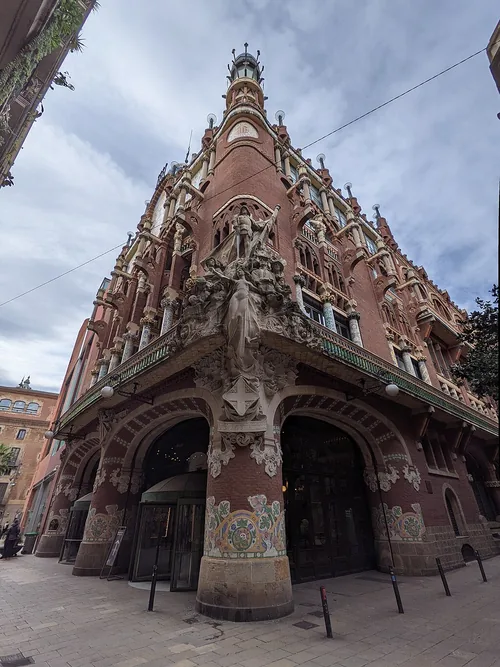
  6. Palau de la Música Catalana in Barcelona, stop 6 on the self-guided walking tour
    6Palau de la Música Catalana
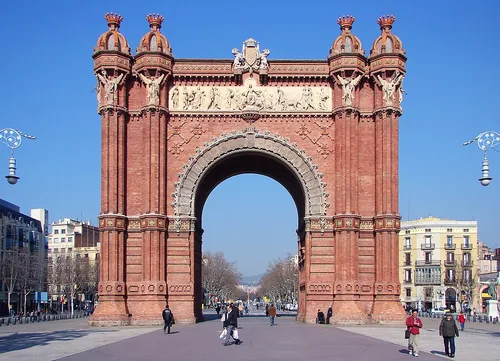
  7. Arc de Triomf in Barcelona, stop 7 on the self-guided walking tour
    7Arc de Triomf
  8. Parc de la Ciutadella in Barcelona, stop 8 on the self-guided walking tour
    8Parc de la Ciutadella
  9. Santa Maria del Mar in Barcelona, stop 9 on the self-guided walking tour
    9Santa Maria del Mar
  10. Barcelona Cathedral, stop 10 on the self-guided walking tour
    10Barcelona Cathedral
  11. Plaça Sant Felip Neri in Barcelona, stop 11 on the self-guided walking tour
    11Plaça Sant Felip Neri
  12. La Boqueria in Barcelona, stop 12 on the self-guided walking tour
    12La Boqueria
  13. Plaça Reial in Barcelona, stop 13 on the self-guided walking tour
    13Plaça Reial
  14. Columbus Monument in Barcelona, stop 14 on the self-guided walking tour
    14Columbus Monument
  15. That's the full route.

    Walk it with an AI Tour Guide talking you through every one of these streets.

    Start free in your browser
    You made it

Your Barcelona Walking Tour: What You See and Where It Pays to Go In

  1. 1

    Park Güell

    Park Güell in Barcelona, stop 1 on the self-guided walking tour

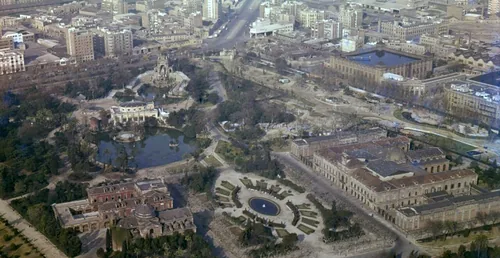
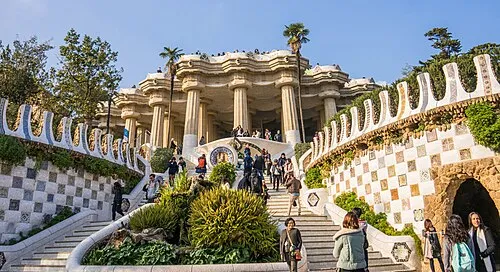
    You start high over the city, on the southern slope of the Carmel hill, in the park Antoni Gaudí built between 1900 and 1914 for the industrialist Eusebi Güell. Look at how walls, paths and structures bend and lean with the hillside instead of fighting it, and at the ornament that runs over them with a freedom that ignores every classical rule.

    The surprising part is that this was never planned as a park. Güell and Gaudí conceived it as an exclusive housing estate: upscale homes with every technical comfort of the day, finished with real artistic care and set into the natural landscape. It opened as a public park in 1926, and that is how the city has used it ever since.

    Park Güell belongs to Gaudí's naturalist period in the first decade of the twentieth century, when he refined his own style by borrowing from the organic shapes of nature and trying out new structural solutions rooted in geometry. Many ideas you will meet later in the Sagrada Família were tested here first, so this start gives you the key to much of the morning.

    Entry requires a ticket; buy it from the official seller rather than a reseller. Give yourself about an hour, then walk 2350 m, around 33 minutes, to the Hospital de Sant Pau.
    Hours
    Open daily year-round, ticket sales/admission 09:00–19:30
    Price
    18 EUR
  2. 2

    Hospital de Sant Pau

    Hospital de Sant Pau in Barcelona, stop 2 on the self-guided walking tour

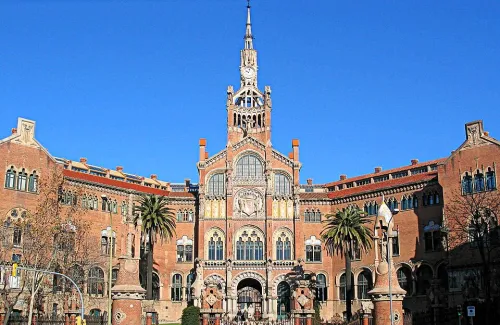
    After Gaudí comes the other great name of Catalan Modernisme. Lluís Domènech i Montaner designed this hospital between 1902 and 1930, and with 27 separate pavilions it is the largest Art Nouveau complex in the world: less a single building than a small ornamented town.

    What makes it striking is how long it did its original job. Patients were treated here until 2009, when they finally moved to a modern building nearby, so these decorated pavilions were a working hospital for most of a century.

    Going in is worth it if architecture is your main reason for being in Barcelona. You can visit on your own or with a guide. If you are saving your time for the Sagrada Família, the exterior already tells much of the story.

    From here it is 1190 m, about 15 minutes, to Gaudí's basilica, his life's work.

    Hours
    Daily: 09:30–18:30 (Apr–Oct); 09:30–17:00 (Nov–Mar). Last entry 30 minutes before closing. Closed Dec 25.
    Price
    Self-guided visit: 18 EUR until 14:00; 17 EUR after 14:00. Guided visit: 21 EUR
  3. 3

    Sagrada Família

    Sagrada Família in Barcelona, stop 3 on the self-guided walking tour

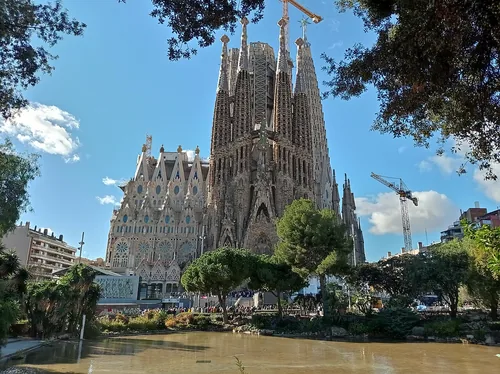
    The Temple Expiatori de la Sagrada Família was begun in 1882 and is still under construction. On 30 October 2025 it became the tallest church in the world, and it is the most visited monument in Spain. Before you go in, take time with the façades and towers; this is the building everything else on the route leads up to.

    Gaudí worked on it for most of his career and, from 1915, almost exclusively. The crypt and apse were still built in a neo-Gothic style; for everything after that he switched to an organic language that imitates nature and relies on ruled geometric forms. Here he brought together all the solutions he had tested in earlier works such as Park Güell, aiming for a building that is structurally sound and harmonious at once.

    Inside, the idea becomes clear: the interior was meant to feel like a forest, with tree-like columns that lean and twist as they rise, a structure that is both simple and strong. The plan is a Latin cross with five naves, a transept of three and an apse with seven chapels. For almost every visitor, the interior is the one ticket on this route not to skip.

    The basic ticket includes an audio guide and gives you the light, the stained glass and the nave; for most people that is enough. A ticket with a guided tour costs more and is worth it only if you want a person to answer your questions. The towers cost extra and pay off only if you want the view from height.

    Afterwards, walk 1520 m, about 21 minutes, to Casa Milà on Passeig de Gràcia.

    Local name
    Temple Expiatori de la Sagrada Família
    Hours
    Nov–Feb: Mon–Sat 09:00–18:00, Sun 10:30–18:00 | Mar: Mon–Fri 09:00–19:00, Sat 09:00–18:00, Sun 10:30–19:00 | Oct: Mon–Fri 09:00–19:00, Sat 09:00–18:00, Sun 10:30–19:00 | Apr–Sep: Mon–Fri 09:00–20:00, Sat 09:00–18:00, Sun 10:30–20:00 | Jan 1: Daily 09:00–14:00 | Jan 6: Daily 09:00–14:00 | Dec 25-Dec 26: Daily 09:00–14:00
    Price
    26 EUR basic (incl. audio guide app), 30 EUR basic+tour, 36 EUR with towers, 40 EUR with towers+tour
  4. 4

    Casa Milà

    Casa Milà in Barcelona, stop 4 on the self-guided walking tour

    Barcelona calls it La Pedrera, the quarry, and once you see the façade the nickname makes sense. Gaudí built it between 1906 and 1910 at number 92 Passeig de Gràcia in the Eixample, for the couple Pedro Milá and Rosario Segimon.

    Gaudí did not work alone here. His team included Josep Maria Jujol and several other assistants, and the builder Josep Bayó i Font had already worked with him on Casa Batlló, the next stop. Like Park Güell, the house belongs to his naturalist period, with forms that avoid straight rationalist lines and draw on the shapes of nature.

    Since it opened to the public in 1987, Casa Milà has welcomed more than 20 million visitors, around a million a year. Since 2013 it has belonged to the Fundació Catalunya-La Pedrera, which runs its exhibitions and visits.

    Entry costs about the same as Casa Batlló, so if you only want one Gaudí house from inside, let your curiosity decide: whichever you skip, you still see its façade from the street. Then walk 510 m, about 7 minutes, along the same avenue to number 43.

    Hours
    Summer (6 Mar-1 Nov 2026): daily 09:00–20:30, night visit 20:40–22:20; winter (2 Nov 2026-25 Feb 2027): 09:00–18:30
    Price
    29 EUR
  5. 5

    Casa Batlló

    Casa Batlló in Barcelona, stop 5 on the self-guided walking tour

    Casa Batlló was not built from scratch. Between 1904 and 1906 Gaudí completely remodelled an existing building by Emilio Sala Cortés at number 43 Passeig de Gràcia, turning an ordinary house into one of the signatures of his naturalist years.

    Look left and right before you look up. This stretch is known as the Block of Discord, because several Modernista architects competed here side by side: Casa Amatller by Josep Puig i Cadafalch stands right next door, and nearby are Casa Lleó Morera by Lluís Domènech i Montaner, Casa Mulleras by Enric Sagnier and Casa Josefina Bonet by Marceliano Coquillat.

    The famous photo costs nothing: the façade is right there on the pavement. Go inside if you want to see Gaudí's rooms and roof; book in advance, and flexible timing helps you get the cheaper slots.

    From here it is 1290 m, about 17 minutes, to the Palau de la Música Catalana, where Domènech i Montaner, whom you met at Sant Pau, returns.

    Hours
    Daily: 08:30–22:30
    Price
    from 29 EUR (advance sale, basic ticket, adults)
  6. 6

    Palau de la Música Catalana

    Palau de la Música Catalana in Barcelona, stop 6 on the self-guided walking tour

    In the La Ribera neighbourhood, on Carrer Alt de Sant Pere, stands the concert hall Lluís Domènech i Montaner built between 1905 and 1908. Its structure was advanced for the time, with large walls of glass, and it merges other arts into the architecture: sculpture, mosaics, stained glass and wrought iron.

    The Palau is the home of the Orfeó Català, the choral society founded in 1891 by Lluís Millet and Amadeu Vives. It was paid for by Catalan industrialists and financiers who loved music, the same social class that had funded the Liceu opera house sixty years earlier. In 1997 UNESCO added it to the World Heritage list, and it still belongs to the Orfeó Català, which promotes Catalan culture and choral music in particular.

    If you want to go in, plan to arrive by early afternoon and check the visit times on the day, as they can change. You can take a guided or audio-guided tour or visit on your own. If you enjoyed Sant Pau, this is the interior that rounds off Domènech i Montaner's story.

    Next comes a short walk of 690 m, about 9 minutes, to the Arc de Triomf.

    Hours
    Visits daily 09:00–15:30 (times can change)
    Price
    24 EUR (guided or audio-guided tour), 20 EUR (self-guided visit)
  7. 7

    Arc de Triomf

    Arc de Triomf in Barcelona, stop 7 on the self-guided walking tour

    This arch was designed by José Vilaseca as the main entrance to the Barcelona Universal Exposition of 1888. Its sculpture is the work of several artists, among them Josep Reynés, Josep Llimona, Antoni Vilanova, Torquat Tasso, Manuel Fuxà and Pere Carbonell.

    Unlike most triumphal arches, it does not celebrate a military victory. Its theme is civic: progress in the arts, sciences and economy, the things the city wanted to show the world in 1888.

    The arch is free and always accessible. It has served as the finish of popular races such as the Jean Bouin and the Barcelona Marathon, and as a venue for music festivals including Primavera Sound. It was restored in 1989.

    Walk on 780 m, about 11 minutes, to Parc de la Ciutadella, the grounds where the Exposition itself took place.

    Hours
    Freely accessible, no opening hours
    Price
    Free
  8. 8

    Parc de la Ciutadella

    Parc de la Ciutadella in Barcelona, stop 8 on the self-guided walking tour

    The park takes its name from the fortress, the Ciutadella, that once stood on this ground. Josep Fontserè laid it out on the model of the Luxembourg Gardens in Paris, and it opened in 1881. Only a few years later, in 1888, it hosted the Universal Exposition whose gate you just walked through.

    For many years this was the only public park in Barcelona, and with 17.42 hectares, 31 including the zoo, it is still the largest city park after Montjuïc. The old arsenal of the fortress now houses the Parliament of Catalonia, and you will also find the Umbracle and the Hivernacle, built to protect plant species, along with Barcelona Zoo.

    Keep your eyes open as you walk: the park holds a large collection of public art, an open-air sculpture museum in effect. It was declared a historic monument in 1951.

    It is free to enter, which makes it the natural place to sit down for a while. Then walk 880 m, about 13 minutes, to Santa Maria del Mar.

    Hours
    Daily: 07:00–22:30
    Price
    Free
  9. 9

    Santa Maria del Mar

    Santa Maria del Mar in Barcelona, stop 9 on the self-guided walking tour

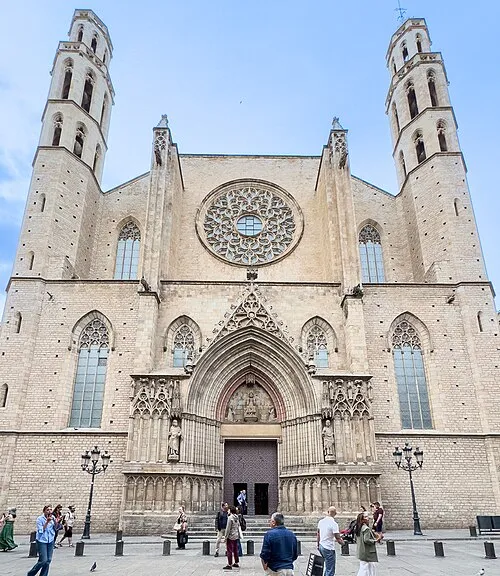
    With Santa Maria del Mar you step back into the Middle Ages. The church was built between 1329 and 1383, in just over half a century, which is quick for a Gothic building and shows when you compare it with the cathedral, the next stop, which took several centuries.

    Today it is a minor basilica, and it has been a protected cultural monument since 3 June 1931.

    It is the cheapest interior on the route and a good choice if you want one Gothic church without a big ticket.

    From here it is 550 m, about 8 minutes, to Barcelona Cathedral.

    Hours
    Mon–Sat 10:00–18:00, Sun 13:00–18:00; last entry 30 min before closing
    Price
    8 EUR adult
  10. 10

    Barcelona Cathedral

    Barcelona Cathedral, stop 10 on the self-guided walking tour

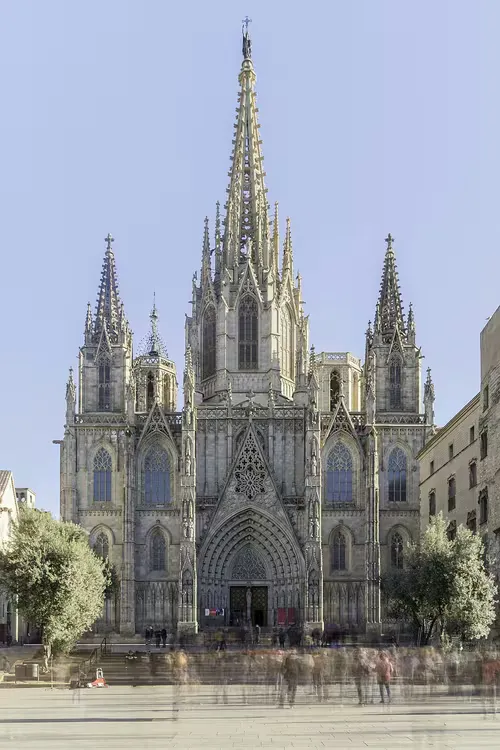
    The Cathedral of the Holy Cross and Saint Eulàlia, known locally as La Seu, was built between the thirteenth and fifteenth centuries on top of a Romanesque cathedral, which itself replaced a Visigothic church and an early Christian basilica. The remains of that basilica can be seen underground in the Museum of the History of the City. The Gothic-style main façade, by contrast, was only finished in the nineteenth century.

    Saint Eulàlia is the story to know here. According to tradition she was a young girl martyred under the Romans for speaking up about the persecution of Christians. Legend says she was exposed naked in the forum and a spring snowfall covered her; then she was rolled downhill in a barrel lined with glass and knives, traditionally along the street called Baixada de Santa Eulàlia. Thirteen tortures followed, one for each year of her life, and finally she was crucified on an X-shaped cross, now the emblem of the cathedral and the diocese.

    Inside, head for the Gothic cloister, where thirteen white geese live. They recall Eulàlia's age and the story that she herded geese on her family's land in Sarrià.

    The cathedral charges for entry. Then walk just 170 m, about 2 minutes, to a quiet square nearby.

    Hours
    Mon–Fri 09:30–18:30 (admission closes 17:45) | Sat 09:30–17:15 (admission closes 16:30) | Sun/holidays 14:00–17:00 (admission closes 16:30)
    Price
    16 EUR
  11. 11

    Plaça Sant Felip Neri

    Plaça Sant Felip Neri in Barcelona, stop 11 on the self-guided walking tour

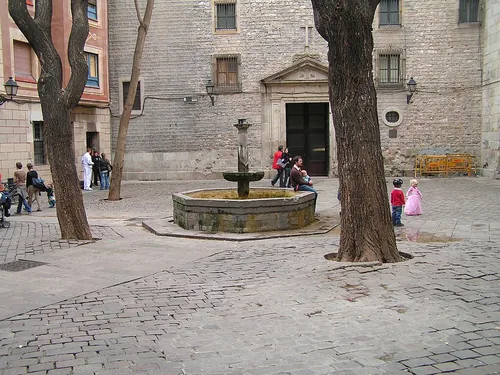
    This small square in the Gothic Quarter is named after the Baroque church of Sant Felip Neri that dominates it. It lies on the site of a medieval cemetery and is lined with Renaissance-style houses, an octagonal fountain in the middle. Two of the buildings were once the guild houses of the coppersmiths and the shoemakers; the latter holds the Shoe Museum.

    Look closely at the church walls and you will see the scars of shrapnel. On 30 January 1938, during the Spanish Civil War, a bomb dropped by the rebel air force exploded here. It killed forty-two people, most of them children who had taken shelter in the church basement, and destroyed the neighbouring houses.

    The city architect Adolfo Florensa rebuilt the space as a square, adapting two Renaissance façades from buildings that had not been reconstructed to create entrances from the cathedral avenue and Via Laietana. The square is free and always open; it is a place for a quiet moment rather than a photo stop.

    From here it is 650 m, about 9 minutes, to La Boqueria.

    Hours
    Freely accessible, no opening hours
    Price
    Free
  12. 12

    La Boqueria

    La Boqueria in Barcelona, stop 12 on the self-guided walking tour

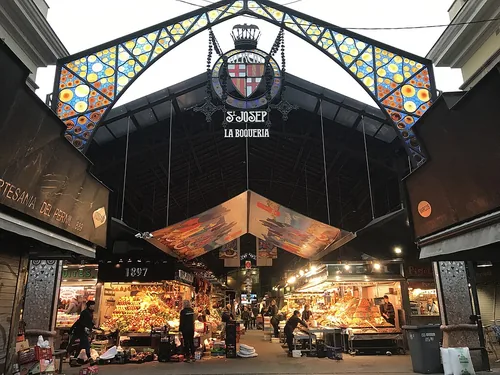
    Officially it is the Mercat de Sant Josep, but everyone calls it La Boqueria. This municipal market on the Rambla covers 2583 m² with more than 300 stalls, selling local and exotic produce to home cooks and the city's restaurants alike. It is the largest market in Catalonia, the most varied and the most visited by tourists.

    That popularity has made it a textbook case of how traditional markets change in tourist cities. You will feel it at the entrance, where the stalls are most polished and prices highest; walk deeper in and the market becomes more of a place where people actually shop.

    Entry is free. Come hungry, compare before you buy and treat it as your lunch stop on this walk.

    Leaving the market, follow La Rambla for 500 m, about 7 minutes, to Plaça Reial.

    Local name
    Mercat de la Boqueria
    Hours
    Mon–Sat: 08:00–20:30 | Sun: Closed
    Price
    Free
  13. 13

    Plaça Reial

    Plaça Reial in Barcelona, stop 13 on the self-guided walking tour

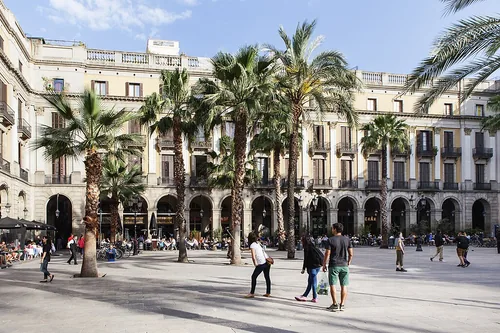
    Plaça Reial was laid out in 1850 by the architect Francisco Daniel Molina, in neoclassical style, over a part of the old town that had been destroyed.

    There is a trick in its geometry. The square is rectangular, but Molina changed the spacing between the pilasters ever so slightly so that it reads as a square. He also built passages through the arcades to reconnect the medieval streets that the new square had cut off, so take one of them as you leave.

    The square is free and always open, a good place to slow down after the market.

    The last leg is 580 m, about 8 minutes, to the Columbus Monument.

    Hours
    Freely accessible, no opening hours
    Price
    Free
  14. 14

    Columbus Monument

    Columbus Monument in Barcelona, stop 14 on the self-guided walking tour

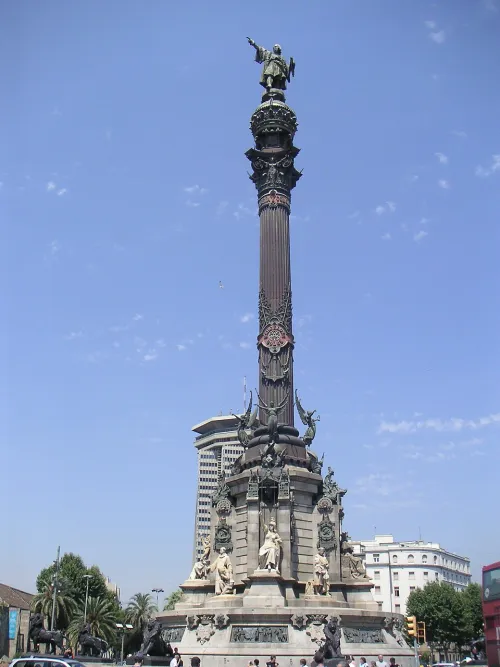
    The walk ends where the 1888 story that began at the Arc de Triomf also ends. The Monument a Colom was erected for that same Universal Exposition: a 60-metre iron column with Columbus on top.

    There is a twist in his gesture. The statue was meant to point towards the New World, yet it actually points southeast, towards the Mediterranean and his birthplace, Genoa.

    Inside the column, a narrow lift climbs to a small viewing platform just beneath the explorer's feet. Going up costs a fee, which you pay at the entrance; it is a fitting finale if you want one last look over the city you just crossed on foot.

    Local name
    Monument a Colom
Walking tour route map of Barcelona Route loaded
Park GüellHospital de Sant PauSagrada FamíliaCasa Milà+10
All 14 stops are already on the map.
You just press start.
AI Tour Guide

You've read the route. Now walk it with a guide in your ear.

Press start wherever you are, even hundreds of kilometres from Barcelona, and the guide begins telling its stories right away. In the city, pick any of the 14 stops to start from: it leads you there, then talks with you the whole route, asking, listening, remembering, and shaping the tour around your answers.

14stops 11.7km 2 h 39 minwalking 13languages
▶Start the tour free

Free to start · Runs in your browser · No app, no download

Shorter Ways to Walk This Barcelona Route

Fourteen stops make a long day. If you have less time or energy, these cuts keep the route's logic intact.

Gaudí morning

Stops: 1, 2, 3, 4, 5

For first-time visitors who came mainly for Gaudí. About 5.6 km with 1 h 16 min of walking, from Park Güell to Casa Batlló. Tickets you may need: Park Güell, the Sagrada Família and one or both of the Passeig de Gràcia houses; Hospital de Sant Pau works just as well from outside.

Old town and free squares

Stops: 6, 7, 8, 9, 10, 11, 12, 13, 14

For a relaxed afternoon or a second day. About 4.8 km with 1 h 7 min of walking, from the Palau de la Música Catalana to the Columbus Monument. Five stops are free; the Palau, Santa Maria del Mar, the cathedral and the Columbus lift charge for entry.

Skip the park, keep the city

Stops: 3, 4, 5, 6, 7, 8, 9, 10, 11, 12, 13, 14

For those who would rather start in the Eixample than on the hill. About 8.1 km with 1 h 52 min of walking, beginning at the Sagrada Família; you lose Park Güell and Sant Pau but keep every Gaudí house and the whole old town.

How Long This Barcelona Tour Takes, With and Without Interiors

Pure walking time is 2 h 39 min. Add an hour in Park Güell, an hour and a half inside the Sagrada Família, short looks at the other stops and a lunch break, and the day comes to about eight hours. Start at 09:00 and you reach the Palau de la Música Catalana around 13:40, in good time to go inside, and Barcelona Cathedral in mid-afternoon. Every extra interior, such as Casa Milà or the Palau, adds roughly another hour.

The Gaudí morning takes about five hours with Park Güell, the Sagrada Família and one house from inside. The old-town walk fills about four and a half hours if you go into the Palau and the cathedral. Skipping the park and Sant Pau, the walk from the Sagrada Família onwards makes a full day of about seven hours with two interiors and lunch.

Before You Set Off from Park Güell

  • Start and finish: The recommended start is Park Güell and the walk ends at the Columbus Monument, so it is a one-way route. You can join at any stop if your hotel is closer to another; the order shown is simply the one that flows best.
  • Best day and time: Pick a weekday and start in the morning at Park Güell. At the weekend several stops keep shorter hours, and La Boqueria is not open every day.
  • Costs: Walking the route is free. Going into everything with standard tickets adds up quickly, so most people pick two or three interiors. The AI Tour Guide starts with 100 free credits; after that you choose between €19.99 for this tour all-inclusive with no time limit, or credits at €5 per hour.

Food and Breaks Along the Old-Town Half of the Route

Lunch falls in the old-town half of the walk, around La Boqueria, where a little choosiness saves real money and gets you a better meal.

Menú del díaThe set lunch served in neighbourhood restaurants, usually on weekdays at lunchtime, gives you several courses at a fair price. Check the menu board for whether a drink and dessert are included.
Fresh juice inside the marketAt the front stalls a cup costs noticeably more; walk further in and you often find the same size for much less. Compare cup size and freshness before you pay. (La Boqueria)

Tourist Traps to Avoid in Barcelona on This Walk

  • Tourist paella on the Rambla: A paella aimed at passers-by can get expensive. A set lunch in a neighbourhood place costs far less and is usually the better value, even if it is not paella. (Between La Boqueria and Plaça Reial)
  • Resold Park Güell tickets: Resellers have charged well above the official price for exactly the same entry and time slot. A genuine guided tour is a different product; a plain entry ticket is not worth the markup.
Walking tour route map of Barcelona
AI Tour Guide

Your AI Tour Guide is ready when you are.

Press start and a voice AI Tour Guide takes it from here: leading the route through Barcelona, telling the stories, and turning your walk into a real back-and-forth conversation. No app or download is needed; it runs in your browser.

14stops 11.7km 2 h 39 minwalking 13languages
▶Start the tour free

Free to start · Runs in your browser · No app, no download

What the AI Tour Guide Adds Between Gaudí and the Gothic Quarter

This walk strings together threads that are easy to miss on your own: Gaudí's ideas travelling from Park Güell to the Sagrada Família, Domènech i Montaner reappearing from the Sant Pau pavilions to the Palau, and the 1888 Exposition linking Arc de Triomf, Parc de la Ciutadella and the Columbus Monument. The AI Tour Guide leads you through them as a conversation: it greets you, tells the stories, asks what caught your eye and remembers it, so the afternoon in the old town builds on what you enjoyed in the morning. Ask it what daily life looked like for the Milà family in their new house, or how the Orfeó Català's choirs use the Palau, and interrupt it whenever you want to linger or move on.

A Real Conversation A voice AI Tour Guide greets you, leads the whole route, and tells the stories and facts as you walk, asking what you want to see and keeping a real conversation going. Not a recording you press play on.
Map Navigation Follow the route on the map and walk at your own pace. You choose where to start and when to move to the next stop.
Ask Anything Curious about a building you pass? Ask your AI Tour Guide on the spot and the conversation carries on.
13 Languages Switch language anytime. No separate tour needed.
Start free in your browser

Common Questions About Walking Barcelona

Can I visit any of the Gaudí houses in the evening?

Yes. Casa Batlló stays open into the evening, and Casa Milà runs night visits for part of the year; in winter an evening return works best at Casa Batlló.

Which public transport ticket suits a day like this?

The T-casual gives you ten trips in zone 1, and a new card costs a small extra. Against single tickets it pays off after a few trips, and transfers are included. It cannot be used by several travellers at the same time and is not valid at the airport metro stations T1 and T2 or on the Aerobús.

What is the cheapest way from the airport into the city?

Bus 46 is the cheapest option and also reaches Plaça Espanya, but with more stops and less room for bags. The Aerobús costs more and stops centrally, which suits travellers with luggage. Taxis run on the meter, with a minimum fare from the airport.

Are there similar walks for a day trip from Barcelona?

Yes. Girona, 86 km away, and Tarragona, 82 km away, both have their own self-guided routes with the same free GPS navigation.

Is the tour really free?

Yes. The whole tour is free: the route, the interactive map and the navigation cost you nothing. Only the voice AI Tour Guide is optional and paid: you test it with 100 free credits, then you pay either €5 per hour or €19.99 for this whole tour, with no time limit. Admission to 9 of the 14 stops is not included: Park Güell, Hospital de Sant Pau, Sagrada Família, Casa Milà, Casa Batlló, Palau de la Música Catalana, Santa Maria del Mar, Barcelona Cathedral and Columbus Monument charge their own entry fees.

Do I need to download an app?

No. Everything runs in your phone browser. Open the route and start walking, no download and no sign-up required.

Do I need to book the walking tour in advance?

No booking needed. This self-guided tour is available anytime. Open the route in your browser and start walking. The AI Tour Guide works instantly, no app, no reservation required.

What languages is the AI Tour Guide available in?

The AI Tour Guide speaks 13 languages, so you take the tour in your own language and can switch at any time.

Can I skip stops or change the route?

Yes. Skip any stop, spend extra time at places you like, or start the route from any point. It is your walk, you set the pace.
Image credits
▶ Start free in your browser Runs in your browser, no app, no download