Free Walking Tour Vilnius: From the KGB Museum to Užupis

Start in the former KGB headquarters, climb to Gediminas Tower and the Three Crosses, then wander through Užupis and the Old Town to the Gates of Dawn.

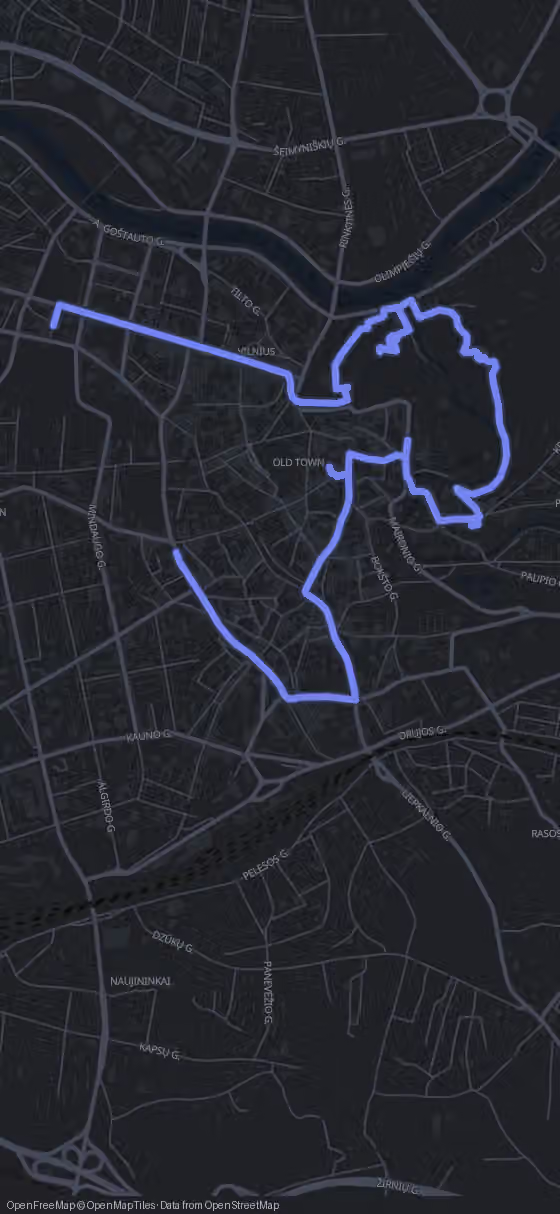
13 Stops 7.7 km ~1 h 54 min walking
Route map for the Vilnius walking tour
Stop 1 of 13
880 m·11 min
Museum of Occupations and Freedom Fights
Head east along Gediminas Prospect toward the Money Museum
Welcome to Vilnius. I'm Alex, and our first story begins with messages prisoners left on their cell walls.
Try this tour with Alex

Your Vilnius Route at a Glance

Thirteen stops lead from the Museum of Occupations and Freedom Fights opposite Lukiškės Square to the MO Museum: 7.7 km and 1 h 54 min of pure walking. Plan about four hours with short looks, or a full day if you go inside the big museums.

Squares, churches, Užupis and the Money Museum are free; the KGB museum, the Palace of the Grand Dukes of Lithuania, Gediminas Tower and MO charge entry. Route, map and GPS navigation from stop to stop are free in your browser, and the AI Tour Guide is optional.

Open free GPS & optional AI Tour Guide
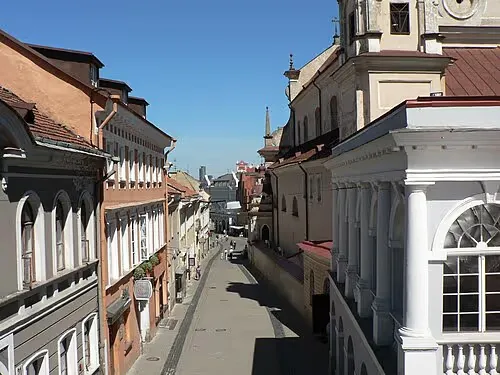
View of Vilnius

The Route

Walking Map of Vilnius: From Lukiškės Square to the MO Museum

13 stops 7.7 km 1 h 54 min walking
Tap to load interactive map

The 13 stops along this route

  1. Museum of Occupations and Freedom Fights in Vilnius, stop 1 on the self-guided walking tour
    1Museum of Occupations and Freedom Fights
  2. Money Museum in Vilnius, stop 2 on the self-guided walking tour
    2Money Museum
  3. Cathedral Square in Vilnius, stop 3 on the self-guided walking tour
    3Cathedral Square
  4. Palace of the Grand Dukes of Lithuania in Vilnius, stop 4 on the self-guided walking tour
    4Palace of the Grand Dukes of Lithuania
  5. National Museum of Lithuania in Vilnius, stop 5 on the self-guided walking tour
    5National Museum of Lithuania
  6. Gediminas Tower in Vilnius, stop 6 on the self-guided walking tour
    6Gediminas Tower
  7. Hill of Three Crosses in Vilnius, stop 7 on the self-guided walking tour
    7Hill of Three Crosses
  8. Užupis in Vilnius, stop 8 on the self-guided walking tour
    8Užupis
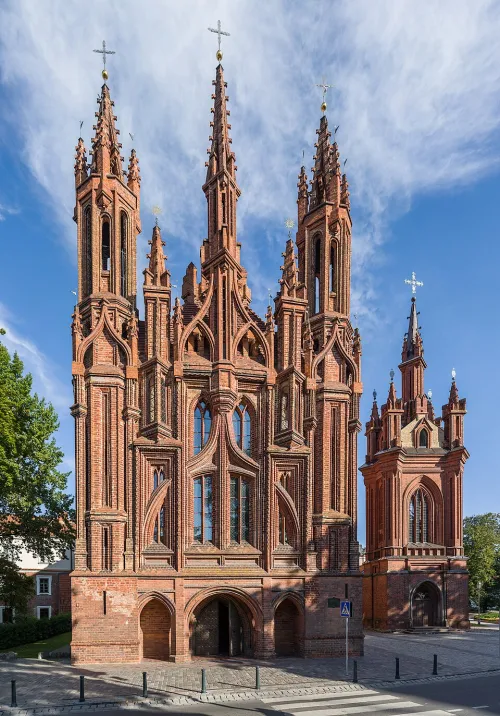
  9. Church of St. Anne in Vilnius, stop 9 on the self-guided walking tour
    9Church of St. Anne
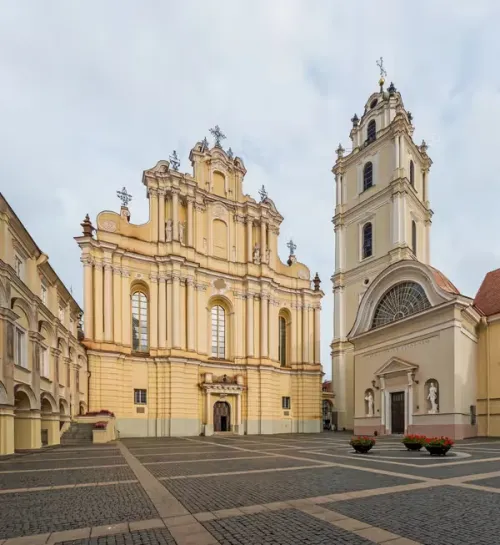
  10. St. Johns Church in Vilnius, stop 10 on the self-guided walking tour
    10St. Johns Church
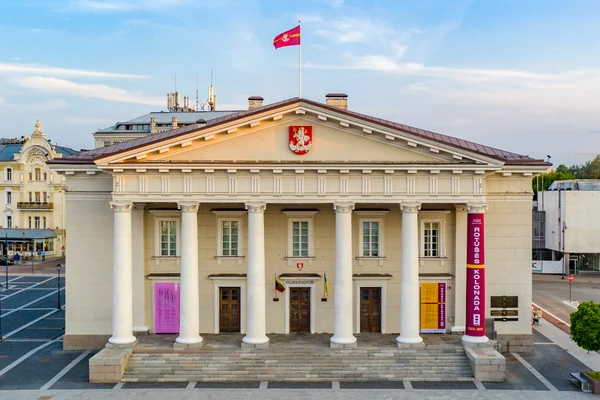
  11. Vilnius Town Hall, stop 11 on the self-guided walking tour
    11Vilnius Town Hall
  12. Gates of Dawn in Vilnius, stop 12 on the self-guided walking tour
    12Gates of Dawn
  13. MO Museum in Vilnius, stop 13 on the self-guided walking tour
    13MO Museum
  14. That's the full route.

    Walk it with an AI Tour Guide talking you through every one of these streets.

    Start free in your browser
    You made it

The Vilnius Walking Tour Stop by Stop: Thirteen Places and Their Stories

  1. 1

    Museum of Occupations and Freedom Fights

    Museum of Occupations and Freedom Fights in Vilnius, stop 1 on the self-guided walking tour

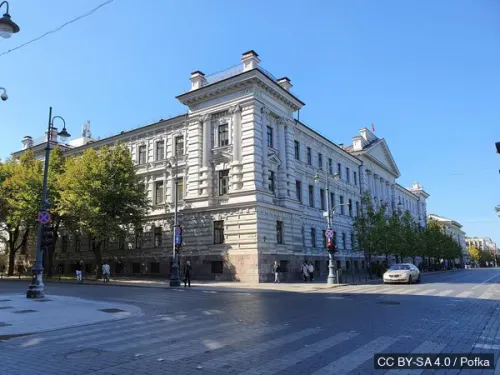
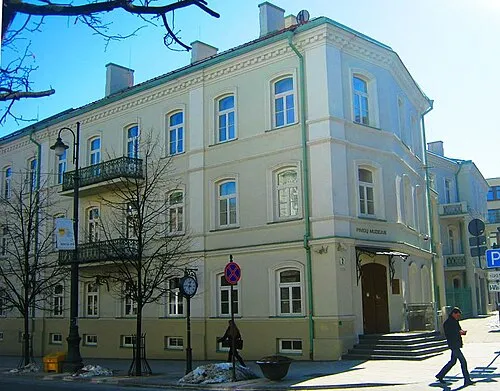
    You start in front of a building that locals still simply call the KGB Museum. It stands opposite Lukiškės Square and looks like what it first was: a solid courthouse, completed in 1890 for the Vilna Governorate, when Lithuania was part of the Russian Empire. Few addresses in the city have changed hands as often as this one.

    During the First World War the German Empire used it. After independence was declared it became a conscription centre for the new Lithuanian army and the seat of the city commander, then, when the Bolsheviks briefly took Vilnius, it housed commissariats and a revolutionary tribunal. After Żeligowski's Mutiny of 1920 Poland held the city and the building served as the courts of the Wilno Voivodeship. Later it became the headquarters of the KGB, and that is the chapter the museum tells.

    The museum was founded in 1992 and since 1997 belongs to the Genocide and Resistance Research Centre. It collects documents and objects from the fifty years of Soviet occupation: the anti-Soviet partisans, the arrests, deportations and executions. Until 2018 it was called the Museum of Genocide Victims; after international criticism it was renamed, partly because only a small part of the space covers the Holocaust in Lithuania.

    Going inside costs entry and asks for your attention, but if you want to understand modern Lithuania, this is the place that explains why freedom is such a big word here. Give it real time or save it for another day. From here it is 880 m, about 12 minutes, along Gedimino prospektas to the Money Museum.
    Local name
    Okupacijų ir laisvės kovų muziejus
    Hours
    Mon–Tue closed, Wed–Fri 10:00–18:00, Sat 10:00–17:00, Sun closed
    Price
    6 EUR
    Website
    olkm.lt ↗
  2. 2

    Money Museum

    Money Museum in Vilnius, stop 2 on the self-guided walking tour

    The Bank of Lithuania runs this museum inside its own building complex on Gedimino prospektas, and entry and tours are free. It opened in 1999 as the bank's museum and, after a rebuild that ended in 2010 (the rooms were once a pharmacy), it was enlarged and renamed the Money Museum.

    The star is the Pyramid of a Million Cents, finished in November 2014: 1,000,935 one-cent litas coins stacked into one shape. In August 2015 it entered the Guinness Book of Records as the largest pyramid ever built from money. A nice detail, since Lithuania switched to the euro, the pyramid is now a monument to a currency that no longer exists.

    Five themed halls spread over two floors. One follows money from its oldest forms to electronic payments, another tells the story of banking, including the crisis years between the wars and the collapse of national banking when the Soviets occupied Lithuania in 1940. A third shows modern banknotes and coins and how Lithuanian money is made.

    It is hands on in a way that works for children and adults alike: you can strike your own souvenir coin and stand on a scale that tells you what you would be worth in gold, platinum or silver. Twenty or thirty minutes are enough and it costs nothing, so drop in even if finance is not your thing. Then it is 430 m, about 6 minutes, to Cathedral Square.

    Local name
    Pinigų muziejus
    Hours
    Mon: Closed | Tue–Fri: 09:00–18:00 | Sat: 10:00–17:00 | Sun: Closed
    Price
    Free
  3. 3

    Cathedral Square

    Cathedral Square in Vilnius, stop 3 on the self-guided walking tour

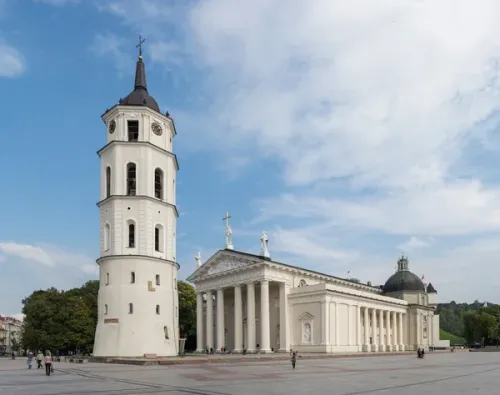
    This is the main square of the Old Town, laid out in front of the neoclassical Vilnius Cathedral where the city's main streets meet. Fairs, parades, concerts, the New Year's Eve celebrations and the tallest Christmas tree in the city all happen here, and the square counts as one of the best known symbols of Lithuania.

    It is younger than it looks. Only in the 19th century, when the cathedral was rebuilt, was the space cleared. Before that, medieval and renaissance houses stood densely packed here, and parts of the area belonged to the Lower Castle. Once open, the square hosted Russian military parades and the annual St. Casimir's Fair.

    In 1905 a monument to Catherine the Great by Mark Antokolski went up here. It did not last: after Germany occupied the city in 1915 and a local Polish administration took over, the statue was destroyed and the fair moved to Lukiškės Square, right where you started this walk.

    Look at the bell tower standing several metres away from the cathedral, a free standing arrangement that is rare outside Italy. Many scholars think it was originally one of the towers of the Lower Castle's walls. You can skip paying to go up; better views come later and cost nothing. The palace is just 170 m away, a 2 minute walk.

    Local name
    Katedros aikštė
    Hours
    Open 24/7
    Price
    Free
  4. 4

    Palace of the Grand Dukes of Lithuania

    Palace of the Grand Dukes of Lithuania in Vilnius, stop 4 on the self-guided walking tour

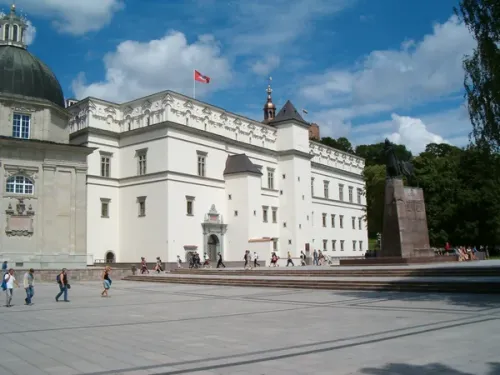
    The white palace in the Lower Castle grounds was home to the rulers of the Grand Duchy of Lithuania and the future kings of Poland, and for four centuries it was a political and cultural centre of the Polish Lithuanian Commonwealth. What you see is a rebuild: the original was demolished in 1801, work on the new palace started in 2002 and took 16 years, until 2018.

    The story goes back further than stone. In the 13th and 14th centuries stone buildings stood here, and some archaeologists think a wooden palace did too. After a major fire in 1419, a Gothic palace with three wings rose, probably two storeys over a basement, meant to host the coronation of Vytautas the Great.

    Grand Duke Alexander Jagiellon moved in, received ambassadors here and lived and died in the palace with his wife, a daughter of Moscow's Grand Duke Ivan III. Sigismund the Old ruled from here too, and in the 1520s had it rebuilt in Renaissance style. A courier of Queen Bona Sforza reported the price: 100,000 gold ducats, probably spent so that his son Sigismund Augustus could be proclaimed Grand Duke in proper splendour.

    Inside, several exhibition routes can be combined on one ticket. It is worth it if the grand duchy fascinates you; if you are short on time, the outside and the castle setting tell the main story. Next, 250 m and about 3 minutes, comes the National Museum.

    Local name
    Lietuvos valdovų rūmai
    Hours
    Summer (1.6-31.8): Mon,Tue,Wed,Sun 10:00–18:00, Thu–Sat 10:00–20:00. Winter (1.9-31.5): Tue,Wed,Fri,Sat 10:00–18:00, Thu 10:00–20:00, Sun 10:00–16:00, Mon closed
    Price
    Combi ticket all 4 routes 14 EUR; individually: Route I 6 EUR, Route II 10 EUR, Route III 4 EUR, Route IV 2 EUR; reduced 50% (students/pupils/retirees)
  5. 5

    National Museum of Lithuania

    National Museum of Lithuania in Vilnius, stop 5 on the self-guided walking tour

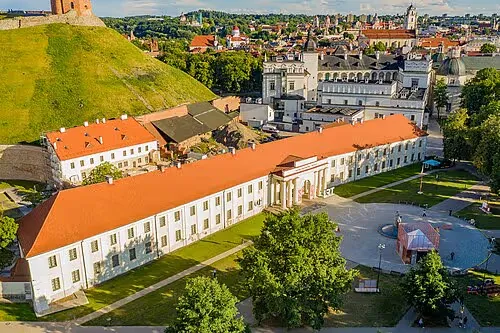
    The National Museum occupies the New Arsenal of the castle complex, its home since 1967. With five departments, from archaeology and ethnography to coins and iconography, it holds around 800,000 items and still runs archaeological digs across the country.

    Its history mirrors the country's. The forerunner was the Museum of Antiquities, founded in 1855 by Eustachy Tyszkiewicz and built largely from Polish private collections. After the January Uprising of 1863, the Russian Empire carried much of it off to Moscow, and in 1915, as the front of the First World War approached, more exhibits went to Russia.

    After independence in 1918, a Museum of History and Ethnography grew from what was left, led by Jonas Basanavičius, one of the signatories of the Act of Independence. Under Polish rule it became part of Vilnius University, in 1941 the Academy of Sciences took over all the city's collections, and in 1952 the historian Vincas Žilėnas made it a separate museum again. Since 1992 it carries its present name.

    Go in if you want the long sweep of Lithuanian history in one place; you find the current ticket price at the desk. If you already spent time in the palace, you can keep this one for a rainy day. From here it is 690 m, around 12 minutes, up to Gediminas Tower, on foot or by funicular.

    Local name
    Lietuvos nacionalinis muziejus
    Website
    lnm.lt ↗
  6. 6

    Gediminas Tower

    Gediminas Tower in Vilnius, stop 6 on the self-guided walking tour

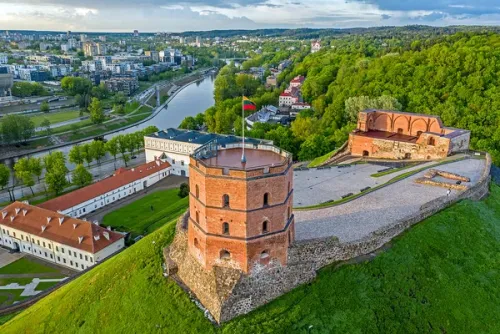
    The brick tower on top of Gediminas Hill is all that remains of the Upper Castle, and it is a symbol of the city and the state. It appeared on the old litas, it turns up in patriotic poems and folk songs, and on 7 October 1988, during the movement to restore independence, the Lithuanian flag was raised here again.

    Gediminas, Grand Duke of Lithuania, built the first wooden fortifications. The first brick castle was finished in 1409 under Vytautas, and the three storey tower you see was rebuilt in 1933 by the Polish architect Jan Borowski. Some other remains of the castle have been restored, guided by archaeology.

    The founding legend belongs here. Gediminas was hunting in the woods of the Šventaragis Valley, killed a wild bull on this hilltop and, tired, spent the night. He dreamed of an iron wolf on the hill, howling like a hundred wolves. His priest Lizdeika explained the dream: he should build a city here, one that would become known around the world.

    The hill itself is free; the tower is a museum with its own entry. Inside are finds from the hill, models of the Vilnius castles from the 14th to the 17th centuries, weapons and old views of the city, and on top a viewing platform over the Old Town and the business district. It is worth it for castle fans. Next, 960 m and about 17 minutes, you head to the Hill of Three Crosses.

    Local name
    Gedimino bokštas
    Hours
    Daily: 10:00–20:00
    Price
    8 EUR, reduced 4 EUR
    Website
    lnm.lt ↗
  7. 7

    Hill of Three Crosses

    Hill of Three Crosses in Vilnius, stop 7 on the self-guided walking tour

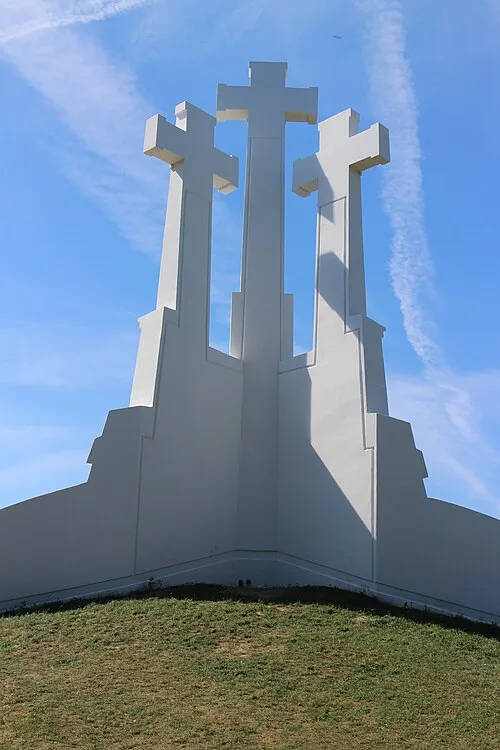
    Three white crosses stand on the Bald Hill in Kalnai Park, part of the city's skyline. At their base a small observation deck opens onto a panorama of the Old Town, free and without any glass or mesh in between, which makes this the viewpoint to linger at.

    The crosses go back to a legend. According to the Bychowiec Chronicle, fourteen Franciscan friars came to Vilnius from Podolia, preached openly and insulted the Lithuanian gods. Angry townspeople burned their monastery and killed them all: seven were beheaded on this hill, the other seven crucified and thrown into the river. Historians doubt the details; it may be an embellished version of older stories about two or five martyred Franciscans, but it was told from the early 16th century on.

    Wooden crosses stood here from before 1649 and had to be replaced whenever the wood rotted. In 1916 the architect and sculptor Antoni Wiwulski, Antanas Vivulskis in Lithuanian, designed a concrete monument. The Soviet authorities had it torn down in 1950. The present crosses, made by Stanislovas Kuzma after a design by Henrikas Šilgalis, went up in 1989, as the country was moving towards freedom, and later appeared on the 50 litas note.

    Take your time here; the way down leads 1010 m, about 15 minutes, into Užupis.

    Local name
    Trijų Kryžių paminklas
    Hours
    Open 24/7
    Price
    Free
  8. 8

    Užupis

    Užupis in Vilnius, stop 8 on the self-guided walking tour

    Užupis means “beyond the river”, and the river is the Vilnia, which also gave the city its name. The district is small, about 60 hectares with around 7,000 inhabitants, nearly 1,000 of them artists. It is cut off by the river on one side, steep hills on another and a Soviet era industrial area on the third, and people compare it to Montmartre and to Christiania in Copenhagen.

    On 1 April 1997, Užupis declared itself an independent republic with its own constitution. The joke has lasted: the Republic has named honorary citizens, among them the 14th Dalai Lama, who first visited in 2013 and came back in 2018 to plant a tree in the Republic's Tibet Square, marking 100 years since the Council of Lithuania proclaimed independence.

    Behind the playful side lies a hard history. The first bridges were built in the 16th century, when most inhabitants were Jewish. Most of them were murdered in the Holocaust, and the Soviets later destroyed the old Jewish cemetery up the hill. Abandoned houses filled with the homeless and squatters, and until 1990 this was one of the most neglected parts of the city, many houses without utilities. Artists stayed throughout, and some still squat in old buildings by the river. The Bernardine Cemetery here is one of the oldest in the city.

    Wander rather than tick things off, and make this your lunch break. Then it is 610 m, about 8 minutes, back across the river to the Church of St. Anne.

    Hours
    Open 24/7
    Price
    Free
  9. 9

    Church of St. Anne

    Church of St. Anne in Vilnius, stop 9 on the self-guided walking tour

    St. Anne's is a small red brick church that people stop for. Its facade of Flamboyant and Brick Gothic is a big part of why the Old Town became a UNESCO World Heritage Site, and it ranks among the most interesting Gothic buildings in Lithuania. The outside has hardly changed since around 1500.

    The first church here was wooden, built for Anna, the first wife of Vytautas the Great, and meant for Catholic Germans and visiting Catholics. It burned in the great fire of 1419. The present brick church was built on the initiative of Alexander Jagiellon, King of Poland and Grand Duke of Lithuania, and after severe fire damage it was restored in 1582 with money from Mikołaj Radziwiłł the Black and Jerzy Radziwiłł.

    The best known story: Napoleon saw the church in 1812 and wished he could carry it home to Paris in the palm of his hand. Look at the main portal, too. In 1762 its side arches were walled up to support the facade, and only the renovation that began in 1902 opened them again and strengthened the walls with iron.

    The church stayed open throughout the Soviet years and was even repaired when the towers were in bad shape. On 23 August 1987 the Lithuanian Liberty League held a protest rally on the square near the church and the Adam Mickiewicz Monument, broken up by the Soviet militia. Entry is free, so step in if the doors are open. From here it is 500 m, about 7 minutes, to St. Johns Church.

    Local name
    Vilniaus Šv. Onos bažnyčia
    Hours
    Mon–Fri: 16:45–18:00 | Sat–Sun: 09:00–17:00
    Price
    Free
  10. 10

    St. Johns Church

    St. Johns Church in Vilnius, stop 10 on the self-guided walking tour

    St. Johns Church dominates the Vilnius University ensemble, and its bell tower, 69 metres high, is the tallest building in the Old Town. Both are prime examples of Vilnian Baroque, shaped by the architect Johann Christoph Glaubitz, the same man who supervised repairs at St. Anne's in 1747.

    Its roots lie in the Christianisation of Lithuania. Jogaila began the first parish church, a Gothic brick building, in 1386; it was finished in 1426 under Vytautas the Great and consecrated a year later. For centuries it was the only parish church of Vilnius inside the city wall, the church of the townspeople, while the cathedral served mainly the rulers and their court.

    With the Jesuit Academy came a university life that never left. Professors and students prayed here, theologians preached, theses were defended, disputes and performances held and monarchs welcomed. Since the 16th century, Vilnius University has handed out its diplomas here. Services are held only in Lithuanian, and the church also hosts concerts. Below lie crypts, where people were buried from the church's early years.

    Entry is free, and the interior is worth a few minutes for the Baroque alone. From here it is 670 m, around 10 minutes, to the Vilnius Town Hall.

    Local name
    Šv. Jonų bažnyčia
    Hours
    Mon–Sat: 09:00–18:00 | Sun: 09:00–13:00
    Price
    Free
    Website
    jonai.lt ↗
  11. 11

    Vilnius Town Hall

    Vilnius Town Hall, stop 11 on the self-guided walking tour

    The neoclassical Town Hall closes off the square at the end of Pilies Street. A town hall here is first mentioned in 1432; it began as a Gothic building and was rebuilt many times, until Laurynas Gucevičius gave it its present form in 1799. It has stayed that way since. Today the city uses it for official occasions and state visits; George W. Bush and Queen Elizabeth II were both received here.

    The square has been the city's marketplace since the early 15th century, lined with small shops selling mostly salt, iron and meat. Trade was strictly controlled. Shops could not be sold or given away freely, Jewish butchers were barred from building their shops here and on Vokiečių Street, and buying goods by the roadside to resell in town at a higher price was forbidden, to prevent price spikes in times of shortage.

    Breaking the rules meant fines, flogging, prison or the loss of your goods, and confiscated merchandise went to shelters and hospitals. Behind all this lay the Magdeburg rights Vilnius received in 1387, the same kind of town law many established European cities followed.

    Today the Kaziukas Fair, the main Christmas tree and big state celebrations fill the square. Entry to the building is free, and the preserved Gothic cellars can be visited. Next, 420 m and about 6 minutes, comes the Gates of Dawn.

    Local name
    Vilniaus rotušė
    Hours
    Mon–Fri 11:00–19:00, Sat 10:00–17:00, Sun closed
    Price
    Free
  12. 12

    Gates of Dawn

    Gates of Dawn in Vilnius, stop 12 on the self-guided walking tour

    The Gates of Dawn is the one survivor of the nine gates in the Vilnius city wall, finished in 1514, and today a major site of Catholic pilgrimage. On the outside you can still see the firing openings that recall its defensive role. It was also called the Medininkai Gate, after the village its road led to, and the Sharp Gate.

    What draws people is the image of the Virgin Mary in the chapel above the passage. A new painting was placed there in the first half of the 17th century and has been venerated ever since. The outer side once showed Christ as Salvator Mundi between St. Casimir and St. Stanislaus, the patrons of Lithuania and the Polish Crown; those paintings were plastered over, forgotten and only rediscovered in 1976 by the conservator Leszek Krzemiński.

    The Discalced Carmelites, who founded a monastery and the Church of St. Theresa next to the gate in 1626, promoted the cult. In 1668 the city allowed them a wooden chapel inside the gate, completed in 1672. Fire destroyed it in 1711, but the image was saved and later moved into a new brick chapel. The stucco altar and decoration you see date from the 1780s. Visiting is free.

    From here it is the longest leg of the walk, 1100 m and about 14 minutes to the MO Museum, passing Halė Market on the way.

    Local name
    Aušros vartai
    Hours
    Daily 7:00–19:00
    Price
    Free
  13. 13

    MO Museum

    MO Museum in Vilnius, stop 13 on the self-guided walking tour

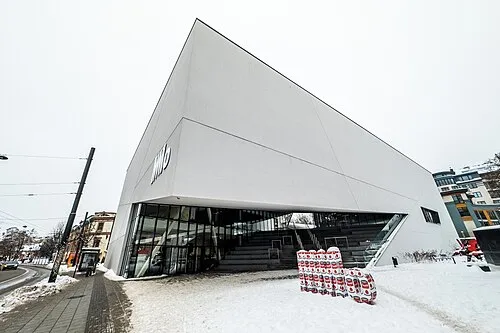
    You finish with the newest building on the route: the MO Museum, opened on 18 October 2018 in a white building by Studio Libeskind and Do Architects. Daniel Libeskind called it his smallest project and one of his favourites, and said it was the first time he used a circular form in a design. The Italian news agency ANSA put it among the top ten museums of the 21st century to visit.

    MO is a private initiative of the scientists and philanthropists Danguolė Butkienė and Viktoras Butkus. They started collecting in 2008 with help from the art expert Raminta Jurėnaitė, and for about ten years MO worked as a museum without walls before it had a home. Their collection of about 6,000 works covers Lithuanian art from the 1950s to today.

    What makes it special is the story it tells: the cultural modernisation of the early 1960s and the slow, steady liberation of art after the Stalin era. That links neatly back to where you started. Fear and control in the KGB building, and here the art that people made despite it.

    Entry is paid, and it is worth it if you still have energy for an hour of art; exhibitions, films, workshops and concerts round out the programme. If not, it is a fine building to look at from outside as you end the walk.

    Local name
    MO muziejus
    Hours
    Mon 10:00–20:00, Tue closed, Wed–Sun 10:00–20:00
    Price
    EUR 5 adult; EUR 3 reduced; EUR 11 family
    Website
    mo.lt ↗
Walking tour route map of Vilnius Route loaded
Museum of Occupations and Freedom FightsMoney MuseumCathedral SquarePalace of the Grand Dukes of Lithuania+9
All 13 stops are already on the map.
You just press start.
AI Tour Guide

You've read the route. Now walk Vilnius with a guide in your ear.

Press start wherever you are, even hundreds of kilometres from Vilnius, and the guide begins telling its stories right away. In the city, pick any of the 13 stops to start from: it leads you there, then talks with you the whole route, asking, listening, remembering, and shaping the tour around your answers.

13stops 7.7km 1 h 54 minwalking 13languages
▶Start the tour free

Free to start · Runs in your browser · No app, no download

Shorter Ways to Walk Vilnius

The full route is long if you go inside the museums. These three cuts follow the same order and keep the best of each part of the city.

Castle and Old Town core

Stops: 3, 4, 5, 6, 7, 8, 9, 10, 11, 12

For a first visit with half a day to spare: from Cathedral Square over Gediminas Hill and the Three Crosses into Užupis, then through the Old Town to the Gates of Dawn. About 5.3 km and 1 h 20 min of walking. Entry only if you choose the palace, the National Museum or the tower; everything else is free.

Occupation and grand dukes

Stops: 1, 2, 3, 4, 5, 6

For history readers who want to spend their time indoors: the KGB museum, the Money Museum, the cathedral and the three castle museums, ending on the hill. About 2.4 km and just 35 min of walking, so most of the day goes into exhibitions. The Money Museum is free; the KGB museum, the palace and the tower charge entry.

Viewpoint, Užupis and churches

Stops: 7, 8, 9, 10, 11, 12, 13

For an afternoon outdoors: start at the Three Crosses, drop into Užupis and finish through the churches and squares at the MO Museum. About 4.3 km and 1 h of walking. Everything is free except MO, which makes a good finale if you still have energy for art.

How Long Does This Vilnius Tour Take, With and Without Museums?

The pure walking time is 1 h 54 min for the whole route. The longest legs come in the middle, from Gediminas Tower to the Three Crosses and on to Užupis, so plan your energy for the hills there rather than for the flat Old Town lanes at the end.

With short looks at every stop and a coffee or lunch in Užupis, expect around four hours. If you go properly inside the KGB museum, the palace, the tower and MO, it becomes a full day; pick two of them if you want to finish relaxed. The castle and Old Town core takes about three hours outdoors, the occupation and grand dukes cut half a day or more depending on the museums, and the afternoon from the Three Crosses to MO around two and a half hours.

Before You Set Off from Lukiškės Square

  • Start: The recommended start is the Museum of Occupations and Freedom Fights, but you can join at any stop; the GPS navigation picks you up wherever you are.
  • Finish: The walk ends at the MO Museum. If you want to return to the start, the GPS navigation guides you back from the last stop.
  • Time of day: Set off in the morning if you plan to go inside several museums, so the hill and Užupis fall around lunchtime. For the walk alone, any time of day works.
  • Entry fees: The KGB museum, the Palace of the Grand Dukes of Lithuania, Gediminas Tower and the MO Museum charge entry, and the National Museum has its own ticket desk. The squares, churches, the Three Crosses, Užupis, the Town Hall and the Money Museum are free.

Food and Breaks on the Way: Cepelinai, Bagels and Coffee

The natural lunch stop is Užupis, roughly halfway, where several of the most loved local places sit within a few streets. Before that, the avenue of the Money Museum has a cheap weekday lunch, and near the end the market hall is good for a snack.

ŠnekutisSimple Lithuanian food and beer, the consensus pick for the real thing. Locals rate the Užupis branch as the one with the best atmosphere; order cepelinai or cold beet soup. (In Užupis, Šv. Stepono g. 8)
Užupis PicerijaPerhaps the best known pizza place in the city and very busy at weekends, so reserve if you plan to eat there on a Saturday or Sunday. (In Užupis)
Coffee1A small family business with its own chocolate and ice cream brand, and a favourite of local guides. Good for a short break before the walk back into the Old Town. (Užupio g. 9)
Senolių TradicijaLunch only, on working days: the daily menu of soup and a main course (dienos pietūs) is the most reliable way to eat well for little money in Vilnius. (Gedimino av. 17)
Džiugas HouseCheese ice cream for the adventurous, plus everything made from Džiugas cheese. An easy treat near the Gates of Dawn. (Aušros Vartų g. 3)
Halės Turgus and BeigelistaiThe market hall has been trading since 1906. Inside, Beigelistai sells bagels and seriously strong coffee, also to go. (Between the Gates of Dawn and the MO Museum)

Tourist Traps to Avoid in Vilnius Old Town

  • Eating on the Pilies main strip: The main pedestrian streets have some overpriced, low quality places. Walk one street further, or plan your meal in Užupis; you eat better and pay less. (Pilies gatvė, which ends at Town Hall Square)
  • Paying to climb the Cathedral bell tower: The climb costs extra and a mesh blocks the view. The Three Crosses give you the classic Old Town panorama for free, and the hill below Gediminas Tower costs nothing either. (Cathedral Square)
  • The charity clipboard: Someone pushes an official looking petition at you, sometimes pretending to be deaf, and asks for a cash donation while an accomplice goes for your pocket. Keep walking and keep your bag closed. (Pilies Street near St. Anne's Church)
  • Free entry strip clubs: Mainly aimed at stag groups in the Old Town and Užupis: free entry and cheap drinks are promised, then bills of several hundred euros appear, sometimes collected with intimidation. Ignore anyone who approaches you with such offers, including on Pilies gatvė.
Walking tour route map of Vilnius
AI Tour Guide

Your Vilnius guide is ready when you are.

Press start and a voice AI Tour Guide takes it from here: leading the route through Vilnius, telling the stories, and turning your walk into a real back-and-forth conversation. No app or download is needed; it runs in your browser.

13stops 7.7km 1 h 54 minwalking 13languages
▶Start the tour free

Free to start · Runs in your browser · No app, no download

What the AI Tour Guide Adds Between the Castle and Užupis

This route jumps between centuries: Soviet cells, grand ducal halls, a pagan legend on the hill, an artists' republic. The AI Tour Guide walks it with you as a conversation. It greets you at the KGB museum, tells the stories of each place, asks whether you lean towards the occupation years or the grand dukes and shifts its stories to match, and you can interrupt any time, for example to hear what the Užupis constitution actually says or how daily life on Town Hall Square felt under the old trade rules. You start with 100 free credits; after that, this tour costs €19.99 all-inclusive with no time limit, or €5 per hour.

A Real Conversation A voice AI Tour Guide greets you, leads the whole route, and tells the stories and facts as you walk, asking what you want to see and keeping a real conversation going. Not a recording you press play on.
Map Navigation Follow the route on the map and walk at your own pace. You choose where to start and when to move to the next stop.
Ask Anything Curious about a building you pass? Ask your AI Tour Guide on the spot and the conversation carries on.
13 Languages Switch language anytime. No separate tour needed.
Start free in your browser

Common Questions About Walking Vilnius

Are the castle museums ever free?

Yes. On the last Sunday of each month, Gediminas Tower, the Palace of the Grand Dukes of Lithuania and the houses of the National Museum of Lithuania let you in for free. It is the same visit, just busier.

Do I have to walk up Gediminas Hill?

No, you can also take the funicular. The footpath is short but steep and uneven at the start, so wear good shoes; with a stroller or limited mobility, the funicular is the better choice.

What are good day trips from Vilnius?

Trakai with its island castle region is the closest, about 23 km away. Kaunas, 92 km away, makes a full day. If Vilnius is one stop on a Baltic trip, Riga is the next capital to the north.

Is the tour really free?

Yes. The whole tour is free: the route, the interactive map and the navigation cost you nothing. Only the voice AI Tour Guide is optional and paid: you test it with 100 free credits, then you pay either €5 per hour or €19.99 for this whole tour, with no time limit.

Do I need to download an app?

No. Everything runs in your phone browser. Open the route and start walking, no download and no sign-up required.

Do I need to book the walking tour in advance?

No booking needed. This self-guided tour is available anytime. Open the route in your browser and start walking. The AI Tour Guide works instantly, no app, no reservation required.

What languages is the AI Tour Guide available in?

The AI Tour Guide speaks 13 languages, so you take the tour in your own language and can switch at any time.

Can I skip stops or change the route?

Yes. Skip any stop, spend extra time at places you like, or start the route from any point. It is your walk, you set the pace.
Image credits
▶ Start free in your browser Runs in your browser, no app, no download