Free Walking Tour Winterthur: Factories to Fine Art

From the old Sulzer works to a rose garden over the roofs: twelve stops that show how a machine town filled itself with art, science and photography.

12 Stops 11.4 km ~2 h 43 min walking
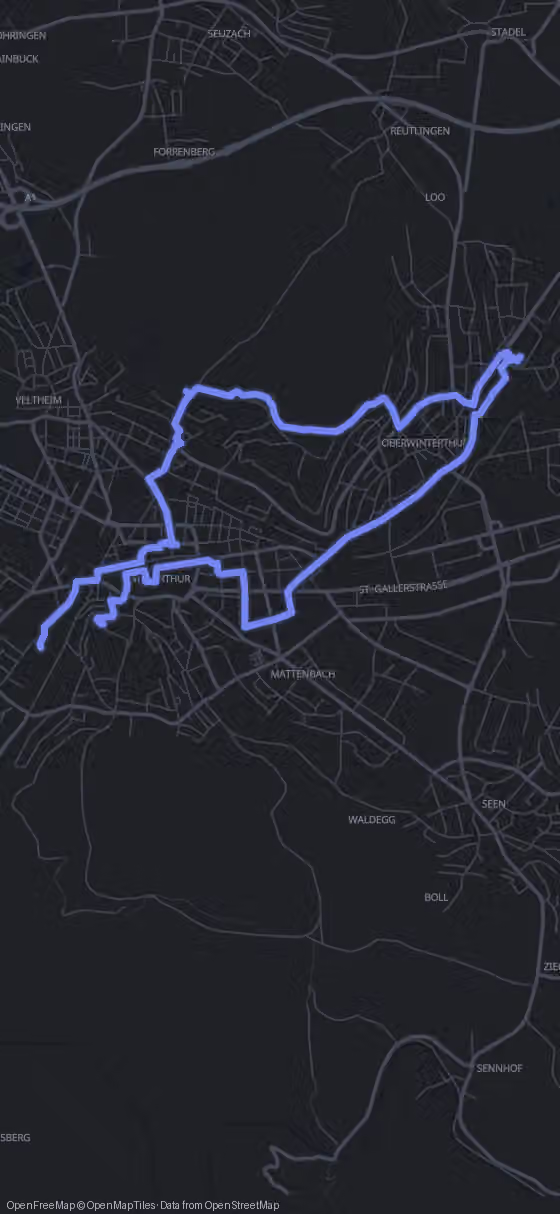
Route map for the Winterthur walking tour
Stop 1 of 12
1.2 km·15 min
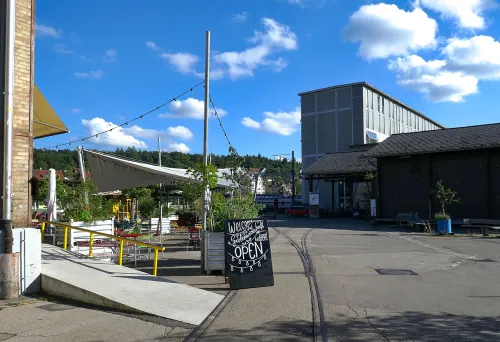
Lagerplatz
Head north-east toward the Stadtgarten
Welcome to Winterthur. I'm Alex, and one civic building here shares an architect with a famous German opera house.
Try this tour with Alex

This Winterthur Route at a Glance

Twelve stops lead from Lagerplatz, the old Sulzer works, through the museum quarter and the Altstadt Winterthur to the Rosengarten on the Heiligberg. The route is 11.4 km with 2 h 43 min of pure walking; with two museum visits, plan a full day.

Parks, squares, the old town and the Stadthaus are free; the six collections charge admission. Route, map and GPS navigation in the browser cost nothing, and the AI Tour Guide is optional.

Open free GPS & optional AI Tour Guide
View of Winterthur

The Route

Walking Map of Winterthur: Lagerplatz to Rosengarten

12 stops 11.4 km 2 h 43 min walking
Tap to load interactive map

The 12 stops along this route

  1. Lagerplatz in Winterthur, stop 1 on the self-guided walking tour
    1Lagerplatz
  2. Stadtgarten in Winterthur, stop 2 on the self-guided walking tour
    2Stadtgarten
  3. Kunstmuseum Winterthur, stop 3 on the self-guided walking tour
    3Kunstmuseum Winterthur
  4. Stadthaus in Winterthur, stop 4 on the self-guided walking tour
    4Stadthaus
  5. Oskar Reinhart Collection Am Roemerholz in Winterthur, stop 5 on the self-guided walking tour
    5Oskar Reinhart Collection Am Roemerholz
  6. Swiss Science Center Technorama in Winterthur, stop 6 on the self-guided walking tour
    6Swiss Science Center Technorama
  7. Fotomuseum Winterthur, stop 7 on the self-guided walking tour
    7Fotomuseum Winterthur
  8. Museum Lindengut in Winterthur, stop 8 on the self-guided walking tour
    8Museum Lindengut
  9. Gewerbemuseum Winterthur, stop 9 on the self-guided walking tour
    9Gewerbemuseum Winterthur
  10. Altstadt Winterthur, stop 10 on the self-guided walking tour
    10Altstadt Winterthur
  11. 11Kellerhof
  12. Rosengarten in Winterthur, stop 12 on the self-guided walking tour
    12Rosengarten
  13. That's the full route.

    Walk it with an AI Tour Guide talking you through every one of these streets.

    Start free in your browser
    You made it

Your Winterthur Walking Tour, From Works Yard to Heiligberg

  1. 1

    Lagerplatz

    Lagerplatz in Winterthur, stop 1 on the self-guided walking tour

    Winterthur grew rich on machines, and this is where the machines stood. Lagerplatz is the former Sulzer industrial site, and the halls that once held heavy industry now house businesses, museums and restaurants. The ground between them is public: no gate, no ticket, open around the clock. Walk in and take in the scale of the buildings first, their height and their width, made for work far heavier than anything going on inside them today.

    The city decided these halls were too good to tear down, and that decision is the thread of this whole walk. A factory town about twenty minutes by train from Zurich turned itself into a city with an unusual number of museums. Six of the eleven stops still ahead hold collections: art, photography, design, science and local history.

    Keep the Sulzer name in mind. It turns up again in the Stadtgarten, where the family once had a private garden, and at the Römerholz villa, which was built for a Sulzer industrialist before an art collector moved in. Nothing at Lagerplatz needs a ticket, and the individual businesses keep their own hours, so don't buy anything yet and don't feel you have to linger.

    From Lagerplatz it is 1210 m, about 17 minutes on foot, to the Stadtgarten, the green edge of the old town and the start of the museum quarter.
    Hours
    Open 24/7
    Price
    Free
  2. 2

    Stadtgarten

    Stadtgarten in Winterthur, stop 2 on the self-guided walking tour

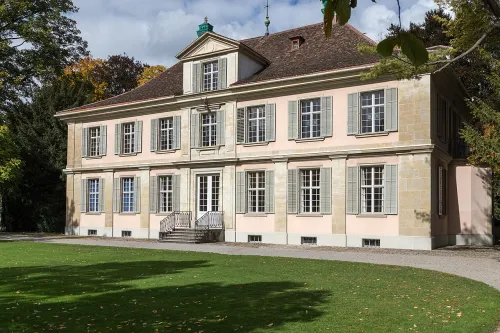
    The Stadtgarten is the most central park in Winterthur, about 22,743 square metres right next to the Altstadt and part of the green belt that wraps around the historic centre. Gravel paths run between wide lawns, loosely planted trees and flower beds; only along Museumstrasse is the planting deliberately thicker, to screen the park from the street. The centrepiece is a long water basin, and there is a playground as well.

    Look for the small baroque house that splits off a corner of the park. It is the Haus zum Balustergarten, built in 1740 and known locally as the «Barockhäuschen». It is the last reminder of what this ground used to be: land outside the city walls where wealthy Winterthur families laid out private pleasure gardens to get away from the crowded town.

    Once the walls and gates had been pulled down, the city bought the garden plots of the Sulzer and Busch families, mainly to keep the land out of the hands of speculators, and held it as a building reserve. In 1899 the local tourism and beautification society suggested turning the two former gardens into a public park, and that is what you are standing in.

    Tree lovers should take a slow lap: the park has some rarer species, including giant sequoias, a cut-leaf beech, a sugar maple and an unusual horse chestnut. The Kunstmuseum Winterthur is just 200 m away, about 3 minutes.

    Hours
    Open 24/7
    Price
    Free
  3. 3

    Kunstmuseum Winterthur

    Kunstmuseum Winterthur, stop 3 on the self-guided walking tour

    The Kunstmuseum Winterthur is run by the local Kunstverein, the art society, and from the very beginning it collected the art of its own time: first Impressionism, then Post-Impressionism and especially the Nabis, and later works by artists such as Richard Hamilton, Mario Merz and Gerhard Richter. Today the museum spreads across three buildings: Beim Stadthaus, Reinhart am Stadtgarten and Villa Flora.

    The main building, Beim Stadthaus, was designed by the architects Rittmeyer & Furrer in 1915. In 1995 the firm Gigon/Guyer added a modernist extension of about 1000 square metres, and the contrast between the two is worth a look from outside even if you don't go in. The same building also holds Winterthur's natural history museum.

    Inside, Impressionism and Post-Impressionism remain the heart of the collection. Look out for Claude Monet's «Low Tide» from 1882, Alfred Sisley's «Under Hampton Court Bridge», Paul Cézanne's horse chestnuts at Jas de Bouffan and Vincent van Gogh's «Dandelions» from 1889. A sculpture gallery has works by Eugène Delacroix and Alberto Giacometti, and the Cubism rooms show Picasso, Mondrian and Gris alongside one of the most important European collections of Fernand Léger. Later work runs from Mark Tobey and Ellsworth Kelly to Brice Marden, Andro Wekua and Pia Fries.

    Admission is charged. If you choose only one art interior on this walk and love the Impressionists, this is a strong candidate. The Stadthaus is right next door, 90 m and about 2 minutes away.

    Hours
    At the Stadthaus (Museumstrasse 52): Tue 10:00–20:00, Wed–Sun 10:00–17:00, Mon closed; Reinhart am Stadtgarten (Stadthausstrasse 6): Tue–Sun 10:00–17:00, Thu 10:00–20:00, Mon closed
    Price
    CHF 18 regular (single admission 1 site), CHF 15 reduced, CHF 9 KulturLegi; total ticket all sites CHF 26 / 19 / 13; up to 16 free
    Website
    kmw.ch ↗
  4. 4

    Stadthaus

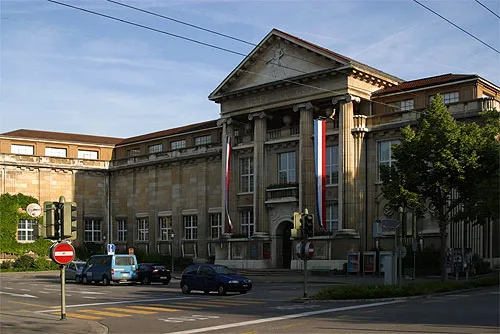
    Stadthaus in Winterthur, stop 4 on the self-guided walking tour

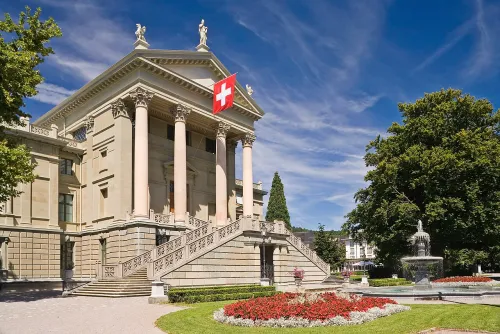
    This monumental sandstone building is one of the most important works of the architect Gottfried Semper and is counted among the outstanding buildings of historicism in Switzerland. The centre section is modelled on a Corinthian temple with four columns, set on a rusticated ground floor. In front, the classicist Stadthaus fountain on the forecourt was added in 1871 by the city architect Karl Wilhelm Bareiss.

    Winterthur, then governed by the Democrats, decided in 1863 to build a grand town hall. Semper's design went up in the second half of the 1860s and was completed in 1869, and on 30 October 1870 the first citizens' assembly met in what is now the concert hall. Semper also had to make his building fit in with neighbours already standing on Stadthausstrasse, the old town schoolhouse and the boys' grammar school that later became a Reinhart museum.

    Look up at the gables. On the south side stands Nemesis, here called Vitodura, goddess of justice and Winterthur's patron; on the north gable Athena, goddess of wisdom, each flanked by two griffins. The original figures did not stand up to the weather and were taken down for safety in 1915. When Leberecht Völki extended the building in the early 1930s, adding two more window bays, they were not replaced. Only after the facade renovation were new figures lifted back into place, in 2005 and 2007.

    Until 2015 the city council governed from here, and the city archive and chancellery are still inside. The former assembly hall has served as a concert hall since 1934 and hosts the Musikkollegium Winterthur orchestra, so the best way to see the interior is a concert. Looking at the building costs nothing. Next comes a longer walk: 1390 m, about 22 minutes, to the Oskar Reinhart Collection Am Roemerholz.

    Hours
    Mon–Wed: 08:00–17:00 | Thu: 08:00–18:30 | Fri: 08:00–16:00
    Price
    Free
  5. 5

    Oskar Reinhart Collection Am Roemerholz

    Oskar Reinhart Collection Am Roemerholz in Winterthur, stop 5 on the self-guided walking tour

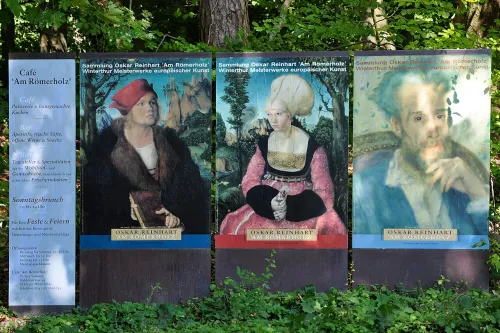
    The villa you are walking towards was built between the wars of industry and art. The Geneva architect Maurice Turrettini designed it for the industrialist Henri Sulzer-Ziegler, and it was finished in 1915. In 1924 Oskar Reinhart bought it, the same year he left business to collect full time. Today the Sammlung Oskar Reinhart «Am Römerholz» belongs to the Swiss federal government and is run under the Federal Office of Culture.

    Reinhart came from a wealthy merchant family. His father Theodor supported Swiss artists and his older brother Georg had started a collection of his own. Oskar joined the family trading firm Gebrüder Volkart at 18, and his work trips abroad let him visit nearly every major museum in Europe and many private collections. A key moment was probably the 1906 Berlin exhibition of German art from 1775 to 1875, which shaped everything he bought afterwards, from French painting and above all the Impressionists to German, Austrian and Swiss artists.

    He collected for the quality of a single picture, not for famous names. The best story is Édouard Manet's «In the Café»: Reinhart admired it in 1923 in Otto Gerstenberg's collection in Berlin and waited thirty years, until 1953, to buy it. Look for it inside.

    Admission is charged, and the visit rewards anyone who likes a collection shaped by one person's eye in the house where it was assembled. Then comes the longest leg of the route: 3280 m, about 45 minutes, to the Swiss Science Center Technorama.

    Local name
    Sammlung Oskar Reinhart «Am Römerholz»
    Hours
    Mon: Closed | Tue: 10:00–17:00 | Wed: 10:00–20:00 | Thu–Sun: 10:00–17:00
    Price
    CHF 18 adults, CHF 15 reduced, CHF 7.50 KulturLegi; up to 16 free; Wed 17:00-20:00 free admission for individuals
  6. 6

    Swiss Science Center Technorama

    Swiss Science Center Technorama in Winterthur, stop 6 on the self-guided walking tour

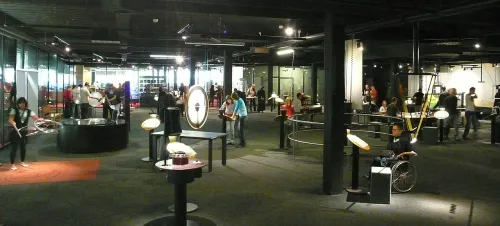
    After a morning of paintings, the Technorama asks you to touch everything. Its roots go back to 1947, when an association set out to found a Swiss technical museum, collecting objects from the industrial companies of the Winterthur, Zurich and Baden region. A foundation followed in 1969, and the first exhibition opened in 1982 as a conventional technology museum with walls of text and audiovisual explanation.

    The turn came in 1990, when director Remo Besio wrote a new mission inspired by the leading science centers of Britain and the United States, among them the Exploratorium in San Francisco, and by the ideas of Frank Oppenheimer, Richard Gregory and Hugo Kükelhaus. By 2000 the museum had become a science center where you explore natural phenomena by experimenting yourself. The laboratory area was expanded in a 2012 remodel.

    It works: in 2024 the Technorama set a visitor record of 372,932, including 63,370 school pupils, more than 70 percent of them from Swiss schools. Children of preschool age are among its regular visitors too.

    This is the steepest ticket on the route, and it only makes sense if you give it real time; with kids or a curious mind it can be the highlight of the day. If you are here for art and history, walk on. From the Technorama it is 3020 m, about 41 minutes, back to the Fotomuseum Winterthur.

    Hours
    Daily: 10:00–17:00
    Price
    CHF 34
  7. 7

    Fotomuseum Winterthur

    Fotomuseum Winterthur, stop 7 on the self-guided walking tour

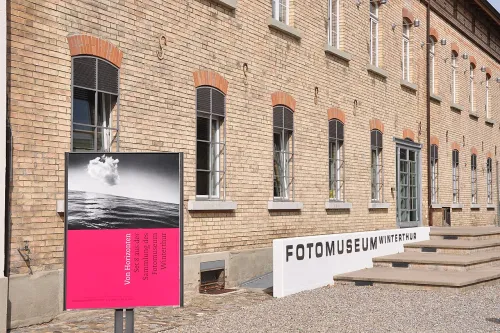
    The Reinhart family story continues here. The Fotomuseum Winterthur was founded in 1993 by the photographer George Reinhart, nephew of the art collector Oskar Reinhart whose villa you saw earlier.

    The museum looks at photography three ways: as an art form shown through contemporary photographers and artists, as the work of 19th and 20th century masters, and as a document of how photography is used in industry, architecture, fashion and more. Past exhibitions have covered police photography, industrial photography, dam construction and medical images, which gives the place a sharper, stranger edge than a typical gallery.

    Since autumn 2003 it has formed a Center of Photography together with the Fotostiftung Schweiz, in two buildings facing each other across Grüzenstrasse. A redevelopment closed the exhibition rooms at Grüzenstrasse 44 in 2023; the expanded complex now has about 1000 square metres of exhibition space, with changing exhibitions in the existing building and the collection of contemporary photography in the new one, along with a library, a shop and the bistro «George».

    Admission is charged, with a combined ticket for the Fotostiftung across the street. Choose it if photography or the visual history of work and industry interests you. Museum Lindengut is 770 m away, about 10 minutes.

    Hours
    Mon: Closed | Tue: 11:00–17:00 | Wed: 11:00–20:00 | Thu–Fri: 11:00–17:00 | Sat–Sun: 11:00–18:00
    Price
    CHF 14 adults, CHF 12 reduced (combi with Fotostiftung CHF 19 / 16); up to 16 free; Wed 17:00-20:00 free admission
  8. 8

    Museum Lindengut

    Museum Lindengut in Winterthur, stop 8 on the self-guided walking tour

    Museum Lindengut is the local history and domestic culture collection in the Villa Lindengut, run by the Historical Society Winterthur rather than by the city, and you can feel it: period rooms and city history, the kind of museum a place keeps for itself.

    It has the lowest admission on the route, but its opening days are the most limited, so check before you count on it. If the door is shut when you pass, don't rearrange your day around it. The villa's park is public and free, and a short wander through it is reason enough to come this way.

    The Gewerbemuseum Winterthur is 500 m away, about 7 minutes, at the edge of the old town.

    Hours
    Mon: Closed | Tue–Thu: 14:00–17:00 | Fri: Closed | Sat: 14:00–17:00 | Sun: 10:00–12:00, 14:00–17:00
    Price
    CHF 5
  9. 9

    Gewerbemuseum Winterthur

    Gewerbemuseum Winterthur, stop 9 on the self-guided walking tour

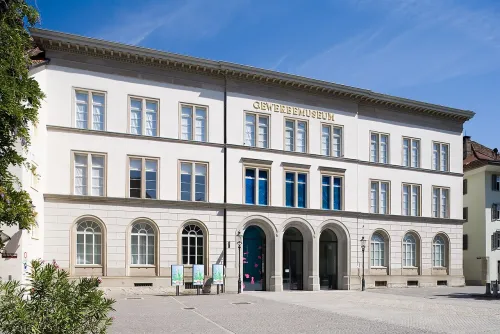
    The Gewerbemuseum is a city museum founded in 1874 and opened in 1875, dealing with design, art and society as well as materials, production and craft. By its own account it is the last museum of its kind in Switzerland. The building is protected as a regional monument, and the Uhrenmuseum Winterthur, the clock museum, shares the same house.

    Its founding is a small Winterthur against Zurich story. In February 1874 a conference of eastern Swiss cantons picked Winterthur for a museum of this type because the Technikum, a technical college, had just opened here. Zurich then applied to the cantonal government, pointing to its status as the capital. When the government took its time, Winterthur's city council simply decided on its own in August 1874, and the citizens confirmed it on 4 October. Zurich answered by founding its own arts and crafts museum, today's Museum für Gestaltung, and the two have been rivals ever since.

    The first home was the old granary at the Untertor, with a reading room and one exhibition room. The first director, Johann Jakob Schäppi, left in 1877; his successor, a chemist from Aargau, lost his job two years later to budget cuts. In 1879 the museum moved into an annex of the Technikum, where students used it heavily.

    Admission is charged, and it suits anyone interested in design and how things are made, with clocks as a bonus. From here it is only 100 m, about a minute, into the Altstadt Winterthur.

    Hours
    Mon: Closed | Tue–Wed: 10:00–17:00 | Thu: 10:00–20:00 | Fri–Sun: 10:00–17:00
    Price
    CHF 12
  10. 10

    Altstadt Winterthur

    Altstadt Winterthur, stop 10 on the self-guided walking tour

    The historic core of Winterthur is protected as a whole and listed as a cultural property of national importance, ringed by the green belt you have been walking along. The entire old town counts as an archaeological site, and rescue excavations take place regularly whenever there is building work.

    Walk the lanes without a plan. This is the cultural centre of the city, with plenty of restaurants, bars and pubs, and it is where Winterthur celebrates. At the end of July the Albanifest, billed as the largest old town festival in Europe, fills these streets; a month later the Winterthurer Musikfestwochen bring two and a half weeks of concerts to the Steinberggasse. Through the rest of the year come special markets and festivals, from Fasnacht in February and the Afro-Pfingsten festival at the end of May to a three week Christmas market in December.

    Two schools still sit within the quarter, among them the Altstadt primary school from 1864 on the corner of Stadthausstrasse and Lindstrasse, the same building Semper's Stadthaus had to fit in with. The old town is free and open at all hours. The Kellerhof at Marktgasse 53 is 190 m away, about 3 minutes.

    Hours
    Open 24/7
    Price
    Free
  11. 11

    Kellerhof

    Marktgasse 53, and a doorway most people walk past. The Kellerhof is the courtyard and passage of the Altes Stadthaus, a classicist building that also houses the Kellertheater, and the yard behind the door is public at any hour.

    Note the name: this is the old Stadthaus, not Semper's Stadthaus from earlier in the walk. Two different buildings with confusingly similar names is a very Winterthur problem, and now you can tell them apart.

    This is a walk through, not a visit. Go in, look around the yard and come out the other side. The last leg starts almost immediately: 660 m, about 11 minutes, climbing onto the Heiligberg to the Rosengarten.

    Hours
    Open 24/7
    Price
    Free
  12. 12

    Rosengarten

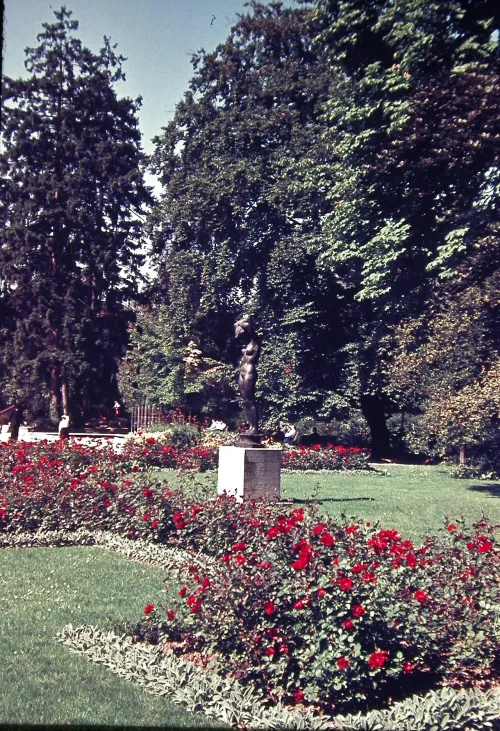
    Rosengarten in Winterthur, stop 12 on the self-guided walking tour

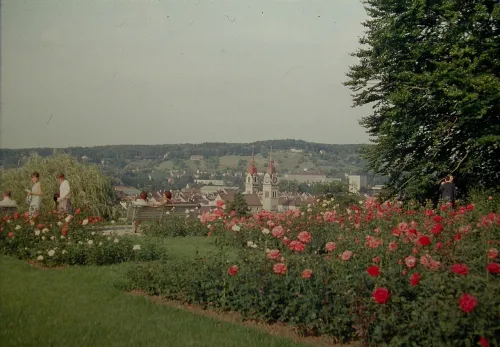
    The final leg is short and it climbs onto the Heiligberg. At the top waits the Rosengarten, a public park with a view over the city, no gate and no closing time. However long your day has been, this is where it was heading all along.

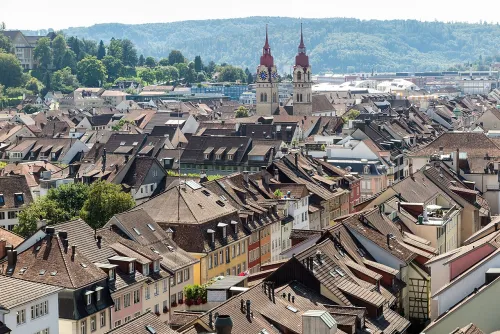
    Turn around and read the map in the roofs: the lanes of the Altstadt, the museums strung out behind them, the line you have walked since the Sulzer works. It is a rose garden by name and by planting, so come between late spring and midsummer if you want the roses in bloom.

    The route does not loop back to Lagerplatz; it ends here on purpose. When you are ready, walk back down into the city you have just been looking at, or let the GPS navigation lead you back to the start.

    Hours
    Open 24/7
    Price
    Free
Walking tour route map of Winterthur Route loaded
LagerplatzStadtgartenKunstmuseum WinterthurStadthaus+8
All 12 stops are already on the map.
You just press start.
AI Tour Guide

You've read the route. Now walk it with a guide in your ear.

Press start wherever you are, even hundreds of kilometres from Winterthur, and the guide begins telling its stories right away. In the city, pick any of the 12 stops to start from: it leads you there, then talks with you the whole route, asking, listening, remembering, and shaping the tour around your answers.

12stops 11.4km 2 h 43 minwalking 13languages
▶Start the tour free

Free to start · Runs in your browser · No app, no download

Shorter Ways Through Winterthur

The full route is a long day. If you have less time or one clear interest, these two sections of it work well on their own.

Art morning: Lagerplatz to the Römerholz

Stops: 1, 2, 3, 4, 5

For painting lovers. You walk from the Sulzer works through the Stadtgarten to the Kunstmuseum and Semper's Stadthaus, then out to the Oskar Reinhart villa: 44 minutes of walking in total. Admission is charged at the Kunstmuseum and at the Römerholz; everything else is free.

Old town afternoon: Fotomuseum to Rosengarten

Stops: 7, 8, 9, 10, 11, 12

For a relaxed half day with photography, design and local history. The walking adds up to just 32 minutes, ending with the climb to the view. The Fotomuseum, Museum Lindengut and the Gewerbemuseum charge admission; the Altstadt, the Kellerhof and the Rosengarten are free.

How Long This Winterthur Tour Takes, Museums Included

Pure walking time is 2 h 43 min over 11.4 km. Most of the legs are short, but two are long: 45 minutes out to the Technorama and 41 minutes back into town to the Fotomuseum. Those two stretches are the price of including the science center.

Nobody visits six collections in one day and enjoys all of them. Choose two interiors, give each about an hour and a half, add short pauses at the free stops, and you are looking at a full day of around seven hours. The Technorama alone easily fills an afternoon, so on a Technorama day treat the rest as outdoor stops. The art morning takes about half a day with both museums; the old town afternoon about three hours with one or two interiors.

Before You Set Off in Winterthur

  • Start and finish: The recommended start is Lagerplatz and the walk ends at the Rosengarten on the Heiligberg. You can join at any stop, and the GPS navigation will lead you back to Lagerplatz from the end if you want it to.
  • Time of day: Start in the morning. The museums keep daytime hours, and an early start leaves room for the interiors you pick plus the evening view from the Rosengarten.
  • Admission: Six stops charge admission: the Kunstmuseum Winterthur, the Oskar Reinhart Collection Am Roemerholz, the Swiss Science Center Technorama, the Fotomuseum Winterthur, Museum Lindengut and the Gewerbemuseum Winterthur. Lagerplatz, the Stadtgarten, the Stadthaus, the Altstadt, the Kellerhof and the Rosengarten are free.
  • Choose before you go: Decide on your two or three interiors in advance. With 11.4 km on foot, a plan saves you from standing at a ticket desk wondering whether there is still time.
Walking tour route map of Winterthur
AI Tour Guide

Your guide is ready the moment you start walking.

Press start and a voice AI Tour Guide takes it from here: leading the route through Winterthur, telling the stories, and turning your walk into a real back-and-forth conversation. No app or download is needed; it runs in your browser.

12stops 11.4km 2 h 43 minwalking 13languages
▶Start the tour free

Free to start · Runs in your browser · No app, no download

What the AI Tour Guide Adds in Winterthur

This route is really one story told across twelve places: how the Sulzer family's factory town became a museum city. The AI Tour Guide follows that thread as a conversation. It greets you at Lagerplatz, tells the stories of each place, asks what caught your eye and remembers it, so if you light up at the Impressionists it can tie the Reinhart family together for you, or explain what the Nabis wanted to do differently, or what a works like Sulzer actually built. You can interrupt it at any time; the route stays the same.

A Real Conversation A voice AI Tour Guide greets you, leads the whole route, and tells the stories and facts as you walk, asking what you want to see and keeping a real conversation going. Not a recording you press play on.
Map Navigation Follow the route on the map and walk at your own pace. You choose where to start and when to move to the next stop.
Ask Anything Curious about a building you pass? Ask your AI Tour Guide on the spot and the conversation carries on.
13 Languages Switch language anytime. No separate tour needed.
Start free in your browser

Common Questions About Walking Winterthur

Can I visit several Kunstmuseum sites on one ticket?

Yes. Besides a single admission for one site, there is a total ticket that covers all sites of the Kunstmuseum Winterthur. It pays off if you want to see both the Beim Stadthaus building and Reinhart am Stadtgarten.

Is this walk good for children?

Parts of it very much are. The Technorama is built around hands-on experiments and a large share of its visitors are school pupils, and the Stadtgarten has a playground. Under 16s get in free at the Kunstmuseum, the Römerholz and the Fotomuseum. For young legs, the old town afternoon variant is the easier choice.

Can I do this as a day trip from Zurich?

Easily. Winterthur is about twenty minutes from Zurich by train, so a morning arrival leaves the whole day for the walk.

Is the Rosengarten worth the climb in winter?

Check the forecast first. Between October and February the Mittelland fog regularly covers the view over the city. On a clear day the climb is worth it in any season; the roses themselves bloom from late spring into midsummer.

Is the tour really free?

Yes. The whole tour is free: the route, the interactive map and the navigation cost you nothing. Only the voice AI Tour Guide is optional and paid: you test it with 100 free credits, then you pay either €5 per hour or €19.99 for this whole tour, with no time limit. Admission to 6 of the 12 stops is not included: Kunstmuseum Winterthur, Oskar Reinhart Collection Am Roemerholz, Swiss Science Center Technorama, Fotomuseum Winterthur, Museum Lindengut and Gewerbemuseum Winterthur charge their own entry fees.

Do I need to download an app?

No. Everything runs in your phone browser. Open the route and start walking, no download and no sign-up required.

Do I need to book the walking tour in advance?

No booking needed. This self-guided tour is available anytime. Open the route in your browser and start walking. The AI Tour Guide works instantly, no app, no reservation required.

What languages is the AI Tour Guide available in?

The AI Tour Guide speaks 13 languages, so you take the tour in your own language and can switch at any time.

Can I skip stops or change the route?

Yes. Skip any stop, spend extra time at places you like, or start the route from any point. It is your walk, you set the pace.
Image credits
▶ Start free in your browser Runs in your browser, no app, no download