

Rambla de la Llibertat
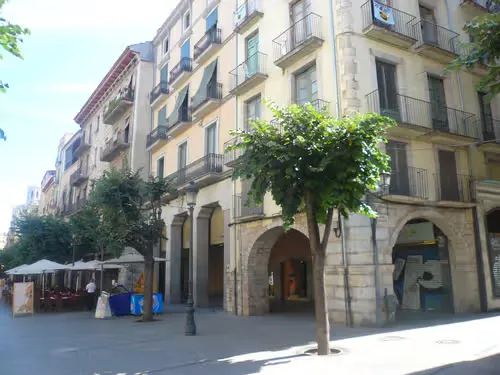
You begin on Girona's favourite promenade, running alongside the Onyar from close to the Pont de Pedra. Look at the east side first: the houses stand on public arcades at street level, some medieval, some neoclassical. Several façades still keep dressed stone and Gothic windows. At number 36, Can Casadevall, you can pick out a 14th-century window in florid Gothic style and a second one from the 15th century.
The name comes from a Liberty Tree planted here in 1869, during the democratic interlude Catalans call the Sexenni Democràtic. Long before that, this was the Plaça de les Cols, Girona's great market. People came from up to about 25 km away, from the Empordà and the Selva, and the fair of Sant Narcís drew visitors from all over Catalonia. On the river side, shops sold spices, sweets, wax and medicines.
The street took shape as an extension of the Argenteria. A narrow lane with arcades, the Voltes dels Esparters, once led on towards the bridge; it was probably built in the 14th century and torn down in 1875. In 1882 the first arcaded house got its neoclassical front and porches, part of a plan to renew all the medieval arcades that was never finished, which is why you still see both styles side by side.
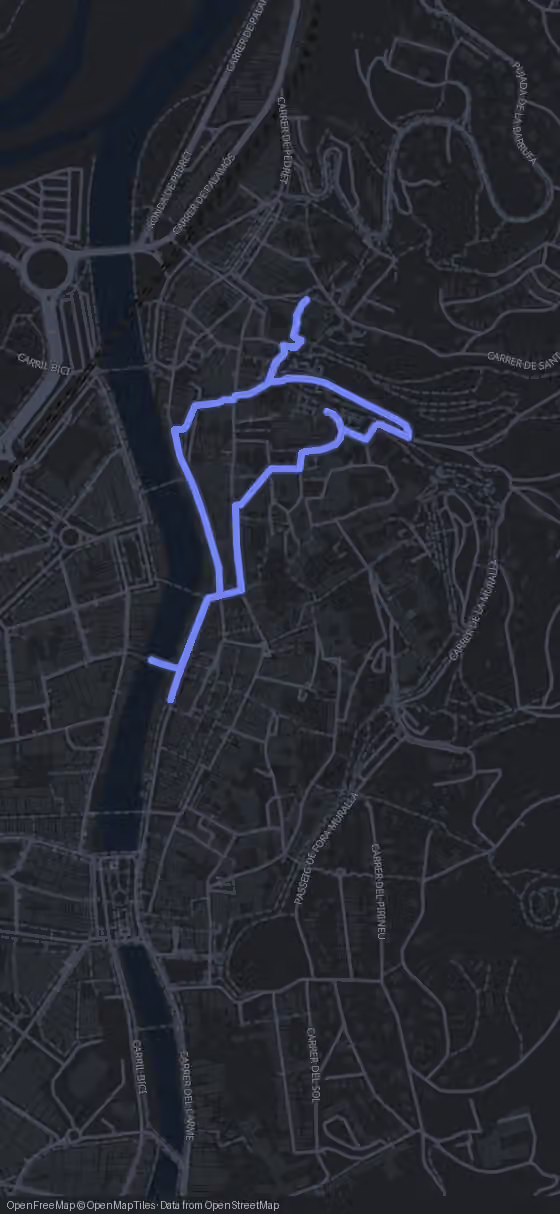
Locals still treat the Rambla as their meeting place: on Saturdays flower stalls go up, and a vermouth at one of the cafés is a fixed ritual. From here it is 410 m, about 6 min, uphill into the old town to the Basilica de Sant Feliu.