Free Walking Tour Bordeaux: Gates, Squares, Garonne

From Saint-Michel's free-standing spire to the Garonne, the great squares and two medieval city gates: eight stops on foot through Bordeaux.

8 Stops 4.8 km ~1 h 7 min walking
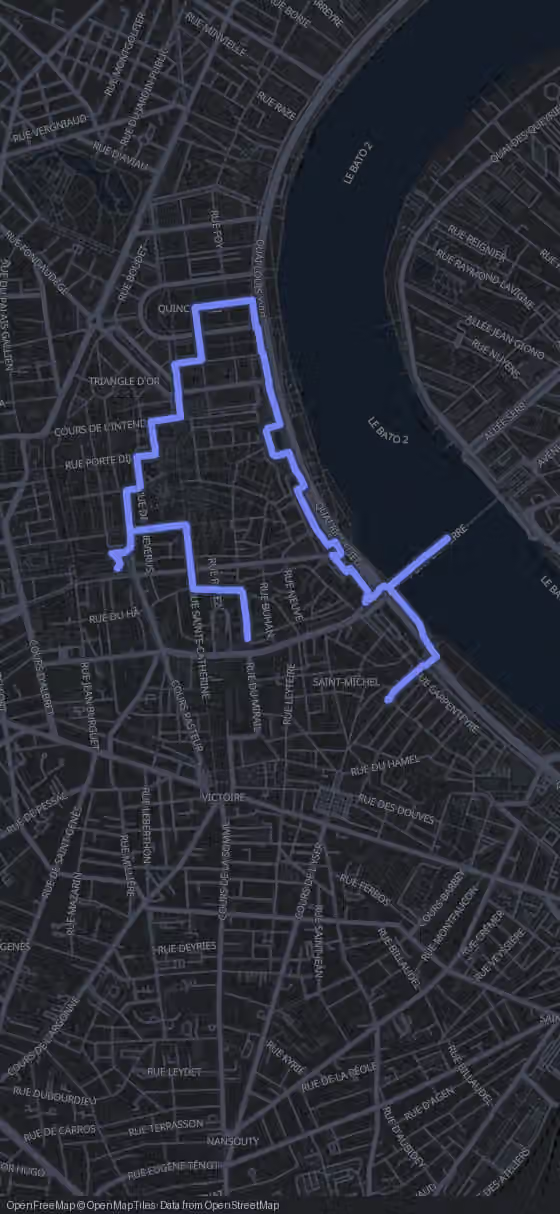
Route map for the Bordeaux walking tour
Stop 1 of 8
760 m·10 min
Basilique Saint-Michel
Head north along the riverbank toward the Pont de Pierre
Bonjour, welcome to Bordeaux. I’m Alex, and this city learned to protect its churches from sound itself.
Try this tour with Alex

This Bordeaux Route at a Glance

Eight stops lead from the Basilique Saint-Michel to the Grosse Cloche: 4.8 km and 1 h 7 min of pure walking. With the interiors worth seeing, plan on about 3 h 45 min.

The squares, the bridge and Saint-Michel cost nothing. Tickets apply at the Porte Cailhau, for the tower at the Cathédrale Saint-André & Tour Pey-Berland and at the Grosse Cloche. The GPS route runs free in your browser; the AI Tour Guide is optional.

Open free GPS & optional AI Tour Guide
This short shows highlights of the route. All 8 stops follow below.

The Route

Walking Map of Bordeaux: Saint-Michel to the Grosse Cloche

8 stops 4.8 km 1 h 7 min walking
Tap to load interactive map

The 8 stops along this route

  1. Basilique Saint-Michel in Bordeaux, stop 1 on the self-guided walking tour
    1Basilique Saint-Michel
  2. Pont de Pierre in Bordeaux, stop 2 on the self-guided walking tour
    2Pont de Pierre
  3. Porte Cailhau in Bordeaux, stop 3 on the self-guided walking tour
    3Porte Cailhau
  4. Place de la Bourse & Miroir d'Eau in Bordeaux, stop 4 on the self-guided walking tour
    4Place de la Bourse & Miroir d'Eau
  5. Place des Quinconces in Bordeaux, stop 5 on the self-guided walking tour
    5Place des Quinconces
  6. Grand Théâtre in Bordeaux, stop 6 on the self-guided walking tour
    6Grand Théâtre
  7. Cathédrale Saint-André & Tour Pey-Berland in Bordeaux, stop 7 on the self-guided walking tour
    7Cathédrale Saint-André & Tour Pey-Berland
  8. Grosse Cloche in Bordeaux, stop 8 on the self-guided walking tour
    8Grosse Cloche
  9. That's the full route.

    Walk it with an AI Tour Guide talking you through every one of these streets.

    Start free in your browser
    You made it

Your Bordeaux Walking Tour: Eight Stops in Order

  1. 1

    Basilique Saint-Michel

    Basilique Saint-Michel in Bordeaux, stop 1 on the self-guided walking tour

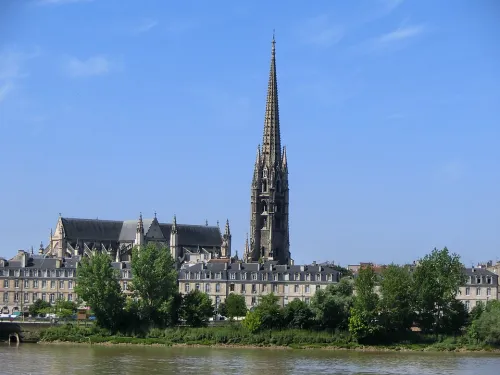
    Start by tilting your head back. The bell tower of the Basilique Saint-Michel stands apart from the church, a free-standing campanile that rises 114 metres. In France only the spires of Rouen, Strasbourg and Chartres cathedrals reach higher, and nothing in the south of the country tops it. Bordeaux has just one other church with a detached bell tower: the cathedral you reach later on this walk.

    The church itself is Flamboyant Gothic, built between the 14th and 16th centuries, and it gave the whole quarter its name. Work began around 1330 in a district of merchants and craftsmen, carpenters and coopers among them, then crawled through the Hundred Years' War, the plague of 1348 and repeated floods. The hall church only stood by 1430, after which the parish had the central nave raised to follow the fashion of the day. Louis XI, who had placed his kingdom under the protection of the Archangel Michael, visited in 1462 and left generous gifts.

    The base of the tower holds a crypt with a strange past. For a long time it served as an ossuary, and later as a showroom for 'mummies' dug up in the 19th century when the old parish cemetery was turned into today's Place Meynard. Listed as a historic monument in 1846 and made a minor basilica in 1903, Saint-Michel has belonged to the UNESCO World Heritage listing of the Routes of Santiago de Compostela in France since 1998.

    Going inside is free, so give the nave twenty minutes even if churches are not usually your thing. From here it is 760 m, about 11 minutes, to the river and the Pont de Pierre.
    Hours
    Daily: 09:00–19:00
    Price
    Free
  2. 2

    Pont de Pierre

    Pont de Pierre in Bordeaux, stop 2 on the self-guided walking tour

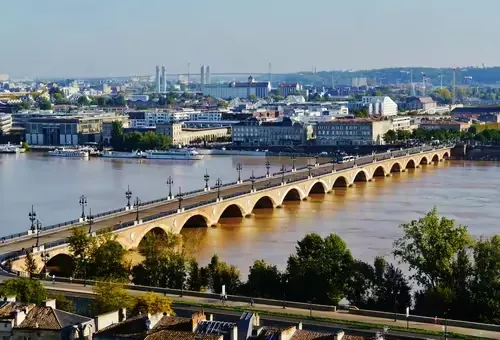
    The Pont de Pierre spans the Garonne and ties the city centre to La Bastide on the right bank. Count the arches: there are 17, resting on 16 piers, over 487 metres of stone and brick. What you cannot see from the bank is that the structure is not solid; it hides hollow spaces inside.

    Work began in 1810 under Napoleon I and ended in 1822 under Louis XVIII. The engineers Claude Deschamps and Jean-Baptiste Basilide Billaudel designed it, and 4,000 workers built it. Originally 14.6 metres wide, it was widened to 19 metres in 1954.

    You may hear that the 17 arches stand for the 17 letters of 'Napoléon Bonaparte'. It is a good story and it is not true. The plan called for 19 arches, and two were dropped in 1819 for reasons of budget and design.

    The money is the more interesting tale. The bridge cost 6.5 million francs, and when funds ran short the Bordeaux merchant Pierre Balguerie-Stuttenberg set up a bridge company in 1818 to raise two million privately. In return, the company collected a toll. The city bought that right back in 1863, and on 1 January 1865 La Bastide became part of Bordeaux. The bridge has been a listed monument since 2002.

    Walking out onto it is free at any hour. Then head 770 m, about 10 minutes, to the Porte Cailhau.

    Hours
    Freely accessible, no opening hours (public bridge)
    Price
    Free
  3. 3

    Porte Cailhau

    Porte Cailhau in Bordeaux, stop 3 on the self-guided walking tour

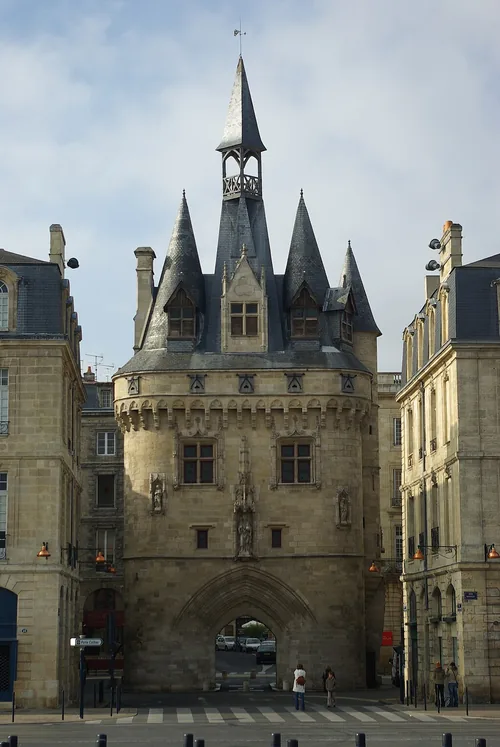
    The Porte Cailhau was both a defensive gate and a triumphal arch, and you can read both roles in the stone: a fortified tower with a niche made for the king. For centuries this was the main way into the city from the port, and it opened onto the Palais de l'Ombrière, home of the dukes of Guyenne and, from 1462, seat of the Parliament of Bordeaux.

    Picture the riverbank without its upright quays. The bank sloped gently into the water, and light boats ferried goods from the ships anchored in the river. The stretch in front of the gate was the first quay in town to be paved with river pebbles, which is where the name comes from: calhau means pebble in Gascon. It is also the name of the Cailhau family, powerful burghers who lived near the palace and gave the city several mayors in the 13th and 14th centuries.

    The first gate sat in the 14th-century wall. The one you see replaced it closer to the river between 1493 and 1496. As it neared completion, Charles VIII won the battle of Fornovo in 1495, with Bordeaux's archbishop André d'Espinay leading a local contingent. So the city magistrates dedicated the gate to the king and gave it his white marble statue holding globe and sceptre, flanked by the cardinal and Saint John the Baptist.

    The ticket gets you inside the gate, worth it if medieval Bordeaux is why you came. The Place de la Bourse is just 380 m away, about 5 minutes.

    Hours
    Apr–Oct: daily 10:00–13:00 & 14:00–18:00 | Nov–March: Wed–Fri 14:00–18:00, Sat–Sun 11:00–13:00 & 14:00–18:00 (closed 25.12 and 01.01); midday closure 13:00–14:00; last admission 30 min before closing
    Price
    5 EUR (adults); children under 12 accompanied free; 2 EUR with youth card; free every 1st Sunday of the month (except July/August)
  4. 4

    Place de la Bourse & Miroir d'Eau

    Place de la Bourse & Miroir d'Eau in Bordeaux, stop 4 on the self-guided walking tour

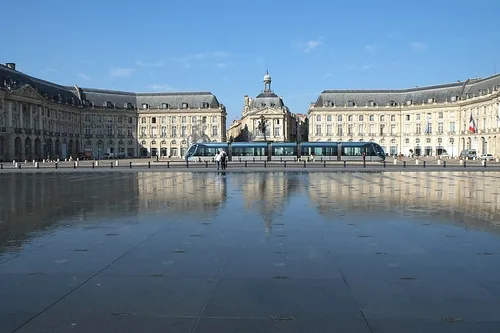
    The Place de la Bourse was the first open square in the history of French town planning: instead of being enclosed on four sides, it opens onto the river. Two symmetrical pavilions frame it, the Palais de la Bourse and the Hôtel des Douanes, and both still do what they were built for, housing the chamber of commerce and the customs administration.

    The idea came from Claude Boucher, appointed intendant by Louis XV in 1720, who wanted to modernise the city and give it a welcoming face for anyone arriving from the right bank. To make room, 21 houses and 10 shops were torn down along with 150 metres of crumbling city wall: the first breach in the medieval ramparts. The royal architects Jacques Gabriel and his son Ange-Jacques Gabriel built the square between 1730 and 1755.

    It was designed as a setting for an equestrian statue of Louis XV, inaugurated in 1743, and its name followed every change of regime: Place Royale, then Place de la Liberté in the Revolution, Place Impériale under Napoleon, Royale again with the Restoration, and finally Place de la Bourse after Louis-Philippe fell in 1848.

    Look towards the water and imagine the terrace as a balcony over some 400 ships at anchor. It stands on pine piles 40 cm thick and juts out 150 metres long and 20 metres wide. The square and the Miroir d'Eau are open at all hours and free. Next comes the Place des Quinconces, 740 m and about 10 minutes away.

    Hours
    Freely accessible, no opening hours (public square)
    Price
    Free
  5. 5

    Place des Quinconces

    Place des Quinconces in Bordeaux, stop 5 on the self-guided walking tour

    The Place des Quinconces covers about 25.6 hectares, which puts it among the largest city squares in Europe. Its size has a military origin: it was laid out on the site of the Château Trompette, a fortress meant to keep Bordeaux from rebelling, its guns turned towards the city centre rather than outwards. The present shape, a long rectangle rounded off by a semicircle, was fixed in 1816, and the trees planted in quincunx patterns in 1818 gave the square its name.

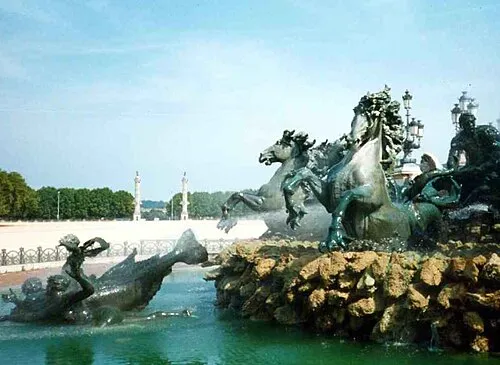
    Nearer the river stand two rostral columns, each 21 metres tall, put up in 1829: one stands for commerce, the other for navigation. The white marble statues of the two great local thinkers, Michel de Montaigne and Montesquieu, followed in 1858.

    The real showpiece is the 54-metre Monument aux Girondins, built between 1894 and 1902 in memory of the Girondins who died in the Terror of the French Revolution. Bronze horses and figures rise from two basins, and at the top Liberty breaks her chains and holds the palm of victory. Just below her, on all four sides, look for the letter G and the crescents of the 'Port of the Moon', the old name for the curve of the river here. The side facing the Grand Théâtre shows the triumph of the Republic.

    The square is free and always open, and since 2003 it has been the city's main transport hub. Your next stop is that very Grand Théâtre, 540 m and about 8 minutes on.

    Hours
    Freely accessible, no opening hours (public square)
    Price
    Free
  6. 6

    Grand Théâtre

    Grand Théâtre in Bordeaux, stop 6 on the self-guided walking tour

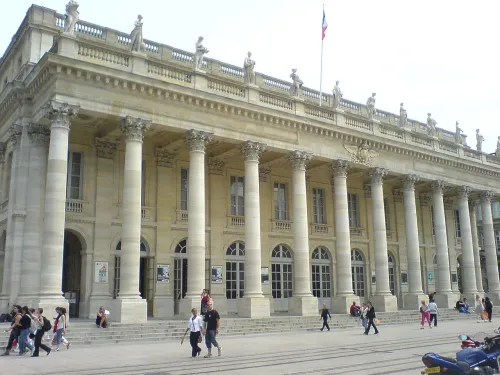
    The Grand Théâtre opened on 17 April 1780, designed by Victor Louis, who went on to build the galleries around the gardens of the Palais Royal in Paris. Its façade is a temple front: 12 colossal Corinthian columns carrying 12 statues of the nine Muses plus Juno, Venus and Minerva. Pierre-François Berruer carved four of them; his assistant Van den Drix made the rest from his models.

    Inside, the ceiling fresco by Jean-Baptiste-Claude Robin pays homage to the arts, to the craftsmen who built the house and to the city. It shows Bordeaux as a woman protected by Hermes and Athena, and in the foreground the three sources of the city's wealth as it saw them then: wine, sea trade and the enslaved. Look for it if you get in; it says a lot about where the money for this splendour came from.

    The stage has its own history. The ballet La Fille mal gardée premiered here in 1789, and a young Marius Petipa staged some of his first ballets here. In 1871 the building briefly hosted the French National Assembly. A restoration in 1991 brought back the original blue and gold, and it is one of the oldest wooden-frame opera houses in Europe never to have burned or been rebuilt. Today it is home to the Opéra National and the Ballet National de Bordeaux.

    On an ordinary day you admire the façade from outside. The theatre regularly holds a free open house, so if one falls on your day, add half an hour to your plan. Then walk 670 m, about 9 minutes, to the cathedral.

    Hours
    First Sunday of each month 14:00–18:00 (open house, free admission)
    Price
    Themed guided visits for families 5–8 EUR
  7. 7

    Cathédrale Saint-André & Tour Pey-Berland

    Cathédrale Saint-André & Tour Pey-Berland in Bordeaux, stop 7 on the self-guided walking tour

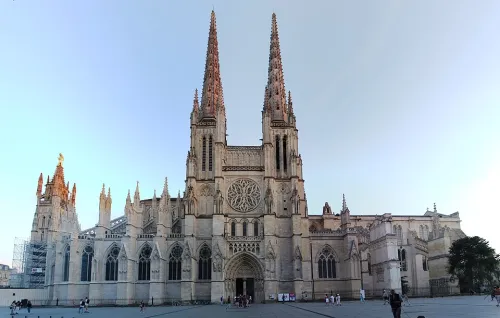
    The Cathédrale Saint-André is the seat of the Archbishop of Bordeaux, and like Saint-Michel it has a bell tower standing on its own, the Tour Pey-Berland. A church of Saint-André appears in documents as early as 814, and Pope Urban II formally consecrated it in 1096. Together with Saint-Michel and Saint-Seurin, it shares the UNESCO listing of the Santiago routes.

    In the 11th and 12th centuries the cathedral fought a long contest with nearby Saint-Seurin for the pilgrims heading to Compostela. Saint-Seurin had the stronger cards: the remains of companions of Saint James and Roland's hunting horn, said to have been placed there by Charlemagne. Yet Saint-André slowly gained the upper hand, became the leading church of Aquitaine and came to answer directly to Rome.

    Its most famous moment came on 25 July 1137, when 13-year-old Eleanor of Aquitaine married the future Louis VII here. A week later the king's father died and she was Queen of France. The marriage was annulled in 1152; that same year she married the future Henry II, became Queen of England in 1154 and was mother to Richard the Lionheart and King John.

    Plan about 45 minutes here if you want both the cathedral and the tower visit; the tower ticket is the paid part of the stop. An afternoon start suits this route. The last leg is the longest: 930 m, about 13 minutes, to the Grosse Cloche.

    Local name
    Cathédrale Saint-André de Bordeaux
    Hours
    Mon: 14:00–19:00 | Tue–Sat: 10:00–12:00, 14:00–19:00 | Sun: 09:30–12:00, 14:00–18:00
    Price
    Pey-Berland Tower 9 EUR; reduced 7.50 EUR; under 18 and EU residents aged 18–25 free
  8. 8

    Grosse Cloche

    Grosse Cloche in Bordeaux, stop 8 on the self-guided walking tour

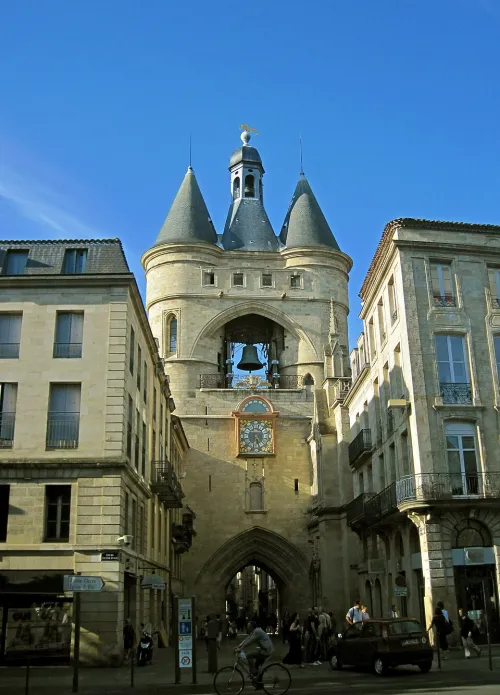
    The Grosse Cloche is a gate of the medieval wall that became the belfry of the old town hall. Two round towers, 40 metres tall, flank a central building crowned by a golden leopard. With the Porte Cailhau it is one of the very few civic buildings Bordeaux keeps from the Middle Ages, and it also goes by Porte Saint-Éloi, after the church built against it, or Porte Saint-James.

    That last name points to the pilgrims. The 15th-century gate stands on the remains of a 13th-century one, and pilgrims bound for Santiago passed beneath it. The nearby rue Saint-James carries the same memory: 'Saint James' is a French rendering of the Gascon Sant Jacme, Saint Jacques.

    The bell is the heart of the story. City magistrates rang it to announce the start of the grape harvest and to warn of fires, which is why it became the emblem of Bordeaux and still appears on the city's coat of arms. When the king wanted to punish the Bordelais, he took their bell away. Henri II did exactly that after the revolt of 1548, the Pitauds uprising, and had it broken; it only returned in 1561, to the joy of the townspeople.

    A ticket takes you inside; ask at the gate for the day's opening times, since you arrive late in the afternoon. This is where the walk ends, and the GPS navigation can lead you back to Saint-Michel if you want to close the loop.

    Price
    EUR 6
Walking tour route map of Bordeaux Route loaded
Basilique Saint-MichelPont de PierrePorte CailhauPlace de la Bourse & Miroir d'Eau+4
All 8 stops are already on the map.
You just press start.
AI Tour Guide

Read the route? Now walk it with a guide in your ear.

Press start wherever you are, even hundreds of kilometres from Bordeaux, and the guide begins telling its stories right away. In the city, pick any of the 8 stops to start from: it leads you there, then talks with you the whole route, asking, listening, remembering, and shaping the tour around your answers.

8stops 4.8km 1 h 7 minwalking 13languages
▶Start the tour free

Free to start · Runs in your browser · No app, no download

Shorter Ways to Walk Bordeaux

Short on time? The route splits neatly at the Place de la Bourse into a medieval half and a grand 18th and 19th century half.

Medieval Bordeaux and the river

Stops: 1, 2, 3, 4

For anyone who has a morning or a spare hour and a half: Saint-Michel, the bridge, the old harbour gate and the riverside square. 1.9 km and 26 minutes of walking; the Porte Cailhau is the only ticket. Allow about 1 h 45 min.

Grand squares, opera and cathedral

Stops: 4, 5, 6, 7, 8

For first-timers who want the showpieces: from the Place de la Bourse to the Quinconces, the Grand Théâtre, the cathedral and the Grosse Cloche. 2.9 km and 40 minutes of walking; tickets for the Tour Pey-Berland and the Grosse Cloche. Allow about 2 h 30 min, and start in the afternoon so the cathedral is open when you arrive.

How Long This Bordeaux Tour Takes, With and Without Tickets

Pure walking time is 1 h 7 min over 4.8 km, and the longest leg comes last: 930 m from the cathedral to the Grosse Cloche. Add twenty minutes inside Saint-Michel, about 25 at the Porte Cailhau, 45 for the cathedral and its tower, a quarter of an hour at the Grosse Cloche and short pauses on the squares and the bridge, and you land at roughly 3 h 45 min.

The timing that works: set off at 1:30 pm. You reach the Porte Cailhau at about 2:20 pm, the Place de la Bourse around 2:50 pm, the Grand Théâtre at about 3:45 pm and the cathedral at about 4 pm, and arrive at the Grosse Cloche shortly after 5 pm. An afternoon start also means the cathedral is open when you get there.

The medieval half alone takes about 1 h 45 min, the grand half from the Place de la Bourse about 2 h 30 min. Skip every interior and the full route shrinks to around two hours.

Before You Set Off in Bordeaux

  • Start: The recommended start is the Basilique Saint-Michel, but you can join at any stop. Arriving by tram? The Quinconces stop serves three tram lines and sits right on the route.
  • End: The walk finishes at the Grosse Cloche. The GPS navigation in your browser can lead you back to Saint-Michel if you want to close the loop.
  • Best time: Start in the early afternoon on any day, so the cathedral and the Porte Cailhau are open when you reach them.
  • Best day: Some days bring free entry at the Porte Cailhau and a free open house at the Grand Théâtre, so it pays to check before you pick your date.
  • Costs: The walk itself is free; only the three paid sights charge admission.
Walking tour route map of Bordeaux
AI Tour Guide

Your guide is ready whenever you start walking.

Press start and a voice AI Tour Guide takes it from here: leading the route through Bordeaux, telling the stories, and turning your walk into a real back-and-forth conversation. No app or download is needed; it runs in your browser.

8stops 4.8km 1 h 7 minwalking 13languages
▶Start the tour free

Free to start · Runs in your browser · No app, no download

What the AI Tour Guide Adds on This Route

This route is a walk through a port city's fortunes: a craftsmen's church, a bridge financed by a merchant, a square built to greet ships, an opera paid for by wine and trade. The AI Tour Guide leads you through it as a conversation. It greets you at Saint-Michel, tells each place's story, asks what you make of it and remembers whether you lean towards medieval gates, revolutions or music, then shifts its stories accordingly. Ask it what life was like for the coopers of Saint-Michel or how the Girondins fell, and cut in whenever you like. You start with 100 free credits; after that it is €19.99 for this tour all-inclusive with no time limit, or €5 per hour.

A Real Conversation A voice AI Tour Guide greets you, leads the whole route, and tells the stories and facts as you walk, asking what you want to see and keeping a real conversation going. Not a recording you press play on.
Map Navigation Follow the route on the map and walk at your own pace. You choose where to start and when to move to the next stop.
Ask Anything Curious about a building you pass? Ask your AI Tour Guide on the spot and the conversation carries on.
13 Languages Switch language anytime. No separate tour needed.
Start free in your browser

Common Questions About Walking Bordeaux

Can I visit the interiors on any day of the week?

Saint-Michel is the easiest to get into. The cathedral and the Porte Cailhau have shorter hours on some days, and the Porte Cailhau also changes with the season, so check before you set off.

Are there reduced tickets for children and young travellers?

Yes. Both the Porte Cailhau and the Tour Pey-Berland offer reduced tickets, and at both, children or young people can get in free.

Can I see the inside of the Grand Théâtre without a show ticket?

Yes, the theatre regularly opens its doors with free admission. There are also themed guided visits for families, for a fee.

Where can I walk next after Bordeaux?

If your trip continues south, there are self-guided routes in San Sebastián and Toulouse, both a little over 200 km away. Heading north, try Nantes.

Is the tour really free?

Yes. The whole tour is free: the route, the interactive map and the navigation cost you nothing. Only the voice AI Tour Guide is optional and paid: you test it with 100 free credits, then you pay either €5 per hour or €19.99 for this whole tour, with no time limit. Admission to 2 of the 8 stops is not included: Porte Cailhau and Grosse Cloche charge their own entry fees.

Do I need to download an app?

No. Everything runs in your phone browser. Open the route and start walking, no download and no sign-up required.

Do I need to book the walking tour in advance?

No booking needed. This self-guided tour is available anytime. Open the route in your browser and start walking. The AI Tour Guide works instantly, no app, no reservation required.

What languages is the AI Tour Guide available in?

The AI Tour Guide speaks 13 languages, so you take the tour in your own language and can switch at any time.

Can I skip stops or change the route?

Yes. Skip any stop, spend extra time at places you like, or start the route from any point. It is your walk, you set the pace.
Image credits
▶ Start free in your browser Runs in your browser, no app, no download