Free Walking Tour Collioure: Castle, Matisse and the Sea

Seven stops on 2.9 km, from a royal fortress past a windmill to a church whose bell tower was once a lighthouse, with Matisse's Collioure hanging along the streets.

7 Stops 2.9 km ~41 min walking
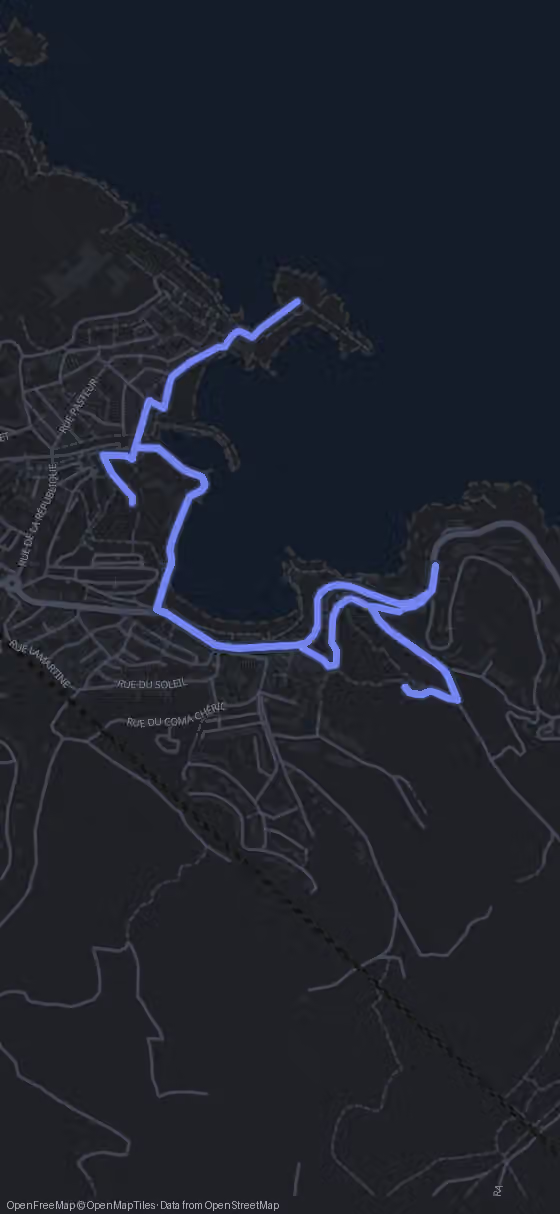
Route map for the Collioure walking tour
Stop 1 of 7
1200 m·15 min
Château Royal de Collioure
Head south-east and uphill toward the Moulin de Collioure
Bonjour, welcome to Collioure. I'm Alex, and even the church tower here once had a life at sea.
Try this tour with Alex

Collioure on Foot: The Route at a Glance

Seven stops on 2.9 km: from the Château Royal de Collioure up to the Moulin de Collioure, past the Musée d'Art Moderne de Collioure to the Port de Collioure, the Chemin du Fauvisme, the Église Notre-Dame-des-Anges and the Chapelle Saint-Vincent. Pure walking time is 41 minutes; with a castle visit, plan on about three hours.

Only the castle charges admission; every other stop is free. The GPS route in your browser costs nothing, and the AI Tour Guide can lead the walk as an optional extra.

Open free GPS & optional AI Tour Guide
This short shows highlights of the route. All 7 stops follow below.

The Route

Walking Map of Collioure, Castle to Jetty

7 stops 2.9 km 41 min walking
Tap to load interactive map

The 7 stops along this route

  1. Château Royal de Collioure, stop 1 on the self-guided walking tour
    1Château Royal de Collioure
  2. Moulin de Collioure, stop 2 on the self-guided walking tour
    2Moulin de Collioure
  3. Musée d'Art Moderne de Collioure, stop 3 on the self-guided walking tour
    3Musée d'Art Moderne de Collioure
  4. Port de Collioure, stop 4 on the self-guided walking tour
    4Port de Collioure
  5. 5Chemin du Fauvisme
  6. Église Notre-Dame-des-Anges in Collioure, stop 6 on the self-guided walking tour
    6Église Notre-Dame-des-Anges
  7. Chapelle Saint-Vincent in Collioure, stop 7 on the self-guided walking tour
    7Chapelle Saint-Vincent
  8. That's the full route.

    Walk it with an AI Tour Guide talking you through every one of these streets.

    Start free in your browser
    You made it

Your Collioure Walking Tour, from Fortress to Chapel

  1. 1

    Château Royal de Collioure

    Château Royal de Collioure, stop 1 on the self-guided walking tour

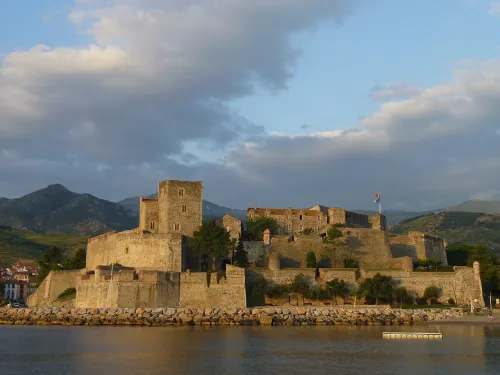
    You start at the Château Royal de Collioure, and the first thing to know is that you are not looking at one castle. The building is at least four castles fused together, each layer added by whoever held this stretch of coast at the time. A fortified site stood here as early as 673, when Wamba, king of the Visigoths, laid siege to the “Castellum Caucoliberi” to crush a rebellion.

    In the 12th century Girard II, the last independent count of Roussillon, left his lands to Alfons II, King of Aragon and Count of Barcelona. The Aragonese kings wanted Collioure to prosper: they granted privileges and tax exemptions, set up an annual fair and paid for works on the castle, the port and the town. The Knights Templar built a castle here around 1207, and in 1276 it was absorbed into the royal castle.

    Then came the Kings of Majorca, who added a second castle in the 13th and 14th centuries. Their realm reached from the Balearic Islands to Roussillon and Cerdanya, and their court never stayed put: it travelled between residences, from Palma to Collioure. The massive walls you see today belong to a later age. Charles V and his son Philip II turned the castle into a modern 16th-century fortress built to resist artillery, reinforcing its defences and everything around it. Even so, it became a prize in the wars between Habsburg Spain and Bourbon France, and in 1642 the troops of Louis XIII besieged Collioure and the Château Royal.

    Is it worth going in? If you want to understand why this small port looks the way it does, yes: it is the only paid stop on the route, and it explains the history behind everything that follows.

    From the gate you face the longest leg of the walk: 1200 m and about 19 minutes up to the windmill, passing La Gloriette on the way.
    Hours
    Nov–Mar daily 10:00–17:00; Apr–Jun daily 10:00–18:00; Jul–Aug daily 09:30–18:30; Sep–Oct daily 10:00–18:00 (Closed Jan 1, May 1, Aug 15-16, Dec 25, Dec 31)
    Price
    9 EUR full, 7 EUR reduced
  2. 2

    Moulin de Collioure

    Moulin de Collioure, stop 2 on the self-guided walking tour

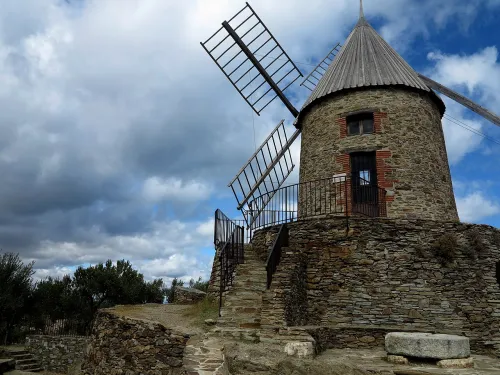
    The Moulin de Collioure, also called the Moulin de la Cortina, stands on a plateau above Parc Pams, a stone tower surrounded by a terraced olive grove. It began life as a grain mill; today it is an oil mill that can show how olive oil is made.

    Its story starts with a document dated 11 February 1337. Raymond de Toulouse, an official of the King of Majorca, who then ruled Collioure, handed a plot of land called Cortines to one Jacques Ermengald so he could build and run a grain mill. It was probably the first mill in Northern Catalonia, although nobody knows for sure whether it stood exactly where this one stands. The tower itself went up in 1340.

    Millers kept it turning for centuries. Records name two millers in 1420 and 1440, and in the 19th century the mill passed through several hands, Philippe Thibault owning it for more than sixty years before a widow, Clara Joseph, and her sons took over. After that the mill fell into ruin, and only most of the outer walls of the tower survived. When the land came to the town, the millwright Bernard Garibal rebuilt it as a working mill, finishing in 2001 with public money and donations. It does not meet modern food hygiene rules, so it demonstrates rather than produces; a volunteer group, the Association des amis du moulin, looks after it.

    Going inside is free, but the doors open only on certain days. The rest of the time you can still see the tower and the olive terraces from Parc Pams, which is reason enough to come up.

    From here it is 420 m, about 6 minutes, to the modern art museum.

    Hours
    Apr–Sep Wed and Sun 10:00–12:00, Mon–Tue and Thu–Sat closed; Oct–Mar closed for interior visits (exterior visible year-round in Parc Pams)
    Price
    Free
  3. 3

    Musée d'Art Moderne de Collioure

    Musée d'Art Moderne de Collioure, stop 3 on the self-guided walking tour

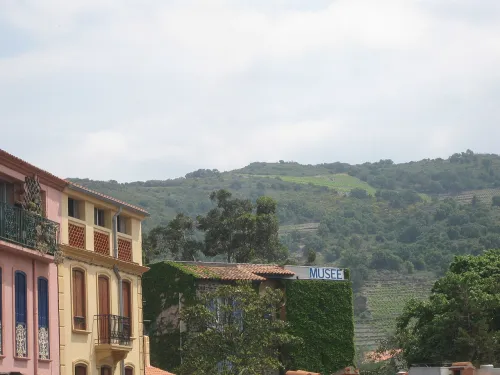
    The Musée d'Art Moderne de Collioure is currently closed, so this is a stop to look at from outside. The building is the Villa Pams. The ground once belonged to the Dominican convent, whose cloister survives in the museum garden. In the 19th century a château was built here, and in the middle of the 20th century it was remodelled in a Mediterranean style and named after its owner, the senator Gaston Pams.

    The collection began with a painter. In 1934 Jean Peské, born in Russia, fell for Collioure and decided to found a museum, as his friend Albert André had done elsewhere. He gathered nearly 200 works from artist friends and showed them in a room of the town hall. The collection then lay dormant until 1981, when the town bought the Villa Pams to house it.

    That purchase was pushed by a circle of friends: the artists Willy Mucha and Jean-Jacques Prolongeau and René Pous, owner of the Hostellerie des Templiers, where artists had stopped since Matisse's time. The museum opened on 20 September 1985 with a tribute show, “Descossy, Giner, Perrot: Three Painters in Collioure”, run by a friends' association chaired by Joseph Pous, René's son. It was first called the Musée Peské, took its present name later and has held the status of Musée de France since 2003. The town now plans to enlarge it with a tribute to Matisse's stay and a permanent collection display.

    Leave the villa behind for the water: it is 800 m, about 10 minutes, down to the port.

    Status
    Currently closed
  4. 4

    Port de Collioure

    Port de Collioure, stop 4 on the self-guided walking tour

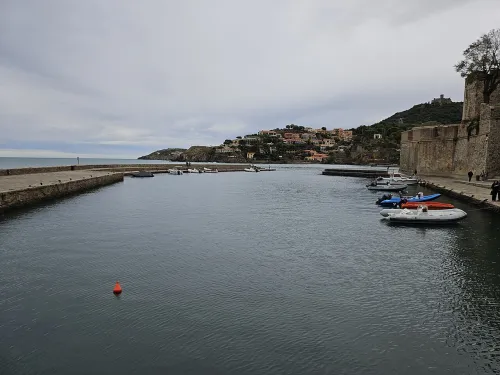
    Down at the water, the Port de Collioure is a public harbour and promenade, open around the clock, with no gate and no ticket. Notice how tight everything is: the houses press hard against the shore, and ahead of you the church rises straight out of the harbour, its tower standing in the sea.

    The castle you started at shaped this place too, as you will see at the church, where a royal engineer's decision decided which buildings could stay and which had to go.

    From here the walk changes pace. The three legs ahead add up to 450 m, so the painting trail, the church and the chapel all sit within a few minutes of each other. Take whatever pause you want here; the second half of the tour rewards going slowly.

    Hours
    Open 24/7
    Price
    Free
  5. 5

    Chemin du Fauvisme

    Collioure hangs paintings outdoors. The Chemin du Fauvisme places reproductions of works by Matisse and Derain along the public streets, free and reachable at any hour, so you move through the town and through the canvases at the same time.

    The link is real: Henri Matisse came to Collioure in 1905 and painted the town again and again. Standing in front of a reproduction, you can often compare the picture with the scene around you and see what the painter kept and what he changed.

    There is no correct direction and no minimum; you collect the reproductions as they come. A printed trail guide and a guided tour exist as paid extras, and the Vitrine sur le Fauvisme keeps seasonal hours, but a closed desk never means a closed trail.

    From the trail it is 190 m, about 3 minutes, past Plage Boramar to the church.

    Hours
    Open 24/7 (outdoor street trail; associated Vitrine sur le Fauvisme open May–Sep Mon–Fri 09:15–18:15, Sat–Sun 10:15–17:45; Apr and Oct 09:15–17:15; Nov–Mar closed)
    Price
    Free
  6. 6

    Église Notre-Dame-des-Anges

    Église Notre-Dame-des-Anges in Collioure, stop 6 on the self-guided walking tour

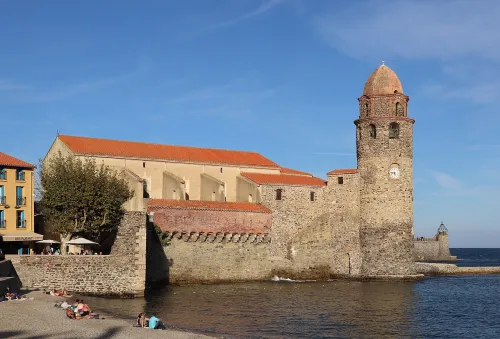
    The Église Notre-Dame-des-Anges stands in the port itself, and its bell tower tells the story before any plaque does. It was the old lighthouse tower, surrounded by the sea on three sides, which once marked the harbour with smoke by day and fires by night.

    The church exists because another one was destroyed. In 1673 Vauban had the medieval parish church on the heights of Collioure torn down to clear open ground around the castle. The town's consuls won permission to build a new church on the reefs that close off the harbour entrance, and the king gave them land next to the old lighthouse. Vauban no longer wanted a port at Collioure, preferring a deep-water bay nearby, so the town no longer needed its lighthouse, and that was handed over too.

    The first stone was blessed on 18 July 1684, but building only began on 26 April 1687, with the south wall facing the town and the castle. The architect was Pierre Aloau, and the mason Etienne Ramona ran the site to the end. The plan is typical of 17th-century Roussillon: a single nave with side chapels set between the buttresses. The church was blessed on 6 April 1691; the lighthouse became a bell tower by 12 June 1693, and the gallery followed in 1694. One odd footnote: in 1725 the town council voted 400 francs to build public latrines along the church, designed to look like part of a fortification.

    Going inside is free and worth it if you find the doors open, as the church only opens at certain times.

    The final leg is short: 120 m, about 2 minutes, out to the chapel.

    Hours
    Tue 17:00–19:00, Wed 09:00–12:00, Thu–Sat 17:00–19:00, Mon and Sun closed (Masses: Wed 09:30, Sat 18:30)
    Price
    Free
  7. 7

    Chapelle Saint-Vincent

    Chapelle Saint-Vincent in Collioure, stop 7 on the self-guided walking tour

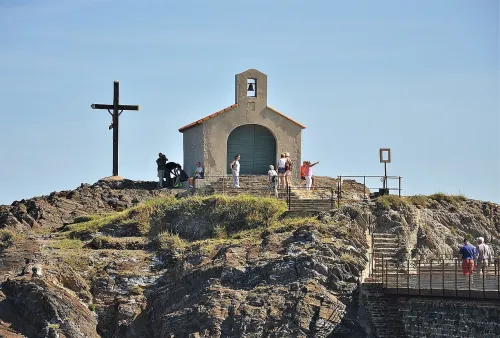
    The walk ends where the land stops. The Chapelle Saint-Vincent stands on a rocky jetty with the bay around it, and that view is the stop: outside, always accessible, no ticket, no gate.

    The interior is a different story. It stays shut except during religious events, and the one that matters is the Fêtes de Saint-Vincent in mid-August, when the doors open. Plan carefully if you come then: the castle closes for part of that week, so see it on another day.

    It is a fitting place to finish. You started at a fortress built up over centuries and end at a small chapel on the rocks, looking back over the harbour, the church tower and the town you have just walked through.

    Hours
    Exterior accessible 24/7; no regular interior access (interior opened only during religious events, notably Fêtes de Saint-Vincent in mid-August)
    Price
    Free
Walking tour route map of Collioure Route loaded
Château Royal de CollioureMoulin de CollioureMusée d'Art Moderne de ColliourePort de Collioure+3
All 7 stops are already on the map.
You just press start.
AI Tour Guide

You know the route now. Walk it with a guide in your ear.

Press start wherever you are, even hundreds of kilometres from Collioure, and the guide begins telling its stories right away. In the city, pick any of the 7 stops to start from: it leads you there, then talks with you the whole route, asking, listening, remembering, and shaping the tour around your answers.

7stops 2.9km 41 minwalking 13languages
▶Start the tour free

Free to start · Runs in your browser · No app, no download

Shorter Ways to Walk Collioure

Not every visit leaves room for the full line. These three cuts keep the order of the route and only drop what you can spare.

Harbour and Matisse only

Stops: 4, 5, 6, 7

For a short stop or an evening stroll. You stay at the water the whole time: 450 m and about 7 minutes of walking, with nothing to pay. Time it for the church's afternoon opening and you see it inside as well.

Fortress and windmill

Stops: 1, 2, 3

For history lovers who care more about walls than paintings. The upper part of the route is 1620 m and about 25 minutes of walking. The castle is the one paid entry; the mill is free whenever its doors are open.

The full line from outside

Stops: 1, 2, 3, 4, 5, 6, 7

For a tight budget. You walk all seven stops in 41 minutes of pure walking and look at the castle from outside, so the whole walk costs nothing.

How Long This Collioure Tour Takes, Castle Included

The walking itself takes 41 minutes. What stretches the walk to about three hours is the castle: allow an hour inside, a quarter of an hour at the mill, ten minutes outside the museum, a pause at the port, twenty minutes on the painting trail and some time inside the church.

An afternoon start works best, so the church is open by the time you reach it. Begin at the castle at 14:30, leave at 15:30, reach the mill at 15:49 and the museum at 16:10, the port at 16:30 and the trail at 16:47. You arrive at the church around 17:10 and stand at the chapel by about 17:30.

The harbour cut takes about an hour with its pauses, the fortress and windmill cut just under two hours with the castle visit, and the full line without going into the castle a little over two hours.

Before You Set Off in Collioure

  • Start and finish: The recommended start is the Château Royal de Collioure, the finish the Chapelle Saint-Vincent on its jetty. You can join at any stop. The route is a line, not a loop; on request the GPS navigation in your browser leads you from the chapel back to the castle.
  • Best day and time: Plan for an afternoon when the church is open, so you can step inside at the end of the walk. If the windmill interior matters more, come on a morning when it is open; you can then look at the castle from outside and keep moving.
  • Costs: Only the castle charges entry; the windmill, the port, the painting trail, the church and the chapel are free. The museum is currently closed, so there is no ticket to buy there. The route, the map and the GPS navigation are free, and the AI Tour Guide is optional.
Walking tour route map of Collioure
AI Tour Guide

Your guide is ready whenever you reach Collioure.

Press start and a voice AI Tour Guide takes it from here: leading the route through Collioure, telling the stories, and turning your walk into a real back-and-forth conversation. No app or download is needed; it runs in your browser.

7stops 2.9km 41 minwalking 13languages
▶Start the tour free

Free to start · Runs in your browser · No app, no download

What the AI Tour Guide Adds in Collioure

On this route the AI Tour Guide greets you at the castle gate and leads the walk as a conversation. It tells the stories of Templars, Majorcan kings, millers and painters, asks whether walls or canvases pull you in more, remembers your answer and shapes the conversation around it, and you can interrupt it whenever you like. It also goes where the text stops: what became of Collioure after Louis XIII's siege of 1642, or what Matisse was working on before he arrived in 1905. You start with 100 free credits; after that you choose this tour all-inclusive for €19.99 with no time limit, or credits at €5 per hour.

A Real Conversation A voice AI Tour Guide greets you, leads the whole route, and tells the stories and facts as you walk, asking what you want to see and keeping a real conversation going. Not a recording you press play on.
Map Navigation Follow the route on the map and walk at your own pace. You choose where to start and when to move to the next stop.
Ask Anything Curious about a building you pass? Ask your AI Tour Guide on the spot and the conversation carries on.
13 Languages Switch language anytime. No separate tour needed.
Start free in your browser

Common Questions about Collioure

Is there a reduced ticket for the Château Royal de Collioure?

Yes, there is a reduced ticket; ask at the ticket desk whether you qualify.

Is the Vitrine sur le Fauvisme open all year?

No, it is open only part of the year. The trail in the streets stays open all year, so you can follow the paintings at any time.

Can I attend Mass at Notre-Dame-des-Anges?

Yes. Mass is held on Wednesday at 09:30 and on Saturday at 18:30. Keep visits quiet during the service.

Which tours combine well with Collioure?

Across the border, Girona is 64 km away and Barcelona 147 km. On the French side, the walled city of Carcassonne lies 96 km away and Montpellier 137 km.

Is the tour really free?

Yes. The whole tour is free: the route, the interactive map and the navigation cost you nothing. Only the voice AI Tour Guide is optional and paid: you test it with 100 free credits, then you pay either €5 per hour or €19.99 for this whole tour, with no time limit. Admission to one of the 7 stops is not included: Château Royal de Collioure charges its own entry fee.

Do I need to download an app?

No. Everything runs in your phone browser. Open the route and start walking, no download and no sign-up required.

Do I need to book the walking tour in advance?

No booking needed. This self-guided tour is available anytime. Open the route in your browser and start walking. The AI Tour Guide works instantly, no app, no reservation required.

What languages is the AI Tour Guide available in?

The AI Tour Guide speaks 13 languages, so you take the tour in your own language and can switch at any time.

Can I skip stops or change the route?

Yes. Skip any stop, spend extra time at places you like, or start the route from any point. It is your walk, you set the pace.
Image credits
▶ Start free in your browser Runs in your browser, no app, no download