Free Walking Tour Oldenburg: Palace, Harbour, Lappan

Nine stops from the counts' palace out to the old Hunte harbour and back past a medieval tower, an 86 m church tower and a duke's landscape garden.

9 Stops 5.2 km ~1 h 12 min walking
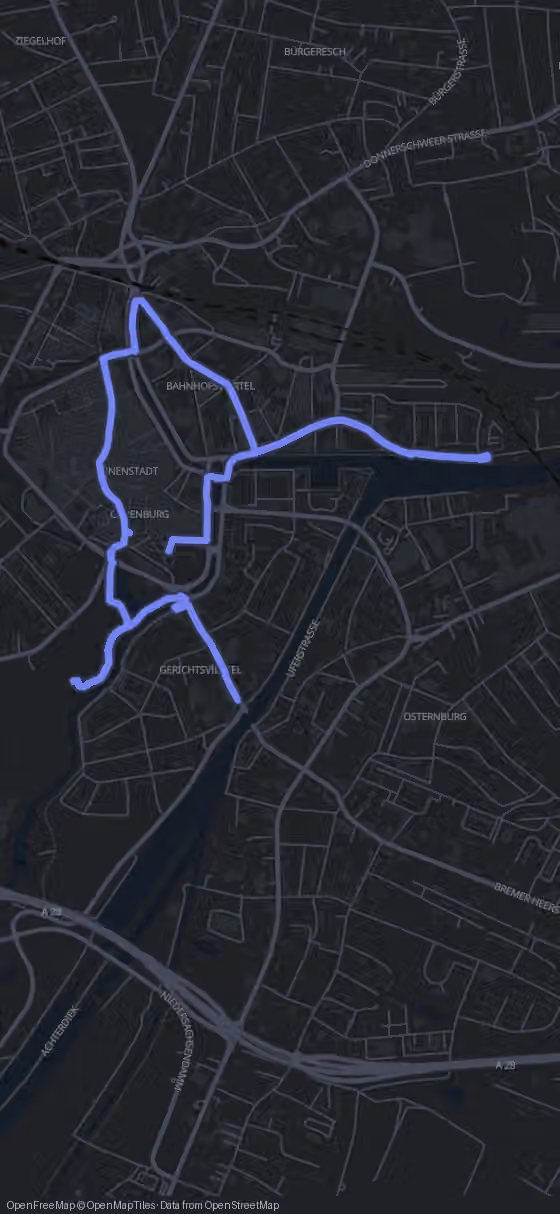
Route map for the Oldenburg walking tour
Stop 1 of 9
1.3 km·17 min
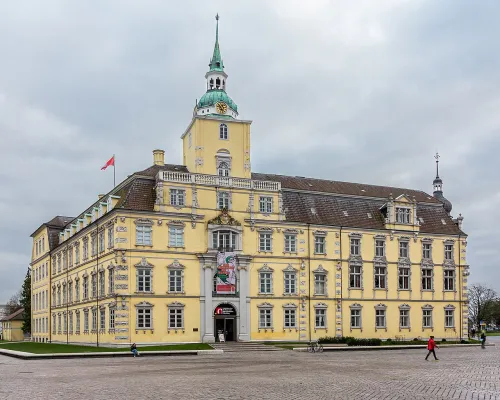
Schloss Oldenburg
Head east from the Schlossplatz toward the Alter Hafen on the Hunte
Welcome to Oldenburg. I'm Alex, and one little tower here survived both a great fire and a campaign to tear it down.
Try this tour with Alex

Oldenburg on Foot at a Glance

Nine stops lead from Schloss Oldenburg out to the Alter Hafen, back via the Horst-Janssen-Museum, the Lappan, the Altes Rathaus and the Lambertikirche, then through the Schlossgarten to the Augusteum and the Landesmuseum für Natur und Mensch. It is 5.2 km with 1 h 12 min of pure walking: about two and a half hours if you stay outside, a full day with the museums.

The harbour, the Lappan, the Altes Rathaus, the church and the garden cost nothing; the palace and the three museums charge admission. Map and GPS navigation run free in your browser, the AI Tour Guide is optional.

Open free GPS & optional AI Tour Guide
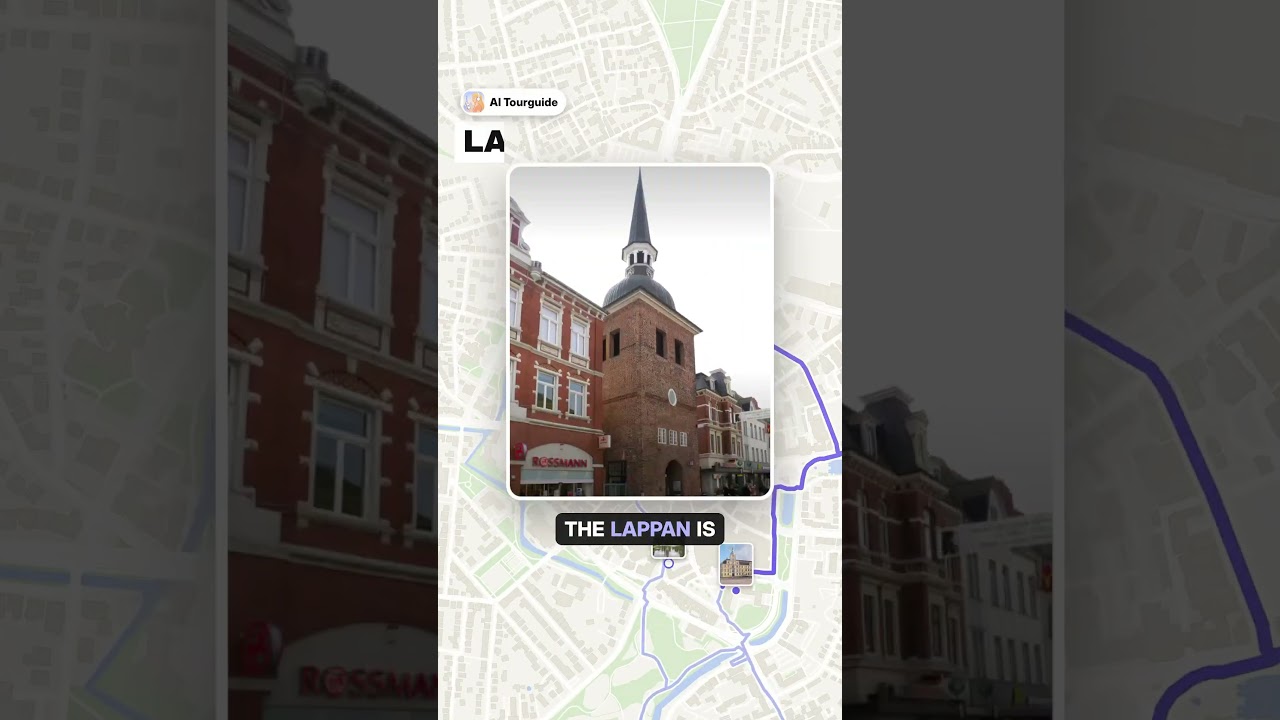
This short shows highlights of the route. All 9 stops follow below.

The Route

Walking Map of Oldenburg, Palace to Landesmuseum

9 stops 5.2 km 1 h 12 min walking
Tap to load interactive map

The 9 stops along this route

  1. Schloss Oldenburg, stop 1 on the self-guided walking tour
    1Schloss Oldenburg
  2. Alter Hafen in Oldenburg, stop 2 on the self-guided walking tour
    2Alter Hafen
  3. Horst-Janssen-Museum in Oldenburg, stop 3 on the self-guided walking tour
    3Horst-Janssen-Museum
  4. Lappan in Oldenburg, stop 4 on the self-guided walking tour
    4Lappan
  5. Altes Rathaus in Oldenburg, stop 5 on the self-guided walking tour
    5Altes Rathaus
  6. Lambertikirche in Oldenburg, stop 6 on the self-guided walking tour
    6Lambertikirche
  7. Schlossgarten in Oldenburg, stop 7 on the self-guided walking tour
    7Schlossgarten
  8. Augusteum in Oldenburg, stop 8 on the self-guided walking tour
    8Augusteum
  9. Landesmuseum für Natur und Mensch in Oldenburg, stop 9 on the self-guided walking tour
    9Landesmuseum für Natur und Mensch
  10. That's the full route.

    Walk it with an AI Tour Guide talking you through every one of these streets.

    Start free in your browser
    You made it

Your Oldenburg Walking Tour, Stop by Stop from Castle Mound to Moor

  1. 1

    Schloss Oldenburg

    Schloss Oldenburg, stop 1 on the self-guided walking tour

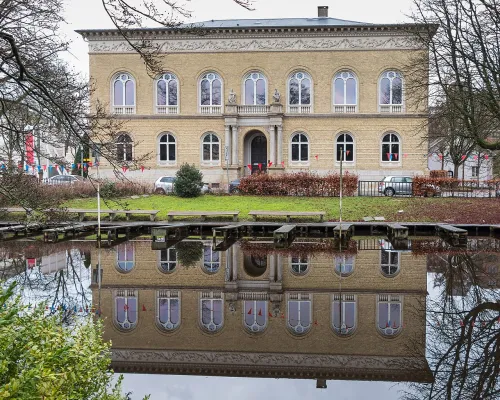
    Your walk starts where Oldenburg itself started. Around 1100 the Counts of Oldenburg built a lowland castle here to control the long-distance trade route from Westphalia to East Frisia, and it became the ancestral home of the House of Oldenburg. What you see today is the later palace: from 1667 to 1785 it housed the counts, then the dukes until 1815 and the grand dukes until 1918. The Schlossplatz opens out on its west and north sides, and across from it stand the Schlosshöfe, a shopping centre opened in 2011.

    The ground here was never easy. Count Elimar I is first named in 1108, the building itself in 1275, and a keep appears in a document in 1313. Even then the buildings had to stand on oak piles. Around 1400 Count Dietrich gave the round complex a moat and an outer wall, turning it into a moated castle, and around 1600 some 350 people lived and worked at court in a tight cluster of houses and farm buildings.

    The muddy subsoil kept winning. By 1573 the castle counted as dilapidated, by 1599 the keep in the courtyard was leaning, and in 1608 it was pulled down. Count Anton Günther, who lived from 1583 to 1667, then planned to turn the jumble of buildings into a regular four-wing palace modelled on the city palazzi of Italy.

    Inside is part of the State Museum for Art and Cultural History: decorative arts, local history and some Old Master paintings. It is worth the ticket if you want to understand the court and the region before walking on; the same day ticket also opens the Augusteum later. From here it is 1320 m, about 18 minutes, out to the Alter Hafen.
    Hours
    Tue–Sun 10:00–18:00, Mon closed
    Price
    6 EUR regular, 4 EUR reduced (day ticket for the palace, Augusteum and Prinzenpalais); 9 EUR regular, 6 EUR reduced including special exhibition; free for children 0-6
  2. 2

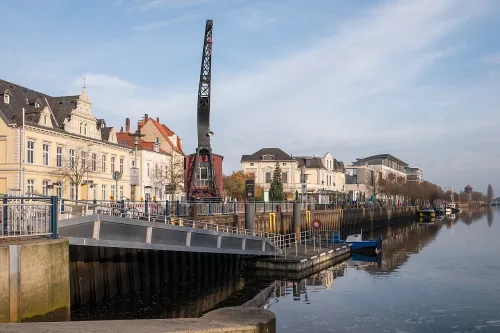
    Alter Hafen

    Alter Hafen in Oldenburg, stop 2 on the self-guided walking tour

    This is the longest detour of the day, out to the Hunte. The Alter Hafen is Oldenburg's former harbour, today a waterfront promenade with no gate and no ticket. After the palace rooms, the open space by the river is the point: here the route slows down and you simply walk.

    Be honest about the trade. The harbour sits between the two longest legs of the whole tour, and in return it asks nothing of you. That makes it the natural place for a break, and also the easiest stop to cut if your day runs short, because here the main experience is the walk itself.

    The next leg is the longest: 1470 m, about 20 minutes, to the Horst-Janssen-Museum. Just before you reach it you pass the Stadtmuseum Oldenburg, which is joined to the Janssen museum both in its buildings and in its organisation.

    Hours
    24/7
    Price
    Free
  3. 3

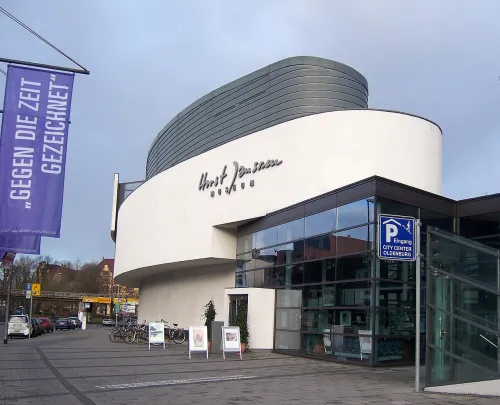
    Horst-Janssen-Museum

    Horst-Janssen-Museum in Oldenburg, stop 3 on the self-guided walking tour

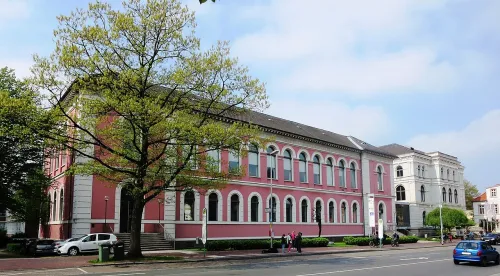
    This museum belongs to a single artist. Horst Janssen was a draughtsman, etcher, printmaker, lithographer, woodcut artist, author, poster designer and illustrator, and the house is built around his work and around drawing as a universal human means of expression. It opened in 2000 with 1,800 sheets from the Janssen collection of the Hamburg couple Carin and Carl Vogel.

    The museum exists thanks to one local decision: in 1995 the Oldenburg entrepreneur Claus Hüppe bought the Vogel collection for 1.5 million marks as its foundation, which made the building possible. It was designed by Peter Reinig, Meike Dreyer and Carl Deters and has three exhibition levels. The first holds the permanent exhibition on Janssen, the other two host three or four special exhibitions a year, often on classic and contemporary drawing.

    The permanent exhibition reopened in 2020 under the title ‘Horst Janssen: Neu entdeckt!’. Four themed islands cover his life, his drawing and printing methods and his writing. There are listening and touch stations, a drawing workshop where you can try things yourself, and film, hands-on stations and originals that show how an etching is made. The originals change three times a year.

    Go in if you like drawing or printmaking, or if you travel with children who want to make something themselves; if neither applies, the town sights ahead will suit you better. The Lappan is only 220 m away, about 4 minutes.

    Hours
    Tue–Sun 10:00–18:00, Mon closed
    Price
    8 EUR regular, 6 EUR reduced; free for children and youths under 18; free admission on the first Sunday of every month
  4. 4

    Lappan

    Lappan in Oldenburg, stop 4 on the self-guided walking tour

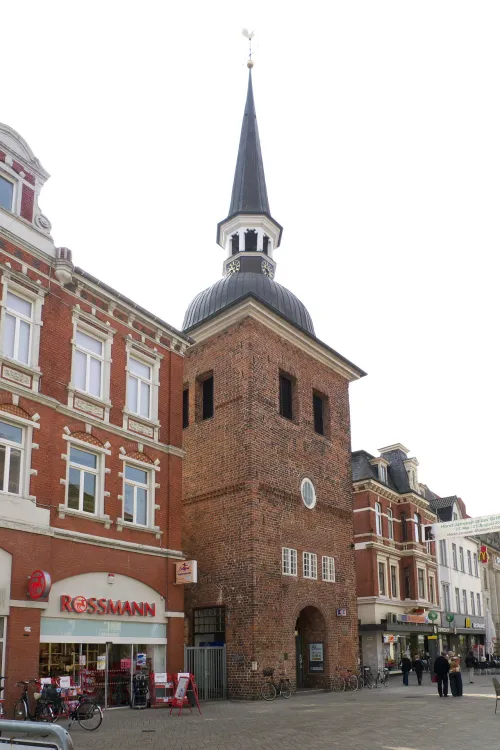
    The 35 m tower in front of you is one of Oldenburg's landmarks, and it began as an afterthought. In 1350 the plague swept through the town, and on this spot a poorhouse and infirmary of the Holy Spirit was set up. In 1356 it received a wooden chapel, which went without a bell tower for more than a hundred years. Only in 1467/68 was a stone tower added.

    The name comes from Low German: the building seemed ‘angelappt’, patched on, to the chapel. At first people used the word for the poorhouse, not the tower. Because the Lambertikirche was then only a low bell house, the Lappan was the first church tower in Oldenburg. It is also one of the few buildings that survived the great town fire of 1676.

    In the Middle Ages the complex was part of the town wall, and until 1845 the Heiligengeisttor, one of the five town gates, stood here; the line of the streets still shows it. After the Reformation the tower and chapel were secularised and used to store the town court's instruments of torture. Today the Lappan marks the edge between the historic centre and the districts to the northeast, with one of the city's central bus stops right next to it.

    The tower stands at the end of Lange Straße, one of the two main streets of the pedestrian zone, which leads you 480 m, about 7 minutes, to the Altes Rathaus on the Marktplatz.

    Hours
    24/7
    Price
    Free
  5. 5

    Altes Rathaus

    Altes Rathaus in Oldenburg, stop 5 on the self-guided walking tour

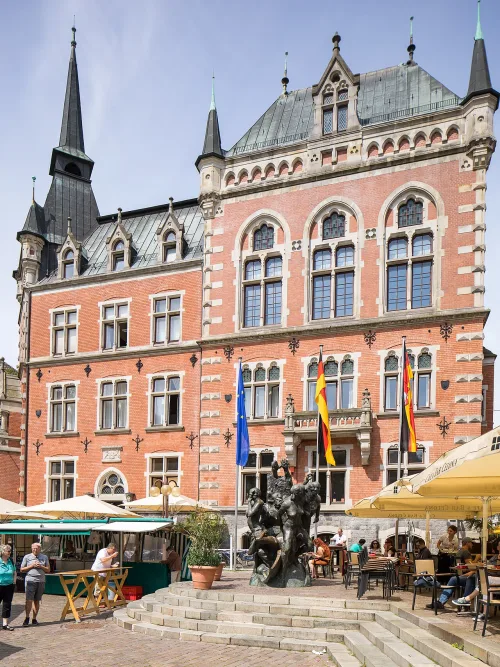
    The Altes Rathaus stands on its own in the middle of the Marktplatz, a triangular building from 1886 by the architects Johann Matthias von Holst and Carl Zaar. It is still used for administration, so the visit is the facade and the square around it. On its east side stands the Degodehaus, regarded as the oldest surviving building in the town, and along the north side runs the narrow Pistolenstraße.

    Before this building there was an earlier town hall, put up in 1635 at the wish of Count Anton Günther with a late Renaissance facade. People named it after its architect, Otto Schwerdtfeger: the Schwerdtfeger-Rathaus.

    The square itself has its own story. From 1933 to 1978 it was the main transfer point for Oldenburg's buses, until the central bus station moved to the main railway station. On 1 August 1967 the inner city became one of the first pedestrian zones in Germany, and since then no private cars reach the Marktplatz. Cafés and restaurants now set its tone, and the square hosts a weekly market and, in December, the Lambertimarkt.

    The Lambertikirche rises directly south of the town hall, just 90 m and a minute away.

    Hours
    Mon–Wed: 08:00–15:30 | Thu: 08:00–18:00 | Fri: 08:00–12:00 | Sat–Sun: Closed
    Price
    Free
  6. 6

    Lambertikirche

    Lambertikirche in Oldenburg, stop 6 on the self-guided walking tour

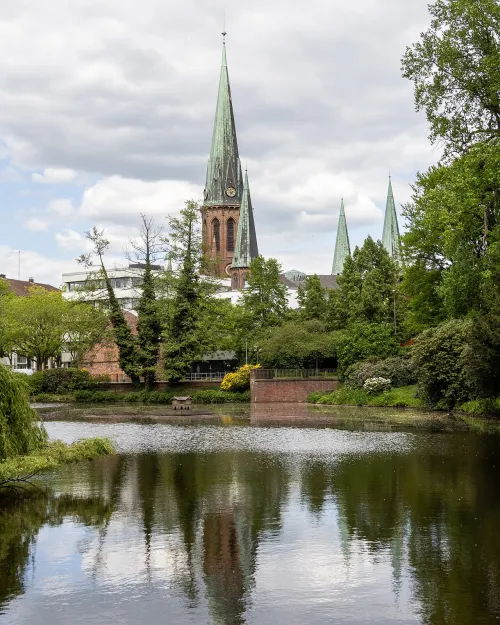
    With its four corner towers and an 86 m main tower, the Lambertikirche is the tallest building in Oldenburg and shapes the skyline. It is the central and oldest church of the Lutheran parish and the preaching church of the bishop of the Evangelical Lutheran Church in Oldenburg. Outside it is neo-Gothic; inside you find something quite different, a classicist rotunda.

    For centuries this was the court church of the counts, then of the dukes and grand dukes. A first church, probably a simple Romanesque one, stood here between the castle and the settlement, built by the House of Oldenburg, likely between 1180/81 and 1200. The counts' devotion to Saint Lambert of Liège shows in another foundation too: around 1200 they also founded the Lambertikirche in Aurich.

    The first written trace of a parish priest dates from 1237, when a Johannes of Oldenburg witnessed a transfer of property to Rastede monastery. The church still owns a late Romanesque communion chalice made around 1265, which is occasionally used.

    Admission is free, so step inside: the contrast between the Gothic exterior and the round classicist interior is the reason. Behind the church lies the Kasinoplatz with the Pulverturm close by, and beyond it the Schlossgarten, 670 m or about 9 minutes away.

    Hours
    Mon 11:00–16:00, Tue–Sat 11:00–18:00; Sun church service at 10:00
    Price
    Free admission
  7. 7

    Schlossgarten

    Schlossgarten in Oldenburg, stop 7 on the self-guided walking tour

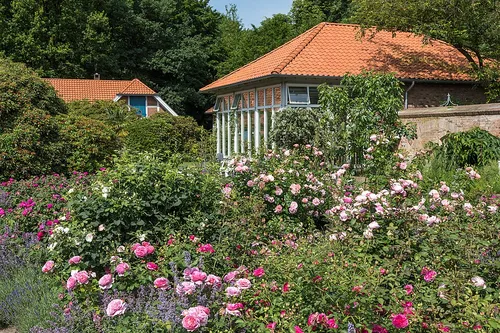
    The Schlossgarten is a 16 hectare park in the style of an English landscape garden, the main public park of the city. At its northwest end are a lake and the Elisabeth-Anna-Palais, built from 1894 to 1896, close to the palace where you began.

    It was Duke Peter Friedrich Ludwig's project. He bought meadowland near the palace in 1803 and 1805, started work in 1809 with detailed plans and drew designs himself, while the court gardener Friedrich Wilhelm Julius Bosse carried them out. The first gardens were largely destroyed during the Napoleonic occupation; reconstruction began in 1814, and the work went on for 42 years. The garden has changed little since.

    From the start the duke wanted his subjects to enjoy it too, and large parts were open to the public. The only conditions were proper clothes and civilised behaviour, and until the 1950s people still came in their Sunday best. Then the garden director Max Heber opened it up to everyday use. After the war it served for a while as a kitchen garden for fruit and vegetables, and some trees were felled for fuel.

    The garden became public property in 1920, belonged to the Free State of Oldenburg until 1946 and since then to Lower Saxony. A society to preserve it was founded in 1952, and it has been protected since 1978. Take your time here, it is free and the best place on the route to sit down. The Augusteum is 570 m, about 8 minutes, away.

    Hours
    Apr–Sep: daily 08:00–20:00; Oct–Mar: daily 08:00 to dusk
    Price
    Free admission
  8. 8

    Augusteum

    Augusteum in Oldenburg, stop 8 on the self-guided walking tour

    The Augusteum looks like a palace from Florence, and that was the idea. Grand Duke Peter II commissioned it to house the grand ducal art collection and named it after his father, Grand Duke Augustus. The architect Ernst Klingenberg designed it in neo-Renaissance style, and paintings by Christian Griepenkerl decorate the building. Opened in 1876 as Oldenburg's first art museum, it is one of the earliest museum buildings in northern Germany.

    Today it holds the Old Masters Gallery of the State Museum for Art and Cultural History: Dutch, Italian, German and French paintings from the 15th to the 18th century. The collection goes back to 1804, when Duke Peter I bought 86 paintings from the private collection of the artist Johann Heinrich Wilhelm Tischbein. The house also served the Oldenburg Art Association, and the conservator Richard tom Dieck lived and worked in its basement. In 1908 the Expressionists Karl Schmidt-Rottluff and Erich Heckel held their first joint exhibition here.

    Then the story turns. In 1918 Grand Duke Frederick Augustus II had to abdicate, left for the Netherlands in 1919 and was soon forced to sell. In a series of sales, a third of the former grand ducal gallery went abroad, including paintings by Rembrandt, with the help of the industrialist Georg Bölts. Oldenburg was left with works of lesser rank.

    Go in if you love Old Masters, especially if you already hold the palace day ticket. The last stop is 390 m, about 5 minutes, away.

    Hours
    Tue–Sun 10:00–18:00, Mon closed
    Price
    6 EUR regular, 4 EUR reduced (day ticket for the palace, Augusteum and Prinzenpalais); 9 EUR regular, 6 EUR reduced including special exhibition; free for children 0-6
  9. 9

    Landesmuseum für Natur und Mensch

    Landesmuseum für Natur und Mensch in Oldenburg, stop 9 on the self-guided walking tour

    The route ends in a museum of archaeology, natural history and ethnology, locally called the Landesmuseum Natur und Mensch Oldenburg. Its focus is the moor archaeology of northwest Germany, and the permanent exhibition is organised around three landscapes: moor, geest, and coast and marsh. The permanent exhibition is currently being renovated, so ask at the desk what is on show.

    Grand Duke Paul Friedrich August opened it in 1836 as the Natural History Museum. Its first director, Baron Alexander von Rennenkampff, had bought the founding collection on his behalf in 1835: 9,800 prepared insects, 490 birds and 26 small native mammals, for 3,000 Reichstaler in gold. The seller, Otto Ernst Oppermann, a district physician from Delmenhorst, had reinvented the craft of taxidermy and wrote a 350 page book on it in the same year.

    In 1867 the ethnological collection, the cabinet of natural objects and the antiquities moved here from the duke's palace, and the collections grew so large that a new building was needed. Court architect Gerhard Schnitger built it from 1876 to 1879, and the museum has been here ever since. An air raid on the night of 22 to 23 September 1943 badly damaged it. In the early 20th century the turn towards the region's own past put archaeology at the centre of the museum.

    Go in if moor finds, animals or regional prehistory appeal to you; it rounds off the day well after palace, church and art. From here, the GPS navigation can lead you back to Schloss Oldenburg if you want.

    Local name
    Landesmuseum Natur und Mensch Oldenburg
    Hours
    Tue–Fri 09:00–17:00, Sat–Sun 10:00–18:00, Mon closed
    Price
    6 EUR regular, 4 EUR reduced (temporary price during permanent exhibition renovation); children 7+: 2 EUR; free under 7
Walking tour route map of Oldenburg Route loaded
Schloss OldenburgAlter HafenHorst-Janssen-MuseumLappan+5
All 9 stops are already on the map.
You just press start.
AI Tour Guide

You've read the route. Now walk Oldenburg with a guide in your ear.

Press start wherever you are, even hundreds of kilometres from Oldenburg, and the guide begins telling its stories right away. In the city, pick any of the 9 stops to start from: it leads you there, then talks with you the whole route, asking, listening, remembering, and shaping the tour around your answers.

9stops 5.2km 1 h 12 minwalking 13languages
▶Start the tour free

Free to start · Runs in your browser · No app, no download

Shorter Ways to Walk Oldenburg

The full route works best with half a day or more. If you have less time or a clear interest, these cuts keep the walking short and the stops strong.

Free and outdoors

Stops: 1, 2, 3, 4, 5, 6, 7, 8, 9

For anyone who wants the whole city without tickets: walk all nine stops, see the palace and the museums from outside and step into the Lambertikirche, which is free. Walking time stays at 1 h 12 min, and nothing costs admission.

Compact old town

Stops: 4, 5, 6, 7, 8, 9

For a short visit or a first evening: start at the Lappan and leave out the long legs to the harbour. About 2.2 km and 30 minutes of walking take you past the Altes Rathaus, the Lambertikirche and the Schlossgarten to the Augusteum and the Landesmuseum, the only two stops here that charge admission.

Drawing and painting

Stops: 3, 4, 5, 6, 7, 8

For art lovers: begin at the Horst-Janssen-Museum and end among the Old Masters of the Augusteum. Around 2 km and 29 minutes of walking, with admission at the two museums and the town sights in between free.

How Long This Oldenburg Tour Takes, Outside and Inside

Pure walking time is 1 h 12 min over 5.2 km. Almost a third of the distance falls on the way out to the Alter Hafen and back into town (1320 m and 1470 m); after that the legs are short, and from the Lappan onwards no stage takes longer than nine minutes.

Seen from outside, with a look into the Lambertikirche, the whole route takes about two and a half hours. Add one museum and you are at around four hours; going into the palace, the Horst-Janssen-Museum, the Augusteum and the Landesmuseum fills a day of about six and a half hours. The compact old town cut takes about an hour and a half outside and roughly three hours with both of its museums; the drawing and painting cut also comes to about three hours.

Before You Set Off from the Palace

  • Start and finish: The recommended start is Schloss Oldenburg, the finish the Landesmuseum für Natur und Mensch. You can join at any stop, and the GPS navigation in your browser will take you from the last stop back to the palace if you want.
  • Time of day: If you plan to go into the museums, start in the morning so the long walk to the harbour does not eat into museum time. Purely outdoors, the route fits any part of the day.
  • Admission: Schloss Oldenburg, the Horst-Janssen-Museum, the Augusteum and the Landesmuseum charge admission; one day ticket covers both the palace and the Augusteum. All other stops are free.
  • Shoes: 5.2 km on foot is a real walk, mostly through the pedestrian zone and the park. Comfortable shoes make the long harbour legs easier.
Walking tour route map of Oldenburg
AI Tour Guide

Your Oldenburg guide is ready when you are.

Press start and a voice AI Tour Guide takes it from here: leading the route through Oldenburg, telling the stories, and turning your walk into a real back-and-forth conversation. No app or download is needed; it runs in your browser.

9stops 5.2km 1 h 12 minwalking 13languages
▶Start the tour free

Free to start · Runs in your browser · No app, no download

What the AI Tour Guide Adds in Oldenburg

On this route one family ties almost everything together: the counts, dukes and grand dukes of Oldenburg built the palace, prayed in the Lambertikirche, laid out the Schlossgarten and filled the Augusteum. The AI Tour Guide follows that thread as a conversation, uses the long walk to the Alter Hafen for the stories that do not fit on a sign, asks what catches your interest and goes deeper there. You can interrupt at any time, for example to ask which Oldenburg paintings ended up in the Netherlands after 1919 or how a moor body is studied.

A Real Conversation A voice AI Tour Guide greets you, leads the whole route, and tells the stories and facts as you walk, asking what you want to see and keeping a real conversation going. Not a recording you press play on.
Map Navigation Follow the route on the map and walk at your own pace. You choose where to start and when to move to the next stop.
Ask Anything Curious about a building you pass? Ask your AI Tour Guide on the spot and the conversation carries on.
13 Languages Switch language anytime. No separate tour needed.
Start free in your browser

Common Questions About Walking Oldenburg

Does one ticket cover the palace and the Augusteum?

Yes. The day ticket of the State Museum for Art and Cultural History covers Schloss Oldenburg, the Augusteum and the Prinzenpalais, so buy it once at your first museum stop. Special exhibitions cost extra.

Can I go inside the Altes Rathaus?

It is a working administrative building, not a museum. The visit is the triangular facade and the Marktplatz around it.

Is the route good with children?

Yes, especially with museum time built in. The Horst-Janssen-Museum has a drawing workshop and hands-on stations, and the Landesmuseum für Natur und Mensch combines animals, archaeology and moor finds. The open Schlossgarten makes a good break between the two.

Can I combine Oldenburg with another city?

Bremen is 40 km away and works well as the next day's walk. If you are heading towards the Netherlands, Groningen is about 110 km away.

Is the tour really free?

Yes. The whole tour is free: the route, the interactive map and the navigation cost you nothing. Only the voice AI Tour Guide is optional and paid: you test it with 100 free credits, then you pay either €5 per hour or €19.99 for this whole tour, with no time limit. Admission to 4 of the 9 stops is not included: Schloss Oldenburg, Horst-Janssen-Museum, Augusteum and Landesmuseum für Natur und Mensch charge their own entry fees.

Do I need to download an app?

No. Everything runs in your phone browser. Open the route and start walking, no download and no sign-up required.

Do I need to book the walking tour in advance?

No booking needed. This self-guided tour is available anytime. Open the route in your browser and start walking. The AI Tour Guide works instantly, no app, no reservation required.

What languages is the AI Tour Guide available in?

The AI Tour Guide speaks 13 languages, so you take the tour in your own language and can switch at any time.

Can I skip stops or change the route?

Yes. Skip any stop, spend extra time at places you like, or start the route from any point. It is your walk, you set the pace.
Image credits
▶ Start free in your browser Runs in your browser, no app, no download