Free Walking Tour Hanover: Old Town, Gardens, Lake

Ride a curved lift up the town hall dome, walk through Sophia's Baroque garden and finish by the Maschsee: one long day through Hanover on foot.

11 Stops 12.8 km ~2 h 55 min walking
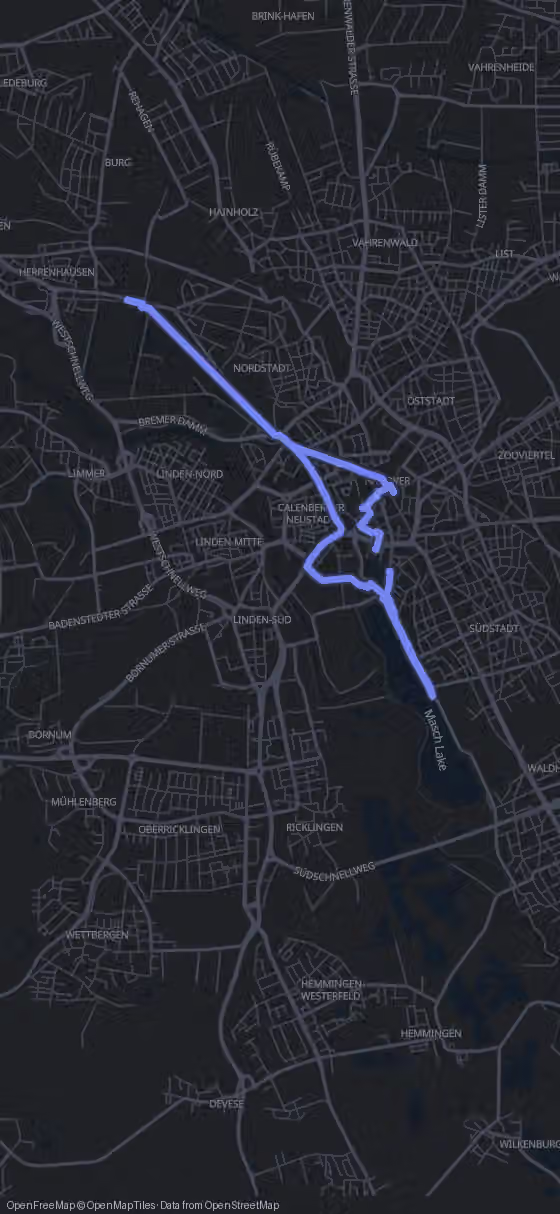
Route map for the Hanover walking tour
Stop 1 of 11
500 m·6 min
New Town Hall
Head north toward the Markthalle
Welcome to Hannover. I'm Alex, and our first story begins with a lift that refuses to travel straight.
Try this tour with Alex

The Route at a Glance

This free walking tour of Hanover links 11 stops on a 12.8 km route, starting at the New Town Hall and ending at the Lower Saxony State Museum right next door. Pure walking time is 2 h 55 min; with the visits worth making, plan about eight hours.

Squares, churches, the lake and the sculptures cost nothing. You pay entry at the Herrenhausen Gardens, the Sprengel Museum, the museum at the end and for the dome lift. Route, map and GPS navigation in your browser are free; the AI Tour Guide is optional.

Open free GPS & optional AI Tour Guide
View of Hanover

The Route

Walking Map of Hanover, from Dome to Lakeshore

11 stops 12.8 km 2 h 55 min walking
Tap to load interactive map

The 11 stops along this route

  1. New Town Hall in Hanover, stop 1 on the self-guided walking tour
    1New Town Hall
  2. Markthalle Hannover in Hanover, stop 2 on the self-guided walking tour
    2Markthalle Hannover
  3. Old Town Hall in Hanover, stop 3 on the self-guided walking tour
    3Old Town Hall
  4. Market Church in Hanover, stop 4 on the self-guided walking tour
    4Market Church
  5. Hannover Opera House in Hanover, stop 5 on the self-guided walking tour
    5Hannover Opera House
  6. Herrenhausen Gardens in Hanover, stop 6 on the self-guided walking tour
    6Herrenhausen Gardens
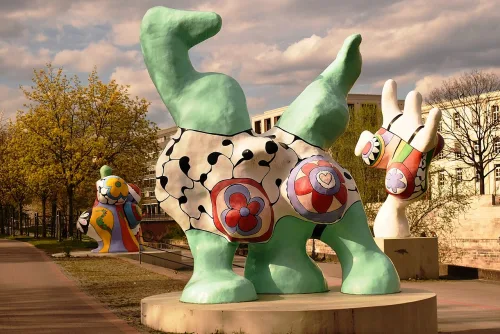
  7. Three Nanas Sculpture in Hanover, stop 7 on the self-guided walking tour
    7Three Nanas Sculpture
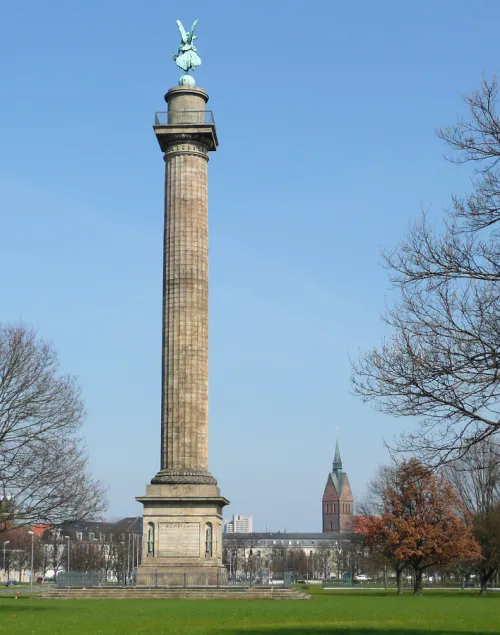
  8. Waterloo Column in Hanover, stop 8 on the self-guided walking tour
    8Waterloo Column
  9. Maschsee in Hanover, stop 9 on the self-guided walking tour
    9Maschsee
  10. Sprengel Museum in Hanover, stop 10 on the self-guided walking tour
    10Sprengel Museum
  11. Lower Saxony State Museum in Hanover, stop 11 on the self-guided walking tour
    11Lower Saxony State Museum
  12. That's the full route.

    Walk it with an AI Tour Guide talking you through every one of these streets.

    Start free in your browser
    You made it

Your Hanover Walking Tour, Place by Place

  1. 1

    New Town Hall

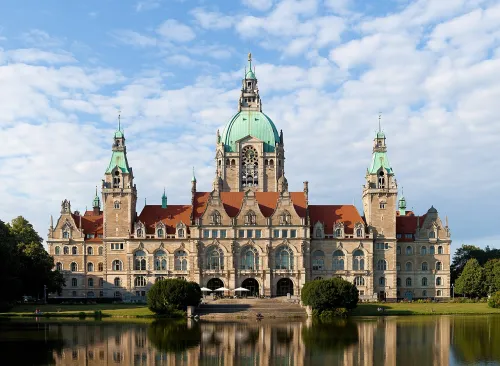
    New Town Hall in Hanover, stop 1 on the self-guided walking tour

    Start in front of a building that looks more like a castle than an office. The New Town Hall opened on 20 June 1913 after twelve years of construction, at the southern edge of the inner city and set inside the 10-hectare Maschpark. The square in front was called Trammplatz until 23 September 2024; today it is the Platz der Menschenrechte, Human Rights Plaza. The old name honoured City Director Heinrich Tramm, who is now recognised as a pioneer of National Socialism.

    Tramm also gave the building its best-known line. The whole thing cost 10 million marks and rests on 6,026 beech piles. At the opening, with Emperor Wilhelm II present, he is said to have announced: 'Ten million marks, Your Majesty, and all paid for in cash.' Architects Hermann Eggert and Gustav Halmhuber designed it in the eclectic style of the Wilhelmine era, and the mayor still has his seat here.

    Go inside; the lobby is open every day. On the ground floor, four city models show how Hanover developed, and they make a good introduction before you walk the real streets. In the 38-metre-high hall, the state of Lower Saxony was proclaimed in 1946, after the building had been damaged in the bombing raids of the Second World War.

    Then the dome. Its lift follows the curve of the dome, tilting up to 17 degrees as it climbs a 50-metre shaft. People often compare it to the lifts in the Eiffel Tower, but those run at one fixed angle; this one changes its angle along the way. The dome reaches 97.73 metres, and on a clear day you can see the Harz mountains from the gallery. The lift runs from March to October, and it's worth it for anyone who enjoys a view or odd engineering.

    From here it's 500 m, about 7 minutes, into the old town to the Markthalle Hannover.
    Local name
    Neues Rathaus
    Hours
    Town hall lobby: Mon–Fri 08:00–18:00, Sat–Sun 10:00–18:00; dome elevator: Mon–Sun 10:00–17:30 (March to October)
    Price
    Dome elevator 5 EUR adults, 4 EUR reduced (children 5-14 yrs, pupils, students, retirees)
  2. 2

    Markthalle Hannover

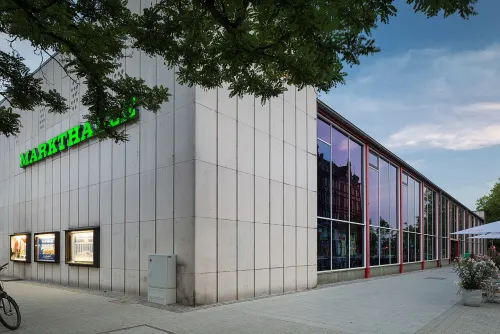
    Markthalle Hannover in Hanover, stop 2 on the self-guided walking tour

    Locals call it the 'Bauch von Hannover', the belly of Hanover. The present hall opened in 1954 at the edge of the old town, directly opposite the Old Town Hall, and entry is free. It's a working market hall, so walk past the traders' stalls and pick up something to eat if you're hungry.

    Its story begins on the streets outside. For centuries, farmers from the surrounding area sold their produce on open squares such as the old market place by the Market Church. By 1875 Hanover had passed 100,000 inhabitants, the number of traders kept rising and their handcarts blocked the streets around the church. Demands for better hygiene added pressure, and in 1888 the royal police directorate pushed for the street market to end. The city decided on a market hall that same year.

    The first hall was designed by architect and city inspector Paul Rowald, who took the Galerie des Machines from the 1889 Paris World Exhibition as his model: iron and glass with brick side walls, 84 metres long, 48 metres wide, about 20 metres high, with towers at the corners. When it opened on 18 October 1892, it was the largest steel and glass building in the German Empire, and 243 traders moved in. Until 1929 tram tracks ran up to the hall to deliver goods, and in the First World War the city enlarged the cold stores underneath to store grain and food and sold staples cheaply here.

    The air raids of 1943 largely destroyed that hall, and it was later demolished. The Old Town Hall is just across the way, 150 m and 2 minutes.

    Hours
    Mon–Wed: 07:00–20:00 | Thu–Fri: 07:00–22:00 | Sat: 07:00–16:00 | Sun: Closed
    Price
    Free
  3. 3

    Old Town Hall

    Old Town Hall in Hanover, stop 3 on the self-guided walking tour

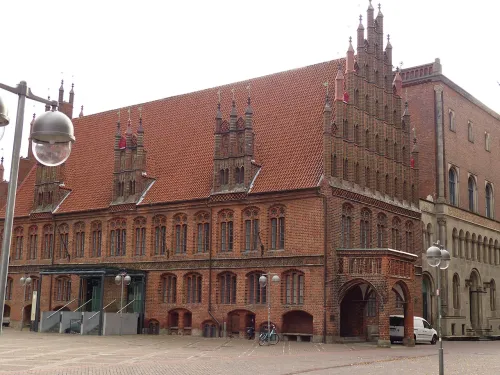
    You're now standing at the oldest secular building in Hanover. The first parts went up in 1410; before that, the city council met wherever it could, documented between 1303 and 1410 in the city's theatre, in the market yard and at the court arbour. The Old Town Hall served as the seat of government until the New Town Hall took over in 1913.

    Look at the market façade. Its Brick Gothic gables, the lucarnes, are highly elaborate and have been preserved and partly restored in their medieval form; some of their elements were copied onto the other wings. Ground levels rose over the centuries, so the original ground floor is today's basement. The Hanover Chronicle records that two new prisons were set up in the building in 1607.

    In 1844 the apothecary wing, a half-timbered building from the 16th century, was torn down and replaced by a municipal court in Italian Renaissance style by August Heinrich Andreae. People call it the Doge's Palace, and it now houses the registry office. At the end of the 19th century the whole town hall was due to be demolished, until a citizens' initiative saved it. Architect Conrad Wilhelm Hase then restored it from 1877 to 1891 to how it looked when first built. Old photographs from 1864 helped him; they showed that some of the windows had originally been segmental arches, not rectangles.

    Bombs hit the building hard in the Second World War, and it was extensively restored in 1953 and 1964. It's free to enter, but the real reward is outside: walk around it and compare the Gothic market front with the Doge's Palace wing. The Market Church is 100 m away, a one-minute walk.

    Local name
    Altes Rathaus
    Hours
    Mon–Sat: 09:00–22:00 | Sun: Closed
    Price
    Free
  4. 4

    Market Church

    Market Church in Hanover, stop 4 on the self-guided walking tour

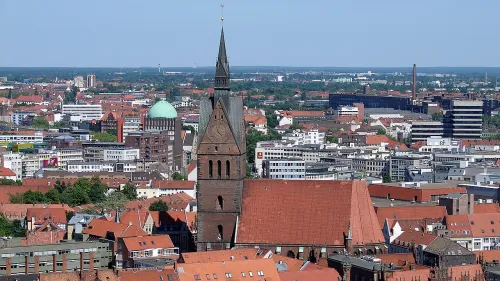
    The Market Church is Hanover's main Lutheran church, and together with the Old Town Hall it counts as the southernmost example of north German Brick Gothic. It's a hall church with a nave, two aisles and a huge saddleback roof above them. The tower on its western side was built as a symbol of the citizens' power and wealth; it is a landmark of the city and one of the highest towers in Lower Saxony.

    The church was built in the 14th century and is recorded in 1342 as the church of Saints James and George. It replaced a smaller church on the same spot dating from 1125, and Hanover grew up around it and around the market place next to it. The roof and the vaults were destroyed in an air raid in 1943 and restored in 1952.

    Inside, go straight to the main altar. It was carved from linden wood around 1480; the front shows the Passion of Christ in 21 scenes based on models by Martin Schongauer, the back scenes from the lives of the two patron saints. Its survival is a story of luck: in 1663 it was moved to the Aegidienkirche to make room for a Baroque altar, in 1856 it went to the Welfenmuseum, and so it escaped when the Aegidienkirche was bombed in the war. It came back here in 1952.

    The main organ stands at the back wall of the southern aisle; the first instrument there was built in 1953 and 1954 by Emil Hammer Orgelbau and Rudolf von Beckerath. Entry is free and worth twenty minutes for anyone; the tower tour costs extra. From here it's 510 m, 7 minutes, to the Hannover Opera House.

    Local name
    Marktkirche
    Hours
    Mon–Fri 10:00–18:00, Sat 10:00–17:30, Sun 09:30–18:00
    Price
    Free (tower tour 3 EUR)
  5. 5

    Hannover Opera House

    Hannover Opera House in Hanover, stop 5 on the self-guided walking tour

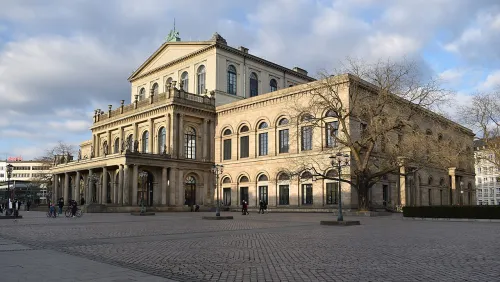
    The Hannover Opera House was built in classical style between 1845 and 1852 to plans by Georg Ludwig Friedrich Laves. Remember the name: you'll meet his work again at the Waterloo Column. The building was badly damaged in the bombing of Hanover and rebuilt from 1948; the acoustics were improved in 1985, and the stage facilities were renovated from 1996 to 1998.

    It's home to the Hanover State Opera, part of the Lower Saxony State Theatre, with seasons running from September through June. Since the early 1980s the house has also hosted the International Choreographic Competition Hannover, the longest-running choreography competition in the world.

    A few names from its music history: George Alexander Albrecht was general music director from 1965 to 1993, longer than anyone else. Karen Kamensek, who held the post from 2011 to 2014, was the first woman and the first American in that role. Stephan Zilias has led the company since 2020.

    Without a ticket you get the façade and the foyer, so this is a short stop unless you plan to come back for a performance. Now comes the longest leg of the day: 3710 m, about 51 minutes, out to the Herrenhausen Gardens. Good shoes help.

    Local name
    Staatsoper Hannover
    Hours
    Box office in the foyer: Tue–Fri 10:00–18:30, Sat 10:00–14:00; interior otherwise only with a performance ticket or on a booked tour
    Price
    Free (foyer; guided tours bookable)
  6. 6

    Herrenhausen Gardens

    Herrenhausen Gardens in Hanover, stop 6 on the self-guided walking tour

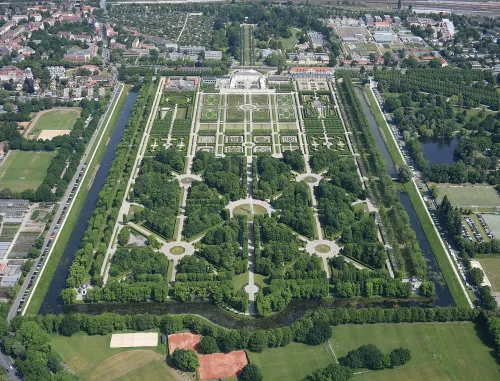
    Herrenhausen is four gardens: the Great Garden, the Hill Garden, the Georgen Garden and the Guelf Garden. The Great Garden has long been counted among the most distinguished Baroque gardens in Europe; the Hill Garden grew from a simple vegetable garden into a large botanical garden. The Georgen Garden and Guelf Garden are laid out as English landscape gardens, where people from Hanover come to relax.

    The Great Garden is largely Sophia's work. She was the wife of the Elector of Hanover and herself heiress to the British throne, and in 1683 she commissioned the French gardener Martin Charbonnier to enlarge an existing garden. It became a summer retreat a few kilometres outside the city, while the Leine Palace remained the main residence. The result covers 50 hectares of lawns, hedges, paths and statues arranged in strict geometric patterns.

    At its centre stands the rather small Herrenhausen Palace, a manor house from 1640 enlarged from 1676. Sophia's husband Ernest Augustus planned to replace it with a grand Baroque palace and began with the Gallery building nearby. Their son George Louis, who became King George I of Great Britain in 1714, dropped the palace and put his money into water features instead. George II planned a new palace too and never built it. Sophia, Ernest Augustus and George I are buried in the mausoleum in the Hill Garden.

    The ticket covers the Great Garden and the Hill Garden, and this is the one paid stop you shouldn't skip; give it about 90 minutes. Then you head back towards the river, 3160 m and 44 minutes, to the Three Nanas Sculpture, where one of the figures is named after Sophia.

    Local name
    Herrenhäuser Gärten
    Hours
    Daily from 09:00 (closing times seasonally between 16:30 and 20:00)
    Price
    10 EUR (Großer Garden + Berggarten); reduced 8 EUR; under 18 free
  7. 7

    Three Nanas Sculpture

    Three Nanas Sculpture in Hanover, stop 7 on the self-guided walking tour

    After the strict lines of Herrenhausen, these three figures are pure exuberance. Niki de Saint Phalle made them from polyester and fibreglass; two are five metres tall, the third 3.75 metres, with big round shapes and bright paint. They stand on a wide pavement between the six-lane Leibnizufer road and the Leine, level with the Historical Museum, as part of the Sculpture Mile.

    Each is named after a woman connected with Hanover. 'Sophie', with white arms and legs, dances on one leg with her arms in the air; she is named after Electress Sophia, who shaped the Great Garden you've just seen. 'Caroline' stands on her head and has green limbs. She honours Caroline Herschel, born in Hanover, an astronomer, violinist and singer who followed her brother William to England and assisted with his observations.

    The most colourful one, 'Charlotte', recalls Charlotte Buff, who married into one of Hanover's leading families. Goethe fell for her after meeting her at a ball in 1772, although she was already engaged, and turned her into Lotte in The Sorrows of Young Werther.

    The figures were installed on 14 January 1974, with the artist present. If you like them, you'll find much more of her work in the Sprengel Museum later. On Saturdays the stalls of the Flea Market at the High Bank reach right up to the Nanas. The Waterloo Column is 810 m away, about 11 minutes.

    Hours
    Freely accessible, no opening hours
    Price
    Free
  8. 8

    Waterloo Column

    Waterloo Column in Hanover, stop 8 on the self-guided walking tour

    Laves again: the Waterloo Column was designed by the court architect and built from 1825 to 1832 to commemorate the Battle of Waterloo. It rises 46.31 metres with a diameter of 3.75 metres. On top stands Victoria, goddess of victory, designed by August Hengst, about 4.55 metres tall and made of copper and iron in the workshop of metalworker Conrad Beckmann.

    Spend your time at the base. It carries the names of 876 fallen soldiers, grouped by regiments named after towns of the Kingdom of Hanover, along with the dedication 'Den Siegern von Waterloo, das dankbare Vaterland', to the victors of Waterloo from the thankful fatherland. Look for the eight barrels of field cannons captured in the battle, set upright into the base.

    The soldiers fought for King George III, who ruled both Britain and Hanover in a personal union. Many men from Hanover had joined the King's German Legion, and its members appear in the list too. The monument balances a celebration of state and monarch with a tribute to the dead.

    The column also lies on the Red Thread, a 4.2 km walking trail through the city centre. From here it's 2330 m, about 32 minutes, to the Maschsee.

    Local name
    Waterloosäule
    Hours
    Freely accessible, no opening hours
    Price
    Free
  9. 9

    Maschsee

    Maschsee in Hanover, stop 9 on the self-guided walking tour

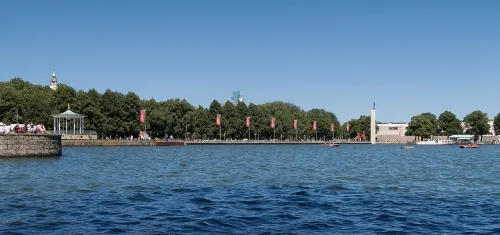
    The Maschsee is an artificial lake of 78 hectares south of the city centre, the largest body of water in Hanover, and today a place for walking, relaxing and water sports. It's free and open at any hour. The name comes from the Leinemarsch, the 'marsh', the low floodplain of the Leine where the lake was built.

    The idea goes back to the late 19th century. The Leine and Ihme rivers regularly flooded the city in spring after the snow melted in the Harz, and a lake promised to lower the risk and make better use of the valley. Over the decades plans of every size came and went, including one with a shooting range on an island.

    In September 1925 the newly elected mayor Arthur Menge brought in Otto Franzius, a water engineer and professor at what is now Leibniz University Hannover, to work out the hydraulic side, while city planner Karl Elkart handled the urban design. Instead of digging into the marsh and letting the Leine flow in, they built the lake above the marsh in a kind of bowl, higher than the river, and filled it with pumps. That way, floods could not leave mud behind.

    Stretch your legs along the shore, then walk 1140 m, about 15 minutes, to the Sprengel Museum.

    Hours
    Freely accessible, no opening hours
    Price
    Free
  10. 10

    Sprengel Museum

    Sprengel Museum in Hanover, stop 10 on the self-guided walking tour

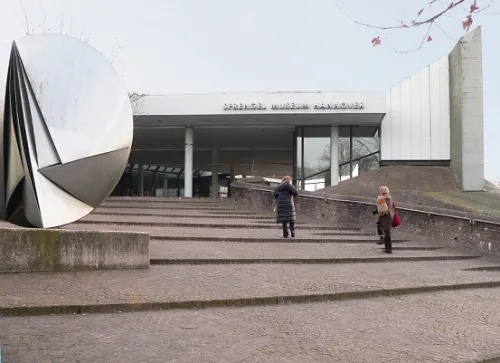
    The Sprengel Museum sits right by the Maschsee and holds one of the most significant collections of modern art in Germany. It exists because of Bernhard Sprengel, who gave his collection to the city in 1969 and helped pay for the building. The city and the state of Lower Saxony run it together. It opened in 1979 in a building by Peter and Ursula Trint and Dieter Quast and was extended in 1992.

    The key names: Kurt Schwitters, the Hanover artist, and Niki de Saint Phalle, whose Nanas you passed by the river. Beside them hang works by Max Ernst, Fernand Léger, Paul Klee, Pablo Picasso, Emil Nolde and Max Beckmann from before 1945, plus 20th-century art owned by the city and the state. In 1988 the museum also received the estate of the artist couple Robert Michel and Ella Bergmann-Michel. A darker piece of local history is here too: a monument depicting the crimes of the serial killer Fritz Haarmann.

    Go in if modern art is your thing; plan about 75 minutes. The last stop is only 350 m away, 5 minutes on foot.

    Hours
    Mon: Closed | Tue: 10:00–20:00 | Wed–Sun: 10:00–18:00
    Price
    14 EUR regular, 6 EUR reduced, under 18 free
  11. 11

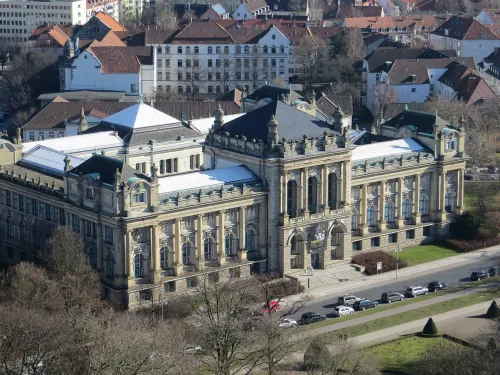
    Lower Saxony State Museum

    Lower Saxony State Museum in Hanover, stop 11 on the self-guided walking tour

    You end where you started: the Lower Saxony State Museum stands right beside the New Town Hall, on the edge of the Maschpark. Hubert Stier designed the Neo-Renaissance building, completed in 1902, because the old museum had run out of space. Look up at the relief frieze 'Key Moments in the Evolution of Humanity' by the Hanover artist Georg Herting, made together with Karl Gundelach and Georg Küsthardt.

    The collection started in 1856 as the Museum of Art and Science, opened in the presence of King George V of Hanover, and went through several names before it became the Lower Saxony State Museum in 1950. In the air raid on the night beginning 8 October 1943 the cupola was destroyed and the second floor burnt out, but most of the collection had already been evacuated. After the war the museum restarted with an exhibition in the orangery at Herrenhausen. Renovation dragged on into the 1960s, and after a full modernisation it reopened on 13 May 2000 for Expo 2000.

    Inside you find the state gallery with art from the 11th to the 20th centuries, plus archaeology, natural history and ethnology, and a vivarium with fish, amphibians, reptiles and arthropods. It's a good pick for families, since entry for children is cheap. From here the New Town Hall is next door, and the GPS navigation can take you back to the start if you need it.

    Local name
    Niedersächsisches Landesmuseum Hannover
    Hours
    Mon: Closed | Tue–Sun: 10:00–18:00
    Price
    10 EUR regular (incl. special exhibitions), 8 EUR reduced, children/youth (6-17 yrs) 2 EUR, children up to 5 free
Walking tour route map of Hanover Route loaded
New Town HallMarkthalle HannoverOld Town HallMarket Church+7
All 11 stops are already on the map.
You just press start.
AI Tour Guide

You've read the route. Now walk it with a guide in your ear.

Press start wherever you are, even hundreds of kilometres from Hanover, and the guide begins telling its stories right away. In the city, pick any of the 11 stops to start from: it leads you there, then talks with you the whole route, asking, listening, remembering, and shaping the tour around your answers.

11stops 12.8km 2 h 55 minwalking 13languages
▶Start the tour free

Free to start · Runs in your browser · No app, no download

Shorter Ways Through Hanover

The full route is a day's walk. If you have less time or one clear interest, these three sections each work on their own.

Old town core

Stops: 1, 2, 3, 4, 5

For a first visit or a short stay. Town hall, market hall, the medieval centre and the opera house lie close together: 1.27 km and 17 minutes of walking. Only the dome lift and the Market Church tower tour cost extra, both optional.

Gardens, Nanas and Waterloo

Stops: 6, 7, 8

For garden lovers and anyone following Sophia's story. From the Herrenhausen Gardens you walk 44 minutes to the Nanas and 11 more to the column, 55 minutes in total. The garden ticket is the only entry.

Lake and museums

Stops: 8, 9, 10, 11

For art lovers and families. From the column to the lake and the two museums is 52 minutes on foot. Entry is charged at the Sprengel Museum and the Lower Saxony State Museum.

How Long This Hanover Tour Really Takes

The walking alone takes 2 h 55 min, but two legs make up most of it: out to Herrenhausen and back to the river. Start in the morning, once the dome lift is running. Give the New Town Hall 45 minutes and keep the old town stops short, and you reach Herrenhausen around 13:00. After 90 minutes in the gardens you are at the Maschsee at about 16:15.

On the full route you have time for one of the two museums, which makes a day of about eight hours. The old town core takes about two hours with the dome and the church, the garden section a little under three hours, and the lake and museums around three hours with one museum, four with both.

Before You Set Off in Hanover

  • Start and finish: The recommended start is the New Town Hall, but you can join at any stop. You finish at the Lower Saxony State Museum beside the New Town Hall; if you want, the GPS navigation leads you back to the start.
  • Best days: Start in the morning so you have enough time for the indoor stops. Some of them, including the Markthalle, the Old Town Hall and both museums, are closed on certain days of the week.
  • What it costs: Walking and all outdoor stops are free, as are the Markthalle, the Old Town Hall, the Market Church and the opera foyer. You pay for the dome lift, the Market Church tower tour, the Herrenhausen Gardens, the Sprengel Museum and the Lower Saxony State Museum; most offer reduced tickets, and children enter free or cheaply at the gardens and both museums.
Walking tour route map of Hanover
AI Tour Guide

Your guide for Hanover is ready when you are.

Press start and a voice AI Tour Guide takes it from here: leading the route through Hanover, telling the stories, and turning your walk into a real back-and-forth conversation. No app or download is needed; it runs in your browser.

11stops 12.8km 2 h 55 minwalking 13languages
▶Start the tour free

Free to start · Runs in your browser · No app, no download

What the AI Tour Guide Adds on This Route

Hanover's story jumps between centuries: a medieval market town, electors who became British kings, a city bombed and rebuilt. The AI Tour Guide connects those threads as a conversation while you walk, which makes the two long legs to and from Herrenhausen go by fast. It notices whether you care more about Sophia's court, the war years or modern art and leans that way, and it takes up questions the page leaves open, such as what Caroline Herschel actually found in the night sky. You start with 100 free credits; after that you choose between this tour all-inclusive for €19.99 with no time limit, or €5 per hour.

A Real Conversation A voice AI Tour Guide greets you, leads the whole route, and tells the stories and facts as you walk, asking what you want to see and keeping a real conversation going. Not a recording you press play on.
Map Navigation Follow the route on the map and walk at your own pace. You choose where to start and when to move to the next stop.
Ask Anything Curious about a building you pass? Ask your AI Tour Guide on the spot and the conversation carries on.
13 Languages Switch language anytime. No separate tour needed.
Start free in your browser

Common Questions About Walking Hanover

Can I see inside the Hannover Opera House without a show ticket?

Only the foyer with the box office, while the box office is open. The auditorium is open to you with a performance ticket or on a booked guided tour.

When should I arrive at the Herrenhausen Gardens?

Closing time changes with the season, so in the darker months arriving in the early afternoon keeps you on the safe side. The ticket covers the Great Garden and the Hill Garden.

Can I go up the Waterloo Column?

There is an observation platform at the top, but it opens only on certain days. Ask locally if you want to try; otherwise the base with its names and cannon barrels is the main thing to see.

Which day trips combine well with Hanover?

Hildesheim is 28 km away and Celle 37 km, both close enough for a half day. For a longer trip, Lüneburg or Goslar make a full day.

Is the tour really free?

Yes. The whole tour is free: the route, the interactive map and the navigation cost you nothing. Only the voice AI Tour Guide is optional and paid: you test it with 100 free credits, then you pay either €5 per hour or €19.99 for this whole tour, with no time limit. Admission to 3 of the 11 stops is not included: Herrenhausen Gardens, Sprengel Museum and Lower Saxony State Museum charge their own entry fees.

Do I need to download an app?

No. Everything runs in your phone browser. Open the route and start walking, no download and no sign-up required.

Do I need to book the walking tour in advance?

No booking needed. This self-guided tour is available anytime. Open the route in your browser and start walking. The AI Tour Guide works instantly, no app, no reservation required.

What languages is the AI Tour Guide available in?

The AI Tour Guide speaks 13 languages, so you take the tour in your own language and can switch at any time.

Can I skip stops or change the route?

Yes. Skip any stop, spend extra time at places you like, or start the route from any point. It is your walk, you set the pace.
Image credits
▶ Start free in your browser Runs in your browser, no app, no download