Free Walking Tour Metz: Roman Walls to Chagall Glass

Six stops on 4.8 km: a medieval gatehouse, a museum under a timber roof, a Roman hall turned church and the cathedral locals call the Good Lord's lantern.

6 Stops 4.8 km ~1 h 7 min walking
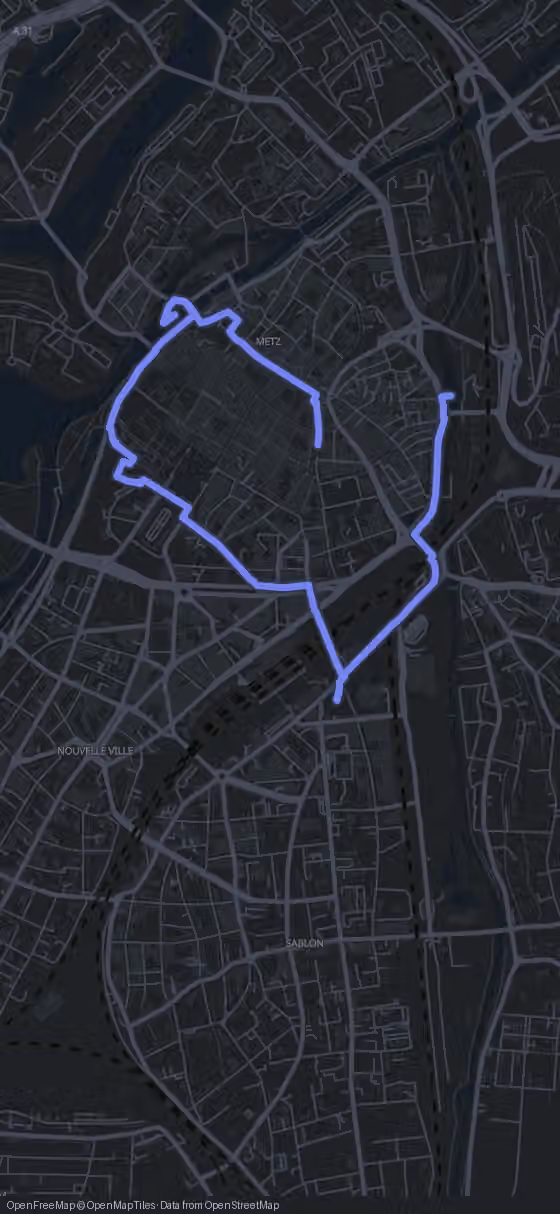
Route map for the Metz walking tour
Stop 1 of 6
1.5 km·19 min
Porte des Allemands
Head south toward the Centre Pompidou-Metz.
Bonjour, welcome to Metz. I’m Alex, and this gate’s name tells a story most people guess completely wrong.
Try this tour with Alex

What the Metz Walk Covers

Six stops on a 4.8 km line from the Porte des Allemands via the Centre Pompidou-Metz, Saint-Pierre-aux-Nonnains and the Temple Neuf to Metz Cathedral and Place Saint-Louis. Pure walking time is 1 h 7 min; with the museum and the cathedral inside, plan about four hours.

The gate, the Roman church, the cathedral and the square are free; the Pompidou and the Temple Neuf charge admission. Map and GPS navigation run free in your browser, and the optional AI Tour Guide can tell the stories as you go.

Open free GPS & optional AI Tour Guide
This short shows highlights of the route. All 6 stops follow below.

The Route

Walking Map of Metz, from Gatehouse to Arcades

6 stops 4.8 km 1 h 7 min walking
Tap to load interactive map

The 6 stops along this route

  1. Porte des Allemands in Metz, stop 1 on the self-guided walking tour
    1Porte des Allemands
  2. Centre Pompidou-Metz, stop 2 on the self-guided walking tour
    2Centre Pompidou-Metz
  3. Saint-Pierre-aux-Nonnains in Metz, stop 3 on the self-guided walking tour
    3Saint-Pierre-aux-Nonnains
  4. Temple Neuf in Metz, stop 4 on the self-guided walking tour
    4Temple Neuf
  5. Metz Cathedral, stop 5 on the self-guided walking tour
    5Metz Cathedral
  6. Place Saint-Louis in Metz, stop 6 on the self-guided walking tour
    6Place Saint-Louis
  7. That's the full route.

    Walk it with an AI Tour Guide talking you through every one of these streets.

    Start free in your browser
    You made it

Your Metz Walking Tour Stop by Stop, Six Places and Seventeen Centuries

  1. 1

    Porte des Allemands

    Porte des Allemands in Metz, stop 1 on the self-guided walking tour

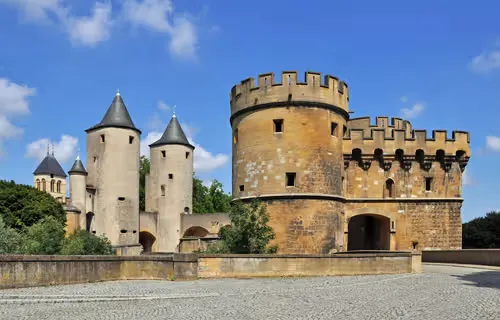
    You start at the only one of Metz's 17 medieval city gates that still stands. The Porte des Allemands, the Germans' Gate, was the main way into the city from the east, and its name has nothing to do with an invading army. It comes from the hospital of the Teutonic Order, set up around 1210 near the church of Saint-Eucaire. A more faithful translation would be the Gate of the Teutonic Knights.

    Look at it as one piece of a much larger machine. Until the middle of the 12th century, Metz still sat inside its late Roman wall. When suburbs grew up outside it, the city decided to protect its trade with a new wall, finished around 1230: 5,500 metres long, enclosing 20,000 people on 160 hectares.

    The defences never stood still. At the end of the 15th century a low outer rampart was set in front of the 13th century main wall, and by the early 16th century the circuit counted twelve gates and 76 towers. Their upkeep fell to the city and to the Metz guilds, so the craftsmen of the town literally held its walls together.

    The gatehouse is free to visit inside, so a short look fits easily into the start of your walk. If it is closed, you still see it well from outside.

    From here it is 1,330 m, about 19 minutes on foot, to the Centre Pompidou-Metz: from medieval defence to a museum that opened in 2010.
    Hours
    Tue–Sun 14:00–19:00 (May–Sep), Tue–Sun 14:00–18:00 (Oct–Apr), Mon closed
    Price
    Free
    Website
    metz.fr ↗
  2. 2

    Centre Pompidou-Metz

    Centre Pompidou-Metz, stop 2 on the self-guided walking tour

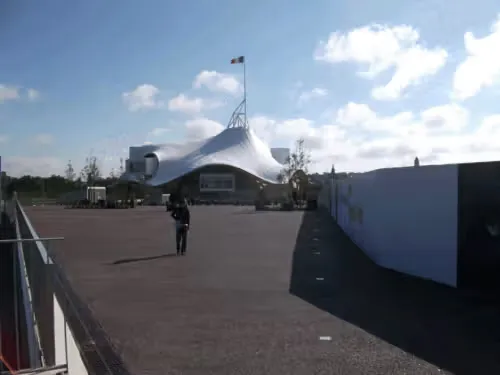
    Before you think about tickets, walk around the building. It is a large hexagon under a roof 90 metres wide and 8,000 square metres in area, made from sixteen kilometres of glued laminated timber. The beams cross to form hexagonal cells that copy the cane-work of a Chinese hat, the object that inspired the Japanese architect Shigeru Ban when he found one in Paris. In the middle rises a spire of 77 metres, a nod to 1977, the year the original Centre Pompidou opened in Paris.

    The first piece of the building was laid on 7 November 2006, and President Nicolas Sarkozy inaugurated it on 12 May 2010. As a branch of the Paris centre, it draws on the National Museum of Modern Art, Europe's largest collection of 20th and 21st century art, for semi-permanent and temporary shows. With 5,000 square metres across three galleries, a theatre and an auditorium, it is the largest temporary exhibition space in France outside Paris.

    Inside, the three rectangular galleries weave through the building on different levels and push out through the roof. Their huge windows are angled at landmarks: the Gothic cathedral, the Imperial railway station, the Arsenal concert hall by Ricardo Bofill, the Arènes sports arena by Paul Chemetov and the Seille park. The great nave covers 1,200 square metres, its ceiling climbing from 5.7 m at one end to 18 m.

    Is it worth going in? If modern art or architecture is your thing, yes: give it about 90 minutes. The museum charges admission, and the price depends on the exhibitions. If you are short on time, the roof alone rewards a slow circuit outside.

    Next comes a jump back of some 1,600 years: Saint-Pierre-aux-Nonnains is 1,310 m away, about 19 minutes on foot.

    Hours
    Mon, Wed–Thu 10:00–18:00, Fri–Sun 10:00–19:00, Tue closed (summer schedule, valid 1 Apr-31 Oct 2026); last admission to the exhibitions 30 min before closing
    Price
    7, 10 or 14 EUR depending on the exhibitions on show; under 26 free
  3. 3

    Saint-Pierre-aux-Nonnains

    Saint-Pierre-aux-Nonnains in Metz, stop 3 on the self-guided walking tour

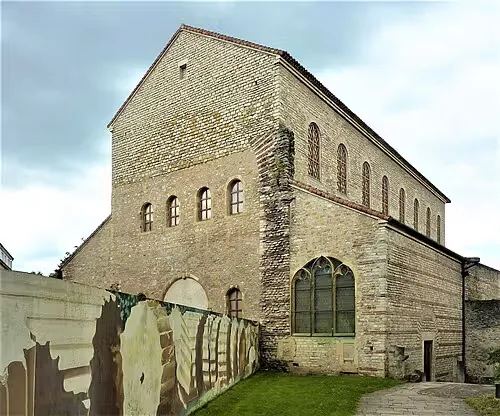
    This plain looking building is one of the oldest you will see anywhere on the walk: a Gallo-Roman hall of the 4th century, probably from the reign of Theodosius. Nobody is quite sure what it first was, perhaps the palaestra, the exercise hall, of a bath complex, perhaps a civil basilica. Look at the walls: bands of brick run between rows of cut stone. That pattern, called opus mixtum, is how you recognise the Roman masonry.

    It went up in uneasy times. The Alamanni had sacked Metz in 253, and the city ringed itself with a wall 3.5 metres thick, reusing pieces of Roman monuments and gravestones. Before the 7th century the hall became the church of a Benedictine abbey, and in that century it received a stone chancel screen to separate choir from nave; the screen is now kept in the Musées de Metz.

    Around the year 1000, when Metz belonged to the Holy Roman Empire, a Romanesque nave was built, and Emperor Otto I endowed the abbey richly. Gothic vaults followed in the 15th and 16th centuries. Then came the siege of 1552 by Charles V: François de Guise had some forty religious buildings torn down, part of this abbey among them. From 1556, with the construction of the citadel, the church became a military warehouse and stayed one into the 20th century. It was listed as a historic monument in 1909, the remains of the cloister in 1932.

    When the doors are open, entry is free, and ten or fifteen minutes are enough to feel the scale of the Roman walls from inside.

    The 1,060 m to the Temple Neuf take about 14 minutes and lead you past the Esplanade de Metz.

    Price
    Free
    Website
    metz.fr ↗
  4. 4

    Temple Neuf

    Temple Neuf in Metz, stop 4 on the self-guided walking tour

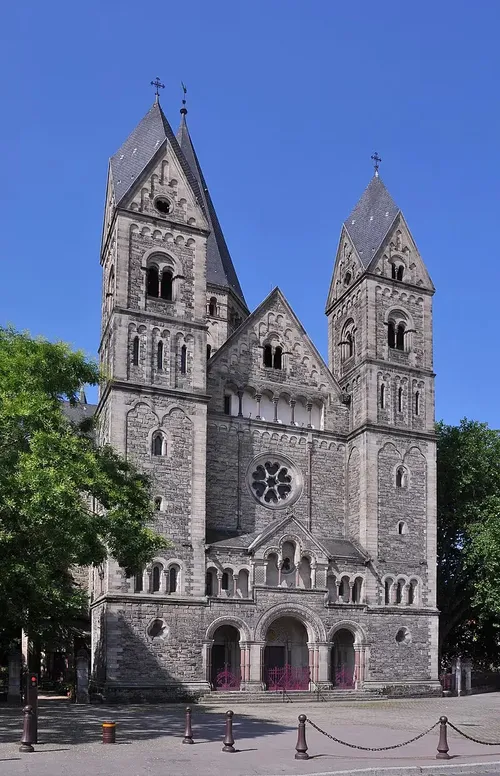
    The Temple Neuf stands on the southwestern tip of the Île du Petit-Saulcy, the little willow island, with the Moselle flowing around it. It is a Reformed Protestant church, and its existence is a direct result of the annexation of Metz after the Franco-Prussian War, when Protestant Germans moved into this traditionally Catholic city.

    By 1886 the congregation had grown to about 8,000 people. Until then they had worshipped in the former chapel of the Trinitarian order, built in 1720 and handed to the small Reformed community in 1803. It had just 350 seats. Enlarging it or taking over another church were both considered and dropped.

    In 1891 the city architect Conrad Wahn presented a first design for a new church. The largely Catholic city council had one firm condition: a domed building with no tower, so that the new church would not rise above the cathedral towers. At that point the plan was still to build on the Trinitarian site, which sits on the highest point of the old town. The church eventually rose here on the island instead.

    The setting by the water is the main reason to stop, and ten minutes outside is enough for most people. Going in costs a fee, payable at the door.

    From here it is only 430 m, about 6 minutes, to Metz Cathedral, past the Marché Couvert de Metz.

  5. 5

    Metz Cathedral

    Metz Cathedral, stop 5 on the self-guided walking tour

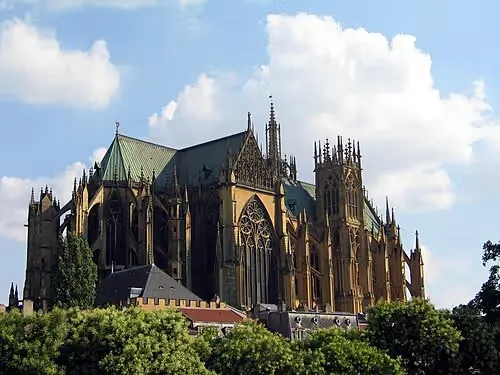
    Walk in and look up. The nave of Metz Cathedral, the Cathédrale Saint-Étienne, reaches 41.41 metres, the third highest of any cathedral in France after Amiens and Beauvais. Then look at the walls of light: 6,496 square metres of stained glass, the largest expanse in the world, which earned the building its nickname, la Lanterne du Bon Dieu, the Good Lord's lantern.

    The glass spans the centuries. The Gothic and Renaissance windows are by masters such as Hermann von Münster, Theobald of Lixheim and Valentin Bousch. Later styles follow: Charles-Laurent Maréchal for Romanticism, Roger Bissière, Jacques Villon's Cubism, Marc Chagall and the contemporary artist Kimsooja. Walking slowly around the church is the best way to read it as a history of art in coloured light.

    The site is far older than the Gothic building begun in the 13th century. A Gallo-Roman fortified town stood here from at least the first century BC, a stop on the trade road between Lyon and Trier, and later an imperial residence. Metz's first bishop, Clement, is recorded in 346. According to Gregory of Tours, the shrine of Saint Stephen was the only building spared when Attila's Huns sacked the city in 451. In the 14th century the cathedral was joined to the collegiate church of Notre-Dame, and the new transept and late Gothic choir were finished between 1486 and 1520.

    Entry is free and the church is open daily; give it at least 40 minutes. The treasury shows vestments and liturgical objects gathered over the long history of the diocese. Since 2014 the cathedral has been part of 'Metz royale et impériale', the historic centre and its German extension, on France's Tentative List for World Heritage.

    The last leg to Place Saint-Louis is 630 m, about 8 minutes.

    Local name
    Cathédrale Saint-Étienne de Metz
    Hours
    Apr–Oct: Daily 08:00–19:00 | Nov–Mar: Daily 08:00–18:00
    Price
    Free
  6. 6

    Place Saint-Louis

    Place Saint-Louis in Metz, stop 6 on the self-guided walking tour

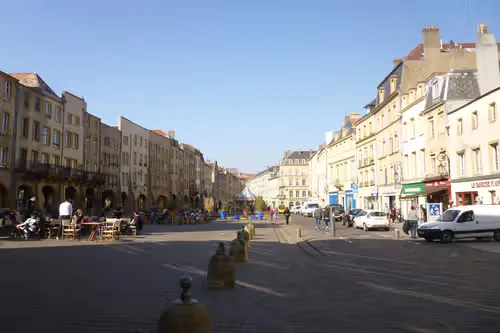
    You finish where the main lines of the pedestrian centre meet. Place Saint-Louis is lined with houses crowned by battlements, with Renaissance balconies above and arcades at street level that have stood since the Middle Ages. Together they form a covered gallery on both sides of the square, still full of shops and places to eat.

    The arcades are the key to the story. In the 13th century the city grew beyond its old limits, and the Roman wall of Divodurum, which had passed right through here in the 3rd century, lost its role. Bankers settled in the new quarter, most of them from Lombardy, and built houses with arcades that reminded them of home. In the 14th century there are said to have been more than 60 of them here. Their trade turned the square into a market and later into a fair ground known far beyond the city.

    The name rests on a mix up. The priest of the neighbouring church of Saint-Simplice, destroyed during the Revolution, put up a statue of King Louis XIII. People later took it for Saint Louis, King Louis IX, and the square was named after him. In 1867 the sculptor Charles Pêtre made a real statue of Louis IX to settle the matter; look for it at the end of the square where the Rue du Change begins.

    The square is open at all hours, so you can linger under the arcades as long as you like, though for dinner the better value lies a street or two away. If you want to return to the start, the GPS navigation can lead you back to the Porte des Allemands.

    Hours
    Open 24/7
    Price
    Free
Walking tour route map of Metz Route loaded
Porte des AllemandsCentre Pompidou-MetzSaint-Pierre-aux-NonnainsTemple Neuf+2
All 6 stops are already on the map.
You just press start.
AI Tour Guide

You know the way through Metz. Now walk it with a guide in your ear.

Press start wherever you are, even hundreds of kilometres from Metz, and the guide begins telling its stories right away. In the city, pick any of the 6 stops to start from: it leads you there, then talks with you the whole route, asking, listening, remembering, and shaping the tour around your answers.

6stops 4.8km 1 h 7 minwalking 13languages
▶Start the tour free

Free to start · Runs in your browser · No app, no download

Shorter Ways Through Metz

Not every day has room for four hours. These two cuts keep the heart of the route and drop the long first leg.

Morning start at the Pompidou

Stops: 2, 3, 4, 5, 6

For anyone who wants to start in the morning. You begin at the museum, then walk on to the Roman church, the Temple Neuf, the cathedral and the arcades: 47 minutes on foot in total. Admission applies at the Pompidou and the Temple Neuf.

Old town in an hour and a half

Stops: 3, 4, 5, 6

For a short visit or a stopover. From Saint-Pierre-aux-Nonnains to Place Saint-Louis it is 28 minutes of walking. Everything is free except the Temple Neuf, so this is also the low budget version of the route.

How Long the Metz Tour Takes, With and Without the Museum

The pure walking time is 1 h 7 min. The real time depends on two decisions: whether you go into the Pompidou (around 90 minutes) and how long you give the cathedral (40 minutes is a good minimum for the glass). Add short stops at the gate, the Roman church and the Temple Neuf and you are at about four hours.

A sample afternoon: start at the Porte des Allemands at 14:00, reach the Pompidou at 14:39, leave at 16:09, stand in Saint-Pierre-aux-Nonnains at 16:28, pass the Temple Neuf at 16:57, enter the cathedral at 17:13 and arrive on Place Saint-Louis just after 18:00.

The morning start at the Pompidou takes about three and a half hours with the museum visit; the old town version from Saint-Pierre-aux-Nonnains fits into roughly an hour and a half.

Before You Set Off at the Porte des Allemands

  • Start and end: The recommended start is the Porte des Allemands, the end is Place Saint-Louis. You can join at any stop. From the last stop, the GPS navigation can lead you back to the start if you want.
  • Best days: Plan the walk for an afternoon if you want to see inside the gatehouse, the museum and the cathedral.
  • Best time: Start at the Porte des Allemands in the early afternoon, and a late arrival at the cathedral still leaves enough time inside.
  • Seasonal note: The Pompidou's opening hours change with the season, so check them before you set out.
  • Costs: The route, map and GPS navigation cost nothing. The Porte des Allemands, Saint-Pierre-aux-Nonnains, the cathedral and Place Saint-Louis are free. The Pompidou charges admission depending on the exhibitions, and the Temple Neuf charges a fee, which you pay at the door.

Food and Breaks on the Way Through Metz

The squares on the route are lined with terraces, but the better meals in Metz tend to sit a street or two away. These are the places worth a pause, from a market lunch to a pastry that locals buy for guests.

Marché Couvert de MetzThe covered market sells affordable prepared food and picnic ingredients. Come early in the morning for the best choice and atmosphere; on the morning variant it falls neatly around lunchtime. (Between the Temple Neuf and Metz Cathedral)
Au Coeur du LibanA friendly Lebanese restaurant with hummus and pita, falafel, tabbouleh and Lebanese red wines. A good break from brasserie menus. (On a side street near Metz Cathedral)
Au Pampre d'OrClassic Lorraine cooking at 31 place Chambre: frog legs, foie gras, local fish with sorrel sauce.
L'EcluseAt 45 place Chambre, a kitchen built around local truffles, which cost less here than their Italian or southern French cousins.
Crêperie Le Saint MaloA dependable budget lunch if you just want a crêpe and a seat.
Pâtisserie MaasAt 6 rue Harelle, a pastry shop of some 50 years where the Messins buy dessert for guests. Order the chenilles, choux pastry with whipped cream. Handy on a wet afternoon, and Metz has a few of those.

Tourist Traps to Avoid in Metz Around the Cathedral and the Squares

  • Terraces on the main squares: Restaurants right on these spots charge premium prices for mediocre food. For dinner, walk one or two streets back. (Around Metz Cathedral, Place Saint-Louis and the Centre Pompidou-Metz)
  • Bread you did not order: If bread or snacks arrive at the table unasked, ask whether they cost extra before you eat them.
  • Bracelets, rings and petitions: Someone ties a string bracelet on your wrist and demands money, picks up a 'gold' ring in front of you to sell it, or asks you to sign a charity petition. Keep walking. (Around Metz Cathedral)
  • ATM that keeps your card: If a machine does not return your card, stay at the machine and call your bank; scammers remove the slot once the owner walks away.
  • Cab helpers at the station: Well dressed people offering to 'get you a cab' charge a fee for the introduction. Go to the taxi rank yourself.
Walking tour route map of Metz
AI Tour Guide

Your Metz guide is ready whenever you are.

Press start and a voice AI Tour Guide takes it from here: leading the route through Metz, telling the stories, and turning your walk into a real back-and-forth conversation. No app or download is needed; it runs in your browser.

6stops 4.8km 1 h 7 minwalking 13languages
▶Start the tour free

Free to start · Runs in your browser · No app, no download

What the AI Tour Guide Adds Between Gate and Cathedral

Metz changed hands between France and the German Empire, and that thread runs through every stop, from the Teutonic Knights' gate to the Protestant church built after 1871. The AI Tour Guide walks you through it as a conversation: it greets you, tells the stories at each place, asks what interests you and follows that, whether you want more on Charles V's siege or on how Chagall worked with the glassmakers. You can interrupt it anytime. You start with 100 free credits; after that you choose this tour all-inclusive for €19.99 with no time limit, or credits at €5 per hour.

A Real Conversation A voice AI Tour Guide greets you, leads the whole route, and tells the stories and facts as you walk, asking what you want to see and keeping a real conversation going. Not a recording you press play on.
Map Navigation Follow the route on the map and walk at your own pace. You choose where to start and when to move to the next stop.
Ask Anything Curious about a building you pass? Ask your AI Tour Guide on the spot and the conversation carries on.
13 Languages Switch language anytime. No separate tour needed.
Start free in your browser

Common Questions About Walking Metz

Is this route a good choice on a rainy day in Metz?

Yes. The gatehouse, the Pompidou, Saint-Pierre-aux-Nonnains and the cathedral all have interiors, so you can spread the outdoor legs between them.

Can I walk it in the evening?

The exteriors work at any hour and Place Saint-Louis is always open, but the gatehouse, museum and cathedral close in the evening. For the interiors, walk in the afternoon.

How do I get back to the Porte des Allemands at the end?

From Place Saint-Louis, the GPS navigation can guide you back to the start on request.

Can I combine Metz with another city on the same trip?

Easily. Nancy is 47 km away, Luxembourg City 55 km and Trier 78 km, each with its own free walking route.

Is the tour really free?

Yes. The whole tour is free: the route, the interactive map and the navigation cost you nothing. Only the voice AI Tour Guide is optional and paid: you test it with 100 free credits, then you pay either €5 per hour or €19.99 for this whole tour, with no time limit. Admission to 2 of the 6 stops is not included: Centre Pompidou-Metz and Temple Neuf charge their own entry fees.

Do I need to download an app?

No. Everything runs in your phone browser. Open the route and start walking, no download and no sign-up required.

Do I need to book the walking tour in advance?

No booking needed. This self-guided tour is available anytime. Open the route in your browser and start walking. The AI Tour Guide works instantly, no app, no reservation required.

What languages is the AI Tour Guide available in?

The AI Tour Guide speaks 13 languages, so you take the tour in your own language and can switch at any time.

Can I skip stops or change the route?

Yes. Skip any stop, spend extra time at places you like, or start the route from any point. It is your walk, you set the pace.
Image credits
▶ Start free in your browser Runs in your browser, no app, no download