Free Walking Tour Sucre: From the Plaza to La Recoleta

Walk from the main square to the Franciscan cloisters of La Recoleta and back past the bell that rang for freedom in 1809 to the hall where Bolivia declared independence.

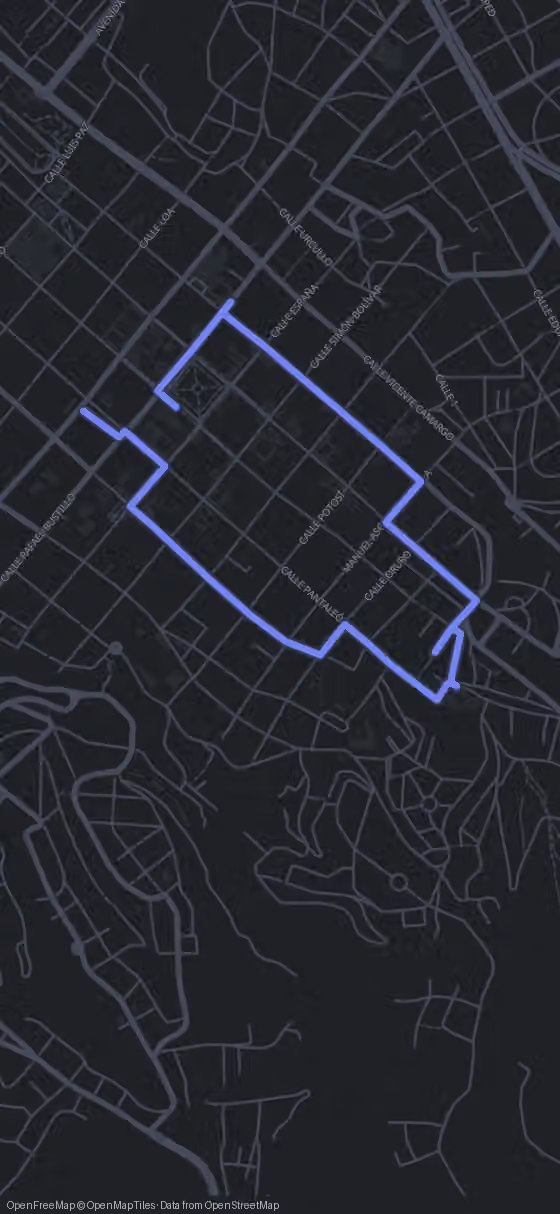
9 Stops 3.3 km ~51 min walking
Route map for the Sucre walking tour
Stop 1 of 9
350 m·4 min
Plaza 25 de Mayo
Head south-east toward the Convento de San Felipe de Neri
Hola, welcome to Sucre. I'm Alex, and one modest building here holds the paperwork that created a country.
Try this tour with Alex

What This Route Through Sucre Covers

Nine stops lead from Plaza 25 de Mayo through the colonial centre out to La Recoleta and back to the Catedral Basílica de Nuestra Señora de Guadalupe on the same square. The route is 3.3 km with 51 min of pure walking; with the interiors worth seeing, plan on about five hours.

The square, the Templo de San Lázaro and the church of the Basílica de San Francisco are free; the convents and museums charge entry. Route, map and GPS navigation run free in your browser, and the AI Tour Guide is optional.

Open free GPS & optional AI Tour Guide
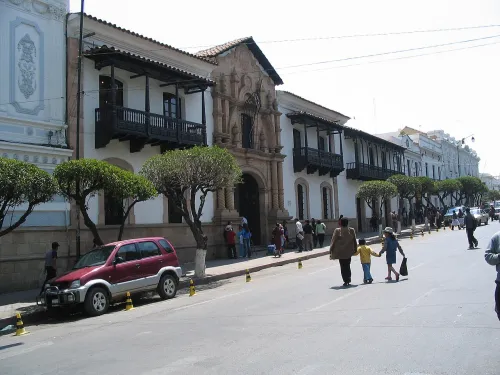
View of Sucre

The Route

Sucre Walking Map: Nine Stops on 3.3 km

9 stops 3.3 km 51 min walking
Tap to load interactive map

The 9 stops along this route

  1. Plaza 25 de Mayo in Sucre, stop 1 on the self-guided walking tour
    1Plaza 25 de Mayo
  2. Convento de San Felipe de Neri in Sucre, stop 2 on the self-guided walking tour
    2Convento de San Felipe de Neri
  3. Iglesia de la Merced in Sucre, stop 3 on the self-guided walking tour
    3Iglesia de la Merced
  4. La Recoleta in Sucre, stop 4 on the self-guided walking tour
    4La Recoleta
  5. 5Museo de Arte Indígena ASUR
  6. Templo de San Lázaro in Sucre, stop 6 on the self-guided walking tour
    6Templo de San Lázaro
  7. Basílica de San Francisco in Sucre, stop 7 on the self-guided walking tour
    7Basílica de San Francisco
  8. Casa de la Libertad in Sucre, stop 8 on the self-guided walking tour
    8Casa de la Libertad
  9. Catedral Basílica de Nuestra Señora de Guadalupe in Sucre, stop 9 on the self-guided walking tour
    9Catedral Basílica de Nuestra Señora de Guadalupe
  10. That's the full route.

    Walk it with an AI Tour Guide talking you through every one of these streets.

    Start free in your browser
    You made it

Sucre Walking Tour Stops: Convents, Churches and Independence

  1. 1

    Plaza 25 de Mayo

    Plaza 25 de Mayo in Sucre, stop 1 on the self-guided walking tour

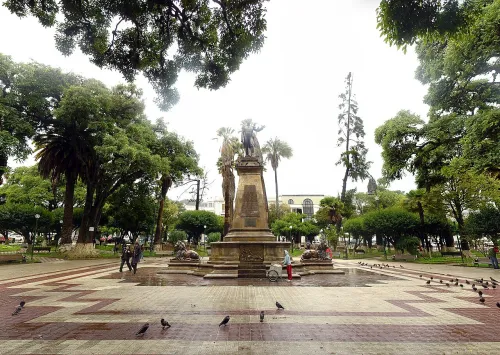
    Start in the heart of Sucre. Plaza 25 de Mayo goes by more than one name, and you'll also hear it called Plaza Mayor or Plaza de Armas. It lies at 2,798 metres above sea level, so take the first minutes slowly and let yourself adjust while you look around.

    Three liberators stand here as monuments: Simón Bolívar, Antonio José de Sucre and Bernardo de Monteagudo. Remember Sucre's face; he comes back later on this walk, at the Basílica de San Francisco, in a far less heroic role.

    Turn slowly and the political and religious centre of the city surrounds you: the Casa de la Libertad, where Bolivia's independence was signed, the cathedral, and the buildings of the Alcaldía, the city hall, and the Gobernación, the regional government. The Casa and the cathedral are the last two stops of the tour, so a first glance is enough for now; you'll be back here at the end.

    In 2014 a national law, Ley 531, declared the square part of Bolivia's cultural and historical heritage. It's free to linger as long as you like.

    From here it's 350 m, about 5 min, to the Convento de San Felipe de Neri.
    Hours
    Open 24/7
    Price
    Free
  2. 2

    Convento de San Felipe de Neri

    Convento de San Felipe de Neri in Sucre, stop 2 on the self-guided walking tour

    The Convento de San Felipe de Neri is an 18th-century convent, and it was meant to show the power of the Catholic Church in colonial society. After conservation work on its entire exterior in 2018, the stone building stands out sharply in the middle of the centre.

    Its story starts in 1767, when Dean Urquiza asked the city council of La Plata, as Sucre was then called, to hand the former Jesuit church and college to the Congregation of the Oratory of Saint Philip Neri. The foundation came later, under Archbishop José Antonio de San Alberto. He paid for the founding priests to travel from Lima, contributed 32,000 pesos from the Royal Treasury for the community's upkeep, and had church and convent built from the foundations, entirely in stone, covering the construction costs himself.

    The Oratorian chroniclers add a lovely detail: after saying mass each day, the archbishop himself carried stones from the Churuquella hill to the site, and his parishioners followed his example. Keep that hill in mind; La Recoleta stands at its foot.

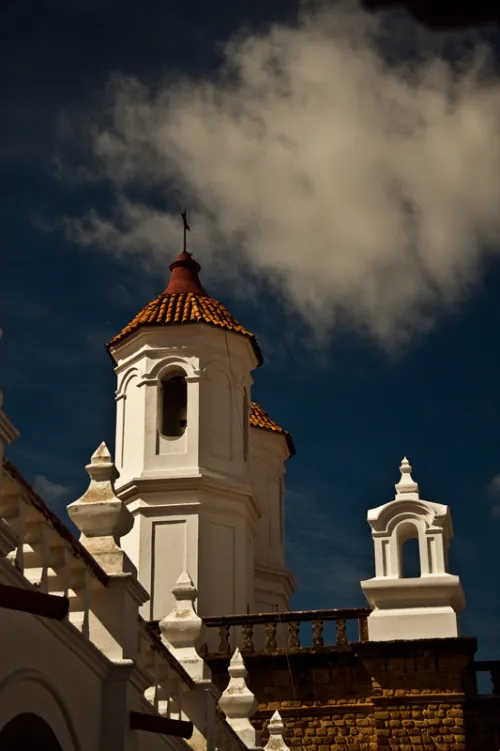
    The reason to buy a ticket is the terraces. Up among domes roofed with colonial tiles, towers and belfries decorated with silver from the mines of Potosí, you look over a city where a church went up on almost every block in colonial times, over red ceramic roofs and carved wooden balconies hung with red flowers above narrow cobbled lanes. If you go inside anywhere on this walk for the view, make it here.

    The Iglesia de la Merced is only 70 m away, a 1-minute walk.

    Hours
    Mon–Sat 14:30–17:30, Sun closed
    Price
    Bs 15
  3. 3

    Iglesia de la Merced

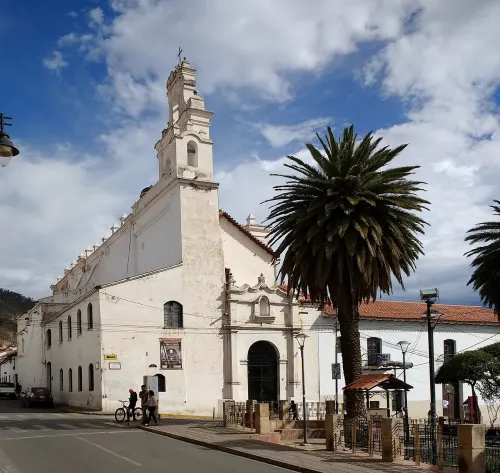
    Iglesia de la Merced in Sucre, stop 3 on the self-guided walking tour

    The Iglesia de la Merced, officially the church of Nuestra Señora de la Merced, was built between 1581 and 1630. From outside, look for the espadaña, the bell gable, which rises asymmetrically above the vaulted roof instead of sitting neatly in the middle.

    Inside, the three naves hold the church's real treasures. The canvases are by Melchor Pérez de Holguín, and the painter placed them where they hang today himself. The high altarpiece is one of the oldest in Bolivia, carved in cedar and gilded in baroque style, and attributed to Luis Niño of the Potosí school. Take a moment, too, for the wooden pulpit in mestizo baroque.

    Bolivia declared the church a National Monument in 1967 by Supreme Decree 8171, and it also holds a municipal listing. In 2013 the building was found to need repairs, and work began on raising the money for them.

    Entry is paid. It's worth it if colonial painting and carved altars are your thing; if you're saving time and budget for the museums later, the facade and the espadaña already give you the church's character.

    Now comes the longest leg of the walk: 1050 m, about 19 min, out to La Recoleta on what was once the edge of the city.

    Hours
    Mon–Sun 10:00–12:00, 15:00–18:00
    Price
    Bs. 10
  4. 4

    La Recoleta

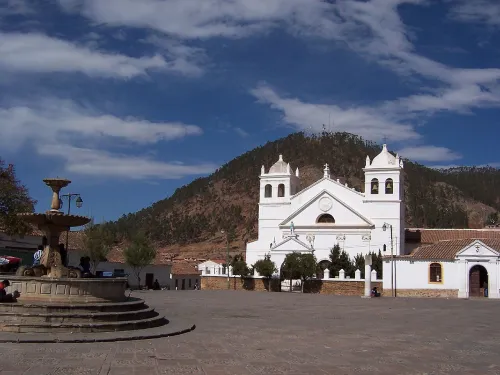
    La Recoleta in Sucre, stop 4 on the self-guided walking tour

    La Recoleta, formally Santa Ana de Monte Sion, is a Franciscan monastery at the foot of the Churuquella hill, built at the far end of the colonial city. In front of the church opens a wide square that witnessed the founding of La Plata, today's Sucre. Its fountain was made by Don Martín de Oviedo, who had won the contract at auction.

    It all began with a purchase. On 25 January 1599 Bishop Alonso Ramírez de Vergara gave a generous donation to buy the Churuquella hill from an Indigenous man named Alfonso Mara. The first stone was laid in 1600, and in 1601 Fray Francisco de Morales founded the community: a small cloister and church, as modest as the order's poverty required. As the community grew, a second floor was added to the cloister in 1650, and on 1 May 1655 Domingo Aguilar was commissioned to build further cloisters.

    After independence in 1825 the convents dwindled and passed to the secular church. In 1837 Fray Andrés Herrero asked the government to gather friars to restore the order across Bolivia; ten of them arrived in La Plata and set to work teaching and repairing convents and churches.

    Inside are square patios ringed by corridors on stone columns, with gardens of roses and geraniums, and passages leading to the restored chapel and the choir, whose thick carved wooden seats once held the singing monks. You can only go in on a guided visit, and entry is paid; for the quiet of the cloisters, it's one of the interiors worth planning your day around.

    To the east, a small square holds a chapel with the Cruz Encarnada, set up by Fray Francisco Solano in 1585 as a marker for departures toward the frontier. From here it's 240 m, about 4 min, to the Museo de Arte Indígena ASUR.

    Hours
    Mon–Fri 09:00–11:30, 14:30–16:30; Sat 09:00–11:30; Sun closed
    Price
    Bs 15 (tourists; Bs 10 residents; guided visit mandatory)
  5. 5

    Museo de Arte Indígena ASUR

    The Museo de Arte Indígena ASUR, run by the ASUR Foundation, is devoted to the art and culture of Bolivia's Indigenous communities, above all the weaving traditions of the Jalq'a and Tarabuco cultures. It grew out of a wider project to revive Indigenous textile art, supporting local artisans and saving ancestral techniques that were close to disappearing.

    Learn to tell the two styles apart and the rooms come alive. Jalq'a textiles are dense with abstract figures and mythical beings in a limited palette, mostly black and red, colours that stand for chaos and order in Andean cosmology. Tarabuco weavings are more figurative, showing everyday scenes and traditional rituals. They're used both in daily life and in religious ceremonies, and they're still made with techniques handed down from generation to generation.

    The museum is more than a showcase. Through the sale of crafts it supports the communities, helping them keep their traditions and improve their living conditions, and it organises workshops, seminars and travelling exhibitions in Bolivia and abroad.

    Entry is paid. After several churches it's a welcome change, and if living culture interests you more than colonial church art, this is the museum to choose.

    From ASUR, walk 500 m, about 7 min, to the Templo de San Lázaro.

    Hours
    Mon–Fri 09:00–12:15, 14:30–18:00; Sat 09:00–12:00, 14:30–18:00; Sun closed
    Price
    Nationals: 15 Bs., foreigners: 40 Bs.
  6. 6

    Templo de San Lázaro

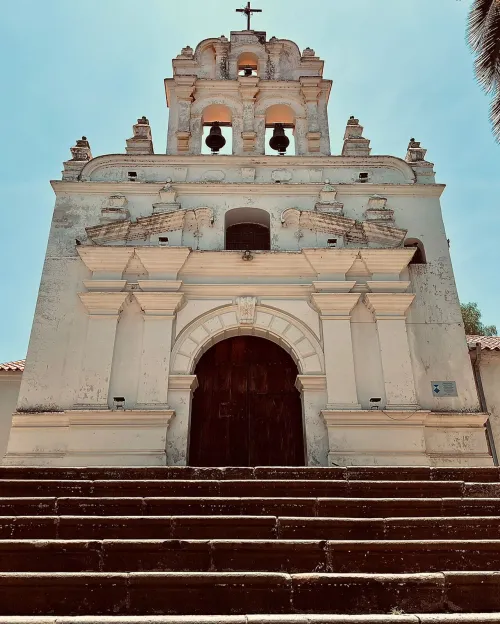
    Templo de San Lázaro in Sucre, stop 6 on the self-guided walking tour

    The Templo de San Lázaro is considered the first religious building in Bolivia, traditionally dated to around 1544 and attributed to the Dominican friars who led the evangelisation of the region. People call it Sucre's first cathedral. It never held that title, but it did serve as the town's main church for several years, and it began as a small temple of straw with a mud altar.

    Start with the outside. The facade is simple but handsome, and almost all the exterior elements are Renaissance or Mannerist. The walls and the par y nudillo timber roof survive from the original structure. In the atrium stands an open chapel, built in 1790 by the priest Juan Alejo Zelaya to teach the farming communities during Lent. It's one of the few surviving examples of an open chapel in South America, a form more common in Sucre than elsewhere in the Americas and rooted in Andean rites older than the conquest.

    Because of that chapel, San Lázaro later became a parish for the Indigenous population, mainly the Poconas and the Yamparas.

    Inside, baroque altarpieces carry more detail and visual weight. The main retablo is by Juan Hernández, a 16th-century sculptor, and paintings by Siciliano Polanco show scenes from the life of Saint Lazarus and other saints. The church is free, with donations appreciated, but its doors open mainly for mass, so getting in depends on your timing.

    Next comes the Basílica de San Francisco, 780 m and about 10 min away.

    Hours
    Mon–Sat 19:00 (mass); Sun 07:00, 10:00, 19:00 (mass)
    Price
    Free (donation appreciated)
  7. 7

    Basílica de San Francisco

    Basílica de San Francisco in Sucre, stop 7 on the self-guided walking tour

    The Basílica de San Francisco, locally San Francisco de Charcas, was built between 1539 and 1581 as the church of the Franciscan monastery in what was then Chuquisaca. Look at the two towers: they're noticeably different, and together with one main nave and one side nave, they make the whole building strikingly asymmetrical. It's part of Sucre's historic centre, a UNESCO World Heritage Site.

    When the main nave was finished in 1580, the remains of the city's founders were moved here in a ceremony from the Chapel of the Immaculate Conception, and the church was consecrated the following year. In 1996 the crypt reopened, revealing burials from the city's founding era.

    This is where the uprising of Chuquisaca broke out on 25 May 1809, remembered as the “first cry of freedom in America”, which was followed by the independence wars in Buenos Aires, Chile and Mexico. The bell in the tower, today called “Libertad”, rang long and loud that day. The date may sound familiar: it's in the name of the square where you started.

    Independence brought the friars no peace. In 1825 President Antonio José de Sucre, the man on the plaza monument, expropriated the Franciscans and gave church and monastery to the municipality and the Ministry of War; the church became a store for weapons and ammunition. He also ordered the arcades in front of it on the Plaza de San Francisco. Worship returned in 1868, a restoration respecting the original structure followed in 1946, and in 1999 Pope John Paul II raised it to a minor basilica.

    The church is free; the museum and the bell tower charge entry, worth it if you want to get close to the Libertad bell. Then it's 240 m, about 3 min, to the Casa de la Libertad, passing the Museo del Tesoro on the way.

    Local name
    Basílica de San Francisco de Charcas
    Hours
    Museum: Mon–Sat 10:00–12:00, 15:00–17:00; Mass: Mon–Fri 07:00, 19:00; Sat 07:00; Sun 07:00, 10:30, 17:00, 19:00
    Price
    Bs 15 museum & bell tower (church free)
  8. 8

    Casa de la Libertad

    Casa de la Libertad in Sucre, stop 8 on the self-guided walking tour

    Back on Plaza 25 de Mayo, the Casa de la Libertad is where the Act of Independence of Bolivia, then Upper Peru, was signed in 1825. Bolivia's first constitution was drafted here, and Congress met in the building until 1898.

    It started life as a chapel in the Jesuit block of La Plata and housed the Aula Magna, the great hall of the Royal and Pontifical University of San Francisco Xavier of Chuquisaca. Look at the facade for the university's coat of arms.

    Today it counts as Bolivia's most important history museum, run since 1995 by the Cultural Foundation of the Central Bank of Bolivia. You'll find relics, portraits and effigies of historical figures, unpublished documents, newspapers, pamphlets, maps and plans, some of them several centuries old, plus a library on historical geography. Most of it was gathered over decades by the Geographic and Historical Society of Sucre, founded in 1886, which was entrusted with the house in 1939. In 1974 the Central Bank took over its repair and care.

    Entry is paid. If you go inside only one building on the whole walk, make it this one: everything you've heard about 1809 and 1825 comes together in these rooms.

    The cathedral is just 110 m away, a 2-minute walk.

    Hours
    Mon–Fri 08:30–16:30, Sat–Sun 09:00–13:00
    Price
    Bolivian nationals Bs. 20, foreigners Bs. 50
  9. 9

    Catedral Basílica de Nuestra Señora de Guadalupe

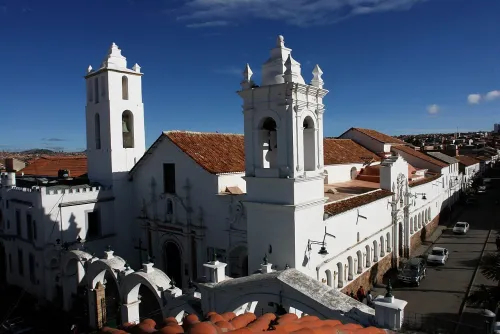
    Catedral Basílica de Nuestra Señora de Guadalupe in Sucre, stop 9 on the self-guided walking tour

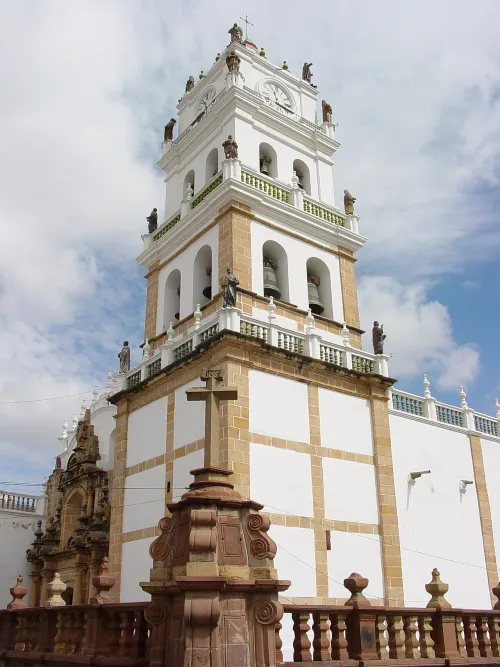
    The Catedral Basílica de Nuestra Señora de Guadalupe, known locally as the Catedral Metropolitana de Sucre, closes the tour on Plaza 25 de Mayo. Construction began in 1551 and, through several rebuilds and extensions, went on for almost two centuries. That long building history is why Renaissance, baroque, neo-Gothic and neoclassical features stand side by side here, with mestizo influences mixed in.

    Look up at the tower: it carries terracotta figures of the twelve apostles and the four evangelists. Between 2017 and 2021 the facades, tower, roofs, atrium and interior were conserved and restored, and the cathedral was added to the municipal cultural heritage in 2018.

    Beside the cathedral stands the Chapel of the Virgin of Guadalupe, from 1617, the most important chapel of the complex. It holds the image of Our Lady of Guadalupe, patron of Sucre, painted by Fray Diego de Ocaña in 1601. The people of Sucre have covered her with jewellery and ornaments; on one mantle, set into embossed silver, you can see precious stones and pearls. Locals call her the Mamita de Guadalupe. Distinguished figures and nobles lie in the crypts.

    Entering the cathedral for worship is free. The cathedral museum, holding one of Bolivia's finest collections of sacred art from the 16th century onward, charges entry, and so do the viewpoint and bell tower. For a last look over the city you've just walked, the tower makes a fitting finale.

    Local name
    Catedral Metropolitana de Sucre
    Hours
    Museum: Mon–Fri 09:00–12:00, 15:00–18:30; Sat 09:00–18:30; Sun closed (Mass: Thu & Sun 09:00)
    Price
    Museum: foreigners 30 Bs, nationals 30 Bs, children 5 Bs; viewpoint and bell tower: 15 Bs (cathedral entry free for worship)
Walking tour route map of Sucre Route loaded
Plaza 25 de MayoConvento de San Felipe de NeriIglesia de la MercedLa Recoleta+5
All 9 stops are already on the map.
You just press start.
AI Tour Guide

You've read the route. Now walk it with a guide in your ear.

Press start wherever you are, even hundreds of kilometres from Sucre, and the guide begins telling its stories right away. In the city, pick any of the 9 stops to start from: it leads you there, then talks with you the whole route, asking, listening, remembering, and shaping the tour around your answers.

9stops 3.3km 51 minwalking 13languages
▶Start the tour free

Free to start · Runs in your browser · No app, no download

Shorter Ways to Walk Sucre's Centre

The full loop fills most of a day once you go inside. These splits keep the walking in one piece and let you pick what matters to you.

Convents and textiles

Stops: 1, 2, 3, 4, 5

For travellers who want the rooftop view, colonial church art and the calm of La Recoleta. About 29 min of walking. San Felipe de Neri, the Merced, La Recoleta (guided visit only) and the ASUR museum all charge entry.

The road to independence

Stops: 6, 7, 8, 9

For history lovers who start at San Lazaro and end on the main square. About 15 min of walking. San Lazaro and the San Francisco church are free; the San Francisco museum and bell tower, the Casa de la Libertad and the cathedral museum and tower charge entry.

One hour of 1809 and 1825

Stops: 7, 8, 9

For a short visit focused on the freedom story: the Libertad bell, the signing hall and the cathedral. About 5 min of walking. Entry applies to the San Francisco museum and tower, the Casa de la Libertad and the cathedral museum.

How Long the Sucre Tour Takes, With and Without Interiors

Pure walking time is 51 min, and the longest leg is the 19-minute walk from the Merced out to La Recoleta. If you only look from outside and pause a few minutes at each stop, you'll be done in under two hours.

Add the interiors that reward the time, the terraces of San Felipe de Neri, the guided visit of La Recoleta, the ASUR textiles, the Casa de la Libertad and the cathedral museum, and the walk grows to about five hours. The convents and textiles split takes around three hours with its four interiors; the independence split takes a little over two hours; the short 1809 and 1825 version fits into an hour if you skip the Casa de la Libertad, and needs about two with it.

Before You Set Out in Sucre

  • Start: The recommended start is Plaza 25 de Mayo, but you can join the route at any stop and follow it from there.
  • Finish: The tour ends at the cathedral on Plaza 25 de Mayo, so you finish on the same square where you began.
  • Timing: Several interiors open only for part of the day, and La Recoleta can be seen inside only on a guided visit. If going inside matters to you, check the hours of those stops and start early enough to fit them in.
  • Entry: San Felipe de Neri, the Merced, La Recoleta, the ASUR museum, the Casa de la Libertad, the San Francisco museum and bell tower and the cathedral museum and tower charge entry. The plaza, San Lazaro (donations welcome) and the San Francisco church are free.
  • Altitude: The main square lies at 2,798 m above sea level, so set an easy pace, especially on the longer leg to La Recoleta.
  • AI Tour Guide: Optional. You get 100 free credits to start; after that, this tour all-inclusive costs €19.99 with no time limit, or you pay €5 per hour in credits.
Walking tour route map of Sucre
AI Tour Guide

Your guide is ready when you reach the plaza.

Press start and a voice AI Tour Guide takes it from here: leading the route through Sucre, telling the stories, and turning your walk into a real back-and-forth conversation. No app or download is needed; it runs in your browser.

9stops 3.3km 51 minwalking 13languages
▶Start the tour free

Free to start · Runs in your browser · No app, no download

What the AI Tour Guide Adds Between Sucre's Churches

On this route the stories connect: the stones carried from Churuquella for San Felipe de Neri, the same hill behind La Recoleta, the bell of 1809 and the signing of 1825. The AI Tour Guide tells them as one conversation, notices whether you lean toward textiles, church art or independence history, and goes deeper where your interest is. Ask what became of Bernardo de Monteagudo or who the Poconas and Yamparas were, and interrupt whenever something on the street catches your eye.

A Real Conversation A voice AI Tour Guide greets you, leads the whole route, and tells the stories and facts as you walk, asking what you want to see and keeping a real conversation going. Not a recording you press play on.
Map Navigation Follow the route on the map and walk at your own pace. You choose where to start and when to move to the next stop.
Ask Anything Curious about a building you pass? Ask your AI Tour Guide on the spot and the conversation carries on.
13 Languages Switch language anytime. No separate tour needed.
Start free in your browser

Common Questions About Walking Sucre

Can I visit La Recoleta without a guide?

Not inside: the monastery can only be visited on a guided visit, and entry is paid. The open square in front of the church, with its fountain, and the small square with the Cruz Encarnada chapel you can see on your own.

Why do I keep hearing the names La Plata and Chuquisaca?

La Plata is Sucre's earlier name, still in use when the Oratorian and Franciscan stories on this walk took place. Chuquisaca appears in the name of the old university and in the uprising of 1809.

Which interior should I choose if I only have time for one?

For independence history, the Casa de la Libertad; for the view over the rooftops, the terraces of San Felipe de Neri; for living Indigenous culture, the ASUR museum.

How is Potosí connected to what I see in Sucre?

Twice on this walk: the belfries of San Felipe de Neri carry silver from Potosí's mines, and the Merced's high altar is attributed to the Potosí school. Potosí is 80 km away, and the Potosí walking tour picks up that thread.

Is the tour really free?

Yes. The whole tour is free: the route, the interactive map and the navigation cost you nothing. Only the voice AI Tour Guide is optional and paid: you test it with 100 free credits, then you pay either €5 per hour or €19.99 for this whole tour, with no time limit. Admission to 5 of the 9 stops is not included: Convento de San Felipe de Neri, Iglesia de la Merced, La Recoleta, Museo de Arte Indígena ASUR and Casa de la Libertad charge their own entry fees.

Do I need to download an app?

No. Everything runs in your phone browser. Open the route and start walking, no download and no sign-up required.

Do I need to book the walking tour in advance?

No booking needed. This self-guided tour is available anytime. Open the route in your browser and start walking. The AI Tour Guide works instantly, no app, no reservation required.

What languages is the AI Tour Guide available in?

The AI Tour Guide speaks 13 languages, so you take the tour in your own language and can switch at any time.

Can I skip stops or change the route?

Yes. Skip any stop, spend extra time at places you like, or start the route from any point. It is your walk, you set the pace.
Image credits
▶ Start free in your browser Runs in your browser, no app, no download