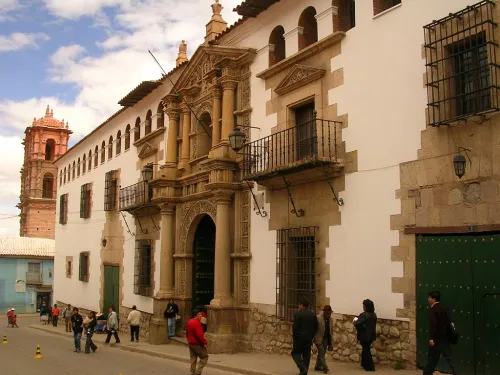
Free Walking Tour Potosí: Silver, Churches and Cerro Rico

From the old Plaza de Regocijo out to Cerro Rico, the silver mountain behind the Spanish dollar, and back past carved church fronts to the mint that struck it.

8 Stops 10.9 km ~2 h 52 min walking
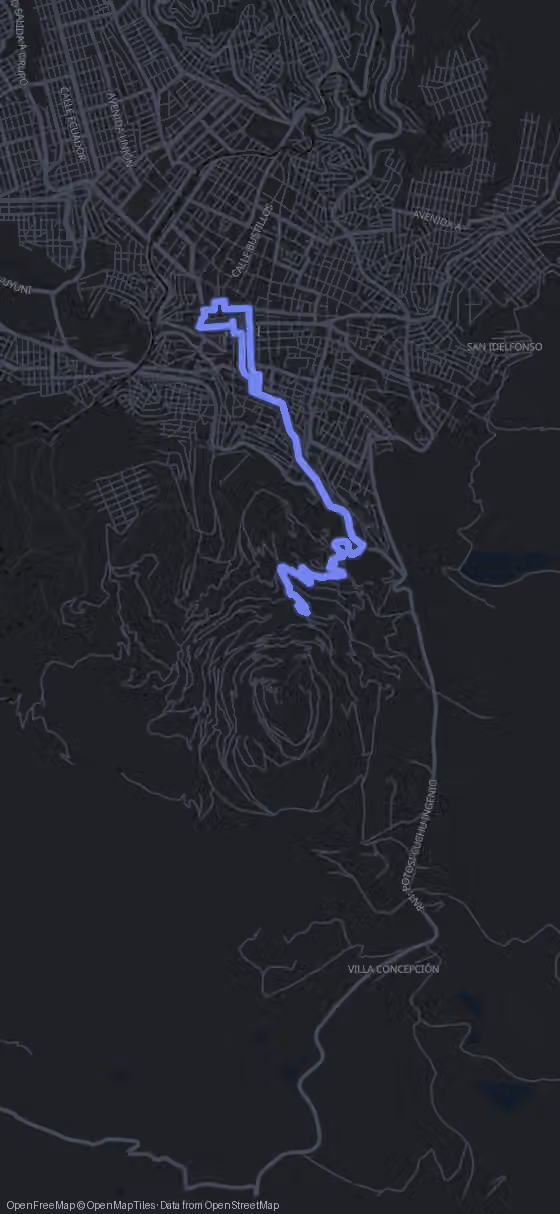
Route map for the Potosí walking tour
Stop 1 of 8
290 m·4 min
Plaza 10 de Noviembre
Head south toward the Iglesia y Convento de San Francisco.
Welcome to Potosí. I'm Alex, and behind one convent wall survives the private world of girls who once entered for life.
Try this tour with Alex

Potosí on Foot: Eight Stops at a Glance

Eight stops lead from Plaza 10 de Noviembre out to Cerro Rico and back to the Casa Nacional de la Moneda de Bolivia: 10.9 km with 2 h 52 min of pure walking. Seen mostly from outside, that makes about four hours; with a few visits inside, plan a full day.

The square and the mountain are free; the churches, the convent museum and the mint charge entry. The GPS route in your browser costs nothing and leads you from stop to stop, and the AI Tour Guide is optional if you'd like the stories told as you walk.

Open free GPS & optional AI Tour Guide
View of Potosí

The Route

Walking Map of Potosí: Centre, Mountain and Mint

8 stops 10.9 km 2 h 52 min walking
Tap to load interactive map

The 8 stops along this route

  1. Plaza 10 de Noviembre in Potosí, stop 1 on the self-guided walking tour
    1Plaza 10 de Noviembre
  2. Iglesia y Convento de San Francisco in Potosí, stop 2 on the self-guided walking tour
    2Iglesia y Convento de San Francisco
  3. Cerro Rico in Potosí, stop 3 on the self-guided walking tour
    3Cerro Rico
  4. Catedral Basílica de Potosí, stop 4 on the self-guided walking tour
    4Catedral Basílica de Potosí
  5. Iglesia de San Lorenzo de Carangas in Potosí, stop 5 on the self-guided walking tour
    5Iglesia de San Lorenzo de Carangas
  6. Museo y Convento de Santa Teresa in Potosí, stop 6 on the self-guided walking tour
    6Museo y Convento de Santa Teresa
  7. Torre de la Compañía de Jesús in Potosí, stop 7 on the self-guided walking tour
    7Torre de la Compañía de Jesús
  8. Casa Nacional de la Moneda de Bolivia in Potosí, stop 8 on the self-guided walking tour
    8Casa Nacional de la Moneda de Bolivia
  9. That's the full route.

    Walk it with an AI Tour Guide talking you through every one of these streets.

    Start free in your browser
    You made it

Your Potosí Walking Tour from Plaza to Mint, Stop by Stop

  1. 1

    Plaza 10 de Noviembre

    Plaza 10 de Noviembre in Potosí, stop 1 on the self-guided walking tour

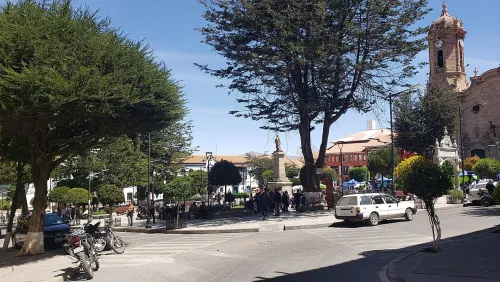
    Start on Plaza 10 de Noviembre, the square at the heart of the old Villa Imperial. Look for its four sculptures: the Statue of Liberty, a heron in one of the fountains, a muse and a cherub. Around the edges stand the buildings that ran colonial Potosí: the Casas Reales, the site of the first mint, the main church that is today's cathedral, and the Cabildo, the old town council.

    The square in its present form dates from the late 19th century, but the space is older. People once called it the Plaza de Regocijo, the Square of Rejoicing, after the celebrations held here. Today it is listed as part of Bolivia's cultural heritage.

    In 2014 the plaza was remodelled with new planting in the beds, new water fountains and restored sculptures. It reopened on 9 November that year, timed to honour the uprising of 1810, one of the events that led to Bolivian independence in 1825. Civic and cultural events take place here throughout the year, so you may well find a ceremony or a stage set up.

    Take a few minutes here; it costs nothing. Then walk 290 m, about 4 minutes, to the Iglesia y Convento de San Francisco, home of the first religious order to settle in Potosí.
    Hours
    Open 24/7
    Price
    Free
  2. 2

    Iglesia y Convento de San Francisco

    Iglesia y Convento de San Francisco in Potosí, stop 2 on the self-guided walking tour

    The Franciscans were the first order to establish themselves in Potosí, founding this convent in 1547 at the request of General Pedro de Hinojosa and Fray Gaspar de Villarroel. Like most churches of those early years, the first building was modest, and as the silver town grew it soon proved too small; in the 17th century it was extended.

    The church you see today is a second start. In 1707 the old church was pulled down, and the new one was finished in 1726 and inaugurated on 13 October that year. It is a basilica with three naves on cross-shaped pillars: a barrel vault over the central nave, domes over the side aisles and three more domes over the crossing. The walls are lime and rubble stone, and a two-tier tower rises beside the portal.

    The real reason to go inside is the cloister. It is Renaissance, square and carved in stone, with seven round arches on each side resting on Doric columns. It dates from the 16th century, originally had just one storey and is considered the oldest cloister in Bolivia. In the church, look for the altarpiece made for the cross.

    Entry is paid and visits run as guided tours at set times, so if early colonial architecture is your thing, plan your day around them; otherwise the façade and tower are worth a look from outside. From here the longest leg of the route begins: 4580 m, about 85 minutes on foot, out of the centre to Cerro Rico.

    Hours
    Mon–Fri: 1st tour 15:00, 2nd tour 16:00
    Price
    Bs 20
  3. 3

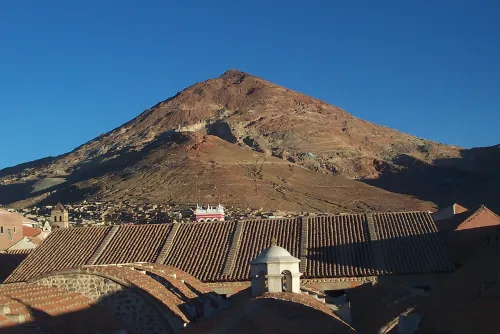
    Cerro Rico

    Cerro Rico in Potosí, stop 3 on the self-guided walking tour

    Cerro Rico, the Rich Mountain, is the reason Potosí exists. It also goes by Cerro Potosí and by its Quechua name Sumaq Urqu, from sumaq, beautiful or good, and urqu, mountain. Popular imagination long pictured it as made of silver ore, and that was not far off: it counts as the richest silver deposit in human history.

    The Spanish began extracting ore here in 1545. From the 16th to the 18th century, 80 percent of the world's silver came out of this one mountain, and around 85 percent of the silver produced in the central Andes in that era. Most of it was shipped to Spain, and on the back of it Potosí grew into one of the largest cities in the New World. The first century of mining reshaped the mountain itself, including the removal of its top; it took on its present form in the 17th century.

    There is a national symbol here too. Tradition says Simón Bolívar once waved a flag from the summit, a gesture tied to the founding of a new nation. One year later Congress changed the flag's colours to yellow, red and green and added a coat of arms with a condor, an alpaca and Cerro Rico itself.

    Look at the slopes and you see a largely barren mountain; only a few plant species have taken hold, and vizcachas live on its flanks. Mining has never stopped. Cooperatives work underground, and the large San Bartolomé open-pit mine is run by Empresa Minera Manquiri. The human cost is high: without proper protection against constant dust, many miners develop silicosis, and their life expectancy is around 40 years.

    Being here is free. Then head back to the centre: 4850 m, about 67 minutes, to the Catedral Basílica de Potosí on Plaza 10 de Noviembre.

    Hours
    Open 24/7
    Price
    Free
  4. 4

    Catedral Basílica de Potosí

    Catedral Basílica de Potosí, stop 4 on the self-guided walking tour

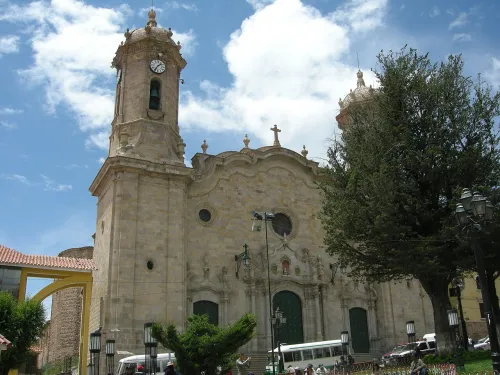
    Back on the main square, the Catedral Basílica de Potosí shows a stone façade in viceregal baroque with clear neoclassical influence. It stands on the spot of the old main church, which collapsed in 1807; work on the new building began on 6 September 1808.

    The man behind it was Fray Manuel de Sanahuja, a Spanish Franciscan friar and trained architect who brought neoclassicism to Potosí and designed other religious and civic buildings in the city at the same time. He later moved to La Paz and died there in 1834, two years before his cathedral was finished. It was solemnly consecrated on 4 April 1838, with President Marshal Andrés de Santa Cruz as sponsor of the ceremony.

    Historians see it as the close of an era: with this cathedral Potosí's colonial building tradition ends, and the long line of great Spanish American cathedrals reaches its culmination in the neoclassical style. Today it is a minor basilica of the Diocese of Potosí.

    Inside are important religious relics in gold and silver and an organ donated by Simón I. Patiño, and part of the building serves as a museum of religious art. Entry is paid; it's worth it if you want to see that gold and silver work up close. Then walk 410 m, about 5 minutes, to the Iglesia de San Lorenzo de Carangas.

    Hours
    Mon–Sat: 09:00–12:00, 14:30–18:00
    Price
    Bs 20
  5. 5

    Iglesia de San Lorenzo de Carangas

    Iglesia de San Lorenzo de Carangas in Potosí, stop 5 on the self-guided walking tour

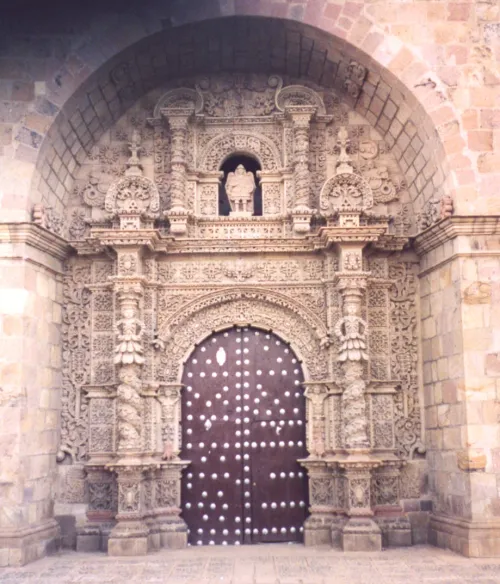
    Here the façade is the main event. The stone portal of the Iglesia de San Lorenzo de Carangas is laid out like an altarpiece and was carved in diorite between 1728 and 1744, in a richly ornamented baroque-mestizo style. Look for the columns held up by figures in human form, the angels playing music and the double-headed eagles.

    Who carved it? It is often attributed to Luis Niño, a painter and sculptor from Charcas, because the same kinds of elements appear in his Virgen Sabaya and the side altarpiece of La Merced. No document has turned up that proves it, so his name remains a well-founded guess.

    The church itself is much older. Under the name La Anunciación it was, together with Santa Bárbara, one of the first two churches in the city. Building began in 1548 as a parish for Spaniards and dragged on until 1552 for lack of cedar for the roof. Ten years after work started, a heavy snowfall brought it down and it had to be repaired. When Viceroy Toledo arrived in 1572 it was renamed San Lorenzo de Carangas and dedicated to the worship of the indigenous Carangas people; once the cathedral was built, it became an indigenous parish. The dome and the portal came with the major remodelling of the 18th century.

    The parish kept a crucifix of great popular devotion, honoured with processions and novenas during an epidemic in 1719 and a drought in 1729, and a confraternity of the Holy Sacrament met here. In 1809 descendants of the Carangas fought off an attempt to move them to the parish of Tarapaya, citing their 'very ancient' claim to this church: their identity held together around it until the last decades of colonial rule.

    The museum inside charges entry; the façade is free from the street and is enough for most visitors. On to the Museo y Convento de Santa Teresa: 400 m, about 5 minutes.

    Hours
    09:00–16:00
    Price
    Bs 10 nationals / approx. Bs 40 foreigners (museum; typical Potosí joint-ticket rate)
  6. 6

    Museo y Convento de Santa Teresa

    Museo y Convento de Santa Teresa in Potosí, stop 6 on the self-guided walking tour

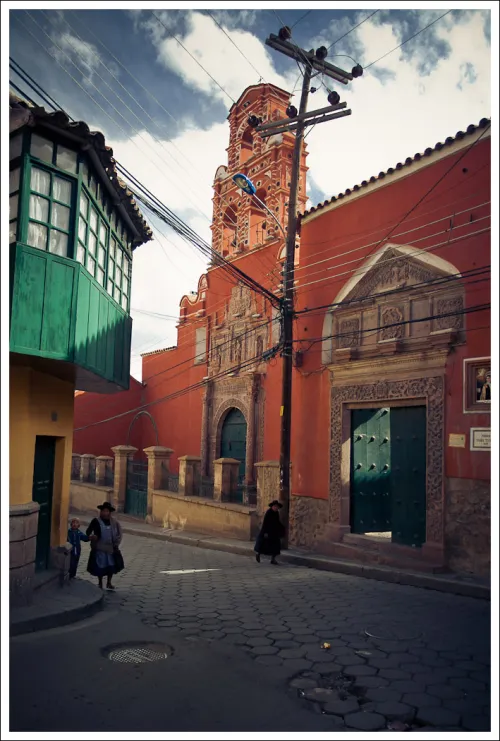
    Behind the baroque façade of the Museo y Convento de Santa Teresa lies a 17th-century Carmelite convent. A royal decree signed in Madrid on 26 July 1684 allowed it; the land was donated by José Fernández Lozano, a cleric and wealthy miner, and noble couples of the viceroyalty paid for the building and its endowment. On 24 December 1685 the first four Discalced Carmelite nuns arrived and the enclosed convent opened.

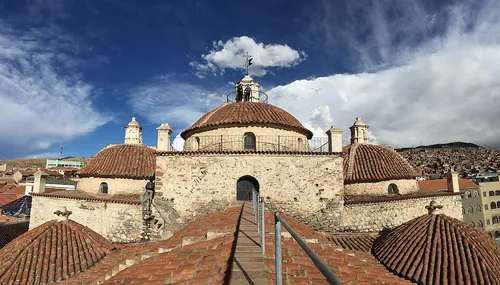
    The church has a single nave, as was usual for nuns' convents. It was finished in 1691 and first used on 26 April 1692. Look up: the ceiling holds 1943 coffers in Mudéjar style, painted mostly red, with blue flowers and edges in gold leaf. There is a high choir, a musicians' gallery beneath it and a low choir on the cloister side.

    The building details reward a closer look. The roof still has its paired wooden rafters, and the woven cane lattice is lashed together with strips of wet cowhide. The convent once had seven patios and hermitages; they are gone, but two cloisters have been restored as part of the museum. The first patio, with 32 wooden columns, Ionic capitals and a fountain in the middle, is the one to linger in.

    Declared a National Monument on 4 November 1930, the convent began to be set up as a museum in 1976 and opened two years later with 15 rooms around the first patio. Entry is paid, and this is the inside visit to choose if convent life and painted ceilings interest you. From here it's 220 m, about 4 minutes, to the Torre de la Compañía de Jesús.

    Hours
    Mon–Sat 09:00–12:30, 15:00–18:00; Sun & Holidays 09:00–12:00, 15:00–18:00 (closed Tue morning & Sun morning)
    Price
    Bs 15
  7. 7

    Torre de la Compañía de Jesús

    Torre de la Compañía de Jesús in Potosí, stop 7 on the self-guided walking tour

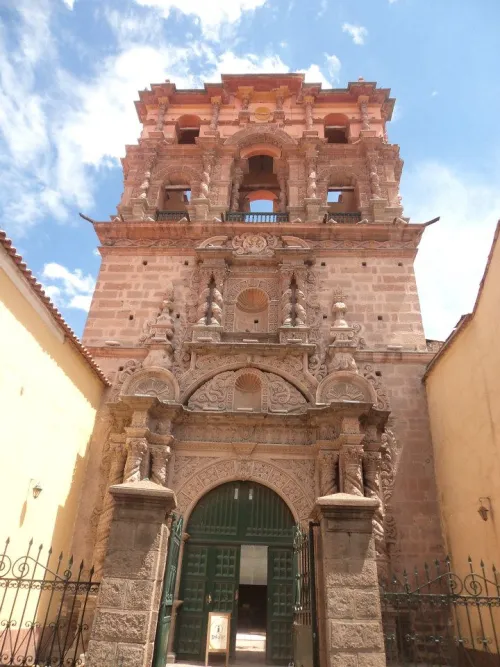
    The Torre de la Compañía de Jesús, locally the Torre de la Compañía, is counted as the main religious monument of 18th-century Bolivia. It was conceived as a triumphal arch: five openings, 32 columns and three half-orange domes, an open display of Catholic splendour.

    The Jesuits settled in Potosí in 1577, according to historian Mario Chacón, with Fray José de Acosta as founder. Their church went up from 1581, one block from the main square, and was finished in 1590. It was built of adobe and brick, and built badly: it collapsed, killing three Jesuits.

    The rebuilding came in the first half of the 18th century, paid for by the miner José de Quiroz. It ran from 1700 to 1707 and cost 40,000 pesos fuertes, mining money turned straight into stone.

    Going in needs a ticket; from the street the arch already tells most of the story. The Casa Nacional de la Moneda de Bolivia is close by: 130 m, about 2 minutes.

    Hours
    08:30–16:30
    Price
    Bs 10 foreigners, Bs 5 nationals
  8. 8

    Casa Nacional de la Moneda de Bolivia

    Casa Nacional de la Moneda de Bolivia in Potosí, stop 8 on the self-guided walking tour

    The Casa Nacional de la Moneda de Bolivia, the Casa de la Moneda, closes the circle that began on Cerro Rico. Most of the silver shipped across the Spanish Main left Potosí as coins: the Spanish dollar, which became the world's major international currency in the days of the Spanish Empire. The coins grew so famous that Cervantes recorded the saying valer un potosí, to be worth a Potosí, meaning a fortune.

    This is the mint's second home. The first was set up on the initiative of Viceroy Francisco de Toledo in 1572, near the Royal Palaces on the Plaza del Regozijo, today's Plaza 10 de Noviembre, where you began. The architect Jerónimo Leto finished it in three years, for over 8,000 pesos, roughly ten million dollars in today's money. Coins were struck there with rudimentary technology until 1767. Charles III of Spain is said to have remarked, on hearing what the mint cost, that the whole building must be made of pure silver.

    Trouble ran through the mint's history. In the Great Potosí Mint Fraud of 1649, officials tampered with the weight and silver content of the coins, undermining trust in the currency and bringing tighter Spanish oversight. A later scandal and investigation ended plans to reform the old works; instead a new building went up on the neighbouring Plaza del Gato. That is the one you stand in: it minted coins from 1773 to 1951 and is now a museum.

    Visits are guided, entry is paid, and it is the priciest ticket of the route. If you go inside only once today, make it here: after Cerro Rico, this is where the silver story ends, and so does your walk.

    Local name
    Casa de la Moneda de Bolivia
    Hours
    Mon–Fri tours 09:00–15:00 (ticket office closes 15:15); Sat–Sun tours 09:15–11:30 (ticket office closes 11:45)
    Price
    Bs 70 foreigners, Bs 20 nationals
Walking tour route map of Potosí Route loaded
Plaza 10 de NoviembreIglesia y Convento de San FranciscoCerro RicoCatedral Basílica de Potosí+4
All 8 stops are already on the map.
You just press start.
AI Tour Guide

You've read the route. Now walk it with a guide at your side.

Press start wherever you are, even hundreds of kilometres from Potosí, and the guide begins telling its stories right away. In the city, pick any of the 8 stops to start from: it leads you there, then talks with you the whole route, asking, listening, remembering, and shaping the tour around your answers.

8stops 10.9km 2 h 52 minwalking 13languages
▶Start the tour free

Free to start · Runs in your browser · No app, no download

Shorter and Longer Ways to Walk Potosí

Cerro Rico decides the length of your day. Take it in or leave it out:

Centre only

Stops: 1, 4, 5, 6, 7, 8

For a shorter day, or if you'd rather spend your energy inside the museums. The cathedral stands on Plaza 10 de Noviembre, so you begin on the square and then walk 1,160 m, about 16 minutes in all, from the cathedral to the mint. The square is free; the cathedral, San Lorenzo, Santa Teresa, the Torre de la Compañía and the mint charge entry.

The full silver route

Stops: 1, 2, 3, 4, 5, 6, 7, 8

For anyone who wants to stand on the mountain behind the whole story. 10.9 km and 2 h 52 min of pure walking; Plaza 10 de Noviembre and Cerro Rico are free, the other six stops charge entry.

How Long Does the Potosí Walk Take with Cerro Rico?

The 2 h 52 min of pure walking are unevenly spread. The two legs out to Cerro Rico and back account for 2 h 32 min; everything else sits close together, and the five stops from the cathedral to the mint lie just 1,160 m and 16 minutes apart.

With short looks from outside, the full route takes about four hours. Add the mint, Santa Teresa and a church or two inside and it becomes a full day. The centre-only version needs little walking, so even with the mint inside it fits into half a day.

Before You Set Off in Potosí

  • Start and finish: Plaza 10 de Noviembre is the recommended start, but you can join at any stop. The route ends at the Casa Nacional de la Moneda de Bolivia, and the GPS navigation in your browser can lead you back to the start if you like.
  • Time of day: Set off early: the walk to Cerro Rico and back alone takes more than two and a half hours, and the inside visits need time of their own.
  • Guided visits: San Francisco and the mint are visited on guided tours at fixed times. Check those times before you go; if San Francisco doesn't fit, see it from outside or do the centre stops first and come back.
  • Entry: Plaza 10 de Noviembre and Cerro Rico are free. San Francisco, the cathedral, the museum at San Lorenzo, Santa Teresa, the Torre de la Compañía and the mint charge entry, paid at each site.
Walking tour route map of Potosí
AI Tour Guide

Your guide is ready whenever you set off.

Press start and a voice AI Tour Guide takes it from here: leading the route through Potosí, telling the stories, and turning your walk into a real back-and-forth conversation. No app or download is needed; it runs in your browser.

8stops 10.9km 2 h 52 minwalking 13languages
▶Start the tour free

Free to start · Runs in your browser · No app, no download

What the AI Tour Guide Adds Between Mountain and Mint

Much of this route is the long walk to Cerro Rico and back, and the AI Tour Guide turns that time into a conversation. It greets you on the plaza, tells the stories of each place as you go, asks what caught your interest and remembers it, so by the time you reach the mint it knows whether you care more about coins, convents or the miners. Ask it things that go beyond the stops' stories, like how Potosí's coins reached markets on the far side of the world, and interrupt it whenever you like. You start with 100 free credits; after that, take this tour all-inclusive for €19.99 with no time limit, or pay €5 per hour.

A Real Conversation A voice AI Tour Guide greets you, leads the whole route, and tells the stories and facts as you walk, asking what you want to see and keeping a real conversation going. Not a recording you press play on.
Map Navigation Follow the route on the map and walk at your own pace. You choose where to start and when to move to the next stop.
Ask Anything Curious about a building you pass? Ask your AI Tour Guide on the spot and the conversation carries on.
13 Languages Switch language anytime. No separate tour needed.
Start free in your browser

Common Questions About Walking Potosí

Is the walk out to Cerro Rico worth it?

If the silver story is why you came, yes: the mountain is free and gives the mint and the churches their meaning. It takes the bulk of your walking time, though, so on a short visit stay in the centre.

Can I do this walk on a day trip from Sucre?

Sucre is 80 km away, so your time on foot is limited. The centre-only version, from the cathedral to the mint, suits a day trip far better than the full route with Cerro Rico.

Where can I walk next after Potosí?

Uyuni is 148 km away and La Paz 427 km; both have their own free walking routes with GPS navigation.

Is the tour really free?

Yes. The whole tour is free: the route, the interactive map and the navigation cost you nothing. Only the voice AI Tour Guide is optional and paid: you test it with 100 free credits, then you pay either €5 per hour or €19.99 for this whole tour, with no time limit. Admission to 5 of the 8 stops is not included: Iglesia y Convento de San Francisco, Catedral Basílica de Potosí, Museo y Convento de Santa Teresa, Torre de la Compañía de Jesús and Casa Nacional de la Moneda de Bolivia charge their own entry fees.

Do I need to download an app?

No. Everything runs in your phone browser. Open the route and start walking, no download and no sign-up required.

Do I need to book the walking tour in advance?

No booking needed. This self-guided tour is available anytime. Open the route in your browser and start walking. The AI Tour Guide works instantly, no app, no reservation required.

What languages is the AI Tour Guide available in?

The AI Tour Guide speaks 13 languages, so you take the tour in your own language and can switch at any time.

Can I skip stops or change the route?

Yes. Skip any stop, spend extra time at places you like, or start the route from any point. It is your walk, you set the pace.
Image credits
▶ Start free in your browser Runs in your browser, no app, no download