Free Walking Tour Deauville:Villas, Sand and Casino
From the 1923 market halls to a Rothschild villa, an old convent, the wooden boards and the casino Jacques Mesrine once held up: 4.5 km of Deauville on foot.
Your Deauville Walking Tour from Market Halls to Gaming Tables
1
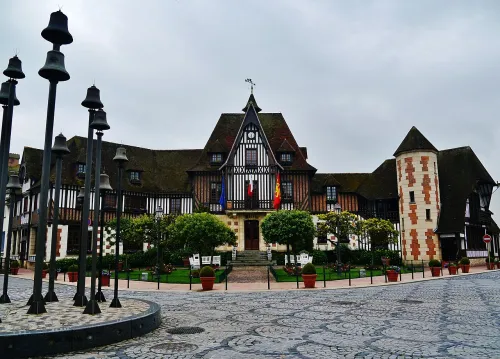
Hôtel de Ville de Deauville
Start at the building that runs Deauville rather than the ones that sell it dreams. The Hotel de Ville is the town hall: council offices and public services, the place where the resort does its paperwork. It asks for no ticket and needs very little of your time.
Whether the doors are open makes little difference for the walk, because you are here for the send-off, not the interior.
Take a moment to get your bearings, because from this spot the route tells the town's story in order: the working market, the villa money, culture in an old convent, then sand, wood and finally luck at the tables. That is the recommended order, though you can join at any point along the way.
The first leg is the shortest warm-up of the day: 410 m and about 6 minutes to the market halls.
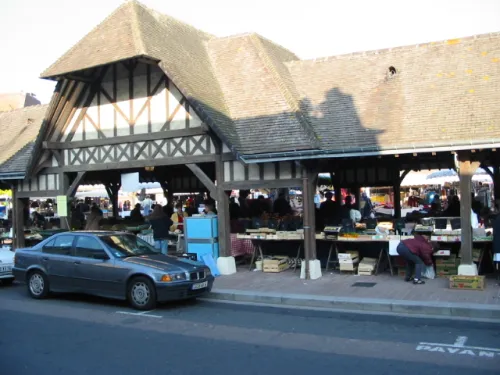
Two half-timbered halls built in 1923 hold Deauville's traditional market. Look up before you look at the stalls: flat tiled roofs, Norman timber framing and, on the ridges, painted ceramic finials, a small piece of decorative art on every roof end. Around the Place du Marché, close to Place Morny, the houses keep the same Norman look, so the whole square reads like a set piece of the old town centre.
This is still a working market, covered yet open at the sides. Local producers bring the classics of Norman cooking: fish and seafood from the nearby fishing ports, Norman poultry, cheeses, country ham, fruit and vegetables, and alongside the food you find clothes, flowers and books.
Come on a market morning. On other days, or in the afternoon, you see the halls empty, which is fine for the architecture but misses the point. Food lovers should give it half an hour; everyone else can take in the roofs and move on.
Keep those ceramic finials in mind. You will meet the same Norman details again on a far grander scale at the next stop, which is the longest leg of the route: 1510 m, about 21 minutes, from the market stalls to Villa Strassburger.
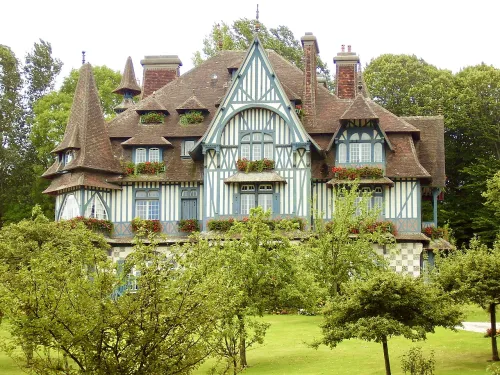
Villa Strassburger began life as a Rothschild house. Henri de Rothschild had it built between 1907 and 1912 by the Caen architect Georges Pichereau, on the site of the Ferme du Coteau, a farm bought in 1875 from Gustave Flaubert. It is the model example of the second generation of neo-Norman style: the manor-house silhouette, timber framing, flat tiles and ceramic finials of the Pays d'Auge, mixed with grander touches such as an imperial roof and small pyramid-shaped ornaments. Its facades and roof have been listed as historic monuments since 29 October 1975.
Rothschild did not keep it long. His wife was disappointed that she could not see the sea closely enough, and in 1924 the house was sold to the American billionaire Ralph Beaver Strassburger, whose name it has carried ever since. The family came for one month a year, in August, for the racing season, yet around thirty staff, including eight gardeners and six cooks, kept the villa ready all year in case they arrived unannounced. They never did.
The guests made up for it: the composer Vincent Scotto, the actress and singer Suzy Delair, the industrialist Marcel Boussac, Prince Aly Khan, the businessman Pierre Wertheimer. German troops ransacked the house during the Occupation, and the Strassburgers furnished it twice, in the 1920s and 1930s and again in 1948. That decor survives. Ralph died in 1959, his widow, a Singer heiress, in 1975, and in 1980 their son Peter gave the house and its furniture to the town.
Inside, the ground floor has two salons divided by a small, theatrical colonnade and a dining room where Lunéville porcelain sits on a console. If interiors and society stories are your thing, the guided visit is worth it. It runs by appointment only in summer and lasts an hour. Outside the summer months, enjoy the facades and walk on.
From the villa it is 1020 m, about 14 minutes, to Les Franciscaines.
Hours
By appointment: Jun–Sep; Guided tours at 11:00–12:00, 14:30–15:30, 16:00–17:00
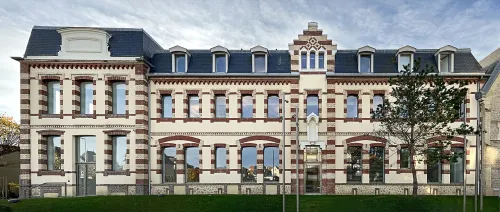
The buildings in front of you were a convent long before they were a culture house. In 1876 Adèle Mérigault bought 25 hectares of land and had the chapel of Notre-Dame de la Pitié built; a relic of Saint Francis of Assisi went into the foundation stone. An orphanage followed in 1877, and on 29 June that year four Franciscan sisters arrived from Perrou in the Orne to run the Saint-Joseph orphanage. The cloister, stables, sheds and laundry came in 1878, and the complex grew to 6500 square metres in neo-Gothic and neo-Romanesque style.
In 1905, under the law separating church and state, the sisters were told to leave. They were already packing their luggage and furniture for Mechelen when the town of Deauville called them back to keep caring for the orphans. Medical equipment arrived, Countess Le Marois founded a Deauville section of the French Red Cross in 1912, and on 6 August 1914 the orphanage became auxiliary hospital no. 16, with 102 beds by the end of that year and an eye centre from 1916.
The sisters stayed until 2012. Since 2021 the converted complex has housed the town's collections (paintings, photographs, horse-related pieces and memories of Deauville), temporary exhibitions, a youth space, a media library of more than 70,000 documents, an auditorium in the former chapel and an artist residence.
For anyone interested in how Deauville saw itself, the full ticket is well spent; give it an hour and a half. If museums are not your plan, the cloister buildings are worth a look from outside before you walk 940 m, about 13 minutes, to the sea.
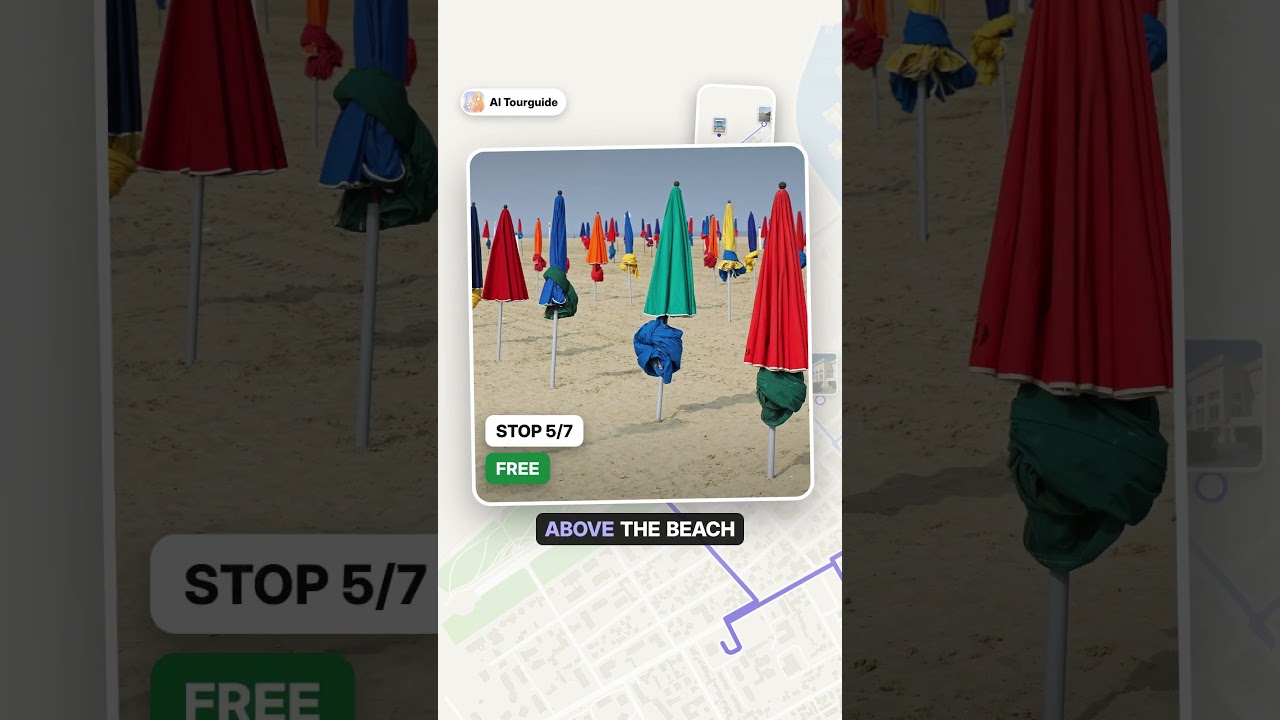
After villa doors and a museum desk, the route hands you the thing the whole town faces: a public sand beach, free, with no gate and no schedule to miss. This is where the walk stops being an itinerary. Drop the pace; there is nothing to decide and nothing to book.
The beach is what made Deauville's name, together with its racecourse, its casino and the Normandy palace hotel, all around 200 km from Paris. Bathing here once meant wooden cabins and a bathing establishment designed in 1912 by Georges Wybo. By 1921, at the start of the Roaring Twenties, they had grown shabby, and the town decided to replace them with something far more ambitious. What came out of that decision is the wooden promenade you are about to walk.
Let the sand have as much of your afternoon as it wants. Les Planches Boardwalk is only 160 m away, about 2 minutes.
In 1921 Mayor Eugène Colas launched a competition among fifteen architects to replace the old baths. The Parisian Charles Adda won and built the Art Deco Bains Pompéiens on the beach: shops, a café bar, steam baths, a pool and 250 bathing cabins grouped in clusters around gardens and pools, linked by galleries with porticoes. Finished in 1922, it paired white concrete with mosaics in sea colours.
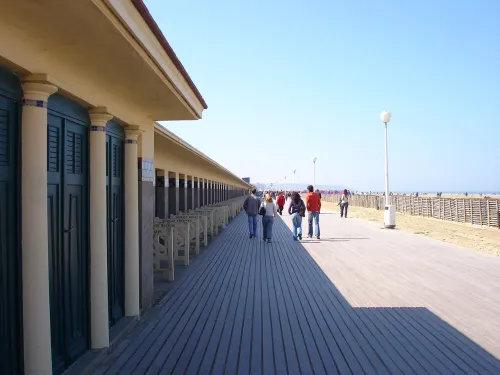
In 1923 Adda added a 643 m promenade so that women could enjoy the seafront without dragging their long dresses through the sand. The whole ensemble was inaugurated on 5 July 1924, and since 11 June 2019 the boardwalk and the bathing establishment, Bains Pompéiens included, have been listed historic monuments.
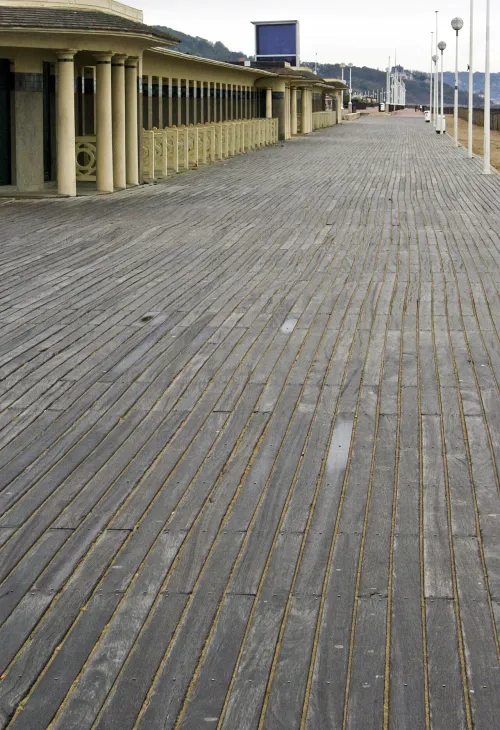
Look down as you walk. The boards today run 656 m long and 7 m wide, sixty-four slats laid side by side, made of azobé, a very hard, very heavy tropical wood from Cameroon, Gabon or Ivory Coast that does not rot. About sixty metres were added at the Port Deauville end in winter 2022. The promenade follows the beach along its whole length, from Port Deauville in the east to the edge of Tourgéville in the west, where paving takes over and carries on to Bénerville-sur-Mer.
Walk as far as you like, then head 480 m, about 7 minutes, to the last stop: luck itself.
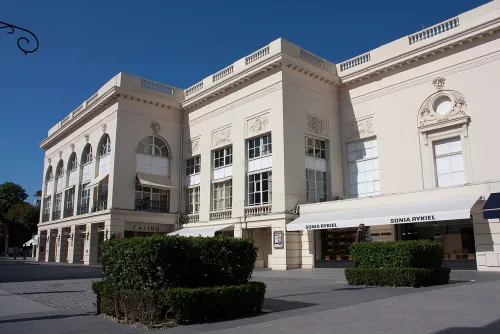
The finale faces the Channel beaches on the seafront road, a classical building founded in 1912. Eugène Cornuché had it built by Georges Wybo, the same architect behind the old beach cabins, and it opened on 11 July 1912. Today it belongs to the Lucien Barrière group, with the Normandy Barrière hotel and the Centre international de Deauville as neighbours.
Inside, the decorator Jacques Garcia restored everything in baroque style in 1988: crystal chandeliers, gilding, marble, velvet and mouldings under a ceiling 20 m high. Beyond the gaming rooms there is the Petit Trianon, an Italian-style 18th-century theatre with 400 seats, a cinema that hosts screenings of the Deauville American Film Festival, two auditoriums, three restaurants, bars, the Club 13 nightclub and the Salon des Ambassadeurs, where the festivals hold their gala dinners. For players: 293 slot machines, 4 stud poker tables, 8 roulette tables split between French and English, 10 blackjack tables and 6 Texas hold'em tables.
The building has its own crime story too. On 26 May 1978 Jacques Mesrine and François Besse robbed the casino, a raid that still belongs to its legend.
Entry is free, and the casino stays open late into the night, so you can come back after dinner if the chandeliers look better to you by night. When you are ready to leave, the GPS navigation can lead you back to the town hall.
Local name
Casino de Deauville
Hours
Mon–Thu 10:00–02:00, Fri 10:00–03:00, Sat 10:00–04:00, Sun 10:00–02:00
All 7 stops are already on the map. You just press start.
AI Tour Guide
You know the route now. Walk it with a guide in your ear.
Press start wherever you are, even hundreds of kilometres from Deauville, and the guide begins telling its stories right away. In the city, pick any of the 7 stops to start from: it leads you there, then talks with you the whole route, asking, listening, remembering, and shaping the tour around your answers.
Free to start · Runs in your browser · No app, no download
Shorter Ways to Walk Deauville
The route runs in one line, so each shorter version is simply a stretch of it. Pick the one that fits your morning, your afternoon or the hour you have left.
Town and villa morning
Stops: 1, 2, 3, 4
For a morning with the market at its liveliest and the villa tour in summer. From the town hall to Les Franciscaines you walk 41 minutes. Tickets apply at Villa Strassburger if you book a guided visit and at Les Franciscaines if you go in.
Culture and coast
Stops: 4, 5, 6, 7
For an afternoon that starts in the old convent and ends at the casino. Only 22 minutes of walking from Les Franciscaines to the casino. The museum ticket is the only cost; beach, boards and casino entry are free.
Seafront hour
Stops: 5, 6, 7
For anyone short on time or done with tickets: sand, Les Planches and the casino facade in 9 minutes of walking, all free.
How Long This Deauville Tour Takes, with and without Tickets
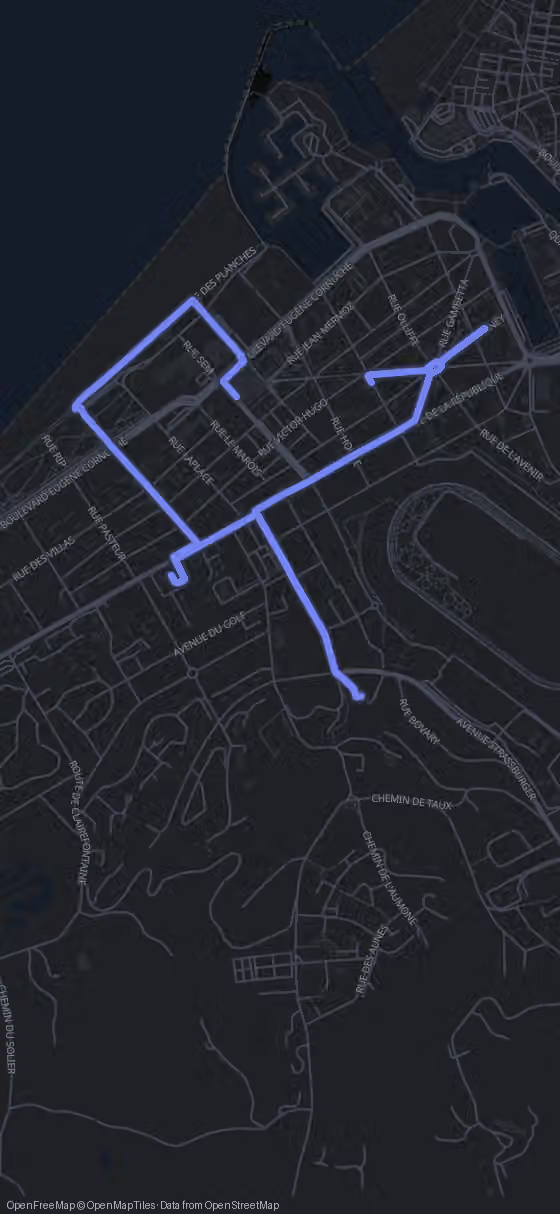
The pure walking time is 1 h 3 min over 4.5 km, and the longest leg is the 21 minutes from the market up to Villa Strassburger. With short looks at every stop you are done in a little over two hours.
A full summer day looks like this: start at the town hall at 09:30, reach the market at 09:46 and give it half an hour, walk on and arrive at the villa at 10:37, in time for the late-morning guided visit. After the hour-long tour you are at Les Franciscaines by 12:14, leave at around 13:45 after an hour and a half inside, and step onto the sand just before 14:00. After about 45 minutes on beach and boards you reach the casino at around 14:52, which makes nearly six hours in total.
Without the villa tour, the same plan comes to about four and a half hours. The Town and villa morning takes roughly three hours with the villa visit, Culture and coast about two and a half with the museum, and the Seafront hour lives up to its name.
Before You Set Off in Deauville
Start and finish: The recommended start is the Hotel de Ville, and the walk ends at the casino. You can join at any stop, and the GPS navigation in your browser can take you from the casino back to the start.
Best days: The market only runs on certain days, and Les Franciscaines has a weekly closing day, so pick a day when both are open if you want the stalls and the museum.
Time of day: Start in the morning: the market packs up around lunchtime, and the villa visits run at set times through the day.
Villa season: Villa Strassburger opens for guided visits by appointment only, and only in the summer months. At other times of year you see it from outside and keep walking.
Costs: Walking the route costs nothing. Budget for two tickets, Villa Strassburger and Les Franciscaines, if you want both interiors; casino entry is free.
AI Tour Guide
Your guide is ready whenever you reach Deauville.
Press start and a voice AI Tour Guide takes it from here: leading the route through Deauville, telling the stories, and turning your walk into a real back-and-forth conversation. No app or download is needed; it runs in your browser.
Free to start · Runs in your browser · No app, no download
What the AI Tour Guide Adds Between Villa and Casino
On this route the AI Tour Guide walks with you as a conversation: it greets you at the town hall, tells the story of each place as you arrive, asks what caught your eye and remembers whether you lean towards Rothschild society, wartime hospitals or Art Deco bathing culture, then shapes the next stop around that. Curious how Norman half-timbering is actually put together, or what Flaubert had to do with this coast beyond selling a farm? Ask, or cut in whenever you like. You start with 100 free credits; after that you choose between €19.99 for this tour all-inclusive with no time limit, or €5 per hour.
A Real Conversation
A voice AI Tour Guide greets you, leads the whole route, and tells the stories and facts as you walk, asking what you want to see and keeping a real conversation going. Not a recording you press play on.
Map Navigation
Follow the route on the map and walk at your own pace. You choose where to start and when to move to the next stop.
Ask Anything
Curious about a building you pass? Ask your AI Tour Guide on the spot and the conversation carries on.
13 Languages
Switch language anytime. No separate tour needed.
Yes. Villa Strassburger has a reduced rate, and Les Franciscaines offers both a reduced price and a cheaper youth and solidarity rate; ask at the desk which one applies to you.
Can I see inside Villa Strassburger outside the summer months?
No. The interior is shown only on guided visits by appointment in June, July, August and September. The rest of the year the villa is a stop to look at from outside.
Can I walk the beach and Les Planches in the evening?
Yes. Deauville Beach and Les Planches Boardwalk are open 24/7 and free, so the seafront part of the route works at any hour.
Which other Normandy towns pair well with a day in Deauville?
The cliffs of Étretat are about 40 km away, Bayeux about 57 km and Rouen about 75 km, each with its own walking route.
Is the tour really free?
Yes. The whole tour is free: the route, the interactive map and the navigation cost you nothing. Only the voice AI Tour Guide is optional and paid: you test it with 100 free credits, then you pay either €5 per hour or €19.99 for this whole tour, with no time limit. Admission to 2 of the 7 stops is not included: Villa Strassburger and Les Franciscaines charge their own entry fees.
Do I need to download an app?
No. Everything runs in your phone browser. Open the route and start walking, no download and no sign-up required.
Do I need to book the walking tour in advance?
No booking needed. This self-guided tour is available anytime. Open the route in your browser and start walking. The AI Tour Guide works instantly, no app, no reservation required.
What languages is the AI Tour Guide available in?
The AI Tour Guide speaks 13 languages, so you take the tour in your own language and can switch at any time.
Can I skip stops or change the route?
Yes. Skip any stop, spend extra time at places you like, or start the route from any point. It is your walk, you set the pace.