Free Walking Tour Étretat: Cliffs, Arches and Lupin

From the pebble beach to both cliff tops, past three chalk arches, Arsène Lupin's house and Monet's motifs, with six of eight stops free.

8 Stops 4.3 km ~1 h 10 min walking
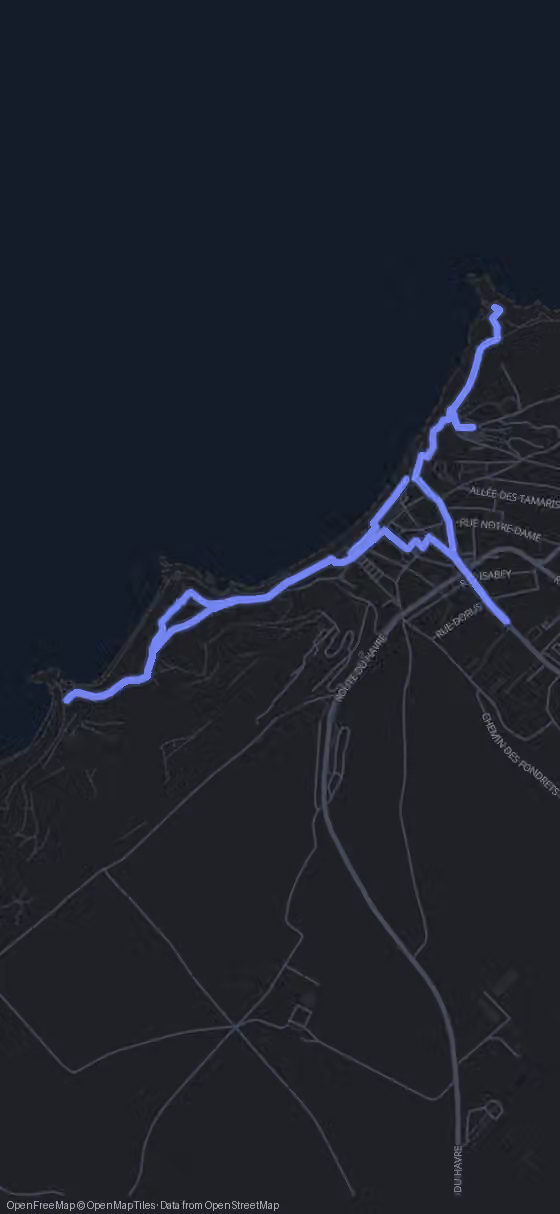
Route map for the Étretat walking tour
Stop 1 of 8
790 m·10 min
Plage d'Étretat
Head south-west from the beach up the path toward the Falaise d'Aval
Welcome to Étretat. I'm Alex, and our first story begins with a chalk arch that locals see as an elephant at the water.
Try this tour with Alex

Étretat on Foot: the Route at a Glance

Eight stops lead from the Plage d'Étretat over the Falaise d'Aval to the Manneporte, back through town to the Marché d'Étretat (Les Halles), Le Clos Lupin and Les Jardins d'Étretat, then past the Chapelle Notre-Dame de la Garde to the Falaise d'Amont. It is 4.3 km with 1 h 10 min of pure walking; plan about five hours with both paid visits.

Six stops are free; Le Clos Lupin and the gardens charge entry. Route, map and GPS navigation run free in your browser, and the optional AI Tour Guide can lead the walk as a conversation.

Open free GPS & optional AI Tour Guide
This short shows highlights of the route. All 8 stops follow below.

The Route

Walking Map of Étretat: Beach, Cliffs and Town

8 stops 4.3 km 1 h 10 min walking
Tap to load interactive map

The 8 stops along this route

  1. Plage d'Étretat, stop 1 on the self-guided walking tour
    1Plage d'Étretat
  2. Falaise d'Aval in Étretat, stop 2 on the self-guided walking tour
    2Falaise d'Aval
  3. Manneporte in Étretat, stop 3 on the self-guided walking tour
    3Manneporte
  4. Marché d'Étretat (Les Halles), stop 4 on the self-guided walking tour
    4Marché d'Étretat (Les Halles)
  5. Le Clos Lupin in Étretat, stop 5 on the self-guided walking tour
    5Le Clos Lupin
  6. Les Jardins d'Étretat, stop 6 on the self-guided walking tour
    6Les Jardins d'Étretat
  7. Chapelle Notre-Dame de la Garde in Étretat, stop 7 on the self-guided walking tour
    7Chapelle Notre-Dame de la Garde
  8. Falaise d'Amont in Étretat, stop 8 on the self-guided walking tour
    8Falaise d'Amont
  9. That's the full route.

    Walk it with an AI Tour Guide talking you through every one of these streets.

    Start free in your browser
    You made it

Your Étretat Walking Tour, Stop by Stop, from the Shingle to the Amont Cliff

  1. 1

    Plage d'Étretat

    Plage d'Étretat, stop 1 on the self-guided walking tour

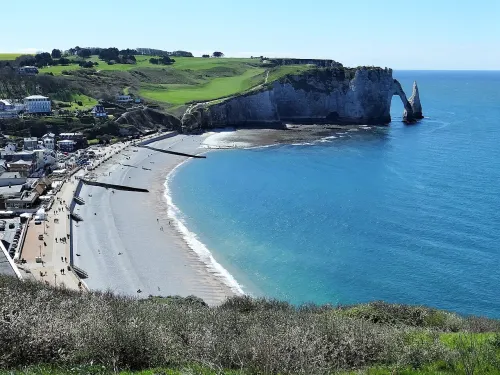
    The walk starts on the shingle of the Plage d'Étretat, a public pebble beach with the promenade running behind it. It is open around the clock and costs nothing, which sets the tone for the whole route: six of the eight stops are free, and the two that charge entry come later, in town and up on the Amont cliff.

    Take a moment here to get your bearings. The route has a clear shape: first the Aval cliffs and their arches, then back through the centre for the market hall and Arsène Lupin's house, up to the gardens, and finally the chapel and the opposite cliff. Nothing in Étretat is ever far from anything else.

    From the beach it is 800 m, about 12 minutes on foot, to the Falaise d'Aval.

    Hours
    Open 24/7
    Price
    0 EUR
  2. 2

    Falaise d'Aval

    Falaise d'Aval in Étretat, stop 2 on the self-guided walking tour

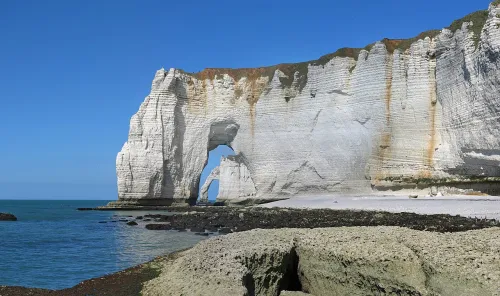
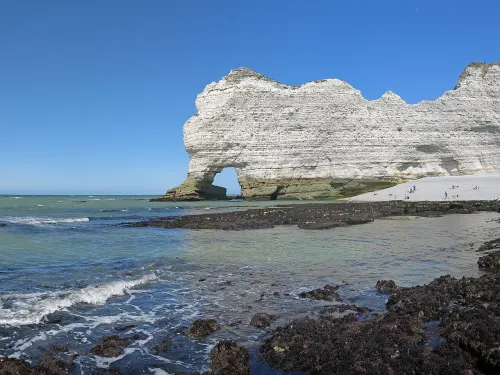
    The Falaise d'Aval is what made Étretat famous: a chalk cliff pierced by a natural arch, with the Aiguille, a 55-metre needle of rock, standing alone in the sea beside it. Both are relics of the old cliff line. An underground river started the work and the sea finished it, wearing the rock away until only the arch and the needle were left. In the local Cauchois dialect a headland pierced like this is called a porte, a door, and the Étretat coast has three of them.

    Maurice Leblanc turned the needle into a literary landmark. In L'Aiguille creuse (1909) he described it as a huge rock more than eighty metres high, a colossal obelisk standing plumb on a granite base, generous with the numbers, since the real needle is 55 metres. In the novel the gentleman thief Arsène Lupin finds the treasure of the kings of France hidden in the rock. Readers took it to heart: even in Leblanc's day 'lupinophiles' came looking, among them American students searching for the key to the cave. Jean-Paul Salomé's 2004 film Arsène Lupin shows the cliff and the needle again and again.

    The Aiguille is not only for looking at. Pierre Allain climbed it first in 1936; German climbers followed in 1942, during the Occupation, and in 2020 the travel writer Sylvain Tesson and the climber Daniel Du Lac made the ascent.

    On the rocky foreshore north of the Aval massif, look for something many visitors walk past: rectangular basins cut into the limestone, partly covered in green algae. They are oyster beds from the time of Marie-Antoinette. In 1777 the Marquis de Belvert had them built to finish flat oysters shipped in from the bay of Cancale aboard two sloops, La Syrène and La Cauchoise. The oysters spent several months here, fed by fresh water from an underground river.

    The Manneporte is 560 m further southwest along the same massif, about 11 minutes away.

    Hours
    Open 24/7
    Price
    0 EUR
  3. 3

    Manneporte

    Manneporte in Étretat, stop 3 on the self-guided walking tour

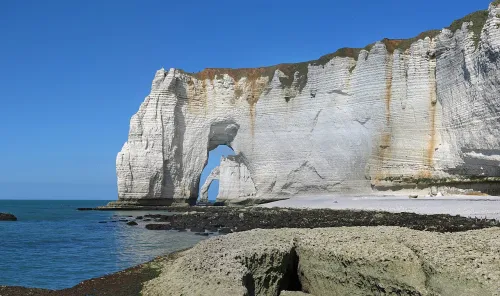
    The Manneporte is the big one. Its name comes from the old French manne porte, the great or main door, and it is the largest rock arch on the Alabaster Coast, wider than the Porte d'Aval about 500 m to the northeast. The headland reaches some 100 metres out into the Channel: white chalk banded with brown-black layers of flint, with the huge opening near its tip. Beyond it to the southwest lies the Pointe de la Courtine.

    Guy de Maupassant saw a Gothic portal here, so large that a ship could sail through it under full canvas. Painters came for the same view: Claude Monet made several pictures of the Manneporte, so if you know his Étretat paintings, this is the arch you have seen in them.

    This is the turning point of the walk. The cliffs end here for now, and the route heads back into town on its longest leg, 1230 m and about 21 minutes, to the Marché d'Étretat (Les Halles).

    Hours
    Open 24/7
    Price
    0 EUR
  4. 4

    Marché d'Étretat (Les Halles)

    Marché d'Étretat (Les Halles), stop 4 on the self-guided walking tour

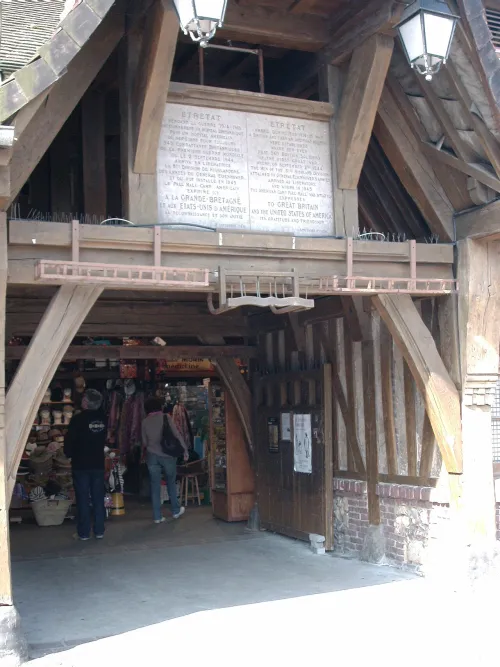
    Back in the centre, the Marché d'Étretat (Les Halles) stands at 16 Place Maréchal Foch: a covered market hall built of wood. The town decided on the building in 1926, and the timber came from Brionne. Inside are several shops selling mostly souvenirs and regional products, and walking through the hall is free.

    The square has a watery past. A farm once stood here, with a canal, a bridge and a tunnel. After heavy rain the site flooded again and again, so the pond was filled in and replaced by a market square lined with small wooden huts, the forerunner of today's hall.

    Look for the memorial plaque on the hall. It remembers the military hospital Étretat ran during both world wars, a reminder that the seaside resort had a very different role in those years.

    On Thursday mornings a weekly market runs here. From the hall, Le Clos Lupin is just 390 m away, about 6 minutes on foot.

    Hours
    Market hall boutiques open during the day (approx. 10:00–19:00); weekly market Thu 08:00–13:00
    Price
    0 EUR
  5. 5

    Le Clos Lupin

    Le Clos Lupin in Étretat, stop 5 on the self-guided walking tour

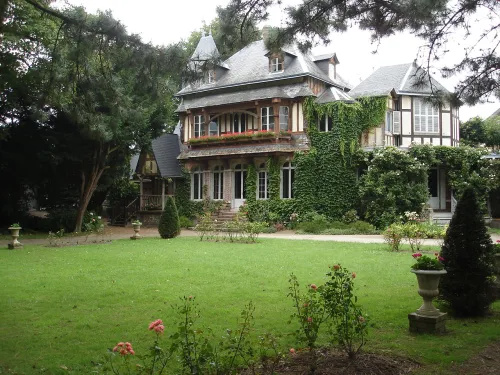
    Le Clos Lupin, at 15 rue Guy-de-Maupassant, is the house where Maurice Leblanc lived and wrote for more than twenty years. It is a two-storey Anglo-Norman villa, half-timbered, built around 1850. When Leblanc bought it in 1918 it was called 'The Sphinx'; he renamed it Clos Lupin, after the gentleman thief he had invented and after the lupins he planted in the garden.

    The house had a turbulent life after him. It was confiscated during the German occupation, and Leblanc's son sold it in 1952. In 1998 his granddaughter Florence Boespflug-Leblanc managed to buy it back and set up a museum with her grandfather's belongings and those of his famous character; it opened in June 1999. In 2011 the Haute-Normandie region, the Seine-Maritime department and the town of Étretat bought house and collection together for €639,000.

    Inside, rooms on both floors show photos, paintings, writings and personal objects of the writer, some of them originals, alongside an audio-visual tour devoted to Arsène Lupin. The garden has old pines, lupins, statues, a historic fountain and a pergola overgrown with wisteria. The house is part of the historic route of writers' houses, and in 2016 its director called it the most visited writer's house in France.

    Entry is charged. Go in if the Lupin stories at the Falaise d'Aval caught you or if you enjoy writers' houses; if neither appeals, the half-timbered facade from the street is enough.

    From here it is 850 m, about 14 minutes, up to Les Jardins d'Étretat.

    Hours
    Apr–Sep: Tue–Sun 10:00–12:00 and 13:30–18:00; Oct–March: Wed, Sat–Sun and school holidays 10:30–12:00 and 13:30–17:30 (Mon closed)
    Price
    8.50 EUR regular, 6.50 EUR reduced (seniors, students, job seekers), children (<12 yrs) 6.00 EUR

  6. 6

    Les Jardins d'Étretat

    Les Jardins d'Étretat, stop 6 on the self-guided walking tour

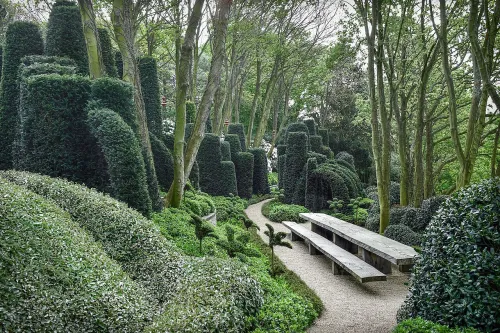
    Les Jardins d'Étretat sit on top of the Amont cliff, overlooking the Channel: an experimental topiary garden laid out around the Belle Époque villa La Roxelane. Between the sculpted greenery you find sculptures and installations from a permanent collection plus temporary exhibitions, and every two years an artist residency invites artists through an open call to create large, site-specific works.

    The place has deep roots in Étretat's artistic past. By the late 19th century the fishing village had become a fashionable retreat for Parisian writers, painters, opera singers and theatre people. Between 1883 and 1885 Claude Monet painted a series of pictures here, many of them from this very cliff. In 1903 the Parisian actress Madame Thébault started a garden up here; the gardener Auguste Lecanu from Fécamp built it, and the architect Louis Valentin designed her villa in Neo-Norman style, half-timbered and trimmed with the flint typical of the region.

    After her death the villa changed hands several times. In 2014 the landscape architect Alexander Grivko and his partner Mark Dumas bought it, began restoring in 2015 and recreated most of the garden's historic elements; with the design and landscaping company IL NATURE they opened it to the public in May 2017.

    This is the priciest stop on the route. It's worth it if you love gardens and contemporary sculpture or want time on the cliff where Monet worked; if you came mainly for the arches, skip it, because the Falaise d'Amont itself is free.

    The chapel is right next door: 80 m, about a minute.

    Hours
    June–Aug: daily 10:00–18:30; Apr–May & Sep–Oct: daily 10:00–17:30; March: Wed–Sun 10:00–17:30; Nov–Feb closed
    Price
    14 EUR regular (high season), 12.90 EUR students, 10 EUR youth (15-17 yrs), 8 EUR children (8-14 yrs), 9 EUR severely disabled, 20 EUR flex ticket
  7. 7

    Chapelle Notre-Dame de la Garde

    Chapelle Notre-Dame de la Garde in Étretat, stop 7 on the self-guided walking tour

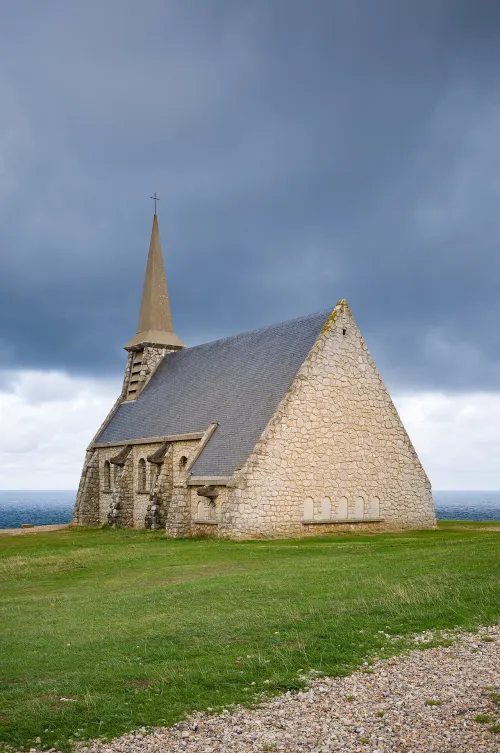
    The Chapelle Notre-Dame de la Garde stands on the Falaise d'Amont, only about 50 metres from the cliff edge and visible from far along the coast. It is a neo-Gothic building of natural stone, with a slender bell tower rising over the west portal, which is closed by an iron grille gate. Look up at the slate roof, shaped like an upturned ship's hull, and at the gargoyles carved as fish heads.

    The first chapel here goes back to the parish priest Père Michel, who launched the project in 1854 to honour sailors lost at sea. It was paid for partly with the help of Étretat's first tourists and consecrated on 6 August 1856, dedicated to sailors and fishermen. German occupying troops destroyed it in 1942. After the war the architect Arthur Giraudet and the builder Lanfry from Rouen rebuilt it in a new form, and Archbishop Joseph-Marie Martin consecrated it on 22 August 1950; since then it has been dedicated to the Virgin. The stained glass dates from 1964 and comes from the Degusseau workshop.

    The chapel is now privately owned and opens to the public only rarely, so plan to enjoy it from outside; the cliff-top setting is free and open at any hour. Just to the east stands the Nungesser and Coli memorial, dedicated to the two aviation pioneers.

    The last leg is 380 m, about 6 minutes, out to the Falaise d'Amont.

    Hours
    Open 24/7
    Price
    Free
  8. 8

    Falaise d'Amont

    Falaise d'Amont in Étretat, stop 8 on the self-guided walking tour

    The walk ends on the Falaise d'Amont, the counterpart to the cliff you saw at the start. It is chalk again, banded with brown-black flint, running narrow for about 120 metres northwest into the Channel, with the arch at its tip that is the Porte d'Amont in the strict sense. The rock here is 39 metres high, and you will also hear the whole formation called Cap de la Porte d'Amont.

    East of the headland lies Le Chaudron, the cauldron, a narrow sea inlet. Inland, on the back of the formation, stand the chapel and the memorial you have just passed, the landmarks you could see from the town all day.

    Like the Manneporte, the Porte d'Amont drew artists again and again, Claude Monet among them. Having begun with the Aval arch and the needle, you now stand on the other side of the same coast, which rounds off the route neatly. From here you head back down into town at your own pace.

    Hours
    Open 24/7
    Price
    0 EUR
Walking tour route map of Étretat Route loaded
Plage d'ÉtretatFalaise d'AvalManneporteMarché d'Étretat (Les Halles)+4
All 8 stops are already on the map.
You just press start.
AI Tour Guide

You've read the route. Now walk Étretat with a guide in your ear.

Press start wherever you are, even hundreds of kilometres from Étretat, and the guide begins telling its stories right away. In the city, pick any of the 8 stops to start from: it leads you there, then talks with you the whole route, asking, listening, remembering, and shaping the tour around your answers.

8stops 4.3km 1 h 10 minwalking 13languages
▶Start the tour free

Free to start · Runs in your browser · No app, no download

Shorter Ways Through Étretat

Not everyone has five hours or wants to pay for the two interiors. Three ways to cut the route down:

All eight stops, outdoors only

Stops: 1, 2, 3, 4, 5, 6, 7, 8

For anyone who came for the cliffs and the arches. You walk the full 4.3 km and 1 h 10 min, look at Le Clos Lupin from the street and leave out the gardens, so the whole walk stays free.

Beach and western cliffs

Stops: 1, 2, 3, 4

For a short visit or a morning. From the Plage d'Étretat over the Falaise d'Aval and the Manneporte back to the market hall: 2590 m and 44 minutes of walking, no entry fees.

Town, Lupin and the Amont cliff

Stops: 4, 5, 6, 7, 8

For Lupin readers and garden lovers who have already seen the western cliffs. From the market hall to the Falaise d'Amont: 1700 m and 27 minutes of walking, with entry at Le Clos Lupin and Les Jardins d'Étretat.

How Long Does This Étretat Tour Take with the Gardens and Le Clos Lupin?

The pure walking time is 1 h 10 min. Add half an hour on each cliff, twenty minutes each at the Manneporte and the market hall, a short look at the chapel, about 50 minutes inside Le Clos Lupin and an hour in the gardens, and the whole route takes about five hours.

A start around 12:30 at the beach works well: you reach the Falaise d'Aval around 12:50, the Manneporte around 13:35 and the market hall around 14:15. Le Clos Lupin follows around 14:40 and Les Jardins d'Étretat around 15:45, which leaves an hour for the gardens. The chapel and the Falaise d'Amont round off the walk at about 17:30.

Without the two interiors the full route takes roughly three hours and twenty minutes. The beach and western cliffs alone need about two hours, the town and Amont half a little over three hours.

Before You Head Out in Étretat

  • Start and finish: The recommended start is the Plage d'Étretat, but you can join at any stop. The route does not loop: it ends on the Falaise d'Amont.
  • Best day and time: Le Clos Lupin is not open every day, so check before you go; a start around midday fits the suggested schedule. On a Thursday morning, begin at the market hall if you want to catch the weekly market.
  • Costs: The beach, both cliffs, the Manneporte, the market hall and the chapel cost nothing; only Le Clos Lupin and Les Jardins d'Étretat charge admission.
Walking tour route map of Étretat
AI Tour Guide

Your Étretat guide is ready when you are.

Press start and a voice AI Tour Guide takes it from here: leading the route through Étretat, telling the stories, and turning your walk into a real back-and-forth conversation. No app or download is needed; it runs in your browser.

8stops 4.3km 1 h 10 minwalking 13languages
▶Start the tour free

Free to start · Runs in your browser · No app, no download

What the AI Tour Guide Adds Between the Cliffs

On this route the stories are the point: a needle that a novelist made far taller than it is, oyster beds from Marie-Antoinette's day, a sailors' chapel rebuilt after the war. The AI Tour Guide leads the walk as a conversation: it greets you on the beach, tells the stories of each place, asks what caught your eye and builds on it, so a Lupin reader hears different things than someone who came for Monet. Ask it, for example, how chalk and flint end up in neat layers, or what life was like for the fishermen the chapel was built for, and interrupt it whenever you like. You start with 100 free credits; after that it's €19.99 for this tour with no time limit, or €5 per hour.

A Real Conversation A voice AI Tour Guide greets you, leads the whole route, and tells the stories and facts as you walk, asking what you want to see and keeping a real conversation going. Not a recording you press play on.
Map Navigation Follow the route on the map and walk at your own pace. You choose where to start and when to move to the next stop.
Ask Anything Curious about a building you pass? Ask your AI Tour Guide on the spot and the conversation carries on.
13 Languages Switch language anytime. No separate tour needed.
Start free in your browser

Common Questions about Walking Étretat

Are there reduced tickets for Le Clos Lupin and Les Jardins d'Étretat?

Yes. Le Clos Lupin offers reduced tickets for seniors, students, job seekers and children. Les Jardins d'Étretat has reduced rates for students, young people, children and visitors with severe disabilities, and also sells a flex ticket.

Is the walk worth doing in winter?

For the outdoor part, yes: the beach, both cliffs, the Manneporte, the market hall and the outside of the chapel are there all year and free. The gardens close in winter, and Le Clos Lupin opens only on a few days in the off season.

Can I combine Étretat with other walks in Normandy?

Easily. Deauville is 40 km away and Rouen 71 km, both with their own free walking routes. Further west, Bayeux and Mont-Saint-Michel make good next stops on a Normandy trip.

Is the tour really free?

Yes. The whole tour is free: the route, the interactive map and the navigation cost you nothing. Only the voice AI Tour Guide is optional and paid: you test it with 100 free credits, then you pay either €5 per hour or €19.99 for this whole tour, with no time limit. Admission to 2 of the 8 stops is not included: Le Clos Lupin and Les Jardins d'Étretat charge their own entry fees.

Do I need to download an app?

No. Everything runs in your phone browser. Open the route and start walking, no download and no sign-up required.

Do I need to book the walking tour in advance?

No booking needed. This self-guided tour is available anytime. Open the route in your browser and start walking. The AI Tour Guide works instantly, no app, no reservation required.

What languages is the AI Tour Guide available in?

The AI Tour Guide speaks 13 languages, so you take the tour in your own language and can switch at any time.

Can I skip stops or change the route?

Yes. Skip any stop, spend extra time at places you like, or start the route from any point. It is your walk, you set the pace.
Image credits
▶ Start free in your browser Runs in your browser, no app, no download