

Place du Vieux Marché
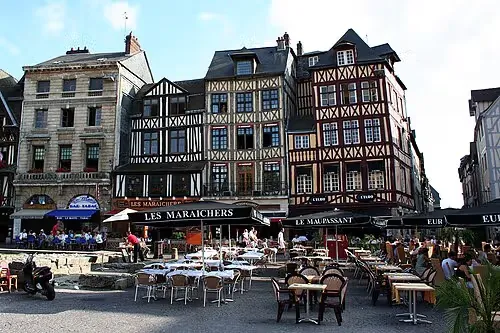
Begin where Rouen's best-known story ended. Place du Vieux Marché takes its name from the market that was originally held here, and it still has the look of an old market square, with timber-framed houses and overhanging upper floors around it. Look closely, though: many of these are old façades that were taken down elsewhere and reassembled on this spot.
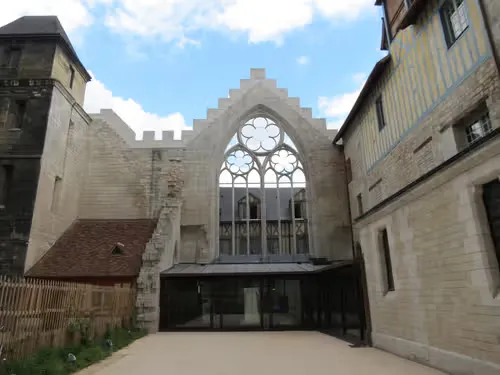
On 30 May 1431 Joan of Arc was burned alive on this square. The actual place of public executions, with the pillory and the firewall built for the pyres, only came to light in excavations in the 1970s, together with the foundations of the church of Saint-Sauveur. That church was destroyed during the Terror in 1794 and 1795, and its remains are visible along the south side of today's Église Sainte-Jeanne d'Arc. Pierre Corneille's parents were buried in it.
Beside the site of the pyre stands a cross, as the annulment trial of 1456 had required. It counts as a national monument: a law of 10 July 1920 created a national Joan of Arc day and called for a monument on the square where she was burned, inscribed 'À Jeanne d'Arc, le peuple français reconnaissant', to Joan of Arc from the grateful French people. The statue of Joan at the stake, made in 1927, is by Maxime Real del Sarte.
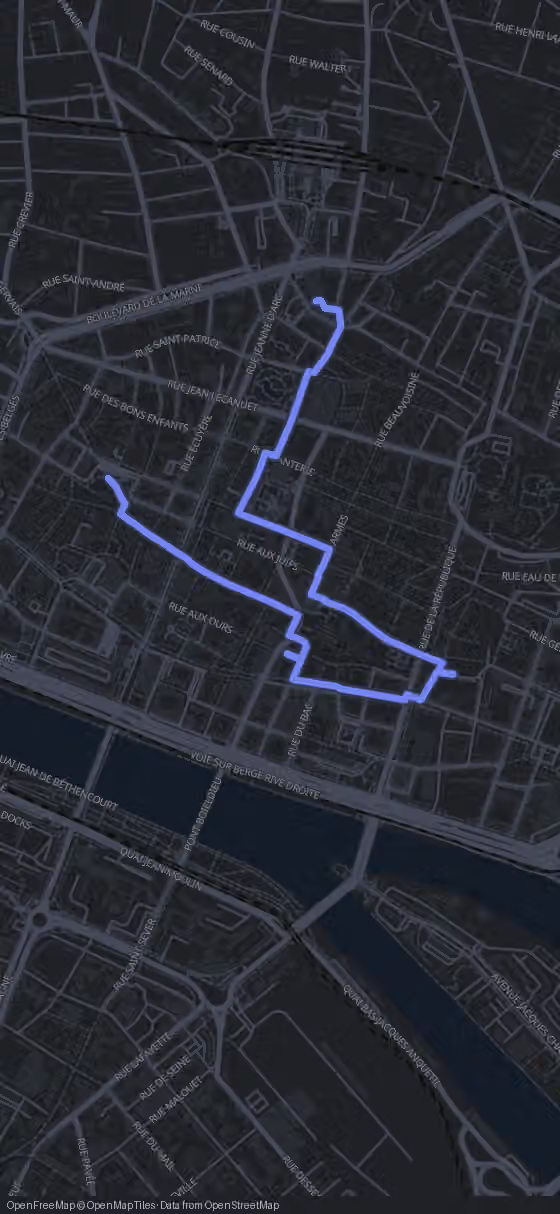
Trade shaped the square as much as memory. Under the Second Empire two market halls went up and turned it into a busy commercial hub, and in 1928 and 1929 the architect Edmond Lair built a reconstruction of the old butchers' hall. From here, follow Rue du Gros-Horloge for 300 m, about 4 minutes, to the clock that gave the street its name.