Free Walking Tour Saint-Malo: Walls, Château and Tidal Fort

1.0 km in and around Saint-Malo's walls: a working gate, the wall walk, a duke's castle, a fort you reach at low tide and a cathedral rebuilt after the war.

5 Stops 1.0 km ~13 min walking
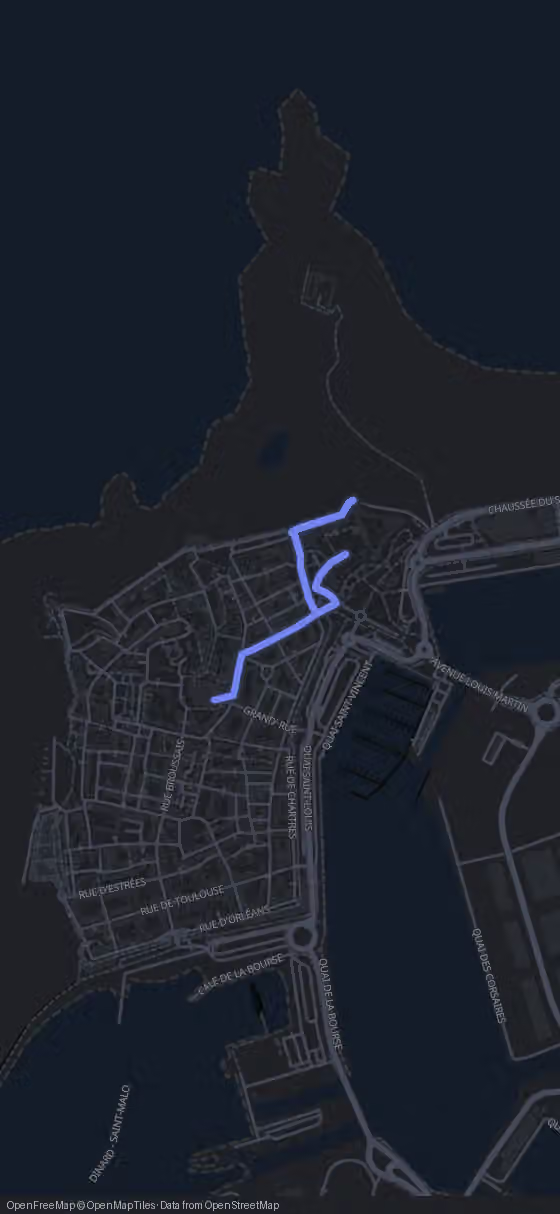
Route map for the Saint-Malo walking tour
Stop 1 of 5
120 m·2 min
Porte Saint-Vincent
Head north from the gate toward the Ramparts of Saint-Malo
Bonjour, welcome to Saint-Malo. I'm Alex, and these formidable walls were not only worried about outsiders.
Try this tour with Alex

Saint-Malo in Five Stops at a Glance

Five stops lead from the Porte Saint-Vincent onto the Ramparts of Saint-Malo, past the Château de Saint-Malo, out to Fort National and on to the Cathédrale Saint-Vincent: 1.0 km, 13 minutes of pure walking, about two hours with visits.

The gate, the walls and the cathedral are free; the château and the fort charge admission, and the fort is reachable on foot only at low tide. Route, map and GPS navigation are free in your browser; the AI Tour Guide is optional.

Open free GPS & optional AI Tour Guide
View of Saint-Malo

The Route

Walking Map of Saint-Malo's Walled Town

5 stops 1.0 km 13 min walking
Tap to load interactive map

The 5 stops along this route

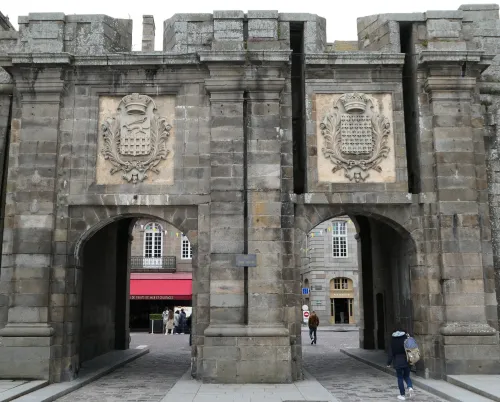
  1. Porte Saint-Vincent in Saint-Malo, stop 1 on the self-guided walking tour
    1Porte Saint-Vincent
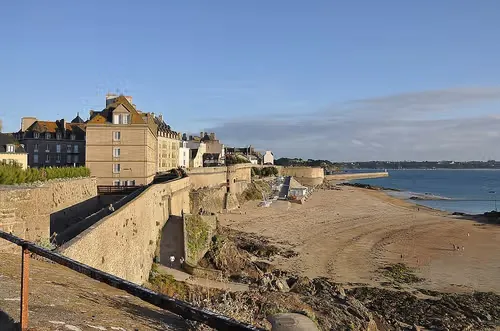
  2. Ramparts of Saint-Malo, stop 2 on the self-guided walking tour
    2Ramparts of Saint-Malo
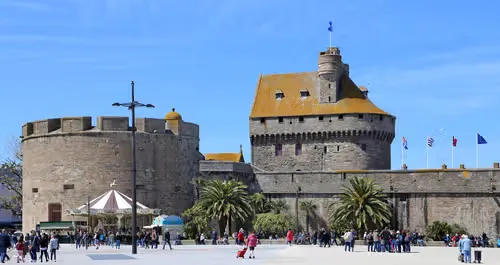
  3. Château de Saint-Malo, stop 3 on the self-guided walking tour
    3Château de Saint-Malo
  4. Fort National in Saint-Malo, stop 4 on the self-guided walking tour
    4Fort National
  5. Cathédrale Saint-Vincent in Saint-Malo, stop 5 on the self-guided walking tour
    5Cathédrale Saint-Vincent
  6. That's the full route.

    Walk it with an AI Tour Guide talking you through every one of these streets.

    Start free in your browser
    You made it

The Five Stops of Your Saint-Malo Walking Tour

  1. 1

    Porte Saint-Vincent

    Porte Saint-Vincent in Saint-Malo, stop 1 on the self-guided walking tour

    Start under the arch. The Porte Saint-Vincent is a working gate in Saint-Malo's town wall: no booth, no queue, no ceremony. Cars, delivery vans and walkers pass through it all day, and that is part of its charm. It is one of nine gates cut into the ramparts, and for most visitors it is the first.

    Come through it and the château is there to greet you. That is your first lesson in scale. The fortress at the corner and the gate you are standing in belong to one enclosed world, and everything on this walk happens inside the walls or in sight of them.

    The gate is the natural starting point for practical reasons, too. The wall attaches to it, and if the lanes inside tangle later, the wall is the simplest handrail in town: meet it anywhere and you know the shape you are standing in.

    Right at the gate you'll also find the Musée d’Histoire de la Ville et du Pays Malouin. For now, walk through: the Ramparts of Saint-Malo are 130 m and about 2 minutes away.

    Hours
    Open 24/7
    Price
    Free
  2. 2

    Ramparts of Saint-Malo

    Ramparts of Saint-Malo, stop 2 on the self-guided walking tour

    Up on the Ramparts of Saint-Malo you are walking the town's armour. The walls run for 1,754 m, reach 16 m in places and are pierced by nine gates. Walking them is free, and it is the one thing on this route nobody should skip.

    The story starts in the middle of the 12th century. Bishop Jean de Châtillon moved his see from Alet to the rock of Saint-Malo and began enclosing it. Later kings modernised the defences: under Charles VI the Château-Gaillard and the small keep were built. Keep that bishop's name in mind; you'll meet him again at the cathedral.

    The walls you see today are largely the work of one man. Siméon Garangeau became director of fortifications in 1691, and Vauban gave him the task of turning Saint-Malo into a citadel of the sea. Medieval towers and turrets could not withstand cast-iron cannonballs, so Garangeau replaced most of them with bastions, Saint-Louis, Saint-Philippe, Fort à la Reine and Hollande among them, linked by straight curtain walls. The guns stood in the open on top. Between 1708 and 1742 he rebuilt three quarters of the circuit and pushed the walls outwards in the south and east, so the town inside grew from 16 hectares to 24. Several older towers and posterns disappeared in the process.

    Look down at the foot of the wall. Originally it went straight onto bare rock and into the sea; the quays you see leaning against it only began to appear from 1582. From here the château is right at hand: the next stop is about a minute along.

    Local name
    Remparts de Saint-Malo
    Hours
    Open 24/7
    Price
    Free
  3. 3

    Château de Saint-Malo

    Château de Saint-Malo, stop 3 on the self-guided walking tour

    The Château de Saint-Malo, also called the Château de la Duchesse Anne, holds the north-east corner of the walled town. Its origins are blunt: John V, Duke of Brittany, commissioned it to keep his own people in check, not to fend off foreign fleets.

    Read it tower by tower. The oldest part is the horseshoe-shaped Grand Donjon, finished in 1424. In 1475 Duke Francis II added the large tower called La Générale at the south-west corner. His daughter Anne followed in 1498 with the Tour Quic-en-Groigne in the north-west corner, a name that translates roughly as "Who's Grumbling Tower", a duchess's answer to the town's complaints. The Tour des Dames and the Tour des Moulins completed the other two corners soon after.

    The Malouins were not easily cowed. In 1590 they stormed the castle to stop its governor from swearing allegiance to the Protestant Henry IV; the matter settled itself four years later when the king converted to Catholicism. During the Revolution they stormed it again. In between, a triangular bastion went up, Vauban had the walls strengthened and barrack blocks were added around the courtyard. The town council bought the whole complex in 1921 and used the barracks for administration, and in the Second World War the château took two days of American bombardment during the Battle of Saint-Malo. It has been a historic monument since 1886.

    Going inside costs admission, and what you can see changes, so ask at the entrance. If your time or budget is tight, the outside tells most of the story. Then head out towards the sea: Fort National is 380 m and about 5 minutes away, but only if the tide is out.

  4. 4

    Fort National

    Fort National in Saint-Malo, stop 4 on the self-guided walking tour

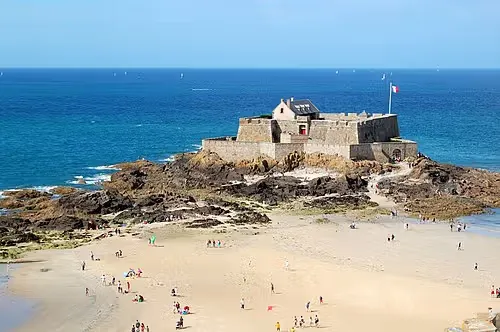
    Fort National sits on a tidal island a few hundred metres off the walled town, and you can walk to it only at low tide. Tide times change daily, so this stop sets the rhythm of the whole route. Vauban had the fort built in 1689 to protect Saint-Malo's port, and Garangeau, the same engineer behind the ramparts, built it to his plans on Louis XIV's orders, probably finishing in 1693.

    The rock it stands on, l'Îlette, has a darker past. A beacon once burned here at night as a lighthouse, but the island was also where the lords of Saint-Malo executed criminals by burning, and later a gallows stood here. The fort's name followed French politics: Fort Royal, then Fort d'Îlette or Républicain after 1789, Fort Impérial, and finally Fort National after 1870.

    Look at the shape: a granite rectangle with two half bastions at the south guarding the gate, once reached by a drawbridge over a dry moat. Inside stands a long building that held quarters for officers and troops and the equipment rooms, and underground lies a cistern holding 50,000 litres, fed by gutters and reached through a trapdoor and a well. The fort was one link in a chain of defences running from Fort-la-Latte to the Pointe de la Varde.

    Its test came in November 1693, when 30 English and Dutch ships appeared off Cap Fréhel. They shelled the coast, took Fort de la Conchée and Cézembre island, then sent a ship packed with gunpowder as a floating mine against the town. It ran aground short of its target and exploded harmlessly. At the time the fort carried 14 guns and three mortars, though some accounts speak of 23 guns.

    The fort charges admission. If you like military architecture or are walking with children, going in is worth it; otherwise the walk out and the view of the walls from the island are reward enough. From here it is 450 m and about 6 minutes to the cathedral.

    Hours
    Tide-dependent, times change daily (reachable on foot at low tide only); open during the Easter and All Saints school holidays, long weekends in May and daily from 1 Jun to 30 Sep
    Price
    5 EUR adults, 3 EUR children 6-16 years, under 6 free; group rate (from 10 pers.) 4 EUR/person

  5. 5

    Cathédrale Saint-Vincent

    Cathédrale Saint-Vincent in Saint-Malo, stop 5 on the self-guided walking tour

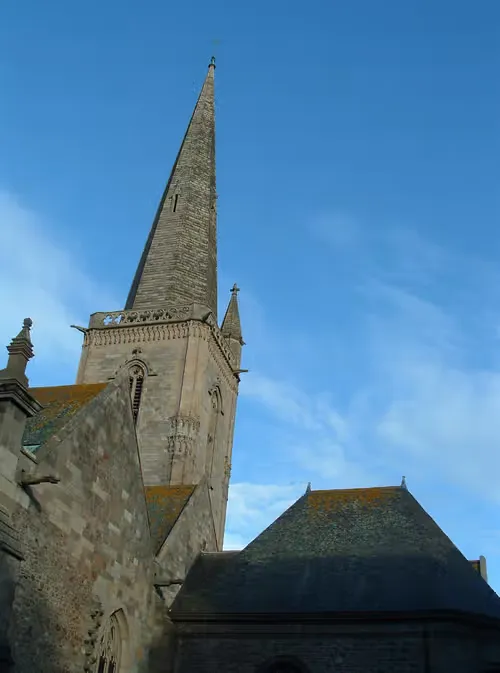
    The Cathédrale Saint-Vincent closes the route, and entry is free. It mixes Romanesque and Gothic and was built under Bishop Jean de Châtillon, the same man who began the ramparts. Around 1152 he rebuilt the church completely, made it a cathedral and moved the bishop's seat from Aleth to Saint-Malo-de-l'Isle, the rock of Aaron you have been walking on.

    That name goes back to the 6th century, when a hermit called Aaron settled on the rock. A Welsh monk named Malo joined him, preached and became Bishop of Aleth, and the town carries his name. His successor Gurval built a church in his honour. Charlemagne's men burned it in 811; Bishop Hélocar rebuilt it in 816 and dedicated it to Saint Vincent, the Spanish deacon martyred in 304. Norman raids in the 10th century left it in ruins, and from 1108 it was a priory of the Benedictine abbey of Marmoutier until Jean de Châtillon won it back after a long struggle.

    The 20th century nearly finished what the Normans started. In the Second World War the steeple toppled onto the Sacred Heart Chapel, and the organ built by Louis Debierre in 1893 was destroyed. Restoration took 28 years and was celebrated on 21 May 1972. Keep that in mind as you look around: much of what you see is a careful rebuilding.

    The cathedral is also a stop on the Tro Breizh, the pilgrimage linking the towns of Brittany's seven founding saints. Step inside even if you only have a few minutes. When you are done, the GPS navigation in your browser can lead you back to the Porte Saint-Vincent.

    Hours
    Mon: 09:30–19:00 | Tue–Thu: 09:30–18:30 | Fri: 09:30–18:00 | Sat: 09:30–18:30 | Sun: 10:00–19:00
    Price
    Free
Walking tour route map of Saint-Malo Route loaded
Porte Saint-VincentRamparts of Saint-MaloChâteau de Saint-MaloFort National+1
All 5 stops are already on the map.
You just press start.
AI Tour Guide

You know the walls now. Walk them with a guide in your ear.

Press start wherever you are, even hundreds of kilometres from Saint-Malo, and the guide begins telling its stories right away. In the city, pick any of the 5 stops to start from: it leads you there, then talks with you the whole route, asking, listening, remembering, and shaping the tour around your answers.

5stops 1.0km 13 minwalking 13languages
▶Start the tour free

Free to start · Runs in your browser · No app, no download

Three Ways to Walk Saint-Malo

The tide decides a lot here. Pick the version that fits the water level and the time you have.

The full low-tide route

Stops: 1, 2, 3, 4, 5

For anyone who arrives while the sea is out. All five stops, 13 minutes of pure walking; the château and Fort National charge admission, everything else is free.

High tide: walls, château and cathedral

Stops: 1, 2, 3, 5

For when the causeway to Fort National is under water. You skip the walk out to the island, so you walk less than the full 13 minutes, and the only admission left is the château if you go inside.

Walls and château only

Stops: 1, 2, 3

For a short first look on arrival. Gate, wall walk and the château from outside take 3 minutes of walking and cost nothing; add time on the ramparts as you like.

How Long This Saint-Malo Tour Takes, Tide Included

The pure walking time is 13 minutes: 130 m from the gate to the ramparts, then straight on to the château, 380 m out to Fort National and 450 m back to the cathedral. The legs are short because the old town is compact; the time goes into looking, not walking.

With time on the walls, the château seen from outside, a visit inside Fort National and a look into the cathedral, plan about two hours. Going inside the château as well brings you closer to three. The high-tide version without the fort fits into about an hour, the walls-and-château taster into half an hour.

Before You Walk Through the Gate

  • Start and finish: The recommended start is the Porte Saint-Vincent, the finish is the Cathédrale Saint-Vincent. You can join at any stop, and the GPS navigation in your browser can lead you from the cathedral back to the gate.
  • Time of day: Plan around low tide: Fort National is reachable on foot only then, and the tide times change daily. Check them before you set off and the fort's opening dates too, since it doesn't open year-round.
  • Admission: The gate, the ramparts and the cathedral are free. The château and Fort National charge admission; you pay on site.
Walking tour route map of Saint-Malo
AI Tour Guide

Your guide is waiting at the gate.

Press start and a voice AI Tour Guide takes it from here: leading the route through Saint-Malo, telling the stories, and turning your walk into a real back-and-forth conversation. No app or download is needed; it runs in your browser.

5stops 1.0km 13 minwalking 13languages
▶Start the tour free

Free to start · Runs in your browser · No app, no download

What the AI Tour Guide Adds Inside the Walls

On a route this short, the AI Tour Guide gives the stones time to talk. It greets you at the gate, tells the stories of each place as a conversation, asks what caught your eye and remembers whether you lean towards dukes, sieges or saints. Curious what the Tro Breizh pilgrimage actually involves, or how Garangeau worked alongside Vauban? Interrupt it whenever you like. You start with 100 free credits; after that you choose between this tour all-inclusive for €19.99 with no time limit, or €5 per hour.

A Real Conversation A voice AI Tour Guide greets you, leads the whole route, and tells the stories and facts as you walk, asking what you want to see and keeping a real conversation going. Not a recording you press play on.
Map Navigation Follow the route on the map and walk at your own pace. You choose where to start and when to move to the next stop.
Ask Anything Curious about a building you pass? Ask your AI Tour Guide on the spot and the conversation carries on.
13 Languages Switch language anytime. No separate tour needed.
Start free in your browser

Common Questions About Saint-Malo

What if the tide is in when I reach Fort National?

Then the island can't be reached on foot. Skip it, carry on to the Cathédrale Saint-Vincent, and come back another time when the water is out. Tide times change daily, so check them in the morning.

Is the route manageable with children?

Yes, it covers 1.0 km with 13 minutes of walking. Children usually enjoy the walk out to a fort on an island, and the fort has reduced tickets for children.

Can I combine Saint-Malo with Mont-Saint-Michel or Rennes?

Both make good day trips. Mont-Saint-Michel is 38 km away and Rennes 65 km, and each has its own free walking route.

Is the cathedral worth it if I only have an hour?

Yes. It's free and at the end of the route, so a short look inside costs you nothing but a few minutes, and it closes the circle the ramparts opened with Jean de Châtillon.

Is the tour really free?

Yes. The whole tour is free: the route, the interactive map and the navigation cost you nothing. Only the voice AI Tour Guide is optional and paid: you test it with 100 free credits, then you pay either €5 per hour or €19.99 for this whole tour, with no time limit. Admission to 2 of the 5 stops is not included: Château de Saint-Malo and Fort National charge their own entry fees.

Do I need to download an app?

No. Everything runs in your phone browser. Open the route and start walking, no download and no sign-up required.

Do I need to book the walking tour in advance?

No booking needed. This self-guided tour is available anytime. Open the route in your browser and start walking. The AI Tour Guide works instantly, no app, no reservation required.

What languages is the AI Tour Guide available in?

The AI Tour Guide speaks 13 languages, so you take the tour in your own language and can switch at any time.

Can I skip stops or change the route?

Yes. Skip any stop, spend extra time at places you like, or start the route from any point. It is your walk, you set the pace.
Image credits
▶ Start free in your browser Runs in your browser, no app, no download