Free Walking Tour Versailles: Market, Trianons and Palace

Start among the stalls of the Notre-Dame quarter, wander through Marie-Antoinette's private world and the royal park, and end in the town where the Revolution took its oath.

11 Stops 10.1 km ~2 h 18 min walking
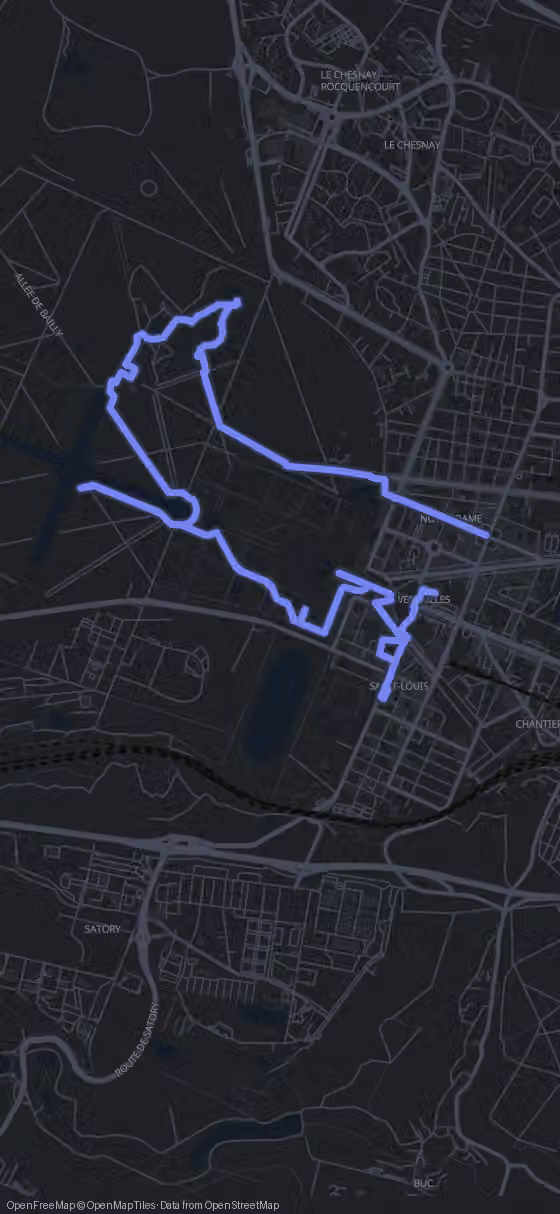
Route map for the Versailles walking tour
Stop 1 of 11
2.2 km·27 min
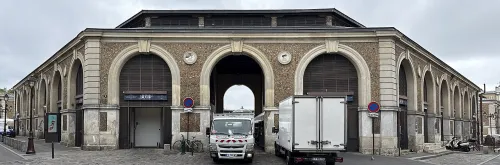
Notre-Dame Market
Head north-west out of the old town toward the Petit Trianon
Bonjour, welcome to Versailles. I'm Alex, and the French Revolution's opening act unfolded in an ordinary indoor tennis court.
Try this tour with Alex

What This Versailles Route Covers

11 stops, 10.1 km, 2 h 18 min of pure walking. You start at Notre-Dame Market, head to Petit Trianon, Marie-Antoinette's Hamlet and Grand Trianon, follow the Gardens of Versailles, Grand Canal and Orangerie to the Palace of Versailles, then end in town at Salle du Jeu de Paume, Versailles Cathedral Saint-Louis and Gallery of the Great Stables.

With visits inside, plan a full day of close to nine hours. The market, Grand Canal and town stops are free; the Trianons and the palace charge entry, gardens and Orangerie only on show days. The GPS route in your browser is free; the AI Tour Guide is optional.

Open free GPS & optional AI Tour Guide
View of Versailles

The Route

Walking Map of Versailles: Market, Park and Town

11 stops 10.1 km 2 h 18 min walking
Tap to load interactive map

The 11 stops along this route

  1. Notre-Dame Market in Versailles, stop 1 on the self-guided walking tour
    1Notre-Dame Market
  2. Petit Trianon in Versailles, stop 2 on the self-guided walking tour
    2Petit Trianon
  3. Marie-Antoinette's Hamlet in Versailles, stop 3 on the self-guided walking tour
    3Marie-Antoinette's Hamlet
  4. Grand Trianon in Versailles, stop 4 on the self-guided walking tour
    4Grand Trianon
  5. Gardens of Versailles, stop 5 on the self-guided walking tour
    5Gardens of Versailles
  6. Grand Canal in Versailles, stop 6 on the self-guided walking tour
    6Grand Canal
  7. Orangerie in Versailles, stop 7 on the self-guided walking tour
    7Orangerie
  8. Palace of Versailles, stop 8 on the self-guided walking tour
    8Palace of Versailles
  9. Salle du Jeu de Paume in Versailles, stop 9 on the self-guided walking tour
    9Salle du Jeu de Paume
  10. Versailles Cathedral Saint-Louis, stop 10 on the self-guided walking tour
    10Versailles Cathedral Saint-Louis
  11. Gallery of the Great Stables in Versailles, stop 11 on the self-guided walking tour
    11Gallery of the Great Stables
  12. That's the full route.

    Walk it with an AI Tour Guide talking you through every one of these streets.

    Start free in your browser
    You made it

Your Versailles Walking Tour, from the Market to the Royal Stables

  1. 1

    Notre-Dame Market

    Notre-Dame Market in Versailles, stop 1 on the self-guided walking tour

    You begin where the town of Versailles fed itself and the court. Come in the morning, when the stalls are trading, and look at how the market is still organised around its squares, the “carrés”. That layout is old: by the early 18th century the market already had four specialised squares, one for veal and poultry, one for butter and seafood together with oats and grain, one for “herbs”, meaning fruit and vegetables, and one for weighing flour, first called the Poids-du-Roi. Inside that flour hall was a room where traders' weights and measures were checked.

    The market is older than the palace you will see later. In November 1634, prompted by Martial de Loménie, Louis XIII set up a weekly Tuesday market here, probably replacing an even older one, with three fairs a year in May, August and October. From 1671 Louis XIV expanded it to keep his young “Ville Neuve” supplied, and in 1725 the market was redesigned, with Louis Blouin building the flour hall.

    It was never a quiet place. A local chronicler described the square as the usual meeting point of small traders, workers and plenty of idlers, and the stage for many disturbances. On 22 August 1740, in the middle of a wheat shortage, bakers from Paris came to buy up flour and the people of Versailles protested violently; afterwards a permanent police force of Swiss Guards was posted here. After the Revolution the market fell into decay, and in 1835 the town bought it, ending its life as royal property. For a long time the square also served as a place of public executions.

    Buy something for later if you like; entry costs nothing. Then comes the longest leg of the day: 2190 m and about 30 minutes to Petit Trianon, from the bourgeois town into the royal park.
    Hours
    Covered market (Halles Notre-Dame): Tue–Sat 07:00–13:30 and 15:00–19:30, Sun 07:00–14:00, Mon closed; Outdoor market (Carrés Notre-Dame): Tue, Fri, Sun 07:30–14:00; Non-food market: Wed, Thu, Sat 09:00–19:30
    Price
    Free
  2. 2

    Petit Trianon

    Petit Trianon in Versailles, stop 2 on the self-guided walking tour

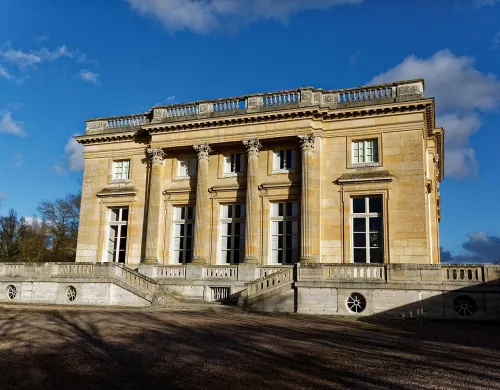
    Petit Trianon looks almost modest after you have heard about Versailles: a square building, simple and clean, with four different façades. The one facing the French garden carries Corinthian columns. This was a new kind of château when Louis XV ordered it from his first architect, Ange-Jacques Gabriel, in 1762, built so that each side opened onto a different garden, and it is regarded as a masterpiece of early neoclassicism.

    The gardens came first. In 1750, urged on by Madame de Pompadour, Louis XV asked Claude Richard to lay out a botanical garden here, reflecting the king's passion for plant experiments; ten years later Bernard de Jussieu joined him. Gabriel added a French garden, a menagerie for ordinary farm animals, quite unlike Louis XIV's exotic Royal Menagerie nearby, and two pavilions for rest and pleasure, the Pavillon français and the Salon frais.

    Inside, the decoration was more refined than rich, with nature and country life at its heart. The ground floor was for service, the main floor held the reception rooms and three small mezzanine rooms for the queen, and the attic housed the “apartments of the lords”. Pompadour never saw it finished: her successor as royal favourite, the Comtesse du Barry, inaugurated it in 1769.

    When Louis XV died, Louis XVI gave Petit Trianon to his young wife Marie-Antoinette. She made it her private world away from the court, built a small society theatre and replaced the botanical garden with an English landscape garden. Go inside if you want to understand her; the ticket is worth it for anyone curious about the queen or 18th-century interiors. From here it is only 450 m, about 6 minutes, to the hamlet she built next.

    Hours
    High season (Apr 1 – Oct 31): Tue–Sun 12:00–18:30 (last entry 17:45), Mon closed; Low season (Nov 1 – Mar 31): Tue–Sun 12:00–17:30 (last entry 16:45), Mon closed; Closed Dec 25, Jan 1, May 1
    Price
    15 EUR full, 12 EUR reduced (EU/EEA residents)
  3. 3

    Marie-Antoinette's Hamlet

    Marie-Antoinette's Hamlet in Versailles, stop 3 on the self-guided walking tour

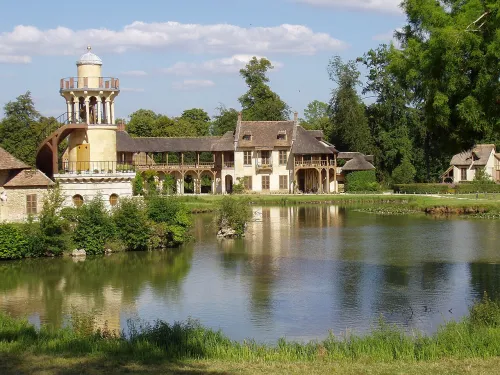
    Here Versailles pretends to be a village. Around an artificial pond once stocked with carp and pike stand twelve half-timbered cottages in Norman or Flemish style: a farm, a tower that served as a lighthouse, a dovecote, a boudoir, a barn, a mill and a keeper's house. Each came with its own vegetable patch, orchard or flower garden. At the centre is the Queen's House, the largest of them, split by a stream that you cross on a small stone bridge.

    Marie-Antoinette commissioned the Hameau de la Reine in the winter of 1782 into 1783. She wanted distance from the constraints of court and longed for a simpler, rustic life, inspired by Rousseau's writings: a small paradise where theatre and parties could make her forget she was queen. Yet it was also a working farm, producing milk and eggs for her table, and it shows how the Enlightenment ideas of the physiocrats reached the aristocracy.

    The architect was Richard Mique, who drew on the hamlet at Chantilly and on drawings by the painter Hubert Robert. Look closely at the timber and thatch: much of what you see is the result of restoration. Abandoned after the Revolution, the hamlet was rebuilt under Napoleon I between 1810 and 1812, which still forms most of its fabric, restored again with money from John D. Rockefeller Jr in the 1930s, and renovated from the 1990s under chief architect Pierre-André Lablaude. It opened to the public in 2006 as part of the Domaine de Marie-Antoinette.

    The hamlet charges entry. It suits anyone who enjoys gardens and the stories behind them; if your time is short, Petit Trianon tells more about the queen herself. Next you walk 980 m, about 13 minutes, back a century to Louis XIV's retreat.

    Local name
    Hameau de la Reine
    Hours
    High season (Apr 1 – Oct 31): Tue–Sun 12:00–18:30 (last entry 17:45), Mon closed; Low season (Nov 1 – Mar 31): Tue–Sun 12:00–17:30 (last entry 16:45), Mon closed; Closed Dec 25, Jan 1, May 1
    Price
    15 EUR full, 12 EUR reduced (EU/EEA residents)
  4. 4

    Grand Trianon

    Grand Trianon in Versailles, stop 4 on the self-guided walking tour

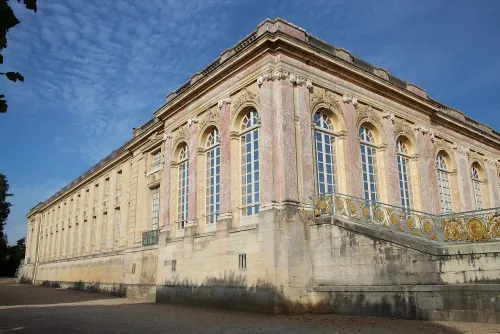
    The first thing you notice is colour: pink and red marble from Languedoc and an open peristyle, a screen of red marble columns looking onto the garden. Louis XIV built Grand Trianon as a retreat for himself and his official mistress, Madame de Montespan, a place where he and invited guests could take light meals, the “collations”, free from the strict etiquette of court.

    Its first version was far more fragile. Between 1663 and 1665 the king bought the hamlet of Trianon on the edge of Versailles, and in 1670 Louis Le Vau designed a porcelain pavilion there, faced with white and blue Delft-style tiles from French workshops in Rouen, Lisieux, Nevers and Saint-Cloud. It was finished two years later, but porcelain does not survive weather well, and by 1686 the tiles had decayed so badly that Louis XIV had it pulled down.

    Jules Hardouin-Mansart built the replacement at twice the size, starting in June 1687 and finishing in January 1688. His plan to keep the core of the porcelain pavilion was dropped in favour of the open peristyle you see today. A detail worth smiling at: the new Trianon was inaugurated in the summer of 1688 by Louis XIV with a different woman at his side, Madame de Maintenon.

    The palace did not stay a Louis XIV relic. Napoleon I, Louis XVIII, Charles X, Louis-Philippe and Napoleon III all used it later. The visit charges entry and is a good choice if you want to see a royal residence on a more human scale than the main palace. From here it is 1040 m, about 14 minutes, to the formal gardens.

    Hours
    High season (Apr 1 – Oct 31): Tue–Sun 12:00–18:30 (last entry 17:45), Mon closed; Low season (Nov 1 – Mar 31): Tue–Sun 12:00–17:30 (last entry 16:45), Mon closed; Closed Dec 25, Jan 1, May 1
    Price
    15 EUR full, 12 EUR reduced (EU/EEA residents)
  5. 5

    Gardens of Versailles

    Gardens of Versailles, stop 5 on the self-guided walking tour

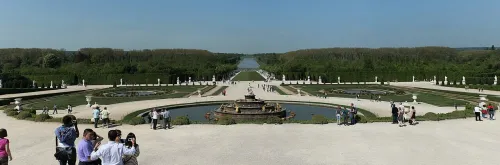
    You are now in the formal heart of the park, the area once called the Petit Parc: bounded by the palace to the east, the Apollo Fountain to the west, the Neptune Fountain to the north and the Orangerie to the south. In the old monarchy this walled garden was set inside the much larger Grand Parc of woods and fields. Today the whole park covers 815 hectares, against more than 8,000 before the Revolution, and 93 hectares of it are formal gardens.

    Keep an eye out for statues. The gardens hold 386 works of art, 221 of them statues, and Apollo appears seven times. Louis XIV saw himself in the sun god, and the idealised image of the Sun King is at its most dazzling in the Apollo Fountain, which looks out onto the Grand Canal you are heading for.

    The main creator was André Le Nôtre. From the 1680s Jules Hardouin-Mansart, first his collaborator and then his rival, reshaped groves, basins and fountains until his death in 1708. The gardens have kept changing ever since, with groves renamed and many replantings, and feeding all that water remains a problem to this day.

    Entry is free except on musical fountain and garden show days. Even if you are short on time, give the long perspectives half an hour. Then walk 860 m, about 11 minutes, down to the water.

    Hours
    High season (Apr 1 – Oct 31): Daily 07:00–20:30 (last access 19:00); Low season (Nov 1 – Mar 31): Daily 08:00–18:00 (last access 17:30)
    Price
    High season musical fountain / garden show days: 15 EUR full, 12 EUR reduced (EU/EEA); Low season & non-show days: Free
  6. 6

    Grand Canal

    Grand Canal in Versailles, stop 6 on the self-guided walking tour

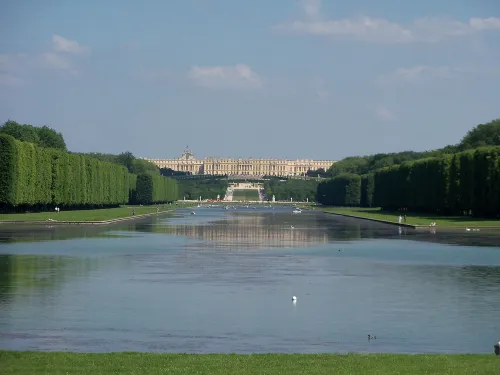
    The Grand Canal is the largest basin in the park, and it is shaped like a cross. The main arm runs east to west in line with the palace for 1,670 metres. The cross arm, dug first, runs north and south for 1.5 km: 400 metres towards Trianon and 600 metres towards the Royal Menagerie, which no longer exists. Both arms are 62 metres wide, cover 24 hectares and have a perimeter of 5.5 km.

    Built between 1667 and 1679 at André Le Nôtre's instigation, it was a bold project. Before that, the park ended at a gate behind the Bassin des Cygnes. The ground here was a marsh known as the “stinking pond”, blamed for many illnesses in Versailles, and the French Academy of Sciences advised the king's gardener against the work. He went ahead anyway, cutting through the Ru de Gally stream, which still feeds the canal. The banks were first lined with four rows of elms and decorated with statues by Jean-Baptiste Tuby, after sketches by Charles Le Brun, of children and seahorses.

    Once complete, the canal became the launch point for fireworks during Louis XIV's great festivities. It also has a myth attached: people often say the sun sets exactly along the canal on 5 September, Louis XIV's birthday, or on 25 August, Saint Louis's day. Neither is true. The alignment happens on 16 August and 26 April, and the canal's direction was most likely set simply by the lie of the land.

    The canal is free. From here you have 1680 m, about 23 minutes, to the Orangerie, the second longest leg of the walk.

    Hours
    High season (Apr 1 – Oct 31): Daily 07:00–20:30 (pedestrian gates vary, last access 19:45); Low season (Nov 1 – Mar 31): Daily 08:00–18:00 (last access 17:30)
    Price
    Free
  7. 7

    Orangerie

    Orangerie in Versailles, stop 7 on the self-guided walking tour

    The Orangerie is where Versailles keeps its trees through the winter. Jules Hardouin-Mansart built it between 1684 and 1686, replacing an earlier design by Louis Le Vau from 1663. Like other grand orangeries in Europe, it had two jobs: protect delicate plants and impress visitors. It also turned the gardens into a stage for entertaining the court.

    From May to October the trees stand outside in the Parterre Bas, over 1,055 plants in boxes. Most are citrus trees originally shipped from Italy, joined by oleanders, olives, pomegranates and palms. In winter they move into the vaulted, cathedral-like galleries, where gardeners once lit fires in the coldest months. Moving the big orange trees was no small task: in 1689 the gardener Valentin Lopin invented a device just for that.

    Why so much effort for oranges? Bitter oranges reached Europe by the 15th or 16th century and were costly enough that some medieval cookbooks set out exactly how many slices a visiting dignitary deserved. Citrus became a fashion of nobles and rich merchants, and in France the first orangery was built by Charles VIII at the Château d'Amboise.

    You see the Orangerie from the gardens; the interior is shown only on guided tours. Entry follows the gardens' rule. From here it is 840 m, about 13 minutes, to the palace, and on this stretch you pass the Hall of Mirrors.

    Hours
    High season (Apr 1 – Oct 31): Daily 07:00–20:30; Low season (Nov 1 – Mar 31): Daily 08:00–18:00 (accessible via the Gardens)
    Price
    High season fountain/garden show days: 15 EUR full, 12 EUR reduced (EU/EEA); Low season & non-show days: Free; Interior by guided tour only
  8. 8

    Palace of Versailles

    Palace of Versailles, stop 8 on the self-guided walking tour

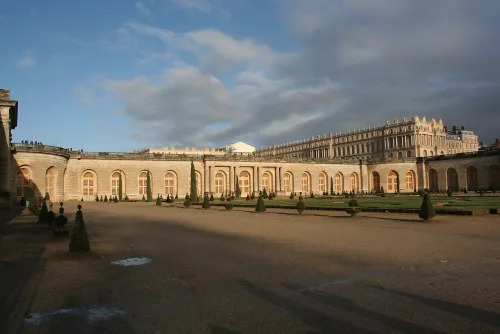
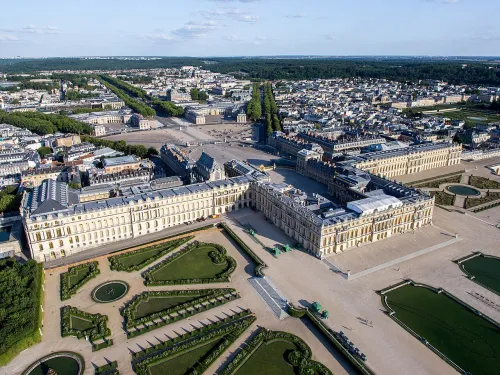
    Now the main building. The Palace of Versailles was the principal residence of Louis XIV, Louis XV and Louis XVI, and from 6 May 1682 until 6 October 1789 the king, the court and the royal government lived here permanently, apart from the Regency years after Louis XIV's death. Louis XIV conceived it to glorify the French monarchy, and it became the great architectural project of his reign, a model copied across Europe in the 18th and 19th centuries.

    The scale is hard to take in from the Place d'Armes: about 63,154 square metres of courtyards and buildings designed to stay in harmony, with roughly 2,300 rooms. Around 1,000 of them belong to the National Museum of the History of France, housed in the palace and the Trianons. The site itself is far older than any of this; Versailles is first mentioned in 1038, in a charter of the Abbey of Saint-Père de Chartres.

    Is it worth going in? On a first visit, yes: the state rooms are what most people travel for, and the Passeport ticket gets you into the palace. Allow about two hours. If you have already seen the interiors, take in the façades and the forecourt and keep your energy for the town, where the end of this royal world played out.

    The palace sits about 16 km from Paris, and the date 6 October 1789, when the court left for good, leads straight to the next stop. Walk 860 m, about 11 minutes, into the Saint-Louis quarter.

    Hours
    High season (Apr 1 – Oct 31): Tue–Sun 09:00–18:30 (last admission 17:45, ticket desks close 17:30), Mon closed; Low season (Nov 1 – Mar 31): Tue–Sun 09:00–17:30 (last admission 16:45, ticket desks close 16:40), Mon closed; Closed Dec 25, Jan 1, May 1
    Price
    Passeport ticket: 25 EUR low season / 35 EUR high season full (reduced: 22 EUR / 32 EUR for EU/EEA; late entry from 15h/16h: 18 EUR / 28 EUR)
  9. 9

    Salle du Jeu de Paume

    Salle du Jeu de Paume in Versailles, stop 9 on the self-guided walking tour

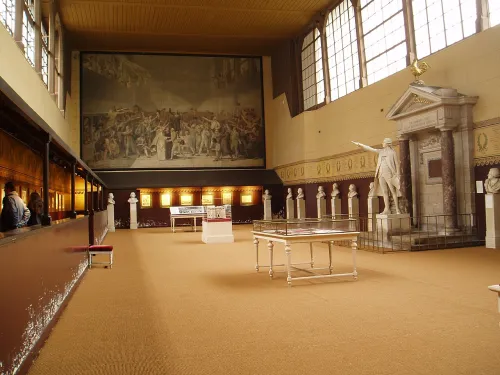
    From outside this is just a long hall at 1 rue du Jeu de Paume, in the Saint-Louis quarter. Inside it measures 29 by 10 metres, with black walls, painted so players could see the ball, and a blue ceiling scattered with fleurs-de-lys. Nicolas Creté built it in 1686 as a court for jeu de paume, the ancestor of tennis; in its day such a hall was called a “tripot”. Louis XIV and his courtiers played here, while commoners were not allowed to.

    It became famous for something else. In June 1789 the Estates-General were turning into a legal revolution: on 17 June the Third Estate declared itself a National Assembly. Louis XVI wanted to regain control and called a royal session for 23 June. In the meantime, against the advice of his minister Necker, he had the assembly hall at the Hôtel des Menus-Plaisirs closed, officially for decorating work.

    On the morning of 20 June, the Assembly's provisional president, Jean-Sylvain Bailly, found the doors guarded by soldiers. Rumours of a coup spread in the street, and the deputies looked for somewhere else to meet. Joseph Ignace Guillotin suggested this privately owned tennis hall. There was hardly any furniture: a few seats and, as a table, a door laid on two barrels. Standing on a table, Bailly read out the oath that the deputies would not separate, now known as the Tennis Court Oath.

    Entry is free, and it is a short visit that brings the Revolution down to the size of one room. Next is only 390 m, about 5 minutes, to the cathedral of the same quarter.

    Hours
    High season (Apr 1 – Oct 31): Tue–Sun 12:30–18:30 (last admission 17:45), Mon closed; Low season (Nov 1 – Mar 31): Tue–Sun 12:30–17:30 (last admission 16:45), Mon closed; Closed Jan 1, May 1, Nov 1, Nov 11, Dec 25
    Price
    Free
  10. 10

    Versailles Cathedral Saint-Louis

    Versailles Cathedral Saint-Louis, stop 10 on the self-guided walking tour

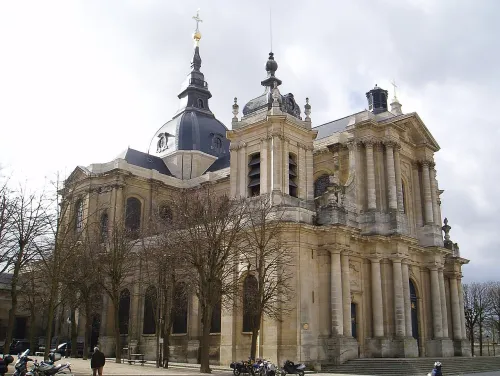
    Versailles Cathedral Saint-Louis is a rocaille church by Jacques Hardouin-Mansart de Sagonne. It was blessed on 25 August 1754, Saint Louis's day, chosen as cathedral when the diocese of Versailles was created in 1802, and only consecrated in 1843.

    Its story is about a growing town that ran out of churches. The old village church of Versailles, dedicated to Saint Julien de Brioude, was demolished in 1681 to make way for the Grand Commun of the palace. In 1684 Louis XIV laid the first stone of the Notre-Dame parish church, but for the roughly 4,050 people of old Versailles and the Parc-aux-Cerfs district, Notre-Dame was far away, and reaching it meant crossing the Place d'Armes.

    So in 1725 a temporary chapel about thirty metres long went up at the corner of rue de Satory and rue d'Anjou, near the King's Kitchen Garden, surrounded by a cemetery. Burials began in April 1727 and baptisms on 17 May 1728. It was still only a branch of Notre-Dame, served by two priests of the Mission, until 4 June 1730, when the archbishop of Paris made it a parish under the patronage of Saint Louis. Around 1740 the parish finally decided to build a real church, the one you are standing in front of.

    Entry is free and it is still a working parish church, so go in quietly. It is a calm counterpoint to the palace and needs only a short visit. From here walk 820 m, about 12 minutes, to the last stop.

    Hours
    Daily 08:30–20:00 (parish reception at presbytery: Mon–Fri 09:30–11:30 and 16:00–19:00, Sat 09:30–11:30; Sunday services 09:30, 11:00, 18:30)
    Price
    Free
Walking tour route map of Versailles Route loaded
Notre-Dame MarketPetit TrianonMarie-Antoinette's HamletGrand Trianon+7
All 11 stops are already on the map.
You just press start.
AI Tour Guide

You've read the Versailles route. Now walk it with a guide in your ear.

Press start wherever you are, even hundreds of kilometres from Versailles, and the guide begins telling its stories right away. In the city, pick any of the 11 stops to start from: it leads you there, then talks with you the whole route, asking, listening, remembering, and shaping the tour around your answers.

11stops 10.1km 2 h 18 minwalking 13languages
▶Start the tour free

Free to start · Runs in your browser · No app, no download

Shorter Ways to Walk Versailles

Not everyone wants the full day. These three cuts keep the route's logic and let you choose between royal interiors, free open-air sights and the revolutionary town.

The royal estate only

Stops: 2, 3, 4, 5, 6, 7, 8

For first-time visitors who came for the palace and Marie-Antoinette. From Petit Trianon to the Palace of Versailles you walk 1 h 20 min. Petit Trianon, the Hamlet, Grand Trianon and the palace charge entry; the gardens and Orangerie only on show days.

Gardens and water, no tickets

Stops: 5, 6, 7

For a relaxed afternoon outdoors on a day without a fountain or garden show. Gardens of Versailles, Grand Canal and Orangerie are linked by 34 min of walking, and on those days all three are free.

The town of the Revolution

Stops: 8, 9, 10, 11

For history readers who have already seen the palace rooms or want a short, free walk. From the palace forecourt to the Gallery of the Great Stables it is 28 min on foot, and the hall, the cathedral and the carriage gallery are all free.

How Long Does This Versailles Tour Take with the Palace and Trianons?

The order follows the history of the place: the town market that fed the court, the private retreats of three kings and a queen, the formal park, the palace itself, and finally the streets where royal power was challenged in 1789. Walking alone takes 2 h 18 min, and the longest leg is the opening one from the market to Petit Trianon.

If you go inside where it pays off, count about two hours for the palace, around two hours for the three Trianon stops together and shorter pauses everywhere else; that adds up to close to nine hours. The royal estate variant fills about six and a half hours with its visits, while the free gardens variant and the town variant each take roughly an hour and a half.

Before You Set Off in Versailles

  • Start and finish: The recommended start is Notre-Dame Market and the walk ends at the Gallery of the Great Stables. You can join at any stop; from the end, the GPS navigation in your browser can lead you back to the start.
  • Time of day: Begin in the morning while the market stalls are trading. Not every stop opens every day, so check the opening days of the palace, the Trianons and the carriage gallery before you pick a date.
  • Tickets: Petit Trianon, Marie-Antoinette's Hamlet, Grand Trianon and the palace charge entry. The Gardens of Versailles and the Orangerie are free except on musical fountain and garden show days. The market, Grand Canal, Salle du Jeu de Paume, cathedral and carriage gallery are free.
Walking tour route map of Versailles
AI Tour Guide

Your guide is ready when you reach the market.

Press start and a voice AI Tour Guide takes it from here: leading the route through Versailles, telling the stories, and turning your walk into a real back-and-forth conversation. No app or download is needed; it runs in your browser.

11stops 10.1km 2 h 18 minwalking 13languages
▶Start the tour free

Free to start · Runs in your browser · No app, no download

What the AI Tour Guide Adds in Versailles

Versailles is a place of people as much as buildings: Pompadour, Du Barry, Montespan, Maintenon, Marie-Antoinette, Bailly. The AI Tour Guide walks you through them as a conversation, greets you at the market, tells the stories at each stop, asks what interests you and follows that thread, whether it is court etiquette, gardens or 1789. Ask what became of Bailly after the oath, or how a royal festival on the canal was staged, and interrupt whenever you like. You start with 100 free credits; after that, choose this tour all-inclusive for €19.99 with no time limit, or credits at €5 per hour.

A Real Conversation A voice AI Tour Guide greets you, leads the whole route, and tells the stories and facts as you walk, asking what you want to see and keeping a real conversation going. Not a recording you press play on.
Map Navigation Follow the route on the map and walk at your own pace. You choose where to start and when to move to the next stop.
Ask Anything Curious about a building you pass? Ask your AI Tour Guide on the spot and the conversation carries on.
13 Languages Switch language anytime. No separate tour needed.
Start free in your browser

Common Questions about Walking Versailles

Can I combine Versailles with Paris or another day trip?

Versailles lies about 16 km from Paris, so many people pair this walk with the Paris walking tour on another day. If you like royal châteaux, Fontainebleau makes a natural second trip.

Can I go inside the Orangerie?

The interior is shown by guided tour only. On the walk you see the building and, from May to October, the citrus and Mediterranean trees set out in the Parterre Bas.

Can I visit Versailles Cathedral Saint-Louis during Sunday services?

It is a working parish church with Sunday services. You are welcome, but keep sightseeing for the time outside the services and move quietly.

Is the Gallery of the Great Stables part of the palace?

Yes, it belongs to the public body that runs the palace, museum and estate of Versailles, but it sits in the town, in the Grande Écurie, and entry is free.

Is the tour really free?

Yes. The whole tour is free: the route, the interactive map and the navigation cost you nothing. Only the voice AI Tour Guide is optional and paid: you test it with 100 free credits, then you pay either €5 per hour or €19.99 for this whole tour, with no time limit. Admission to 6 of the 11 stops is not included: Petit Trianon, Marie-Antoinette's Hamlet, Grand Trianon, Gardens of Versailles, Orangerie and Palace of Versailles charge their own entry fees.

Do I need to download an app?

No. Everything runs in your phone browser. Open the route and start walking, no download and no sign-up required.

Do I need to book the walking tour in advance?

No booking needed. This self-guided tour is available anytime. Open the route in your browser and start walking. The AI Tour Guide works instantly, no app, no reservation required.

What languages is the AI Tour Guide available in?

The AI Tour Guide speaks 13 languages, so you take the tour in your own language and can switch at any time.

Can I skip stops or change the route?

Yes. Skip any stop, spend extra time at places you like, or start the route from any point. It is your walk, you set the pace.
Image credits
▶ Start free in your browser Runs in your browser, no app, no download