Free Walking Tour Delhi: Red Fort to Humayun's Tomb

Follow Shah Jahan's family through their city: from the Red Fort and Jahanara's moonlit bazaar to a Sufi shrine and the garden tomb that paved the way for the Taj Mahal.

6 Stops 12.9 km ~3 h walking
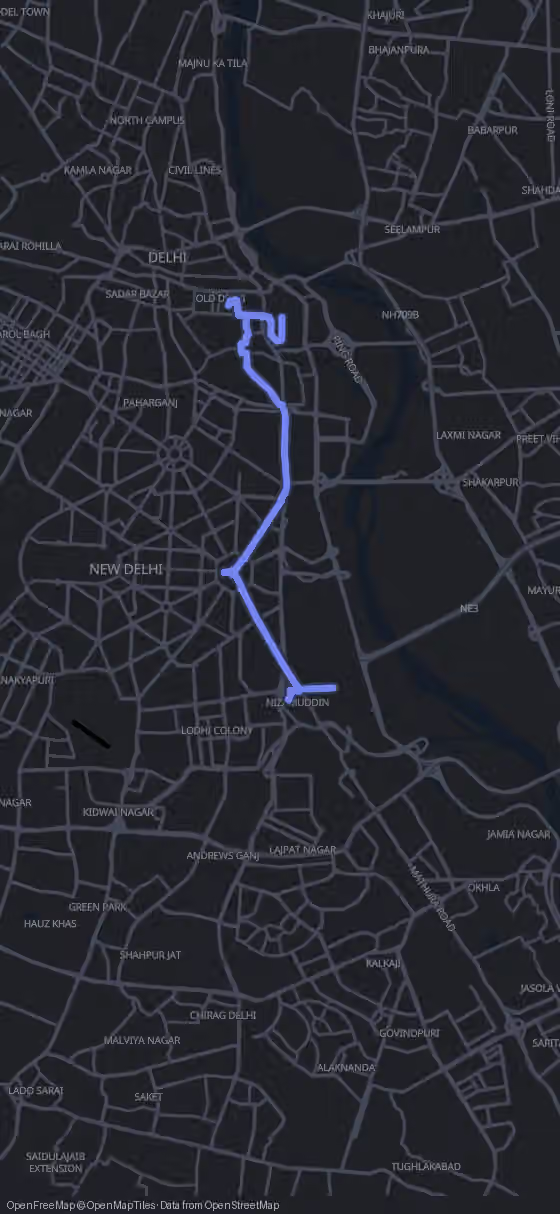
Route map for the Delhi walking tour
Stop 1 of 6
2.2 km·27 min
Red Fort
Head west along Chandni Chowk Road toward the market
Namaste, welcome to Delhi. I'm Alex, and the Red Fort once held an imperial seat famous far beyond these walls.
Try this tour with Alex

What This Delhi Route Covers

Six stops lead from the Red Fort through Chandni Chowk and Jama Masjid in Old Delhi to India Gate, Nizamuddin Dargah and Humayun's Tomb. The route runs 12.9 km with 3 h of pure walking; with time inside the main sites, plan about eight hours.

Chandni Chowk, India Gate and Nizamuddin Dargah are free. The Red Fort, Jama Masjid and Humayun's Tomb charge admission, with higher rates for foreign visitors. Route, map and GPS navigation are free in your browser; the AI Tour Guide is optional.

Open free GPS & optional AI Tour Guide
This short shows highlights of the route. All 6 stops follow below.

The Route

Walking Map of Delhi: Old Delhi to the Nizamuddin Tombs

6 stops 12.9 km 3 h walking
Tap to load interactive map

The 6 stops along this route

  1. Red Fort in Delhi, stop 1 on the self-guided walking tour
    1Red Fort
  2. Chandni Chowk in Delhi, stop 2 on the self-guided walking tour
    2Chandni Chowk
  3. Jama Masjid in Delhi, stop 3 on the self-guided walking tour
    3Jama Masjid
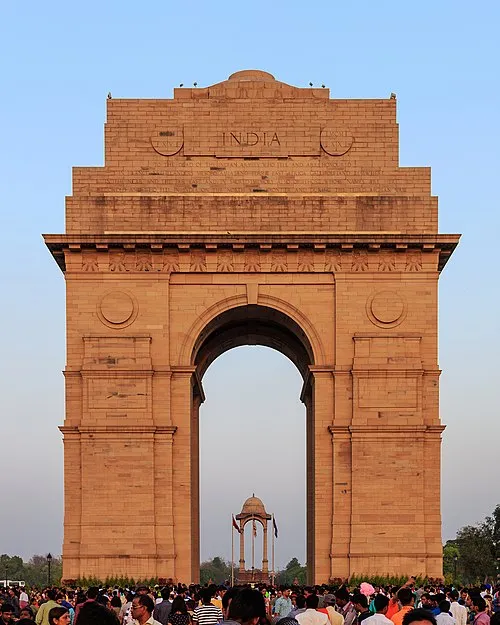
  4. India Gate in Delhi, stop 4 on the self-guided walking tour
    4India Gate
  5. Nizamuddin Dargah in Delhi, stop 5 on the self-guided walking tour
    5Nizamuddin Dargah
  6. Humayun's Tomb in Delhi, stop 6 on the self-guided walking tour
    6Humayun's Tomb
  7. That's the full route.

    Walk it with an AI Tour Guide talking you through every one of these streets.

    Start free in your browser
    You made it

Your Delhi Walking Tour, from Mughal Fort to Garden Tomb

  1. 1

    Red Fort

    Red Fort in Delhi, stop 1 on the self-guided walking tour

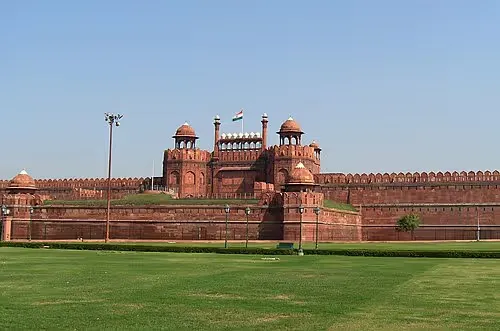
    You start where Mughal Delhi started. At the end of the 1630s Shah Jahan decided to move his capital from Agra to Delhi and commissioned this fortress as the residence of the imperial family. Its design is credited to Ustad Ahmad Lahori, the architect also named for the Taj Mahal. The emperors called it Qila-i-Mubarak, the Blessed Fort; the popular name Lal Qila simply describes the red sandstone walls, with lal meaning red in Hindi and qila coming from the Arabic word for fortress.

    Look at the walls as a piece of design: the fort blends Persian and Indian building traditions, and it was originally finished in red and white. The Yamuna once fed the moats that ran along most of these walls. The main entrance is the Lahori Gate, and it carries modern India's most famous moment: on 15 August 1947 Jawaharlal Nehru, the first Prime Minister, raised the national flag above it. Every Independence Day since, the Prime Minister hoists the tricolour here and addresses the country from the ramparts.

    What you see inside is what survived two disasters. In 1739 the Persian ruler Nadir Shah plundered the fort and stripped it of its artwork and jewels. After the rebellion of 1857 the British demolished many of the marble buildings, left the defensive walls standing and turned the complex into a military garrison. In 2007 the Red Fort Complex became a UNESCO World Heritage Site.

    Is it worth going in? If Mughal history draws you to Delhi at all, yes; give it about 90 minutes. In the evening there is also a Sound and Light show. Foreign visitors pay considerably more than Indian, SAARC and BIMSTEC citizens, and booking online is a little cheaper than paying cash. Short on time, the walls and the Lahori Gate from outside already tell the main story.

    From here it is 2,170 m, about 30 minutes on foot, to Chandni Chowk. The fort sits at the eastern edge of the bazaar, which was laid out as the grand street of the same new capital.
    Hours
    Daily sunrise to 21:00 (general monument sunrise to sunset; Sound and Light show until 21:00)
    Price
    600 INR cash / 550 INR online (foreign visitors); 50 INR cash / 35 INR online (Indian, SAARC, BIMSTEC citizens); free for children under 15
  2. 2

    Chandni Chowk

    Chandni Chowk in Delhi, stop 2 on the self-guided walking tour

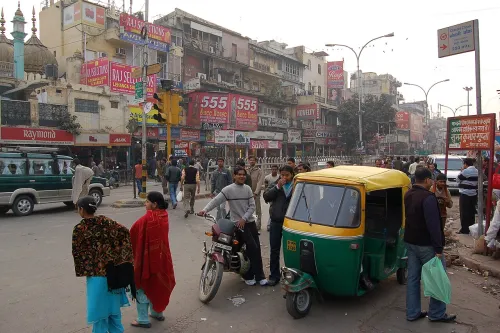
    Chandni Chowk means Moonlight Square, and the name was once literal. When Shah Jahan founded his capital Shahjahanabad, his favourite daughter, Princess Jahanara Begum, designed this market in 1650. The original square was half-moon shaped, with a pool at its centre that shimmered in the moonlight; the colonial Townhall, built by the British after their victory in 1857, later rose in front of where that square lay.

    Picture the street as it was planned: a shallow water channel fed by the Yamuna ran down the middle, with roads and shops on either side. Three bazaars lined the route, about 1,560 shops in all, along a street roughly 40 yards wide and 1,520 yards long. The shops themselves were arranged in a half-moon pattern that has since been lost. Silver merchants made the bazaar famous, which earned it the nickname Silver Street, a play on chandi, the Hindi word for silver.

    The canals disappeared under British rule, and what remains is dense, loud and crowded, still one of the biggest wholesale markets in India. That is exactly the point of walking it: this is Old Delhi at full speed, not a museum piece. The street itself is free to walk, but to see the bazaar rather than just the street, come when the shops and food outlets are open.

    Keep Jahanara in mind as you walk on. You will meet her again at Nizamuddin Dargah, where she is buried. Next comes her father's great mosque, 1,400 m or about 19 minutes away.

    Hours
    Open 24/7 (bazaar shops and food outlets typically open ~10:30–21:00, many closed on Sundays)
    Price
    Free
  3. 3

    Jama Masjid

    Jama Masjid in Delhi, stop 3 on the self-guided walking tour

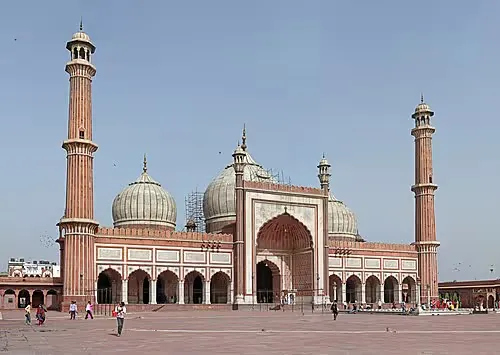
    Shah Jahan gave this mosque a poetic name, Masjid-i-Jahan-Numa, usually read as the mosque that reflects the whole world. Ordinary Delhi preferred Jama Masjid, the congregational or Friday mosque, a term used for community mosques around the world since the 7th century. It is one of the largest mosques in India and still in active use.

    Shah Jahan built it between 1650 and 1656 on the highest point of Shahjahanabad, so it would dominate his new city. About 5,000 workers raised it, a mixed crew of Indians, Arabs, Persians, Turks and Europeans, overseen by the wazir Sadullah Khan and Fazil Khan, the comptroller of the imperial household. Its first imam was Syed Abdul Ghafoor Shah Bukhari. Until the empire ended in 1857 this was the imperial mosque, a statement of Mughal power, and it stayed politically charged through several periods of British rule.

    When you stand in front of it, look across: the Red Fort and the smaller Sunehri Masjid face the mosque, and the tomb of Abul Kalam Azad, a leader of India's independence movement, lies right next to it. The whole structure is a Monument of National Importance.

    Going in is worthwhile for anyone; 40 minutes is enough to take in the courtyard. Foreign visitors pay admission, Indian visitors go in free, and photography costs nothing extra. Tourists are kept out during prayer times, so plan your visit around them.

    Now comes the long leg: 5,150 m, about 72 minutes on foot, out of Mughal Delhi and into the planned capital of the British era at India Gate.

    Hours
    Daily 08:00 to sunset for foreign tourists, 11:00 to sunset for Indian tourists (general visitor hours 07:00–12:00, 13:30–18:30; closed to tourists during prayer times)
    Price
    Free for Indian tourists; 400 INR for foreign tourists; photography free
  4. 4

    India Gate

    India Gate in Delhi, stop 4 on the self-guided walking tour

    The arch in front of you stands 43 m high on Kartavya Path. Completed in 1931 and originally called the All India War Memorial, it takes its cue from the Arc de Triomphe in Paris. The red and yellow sandstone ties it visually to the Mughal monuments you have just left, though it belongs to a very different empire.

    It honours the Indian soldiers who served in the British army and died in the First World War and the Afghan wars. Walk close to the walls: about 13,300 names are carved into them, among them some soldiers and officers from the United Kingdom.

    The space around the arch tells the story of independence. A statue of George V once stood in front of it; after independence it was moved, with other statues of the British Raj, to Coronation Park, and only the empty canopy remains as a symbol. India Gate became the site of a memorial to the unknown soldier: the Amar Jawan Jyoti was placed beneath the arch, a rifle topped with a soldier's helmet, with flames burning at its four corners. Each year the Prime Minister and the chiefs of the three armed services lay wreaths here.

    The memorial is free and open around the clock, and 20 minutes is plenty by day. Several of Delhi's important roads fan out from its corners, and in the evening the lawns take on the mood of a fair. From here you walk 3,110 m, about 43 minutes, to Nizamuddin Dargah.

    Hours
    Open 24/7
    Price
    Free
  5. 5

    Nizamuddin Dargah

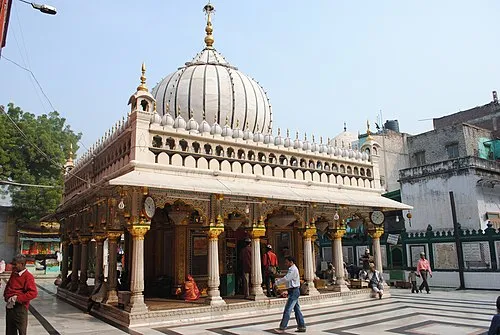
    Nizamuddin Dargah in Delhi, stop 5 on the self-guided walking tour

    After the noise of the avenues, this is a living place of faith. Hazrat Nizamuddin Dargah is the shrine of the Sufi saint Nizamuddin Auliya, and thousands of pilgrims come every week. Admission is free, and the shrine is famous for its evening qawwali, devotional music sung at the shrine. Move quietly and let the pilgrims go first.

    Look for the white dome over the saint's tomb, about 6 m across. Muhammad bin Tughluq built the first structure after Nizamuddin's death in 1325; Firuz Shah Tughlaq later repaired it and hung four golden cups in the recesses of the dome. The marble balustrade around the grave was a gift from Nawab Khurshid Jah of Hyderabad's Paigah family, and the present dome dates from 1562, built by Faridun Khan. A marble patio and finely carved jalis, stone trellis screens, surround the tomb.

    At the entrance lie two graves that link back to your morning: Amir Khusrau, the saint's disciple, and Jahanara Begum, Shah Jahan's daughter who designed Chandni Chowk. Historian Ziauddin Barani and the Mughal emperor Muhammad Shah are buried here too, among more than 70 graves. The Aga Khan Trust for Culture restored the complex around 2010.

    Next to the dargah stands the Jamat Khana Masjid, also called the Khilji Mosque, built in red sandstone under Alauddin Khalji by his son Khizr Khan. Look at its three bays, the Quranic inscriptions in the walls and the lotus buds carved on the arches. The complex also holds a baoli, a stepwell. Allow about 30 minutes, then walk 1,060 m, about 15 minutes, to Humayun's Tomb, whose main building was ordered in the same year the saint's dome was rebuilt.

    Local name
    Hazrat Nizamuddin Dargah
    Hours
    Daily 05:00–22:30
    Price
    Free admission
  6. 6

    Humayun's Tomb

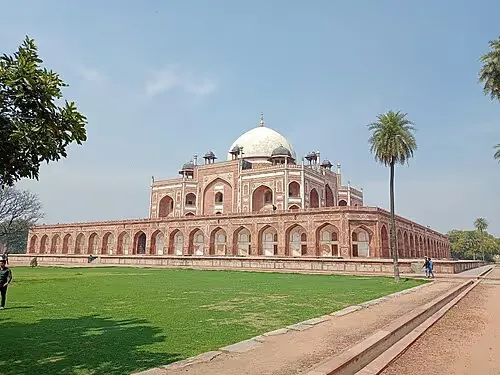
    Humayun's Tomb in Delhi, stop 6 on the self-guided walking tour

    You finish with the building that began the great Mughal garden tombs. Humayun's widow, Hamida Banu Begum, ordered it in 1562, and the architects, Sayyid Muhammad ibn Mirak Ghiyathuddin and his father Mirak Ghiyathuddin, were brought in especially from Herat in Afghanistan. The main building took about eight years. It stands in the Nizamuddin East area near Purana Qila, on land that once belonged to Kilokhari fort, the capital of the 13th-century Sultan Kaiqubad.

    Two things were new here. It was the first charbagh, the four-part garden, on the Indian subcontinent, and the first time red sandstone was used on such a scale. The model was the tomb of Humayun's ancestor Timur in Samarkand, and the result inspired the Mughal tombs that followed, a line that reached its peak with the Taj Mahal. Compare it in your mind with Babur's simple garden grave in Kabul: this is a monument meant to impress.

    It is also a family vault. Besides Humayun lie Hamida Banu Begum, Dara Shikoh, eldest son of Shah Jahan, and later emperors including Jahandar Shah, Farrukhsiyar, Rafi ul-Darjat, Rafi ud-Daulat and Alamgir II. UNESCO listed the complex as a World Heritage Site in 1993.

    Going in is clearly worth it; plan an hour or a little more for the tomb and the gardens. Foreign visitors pay considerably more than Indian, SAARC and BIMSTEC citizens, and booking online is a little cheaper than paying cash. This is the end of the route, and a fitting one: the garden design you see here leads straight to the Taj Mahal.

    Hours
    Daily sunrise to 21:00 (general monument sunrise to sunset)
    Price
    600 INR cash / 550 INR online (foreign visitors); 40-50 INR cash / 35 INR online (Indian, SAARC, BIMSTEC citizens); free for children under 15
Walking tour route map of Delhi Route loaded
Red FortChandni ChowkJama MasjidIndia Gate+2
All 6 stops are already on the map.
You just press start.
AI Tour Guide

You know the route now. Walk it with a guide in your ear.

Press start wherever you are, even hundreds of kilometres from Delhi, and the guide begins telling its stories right away. In the city, pick any of the 6 stops to start from: it leads you there, then talks with you the whole route, asking, listening, remembering, and shaping the tour around your answers.

6stops 12.9km 3 hwalking 13languages
▶Start the tour free

Free to start · Runs in your browser · No app, no download

Shorter Ways to Walk Delhi

The longest leg of the day, 72 minutes on foot from Jama Masjid to India Gate, splits the route neatly into two halves. Each works on its own, so you can walk one in the morning and save the other for another day.

Old Delhi in a morning

Stops: 1, 2, 3

For anyone who cares most about Shah Jahan's city. Red Fort, Chandni Chowk and Jama Masjid lie about 3.6 km apart in total, 49 minutes of walking. You pay admission at the Red Fort and, as a foreign visitor, at Jama Masjid; the bazaar is free.

Shrines and gardens in the south

Stops: 4, 5, 6

For a calmer half with more green. India Gate, Nizamuddin Dargah and Humayun's Tomb add up to about 4.2 km and 58 minutes of walking. Only Humayun's Tomb charges admission; the memorial and the dargah are free.

How Long Does This Delhi Walk Really Take?

The walking itself takes 3 h, and almost half of that sits in two legs: 72 minutes from Jama Masjid to India Gate and 43 minutes from there to Nizamuddin Dargah. The rest are short hops of 15 to 30 minutes, so Old Delhi and the Nizamuddin area each feel compact.

A realistic full day: start at the Red Fort at 08:00 and allow 90 minutes inside. You reach Chandni Chowk at 10:00 and Jama Masjid at about 11:05. India Gate follows at about 13:00, Nizamuddin Dargah at about 14:00 and Humayun's Tomb at about 14:45; with an hour and a quarter in the gardens you finish around 16:00.

Walked on their own, the Old Delhi half takes about 3 h 45 min including the visits, the southern half about 3 h.

Before You Set Off in Old Delhi

  • Start and finish: The recommended start is the Red Fort and the walk ends at Humayun's Tomb. You can join at any stop; the order here simply follows the story from Mughal court to garden tomb.
  • Best day and time: Pick a day when the shops of Chandni Chowk are open, and start early so you have plenty of time at Jama Masjid, which closes to tourists during prayer times.
  • Costs: As a foreign visitor you pay admission at the three paid sites, and booking the Red Fort and Humayun's Tomb online is a little cheaper than paying cash. The route itself costs nothing. If you add the AI Tour Guide, you start with 100 free credits, then choose between this tour all-inclusive for €19.99 with no time limit or credits at €5 per hour.
Walking tour route map of Delhi
AI Tour Guide

Your Delhi guide is ready whenever you are.

Press start and a voice AI Tour Guide takes it from here: leading the route through Delhi, telling the stories, and turning your walk into a real back-and-forth conversation. No app or download is needed; it runs in your browser.

6stops 12.9km 3 hwalking 13languages
▶Start the tour free

Free to start · Runs in your browser · No app, no download

What the AI Tour Guide Adds Between Fort and Tomb

This route is one family's story told across a city: Shah Jahan builds the fort and the mosque, his daughter Jahanara lays out the bazaar and lies buried beside a Sufi saint, and his eldest son ends up in Humayun's garden tomb. The AI Tour Guide leads you through that thread as a conversation, greets you at the Red Fort, asks whether you lean toward court intrigue, faith or architecture, and remembers it at the next stop. Wonder what daily life inside the Blessed Fort looked like, or why Amir Khusrau still matters to qawwali singers? Just ask, and the guide takes the story there before walking on.

A Real Conversation A voice AI Tour Guide greets you, leads the whole route, and tells the stories and facts as you walk, asking what you want to see and keeping a real conversation going. Not a recording you press play on.
Map Navigation Follow the route on the map and walk at your own pace. You choose where to start and when to move to the next stop.
Ask Anything Curious about a building you pass? Ask your AI Tour Guide on the spot and the conversation carries on.
13 Languages Switch language anytime. No separate tour needed.
Start free in your browser

Delhi Questions Before You Go

Should I buy Red Fort and Humayun's Tomb tickets online?

Yes, if you can. Both monuments charge less for online tickets than for cash at the gate, for foreign and Indian visitors alike. Jama Masjid sells its tourist ticket on site.

Do children pay at the monuments in Delhi?

Children under 15 enter the Red Fort and Humayun's Tomb for free. Nizamuddin Dargah, India Gate and Chandni Chowk are free for everyone.

Can I hear qawwali at Nizamuddin Dargah?

The dargah is known for its evening qawwali sessions. The full-day route brings you there in the afternoon, so the easiest way is to come back after Humayun's Tomb. Ask at the shrine when the music starts that day.

Where can I continue after Delhi?

Jaipur is 234 km away and makes a natural next stop for more palaces and forts. Heading further, Mumbai shows a completely different, colonial and coastal side of India.

Is the tour really free?

Yes. The whole tour is free: the route, the interactive map and the navigation cost you nothing. Only the voice AI Tour Guide is optional and paid: you test it with 100 free credits, then you pay either €5 per hour or €19.99 for this whole tour, with no time limit. Admission to 3 of the 6 stops is not included: Red Fort, Jama Masjid and Humayun's Tomb charge their own entry fees.

Do I need to download an app?

No. Everything runs in your phone browser. Open the route and start walking, no download and no sign-up required.

Do I need to book the walking tour in advance?

No booking needed. This self-guided tour is available anytime. Open the route in your browser and start walking. The AI Tour Guide works instantly, no app, no reservation required.

What languages is the AI Tour Guide available in?

The AI Tour Guide speaks 13 languages, so you take the tour in your own language and can switch at any time.

Can I skip stops or change the route?

Yes. Skip any stop, spend extra time at places you like, or start the route from any point. It is your walk, you set the pace.
Image credits
▶ Start free in your browser Runs in your browser, no app, no download