Free Walking Tour Mumbai: Gateway to Marine Drive

From the basalt arch by the Arabian Sea to the Queen's Necklace: nine stops through old Bombay, its grand hotel, a museum of Indian history and a great railway terminus.

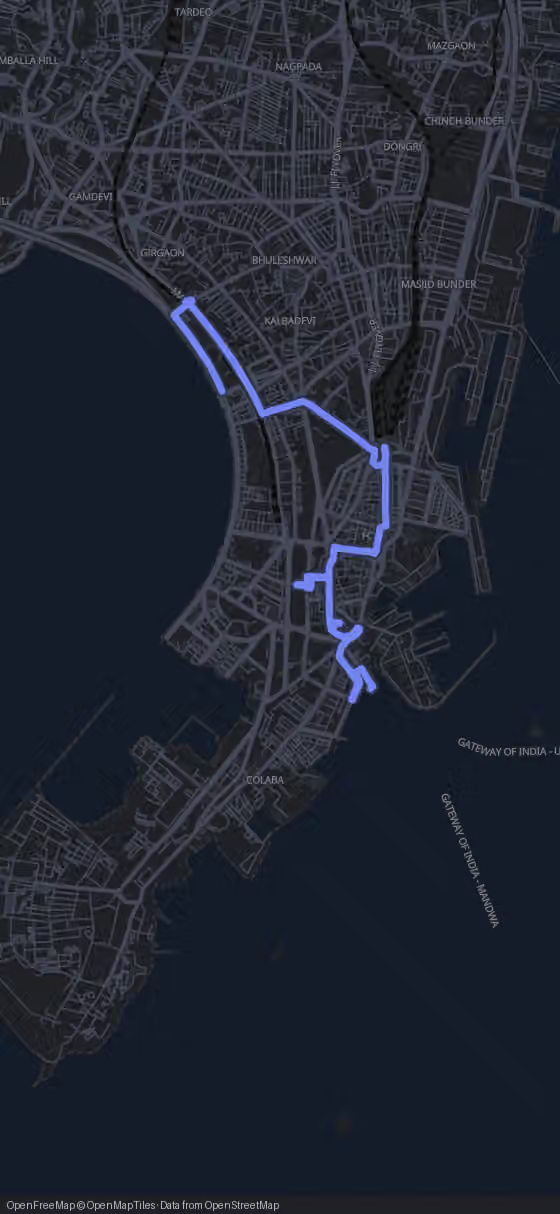
9 Stops 8.1 km ~1 h 56 min walking
Route map for the Mumbai walking tour
Stop 1 of 9
730 m·9 min
Gateway of India
Head north-west toward the Taj Mahal Palace Hotel
Namaste, welcome to Mumbai. I'm Alex, and the city's great ceremonial gateway ended up framing an imperial exit.
Try this tour with Alex

What This Walk Through South Mumbai Covers

Nine stops take you from the Gateway of India through the Fort district to Chhatrapati Shivaji Terminus and out to Marine Drive. That is 8.1 km and 1 h 56 min of pure walking; plan about five and a half hours with a proper museum visit.

Everything is free to see except the Chhatrapati Shivaji Maharaj Vastu Sangrahalaya, which charges entry. The GPS route in your browser is free and leads you from stop to stop; the AI Tour Guide is optional and tells the stories as you go.

Open free GPS & optional AI Tour Guide
This short shows highlights of the route. All 9 stops follow below.

The Route

Walking Map of Mumbai: Colaba, the Fort and the Bay

9 stops 8.1 km 1 h 56 min walking
Tap to load interactive map

The 9 stops along this route

  1. Gateway of India in Mumbai, stop 1 on the self-guided walking tour
    1Gateway of India
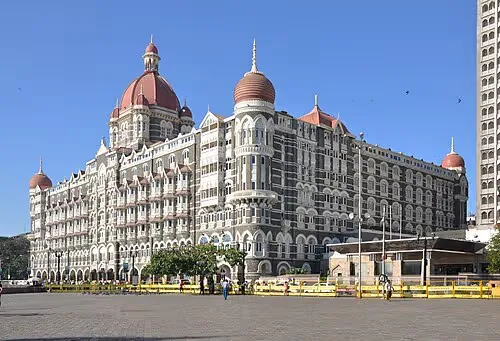
  2. Taj Mahal Palace Hotel in Mumbai, stop 2 on the self-guided walking tour
    2Taj Mahal Palace Hotel
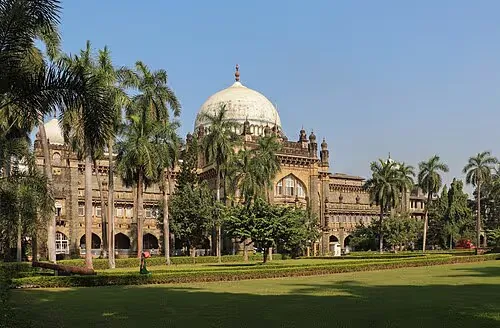
  3. Chhatrapati Shivaji Maharaj Vastu Sangrahalaya in Mumbai, stop 3 on the self-guided walking tour
    3Chhatrapati Shivaji Maharaj Vastu Sangrahalaya
  4. Oval Maidan in Mumbai, stop 4 on the self-guided walking tour
    4Oval Maidan
  5. Rajabai Clock Tower in Mumbai, stop 5 on the self-guided walking tour
    5Rajabai Clock Tower
  6. Flora Fountain in Mumbai, stop 6 on the self-guided walking tour
    6Flora Fountain
  7. Horniman Circle Gardens in Mumbai, stop 7 on the self-guided walking tour
    7Horniman Circle Gardens
  8. Chhatrapati Shivaji Terminus in Mumbai, stop 8 on the self-guided walking tour
    8Chhatrapati Shivaji Terminus
  9. Marine Drive in Mumbai, stop 9 on the self-guided walking tour
    9Marine Drive
  10. That's the full route.

    Walk it with an AI Tour Guide talking you through every one of these streets.

    Start free in your browser
    You made it

Your Mumbai Walking Tour Through Old Bombay, Stop by Stop

  1. 1

    Gateway of India

    Gateway of India in Mumbai, stop 1 on the self-guided walking tour

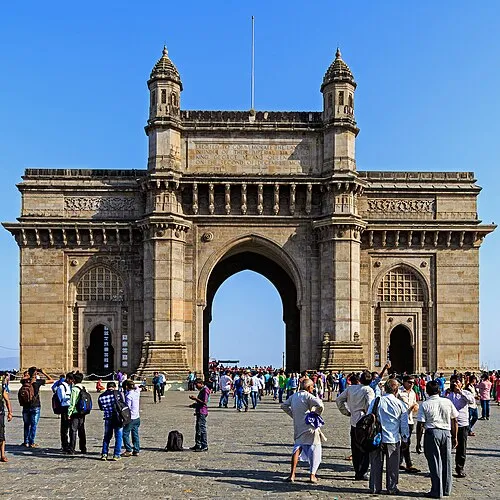
    Start where Bombay once greeted its rulers. The Gateway of India is a triumphal arch of basalt, 26 metres high, standing on the shore at Apollo Bunder and looking out over the Arabian Sea. Its style is Indo-Islamic, with elements borrowed from 16th-century Gujarati architecture, so walk around it and look at the carving in the dark stone before you turn to the water. It sits at an angle on the waterfront, facing the Taj Mahal Palace Hotel.

    It was built to remember the first visit of King George V and Queen Mary in December 1911. The irony: when the royal couple actually landed, there was no arch yet, and they were welcomed by a cardboard structure. The foundation stone followed in March 1913, architect George Wittet's final design was accepted in 1914, and the work was finished only in 1924.

    For the next decades it served as the ceremonial entrance to India for important officials. Then it closed that chapter itself: in 1948, a year after the British withdrawal, the last British troops left the country through this arch. Since 2003 the local Jewish community has lit a menorah here at Hanukkah.

    The place has seen dark days too. A taxi bomb exploded in front of it in August 2003, and after the 2008 attacks, which also targeted the hotel opposite, access to the arch was restricted. Today you share it with locals, street vendors and photographers offering their services. Five jetties lie at the Gateway, two of them used by commercial ferries, and boat trips for visitors leave from here. The Taj Mahal Palace Hotel is 750 m away, about 11 minutes on foot.
    Hours
    Open 24/7
    Price
    Free
  2. 2

    Taj Mahal Palace Hotel

    Taj Mahal Palace Hotel in Mumbai, stop 2 on the self-guided walking tour

    The Taj Mahal Palace Hotel opened its doors on 16 December 1903, and for most of the city it is simply “The Taj”. Built in the Indo-Saracenic style and named after the Taj Mahal in Agra, about 1,050 km away, it has been counted among the finest hotels of the East since the days of the British Raj. What you see is really two buildings: the original Palace of 1903 and the Tower, opened in 1972, historically and architecturally a different thing altogether.

    The hotel was commissioned by Jamsetji Tata, and the story you will hear most often is that he built it after being refused entry to Watson's Hotel, which was reserved for Europeans. The writer Charles Allen doubted it. In his account, the editor of The Times of India pushed for a hotel “worthy of Bombay”, and Tata built it as a gift to the city he loved. One detail to keep in mind as you look at it: the main entrance originally faced the land side, where the pool is today.

    Its life has had ups and downs. The jazz musician Micky Correa, “The Sultan of Swing”, made the hotel his home in 1936 and stayed until 1960. By 1966 it had become neglected and run-down, perhaps because British guests stayed away after independence. In 2008 it was one of the main targets of the Mumbai attacks. Today it is the flagship of the Taj Hotels, owned by a Tata Group company, with around 1,500 staff.

    The lobby and public areas are free to walk into, and a few minutes inside are worth it even if you are not a guest: you get a feel for the building without spending anything. Then head inland, 940 m or about 13 minutes, to the museum.

    Hours
    Open 24/7
    Price
    Free (lobby and public areas)
  3. 3

    Chhatrapati Shivaji Maharaj Vastu Sangrahalaya

    Chhatrapati Shivaji Maharaj Vastu Sangrahalaya in Mumbai, stop 3 on the self-guided walking tour

    This is the stop to plan your day around. The Chhatrapati Shivaji Maharaj Vastu Sangrahalaya, often still called by its old name, the Prince of Wales Museum of Western India, tells the history of India from prehistoric to modern times. The building is Indo-Saracenic, with Mughal, Maratha and Jain elements mixed in, and it stands in a garden of palm trees and formal flower beds.

    Its story leads straight back to the Gateway. In 1904 leading citizens of Bombay decided to build a museum to mark the visit of the Prince of Wales, the later King George V. He laid the foundation stone himself on 11 November 1905, and in 1907 the government gave the committee a plot called the “Crescent Site”, where the museum stands today. In 1998 it was renamed after Shivaji, founder of the Maratha Kingdom.

    Inside are roughly 50,000 exhibits in three main sections: Art, Archaeology and Natural History. Look out for the artefacts of the Indus Valley Civilization and the relics from the times of the Mauryas, Guptas, Chalukyas and Rashtrakutas. If ancient India interests you at all, give it about 90 minutes. If museums are not your thing, admire the facade and the garden setting and walk on.

    Foreign visitors pay more than Indian residents, and the foreign adult ticket includes an audio guide. Oval Maidan is 850 m away, about 12 minutes, and on the way you pass the Jehangir Art Gallery and the Kala Ghoda Art Precinct.

    Hours
    Mon–Sun 10:15–18:00 (ticket counter closes at 17:45)
    Price
    Rs 200 Indian adult, Rs 700 foreign adult (includes audio guide), Rs 100 Indian senior/defence/college student, Rs 40 Indian child (5-15), Rs 200 foreign child (upto 15)
    Website
    csmvs.in ↗
  4. 4

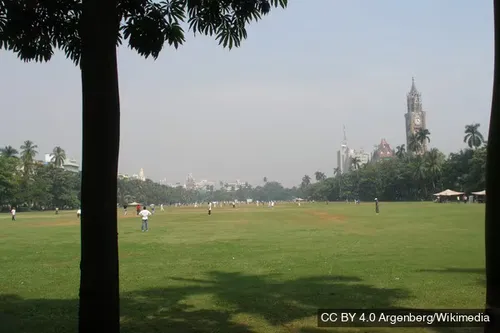
    Oval Maidan

    Oval Maidan in Mumbai, stop 4 on the self-guided walking tour

    Oval Maidan is exactly what the name says: a huge oval of grass, 22 acres (8.9 ha), just south of Churchgate. It is a Grade I recreational ground, and the games you will see here are mostly cricket and football. Political rallies and religious functions are banned, so it stays a place for play.

    Until the early 20th century this was part of a far larger open space called the Esplanade, together with Azad Maidan, Cooperage Ground and Cross Maidan. That emptiness was deliberate: the old Fort kept level open ground on its western fringe to control fires.

    For much of the 20th century the state government owned and ran the ground, and maintained it poorly. In 1997 residents of the area formed the Oval-Cooperage Residents Association, a public charitable trust, and petitioned the Maharashtra government to look after it. When the government did not respond, they went to the Bombay High Court and won: the state had to maintain the maidan or hand it over, and it handed it over. The residents fenced the ground, built a jogging course around the edge and paved the lane that cuts across it.

    For a few years the former Indian cricketer Dilip Vengsarkar ran the Elf cricket academy on the northern side of the ground. From here the Rajabai Clock Tower is only 180 m away, about 3 minutes.

    Hours
    Open 24/7
    Price
    Free
  5. 5

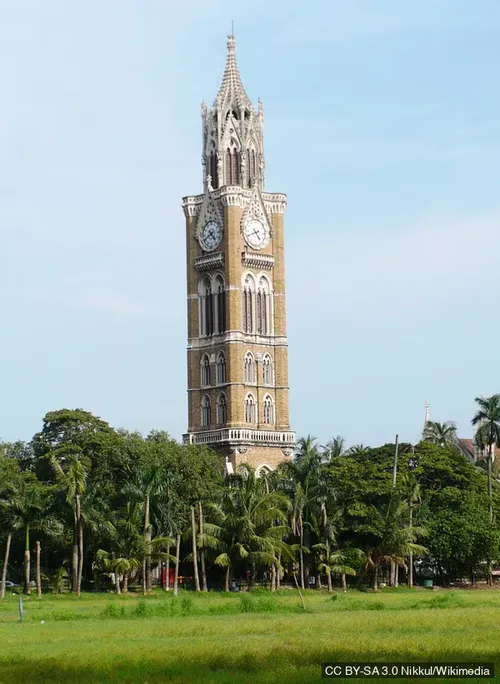
    Rajabai Clock Tower

    Rajabai Clock Tower in Mumbai, stop 5 on the self-guided walking tour

    Rising 85 metres from the Fort campus of the University of Mumbai, the Rajabai Clock Tower was the tallest structure in the city when it was completed in November 1878; its foundation stone had been laid on 1 March 1869. The English architect Sir George Gilbert Scott modelled it on Big Ben in London but dressed it in a blend of Venetian and Gothic styles, built in buff-coloured Kurla stone from the region. Follow its shape upward: square up to the first gallery at 21 metres, then octagonal to the top.

    The name has a story. Part of the ₹550,000 construction cost, a large sum at the time, came from Premchand Roychand, the wealthy broker who founded the Bombay Stock Exchange. His condition was that the tower carry the name of his mother, Rajabai. She was blind and, as a devout Jain, had to eat her dinner before evening. Legend says the evening bell of the tower let her know the time without asking anyone.

    In the 19th century the clock played sixteen tunes, among them “Home! Sweet Home!” and “A Handel Symphony”, changing four times a day. Since 2018 the tower has been part of the Victorian and Art Deco Ensemble of Mumbai, a UNESCO World Heritage Site.

    The tower itself has long been closed to the public, so this is an exterior stop: take your time with the details from outside. Flora Fountain is 530 m away, about 8 minutes on foot.

    Hours
    Open 24/7 (exterior viewing)
    Price
    Free (exterior only)
  6. 6

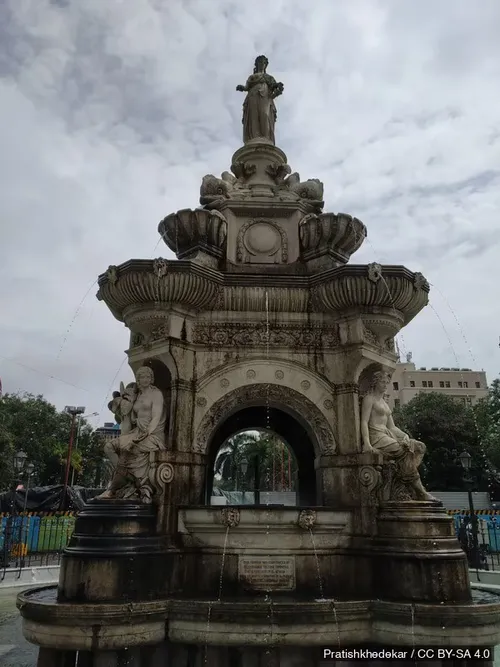
    Flora Fountain

    Flora Fountain in Mumbai, stop 6 on the self-guided walking tour

    Flora Fountain stands at Hutatma Chowk, at the southern end of Dadabhai Naoroji Road in the Fort business district. Built in 1864, it shows the Roman goddess Flora, carved in imported Portland stone by James Forsythe to a design by Richard Norman Shaw. It cost Rs 47,000, about 9,000 pounds sterling, a large sum then; Cursetjee Fardoonjee Parekh donated Rs 20,000 of it, and the Agri-Horticultural Society of Western India had it built. It was originally meant for the Victoria Gardens.

    The spot is the real story. Between 1686 and 1743 the British East India Company built a fort here, with a moat, an esplanade and three gates: the Apollo Gate, the Church Gate and the Bazaar Gate. In 1860 Governor Sir Bartle Frere had it demolished to improve sanitation and give the growing city room. The fountain stands exactly where the Church Gate used to be, the gate named after St. Thomas Cathedral.

    With the walls gone, the narrow Hornby Road was widened into a broad avenue, and commercial buildings in Neo-Classical and Gothic Revival designs went up along it. Today's D. N. Road became a showpiece of colonial splendour, a “Mile Long Road” with Flora Fountain at its southern end and Crawford Market and the great railway terminus anchoring the north. Look along it before you move on.

    Horniman Circle Gardens are just 340 m away, about 5 minutes.

    Hours
    Open 24/7
    Price
    Free
  7. 7

    Horniman Circle Gardens

    Horniman Circle Gardens in Mumbai, stop 7 on the self-guided walking tour

    Horniman Circle Gardens is a round park of 1.01 hectares (2.5 acres) in the Fort district, ringed by office buildings that house the country's premier banks. It was planned as a large open space framed by grand buildings in the middle of the walled city. In the 18th century it was Bombay Green, later Elphinstone Circle; after independence in 1947 it was renamed after Benjamin Horniman, editor of The Bombay Chronicle, who supported Indian independence.

    It was not always a garden. In 1842 the Green was a dump of coconut shells and debris, a swamp in the monsoon and a heap of rocks in fine weather, famously called “the mother of dead dogs in the monsoon, and of living ones in the hot season”. Still, residents guarded it jealously. In 1852 they sent a petition to the Court of Directors in London against any building on the Green, and a copy went to every firm or individual that knew Bombay.

    At night, wrote James Douglas in 1893, palanquins were spread across the Green and hamals sang their see-saw songs. Locals called it the Chowk because of its central place in the fort town. At its centre stood a statue of Governor General Lord Cornwallis in a temple-like structure, paid for by Bombay's residents in 1822 at a cost of £5,000 and flanked by statues of Wisdom and Integrity.

    Entry is free. Chhatrapati Shivaji Terminus is 940 m away, about 14 minutes.

    Hours
    Mon–Fri: 10:00–20:00 | Sat: 16:00–20:00 | Sun: 10:00–20:00
    Price
    Free
  8. 8

    Chhatrapati Shivaji Terminus

    Chhatrapati Shivaji Terminus in Mumbai, stop 8 on the self-guided walking tour

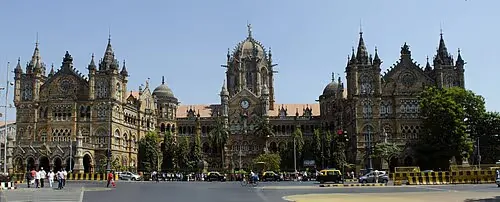
    Chhatrapati Shivaji Terminus, known to many simply as VT or CSMT, is a historic railway station and the headquarters of India's Central Railway. It is one of the busiest stations in the country, where Central Railway trains and Mumbai's suburban trains end their journeys, and it is said to be the most photographed monument in India after the Taj Mahal.

    It was designed by Frederick William Stevens at a cost of 16.14 lakh rupees. After taking his fee for a watercolour of the design, Stevens set off on a ten-month trip through Europe to study stations, and the result shows: the finished building echoes St Pancras in London. Construction took ten years.

    It opened as Victoria Terminus, named after Queen Victoria. In 1996, following a demand by the Shiv Sena and a policy of replacing names with Indian ones, the state government renamed it after the 17th-century Maratha ruler Chhatrapati Shivaji Maharaj, whose name you already met at the museum. Many locals still say VT.

    Looking at the facade costs nothing, and this is the place for your photos. Then comes the longest leg of the day: 3,560 m, about 50 minutes, out to Marine Drive. If your legs are done, ending here is a perfectly good choice.

    Local name
    Chhatrapati Shivaji Maharaj Terminus
    Hours
    Open 24/7
    Price
    Free (exterior)
  9. 9

    Marine Drive

    Marine Drive in Mumbai, stop 9 on the self-guided walking tour

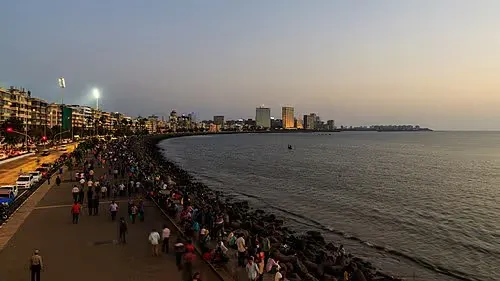
    Marine Drive is a 3-kilometre promenade curving along a natural bay, a banana-shaped six-lane concrete road built by Pallonji Mistry in 1940 on reclaimed land. Its official name, Netaji Subhash Chandra Bose Road, is rarely used. Everyone calls it the Queen's Necklace: seen from above at night, its streetlights look like a string of pearls.

    Look at the buildings along it. Many were put up by wealthy Parsis in the Art Deco style popular in the 1920s and 1930s. Among the earliest are Kapur Mahal, Zaver Mahal and Keval Mahal, built between 1937 and 1939 for a total of 1 million rupees and part of the same UNESCO World Heritage Site as the Rajabai Clock Tower. Hotels line the drive too, the 5-star Oberoi the most prominent among them.

    The road links Nariman Point, the business district at the southern tip, with Malabar Hill in the north. At its northern end lies Girgaon Chowpatty with Chowpatty Beach, famous for its bhel puri, and further on Walkeshwar, a wealthy neighbourhood and home of the Governor of Maharashtra. Palm trees line the promenade, and after a day of colonial stone it is a fine place to sit by the sea and let the walk end.

    Hours
    Open 24/7
    Price
    Free
Walking tour route map of Mumbai Route loaded
Gateway of IndiaTaj Mahal Palace HotelChhatrapati Shivaji Maharaj Vastu SangrahalayaOval Maidan+5
All 9 stops are already on the map.
You just press start.
AI Tour Guide

You've read the route. Now walk Mumbai with a guide in your ear.

Press start wherever you are, even hundreds of kilometres from Mumbai, and the guide begins telling its stories right away. In the city, pick any of the 9 stops to start from: it leads you there, then talks with you the whole route, asking, listening, remembering, and shaping the tour around your answers.

9stops 8.1km 1 h 56 minwalking 13languages
▶Start the tour free

Free to start · Runs in your browser · No app, no download

Shorter Ways to Walk South Mumbai

The full route ends with a long final leg to the sea, and the museum alone can fill a morning. These cuts keep what matters most to you.

The full walk, Gateway to the Queen's Necklace

Stops: 1, 2, 3, 4, 5, 6, 7, 8, 9

For a full day with time for the museum. 8.1 km and 1 h 56 min of walking; the museum is the only ticketed stop.

Gateway to Chhatrapati Shivaji Terminus

Stops: 1, 2, 3, 4, 5, 6, 7, 8

For anyone who would rather skip the 50-minute leg to Marine Drive. About 4.5 km and 1 h 6 min of walking, with the museum as the only entry fee.

The free Fort circuit

Stops: 4, 5, 6, 7, 8

For a short visit or a zero budget: from Oval Maidan to the station is about 2 km and 30 minutes of walking, and every stop is free to see.

How Long Does This Mumbai Tour Take on Foot?

The pure walking time is 1 h 56 min. Add about 90 minutes in the museum and around a quarter of an hour at most other stops, and you are looking at roughly five and a half hours from the Gateway to Marine Drive; without the museum, about four.

A day that works: start at the Gateway of India at 9:30, reach the Taj around 10:00 and the museum by about 10:30. Leave around noon, cross the Fort quarter in the early afternoon, reach the station at about 13:30 and Marine Drive at about 14:40.

Ending at the station drops the last 50 minutes of walking: count on a little over four hours with the museum. The free Fort circuit from Oval Maidan takes about an hour and a half.

Before You Set Off from the Gateway

  • Start and finish: The recommended start is the Gateway of India, the finish is Marine Drive. You can join at any stop; the GPS route picks up from wherever you are.
  • Best day and time: Start in the morning: a 9:30 start at the Gateway brings you to the museum mid-morning, with the rest of the day for the Fort quarter and Marine Drive.
  • Costs: The museum is the only stop with a ticket. The Taj lobby, the Gateway, the gardens and the promenade are free, and the clock tower and the station are exterior stops.
Walking tour route map of Mumbai
AI Tour Guide

Your Mumbai guide is ready when you are.

Press start and a voice AI Tour Guide takes it from here: leading the route through Mumbai, telling the stories, and turning your walk into a real back-and-forth conversation. No app or download is needed; it runs in your browser.

9stops 8.1km 1 h 56 minwalking 13languages
▶Start the tour free

Free to start · Runs in your browser · No app, no download

What the AI Tour Guide Adds Between Colaba and Marine Drive

On this walk the stories connect: one king behind the arch and the museum, one Tata behind the hotel, one blind mother behind a clock tower. The AI Tour Guide carries those threads from stop to stop as a conversation. It greets you, tells the stories as you arrive, asks what you are curious about, remembers it and leans into more architecture or more people accordingly. You can interrupt it any time, for example to ask what the Apollo and Bazaar gates of the old Fort looked like. The route and GPS navigation stay free; the guide starts with 100 free credits, and then you choose: this tour all-inclusive for €19.99 with no time limit, or €5 per hour.

A Real Conversation A voice AI Tour Guide greets you, leads the whole route, and tells the stories and facts as you walk, asking what you want to see and keeping a real conversation going. Not a recording you press play on.
Map Navigation Follow the route on the map and walk at your own pace. You choose where to start and when to move to the next stop.
Ask Anything Curious about a building you pass? Ask your AI Tour Guide on the spot and the conversation carries on.
13 Languages Switch language anytime. No separate tour needed.
Start free in your browser

Common Questions About Walking Mumbai

Can I walk the route in reverse, from Marine Drive to the Gateway?

Yes, the GPS route works from any stop. The recommended direction puts you at the museum soon after it opens and leaves the long leg between the station and Marine Drive for the end, where you can easily drop it.

Which names will I hear locally for these places?

Older names are still in use: VT or CSMT for Chhatrapati Shivaji Terminus, Prince of Wales Museum for the CSMVS, “The Taj” for the hotel and Queen's Necklace for Marine Drive. Flora Fountain stands at Hutatma Chowk, and the Gateway at Apollo Bunder.

Where can I do a similar walk elsewhere in India?

If your trip continues, there are walking routes in Delhi and Jaipur, each with a free GPS route and the same optional AI Tour Guide.

Is the tour really free?

Yes. The whole tour is free: the route, the interactive map and the navigation cost you nothing. Only the voice AI Tour Guide is optional and paid: you test it with 100 free credits, then you pay either €5 per hour or €19.99 for this whole tour, with no time limit. Admission to one of the 9 stops is not included: Chhatrapati Shivaji Maharaj Vastu Sangrahalaya charges its own entry fee.

Do I need to download an app?

No. Everything runs in your phone browser. Open the route and start walking, no download and no sign-up required.

Do I need to book the walking tour in advance?

No booking needed. This self-guided tour is available anytime. Open the route in your browser and start walking. The AI Tour Guide works instantly, no app, no reservation required.

What languages is the AI Tour Guide available in?

The AI Tour Guide speaks 13 languages, so you take the tour in your own language and can switch at any time.

Can I skip stops or change the route?

Yes. Skip any stop, spend extra time at places you like, or start the route from any point. It is your walk, you set the pace.
Image credits
▶ Start free in your browser Runs in your browser, no app, no download