Free Walking Tour Fulda: Baroque Core to Carolingian Crypt

Ten stops on 2.5 km: from the burial church of Saint Boniface through Dientzenhofer's palace and garden to a rotunda whose crypt dates from 820.

10 Stops 2.5 km ~35 min walking
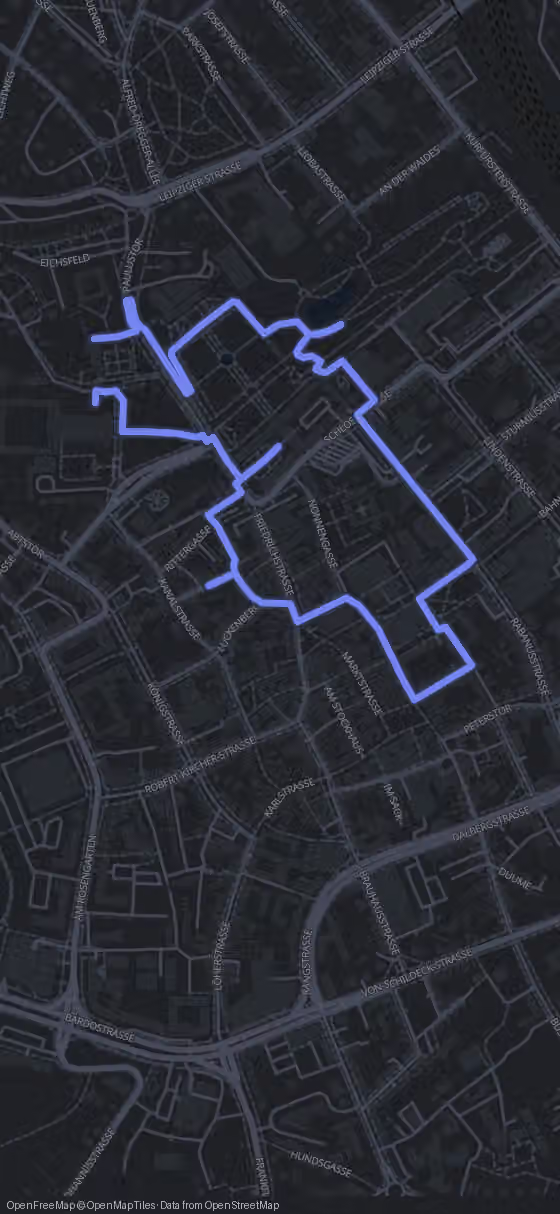
Route map for the Fulda walking tour
Stop 1 of 10
80 m·1 min
Fulda Cathedral (Dom St. Salvator)
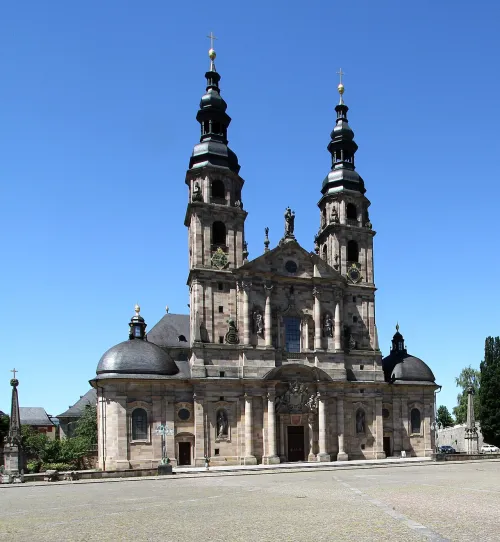
Head east across the square toward Domplatz
Welcome to Fulda. I'm Alex, and our first story begins with the English monk buried beneath the city's cathedral.
Try this tour with Alex

Fulda on Foot at a Glance

Ten stops, 2.5 km, 35 min of pure walking: you start at Fulda Cathedral (Dom St. Salvator) and finish at its neighbour, Michaelskirche (St. Michael's Church). In between: Domplatz, Stadtschloss (City Palace), Severikirche (St. Maria and Severus), Vonderau Museum, Old University (Alte Universität), Schlossgarten (Palace Garden), Orangerie and Paulustor.

Plan about two and a half hours, around four with both museums. Only the Stadtschloss and the Vonderau Museum charge admission; everything else is free. The GPS route in your browser costs nothing, and the AI Tour Guide is an optional extra.

Open free GPS & optional AI Tour Guide
This short shows highlights of the route. All 10 stops follow below.

The Route

Walking Map of Fulda: From Cathedral Hill to the Paulustor

10 stops 2.5 km 35 min walking
Tap to load interactive map

The 10 stops along this route

  1. Fulda Cathedral (Dom St. Salvator), stop 1 on the self-guided walking tour
    1Fulda Cathedral (Dom St. Salvator)
  2. Domplatz in Fulda, stop 2 on the self-guided walking tour
    2Domplatz
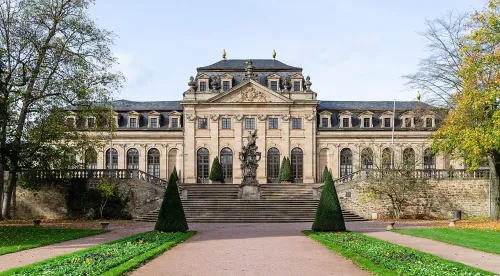
  3. Stadtschloss (City Palace) in Fulda, stop 3 on the self-guided walking tour
    3Stadtschloss (City Palace)
  4. Severikirche (St. Maria and Severus) in Fulda, stop 4 on the self-guided walking tour
    4Severikirche (St. Maria and Severus)
  5. Vonderau Museum in Fulda, stop 5 on the self-guided walking tour
    5Vonderau Museum
  6. Old University (Alte Universität) in Fulda, stop 6 on the self-guided walking tour
    6Old University (Alte Universität)
  7. Schlossgarten (Palace Garden) in Fulda, stop 7 on the self-guided walking tour
    7Schlossgarten (Palace Garden)
  8. Orangerie in Fulda, stop 8 on the self-guided walking tour
    8Orangerie
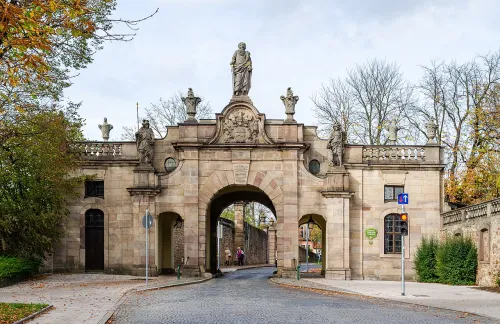
  9. Paulustor in Fulda, stop 9 on the self-guided walking tour
    9Paulustor
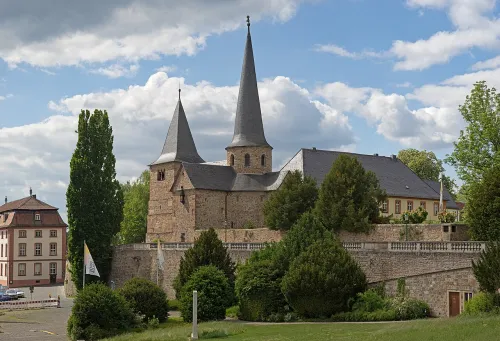
  10. Michaelskirche (St. Michael's Church) in Fulda, stop 10 on the self-guided walking tour
    10Michaelskirche (St. Michael's Church)
  11. That's the full route.

    Walk it with an AI Tour Guide talking you through every one of these streets.

    Start free in your browser
    You made it

Your Fulda Walking Tour, Ten Stops in Order

  1. 1

    Fulda Cathedral (Dom St. Salvator)

    Fulda Cathedral (Dom St. Salvator), stop 1 on the self-guided walking tour

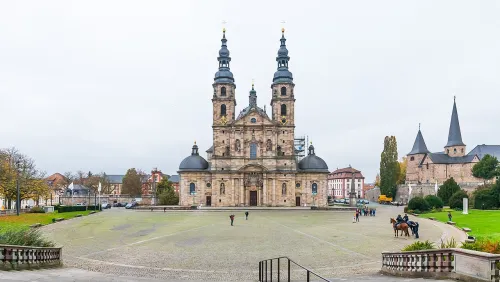
    Start in front of the facade and look for the dedication tablet. Prince-Abbot Adalbert von Schleifras had it placed there, and it names the church for Christus Salvator, Christ the Saviour, which is why Fulda's cathedral is also called St. Salvator. This is the high point of the Baroque district and the building the town uses as its symbol.

    The church you see replaced something older and, in its time, bigger in reputation: the Ratgar Basilica, once the largest basilica north of the Alps, the church of Fulda Abbey and the burial place of Saint Boniface. It was torn down for the new building, which partly reuses its foundations. Work began on 23 April 1704; the shell stood in 1707, the roof in 1708, the interior in 1712, and the church was dedicated on 15 August 1712. Boniface's grave and the role of abbey church passed straight to the new walls.

    The architect was Johann Dientzenhofer, one of the great names of German Baroque. He drew the plans in 1700, recommended by the Pope after a study trip to Rome in 1699, and you can feel Rome inside: the arrangement deliberately echoes St. Peter's Basilica. Keep his name in mind, because he also built the palace and the city gate on this walk.

    In 1752 the abbey church became a cathedral when the Diocese of Fulda was created, and its prince-abbots became bishops. The abbey was dissolved in 1802, but the bishops stayed. One odd episode: on 4 June 1905, during the celebrations for the 1150th anniversary of Boniface's death, a stray firework lodged in the right-hand tower and started a fire, probably by lighting old jackdaws' nests.

    Go inside; it is free and open from early morning, and half an hour is well spent comparing the interior with what you know of St. Peter's. Then turn around and walk 130 m, about 2 minutes, onto the Domplatz.
    Hours
    Apr–Oct: Mon–Sat 06:30–19:00, Sun & holidays 09:00–19:30; Nov–Mar: Mon–Sat 06:30–18:00, Sun & holidays 09:00–19:30
    Price
    Free
  2. 2

    Domplatz

    Domplatz in Fulda, stop 2 on the self-guided walking tour

    The Domplatz is the space the cathedral was built to be seen from, free and open around the clock. Stand still for a minute: only from here does the whole ensemble settle into proportion, the facade, the towers and the tablet you just read.

    The square is the hinge of the route, with the church behind you and the palace ahead, and it is the one place on the walk made purely for standing and looking. Large concerts occasionally fence off parts of it; on a normal day you cross freely. From here it is 240 m, about 4 minutes, to the Stadtschloss, where the first ticket of the day waits.

    Hours
    24/7
    Price
    Free
  3. 3

    Stadtschloss (City Palace)

    Stadtschloss (City Palace) in Fulda, stop 3 on the self-guided walking tour

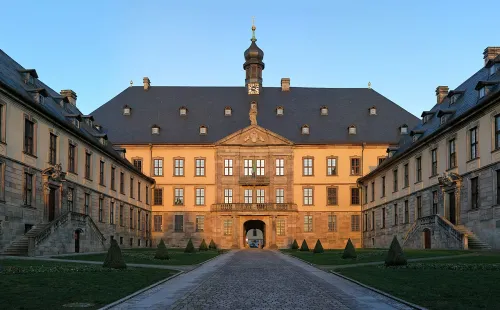
    The Baroque palace in front of you was built between 1706 and 1714 by Johann Dientzenhofer, the cathedral's architect, as the residence of Fulda's prince-abbots and later its prince-bishops. Cathedral and palace rose at the same time, from the same drawing board.

    Its story starts much earlier, with a castle first mentioned as the "new castle" at the end of Prince-Abbot Heinrich V. von Weilnau's rule in the early 14th century. Heinrich probably used a quarrel with his monks over the abbey's income as a reason to move out of the monastery altogether; the dean took over the old abbot's lodgings. Heinrich picked a rise between monastery and town, easier to defend and a clear display of the abbots' growing power.

    Stand in the courtyard of honour and you are on top of that castle. Excavations between 1979 and 1982 found moat walls, the base of a round tower, probably the keep, and pieces of the wall walk and the moat bridge. Its northern ring wall doubled as the town wall. Later builders turned the castle into a Renaissance palace in the 17th century, Dientzenhofer gave it its Baroque form, and in the early 19th century parts were reshaped in a late classicist style for the electoral prince.

    Going inside is worth it if you want to see how the prince-bishops lived, and the ticket is inexpensive; give it about 45 minutes. Afterwards it is 280 m, about 4 minutes, to the Severikirche.

    Hours
    Tue–Sun 10:00–17:00, Mon closed
    Price
    3.50 EUR full, 2.30 EUR reduced (combi card with Vonderau Museum 6.00 EUR / reduced 4.50 EUR; free entry up to 18 years resp. up to 25 years for pupils/trainees/students)
  4. 4

    Severikirche (St. Maria and Severus)

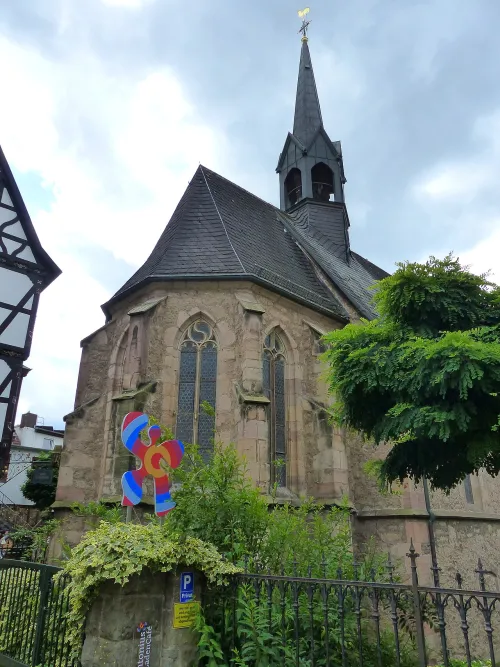
    Severikirche (St. Maria and Severus) in Fulda, stop 4 on the self-guided walking tour

    After two Baroque giants, a small Gothic church. A Fulda citizen, Erasmus Kämmerer, paid for it, and it went up between 1438 and 1445 in what was then the new Gothic style, simply called the "New Church" at first.

    Its name comes from the wool weavers, at the time the largest guild in Fulda. In 1451 they made it their guild chapel and venerated Saint Severus of Ravenna as their patron, and the townspeople started calling it the Severikirche. During the Reformation it stood unused; it was renovated from 1616 and consecrated again in 1621 to the Virgin Mary and Saint Severus.

    Few buildings in town changed hands as often. The Franciscans used it as their first church in Fulda in the 1620s, Benedictine nuns briefly in 1626, the military parish as garrison church from 1722 until 1882, and later a teachers' seminary and a secondary school held their services here. The organ is a newcomer: built in 1968 by Matthias Kreienbrink for the seminary church of the diocesan seminary, it moved here in 1997.

    The church is a working filial church, open mainly for Mass and otherwise for services and events. Most visitors see it from outside, which still tells you its story in stone. Then walk 440 m, about 6 minutes, through the historic old town to the Vonderau Museum.

    Hours
    Tue 09:00 (parish Mass), Thu 06:15 (early Mass); otherwise services and events
    Price
    Free
  5. 5

    Vonderau Museum

    Vonderau Museum in Fulda, stop 5 on the self-guided walking tour

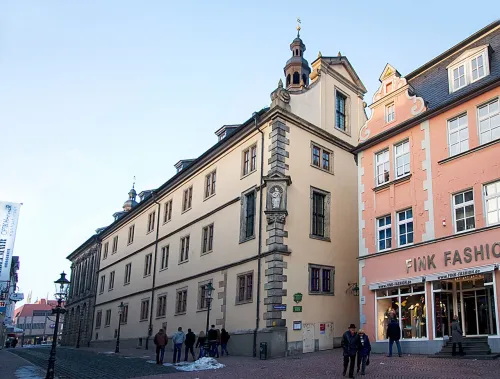
    Fulda's town museum carries the name of Joseph Vonderau, a teacher and local historian who ran it from 1897 for half a century. It was named after him on 2 April 1938, his 75th birthday.

    The museum goes back to a foundation by cathedral canon Konrad Hahne in 1875, when the bishop's see was vacant because of the Kulturkampf and he was running the diocese. The collection started in the north wing of the town school, moved into the Stadtschloss in 1930, and returned to the school in 1968 while the palace rooms were restored. In the late 1980s the old school was rebuilt as a purpose-made museum with 4,000 m² of exhibition space, opened on 8 March 1994.

    Inside you find cultural history, natural history, painting and sculpture, and a planetarium. The real specialty is the prehistory of the Fulda district, above all the Celts and their hilltop settlement on the Milseburg. If that sounds interesting, or you travel with children, or it rains, give it an hour.

    The museum charges a modest admission. The Old University is only 90 m away, a one-minute walk.

    Hours
    Tue–Sun 10:00–17:00 (every 3rd Tue 10:00–20:00), Mon closed
    Price
    3.50 EUR full, 2.30 EUR reduced (combi card city palace 6.00 EUR / 4.50 EUR; free entry up to 25 years and every 1st Sunday of the month)
  6. 6

    Old University (Alte Universität)

    Old University (Alte Universität) in Fulda, stop 6 on the self-guided walking tour

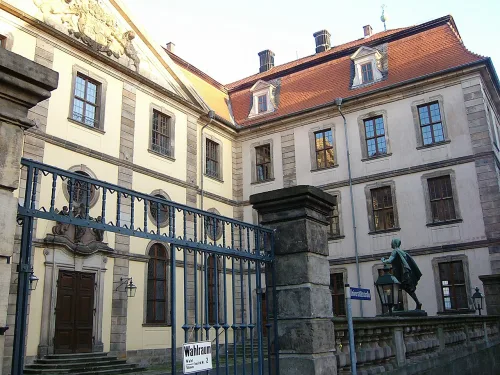
    This Baroque building was put up between 1731 and 1734 to plans by court architect Andreas Gallasini, for a university founded in 1734 by Adolphus von Dalberg and named after him: Alma mater Adolphiana. It started with four faculties, theology, philosophy, medicine and law.

    Most students and professors were Catholic, and Jesuits and Benedictines held the theology chairs until the Jesuit order was suppressed in 1773; from then on the Benedictines ran it alone. Under Prince-Bishop Heinrich von Bibra the doors opened to Protestants, and from 1777 they could take a degree in every faculty except theology. Remember von Bibra; you meet him again at the Paulustor.

    In its 71 years the university had about 4,100 students, 935 of them from the town itself, others from as far as France, Nassau and Westphalia. It ended with the secularization of Fulda Abbey in 1802: in 1805 William I of the Netherlands, the new sovereign, closed it. Its assembly hall then served as a Protestant church for about a century, until 1902, and today hosts festive events.

    The building opens only on certain days and entry is free, so if you find it open, go in. From here comes the longest leg of the walk, 690 m and about 10 minutes, to the Schlossgarten.

    Hours
    Fri: 14:00–18:00 | Sat–Sun: 10:00–18:00 | Mon–Thu: Closed
    Price
    Free
  7. 7

    Schlossgarten (Palace Garden)

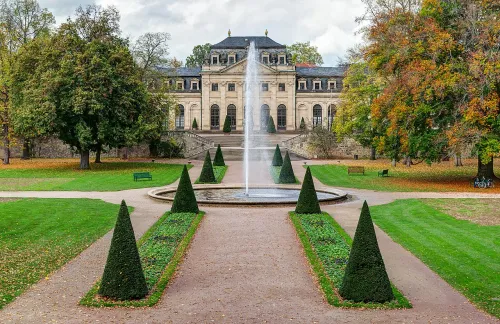
    Schlossgarten (Palace Garden) in Fulda, stop 7 on the self-guided walking tour

    Now the route slows down. After museums and facades you enter a historic public park, free, with gates that close in the evening, earlier in winter.

    Keep the winter closing time in mind, because the Orangerie sits inside these gates and a locked gate costs you the next stop. Otherwise, give the garden more time than you planned: it is the one stretch of the walk built for lingering rather than for looking. The Orangerie is 240 m away, about 3 minutes.

    Hours
    Apr–Oct: daily 07:00–22:30; Nov–Mar: daily 07:00–21:00
    Price
    Free
  8. 8

    Orangerie

    Orangerie in Fulda, stop 8 on the self-guided walking tour

    An orangery exists to carry delicate trees through a German winter, and this Baroque one now earns its keep as a host: a hotel and its restaurant use the building, along with concerts and festivals.

    You see it from outside, within the garden and its opening hours, free, and from outside it is genuinely enough. If you would rather sit than look, the restaurant is the one interior on this stretch that takes guests instead of tickets. Then leave the garden and walk 260 m, about 4 minutes, to the Paulustor.

    Hours
    Exterior view free of charge within the Schlossgarten during garden opening hours (Apr–Oct daily 07:00–22:30, Nov–Mar daily 07:00–21:00)
    Price
    Free
  9. 9

    Paulustor

    Paulustor in Fulda, stop 9 on the self-guided walking tour

    This Baroque gate is Johann Dientzenhofer's third building on the walk, built between 1709 and 1711. Look at the figures: the apostle Paul stands in the middle above the portal, flanked by Fulda's town saints. On the right, Saint Simplicius carries a spear, a shield and a cross; on the left, Saint Faustinus holds a spear and a shield with a lily and half an imperial eagle. Both sandstone statues are probably by Andreas Balthasar Weber and were meant as guardians of the town and of the faith.

    The gate did not always stand here. It first sat between the Stadtschloss and the Hauptwache, in the wall that separated the abbey district from the town. In 1771 building inspector Karl Philipp Arnd moved it to the end of the Pauluspromenade and added the side buildings, at the wish of Prince-Bishop Heinrich von Bibra, the same man who opened the university to Protestants. The historian Werner Kirchhoff read the move as a political statement: the wall between abbey and town was gone, and former subjects were now citizens.

    Its survival was not guaranteed. In 1871 the new Prussian administration put the gate at risk, and the town, led by mayor Franz Rang, bought it from the state for 200 Reichstaler to prevent its demolition. Walk through it, then 130 m, about 2 minutes, to the Michaelskirche.

    Hours
    24/7
    Price
    Free (city gate)
  10. 10

    Michaelskirche (St. Michael's Church)

    Michaelskirche (St. Michael's Church) in Fulda, stop 10 on the self-guided walking tour

    The last stop is the oldest. Abbot Eigil had this church built between 820 and 822 in the pre-Romanesque Carolingian style, on the Michaelsberg right next to the cathedral. It ranks among the most important medieval church buildings in Germany, and for a long time it was considered the oldest German copy of the Church of the Holy Sepulchre in Jerusalem, a link some recent research questions.

    It served as the cemetery chapel of Fulda Abbey, founded in 744, and as Eigil's own burial place; his plan to make it the burial church of all abbots never came true. What makes it special for historians is a contemporary text: the monk Brun Candidus explained the symbolism of the building in his life of Eigil, explicitly citing Hrabanus Maurus.

    Much of the church was destroyed, possibly in a Hungarian raid, and rebuilt in the 10th and 11th centuries, but the original idea survived. Inside you stand in a rotunda on eight columns, surrounded by an ambulatory that was probably single-storey at first and has two storeys today. Below lies the crypt, the only Carolingian part to survive, dating from 820: vaulted over two concentric rings of walls and a single central column, an unusually early hall-like crypt.

    Do go in; it is free, though in winter it keeps shorter hours. The crypt is the moment to slow down: you are standing in rooms twelve centuries old, a few metres from where you began at the cathedral.

    Hours
    Apr-31 Oct: daily 10:00–18:00; 1 Nov-31 Mar: daily 14:00–17:00
    Price
    Free
Walking tour route map of Fulda Route loaded
Fulda Cathedral (Dom St. Salvator)DomplatzStadtschloss (City Palace)Severikirche (St. Maria and Severus)+6
All 10 stops are already on the map.
You just press start.
AI Tour Guide

You know the route now. Walk it with a guide in your ear.

Press start wherever you are, even hundreds of kilometres from Fulda, and the guide begins telling its stories right away. In the city, pick any of the 10 stops to start from: it leads you there, then talks with you the whole route, asking, listening, remembering, and shaping the tour around your answers.

10stops 2.5km 35 minwalking 13languages
▶Start the tour free

Free to start · Runs in your browser · No app, no download

Shorter Ways Through Fulda's Baroque Quarter

The route splits naturally into a town half with the two ticketed interiors and a green half that ends beside the cathedral again. Pick the part that matches your day.

Cathedral, palace and town

Stops: 1, 2, 3, 4, 5, 6

For a rainy day or anyone who likes interiors: 1,180 m and 17 minutes of walking, with tickets for the Stadtschloss and the Vonderau Museum, plus the Old University on the days it is open.

Garden, gate and crypt

Stops: 7, 8, 9, 10

For a late afternoon: 630 m and 9 minutes of walking from the Schlossgarten past the Orangerie and through the Paulustor to the Michaelskirche, all free. You finish right next to the cathedral, so it pairs well with a quick look inside the Dom.

All ten without tickets

Stops: 1, 2, 3, 4, 5, 6, 7, 8, 9, 10

For a tight budget: the full 2.5 km, the free interiors of the cathedral and the Michaelskirche, and the palace and museum from outside only.

How Long This Fulda Tour Takes, With and Without Museums

The 2.5 km take 35 min of pure walking, and no single leg is longer than the 690 m from the Old University into the Schlossgarten. With half an hour in the cathedral, time in the Michaelskirche and the Old University and short pauses elsewhere, you need about two and a half hours.

Add roughly 45 minutes for the Stadtschloss and an hour for the Vonderau Museum and the walk grows to about four hours. Start at 10:00 on a Saturday with both interiors and you reach the Michaelskirche at around 13:50; in winter it opens later in the day, so take a few extra minutes in the Schlossgarten. The town half alone fits into a morning, the green half into an hour.

Before You Set Off in Fulda

  • Start and finish: Begin at Fulda Cathedral, the recommended order; you can join at any stop. You end at the Michaelskirche, right beside the cathedral, so you are back where you started.
  • Best day: Pick a day when the Stadtschloss, the Vonderau Museum and the Old University are all open; the Old University opens on the fewest days.
  • Costs: Two tickets at most. If you want both the Stadtschloss and the Vonderau Museum, there is a combi card.
  • Garden gates: The Schlossgarten shuts its gates in the evening; the Orangerie can only be reached while the garden is open.
Walking tour route map of Fulda
AI Tour Guide

Your guide is ready when you reach the cathedral.

Press start and a voice AI Tour Guide takes it from here: leading the route through Fulda, telling the stories, and turning your walk into a real back-and-forth conversation. No app or download is needed; it runs in your browser.

10stops 2.5km 35 minwalking 13languages
▶Start the tour free

Free to start · Runs in your browser · No app, no download

What the AI Tour Guide Adds Between Dom and Crypt

On this route the AI Tour Guide talks you through the stops as a conversation: it greets you at the cathedral, tells the stories of each place, asks what caught your eye and follows the thread you care about, whether that is Dientzenhofer's three buildings or the prince-bishops behind them. It goes where the text stops, for instance who Saint Boniface was and why his grave made Fulda so important, or what Hrabanus Maurus did here. You can interrupt it anytime; it doesn't change the route. You start with 100 free credits; after that, choose this tour all-inclusive for €19.99 with no time limit, or €5 per hour.

A Real Conversation A voice AI Tour Guide greets you, leads the whole route, and tells the stories and facts as you walk, asking what you want to see and keeping a real conversation going. Not a recording you press play on.
Map Navigation Follow the route on the map and walk at your own pace. You choose where to start and when to move to the next stop.
Ask Anything Curious about a building you pass? Ask your AI Tour Guide on the spot and the conversation carries on.
13 Languages Switch language anytime. No separate tour needed.
Start free in your browser

Common Questions About Walking Fulda

Can I walk the route in the evening?

Partly. The Stadtschloss, the Vonderau Museum and the Michaelskirche close in the late afternoon or early evening, but the Schlossgarten stays open late, especially in summer, so an evening walk works for the garden, the Orangerie, the Paulustor and the facades.

What changes in winter?

In winter the Schlossgarten closes earlier in the evening, the Michaelskirche opens only in the afternoon, and the cathedral closes earlier too. Plan the walk so that you reach the Michaelskirche in the afternoon.

Do young visitors pay admission?

Often not. The Vonderau Museum is free for everyone up to 25. The Stadtschloss is free up to 18, and for pupils, trainees and students up to 25.

What else can I combine with Fulda?

Fulda sits in the middle of several good city walks: Eisenach is 65 km away, Würzburg 87 km and Frankfurt 86 km. Each has its own free route.

Is the tour really free?

Yes. The whole tour is free: the route, the interactive map and the navigation cost you nothing. Only the voice AI Tour Guide is optional and paid: you test it with 100 free credits, then you pay either €5 per hour or €19.99 for this whole tour, with no time limit. Admission to 2 of the 10 stops is not included: Stadtschloss (City Palace) and Vonderau Museum charge their own entry fees.

Do I need to download an app?

No. Everything runs in your phone browser. Open the route and start walking, no download and no sign-up required.

Do I need to book the walking tour in advance?

No booking needed. This self-guided tour is available anytime. Open the route in your browser and start walking. The AI Tour Guide works instantly, no app, no reservation required.

What languages is the AI Tour Guide available in?

The AI Tour Guide speaks 13 languages, so you take the tour in your own language and can switch at any time.

Can I skip stops or change the route?

Yes. Skip any stop, spend extra time at places you like, or start the route from any point. It is your walk, you set the pace.
Image credits
▶ Start free in your browser Runs in your browser, no app, no download