Free Walking Tour Mühlhausen: Müntzer, Bach and the Wall

Walk 1.9 km through the town where Thomas Müntzer preached and Bach played the organ, along a medieval wall to a quiet park by the old moat.

7 Stops 1.9 km ~26 min walking
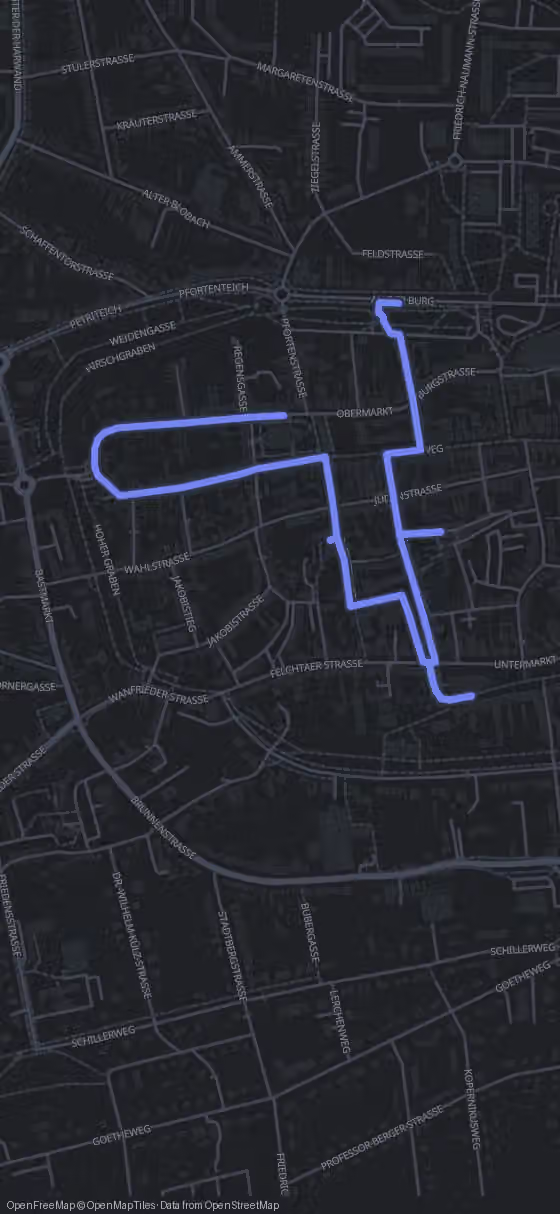
Route map for the Mühlhausen walking tour
Stop 1 of 7
300 m·4 min
Marienkirche
Head west toward the Stadtmauer, the historic town wall
Welcome to Mühlhausen. I'm Alex, and one church here still carries the voice of a radical preacher.
Try this tour with Alex

This Route at a Glance

Seven stops, 1.9 km, 26 minutes of pure walking: from the Marienkirche past the Stadtmauer (Historic Town Wall), the Rathaus, the Kornmarktkirche (Peasants' War Museum), the Divi-Blasii-Kirche and the Alte Synagoge to the Park an der Burg. Allow about an hour outside only, three and a half with the interiors.

The Rathaus, Divi Blasii, the synagogue and the park are free; the Marienkirche, the wall and the museum charge admission. The GPS route runs free in your browser; the AI Tour Guide is optional.

Open free GPS & optional AI Tour Guide
This short shows highlights of the route. All 7 stops follow below.

The Route

Walking Map of Mühlhausen: From Church Spire to Moat

7 stops 1.9 km 26 min walking
Tap to load interactive map

The 7 stops along this route

  1. Marienkirche in Mühlhausen, stop 1 on the self-guided walking tour
    1Marienkirche
  2. Stadtmauer (Historic Town Wall) in Mühlhausen, stop 2 on the self-guided walking tour
    2Stadtmauer (Historic Town Wall)
  3. Rathaus in Mühlhausen, stop 3 on the self-guided walking tour
    3Rathaus
  4. Kornmarktkirche (Peasants' War Museum) in Mühlhausen, stop 4 on the self-guided walking tour
    4Kornmarktkirche (Peasants' War Museum)
  5. Divi-Blasii-Kirche in Mühlhausen, stop 5 on the self-guided walking tour
    5Divi-Blasii-Kirche
  6. Alte Synagoge in Mühlhausen, stop 6 on the self-guided walking tour
    6Alte Synagoge
  7. Park an der Burg in Mühlhausen, stop 7 on the self-guided walking tour
    7Park an der Burg
  8. That's the full route.

    Walk it with an AI Tour Guide talking you through every one of these streets.

    Start free in your browser
    You made it

Your Mühlhausen Walking Tour, Seven Stops in Detail

  1. 1

    Marienkirche

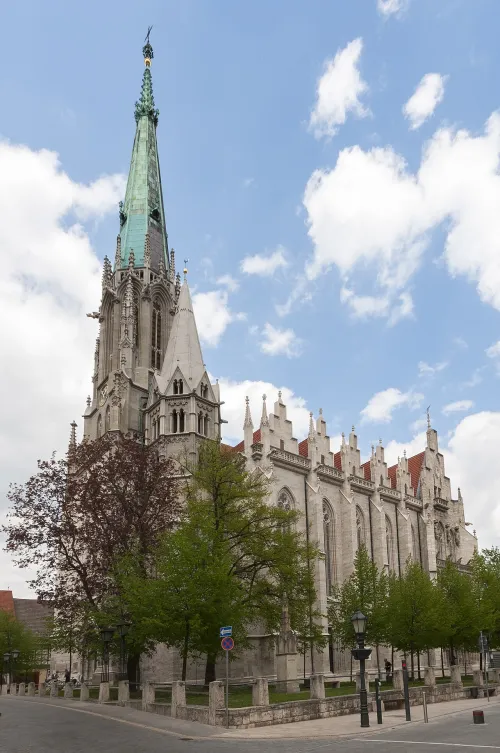
    Marienkirche in Mühlhausen, stop 1 on the self-guided walking tour

    Stand on the square in front of the south side and look up. The Marienkirche is the second-largest church building in Thuringia, outdone only by the cathedral in Erfurt, and its central spire, 86.7 metres high, is the tallest in the state. That spire is younger than it looks: it went up between 1898 and 1903, while the two side spires, roughly 42 metres each, and the body of the church are mostly 14th-century Gothic, built of local travertine.

    The main entrance is the south transept portal right in front of you. It sits flush with the side wall, yet two flanking pillars make it look wider and more prominent than it is. Look above its centre: on an illusory balcony, four stone figures lean over and look down on the square, as if checking who is coming in. At the eastern end you'll see three choirs, a tall, slender central one flanked by two smaller ones; the northern one was a baptismal chapel dedicated to Saint Nicholas, and the sacristy lies under the southern one.

    Inside, the scale makes sense. This is a five-aisled hall church, its central nave twice as wide as the side aisles, and four rows of five slender columns divide the space into 30 rectangles. The transept is as wide as the nave and doesn't stick out at the ends. In the Middle Ages the gallery held a library, as larger churches often did. Organ lovers should look for the Sauer organ of 1891, the largest surviving 19th-century organ in Thuringia.

    This is also where Mühlhausen's most turbulent year began. Thomas Müntzer, the revolutionary leader of the German Peasants' War, served as pastor here, and on 17 March 1525 he founded the Eternal Council inside this church. The church charges admission, and going in is worth it for almost everyone.

    From here it is 300 m, about 4 minutes, to the town wall; on the way you pass the Rabenturm.
    Hours
    Mar–Oct: Tue–Sun 10:00–17:00, Mon closed; Nov–Feb: Tue–Sun 10:00–16:00, Mon closed
    Price
    Adults 6 EUR, reduced 4 EUR, children (6-12) 3 EUR, under 6 free
  2. 2

    Stadtmauer (Historic Town Wall)

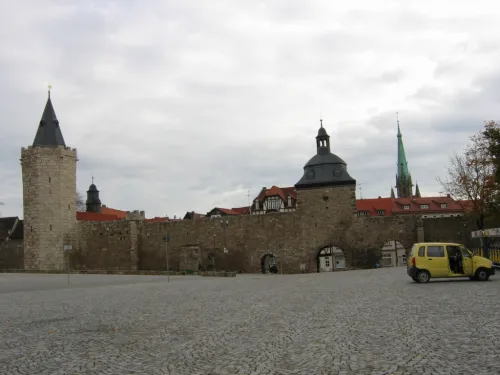
    Stadtmauer (Historic Town Wall) in Mühlhausen, stop 2 on the self-guided walking tour

    Around 1400, Mühlhausen was a Free Imperial City of roughly 10,000 people and one of the twenty largest towns in Germany. Its prosperous, self-confident citizens demanded rights and freedoms, and the wall in front of you is how they defended them. Its remains count among the best preserved in Germany, and the inner wall, begun in 1211 under Gunzelin von Wolfenbüttel (other accounts say 1170) and completed in 1251, makes it one of the oldest non-Roman town fortifications in the country.

    Look at the masonry: mostly the same travertine as the Marienkirche, laid as a double shell up to 1.8 metres thick and on average about 8 metres high. Of the original 2.7 km ring around the old town, about 2.2 km survives, most of it from the 15th century. Builders even worked walls of the former Mühlhausen castle into the circuit. An outer ring followed in the 14th century, but of it only the Outer Frauentor remains.

    The wall lost its purpose in the 19th century. In 1833, with the Prussian municipal ordinance, large parts were torn down and built over. Of 38 defensive towers, seven survive complete, together with the Inner Frauentor and long stretches of wall. Some tower stumps along the Hirschgraben were topped with garden houses in the late 18th and early 19th century, mostly in the Biedermeier years, a charming sign of how a war machine turned into a backyard.

    Walking the fortifications costs admission. Worth it if medieval defences interest you; if not, the walls are impressive enough from the street.

    From the wall it is 460 m, about 6 minutes, to the Rathaus in the heart of the old town.

    Hours
    Apr–Oct (Maundy Thursday to Oct 31): Mon–Sun 10:00–17:00; Nov–Mar: closed
    Price
    Adults 6 EUR, reduced 4 EUR, children (6-12) 3 EUR, under 6 free
  3. 3

    Rathaus

    Rathaus in Mühlhausen, stop 3 on the self-guided walking tour

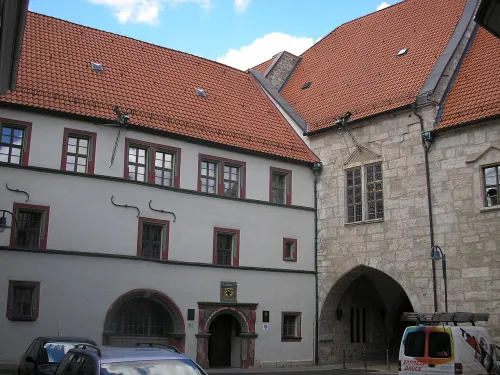
    The Rathaus sits between the Untermarkt and the Obermarkt, partly built over the brook known as the Schwemmnotte. Before you go in, find the pointed Gothic arch over the Ratsstraße: that is the oldest part of the building. The town's oldest surviving seals date from 1260 and 1278, the Rathaus itself is first mentioned in 1310, and from 1251 the town had its own courts. The building also served as the mint and the imperial city archive.

    The two-storey Gothic core was probably begun after the storming of the royal palace in 1256 and served for centuries as a market hall. In its lower storey was the council chapel, today the registry office. Early in the 14th century a Gothic extension went up on the west side, the upper hall was lengthened and the Great Council Chamber was added beside it. Around 1570 came the chancery and the silver chamber, later in the 16th century the south wing, whose Renaissance portal of 1596 is today's main entrance. The imperial city archive has been kept in that wing since 1614.

    Inside, the Great Council Chamber is the highlight: a late Gothic painted wooden partition facing the hall, Renaissance murals on the other walls, a depiction of the Quaternions on the west side dated 1572 and a wooden door carved with inscriptions and the year 1571. The hall itself has a painted barrel vault from the 17th century.

    Look out for a piece of GDR history in the hall: Wilhelm Otto Pitthan's 1960 painting of Müntzer installing the Eternal Council. It shows the council in front of the chamber's Gothic painting, although the council was founded in the Marienkirche, a telling bit of rewriting history.

    Entry is free, as this is a working town hall, so it keeps office hours rather than museum hours. The Kornmarktkirche is just 160 m away, about 2 minutes.

    Hours
    Mon 08:00–12:00, Tue 08:00–12:00 & 13:00–18:00, Wed closed (appointments only), Thu 08:00–12:00 & 13:00–18:00 (core administration 13:00–16:00), Fri 08:00–12:00, Sat–Sun closed (citizens' office open 1st Sat of month 09:00–11:30)
    Price
    Free (historic rooms; municipal administration)
  4. 4

    Kornmarktkirche (Peasants' War Museum)

    Kornmarktkirche (Peasants' War Museum) in Mühlhausen, stop 4 on the self-guided walking tour

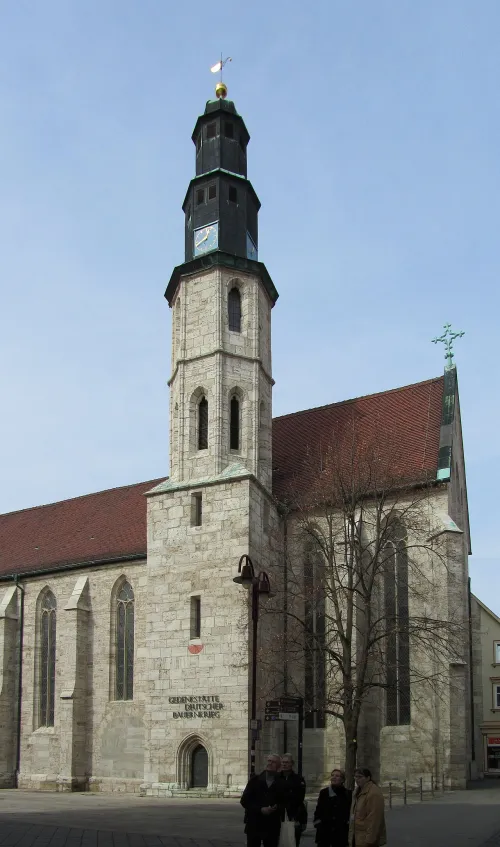
    Mühlhausen had twelve medieval churches, and this one, the former Franciscan church of St. Crucis, tells a story of friars who were not welcome. Franciscans are said to have first come to town in 1225, but the local clergy rejected these barefoot preachers, and the Teutonic Order, then taking control of the town's parishes, distrusted reformers who reached out to the poorest. A contract later restricted the friars' work, yet in 1231 they settled for good after being given a plot with a chapel, which they first used as their oratory.

    Building the church at its present size began in the mid-13th century, working from the choir toward the west wall. Look at the north wall of the nave: remains of the earlier building are still visible there. The single-nave hall is a typical early form of mendicant church in 13th-century Thuringia, and keeping to the order's rule of simplicity was no easy task among the town's grand buildings. The choir was raised in 1307, and after an earthquake the damaged eastern window bays of the south wall were rebuilt in altered form in 1348.

    Today the church houses the Peasants' War Museum, one of the Mühlhäuser Museen along with the Marienkirche and the fortifications. If Müntzer's story has gripped you, this is where to follow it further; the museum charges admission.

    Divi Blasii is 210 m away, about 3 minutes, on the Untermarkt.

    Hours
    Mar–Oct: Tue–Sun 10:00–17:00, Mon closed; Nov–Feb: Tue–Sun 10:00–16:00, Mon closed
    Price
    Adults 6 EUR, reduced 4 EUR, children (6-12) 3 EUR, under 6 free
  5. 5

    Divi-Blasii-Kirche

    Divi-Blasii-Kirche in Mühlhausen, stop 5 on the self-guided walking tour

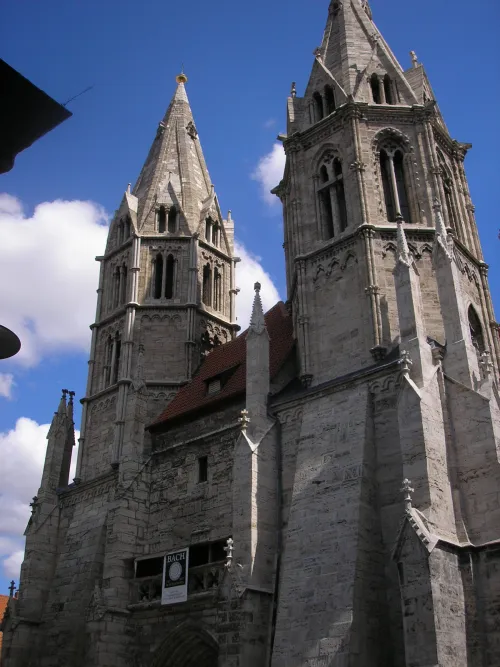
    Along with the Marienkirche, Divi Blasii is one of Mühlhausen's two principal churches, and its show side faces an old trade route. Stand before the north façade with its tracery, pinnacles and rose window in the transept, only slightly smaller than the one at Notre-Dame in Paris. Beneath it, a Gothic portal with a pointed gable frames the entrance.

    The Teutonic Order began this church around 1276, on a site with buildings going back to the early 12th century. In 1556 the order handed it over to a Lutheran congregation. It is named after Saint Blaise, and around 1600 the Latin 'sanctus Blasius' gave way to 'divus Blasius', the divine Blaise, which is where the name Divi Blasii comes from. Inside, it is a three-aisled cruciform hall church with nave and aisles of roughly equal height.

    Music lovers come here for Johann Sebastian Bach. He was organist from July 1707 to July 1708, and the townspeople valued him enough to commission a new organ built to his specifications. For the change of the town council in 1708 he wrote the festive cantata 'Gott ist mein König' (God is my King) for both principal churches; the council paid to have it printed, and it is the only Bach cantata to survive in a print from his lifetime.

    Going in is free, with donations requested, and today the church hosts concerts and art exhibitions.

    The Alte Synagoge is 340 m away, about 5 minutes.

    Hours
    Apr–Oct: Tue–Sat 10:00–17:00, Sun 11:00–17:00, Mon closed; Nov–Mar: by appointment / prior arrangement via parish office
    Price
    Free (donations requested)
    Website
    ekmd.de ↗
  6. 6

    Alte Synagoge

    Alte Synagoge in Mühlhausen, stop 6 on the self-guided walking tour

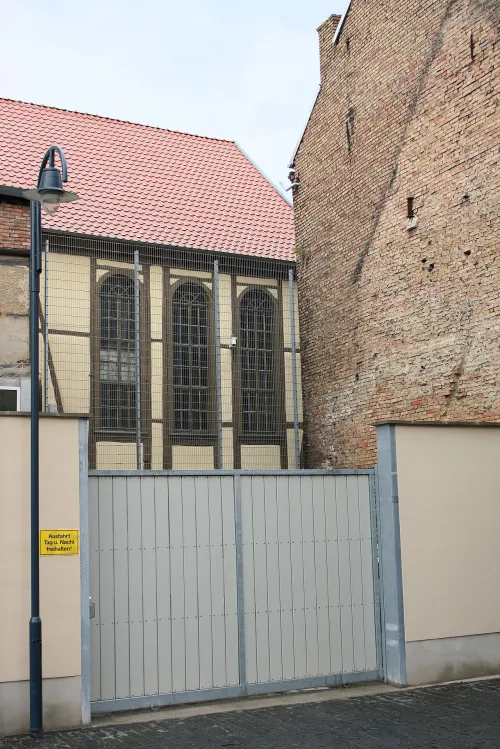
    The synagogue hides in a courtyard on the Jüdenstraße, behind the former Jewish community house at number 24. The foundation stone was laid on 7 September 1840, and the building was consecrated on 6 August 1841. Local Jewish families paid for it themselves, as they did for a religious school, a ritual bath and a cemetery. The first rabbi and teacher was Gerson Cohn; from 1861 Michael Fackenheim worked here as preacher and teacher.

    The building stands for a long and broken history. A Jewish community probably existed in the Free Imperial City from the 13th century. A plague outbreak in 1349 was followed by a pogrom; a first synagogue is mentioned in 1380, and after another pogrom in 1452 most Jews left the town. In 1561 they were banished 'for all time', and only from 1774 are Jews recorded here again.

    Settlement became continuous at the end of the 18th century: 78 Jews were registered in 1793, the community was founded in 1806, and by 1933 it had 203 members. It existed until 1943. After a thorough restoration the synagogue was rededicated in 1998 and is now mainly a meeting place with an exhibition on Jewish history in Mühlhausen.

    Entry is free, with donations requested. Opening hours are limited, but guided visits can be arranged year-round through the Tourist Information. If your timing fits, don't skip it: it is a small place that changes how you see the rest of the town.

    The last leg to the Park an der Burg is 460 m, about 6 minutes.

    Hours
    Easter to Oct: Mon 10:00–13:00, Thu 13:00–16:00; guided tours year-round by appointment
    Price
    Free (donations requested; guided tours by arrangement via Tourist Information)
  7. 7

    Park an der Burg

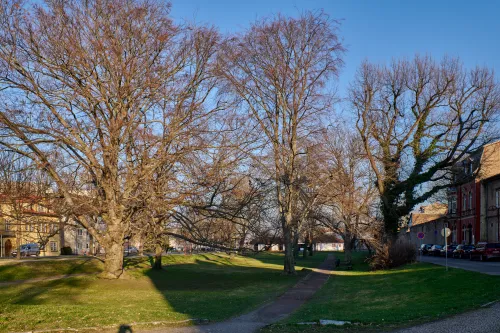
    Park an der Burg in Mühlhausen, stop 7 on the self-guided walking tour

    The route ends green. The Park an der Burg covers 10,600 square metres of public park along the old moat and the town wall, the same defences you met earlier on the walk. There is no gate, no closing time and no admission.

    After six stops of stone, paintings and opening hours, this is where you sit down. Stay as long as you like. When you're ready, the GPS navigation in your browser can lead you back to the Marienkirche, or you can wander back into the old town at your own pace.

    Hours
    Open 24/7
    Price
    Free
Walking tour route map of Mühlhausen Route loaded
MarienkircheStadtmauer (Historic Town Wall)RathausKornmarktkirche (Peasants' War Museum)+3
All 7 stops are already on the map.
You just press start.
AI Tour Guide

You've read the route. Now walk it with a guide in your ear.

Press start wherever you are, even hundreds of kilometres from Mühlhausen, and the guide begins telling its stories right away. In the city, pick any of the 7 stops to start from: it leads you there, then talks with you the whole route, asking, listening, remembering, and shaping the tour around your answers.

7stops 1.9km 26 minwalking 13languages
▶Start the tour free

Free to start · Runs in your browser · No app, no download

Shorter Ways to Walk Mühlhausen

The route is a single line, so every variant is simply a stretch of it. Pick by interest, by budget or by the day of the week.

The Peasants' War line

Stops: 1, 2, 3, 4

For anyone drawn by Thomas Müntzer and the revolt of 1525: his church, the wall that protected the Free Imperial City, the council's painted hall and the museum devoted to the war. Twelve minutes of walking. The Marienkirche, the wall and the museum each charge admission; the Rathaus is free. Plan about two and a half hours.

The old-town core

Stops: 3, 4, 5, 6

Four stops packed into ten minutes of walking. Only the museum charges admission; the Rathaus, Divi Blasii and the synagogue are free. About an hour and a half with all four interiors.

All seven, no tickets

Stops: 1, 2, 3, 4, 5, 6, 7

The full 26 minutes of walking, admiring the Marienkirche, the wall and the Franciscan church from outside and going in only where it costs nothing: the Rathaus, Divi Blasii and the synagogue, then the park. Roughly an hour and a half, and you spend nothing beyond a donation.

How Long Does This Mühlhausen Tour Take with the Interiors?

The pure walking time is 26 minutes for 1.9 km, and no leg takes longer than six minutes. If you only look at façades and portals, you reach the park in about an hour.

With all the interiors, plan about three and a half hours. For example: start at the Marienkirche at 10:00 and give it 45 minutes, reach the wall at 10:49 for half an hour, arrive at the Rathaus at 11:25, enter the museum at 11:47 and leave at 12:32. Twenty minutes in Divi Blasii and the five-minute walk bring you to the synagogue at 13:00; after 25 minutes there you sit down in the park at about 13:31.

The shorter variants take two and a half hours for the Peasants' War line and about an hour and a half for the old-town core or the ticket-free version.

Before You Set Off in Mühlhausen

  • Start and finish: The recommended start is the Marienkirche, but you can join at any stop. The walk ends in the Park an der Burg; the GPS navigation in your browser will lead you back to the start if you want.
  • Best day: Not every interior is open every day. The churches, the museum, the Rathaus and the synagogue each keep their own hours, so check the stops you care about before you go.
  • Winter: In winter several interiors are closed or open by appointment only, and the rest close earlier.
  • Costs: The walk is free. The Marienkirche, the wall and the Peasants' War Museum charge admission. The Rathaus, Divi Blasii and the synagogue are free, with donations welcome at the two places of worship.
Walking tour route map of Mühlhausen
AI Tour Guide

Your guide is ready whenever you reach the first spire.

Press start and a voice AI Tour Guide takes it from here: leading the route through Mühlhausen, telling the stories, and turning your walk into a real back-and-forth conversation. No app or download is needed; it runs in your browser.

7stops 1.9km 26 minwalking 13languages
▶Start the tour free

Free to start · Runs in your browser · No app, no download

What the AI Tour Guide Adds in Mühlhausen

On this route the AI Tour Guide talks with you rather than at you: it greets you at the Marienkirche, tells the stories of each place, asks what interests you and remembers it, so a Bach fan hears more about music and a history buff more about 1525. It can take up what the page leaves open, such as what Müntzer actually preached or why Bach left after only a year, and you can interrupt it at any time. You start with 100 free credits; after that you choose between this tour all-inclusive for €19.99 with no time limit or credits at €5 per hour.

A Real Conversation A voice AI Tour Guide greets you, leads the whole route, and tells the stories and facts as you walk, asking what you want to see and keeping a real conversation going. Not a recording you press play on.
Map Navigation Follow the route on the map and walk at your own pace. You choose where to start and when to move to the next stop.
Ask Anything Curious about a building you pass? Ask your AI Tour Guide on the spot and the conversation carries on.
13 Languages Switch language anytime. No separate tour needed.
Start free in your browser

Common Questions about Walking Mühlhausen

Can I do the walk on a Sunday?

Yes, the route itself works any day and the park is always open. Not every interior opens on a Sunday, though, so check the stops you want to go into.

Can I visit Mühlhausen as a day trip?

Yes. The town is 47 km from Erfurt and 28 km from Eisenach, and the full walk with interiors fills a morning, leaving the afternoon free.

Is the walk manageable with children?

The legs are short, the longest is six minutes, and the tour ends in a park. The three paid sites offer reduced children's tickets.

If I only buy one ticket, which should it be?

The Marienkirche for Gothic architecture and the Sauer organ, the Peasants' War Museum if Müntzer's story is what brought you, the wall if you are here in season and want the medieval town's defences up close.

Is the tour really free?

Yes. The whole tour is free: the route, the interactive map and the navigation cost you nothing. Only the voice AI Tour Guide is optional and paid: you test it with 100 free credits, then you pay either €5 per hour or €19.99 for this whole tour, with no time limit. Admission to 3 of the 7 stops is not included: Marienkirche, Stadtmauer (Historic Town Wall) and Kornmarktkirche (Peasants' War Museum) charge their own entry fees.

Do I need to download an app?

No. Everything runs in your phone browser. Open the route and start walking, no download and no sign-up required.

Do I need to book the walking tour in advance?

No booking needed. This self-guided tour is available anytime. Open the route in your browser and start walking. The AI Tour Guide works instantly, no app, no reservation required.

What languages is the AI Tour Guide available in?

The AI Tour Guide speaks 13 languages, so you take the tour in your own language and can switch at any time.

Can I skip stops or change the route?

Yes. Skip any stop, spend extra time at places you like, or start the route from any point. It is your walk, you set the pace.
Image credits
▶ Start free in your browser Runs in your browser, no app, no download