Free Walking Tour Kassel: Baroque Park to Brothers Grimm

From a round square that once held Napoleon's statue, past documenta's home and a marble baroque bath, to the world of the Brothers Grimm: 5.0 km of Kassel on foot.

11 Stops 5.0 km ~1 h 9 min walking
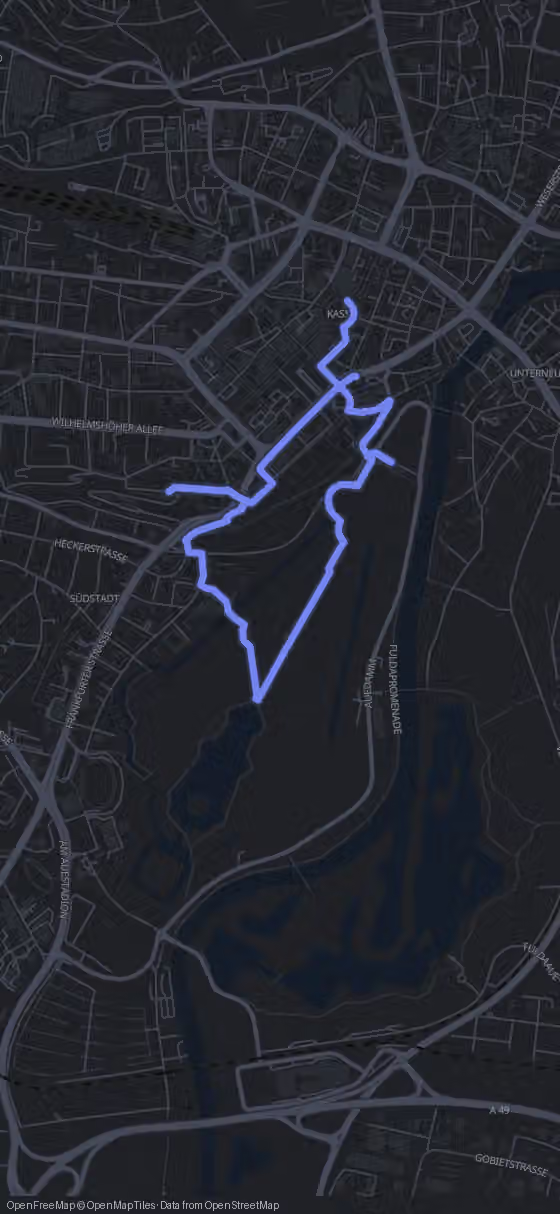
Route map for the Kassel walking tour
Stop 1 of 11
380 m·5 min
Königsplatz
Head south toward the Museum Fridericianum
Hi, welcome to Kassel. I'm Alex, and a marble-clad Baroque interior here was designed for bathing.
Try this tour with Alex

What this Kassel walk covers

Eleven stops take you from Königsplatz across Friedrichsplatz and through the Staatspark Karlsaue to the museums on the Weinberg, ending at the Ottoneum. The walk covers 5.0 km with 1 h 9 min of pure walking time; if you stay outside, allow about two and a half hours.

Königsplatz, the park and the Marmorbad cost nothing; the museums charge entry. Route, map and GPS navigation are free in your browser, and the optional AI Tour Guide tells the stories as you go.

Open free GPS & optional AI Tour Guide
View of Kassel

The Route

Walking Map of Kassel: Königsplatz to the Ottoneum

11 stops 5.0 km 1 h 9 min walking
Tap to load interactive map

The 11 stops along this route

  1. Königsplatz in Kassel, stop 1 on the self-guided walking tour
    1Königsplatz
  2. Museum Fridericianum in Kassel, stop 2 on the self-guided walking tour
    2Museum Fridericianum
  3. documenta-Halle in Kassel, stop 3 on the self-guided walking tour
    3documenta-Halle
  4. Orangerie in Kassel, stop 4 on the self-guided walking tour
    4Orangerie
  5. Marmorbad in Kassel, stop 5 on the self-guided walking tour
    5Marmorbad
  6. Staatspark Karlsaue in Kassel, stop 6 on the self-guided walking tour
    6Staatspark Karlsaue
  7. Museum für Sepulkralkultur in Kassel, stop 7 on the self-guided walking tour
    7Museum für Sepulkralkultur
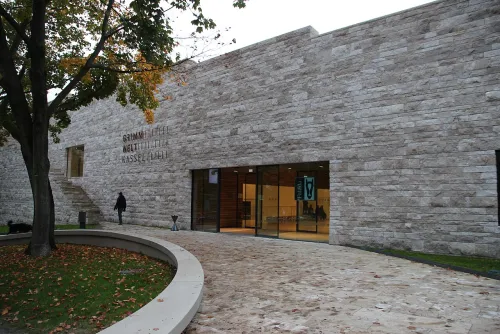
  8. Grimmwelt in Kassel, stop 8 on the self-guided walking tour
    8Grimmwelt
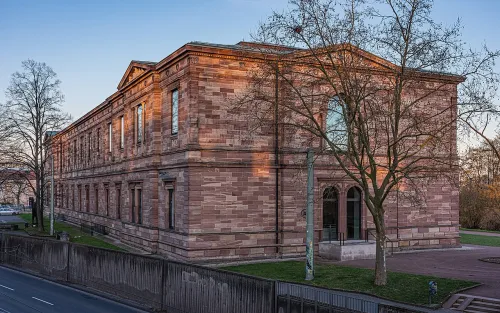
  9. Neue Galerie in Kassel, stop 9 on the self-guided walking tour
    9Neue Galerie
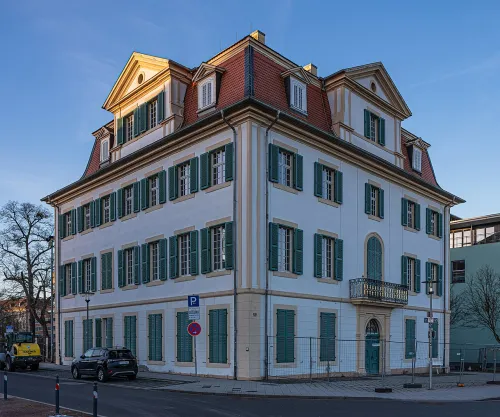
  10. Brüder-Grimm-Museum in Kassel, stop 10 on the self-guided walking tour
    10Brüder-Grimm-Museum
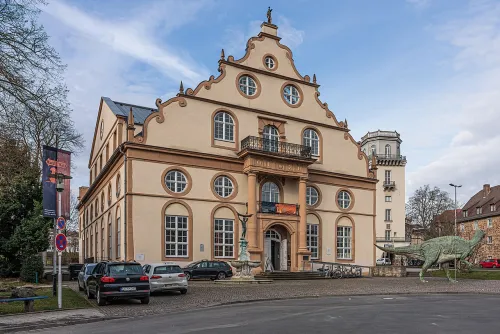
  11. Ottoneum in Kassel, stop 11 on the self-guided walking tour
    11Ottoneum
  12. That's the full route.

    Walk it with an AI Tour Guide talking you through every one of these streets.

    Start free in your browser
    You made it

Your Kassel Walking Tour, Stop by Stop: Squares, Baroque and Grimm

  1. 1

    Königsplatz

    Königsplatz in Kassel, stop 1 on the self-guided walking tour

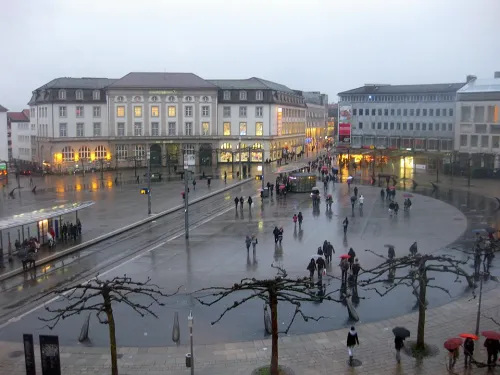
    Königsplatz is a round square where six streets meet, right in Kassel's pedestrian zone. It divides the Obere from the Untere Königsstraße, and the tram runs straight across the middle along both. Stand near the centre for a moment and look down each street in turn: the radial layout is the clearest trace of the planned city that was laid out here in the 18th century.

    The square dates from 1767, when Kassel was redesigned to plans by Simon Louis du Ry, an architect you will meet again in a few minutes. It was named after Landgrave Friedrich I, who was at the same time King of Sweden. Important public buildings stood around it, among them the seat of the state government and the regional postal headquarters.

    Its most turbulent chapter came when Kassel belonged to the Kingdom of Westphalia and the square was renamed Napoléonsplatz. In 1810 King Jérôme decreed a statue of his brother. The first plan called for bronze from local mines, worked by the Kassel sculptor Johann Werner Henschel on the painter Jacques-Louis David's recommendation, but it was dropped. Instead, on 12 November 1812, a Carrara marble statue by Antoine-Denis Chaudet was unveiled: Napoleon as an idealised Roman emperor in toga and laurel wreath, a scroll in his right hand standing for the constitution. It lasted barely a year. After the French left in 1813 it was smashed, and its mutilated remains are now in the Museum Schloss Friedrichstein in Bad Wildungen.

    Art divided the city here once more after 1992. For documenta 9, the Hamburg landscape architect Gustav Lange, pushed by the festival's artistic director Jan Hoet, built a wooden platform in the middle of the square. It stayed after the exhibition, meant to spark a redesign, and for years Kassel argued about it: many residents saw it as a blight and demanded its removal, while the architect fought to keep it.

    From here it is 380 m, about 5 minutes on foot, to the Museum Fridericianum, du Ry's other great contribution to the city.
    Hours
    Open 24/7
    Price
    Free
  2. 2

    Museum Fridericianum

    Museum Fridericianum in Kassel, stop 2 on the self-guided walking tour

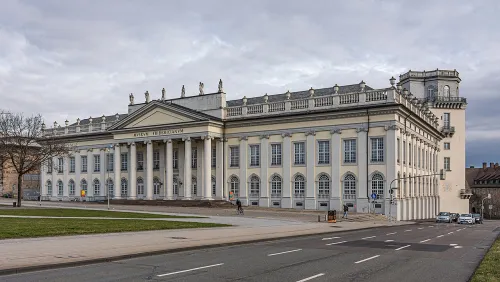
    The Fridericianum faces Friedrichsplatz, laid out as a parade square shortly before the museum was built. Opened in 1779, it is one of the oldest public museums in Europe, and since 1955 it has been the centre of documenta, the art festival held every five years, with works regularly spilling out onto the square in front.

    The money behind it had an uncomfortable source. Landgrave Friedrich II grew rich by selling soldiers to the British, and he used those funds to commission the Huguenot architect Simon Louis du Ry. The result was an encyclopedic museum: the state library of Hesse, the landgraves' art collections and statue gallery, rooms for medals, machines and watches, prints, manuscripts and maps, scientific instruments, cork models of Roman buildings and wax figures of Hessian landgraves. The library was built for 100,000 volumes, and the museum was connected to the medieval Zwehrenturm, which had been turned into an observatory.

    Under Jérôme Bonaparte, Napoleon's youngest brother, Kassel became capital of the Kingdom of Westphalia and the Fridericianum became the first parliament building in Germany. After Jérôme was driven out in 1813 it went back to being a museum. In those years Jacob and Wilhelm Grimm worked in its library, a thread you will pick up again on the Weinberg.

    Is it worth going in? Since 1988 the house has shown changing exhibitions of contemporary art, so go in if that is your interest; the landgraves' cabinets of curiosities are not what you will find. Entry is charged, with reduced tickets available.

    The documenta-Halle is only 240 m away, about 3 minutes across the square; on this short stretch you pass Joseph Beuys's 7000 Eichen.

    Hours
    Tue–Wed 11:00–18:00, Thu 11:00–20:00, Fri–Sun 11:00–18:00, Mon closed
    Price
    6 EUR full, 4 EUR reduced
  3. 3

    documenta-Halle

    documenta-Halle in Kassel, stop 3 on the self-guided walking tour

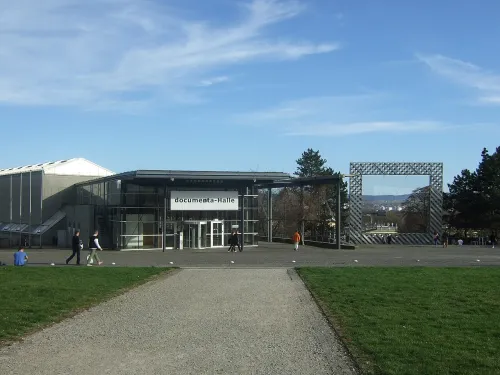
    The documenta-Halle went up on Friedrichsplatz in 1992 because documenta, for all its fame, had no permanent exhibition rooms of its own. Early designs would have closed the square off from the Staatspark Karlsaue. What was built instead sits on the edge of the slope, so the view out over the park landscape stays open.

    The architects Jourdan & Müller (PAS) gave it a postmodern, constructivist look with cubist elements, conceived as a companion to the neighbouring theatre by Paul Bode and Ernst Brundig. Look at the glass front that opens toward the park: despite the concrete supports in front of it, so much light came in that an awning was fitted. Inside, the large rotunda on the lower level mirrors the geometry of the outer shell and remains hard for a layperson to read.

    The hall has had a varied life. Besides documenta exhibitions it hosts temporary shows, events, fairs and congresses. Its several levels made it awkward to use, so since 2008 it has mainly presented work by master classes. Until the main house of the Staatstheater reopened after renovation in February 2007, it served as one of the theatre's substitute stages, and from 2013 it became the venue of the tattoomenta, a tattoo and piercing fair counted among the scene's renowned public events.

    Opening times and prices depend on what is on, so ask at the entrance. If nothing appeals, the building and the open view toward the park are reason enough to pause. From here, 490 m and about 6 minutes bring you to the Orangerie.

    Hours
    Varies by exhibition
    Price
    Varies by exhibition
  4. 4

    Orangerie

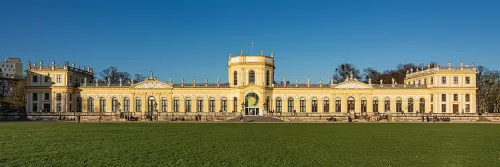
    Orangerie in Kassel, stop 4 on the self-guided walking tour

    The Orangerie is a baroque single-wing building on the Karlsaue, built as a house for plants. Landgrave Karl had it built from 1701 to a design by his master builder Johann Konrad Giesler, whose name turns up again at the very end of this walk, at the Ottoneum.

    Look at it as an ensemble rather than a single building: the Küchenpavillon, the former kitchen pavilion, stands on its eastern side, the Marmorbad on its western side. Like so much of Kassel, the Orangerie was destroyed in 1943, and it took until 1981 to rebuild it.

    Today it houses the Astronomisch-Physikalisches Kabinett. The ticket is worth it if scientific instruments and the landgraves' interest in the sky appeal to you; otherwise the exterior and the park front are enough.

    The Marmorbad is just 150 m away, about 2 minutes on foot, on the western side of the ensemble.

    Hours
    Thu–Sun & public holidays 10:00–17:00, Mon–Wed closed
    Price
    8 EUR full, 5 EUR reduced
  5. 5

    Marmorbad

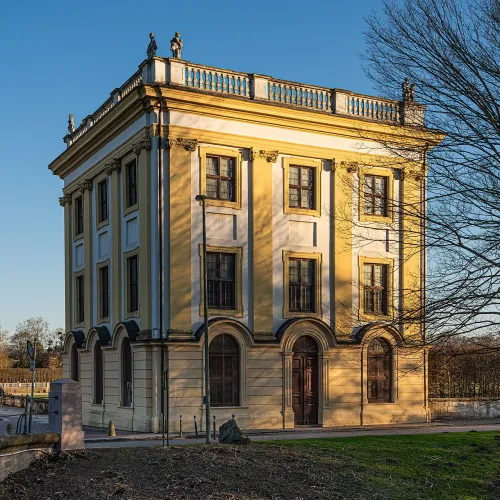
    Marmorbad in Kassel, stop 5 on the self-guided walking tour

    Do not skip this one. The Marmorbad, a square building close to the Orangerie, is Germany's last major surviving representative bath of the late baroque. Landgrave Karl had it built between 1722 and 1728, and at its centre lies the marble bathing pool.

    The real treasure is the decoration by the French sculptor Pierre-Étienne Monnot, who worked on it from 1712. He made twelve marble statues, ten wall reliefs and medallions, including portraits of Karl and his wife Amalia of Courland, who died a year before construction began. The walls are clad in colour, so the white marble stands out against them.

    Almost everything comes from Roman mythology. On two facing fireplaces the scenes are drawn from Ovid's Metamorphoses. Among the statues, look for Leda with the swan, Apollo flaying Marsyas, Narcissus, Paris with the apple and a bacchante whose head has not survived. The reliefs show Europa and the bull, Perseus freeing Andromeda, Apollo and Daphne, Diana and Actaeon and the wedding of Bacchus and Ariadne.

    Entry is free, and you can see the room in about twenty minutes, so this is an easy yes for anyone. The Marmorbad is open only part of the year; out of season you see it from outside only.

    From here the route heads into the park itself: 1170 m, about 16 minutes, to the Staatspark Karlsaue.

    Hours
    Tue–Sun & public holidays 10:00–17:00, Mon closed (Apr–Oct only; Nov–Mar closed)
    Price
    free
  6. 6

    Staatspark Karlsaue

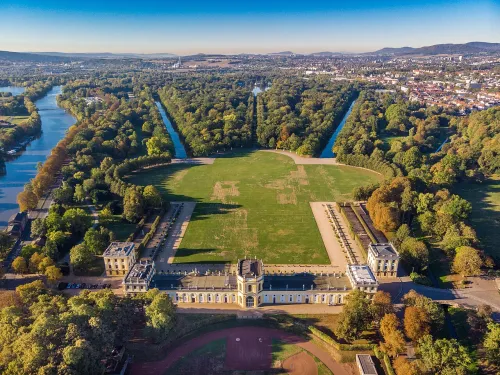
    Staatspark Karlsaue in Kassel, stop 6 on the self-guided walking tour

    The Staatspark Karlsaue covers 1.50 km² and began as a baroque park laid out almost entirely on flat ground. What you notice most is the water: ponds and canal-like channels, all of them artificial and there for plants and wildlife. Since 2009 the park has belonged to the European Garden Heritage Network.

    Its baroque bones are still readable. Three axes run from the Karlswiese, originally a bowling green, to the Großes Bassin and the flower island of Siebenbergen behind it. A second garden palace was once planned on what are now the Giesewiesen, but it was never built.

    The well-made sandy paths let you wander for hours through planting that changes from open lawns to small, intimate corners. Footbridges, the Schwimmbadbrücke and the Gärtnerplatzbrücke, lead across to the neighbouring Fuldaaue; together the two form one of the largest inner-city parks in Germany, and they hosted the Bundesgartenschau in 1955 and again in 1981. A planet trail, the Planetenwanderweg, starts at the Orangerie and runs largely through the Karlsaue.

    Now comes the longest leg of the walk: 1470 m, about 23 minutes, to the Museum für Sepulkralkultur on the Weinberg.

    Hours
    Open 24/7
    Price
    Free
  7. 7

    Museum für Sepulkralkultur

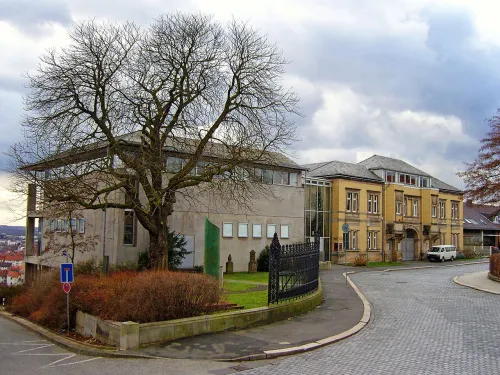
    Museum für Sepulkralkultur in Kassel, stop 7 on the self-guided walking tour

    This is one of Kassel's more unusual museums, and that is the point. Opened in 1992 on Weinbergstraße, the Museum für Sepulkralkultur is devoted to dying, death, burial, mourning and remembrance. It is not run by the state but by an association, the Arbeitsgemeinschaft Friedhof und Denkmal.

    The building has two parts: the Remise, a former outbuilding of the Henschel villa, and a bright new wing from 1992 by the architect Wilhelm Kücker. In the front garden and the grounds behind, gravestones, design objects and artworks are on show, and the terrace has a wide view over Kassel. Keeping the building in shape is a struggle for a private association; in 2024 rainwater got in and the rooms lacked ventilation, and the federal, state and city governments promised funding.

    The permanent exhibition fills around 1,400 m² with the culture of death in German-speaking countries from the Middle Ages to today: coffins and hearses, mourning clothes and jewellery, gravestones, sculptures and everyday objects. Since 2014 a section has documented how multicultural Germany is changing its cemeteries and burials. Behind the scenes there are around 16,500 prints from the 15th century on and a public specialist library.

    Go in if you are curious rather than squeamish; it is quieter and more thoughtful than its theme suggests. The museum charges entry, with reduced tickets available. The Grimmwelt is right next door: 90 m, a single minute on foot.

    Hours
    Tue 10:00–17:00, Wed 10:00–20:00, Thu–Sun 10:00–17:00, Mon closed
    Price
    8 EUR full, 5 EUR reduced
  8. 8

    Grimmwelt

    Grimmwelt in Kassel, stop 8 on the self-guided walking tour

    The Grimmwelt is Kassel's house for the life and work of Jacob and Wilhelm Grimm, the same brothers who once worked in the library of the Fridericianum. It stands on the upper Weinberg, near the Hessisches Landesmuseum and the Museum für Sepulkralkultur.

    Inside, interactive presentations cover the Deutsches Wörterbuch, the great German dictionary the brothers started, the Kinder- und Hausmärchen, their collection of fairy tales, and their lives. The exhibition is divided into 25 areas, each named after a word from the dictionary, and changing special exhibitions add to it.

    The building exists because the old home did not work. Until the end of October 2014 the Grimm collection was shown in the Palais Bellevue, a building not officially designated as a museum; making it one would have meant deep interventions in the historic fabric. So the city chose a new building, held an architecture competition in 2011 that the Aachen firm kadawittfeldarchitektur won, and broke ground on 21 August 2013. The mayor, Bertram Hilgen, asked residents for name ideas; 270 came in, and on 22 October 2013 the jury announced the name.

    If you only go inside one museum on this walk, make it this one, especially with children or if fairy tales brought you to Kassel. Entry is charged, with reduced tickets available. Next comes the Neue Galerie, 320 m and about 4 minutes away.

    Hours
    Tue–Sun 10:00–18:00, Mon closed
    Price
    10 EUR full, 7 EUR reduced
  9. 9

    Neue Galerie

    Neue Galerie in Kassel, stop 9 on the self-guided walking tour

    The Neue Galerie stands on Schöne Aussicht, looking out over the Karlsaue. It shows painting, sculpture and contemporary art from around 1800 to today, drawn from the city's and the state's art collections, and belongs to Hessen Kassel Heritage.

    The building was built between 1871 and 1877 for something else entirely: Kassel's Old Masters. Heinrich von Dehn-Rotfelser, an architect and professor at the Kassel academy, designed it, and it held Dutch paintings by Rembrandt, Paul Potter and Philips Wouwerman, among others.

    Then came the night of 22 to 23 October 1943. A Royal Air Force raid set off a firestorm that destroyed much of Kassel's old town, and the gallery burned out. The most important paintings had been evacuated beforehand; one group went to Vienna and only came back in 1956. After the war the Old Masters never returned here and eventually went to Schloss Wilhelmshöhe. The repaired building reopened in 1976 under its present name, focused on the 19th and 20th centuries and later on contemporary art and works tied to documenta, which has used it as a venue again and again.

    Go in if you want art from 1800 onward with a strong documenta link; entry is charged, with reduced tickets available. The Palais Bellevue with the former Brüder-Grimm-Museum is only 80 m away, a minute's walk.

    Hours
    Tue–Sun & public holidays 10:00–17:00 (every 4th Friday of the month 10:00–19:00), Mon closed
    Price
    8 EUR full, 5 EUR reduced
  10. 10

    Brüder-Grimm-Museum

    Brüder-Grimm-Museum in Kassel, stop 10 on the self-guided walking tour

    This stop is about the building and its story, seen from outside. The Brüder-Grimm-Museum in the Palais Bellevue closed on 31 October 2014 to make way for the new concept of the Grimmwelt, so the Grimm exhibits you may have come for are now next door at the Grimmwelt.

    The Palais Bellevue itself deserves a look: it is the only former city palace of the Hessen-Kassel landgraves and electors whose interior is still largely preserved. That is exactly why it could not become a modern museum without major changes to its historic substance.

    The museum was founded in 1959 by the city of Kassel and the Brüder Grimm-Gesellschaft, and its last director was Bernhard Lauer. It saw itself not only as an exhibition space but as a library, archive and research institute, and it claimed to be the central place for Grimm research nationally and internationally, a claim that scholars debated.

    From here, 610 m and about 8 minutes on foot bring you to the last stop, the Ottoneum.

    Hours
    Mon: Closed | Tue–Sun: 10:00–18:00
    Price
    10 EUR
  11. 11

    Ottoneum

    Ottoneum in Kassel, stop 11 on the self-guided walking tour

    The walk ends at the Ottoneum, the first theatre building in Germany and today a natural history museum. Landgrave Moritz had it built in 1606 by the architect William Vernukken and named it after his favourite son, Otto. With the Thirty Years' War its days as a cultural centre were over, and the building was put to other uses.

    In 1696 Landgrave Karl had Johann Conrad Giesler, the builder of the Orangerie, convert it for the landgraves' art and natural history collection, with Paul du Ry carrying out the work. In 1709 Karl founded the Collegium Carolinum, a research centre around scholars such as Georg Forster and Samuel Thomas von Soemmerring, and the Ottoneum gained an anatomical theatre and an observatory. By 1779 the collections had outgrown it and moved to the Fridericianum, where the public could finally see them.

    A century later, under Prussia, natural history objects came back, and since 1928, when the city took the building over again, it has been the Naturkundemuseum. In October 1943 fire and bombs damaged it and more than half the collection was lost. It was rebuilt from historic plans between 1949 and 1954, and the collection has grown again through purchases and donations. Today it is also a place to discuss the protection of nature.

    The highlight is the Goethe elephant skeleton, which Soemmerring lent to Goethe for his anatomical research on the premaxilla. It is also the cheapest museum on the route. If you want to go back to Königsplatz afterwards, the GPS navigation will take you there.

    Hours
    Tue 10:00–17:00, Wed 10:00–20:00, Thu–Sat 10:00–17:00, Sun 10:00–18:00, Mon closed
    Price
    5 EUR full, 3 EUR reduced
Walking tour route map of Kassel Route loaded
KönigsplatzMuseum Fridericianumdocumenta-HalleOrangerie+7
All 11 stops are already on the map.
You just press start.
AI Tour Guide

You know the route now. Walk it from Königsplatz with a guide in your ear.

Press start wherever you are, even hundreds of kilometres from Kassel, and the guide begins telling its stories right away. In the city, pick any of the 11 stops to start from: it leads you there, then talks with you the whole route, asking, listening, remembering, and shaping the tour around your answers.

11stops 5.0km 1 h 9 minwalking 13languages
▶Start the tour free

Free to start · Runs in your browser · No app, no download

Shorter ways to walk Kassel

The route splits neatly into a baroque half around Friedrichsplatz and the Karlsaue, and a museum half on the Weinberg. Each works on its own if you only have a morning or an afternoon.

Squares, documenta and the baroque park

Stops: 1, 2, 3, 4, 5, 6

For a first look at Kassel and anyone who wants fresh air more than museums. From Königsplatz to the Staatspark Karlsaue you walk 32 minutes in total. Paid entries on this half are the Fridericianum and the Orangerie; the Marmorbad is free, and at the documenta-Halle the price depends on the current show.

Grimm and museums on the Weinberg

Stops: 7, 8, 9, 10, 11

For a rainy day or a museum lover. The five stops lie close together, with just 14 minutes of walking from the Museum für Sepulkralkultur to the Ottoneum. The Museum für Sepulkralkultur, the Grimmwelt, the Neue Galerie and the Ottoneum charge entry; the Brüder-Grimm-Museum is only seen from outside.

How Long Does This Kassel Tour Take with Museum Visits?

Most of the 1 h 9 min of walking falls on two stretches through the park: 16 minutes from the Marmorbad into the Staatspark Karlsaue and 23 minutes from there to the Museum für Sepulkralkultur. Everything else is a matter of a few minutes, so the real question is how many interiors you choose.

A sensible mix is the free Marmorbad, which you can see in about twenty minutes, plus the Grimmwelt, where an hour and a half goes quickly. With those two inside, count on roughly four and a half hours. Add the Fridericianum, the Neue Galerie or the Ottoneum and the walk becomes a full day; on such a day you will not fit every interior, so pick by interest. The baroque half alone takes about an hour and a half with a stroll in the park, the Weinberg half a good afternoon with two museums.

Before you set off in Kassel

  • Start and finish: The recommended start is Königsplatz, but you can join at any stop. The walk ends at the Ottoneum; if you like, the GPS navigation leads you from there back to Königsplatz.
  • Best day and time: Not every museum on the route opens every day, and the Orangerie opens on the fewest days, so check before you pick your day for the full route. If you want to see the Fridericianum from inside, time your start at Königsplatz so you arrive once it has opened. The Marmorbad is open only part of the year.
  • Costs: The route, map and GPS navigation are free. The Fridericianum, Orangerie, Museum für Sepulkralkultur, Grimmwelt, Neue Galerie and Ottoneum charge entry, with reduced prices at each; the Marmorbad is free. The optional AI Tour Guide starts with 100 free credits; after that you choose between this tour all-inclusive for €19.99 with no time limit or credits at €5 per hour.
Walking tour route map of Kassel
AI Tour Guide

Your guide is ready when you are, from Friedrichsplatz to the Weinberg.

Press start and a voice AI Tour Guide takes it from here: leading the route through Kassel, telling the stories, and turning your walk into a real back-and-forth conversation. No app or download is needed; it runs in your browser.

11stops 5.0km 1 h 9 minwalking 13languages
▶Start the tour free

Free to start · Runs in your browser · No app, no download

What the AI Tour Guide adds between park and museums

In Kassel the stories run across the stops: du Ry plans both Königsplatz and the Fridericianum, Giesler builds the Orangerie and later converts the Ottoneum, the Grimms work in a library long before the Grimmwelt exists. The AI Tour Guide ties these threads together as you walk, asks what caught your eye and goes deeper where you want, and you can interrupt it any time. Ask it, for instance, what the Astronomisch-Physikalisches Kabinett in the Orangerie actually holds, or how Jérôme's parliament in the Fridericianum worked.

A Real Conversation A voice AI Tour Guide greets you, leads the whole route, and tells the stories and facts as you walk, asking what you want to see and keeping a real conversation going. Not a recording you press play on.
Map Navigation Follow the route on the map and walk at your own pace. You choose where to start and when to move to the next stop.
Ask Anything Curious about a building you pass? Ask your AI Tour Guide on the spot and the conversation carries on.
13 Languages Switch language anytime. No separate tour needed.
Start free in your browser

Common Questions about Walking Kassel

Is this walk a good idea with children?

Yes, with a little planning. The Grimmwelt is built around interactive presentations on fairy tales and words, the Ottoneum has the Goethe elephant skeleton, and the Karlsaue gives them space to run. The Museum für Sepulkralkultur, with its coffins and hearses, is something to judge for your own family.

What changes during a documenta year?

The festival takes place every five years and is centred on the Fridericianum, with works on Friedrichsplatz and exhibitions in the documenta-Halle. In those months the first stops of the walk become part of the festival itself, so check what is on before you plan your time there.

Where are Kassel's Old Masters, like the Rembrandts?

Not on this route. The Old Masters collection that once hung in the building of the Neue Galerie was moved to Schloss Wilhelmshöhe after the war, so plan that as a separate outing.

Which towns make a good next stop after Kassel?

The closest is Göttingen, a university town 39 km away. Marburg and Eisenach are each about 70 km away and have their own self-guided walks.

Is the tour really free?

Yes. The whole tour is free: the route, the interactive map and the navigation cost you nothing. Only the voice AI Tour Guide is optional and paid: you test it with 100 free credits, then you pay either €5 per hour or €19.99 for this whole tour, with no time limit. Admission to 7 of the 11 stops is not included: Museum Fridericianum, Orangerie, Museum für Sepulkralkultur, Grimmwelt, Neue Galerie, Brüder-Grimm-Museum and Ottoneum charge their own entry fees.

Do I need to download an app?

No. Everything runs in your phone browser. Open the route and start walking, no download and no sign-up required.

Do I need to book the walking tour in advance?

No booking needed. This self-guided tour is available anytime. Open the route in your browser and start walking. The AI Tour Guide works instantly, no app, no reservation required.

What languages is the AI Tour Guide available in?

The AI Tour Guide speaks 13 languages, so you take the tour in your own language and can switch at any time.

Can I skip stops or change the route?

Yes. Skip any stop, spend extra time at places you like, or start the route from any point. It is your walk, you set the pace.
Image credits
▶ Start free in your browser Runs in your browser, no app, no download