Free Walking Tour Frankfurt: Old Town, River and Städel

A coronation church, a market hall full of Green Sauce, an iron footbridge and Goethe's birthplace: one 7.7 km walk through Frankfurt's long history.

11 Stops 7.7 km ~1 h 49 min walking
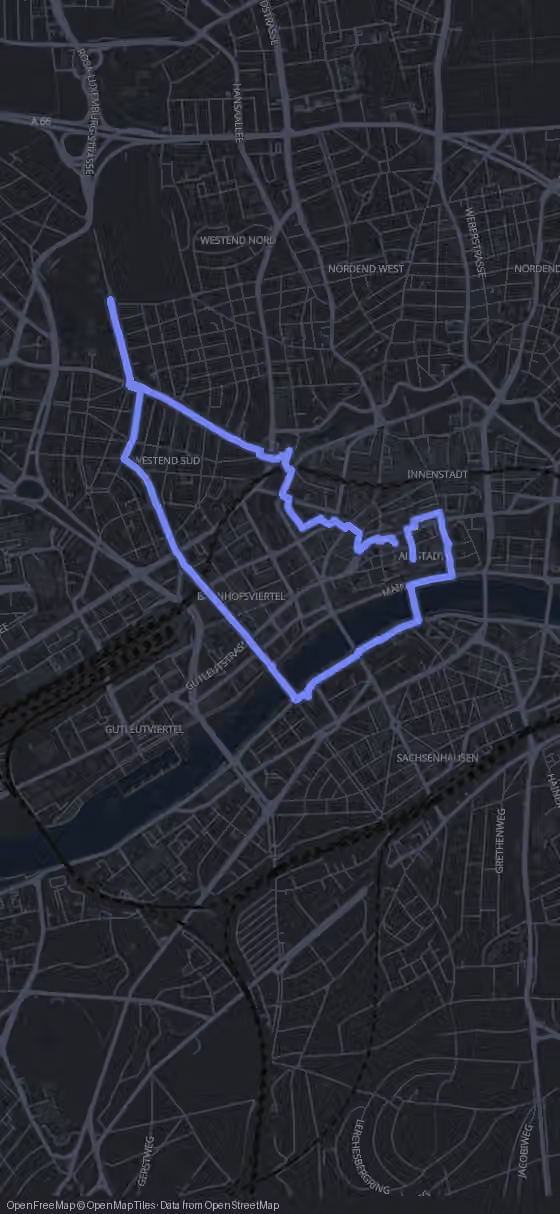
Route map for the Frankfurt walking tour
Stop 1 of 11
370 m·5 min
Roemerberg
Head north toward the Kleinmarkthalle
Guten Tag, welcome to Frankfurt. I'm Alex, and the old city here is younger than it first appears.
Try this tour with Alex

What Your Frankfurt Walk Covers

Eleven stops, 7.7 km, 1 h 49 min of pure walking: from the Roemerberg via the Kleinmarkthalle, Kaiserdom St. Bartholomaeus, Eiserner Steg and Museumsufer to the Stael Museum, out to the Palmengarten, then back past the Alte Oper, Main Tower and Goethe-Haus to the Paulskirche. With the paid visits, it fills a whole day.

The squares, the market hall, the Kaiserdom, the bridge and the Paulskirche are free; the Städel, Palmengarten, Main Tower and Goethe-Haus charge entry. Route, map and GPS navigation run free in your browser, and the AI Tour Guide is optional.

Open free GPS & optional AI Tour Guide
This short shows highlights of the route. All 11 stops follow below.

The Route

Walking Map of Frankfurt, Old Town to Westend

11 stops 7.7 km 1 h 49 min walking
Tap to load interactive map

The 11 stops along this route

  1. Roemerberg in Frankfurt, stop 1 on the self-guided walking tour
    1Roemerberg
  2. Kleinmarkthalle in Frankfurt, stop 2 on the self-guided walking tour
    2Kleinmarkthalle
  3. Kaiserdom St. Bartholomaeus in Frankfurt, stop 3 on the self-guided walking tour
    3Kaiserdom St. Bartholomaeus
  4. Eiserner Steg in Frankfurt, stop 4 on the self-guided walking tour
    4Eiserner Steg
  5. Museumsufer in Frankfurt, stop 5 on the self-guided walking tour
    5Museumsufer
  6. Stael Museum in Frankfurt, stop 6 on the self-guided walking tour
    6Stael Museum
  7. Palmengarten in Frankfurt, stop 7 on the self-guided walking tour
    7Palmengarten
  8. Alte Oper in Frankfurt, stop 8 on the self-guided walking tour
    8Alte Oper
  9. Main Tower in Frankfurt, stop 9 on the self-guided walking tour
    9Main Tower
  10. Goethe-Haus in Frankfurt, stop 10 on the self-guided walking tour
    10Goethe-Haus
  11. Paulskirche in Frankfurt, stop 11 on the self-guided walking tour
    11Paulskirche
  12. That's the full route.

    Walk it with an AI Tour Guide talking you through every one of these streets.

    Start free in your browser
    You made it

Your Frankfurt Walking Tour, From Römer Square to the Paulskirche

  1. 1

    Roemerberg

    Roemerberg in Frankfurt, stop 1 on the self-guided walking tour

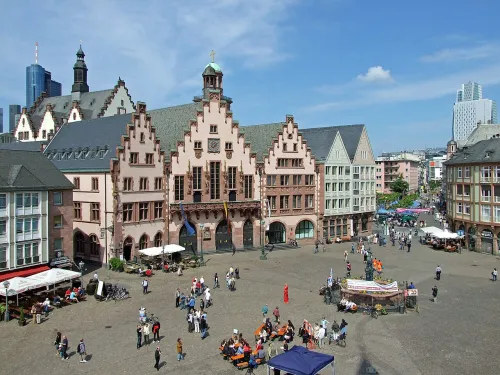
    Start where Frankfurt has always gathered. The Roemerberg has been the centre of the old town since the High Middle Ages, and it takes its name from the Haus zum Römer, the ‘Römer’ for short, which has served as the city hall since the 15th century. Look across to the eastern side, known as the Samstagsberg: its row of half-timbered houses was rebuilt at the start of the 1980s, and ever since the square has been a favourite with Frankfurters and visitors alike.

    This square has seen almost everything the city has lived through. The Frankfurt trade fairs were held here, the imperial coronations of the early modern period were celebrated here, and today it hosts the Frankfurt Christmas market as well as large public and political rallies. When you picture an emperor's procession, picture it on these cobbles.

    The ground tells a story too. At its highest point, the Samstagsberg rises about four metres above the hollows around it, which in the early Middle Ages were marshy or crossed by little streams. Along today's Braubachstraße ran an arm of the Main, the Braubach, which silted up in the Middle Ages, and the river itself was once much wider, its north bank roughly at today's Saalgasse. Until the 19th century a gate called the Fahrtor led from the square down to the harbour.

    Northwards, the Neue Kräme, one of the old main shopping streets, leads to the Liebfrauenberg, the second large square of the medieval town. On the other side, a block that held the old stock exchange was never rebuilt after 1945, so the Roemerberg now opens straight onto the much enlarged Paulsplatz, where this walk will finish. From here it is 370 m, about 5 minutes, to the Kleinmarkthalle.
    Local name
    Römerberg
    Hours
    Open 24/7
    Price
    Free
  2. 2

    Kleinmarkthalle

    Kleinmarkthalle in Frankfurt, stop 2 on the self-guided walking tour

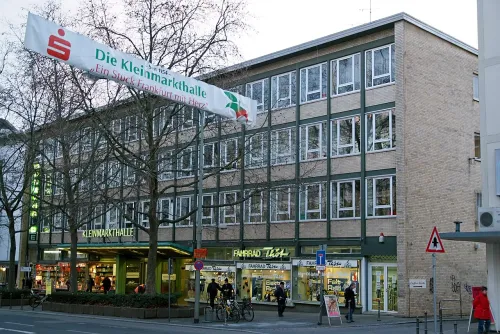
    Step into Frankfurt's pantry. The Kleinmarkthalle was built in 1954, and on weekdays 63 traders sell around 5,000 products from 156 stalls on roughly 1,500 square metres, mostly fresh food but some non-food too. Look for regional specialities such as Frankfurter Grüne Soße, the city's green herb sauce, alongside imported delicacies; several traders run snack stands inside and in front of the hall, so this is the natural place for a bite on the route.

    The building itself is a listed monument, protected since 2000 for its architecture and history. It is 100 metres long and 24 metres wide, with a fully glazed, slanted façade on the north side and a closed wall on the south, where the butchers have their counters. Notice how the single-pitch roof drops from 13 metres in the north to 8 metres in the south. Down in the basement, beyond the storerooms, are tanks for fish kept alive until they are sold.

    The main entrance faces east onto the Hasengasse, fronted by a three-storey head building. A matching one was planned for the west end but never built, so the western entrance is a pavilion, today topped by a broad terrace reached from the street. The Ziegelgasse in front of it forms a forecourt that runs into the Liebfrauenberg and, on Saturdays above all, becomes an open-air ‘Schlemmergarten’ for eating and drinking.

    Entry is free and the hall is worth even a short wander, especially if you like food markets; Saturday is when it draws shoppers from across the whole Rhine-Main region. Then it is 300 m, about 4 minutes, to the Kaiserdom, passing through the Neue Altstadt on the way.

    Hours
    Mon–Fri: 08:00–18:00 | Sat: 08:00–16:00 | Sun: Closed
    Price
    Free
  3. 3

    Kaiserdom St. Bartholomaeus

    Kaiserdom St. Bartholomaeus in Frankfurt, stop 3 on the self-guided walking tour

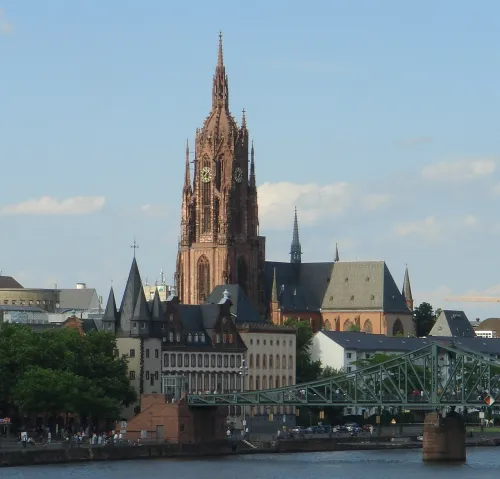
    Frankfurt's great Gothic church is the city's largest religious building and was the election and coronation church of the Roman-German emperors. Curiously, it was never a cathedral: from 852 to 1803 it was a collegiate church, and the name ‘Kaiserdom’ honours the emperors rather than a bishop. In the 19th century it became a symbol of national unity.

    The building you see is the fourth church on this spot, and excavations have traced its predecessors back to the 7th century. The early Carolingian chapel of the royal palace hosted the Synod of Frankfurt in 794, and in the Salvatorkirche, consecrated in 852, the first royal election in Frankfurt took place in 855. In 1239 the church was dedicated to the Apostle Bartholomew and work on the Gothic building began, lasting essentially from 1250 until 1514.

    Look up at the west tower. Begun in 1415, it had to be finished in 1514 without its planned lantern because the money ran out, a solution unique in Central Europe that shaped the skyline for centuries. Only after a fire in 1867 was the tower completed by 1878, following the surviving medieval plans. Inside, notice the proportions: a nave of just three bays and a very long transept give the hall church the feel of a centrally planned building. Everything is natural stone, with rougher rubble hidden behind the plaster.

    The church stayed Catholic after the Reformation, apart from two short periods, and until 1917 it was the only Catholic parish church in the city; today it is the largest church in the Diocese of Limburg. Going in is free, so it is an easy yes for anyone with even a passing interest in history. Next, walk 480 m, about 7 minutes, down to the river and the Eiserner Steg.

    Local name
    Kaiserdom St. Bartholomäus
    Hours
    Daily: 09:00–20:00
    Price
    Free
  4. 4

    Eiserner Steg

    Eiserner Steg in Frankfurt, stop 4 on the self-guided walking tour

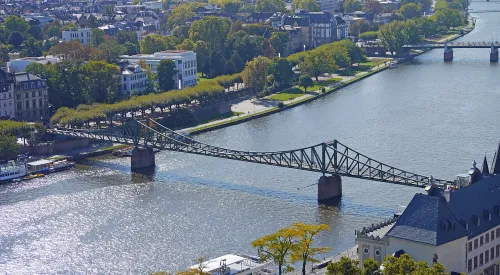
    This footbridge has crossed the Main since 1868, linking the old town at the Fahrtor and the Historisches Museum with Sachsenhausen on the far bank. Stop halfway across for the view along the river, and look at the riveted iron structure: it dates from 1912, when the first bridge was replaced by a wider, stronger and higher one.

    The story of how it got built is very Frankfurt. In the early 19th century the population grew from 35,000 around 1800 to almost 57,000 in 1840, and the Alte Brücke was still the only crossing. Petitions poured in, arguing that the old bridge could never cope with all the cabs heading for the stations, the carts of stone and especially the growing number of beer wagons. The city council, worried about the cost, would not budge.

    So the citizens, and above all the merchants, helped themselves. In June 1867 they founded an association to build an iron footbridge, selling shares worth 100 guilders at 5 percent interest. Once the estimated 120,000 guilders of building costs were paid off, the bridge was to be handed to the city free of charge, and with that promise the council finally agreed. The engineer Peter Schmick designed a stiffened suspension bridge based on ideas by Claus Koepcke.

    The 1912 bridge was blown up in the last days of the Second World War, rebuilt unchanged in 1946 and raised a little higher again during a renovation in 1993. Cross it to the Sachsenhausen side: the Museumsufer is 440 m away, about 6 minutes on foot.

    Hours
    Open 24/7
    Price
    Free
  5. 5

    Museumsufer

    Museumsufer in Frankfurt, stop 5 on the self-guided walking tour

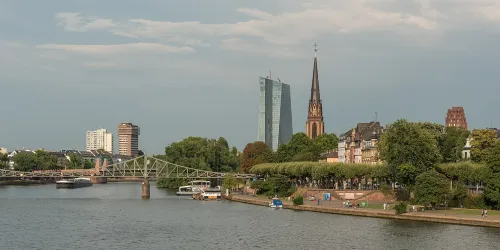
    The Museumsufer, or Museum Embankment, is not one building but a whole landscape of museums lined up along both banks of the Main and in the streets close by. As of 2022, 39 museums belonged to it, with the Städel as its centre. Walking along here, you pass historic villas that were turned into museums and striking new buildings added beside them.

    The idea came in 1977 from Hilmar Hoffmann, then the city's head of culture. Between 1980 and 1990 existing museums were expanded and many new ones built, by internationally known architects including Richard Meier, Oswald Mathias Ungers, Josef Paul Kleihues, Günter Behnisch and Hans Hollein. Since 2008 the city has restored and extended several of them again, adding an annex to the Städel and renovating the Film Museum. In 2006 the exhibition hall Portikus opened on an island by the Alte Brücke.

    Which door to open depends on what you love. The Deutsches Filmmuseum traces film-making from its 19th-century beginnings to today and includes an art house cinema; the Deutsches Architekturmuseum shows current projects from around the world; the Museum Angewandte Kunst covers furniture and design from the 10th to the 21st century with a notable East Asian collection. There are also the Icon Museum, the Museum der Weltkulturen and the Museum für Kommunikation. Each charges its own entry, so pick one if you have time to spare.

    For this route the Museumsufer is mainly a stroll and a menu of ideas for another day. Continue 500 m, about 7 minutes, to the Städel.

  6. 6

    Stael Museum

    Stael Museum in Frankfurt, stop 6 on the self-guided walking tour

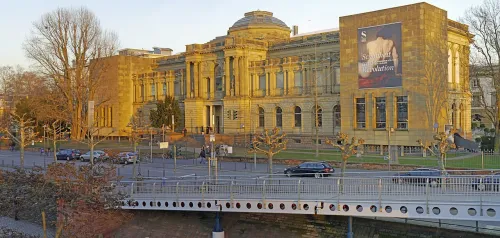
    The Städel holds one of the most important art collections in Germany: 3,100 paintings, 660 sculptures, more than 4,600 photographs and over 100,000 drawings and prints, shown across about 7,000 square metres. In 2012 the German section of the art critics' association AICA named it Museum of the Year, and that same year it welcomed 447,395 visitors, the most in its history.

    It all began with one man's will. The Frankfurt banker and art patron Johann Friedrich Städel, who died in 1816, left his house, his collection and his fortune with the request that an art institute be founded, and the museum opened in 1817. At first his collection hung in his former home on the Roßmarkt; in 1833 it moved to a building on the Neue Mainzer Straße, and in 1878 Oskar Sommer built the Neo-Renaissance museum here on the Schaumainkai.

    The 20th century was hard on it. In 1937 the National Socialists confiscated 77 paintings and 700 prints as ‘degenerate art’. In 1939 the collection was moved for safety to Schloss Rossbach in Bavaria, where the American officer Thomas Carr Howe of the Monuments, Fine Arts and Archives programme later found the paintings and the library. The building itself was badly damaged in air raids and rebuilt in 1966 to a design by Johannes Krahn.

    Is it worth going in? If art matters to you at all, yes, and give it at least two hours. If not, enjoy the façade and save your energy, because the next leg is the longest of the day: 2,780 m, about 40 minutes, to the Palmengarten.

    Local name
    Städel Museum
    Hours
    Tue, Wed, Fri, Sat, Sun 10:00–18:00
    Price
    From 19 EUR / reduced 17 EUR, 10 EUR Tuesdays from 15:00
  7. 7

    Palmengarten

    Palmengarten in Frankfurt, stop 7 on the self-guided walking tour

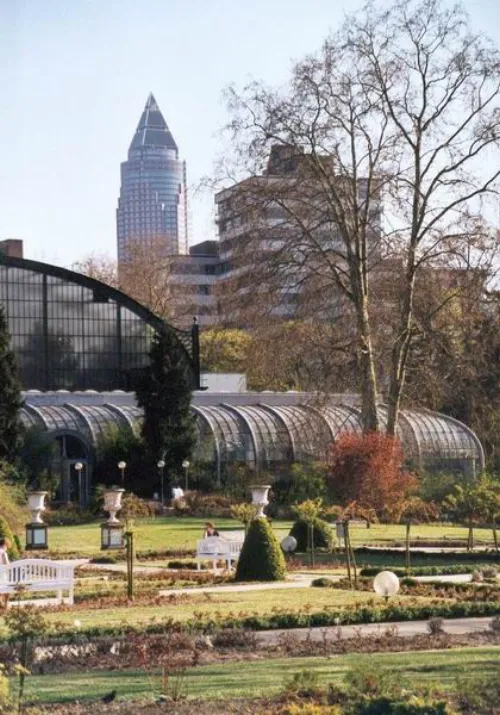
    The Palmengarten is one of Frankfurt's two botanical gardens and covers 22 hectares in the Westend-Süd district. Like many public places in Frankfurt it was privately financed, laid out by Heinrich Siesmayer and opened to the public in 1871. Its most colourful early visitor was Buffalo Bill, who brought his Western show to the garden in 1890.

    The city took it over in 1931, but after the Second World War it passed to the American occupation authorities. When it came back into city hands in the 1960s, a long rebuilding began: greenhouses destroyed in the war were redeveloped and enlarged, and the work was only fully completed in 1992. The neighbouring Botanical Garden, which once belonged to the biology department of the Goethe University, is now run by the Palmengarten as well.

    You enter through half of the original 1905 society building, rebuilt and now flanked by exhibition and teaching rooms; look out for carnivorous plants in the south wing and pineapple plants grown indoors in the north wing. Beyond lies the Rosaleda, a rose garden with geometric beds and a pergola, with the Rosenbrunn house of 1884 at its centre. The plants are arranged by origin, outdoors or in climate-controlled greenhouses full of tropical and subtropical species, with information points explaining their ecology.

    Plant lovers and anyone needing green space after the city will find an hour here well spent. Watch the season, as it closes much earlier in winter. From here, walk 1,540 m, about 21 minutes, back towards the centre and the Alte Oper.

    Hours
    Mar–Oct: Daily 09:00–19:00 | Nov–Feb: Daily 09:00–16:00; closed Dec 24, Dec 31
    Price
    9 EUR, seniors 67+ 8 EUR, reduced 5 EUR, under 18 free; after-work ticket Mon–Fri from 18:30 5 EUR
  8. 8

    Alte Oper

    Alte Oper in Frankfurt, stop 8 on the self-guided walking tour

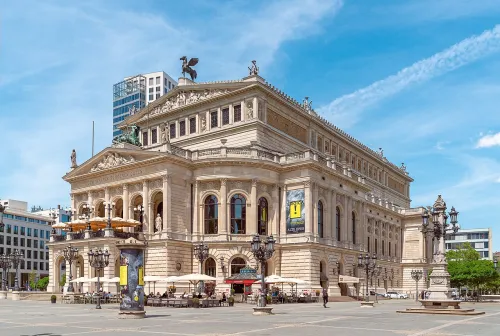
    The grand building on Opernplatz opened on 20 October 1880 as the city's opera house, designed by the Berlin architect Richard Lucae, paid for by Frankfurt's citizens and built by Philipp Holzmann. Kaiser Wilhelm I attended the opening, which was celebrated with Mozart's Don Giovanni, and was so impressed he remarked that he could not allow himself something like this in Berlin.

    Look for the inscription on the frieze: ‘Dem Wahren, Schönen, Guten’, to the true, the beautiful, the good. The costs had swollen from the planned 2 million marks to several times that, and the local dialect poet Adolf Stoltze answered with a rhyme meaning ‘to the true, the beautiful, the good, the citizens must bleed’. As an opera house it saw major premieres, among them Schreker's Der ferne Klang and, in 1937, Carl Orff's Carmina Burana.

    Bombs gutted it in 1944, though many outer walls and façades survived. In the 1960s the city planned an office block on the site, and the Hessian economics minister Rudi Arndt earned the nickname ‘Dynamit-Rudi’ for suggesting that ‘Germany's most beautiful ruin’ be blown up with a little dynamite. A citizens' initiative fought back, raising 15 million marks, and Arndt himself later helped save it. Rebuilt as a concert hall with a large hall and smaller venues, it reopened in 1981.

    Today it is surrounded by the banking district, and you can only go inside for a performance or event, so for most walkers this is a stop to admire from the square. The Main Tower is 430 m away, about 6 minutes.

    Hours
    Open for performances and events
  9. 9

    Main Tower

    Main Tower in Frankfurt, stop 9 on the self-guided walking tour

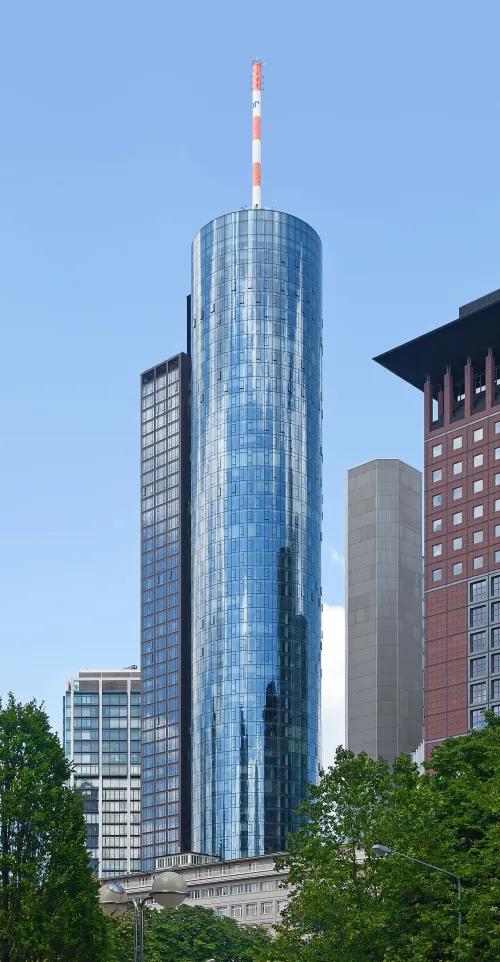
    Look up: the Main Tower rises 200 metres, 240 with its mast, and together with Tower 185 ranks as the fifth tallest high-rise in Germany. It was built between 1996 and 1999 and inaugurated on 28 January 2000 as the Frankfurt headquarters of the Landesbank Hessen-Thüringen, or Helaba, designed by the Hamburg architects Schweger + Partner.

    Notice the base before you head in: parts of the lower floors are set into the historic façade of the buildings that stood here first, a small piece of old Frankfurt wrapped into the skyline. Inside, the lifts travel at up to seven metres per second, among the fastest in Germany, so the ride up is over before you know it.

    The tower has 56 floors above ground and two public viewing platforms, at 198 metres and about 192 metres, reached with a paid ticket. On the 53rd floor, at 187 metres, there is a restaurant and lounge. Tenants include banks, international law firms and, since 2006, the Australian consulate.

    If you want to see how the medieval old town you just walked through sits among the bank towers, this is the place to do it, and the ticket is fair for the view. If heights are not your thing, skip it without regret. From the foot of the tower it is 560 m, about 8 minutes, to the Goethe-Haus.

    Hours
    Sun–Thu 10:00–21:00 | Fri–Sat 10:00–23:00 (last ride up 45 min before closing)
    Price
    9 EUR
  10. 10

    Goethe-Haus

    Goethe-Haus in Frankfurt, stop 10 on the self-guided walking tour

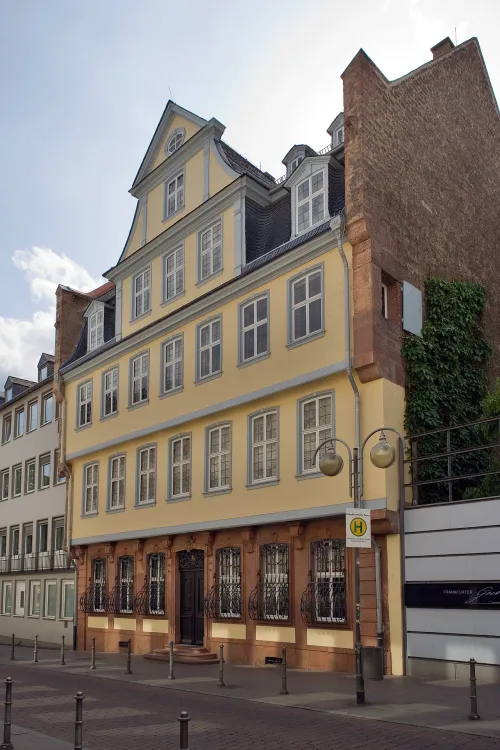
    Johann Wolfgang von Goethe was born in this house on 28 August 1749 and grew up here. It is also where he wrote Götz von Berlichingen, The Sorrows of Young Werther and the first drafts of the Urfaust, so for anyone who has read German literature this is a real place of pilgrimage.

    The house is older than the Goethes: a Flemish goldsmith, Matthis van Hinsberg, built it around 1618. Goethe's grandmother Cornelia, who had run an inn on the nearby Zeil, bought it in 1733 together with the property next door and knocked through the dividing wall. His father, Johann Caspar Goethe, moved in in 1741 and lived here with his wife Catharina Elisabeth from 1748.

    After Cornelia died in 1754, Johann Caspar quickly set about rebuilding the house on the Großer Hirschgraben, acting as his own architect with help from his friend Johann Friedrich Armand von Uffenbach. The smaller house was pulled down and the remaining one extended over the whole plot, work that ran from April 1755 to February 1756. What you see inside is period furniture and paintings from Goethe's time here.

    The Freies Deutsches Hochstift bought the house in 1863 and has run it as a museum for most of the time since. It was destroyed by an RAF night raid in the Second World War and rebuilt afterwards. Worth the ticket if you care about Goethe or simply like seeing how a wealthy Frankfurt family lived in the 18th century. The last stop, the Paulskirche, is 320 m away, about 5 minutes.

    Hours
    Mon–Wed: 10:00–18:00 | Thu: 10:00–21:00 | Fri–Sun: 10:00–18:00
    Price
    12 EUR
  11. 11

    Paulskirche

    Paulskirche in Frankfurt, stop 11 on the self-guided walking tour

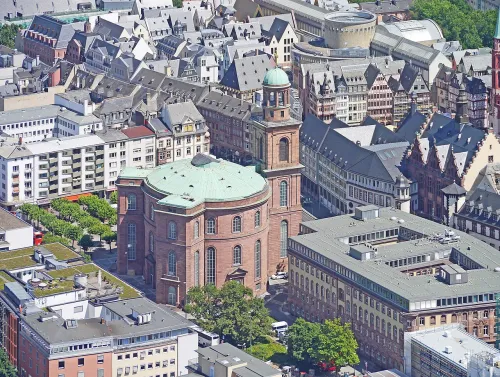
    The round classical church in front of you is where German democracy began. In 1848 and 1849 the Frankfurt National Assembly met here, the first democratically elected parliament for all of Germany, and the constitution it drafted became the model for the Weimar constitution of 1919 and for the Federal Republic's Basic Law of 1949.

    The architect Johann Friedrich Christian Hess built the rotunda between 1789 and 1833 on the site of the medieval Barfüßerkirche, demolished in 1786, and until 1944 it was Frankfurt's main Lutheran church. On 18 March 1944 an air raid burned it out completely, like much of the old town around it, so almost nothing of the interior from the parliament's days survives.

    After the war it was the first historic building in Frankfurt to be rebuilt, in 1947 and 1948, with donations from all the German states, restored outside except for its conical roof. Money and materials were short, so the interior became very plain: a low foyer with an assembly hall above, seated like a parliament. It reopened as the ‘House of all Germans’ on 18 May 1948, the centenary of the National Assembly, and was renovated in 1986. Today it hosts exhibitions and public events, the best known being the annual award of the Peace Prize of the German Book Trade.

    Entry is free; make sure it is still open when you finish, or look in at the start of the day. Paulsplatz borders the Roemerberg directly, which means you end the walk just steps from where you began.

    Hours
    Daily: 10:00–17:00
    Price
    Free
Walking tour route map of Frankfurt Route loaded
RoemerbergKleinmarkthalleKaiserdom St. BartholomaeusEiserner Steg+7
All 11 stops are already on the map.
You just press start.
AI Tour Guide

You know the route now. Walk it with a guide talking you through it.

Press start wherever you are, even hundreds of kilometres from Frankfurt, and the guide begins telling its stories right away. In the city, pick any of the 11 stops to start from: it leads you there, then talks with you the whole route, asking, listening, remembering, and shaping the tour around your answers.

11stops 7.7km 1 h 49 minwalking 13languages
▶Start the tour free

Free to start · Runs in your browser · No app, no download

Shorter Ways to Walk Frankfurt

The full route is long because of the stretch out to the Palmengarten and back. If you have half a day, split it into two compact walks that work well on their own.

Old Town and the River

Stops: 1, 2, 3, 4, 5, 6

For first-timers who want the medieval core, the market hall, the Main and the art. 29 minutes of walking from the Roemerberg to the Städel; the only ticket you need is for the Städel, and only if you go in. You finish on the Sachsenhausen bank with the Museumsufer all around you.

City Centre, Goethe and Democracy

Stops: 8, 9, 10, 11

For an afternoon in the city centre: Alte Oper, Main Tower, Goethe-Haus and Paulskirche with just 19 minutes of walking. Tickets apply for the Main Tower platform and the Goethe-Haus; the Paulskirche is free. You end beside the Roemerberg, so you can pair it with the old town another day.

The Whole Route

Stops: 1, 2, 3, 4, 5, 6, 7, 8, 9, 10, 11

For a full day with comfortable shoes: all eleven stops and 1 h 49 min of walking, including the 40 minute leg from the Städel to the Palmengarten. Worth it if gardens and the skyline view both matter to you.

How Long the Frankfurt Tour Takes, With and Without Museums

The pure walking time is 1 h 49 min. If you only look around at the free stops and keep the paid places for another day, you need just under four hours in total.

With the visits that really pay off (about two hours in the Städel, an hour in the Palmengarten, 45 minutes on the Main Tower and an hour in the Goethe-Haus), plan around eight and a half hours. Start at the Roemerberg at 9:00 and you reach the Kaiserdom soon after, the Städel at about 11:00, the Palmengarten around 13:40, the Main Tower at about 15:15 and the Goethe-Haus shortly after 16:00. That brings you to the Paulskirche after it has closed for the day, so on a full day step inside it first thing, then admire it from the outside at the end.

The old town and river walk takes about four hours with a proper Städel visit; the city centre walk takes about two and a half hours with both tickets, so start it early enough to catch the Paulskirche open.

Before You Set Off at the Roemerberg

  • Start and finish: The recommended start is the Roemerberg and the walk ends at the Paulskirche, right next to it. You can join at any stop, and the GPS navigation in your browser can lead you from the last stop back to the start.
  • Best days: Pick a day when both the Städel and the Kleinmarkthalle are open. You pass the market hall early in the morning, so its closing time rarely gets in the way.
  • What it costs: The walk itself is free, and so are the Roemerberg, the Kleinmarkthalle, the Kaiserdom, the Eiserner Steg and the Paulskirche. The Städel, the Palmengarten, the Main Tower and the Goethe-Haus charge admission if you go in. The museums of the Museumsufer and concerts at the Alte Oper each have their own prices, which you'll find at the desk or box office.
  • Time of day: Start in the morning if you want the full route with the museums. The Kaiserdom and the Städel are open by then, which lines up neatly with the first hour of walking.
Walking tour route map of Frankfurt
AI Tour Guide

Your guide starts whenever you do.

Press start and a voice AI Tour Guide takes it from here: leading the route through Frankfurt, telling the stories, and turning your walk into a real back-and-forth conversation. No app or download is needed; it runs in your browser.

11stops 7.7km 1 h 49 minwalking 13languages
▶Start the tour free

Free to start · Runs in your browser · No app, no download

What the AI Tour Guide Adds on This Route

On a route that jumps from Carolingian synods to a 1999 skyscraper, the AI Tour Guide keeps the thread for you. It greets you at the Roemerberg, tells the stories of each place as a conversation, asks what grabs you and remembers it: if the coronations caught your interest, it comes back to them at the Paulskirche. You can interrupt any time with your own questions, say what an election of a king in 855 actually looked like, or which works in the Städel came back after the war. Start with 100 free credits; after that, choose this tour all-inclusive for €19.99 with no time limit, or €5 per hour.

A Real Conversation A voice AI Tour Guide greets you, leads the whole route, and tells the stories and facts as you walk, asking what you want to see and keeping a real conversation going. Not a recording you press play on.
Map Navigation Follow the route on the map and walk at your own pace. You choose where to start and when to move to the next stop.
Ask Anything Curious about a building you pass? Ask your AI Tour Guide on the spot and the conversation carries on.
13 Languages Switch language anytime. No separate tour needed.
Start free in your browser

Questions Before You Walk Frankfurt

Can I see the Goethe-Haus and the Deutsches Romantik-Museum on one ticket?

Yes. The Deutsches Romantik-Museum opened in 2021 right next to Goethe's birthplace, and the same ticket covers both, so allow a little extra time if Romanticism interests you.

Is there a cheaper way into the Palmengarten?

Yes. There are reduced tickets, including one for seniors and a cheaper after-work ticket, and young visitors go free.

Is there a cheaper way into the Städel?

Yes. There is a reduced ticket, and entry is also cheaper on one late afternoon in the week. If you want that deal, walk the city centre part first and save the old town and the river for the afternoon.

Is the Main Tower a good evening option?

Yes. It stays open into the evening, which makes it a good add-on after the walk.

Which towns near Frankfurt make a good day trip?

Mainz and Wiesbaden are both about 31 km away, Heidelberg is 78 km and Würzburg 96 km. Each has its own free walking route.

Is the tour really free?

Yes. The whole tour is free: the route, the interactive map and the navigation cost you nothing. Only the voice AI Tour Guide is optional and paid: you test it with 100 free credits, then you pay either €5 per hour or €19.99 for this whole tour, with no time limit. Admission to 6 of the 11 stops is not included: Museumsufer, Stael Museum, Palmengarten, Alte Oper, Main Tower and Goethe-Haus charge their own entry fees.

Do I need to download an app?

No. Everything runs in your phone browser. Open the route and start walking, no download and no sign-up required.

Do I need to book the walking tour in advance?

No booking needed. This self-guided tour is available anytime. Open the route in your browser and start walking. The AI Tour Guide works instantly, no app, no reservation required.

What languages is the AI Tour Guide available in?

The AI Tour Guide speaks 13 languages, so you take the tour in your own language and can switch at any time.

Can I skip stops or change the route?

Yes. Skip any stop, spend extra time at places you like, or start the route from any point. It is your walk, you set the pace.
Image credits
▶ Start free in your browser Runs in your browser, no app, no download