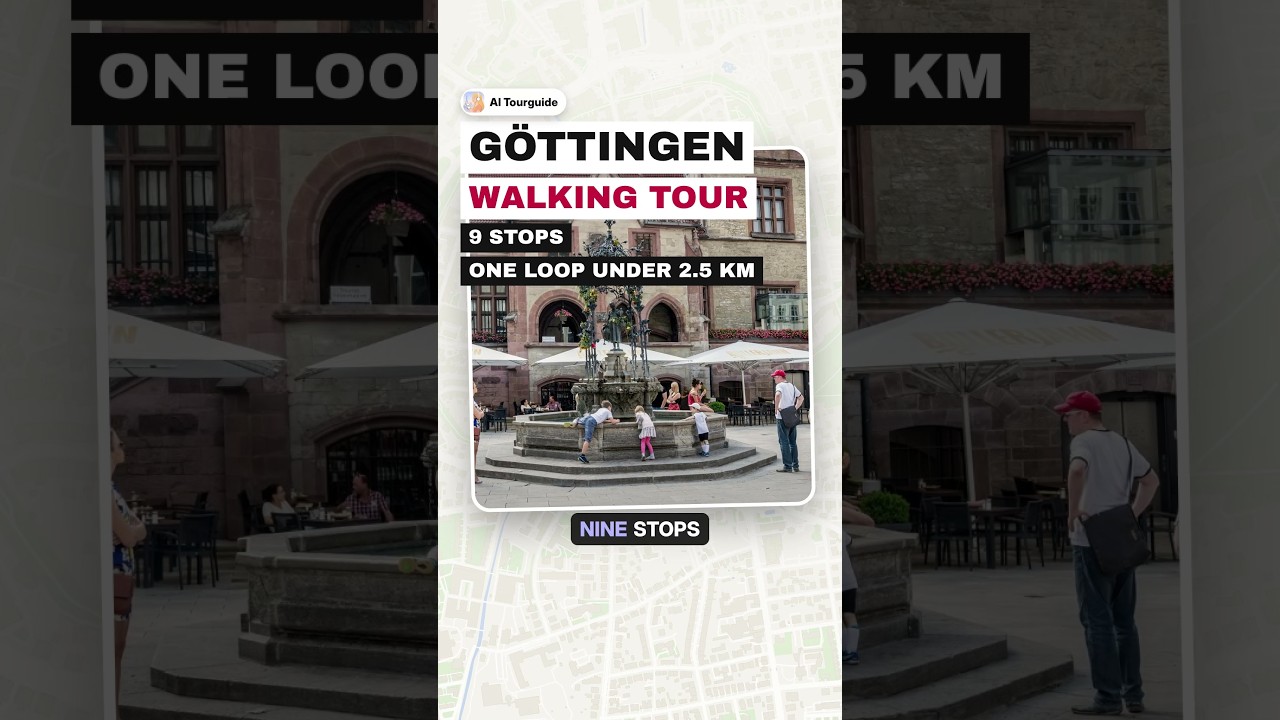
Free Walking Tour Göttingen: Goose Girl to Gothic House

Start where new doctors kiss the Goose Girl and finish at Göttingen's oldest house, passing the church where the university was born.

9 Stops 2.3 km ~31 min walking
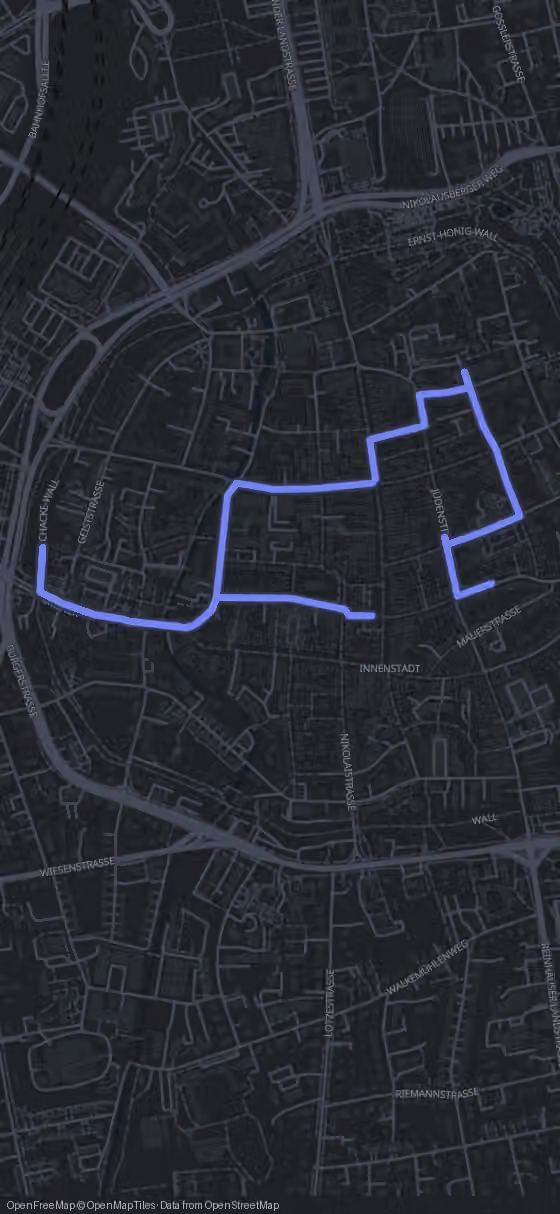
Route map for the Göttingen walking tour
Stop 1 of 9
20 m·1 min
Gänseliesel-Brunnen
Turn west toward the Altes Rathaus, directly behind the fountain
Welcome to Göttingen. I'm Alex, and our first story begins with a bronze girl kissed by generations of new doctors.
Try this tour with Alex

What This Göttingen Walk Covers

Nine stops lead from the Gänseliesel-Brunnen to the Gotisches Haus: 2.3 km and 31 minutes of pure walking, around three hours with the visits worth making.

Every stop is free to see, and the Altes Rathaus, the churches and the permanent collection of the Städtisches Museum are free inside. Only special exhibitions and the guided tour of the Aula der Universität cost money. The GPS route in your browser is free; the AI Tour Guide is optional.

Open free GPS & optional AI Tour Guide
This short shows highlights of the route. All 9 stops follow below.

The Route

Walking Map of Göttingen's Old Town Route

9 stops 2.3 km 31 min walking
Tap to load interactive map

The 9 stops along this route

  1. Gänseliesel-Brunnen in Göttingen, stop 1 on the self-guided walking tour
    1Gänseliesel-Brunnen
  2. Altes Rathaus in Göttingen, stop 2 on the self-guided walking tour
    2Altes Rathaus
  3. Stadtwall in Göttingen, stop 3 on the self-guided walking tour
    3Stadtwall
  4. Paulinerkirche in Göttingen, stop 4 on the self-guided walking tour
    4Paulinerkirche
  5. Jacobikirche in Göttingen, stop 5 on the self-guided walking tour
    5Jacobikirche
  6. Städtisches Museum in Göttingen, stop 6 on the self-guided walking tour
    6Städtisches Museum
  7. Aula der Universität in Göttingen, stop 7 on the self-guided walking tour
    7Aula der Universität
  8. Junkernschänke in Göttingen, stop 8 on the self-guided walking tour
    8Junkernschänke
  9. Gotisches Haus in Göttingen, stop 9 on the self-guided walking tour
    9Gotisches Haus
  10. That's the full route.

    Walk it with an AI Tour Guide talking you through every one of these streets.

    Start free in your browser
    You made it

Your Göttingen Walking Tour, from Fountain to Gothic House

  1. 1

    Gänseliesel-Brunnen

    Gänseliesel-Brunnen in Göttingen, stop 1 on the self-guided walking tour

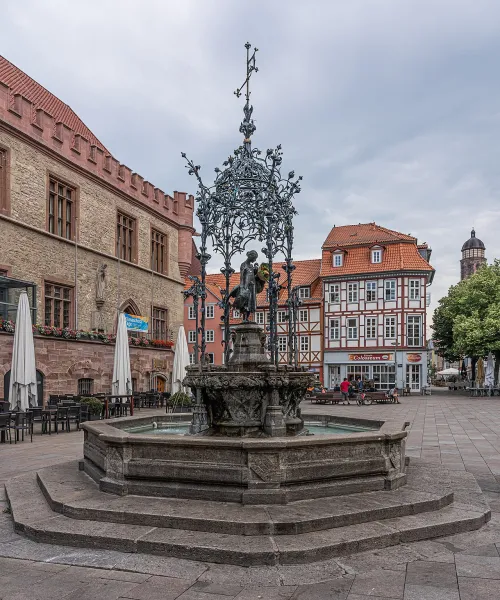
    The walk begins at a small fountain with a big reputation. The Gänseliesel, the goose girl, has stood in front of the medieval town hall since 1901, and although the figure is rather modest in size, she is the best-known landmark of Göttingen. Take a moment to notice what she is not: no professor, no prince, no founder, just a girl from ordinary life, in a city otherwise full of statues of famous scientists.

    That contrast is exactly why she is here. A fountain already stood on this spot in the 18th century, but it decayed and was partly pulled down in the early 19th century. In 1898 the city council called for designs, and sculptors from all over Germany sent proposals. The jury favoured a neo-Gothic design by the sculptors Mehs and Jehs called “In the Spirit of the Ancients / Fountain of Virtue”. The goose girl, designed by the architect Heinrich Stöckhardt and sculpted by Paul Nisse, came second.

    Then the three best designs went on public display, and the people of Göttingen clearly preferred the simple girl, perhaps because she stood for them rather than for the university's great names. After long discussion she was put up in 1901, without any official ceremony. Oddly, the fountain has no particular link to the town's history at all.

    What gave her meaning came soon after: newly enrolled students of the Georgia Augusta began to climb the fountain and kiss the statue, and it quickly became a university tradition. Today it is part of graduation, as new doctors of the University of Göttingen climb up to kiss the goose girl. The figure you see is a copy; the original is kept in the Städtisches Museum, later on this walk.

    The Marktplatz opens around you, and the Altes Rathaus is just 20 m away, about a minute's walk.
    Hours
    Open 24/7
    Price
    Free
  2. 2

    Altes Rathaus

    Altes Rathaus in Göttingen, stop 2 on the self-guided walking tour

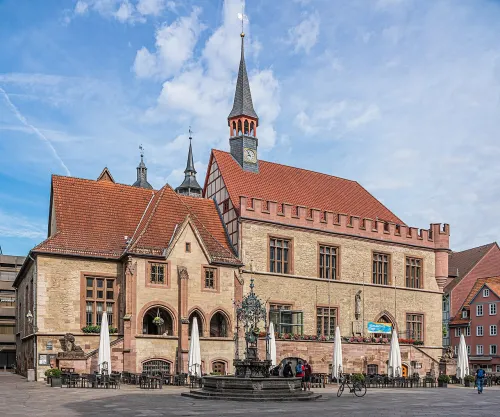
    The Altes Rathaus on the west side of the market was built in several stages from around 1270 and housed the city council and administration until 1978. Today it is used for official occasions, events and exhibitions. Admission is free, so if the doors are open, step inside.

    Nobody recorded exactly when building began. Göttingen received town rights around 1200, and a council is first mentioned in 1229. The oldest surviving parts sit high up in the medieval roof structure over the southern, single-storey section: tree-ring dating showed that its timbers were felled around 1270, while the northern roof dates to 1370. Since freshly felled trees were usually built in soon after, that gives a good idea of the building's age.

    This was never just a council chamber. A document from 1344 calls it the “cophus”, the merchants' hall, which shows that the powerful merchant guild used it too, and even then the cellar served as a wine cellar. The early building was about as long as today's but shallower, consisting of a single hall inside. Look at the portal for the door pull from around 1300; the one in place is a copy, and the original, like the goose girl, is in the Städtisches Museum.

    In the last quarter of the 14th century the building was thoroughly remodelled. In March 1366 Duke Ernst I, then ruler of the Principality of Göttingen, granted the citizens the right to build their merchants' hall and town hall “on the street and over the street, wherever and however they wish”, a remarkably generous charter for a self-confident town.

    Now comes the longest leg of the route: 620 m, about 8 minutes, out to the Stadtwall.

    Hours
    Mon–Fri: 09:30–18:00 | Sat: 10:00–18:00 | Sun & holidays (Apr–Oct): 10:00–14:00
    Price
    Free admission
  3. 3

    Stadtwall

    Stadtwall in Göttingen, stop 3 on the self-guided walking tour

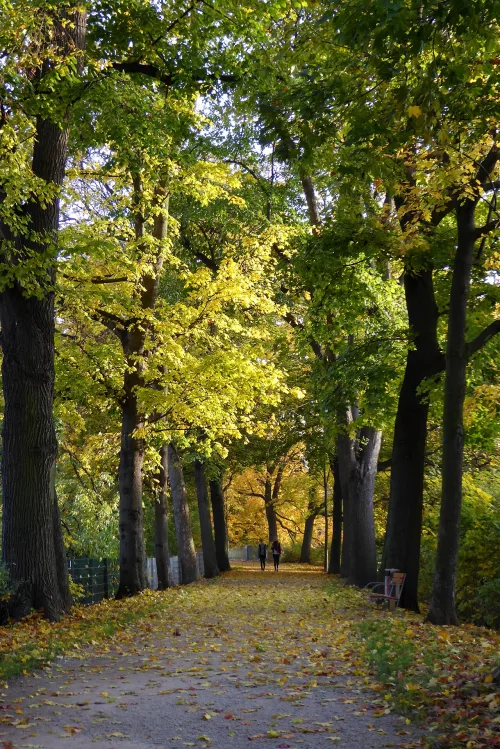
    The Stadtwall is a public promenade laid over the old fortifications, a green avenue that wraps around the entire old town. It is open around the clock and costs nothing.

    After facades and fountains, this is where you grasp the shape of Göttingen as a whole. Because the wall rings the whole centre, walking a stretch of it shows you how compact the medieval town was, and how everything you have seen and are about to see sits inside this ring.

    Use it as a reset. The market and town hall were the postcard part of the walk; what follows is the story of the university, with a church that became a library, a city museum in a noble residence and a festive hall built for a king's university. If any stop on this route deserves unscheduled minutes, it is this one.

    From here it is 490 m, about 7 minutes, to the Paulinerkirche.

    Hours
    Open 24/7
    Price
    Free
  4. 4

    Paulinerkirche

    Paulinerkirche in Göttingen, stop 4 on the self-guided walking tour

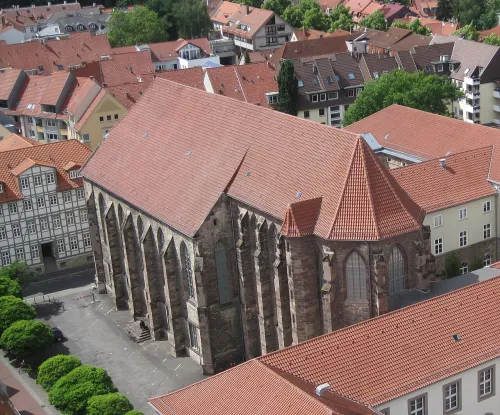
    The Paulinerkirche is a former church, completed in 1304, that today serves the Göttingen State and University Library as a venue for conferences and exhibitions. It was built as a Gothic hall church in the style typical of the Dominican order and became the oldest Gothic hall church in Göttingen's historic centre. Admission is free.

    The story starts in 1294, when the Dominicans were allowed to settle in Göttingen and began building a friary in the western part of the town. The church was dedicated in 1331 to the apostles Peter and Paul, which is where its name comes from. From 1341 it held important relics of Saint Thomas Aquinas, and these drew crowds of pilgrims to the annual Thomas mass and spread the church's reputation far beyond the town.

    Then came the Reformation, which took hold in Göttingen in 1529, twelve years after Luther published his 95 Theses. The parish churches were under Duke Eric I of Brunswick-Lüneburg, who stayed loyal to the old faith and refused Lutheran sermons in them. So the town magistrate had Lutheran services held in the churches of the mendicant orders, and this was the larger one. On 24 October 1529, against the wishes of the monks, Friedrich Hüventhal held the first regular Lutheran service here, and the first children in Göttingen were baptised Lutheran in this church.

    The friary was dissolved soon after and the building became a school, a paedagogium. That led to the founding of the University of Göttingen in this very building in 1737, shortly after its library had been established. Services for students and scholars continued until 1803, and from 1812 the church was converted into an expanded university library. If you care about how Göttingen became a university town, this is the place to step inside.

    Continue 410 m, about 6 minutes, to the Jacobikirche.

    Hours
    Mon–Fri: 10:00–18:00 | Sat–Sun: Closed
    Price
    Free admission
  5. 5

    Jacobikirche

    Jacobikirche in Göttingen, stop 5 on the self-guided walking tour

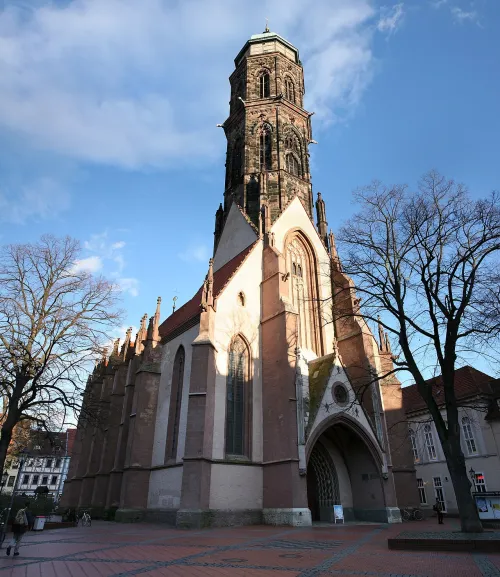
    The St.-Jacobi-Kirche is a Lutheran parish church, a three-aisled Gothic hall church built between 1361 and 1433 and dedicated to St James the Elder. Its tower rises 72 metres, making it the tallest building in Göttingen's old town. Since 1697 the top has carried a half-timbered stage crowned with a Baroque domed cap. Admission is free.

    Its roots are older than the building. Around 1186, Henry the Lion or his son Henry of Brunswick had a predecessor built as the chapel of the town castle Bolruz, first recorded in 1245. It was dedicated to St James, patron saint of pilgrims, possibly because the Way of St James ran through Weender Straße. The chapel grew too small, and in 1350 Duke Ernst I allowed it to be enlarged.

    Work on the choir began in December 1361, recorded on an inscription tablet in the porch, probably moved there later, so look out for it as you enter. A papal indulgence in 1372 was meant to encourage donations, and by 1383 a Marian altar stood in the north aisle. In 1387, during a feud with Duke Otto III, known as “the Evil”, the citizens razed the nearby castle to its foundations and from then on drove the church building forward themselves. The tall west tower was begun in 1426 and finished in 1433.

    Inside, the reason to go in is the Gothic winged altar of 1402 in the choir, a work of importance well beyond the region. The porch you pass through was destroyed in 1555 when the burning spire crashed down, and was reconstructed in 1880/81 to plans by the Göttingen-born architect Hans Grisebach.

    The Städtisches Museum is 200 m away, about 3 minutes on foot.

    Local name
    St.-Jacobi-Kirche
    Hours
    Daily: 11:00–15:00
    Price
    Free admission
  6. 6

    Städtisches Museum

    Städtisches Museum in Göttingen, stop 6 on the self-guided walking tour

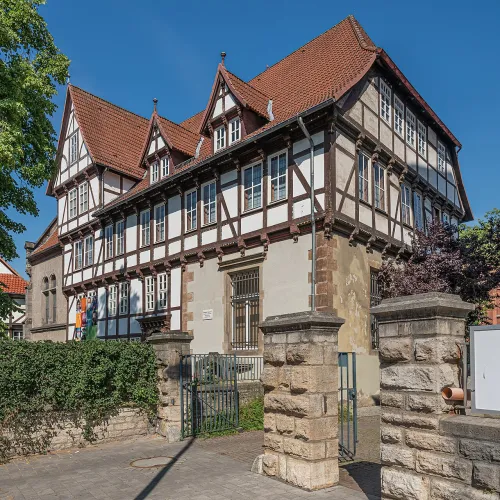
    The city museum at Ritterplan 7 occupies the Hardenberger Hof, the only surviving Renaissance noble residence in Göttingen. The Brunswick chancellor Johann von Jagemann built it in 1592, and from 1619 to 1812 it served the von Hardenberg family as their town house. The city bought it in 1896 and had it converted by city architect Heinrich Gerber, who gave it the large roof gable and dormers and added the unusual chapel building at the western end, meant to hold church objects. At its core lies what is thought to be a medieval stone house.

    Look to the side as well: attached to the neighbouring house is a “blind” half-timbered facade, that of the Siedentopf house. When this 16th-century house in Rote Straße was demolished, its front was moved here as a display piece, part of the museum's original concept together with the garden in front.

    The museum goes back to Moritz Heyne, a professor of German studies, supported by Mayor Georg Merkel. Their municipal collection of antiquities first found space in the Grätzel-Haus from 1889 and in Haus Velguth from 1893, and on 28 November 1897 it opened here.

    Today around 150,000 objects trace the town and its surroundings from the first settlement through the founding of the Georg-August-Universität to the present. This is also where the original goose girl and the medieval door pull from the town hall are kept, so the museum ties together what you saw at the start. The permanent exhibition is free; special exhibitions cost extra. Give it about 45 minutes.

    From here it is 280 m, about 4 minutes, to the Aula der Universität.

    Hours
    Tue–Fri: 10:00–17:00 | Sat–Sun: 11:00–17:00 | Mon: Closed
    Price
    Free admission (permanent exhibition); Special exhibitions: 4 EUR single, 2.50 EUR reduced, 6 EUR family
  7. 7

    Aula der Universität

    Aula der Universität in Göttingen, stop 7 on the self-guided walking tour

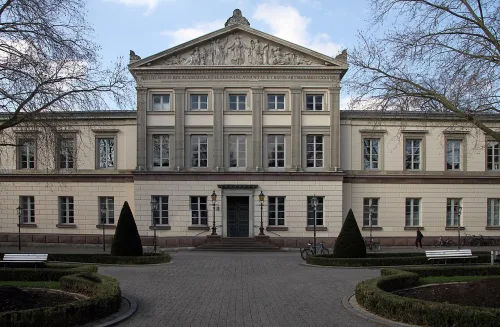
    The Aula der Georg-August-Universität on Wilhelmsplatz is the university's festive hall, built in classicist style between 1835 and 1837 and inaugurated in September 1837 for the university's first centenary. You can see the interior only on a paid guided tour, booked via the Tourist-Information at Markt 8, so if you want to go in, arrange it before you set off.

    Its patron was William IV, King of the United Kingdom of Great Britain and Ireland and, in personal union, King of Hanover, and in that role formally rector of the University of Göttingen. In 1835 he added 3,000 pounds sterling to the building costs.

    The hall exists because the university had lost its ceremonial room. Once the Paulinerkirche had been turned into the expanded library from 1812, there was, as people complained, no sufficiently spacious and respectable place for the university's solemn acts. Professors also wanted a large room for popular lectures, and the centenary celebration of 1837 with prominent guests was approaching. After a long search near the old university buildings, the ministry in Hanover chose a different site on the east side of the centre: a square created only in 1822 after the Franciscan friary was demolished.

    Together with the Auditorium, the Aula is the most important university building from the period between the first building wave after the founding and the many Prussian new buildings after 1866. It suits anyone curious about university history; for others, the facade is enough.

    Next is the Junkernschänke, just 100 m on, about a minute across Wilhelmsplatz and past the Kunstsammlung der Universität Göttingen.

    Local name
    Aula der Georg-August-Universität
    Hours
    By guided tour only (booked via Tourist-Information, Markt 8)
    Price
    Guided tour 5 EUR per person
  8. 8

    Junkernschänke

    Junkernschänke in Göttingen, stop 8 on the self-guided walking tour

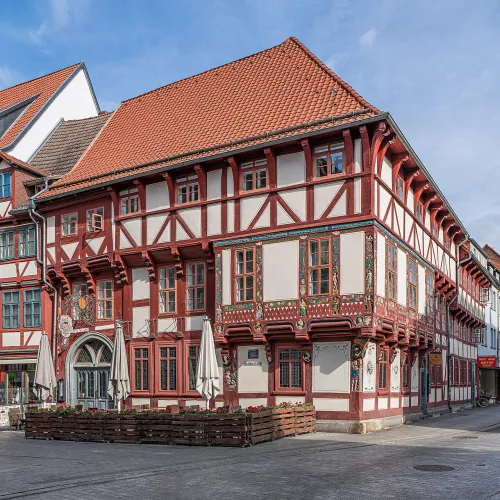
    The Junkernschänke at Barfüßerstraße 5, on the corner of Jüdenstraße, is a timber-framed house from the 15th and 16th centuries that has been a restaurant since 1883. There is no admission. Stand at the corner and look up: the hipped corner roof and the lavishly carved, brightly painted corner oriel on the upper floor are its signature.

    Tree-ring dating places the late Gothic core in 1446, built on the plot of a burned predecessor. From 1499 until 1531 the house belonged to the woodcarver Bartold Kastrop. His widow sold it in 1541 to the patrician Gyseler Schwanenflogel, who lived here until his death in 1566 and was twice mayor of Göttingen, from 1550 until 1560 and again in 1565/66. The corner oriel and roof date from his remodelling between 1547 and 1549, as does the western extension along Barfüßerstraße. At the back of the plot sits a medieval stone house.

    Even the name is a puzzle. Its origin is unclear, and it can only date from the tavern era after 1883; as late as 1940 the building was also called Junkernhaus. It supposedly refers to a Junkernsaal inside, but the town historian Otto Fahlbusch found that as early as 1734 people were confusing it with the nearby civic exchange and its own Junkernsaal. Another story claims the house was counted in 1702 among 336 derelict buildings in town, yet the unbroken record of owners through the 17th century says nothing of destruction.

    The last leg is short: 150 m, about 2 minutes, to the Gotisches Haus.

    Price
    Free (restaurant, no admission)
  9. 9

    Gotisches Haus

    Gotisches Haus in Göttingen, stop 9 on the self-guided walking tour

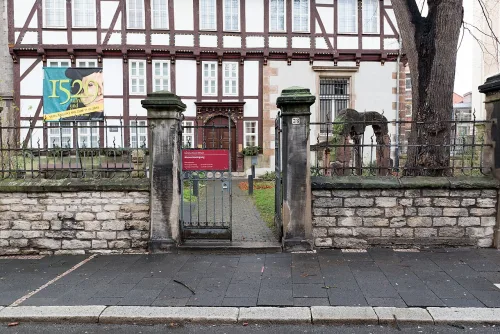
    The walk saves its oldest object for last. In Rote Straße stands the Gotisches Haus, also recorded as the Holbornsches Haus, a medieval stone and half-timbered house documented as Göttingen's oldest residential building. Its rubble-stone core is dated to 1266.

    You started at a fountain from 1901; you finish more than six centuries earlier. That arc, from the city's emblem back to its early days, is the point of ending here. Rote Straße also links back to the museum, since the Siedentopf facade you saw there came from a house on this same street.

    There is no interior to wait for: you see the house from the street, at any hour. Take a last look, and you have the whole walk folded around you, from the fountain and the wall to the library church and the king's festive hall.

    Hours
    Open 24/7 (exterior only)
    Price
    Free
Walking tour route map of Göttingen Route loaded
Gänseliesel-BrunnenAltes RathausStadtwallPaulinerkirche+5
All 9 stops are already on the map.
You just press start.
AI Tour Guide

You know the stories now. Walk them with a guide in your ear.

Press start wherever you are, even hundreds of kilometres from Göttingen, and the guide begins telling its stories right away. In the city, pick any of the 9 stops to start from: it leads you there, then talks with you the whole route, asking, listening, remembering, and shaping the tour around your answers.

9stops 2.3km 31 minwalking 13languages
▶Start the tour free

Free to start · Runs in your browser · No app, no download

Shorter Ways Through Göttingen's Old Town

Not every day leaves room for the whole walk. These two halves follow the recommended order and work on their own.

Market and wall in under an hour

Stops: 1, 2, 3

For a short first look: the fountain, the town hall and a stretch of green promenade on the old fortifications. Nine minutes of walking, and everything on it is free.

University and old houses

Stops: 4, 5, 6, 7, 8, 9

For anyone drawn to the university's story and to the oldest houses. Sixteen minutes of walking from the Paulinerkirche to the Gotisches Haus. Plan it for a day when the library church and the museum are both open. Entry is free except for special exhibitions in the museum and the booked Aula tour.

How Long Does This Göttingen Tour Take with Visits Inside?

The walking itself takes 31 minutes for 2.3 km. Most legs are short; only the stretch out to the Stadtwall and on to the Paulinerkirche takes longer, and both are worth it.

Realistically, plan around three hours: about 10 minutes at the fountain, 20 in the Altes Rathaus, 15 on the wall, 15 in the Paulinerkirche, 20 in the Jacobikirche and 45 in the Städtisches Museum, with brief looks at the Aula, the Junkernschänke and the Gotisches Haus. A booked Aula tour comes on top.

The market and wall variant fits into less than an hour. The university half, with the museum visit, takes just under two hours.

Before You Set Off in Göttingen

  • Start: At the Gänseliesel-Brunnen, the recommended beginning. You can join the route at any stop.
  • End: At the Gotisches Haus in Rote Straße. If you want to return to the fountain, the GPS navigation in your browser leads you back on request.
  • Best day: Pick a day when both the Städtisches Museum and the Paulinerkirche are open.
  • Time of day: Start at the fountain around 10:30. With the stays suggested for each stop, you reach the Jacobikirche at about 11:50, the museum around 12:15 and the Gotisches Haus at roughly 13:20.
  • Costs: The route and all stops are free to see. Extra costs only arise for special exhibitions in the museum and the Aula tour.
Walking tour route map of Göttingen
AI Tour Guide

Your guide is ready when you are, right at the fountain.

Press start and a voice AI Tour Guide takes it from here: leading the route through Göttingen, telling the stories, and turning your walk into a real back-and-forth conversation. No app or download is needed; it runs in your browser.

9stops 2.3km 31 minwalking 13languages
▶Start the tour free

Free to start · Runs in your browser · No app, no download

What the AI Tour Guide Adds Between Fountain and Gothic House

On this route the AI Tour Guide turns the walk into a conversation: it greets you at the fountain, tells the stories of friars, dukes, mayors and professors, asks what caught your attention and shapes what comes next around it. You can interrupt whenever you like, for example to ask how tree rings can date a roof beam or how daily life worked in a Dominican friary. The free GPS route stays exactly the same. You start with 100 free credits; after that, choose this tour all-inclusive for €19.99 with no time limit, or €5 per hour.

A Real Conversation A voice AI Tour Guide greets you, leads the whole route, and tells the stories and facts as you walk, asking what you want to see and keeping a real conversation going. Not a recording you press play on.
Map Navigation Follow the route on the map and walk at your own pace. You choose where to start and when to move to the next stop.
Ask Anything Curious about a building you pass? Ask your AI Tour Guide on the spot and the conversation carries on.
13 Languages Switch language anytime. No separate tour needed.
Start free in your browser

Common Questions About Walking Göttingen

Are there other Goose Girl fountains besides the one in Göttingen?

Yes. Other Gänseliesel figures stand in Monheim am Rhein, on Steintor Square in Hanover and on Nikolsburger Square in Berlin, but the Göttingen one is the famous one.

Can I visit the Altes Rathaus on a Sunday?

Yes, but only during part of the year, and for shorter hours than during the week.

Do special exhibitions at the Städtisches Museum cost extra?

Yes. The permanent exhibition is free, while special exhibitions charge entry, with reduced and family tickets available.

Which towns combine well with Göttingen for another walk?

Kassel is 39 km away, and the half-timbered towns of Goslar and Hildesheim are within about 70 km, each with its own free GPS walking route.

Is the tour really free?

Yes. The whole tour is free: the route, the interactive map and the navigation cost you nothing. Only the voice AI Tour Guide is optional and paid: you test it with 100 free credits, then you pay either €5 per hour or €19.99 for this whole tour, with no time limit.

Do I need to download an app?

No. Everything runs in your phone browser. Open the route and start walking, no download and no sign-up required.

Do I need to book the walking tour in advance?

No booking needed. This self-guided tour is available anytime. Open the route in your browser and start walking. The AI Tour Guide works instantly, no app, no reservation required.

What languages is the AI Tour Guide available in?

The AI Tour Guide speaks 13 languages, so you take the tour in your own language and can switch at any time.

Can I skip stops or change the route?

Yes. Skip any stop, spend extra time at places you like, or start the route from any point. It is your walk, you set the pace.
Image credits
▶ Start free in your browser Runs in your browser, no app, no download