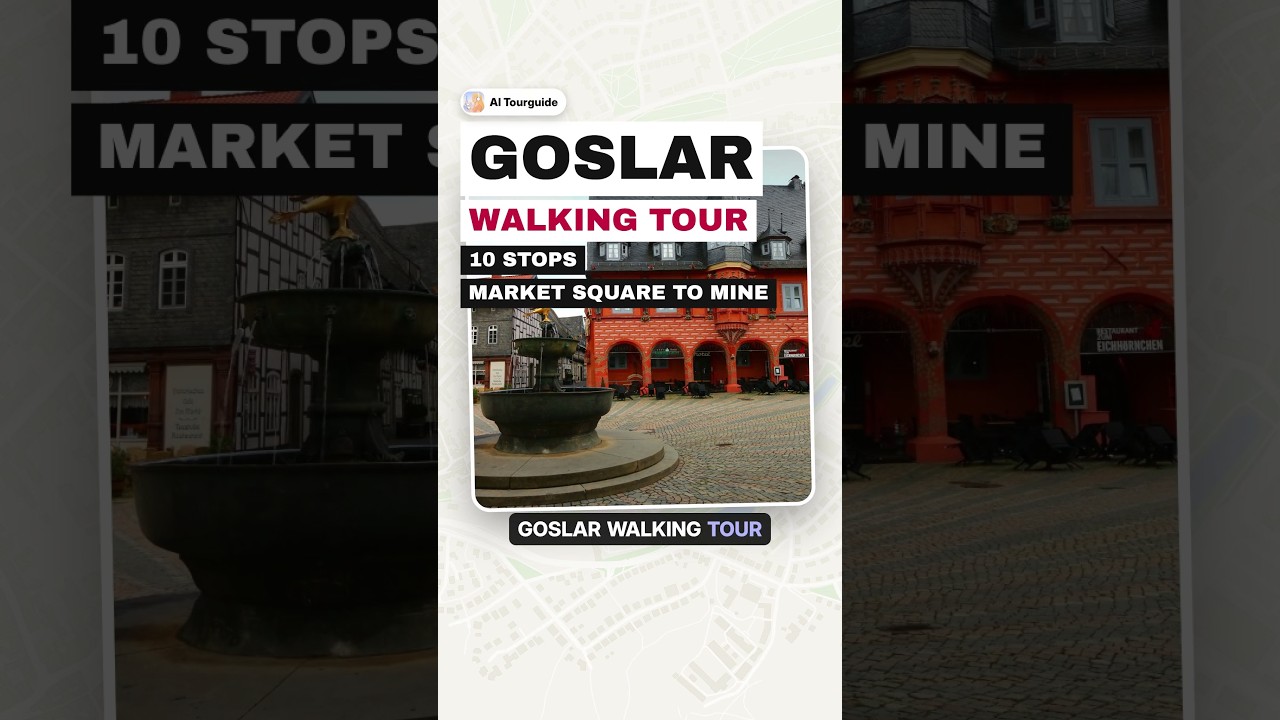
Free Walking Tour Goslar: Old Town, Mine and Palace

From the eagle fountain on the market square to a thousand years of mining at the Rammelsberg and the emperors' palace: Goslar on foot in ten stops.

10 Stops 10.0 km ~2 h 41 min walking
Route map for the Goslar walking tour
Stop 1 of 10
40 m·1 min
Marktplatz (Market Square)
Head south-west to the Altes Rathaus, the arcaded town hall on the square
Grüß dich, welcome to Goslar. I'm Alex, and the timbered old town owes much of its grandeur to the hill beyond it.
Try this tour with Alex

The Goslar Route at a Glance

Ten stops lead from the Marktplatz (Market Square) through the old town, out to the Rammelsberg Mine and back to the Goslarer Museum: 10.0 km and 2 h 41 min of pure walking. With the interiors that matter it fills a long day, and many people split it over two.

The squares, the town gate and the churches are free. You pay entry at the Altes Rathaus (Old Town Hall), the mine, the Kaiserpfalz (Imperial Palace) and the museum. Route, map and GPS navigation in your browser cost nothing; the AI Tour Guide is optional.

Open free GPS & optional AI Tour Guide
This short shows highlights of the route. All 10 stops follow below.

The Route

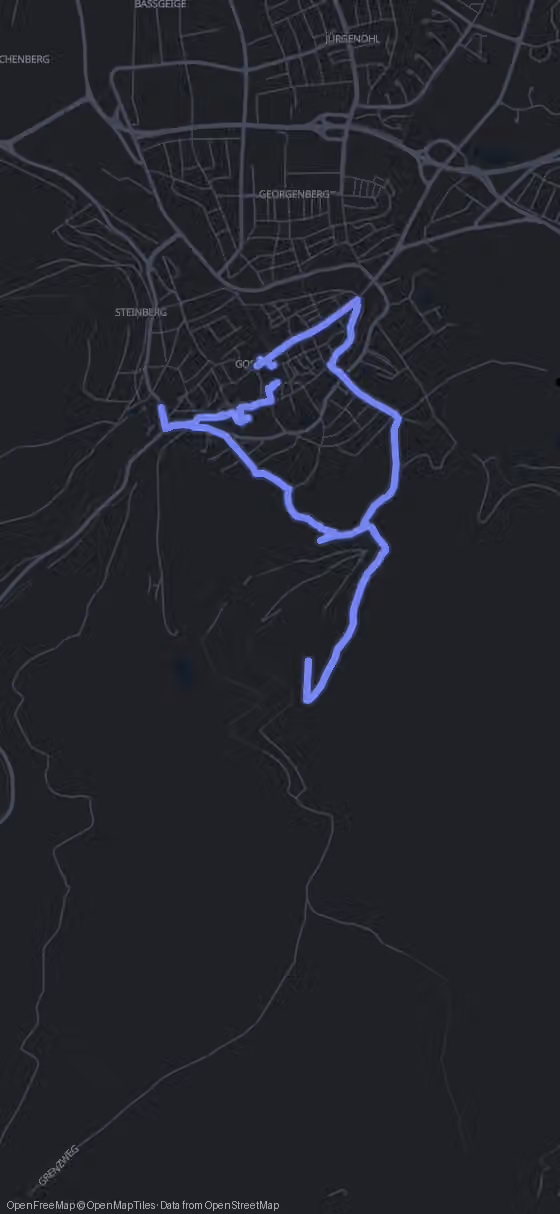
Walking Map of Goslar, from the Market Square to the Mine

10 stops 10.0 km 2 h 41 min walking
Tap to load interactive map

The 10 stops along this route

  1. Marktplatz (Market Square) in Goslar, stop 1 on the self-guided walking tour
    1Marktplatz (Market Square)
  2. Altes Rathaus (Old Town Hall) in Goslar, stop 2 on the self-guided walking tour
    2Altes Rathaus (Old Town Hall)
  3. Marktkirche St. Cosmas and Damian in Goslar, stop 3 on the self-guided walking tour
    3Marktkirche St. Cosmas and Damian
  4. Schuhhof in Goslar, stop 4 on the self-guided walking tour
    4Schuhhof
  5. Kaiserworth in Goslar, stop 5 on the self-guided walking tour
    5Kaiserworth
  6. Breites Tor in Goslar, stop 6 on the self-guided walking tour
    6Breites Tor
  7. Rammelsberg Mine in Goslar, stop 7 on the self-guided walking tour
    7Rammelsberg Mine
  8. Frankenberger Kirche in Goslar, stop 8 on the self-guided walking tour
    8Frankenberger Kirche
  9. Kaiserpfalz (Imperial Palace) in Goslar, stop 9 on the self-guided walking tour
    9Kaiserpfalz (Imperial Palace)
  10. Goslarer Museum, stop 10 on the self-guided walking tour
    10Goslarer Museum
  11. That's the full route.

    Walk it with an AI Tour Guide talking you through every one of these streets.

    Start free in your browser
    You made it

The Goslar Walking Tour Stop by Stop: Guildhalls, Ore and Emperors

  1. 1

    Marktplatz (Market Square)

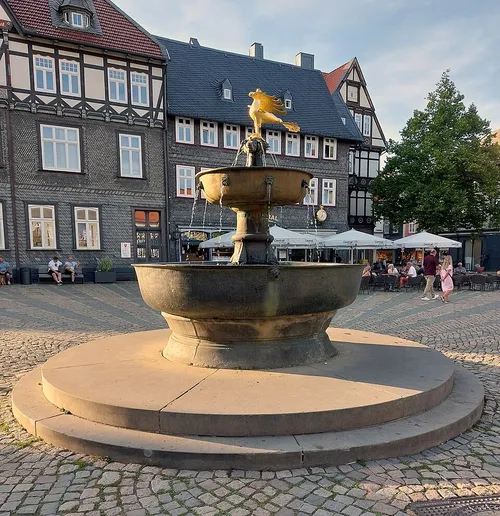
    Marktplatz (Market Square) in Goslar, stop 1 on the self-guided walking tour

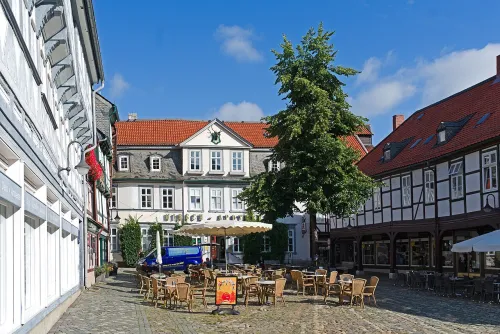
    Start at the fountain. The Marktbrunnen carries the eagle of Goslar on its top, and that bird is the easiest landmark in the old town to steer by: whenever you catch sight of it again, you know you are back at the heart of the walk. The square is public, open around the clock and free, so it works as a starting point at any hour.

    If you can, time your arrival. The Glocken- und Figurenspiel plays four times a day, and the nine o'clock performance is the best argument for an early start. If you miss it, nothing is lost: the fountain and the square carry this first stop on their own.

    Take a slow turn on the spot before you move on. Two of the buildings you are about to meet properly belong to this square: the Altes Rathaus with its open arcades and the old guildhall of the Kaiserworth with its row of emperors. Together they tell you straight away who ran medieval Goslar, the council and the rich merchants. The town hall is only 40 m away, a minute on foot.
    Hours
    Open 24/7
    Price
    Free
  2. 2

    Altes Rathaus (Old Town Hall)

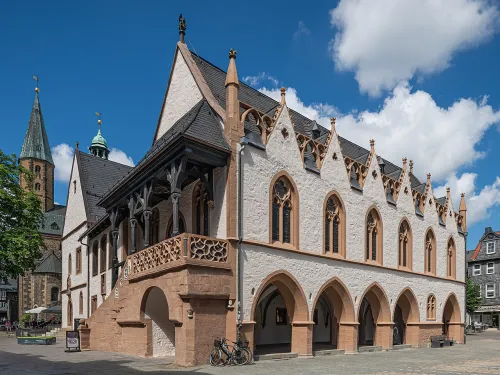
    Altes Rathaus (Old Town Hall) in Goslar, stop 2 on the self-guided walking tour

    The town hall stands between the market square and the Marktkirche, a rectangular two-storey building that replaced an earlier one between 1295 and 1326. At ground level, five arcades open onto a two-aisled hall with cross vaults. This was where people traded and where justice was done. Look at the sixth bay, closed except for a single window: the pillory once stood in front of it.

    Walk around the corner and you will find a Madonna in a niche. She marks the Marienkapelle at the northwest corner, built in Romanesque times and enlarged in the Gothic period. The extension on the north side is half-timbered in its upper part, in Renaissance style. What you see on the market side is partly a rebuild: at the end of the 19th century the hall was restored in neo-Gothic manner, and neo-Gothic windows replaced the Renaissance ones. Since 1972 the rubble masonry has been plastered again and the stone frames painted in colour.

    Inside, the furnishings are the reason to pay. The hall has a flat blue wooden ceiling scattered with 644 gilded wooden stars. A brass Marian chandelier from the late 15th century came from Goslar's former cathedral, and two antler chandeliers each carry an emperor figure: the smaller one, of reindeer antlers, dates from the 1480s, the larger one, of red deer antlers, was made around 1520 in the workshop of the Goslar artist Hans Witten. The stained glass on the market side was a gift for the town's 1,000th anniversary in 1922, from towns of the Hanover town association and well-known Goslar families such as the Siemens. The windows tell Goslar's story from its legendary founding by King Henry I in 922 to the loss of its imperial freedom and the takeover by Prussia.

    Entry is charged. If you go into only one interior in the old town, make it this one. The Marktkirche is 110 m on, two minutes away.

    Hours
    Jan–Mar & Nov: Mon–Sat 10:30–14:30, Sun closed; Apr–Oct & Dec: daily 10:30–16:30; closed Dec 24, Dec 31, Jan 1
    Price
    6.00 EUR full, 5.00 EUR guest card, 4.00 EUR pupils/students
  3. 3

    Marktkirche St. Cosmas and Damian

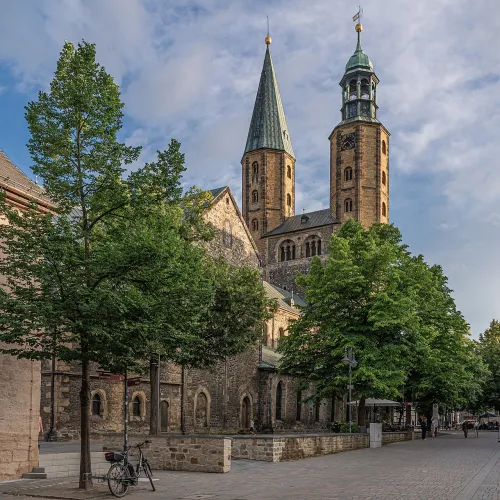
    Marktkirche St. Cosmas and Damian in Goslar, stop 3 on the self-guided walking tour

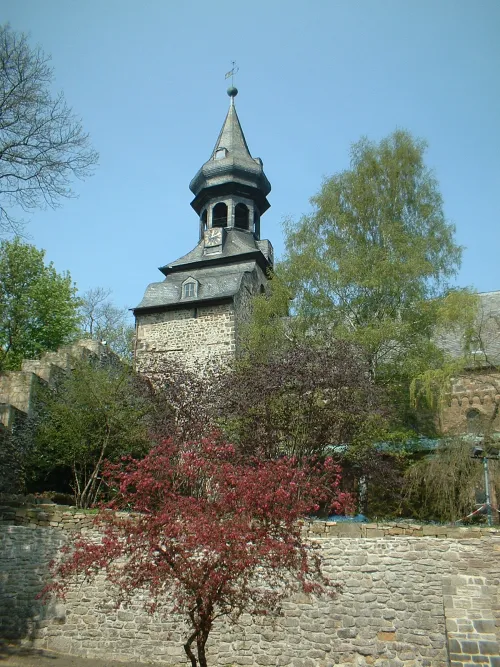
    Look up first. The west front with its two towers rises like a castle, and it probably survives from the Romanesque predecessor, a church dedicated to St Nicholas of Myra. The market church, the council church and main parish church of Goslar, is first recorded in 1151 as the “ecclesia forensis”, though a building stood here back in the 11th century. The towers are almost twins: the north tower is 66 m tall, the south tower 65.4 m.

    The difference is in the tops. After a fire in 1589 the north tower was rebuilt in 1593 as an “open lantern” with a Welsch hood, and it still holds a tower keeper's room. Fire came back on the night of 14 July 1844, when the roof, both towers and the bells were lost. The church was rebuilt and consecrated again in 1849.

    The bells in the middle section of the west front date from 1848. The largest, Johanna, weighs 6.8 tonnes, has a diameter of 2.21 m and is one of the largest bells in Lower Saxony; the other two are called Christina and Paulina. Up in the lantern of the north tower, iron bells struck the hours and quarters until 2016. They have since been replaced by a historic bronze bell for the hours and a new bronze casting for the quarters.

    Entry is free, so a short visit costs you nothing but twenty minutes. On the north side of the choir, a two-storey annex completed in 1535 holds the sacristy, with the room above it that housed the church library for long periods. The north tower can also be climbed as a lookout; ask in the church. The Schuhhof is just 70 m away, one minute on foot.

    Hours
    Daily 10:00–17:00
    Price
    Free admission
  4. 4

    Schuhhof

    Schuhhof in Goslar, stop 4 on the self-guided walking tour

    One left turn and the scale drops. The Schuhhof is the oldest public square in Goslar, framed by timber-framed guild houses, with the arcades of the shoemakers' guild house along one side.

    Give it ten minutes of looking up at the timber frames. This is the craftsmen's Goslar, a different town from the parade of the market square, and it hides only one street away from it. Keep that contrast in mind for the next stop, where the wealthiest guild of all showed off its money. The Kaiserworth is 80 m away, one minute on foot.

    Hours
    Open 24/7
    Price
    Free
  5. 5

    Kaiserworth

    Kaiserworth in Goslar, stop 5 on the self-guided walking tour

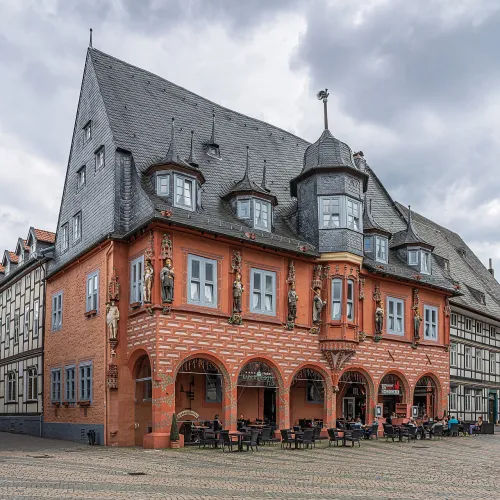
    Back on the market square, the Kaiserworth is the old guildhall of the cloth merchants, built in 1494 on the foundations of the first guildhall from 1274. In Goslar the association of long-distance and wholesale traders called itself the “Worthgilde”, and it was the most important guild with a seat on the council. The late Gothic building shows it: six arcades open to the square, where market stalls once stood, a decorative oriel in the middle of the upper floor that turns into a small tower on the roof, and a crowd of figures on the facade. The roof turret and dormers were added later.

    Find the stone figures on the east side: Hercules, and Abundantia, the goddess of plenty, with the little “Dukatenmännchen” crouching beneath her. Both are original and point plainly at the wealth of the owners and of the town. Between the upper windows stand eight baroque wooden emperors on carved brackets under canopies. They represent the rulers from 919 to 1138, the period in which Goslar was founded in 922 and grew, by the 12th century, to the size its old town still has within the walls.

    The emperors are only documented from 1684, and before that figures from ancient mythology are said to have stood there. Heinrich Heine was not impressed: the emperors, he mocked, looked like roasted university beadles. Since 1831 the house has been an inn and hotel. In 1836 “Die Worth” was renamed “Kaiserworth” because the neighbouring hotel was called “Römischer Kaiser”, and the owners wanted to sound just as grand.

    Looking costs nothing; the hotel and restaurant set their own prices. From here the route leaves the core: 730 m and 9 minutes to the Breites Tor.

    Hours
    Open 24/7
    Price
    Free to view exterior; hotel/restaurant prices vary
  6. 6

    Breites Tor

    Breites Tor in Goslar, stop 6 on the self-guided walking tour

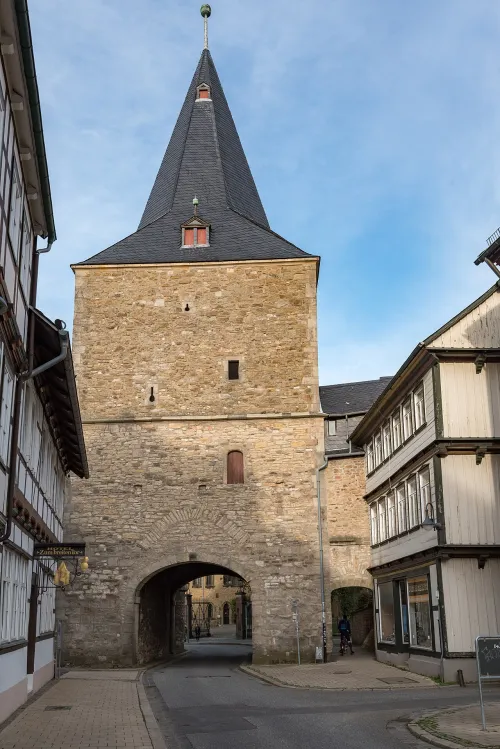
    The route now heads east to the town wall and the Breites Tor, a 16th-century fortress gate with flanking towers, the Flankierungszwinger, and the Werderhof gatehouse barracks beside it. Stand in the passage and look back once. Everything you have walked so far lies inside the old town this gate once guarded.

    This is the decision point of the route. The Rammelsberg Mine is next, and that leg is long: 3,730 m, 74 minutes on foot. If you are short of time or tired, fold back into town here and keep the mine for a second day. Otherwise commit, because the mine is the reason Goslar became rich enough to build everything you have just seen.

    Hours
    Open 24/7
    Price
    Free
  7. 7

    Rammelsberg Mine

    Rammelsberg Mine in Goslar, stop 7 on the self-guided walking tour

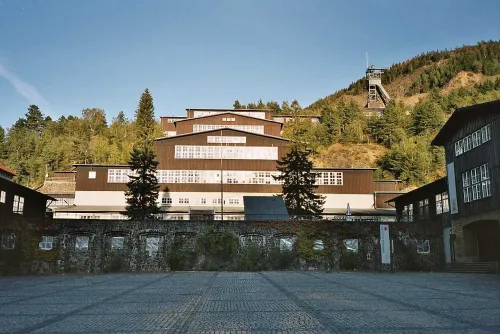
    The ore mine on the Rammelsberg lies south of the town centre, below the 635.1 m hill of the same name. Miners worked here almost without a break for more than 1,000 years, until the mine closed in 1988. Since 1992 it has been a UNESCO World Heritage Site, and since an extension in 2010 the site carries the name Mines of Rammelsberg, Historic Town of Goslar and Upper Harz Water Management System.

    How the hill got its name depends on whom you ask. Legend has it that in 968 the horse of a knight called Ramm scraped the ore free with its hooves during a hunt. Local historians point instead to “Ramsen”, the Harz word for wild garlic, which would make the Rammelsberg simply the hill covered in wild garlic.

    The ore itself has a stranger story. It formed in the Devonian period, when hot, metal-rich springs vented onto the sea floor and left two large ore lenses behind. Later folding tilted them, so they lie aslant in the hill, and the deposit is overturned, with the older layers on top. Mining began in the Old Deposit, exposed at the surface by erosion; the New Deposit was only found in the 19th century through targeted exploration. Out of these ores came gold, silver, lead, copper and zinc, and with them the medieval wealth of Goslar that Abundantia on the Kaiserworth celebrates.

    The mine charges entry, with tickets for the museum alone or combined with one or two guided tours. Having walked this far, take at least one tour. The way back into town is long again: 3,840 m and 56 minutes to the Frankenberger Kirche.

    Hours
    Apr–Oct: daily 09:00–18:00 (last tour 16:30); Nov–Mar: daily 09:00–17:00 (last tour 15:30); closed Dec 24 and Dec 31
    Price
    10.00 EUR adult museum only, 21.00 EUR museum + 1 tour, 30.00 EUR museum + 2 tours; children (4-17) 5.50 EUR museum only, 14.00 EUR museum + 1 tour
  8. 8

    Frankenberger Kirche

    Frankenberger Kirche in Goslar, stop 8 on the self-guided walking tour

    The church of St Peter and Paul, known simply as the Frankenberger Kirche, stands on the rise called the Frankenberg at the western end of the old town. It is a three-aisled Romanesque basilica on a cross-shaped plan, dating from the first half of the 12th century, built partly of rubble and partly of dressed stone. It began with a flat ceiling and was vaulted around 1230. A church here is first recorded in 1108, but that building was probably older still and later torn down completely.

    The church first served a parish, then the convent of the Magdalene sisters, the “penitent sisters of St Mary Magdalene”, probably founded in 1234. The Reformation dissolved the convent in 1568, but it lived on as a Lutheran foundation for women with an abbess, a provost and a convent of unmarried women. Its best-known provost was Andreas Jacob Krieg, author of the “Hartzburgischer Mahlstein” of 1706. The last abbess, von Kniestedt, died in the 1820s; the dissolution had started in 1796 and ended with the auction of the property in 1837, after which the church became a parish church again.

    Take a moment for the buildings around it, which together give a rare picture of medieval town planning: the Kleines Heiliges Kreuz, a hospital from the 14th to the 17th century, the sexton's house of 1504, and a gate from 1510 that originally opened onto Bergstraße 62 and was only set up here after 1906.

    Entry is free, but the church is not always open. If you find it shut, the exterior and its little ensemble still justify the stop. The Kaiserpfalz is 910 m away, 12 minutes on foot.

    Hours
    Easter to autumn holidays: Mon–Sat 15:00–18:00, Sun after church service until 18:00; winter: closed / by arrangement
    Price
    Free admission
  9. 9

    Kaiserpfalz (Imperial Palace)

    Kaiserpfalz (Imperial Palace) in Goslar, stop 9 on the self-guided walking tour

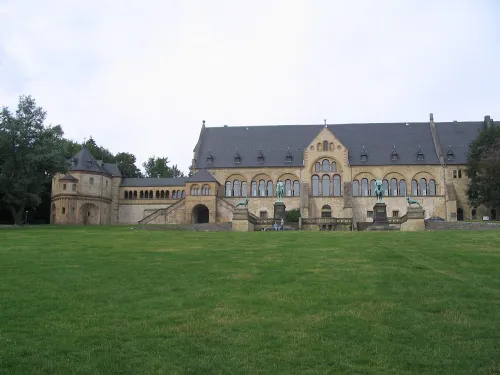
    The palace district lies at the foot of the Rammelsberg in the south of the town and covers about 340 by 180 metres. Its west side is dominated by the Kaiserhaus, the long main building of the whole complex. It was a favourite residence of the emperors, especially the Salians, and as early as the 11th century the chronicler Lambert of Hersfeld called it the “most famous residence in the empire”. What began, according to Adam of Bremen, probably as a royal hunting lodge in Ottonian times grew into a seat of power. The Kaiserhaus you see was extensively restored in the late 19th century.

    The ground tells you what is missing. To the north, the Church of Our Lady once joined the Kaiserhaus at a right angle; nothing of it is left, and its foundations lie under the path leading up to the Kaiserhaus. To the south, a 19th-century arcade links the Kaiserhaus to the Chapel of St Ulrich. Opposite, to the east, stood the collegiate church of St Simon and St Jude: only its north porch survives, and its ground plan is marked in the surface of today's car park. Around them were the houses of the canons, the imperial officials and the entourage, stables and storehouses, all enclosed by a wall.

    The palace charges entry, with free admission for young visitors and students. It is worth going in: this is where Goslar's imperial history becomes tangible. The last stop, the Goslarer Museum, is 450 m away, six minutes on foot; on the way you pass the Zinnfiguren Museum Goslar.

    Hours
    Tue–Sun 10:00–17:00 (last admission 16:30), Mon closed; open public holidays 10:00–17:00 (except Dec 24 and Jan 1)
    Price
    7.50 EUR adults, 6.00 EUR guest card / groups (10+ pers), under 18 & trainees/students 18+ free
  10. 10

    Goslarer Museum

    Goslarer Museum, stop 10 on the self-guided walking tour

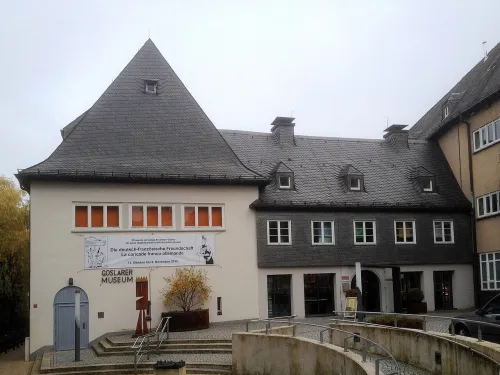
    The town and geology museum sits on the Abzucht, in a canon's house built in 1514. That makes it the right place to finish: many of its most important medieval artworks come from the collegiate church of St Simon and St Jude, demolished in 1820, whose outline you just saw marked in the car park at the Kaiserpfalz.

    The collection goes beyond church treasures. Objects from everyday life and business show how the townspeople lived, and the geological department explains the earth's history with rocks, minerals and fossils, a good companion to what you heard about ore at the Rammelsberg. Changing special exhibitions are added on top.

    The museum grew out of two local societies, the natural science society founded in 1852 and the museum society founded in 1905. After temporary homes, the manufacturer H. Borchers gave them this building in 1922, and in the same year the town and both societies agreed to run it together.

    Like the Kaiserpfalz, it charges entry, with the special exhibition included, reduced tickets and free admission for young visitors. Worth it if you want the full picture after the palace; plan about 45 minutes. This is where the walk ends, and the GPS navigation can lead you back to the fountain on the Marktplatz.

    Hours
    Tue–Sun 10:00–17:00 (last admission 16:30), Mon closed; open public holidays 10:00–17:00 (except Dec 24 and Jan 1)
    Price
    6.00 EUR adults (incl. special exhibition), 4.00 EUR reduced, under 18 free
Walking tour route map of Goslar Route loaded
Marktplatz (Market Square)Altes Rathaus (Old Town Hall)Marktkirche St. Cosmas and DamianSchuhhof+6
All 10 stops are already on the map.
You just press start.
AI Tour Guide

You know the route now. Walk it with a guide in your ear.

Press start wherever you are, even hundreds of kilometres from Goslar, and the guide begins telling its stories right away. In the city, pick any of the 10 stops to start from: it leads you there, then talks with you the whole route, asking, listening, remembering, and shaping the tour around your answers.

10stops 10.0km 2 h 41 minwalking 13languages
▶Start the tour free

Free to start · Runs in your browser · No app, no download

Three Ways to Walk Goslar

The full loop is long because of the mine, and the opening hours of the palace and the museum do not leave room for everything in one day. These three cuts follow the recommended order.

The market square circuit

Stops: 1, 2, 3, 4, 5

For a morning or a short visit. Only 330 m and 5 minutes of walking between the fountain, the town hall, the Marktkirche, the Schuhhof and the Kaiserworth. The Altes Rathaus is the only entry you pay; the church is free.

Day one: old town and mine

Stops: 1, 2, 3, 4, 5, 6, 7

For anyone who wants the Rammelsberg without rushing it. 88 minutes of walking, most of it on the leg from the Breites Tor out to the mine. Entries: the Altes Rathaus and the mine, ideally with one guided tour.

Day two: church, palace and museum

Stops: 8, 9, 10

For the imperial side of Goslar. 1,360 m and 18 minutes of walking. The Frankenberger Kirche is free; you pay at the Kaiserpfalz and the Goslarer Museum.

How Long the Goslar Tour Takes, With and Without the Mine

The pure walking time is 2 h 41 min over 10.0 km, and the two legs to and from the Rammelsberg account for more than two hours of it. Everything else sits close together: the five stops around the market square are a few minutes apart in total.

With the town hall interior (about 45 minutes), a short look into the Marktkirche, the mine museum with one tour (plan around two and a half hours), the Kaiserpfalz (about an hour) and the Goslarer Museum (about 45 minutes), the full loop comes to around eight hours. In practice it does not fit one day: by the time you are back from the mine, the palace and the museum have stopped admitting visitors.

That is why the split works so well. The market square circuit takes under two hours with both interiors. Day one with the mine takes about five and a half hours, starting in the late morning so you reach the Rammelsberg in the early afternoon, well ahead of the last tour. Day two with church, palace and museum takes about two and a half hours.

Before You Set Off from the Marktplatz

  • Start and finish: The recommended start is the fountain on the Marktplatz, the finish is the Goslarer Museum. You can join at any stop, and the GPS navigation in your browser leads you from the last stop back to the start if you like.
  • Which day: Plan around opening days: the Kaiserpfalz and the museum have a weekly rest day, the Altes Rathaus keeps shorter hours in winter, and in winter the Frankenberger Kirche is closed except by arrangement.
  • Time of day: The figure play on the square at nine is a good reason to start early, but the town hall interior opens later. Either look at the Rathaus from outside first and come back later, or start mid-morning, when the Rathaus is open, and walk the order as it stands.
  • Costs: The route itself is free; the Altes Rathaus, the mine, the Kaiserpfalz and the museum charge entry. The AI Tour Guide starts with 100 free credits; after that you choose this tour all-inclusive for €19.99 with no time limit, or €5 per hour.
Walking tour route map of Goslar
AI Tour Guide

Your guide for Goslar is ready when you are.

Press start and a voice AI Tour Guide takes it from here: leading the route through Goslar, telling the stories, and turning your walk into a real back-and-forth conversation. No app or download is needed; it runs in your browser.

10stops 10.0km 2 h 41 minwalking 13languages
▶Start the tour free

Free to start · Runs in your browser · No app, no download

What the AI Tour Guide Adds Between Rathaus and Rammelsberg

On this route the long walk out to the mine is where the AI Tour Guide earns its place. It greets you on the market square, tells the stories of each place as you reach it and uses the quiet stretches to ask what interests you: medieval trade, mining, the emperors. If you want to know how miners actually worked the ore underground, or what life inside a canons' house looked like, just ask, and the conversation follows you there. You can interrupt at any moment; the route stays the same.

A Real Conversation A voice AI Tour Guide greets you, leads the whole route, and tells the stories and facts as you walk, asking what you want to see and keeping a real conversation going. Not a recording you press play on.
Map Navigation Follow the route on the map and walk at your own pace. You choose where to start and when to move to the next stop.
Ask Anything Curious about a building you pass? Ask your AI Tour Guide on the spot and the conversation carries on.
13 Languages Switch language anytime. No separate tour needed.
Start free in your browser

Common Questions About Walking Goslar

Do children and students pay less in Goslar's museums?

Yes. Young visitors get into the Kaiserpfalz and the Goslarer Museum free, and students are free at the Kaiserpfalz too. The Altes Rathaus has reduced tickets for pupils and students, and at the Rammelsberg children pay less for the museum and the tours.

Does a guest card save money on this tour?

At two stops: the Altes Rathaus and the Kaiserpfalz are both cheaper with a guest card.

What still works on a Monday?

Most of the route: the squares, the Breites Tor and the Kaiserworth facade are open around the clock, the Marktkirche, the Altes Rathaus and the mine open daily, and in season the Frankenberger Kirche opens in the afternoon. Only the Kaiserpfalz and the Goslarer Museum are closed.

Where can I go next from Goslar?

The Harz towns are close. Wernigerode is 26 km away and Quedlinburg 50 km; for another cathedral town, Hildesheim is 43 km away.

Is the tour really free?

Yes. The whole tour is free: the route, the interactive map and the navigation cost you nothing. Only the voice AI Tour Guide is optional and paid: you test it with 100 free credits, then you pay either €5 per hour or €19.99 for this whole tour, with no time limit. Admission to 4 of the 10 stops is not included: Altes Rathaus (Old Town Hall), Rammelsberg Mine, Kaiserpfalz (Imperial Palace) and Goslarer Museum charge their own entry fees.

Do I need to download an app?

No. Everything runs in your phone browser. Open the route and start walking, no download and no sign-up required.

Do I need to book the walking tour in advance?

No booking needed. This self-guided tour is available anytime. Open the route in your browser and start walking. The AI Tour Guide works instantly, no app, no reservation required.

What languages is the AI Tour Guide available in?

The AI Tour Guide speaks 13 languages, so you take the tour in your own language and can switch at any time.

Can I skip stops or change the route?

Yes. Skip any stop, spend extra time at places you like, or start the route from any point. It is your walk, you set the pace.
Image credits
▶ Start free in your browser Runs in your browser, no app, no download