Free Walking Tour Heidelberg: Bridge, Castle, Old Town

Cross the Alte Brücke, climb the Philosophenweg for the view over the Neckar, then wind through the old town up to the castle ruins and back down.

12 Stops 6.1 km ~1 h 36 min walking
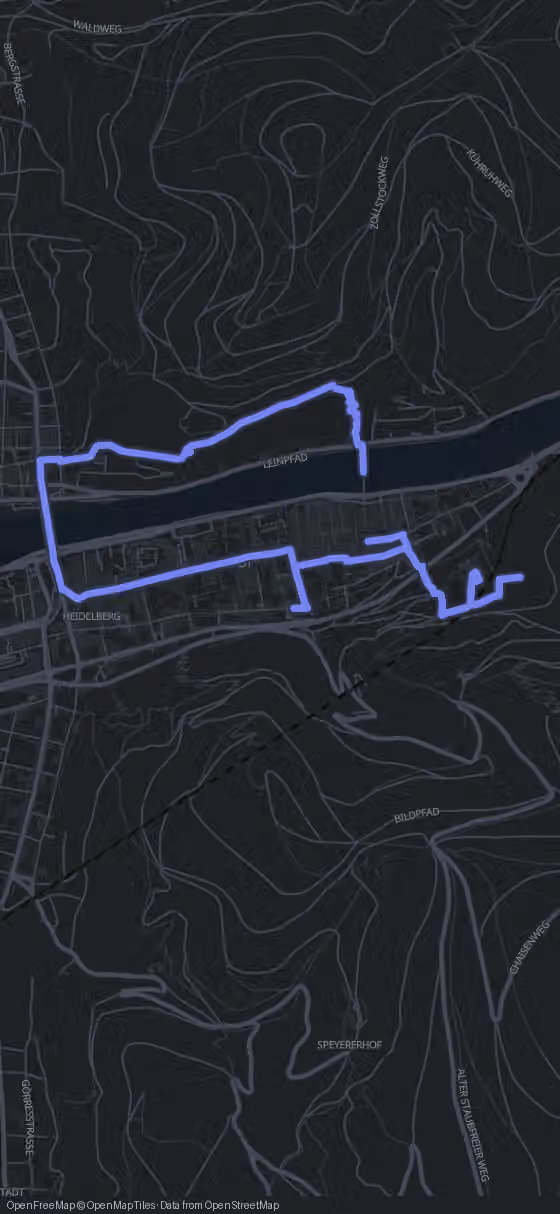
Route map for the Heidelberg walking tour
Stop 1 of 12
1.15 km·14 min
Alte Brücke
Head west across the Neckar toward the Philosophenweg
Welcome to Heidelberg. I'm Alex, and even the city's best-known crossing has been replaced again and again.
Try this tour with Alex

This Heidelberg Route at a Glance

Twelve stops lead from the Alte Brücke across the Neckar and back through the old town, up to the castle and down to the Heiliggeistkirche: 6.1 km with 1 h 36 min of pure walking. With the paid visits, plan on about six and a half hours.

Streets, squares, views and the church are free. Tickets are needed at the Kurpfälzisches Museum, the Studentenkarzer / Alte Universität and the Heidelberger Schloss, whose ticket also covers the Deutsches Apotheken-Museum. The GPS route runs free in your browser; the AI Tour Guide is optional.

Open free GPS & optional AI Tour Guide
This short shows highlights of the route. All 12 stops follow below.

The Route

Walking Map of Heidelberg: River, Hillside and Castle

12 stops 6.1 km 1 h 36 min walking
Tap to load interactive map

The 12 stops along this route

  1. Alte Brücke in Heidelberg, stop 1 on the self-guided walking tour
    1Alte Brücke
  2. Philosophenweg in Heidelberg, stop 2 on the self-guided walking tour
    2Philosophenweg
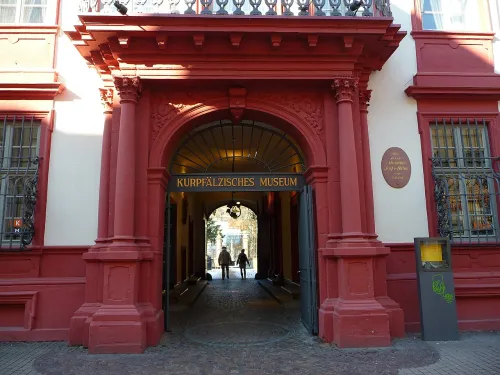
  3. Kurpfälzisches Museum in Heidelberg, stop 3 on the self-guided walking tour
    3Kurpfälzisches Museum
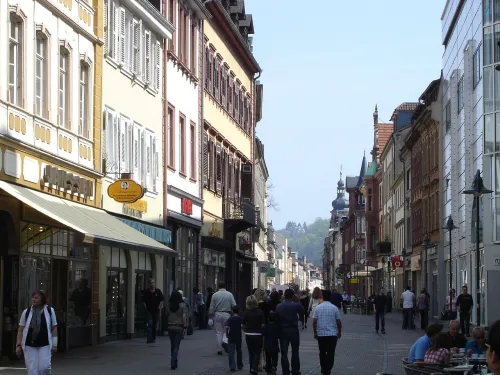
  4. Hauptstraße in Heidelberg, stop 4 on the self-guided walking tour
    4Hauptstraße
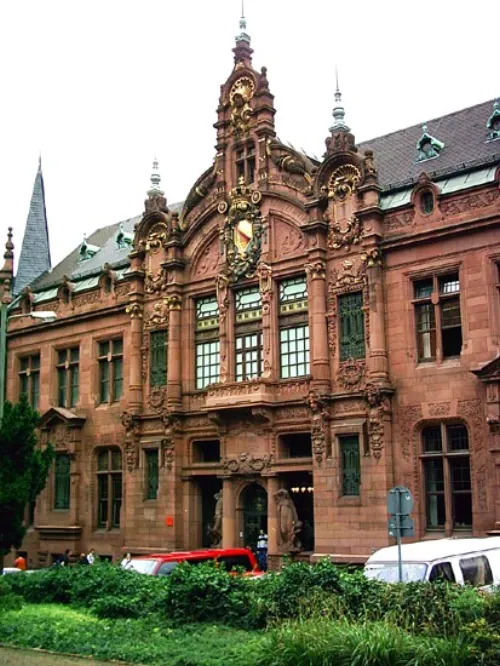
  5. Universitätsbibliothek Heidelberg, stop 5 on the self-guided walking tour
    5Universitätsbibliothek Heidelberg
  6. Heidelberger Altstadt, stop 6 on the self-guided walking tour
    6Heidelberger Altstadt
  7. Studentenkarzer / Alte Universität in Heidelberg, stop 7 on the self-guided walking tour
    7Studentenkarzer / Alte Universität
  8. Schlossgarten in Heidelberg, stop 8 on the self-guided walking tour
    8Schlossgarten
  9. Deutsches Apotheken-Museum in Heidelberg, stop 9 on the self-guided walking tour
    9Deutsches Apotheken-Museum
  10. Heidelberger Schloss, stop 10 on the self-guided walking tour
    10Heidelberger Schloss
  11. Kornmarkt in Heidelberg, stop 11 on the self-guided walking tour
    11Kornmarkt
  12. Heiliggeistkirche in Heidelberg, stop 12 on the self-guided walking tour
    12Heiliggeistkirche
  13. That's the full route.

    Walk it with an AI Tour Guide talking you through every one of these streets.

    Start free in your browser
    You made it

Your Heidelberg Walking Tour Stop by Stop, from the Neckar to the Castle Hill

  1. 1

    Alte Brücke

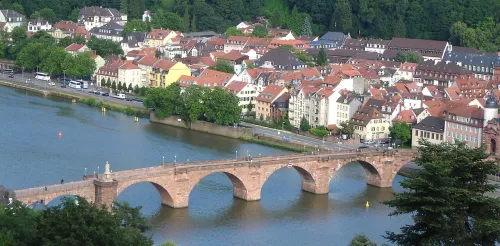
    Alte Brücke in Heidelberg, stop 1 on the self-guided walking tour

    Start on the Alte Brücke, the arch bridge of Neckar sandstone that carries you from the old town across the river to Neuenheim. Its official name is Karl-Theodor-Brücke, after Elector Charles Theodore, who had it built in 1788. Look at the bridge gate at the old town end: it is medieval and far older than the arches you are standing on, a reminder that this crossing was once part of the town's defences.

    Old is relative here. The current bridge is the ninth on this spot and rests on the foundations of its predecessors. The nickname only stuck after 1877, when a second bridge, today's Theodor-Heuss-Brücke, was built and this one became the old one.

    The history of crossings goes back much further. The Romans built a wooden pile bridge in the first century CE, between today's Neuenheim and Bergheim, and rebuilt it in stone around the year 200. After it collapsed, the area went almost a thousand years without a bridge. One reappears in the records in 1284, placed exactly in line with the marketplace. Until 1460 the far bank belonged to the Electorate of Mainz, so this was a border, and the gate guarded it.

    Look closely at the arches. On 29 March 1945 German troops blew up three of them and two pillars; what you see was restored after the war. You can cross for free at any hour. From the far end it is 1150 m, about 22 minutes, to the Philosophenweg. Keep the GPS route open for this leg: the entrance to the path is signposted but easy to miss if you are new to the city.
    Hours
    Open 24/7
    Price
    0 EUR
  2. 2

    Philosophenweg

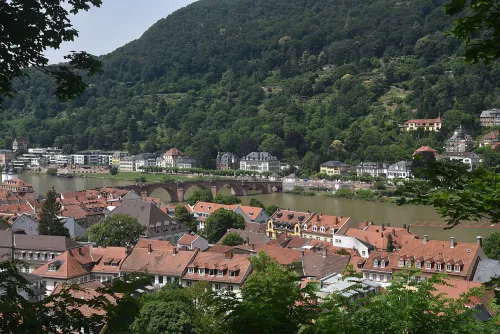
    Philosophenweg in Heidelberg, stop 2 on the self-guided walking tour

    The Philosophenweg runs for about two kilometres from Neuenheim up onto the Heiligenberg, directly facing the castle across the valley. Be ready for the start: the first 700 metres wind steeply through one of Heidelberg's most expensive residential areas. Take it slowly; the reward comes once the houses end.

    At the first bend stands the university's Institute of Physics at number 12, built in the early 20th century precisely because this spot was sheltered from vibrations. The Institute for Theoretical Physics uses numbers 16 and 19. Number 16 carries its own story: the zoologist Hugo Merton lived there from 1912, lost his professorship under the Nazis and emigrated to England in 1937. In 1952 the physicist Hans Jensen, who won the Nobel Prize in 1963, bought the house for the university.

    With number 21 the steep, built-up part ends and the path continues almost level past the Philosophengärtchen. This little garden is the place to stop: the view runs across the Neckar to the old town, the Königstuhl and the castle, and out into the Upper Rhine plain. Look for a metal plaque on one of the low walls that reads 'Heidelbären der Erkenntnis', a pun on Francisco Varela's book 'The Tree of Knowledge' and on Kant's insight that we can never step outside the conditions of our own perception. On a platform stands a bust of Joseph von Eichendorff with one of his poems engraved in the base; the Romantic poet studied in Heidelberg for a few months.

    Walking on to the eastern end, which adds distance to the route, brings you to the Hölderlin-Anlage, where a stone recalls Friedrich Hölderlin's ode to Heidelberg. Then head back down into town: the walk to the Kurpfälzisches Museum is 1880 m, about 26 minutes, the longest leg of the tour, and takes you past the Anatomiegarten as you reach the old town.

    Hours
    Open 24/7
    Price
    0 EUR
  3. 3

    Kurpfälzisches Museum

    Kurpfälzisches Museum in Heidelberg, stop 3 on the self-guided walking tour

    Back in the old town, the Kurpfälzisches Museum fills the Palais Morass with art and archaeology from the region. It began in the late 1870s, when the city bought the private collection of Charles de Graimberg, an artist and art historian. Keep the name in mind: he turns up again at the castle.

    Start with the archaeology from the Lower Neckar Valley. There is a facsimile of the lower jaw of Homo heidelbergensis, found in Mauer, along with Roman artefacts, a life-size reconstruction of Heidelberg's mithraeum and objects from the years when Heidelberg was the residence of the Electoral Palatinate.

    The paintings span five centuries. You meet Heidelberg figures in portraits, among them Elector Frederick V, Elizabeth Charlotte and Perkeo, next to religious works by Rogier van der Weyden and Lucas Cranach the Elder, Dutch still lifes, and 20th century pictures by Max Beckmann and Alexei Jawlensky. Four rooms recreate 18th and 19th century interiors with Frankenthal porcelain and portraits of the prince-electors, and there are costumes of a Heidelberg family worn over almost two centuries.

    Is it worth going in? If the weather turns, or if you enjoy seeing how the city, the castle and the Palatinate looked in older pictures, yes, and the ticket is modest. Give it about an hour. From the door it is only 200 m, about 3 minutes, to the Hauptstraße.

    Hours
    Mon: Closed | Tue–Sun: 10:00–18:00
    Price
    Adults 3 EUR (weekdays), 1.80 EUR (Sundays and holidays); reduced 1.80 EUR (weekdays) / 1.20 EUR (Sundays and holidays)
  4. 4

    Hauptstraße

    Hauptstraße in Heidelberg, stop 4 on the self-guided walking tour

    The Hauptstraße is the spine of the old town: a pedestrian street of around 1.8 km from Bismarckplatz to the Karlstor, with a gentle bend that follows the river. Lanes called Gassen cross it from north to south, and five squares open along its length.

    Notice the house numbers. They start at Bismarckplatz, odd on the north side and even on the south, and climb to 251. Only the Marktplatz was planned as a square from the beginning; Anatomiegarten, Universitätsplatz, Kornmarkt and Karlsplatz were created when buildings were torn down.

    The road is older than the town. It existed before Heidelberg was founded in 1220 and became the central axis of the new city. Its names tell the story: Obere Gasse in 1391, the Latin platea magna in 1491, Speierer Straße in 1508, and Hauptstraße since 1689. City gates closed both ends; in the east the Obere Tor stood near today's Plankengasse until the Karlstor took its place in the 18th century.

    As you walk, you may feel a slight rise between Theaterstraße and Universitätsplatz. That is the work of the Klingenteichbach, a stream that now runs underground and whose old deposits lift the street. From here it is 300 m, about 4 minutes, to the Universitätsbibliothek.

    Hours
    Always open
    Price
    0 EUR
  5. 5

    Universitätsbibliothek Heidelberg

    Universitätsbibliothek Heidelberg, stop 5 on the self-guided walking tour

    The Universitätsbibliothek Heidelberg is the oldest university library in Germany. Its story starts with the founding of the university in 1386 and, two years later, with a single chest of documents bought by the first rector, Marsilius von Inghen, and stored in the Heiliggeistkirche, where your walk ends today.

    The collection grew from gifts by bishops, chancellors and early professors. Elector Louis III left his large and valuable collection to the university, and so did the Fuggers of Augsburg. In the 16th century Elector Otto Henry combined the university's libraries into the Bibliotheca Palatina.

    Then came the loss. After Tilly conquered Heidelberg in September 1622, during the Thirty Years' War, the victorious Maximilian I of Bavaria gave the Bibliotheca Palatina to Pope Gregory XV. More than 3,700 manuscripts and about 13,000 pamphlets were taken to the Vatican in Rome.

    Today the library holds about 3.2 million books and special collections on the Palatinate and Baden, Egyptology, archaeology, art history and South Asia. The reading room is free to enter. The next stop takes in the Heidelberger Altstadt as a whole, just 190 m, about 2 minutes, on.

    Hours
    Reading room daily 08:30–01:00; lending Mon–Fri 09:00–20:00, Sat 13:00–17:00; open stacks Mon–Fri 09:00–19:50, Sat 13:00–16:50
    Price
    0 EUR
  6. 6

    Heidelberger Altstadt

    Heidelberger Altstadt, stop 6 on the self-guided walking tour

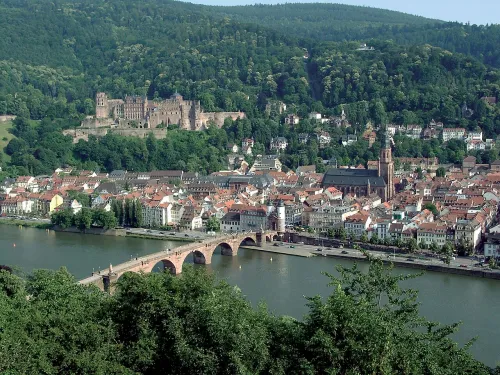
    Pause here and take in the Heidelberger Altstadt as a whole. It sits on the south bank of the Neckar on a narrow wedge of river sand, squeezed between the water and the slope of the Königstuhl at the foot of the castle. The valley floor narrows eastward into a triangle about 1900 metres long and on average 450 metres wide. Across the river rises the Heiligenberg, where you walked the Philosophenweg.

    The town was laid out to plan in the 13th century and expanded at the end of the 14th. Until well into the 19th century, the old town simply was Heidelberg.

    What you see around you is a baroque town on a medieval street plan. After the destruction of 1693 in the War of the Palatine Succession, Heidelberg was rebuilt along its old lines, which is why the lanes keep their medieval course while the facades are baroque.

    The oldest core lies between Universitätsplatz and Plankengasse. Between Plankengasse and the Karlstor is the small Jakobsvorstadt, a 14th century suburb also called the Upper or Eastern suburb. The Studentenkarzer is only 90 m away, about a minute, past the Universitätsmuseum.

    Hours
    Always open
    Price
    0 EUR
  7. 7

    Studentenkarzer / Alte Universität

    Studentenkarzer / Alte Universität in Heidelberg, stop 7 on the self-guided walking tour

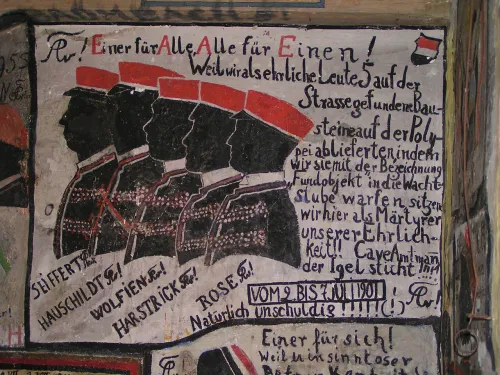
    Behind the entrance at Augustinergasse 2 lies the last student prison in Heidelberg's history, now part of the museum on the history of the university at the Alte Universität. The idea goes back to the university's founding in the 14th century, when it had its own jurisdiction over students. Prison sentences became usual in the 16th century, and these rules lasted here until the beginning of the 20th century.

    The reason to go in is the walls. The colourful paintings date only from the last decades of use, when serving time in the Karzer had become a lark and a point of pride. Inmates left their names, their portraits and the crests of their student fraternities behind. Every painting that survives was made by a student enrolled at Heidelberg.

    Prisoners were locked up separately according to their type of fraternity, Corps, Burschenschaft, Landsmannschaft and so on. Members of rival groups would otherwise have started fights and turned a sentence into a riot.

    Worth it? Yes, if you have half an hour and like the quirky side of history; the Karzer counts among the most popular sights in the old town. The university museum is reached through the same entrance. Then the route heads uphill: 1120 m, about 19 minutes, to the Schlossgarten.

    Hours
    October–May: Mon–Sat 10:30–16:00; June–September: Mon–Sun 10:00–18:00 (in summer daily 13:45–14:15 closed)
    Price
    Karzer alone: adults 6 EUR, reduced 4 EUR; combi ticket Karzer+university museum: adults 7.50 EUR, reduced 5 EUR; school classes 3.50 EUR/person
  8. 8

    Schlossgarten

    Schlossgarten in Heidelberg, stop 8 on the self-guided walking tour

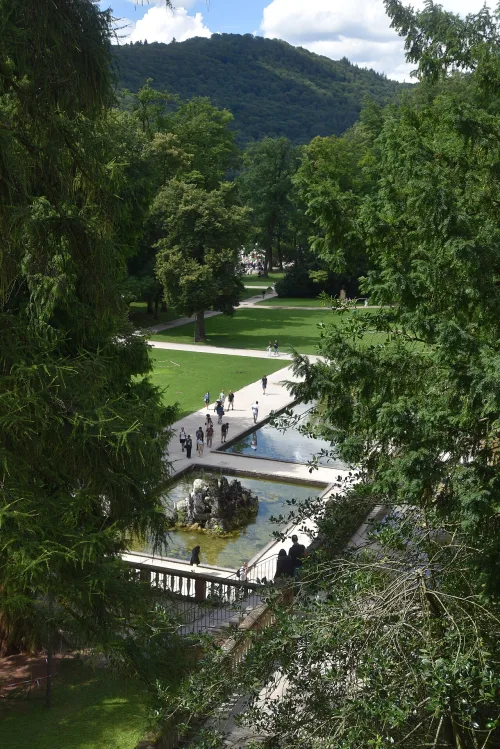
    The Schlossgarten is the setting of the Hortus Palatinus, the Baroque garden Elector Frederick V commissioned in 1614 for his new wife, Elizabeth Stuart, daughter of King James I of England. In the 17th century it was famous across Europe and known as the Eighth Wonder of the World; it has since been called Germany's greatest Renaissance garden.

    The marriage was political, uniting the Protestant lines of England, the Palatinate, the Dutch House of Orange-Nassau and Denmark, yet the two were genuinely in love and stayed a romantic couple. Frederick travelled home ahead of his bride and remade his castle for her: an English wing, a monkey house, a menagerie and the beginnings of this garden in the Italian Renaissance style then popular in England.

    The designer was Salomon de Caus, a French engineer and Elizabeth's former tutor, whom Frederick had met at King James's court. De Caus had worked on a garden for Prince Henry at Richmond Palace, halted when the prince died in 1612, and some writers suspect he brought those ideas to Heidelberg on a larger scale. Work here began in July 1614.

    Think about the ground under your feet. The terrain around the castle was steep and mountainous, and the engineers had to level it into a huge terrace on several levels. The garden is free and open during the day. From here it is 400 m, about 5 minutes, to the Deutsches Apotheken-Museum; have your castle ticket ready, since it is your way in.

    Hours
    Freely accessible during the day
    Price
    0 EUR
  9. 9

    Deutsches Apotheken-Museum

    Deutsches Apotheken-Museum in Heidelberg, stop 9 on the self-guided walking tour

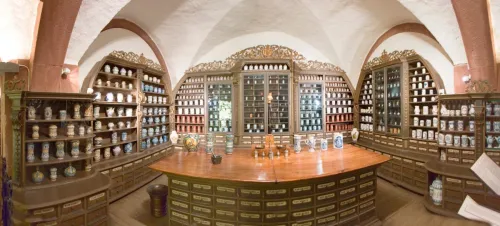
    Inside the castle, the Deutsches Apotheken-Museum spreads over eleven rooms in the Ottheinrichsbau, the Ludwigsbau and the Apothekenturm. There is no separate ticket: the castle ticket gets you in.

    Look for the seven complete pharmacy interiors from the Renaissance, Baroque and Biedermeier periods, plus one from the 1930s, and the herb chamber. Under the Apothekenturm, a reconstructed historic laboratory is fitted with many original instruments. Glass lovers will find the world's largest collection of 18th century enamel-painted glasses, along with technical glassware, precious majolica and faience, and massive mortars from the 15th century onward.

    The collection has travelled. The museum was founded in 1937 as a non-profit foundation and opened in Munich in 1938. Its core was Walter Heinrici's private collection, then the largest of its kind in Germany, which came to the museum on the orders of Albert Schmierer, the Reichsapothekerführer. In 1943 the Munich building was almost completely destroyed, but most of the objects had already been moved to safety. After the war they went to the Neue Residenz in Bamberg, which proved too small, and since 1957 the growing collection has been at home in Heidelberg Castle.

    Even if pharmacy history is not your thing, it is included in your ticket, and the laboratory alone is worth a few minutes. The Heidelberger Schloss itself is 30 m away, a one-minute walk.

    Hours
    Daily: 10:00–18:00
    Price
    Included in the castle ticket (adults 11 EUR, reduced 5.50 EUR); no separate single ticket
  10. 10

    Heidelberger Schloss

    Heidelberger Schloss, stop 10 on the self-guided walking tour

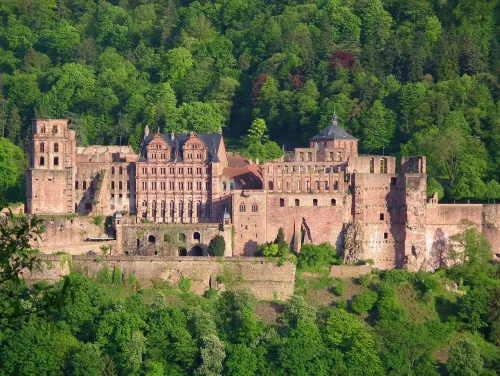
    The Heidelberger Schloss, a ruin of red Neckar valley sandstone on the northern slope of the Königstuhl above the old town, is the emblem of the city. Built first as a fortress and later expanded into a palace, it served the Electors Palatine as their residence for almost three centuries and was a centre of court and noble life in the Holy Roman Empire.

    Its downfall came in stages. In the War of the Palatine Succession, fought between 1688 and 1697, it was destroyed twice. On 6 September 1693 French sappers blew up the powder tower along with other buildings and fortifications, and afterwards the castle could only be used in part. A restoration had barely begun when lightning started a fire on 24 June 1764. Rebuilding was abandoned, and the electors stayed in their palace in Mannheim.

    Then the Romantics fell for the ruin as a symbol of human greatness and transience. Charles de Graimberg, the Frenchman whose collection founded the Kurpfälzisches Museum, admired it and paid for its upkeep for many years. Hölderlin and Eichendorff, both remembered on the Philosophenweg, wrote it into Heidelberg's image as a romantic city.

    Take your time with the palace buildings added over several centuries; the Ottheinrichsbau counts among the most important works of German Mannerism. Is the ticket worth it? For most visitors, yes: it covers the courtyard, the Great Tun and the Apotheken-Museum. Allow about an hour, then walk 640 m, about 11 minutes, down to the Kornmarkt.

    Hours
    Castle courtyard/Altan/vault cellar daily (also holidays) 09:00–18:00, last admission 17:30
    Price
    Adults 11 EUR, reduced 5.50 EUR (includes funicular round trip, castle courtyard, Great Tun and the German Pharmacy Museum)
  11. 11

    Kornmarkt

    Kornmarkt in Heidelberg, stop 11 on the self-guided walking tour

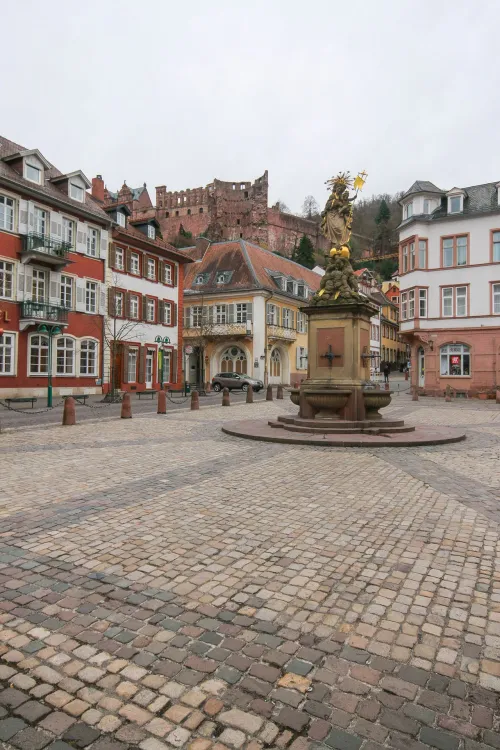
    The Kornmarkt is bordered by the Hauptstraße to the north, with the Rathaus beyond, while the Burgweg, the lane up to the castle, begins just to its south. In the middle stands the Kornmarkt-Madonna, a Marian column made by Peter van den Branden in 1718, with three fountains.

    Look down at the paving. From the 13th century the Heilig-Geist-Spital, a hospital, stood here, and the outline of its former chapel is marked out in the pavement. In 1557 the city council had the buildings demolished to make room for a milk and vegetable market. It was first called the Neuer Markt before the name Kornmarkt won out.

    In 1986, work on an underground car park uncovered the hospital walls and its cemetery, used from the end of the 13th century into the early 15th. Around 270 of roughly 800 graves were examined. One of them, plot 45 from the 14th century, held two women of about thirty in a shared grave of the kind usually used for spouses. The first excavators took them for blood relatives; later it was suggested they may have been a couple, or that one of them was transgender.

    On the southeast corner stands the Palais Graimberg, and on the west side the Prinz Carl, once a luxury hotel and now a civic administration building. Cross the Marktplatz to the Heiliggeistkirche, just 120 m, about 2 minutes, away.

    Hours
    Always open
    Price
    0 EUR
  12. 12

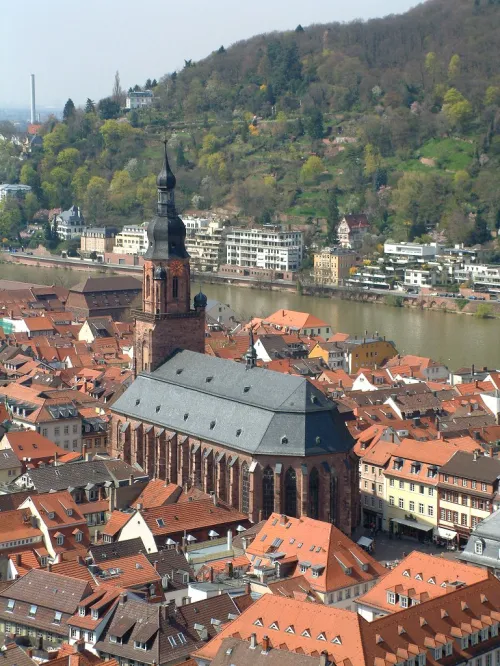
    Heiliggeistkirche

    Heiliggeistkirche in Heidelberg, stop 12 on the self-guided walking tour

    The Heiliggeistkirche on the marketplace is the largest church in Heidelberg, built between 1398 and 1515 in Romanesque and Gothic styles and visited by millions of people every year. A Romanesque chapel stood here as early as 1239, followed by an aisleless Gothic chapel around 1300; King Rupert commissioned the present church in 1398, the third sacred building on this site.

    It was planned as the burial church of the Electors Palatine. Their graves were destroyed in the War of the Palatine Succession, and only the tomb of the founder, Elector Ruprecht III, survives. This is also where Heidelberg University was founded and where the Bibliotheca Palatina was first kept, so the walk ends where the library chest from the morning began its story.

    The most unusual chapter is about faith. Between the 16th and 20th centuries the church changed denomination more than ten times, among Lutheran, Calvinist, Catholic and Old Catholic. For around 300 years, on and off, a wall separated the nave from the choir so that Catholics and Protestants could worship at the same time. It came down only in 1936, and the congregation is now Protestant. The first Protestant service here was held in 1546.

    Go inside; entry is free. This is where the tour ends.

    Hours
    Mon–Sat 11:00–17:00, Sun 12:30–17:00
    Price
    0 EUR (church interior)
Walking tour route map of Heidelberg Route loaded
Alte BrückePhilosophenwegKurpfälzisches MuseumHauptstraße+8
All 12 stops are already on the map.
You just press start.
AI Tour Guide

You know the way across the Neckar. Now walk it with a guide in your ear.

Press start wherever you are, even hundreds of kilometres from Heidelberg, and the guide begins telling its stories right away. In the city, pick any of the 12 stops to start from: it leads you there, then talks with you the whole route, asking, listening, remembering, and shaping the tour around your answers.

12stops 6.1km 1 h 36 minwalking 13languages
▶Start the tour free

Free to start · Runs in your browser · No app, no download

Shorter Ways to Walk Heidelberg

Not every visit leaves room for a full day. These sections of the route work well on their own.

River and hillside view

Stops: 1, 2

For anyone who wants the classic view without a ticket: the Alte Brücke and the Philosophenweg, about 22 minutes on foot between the two plus your time on the path. Everything is free.

Old town on a rainy morning

Stops: 3, 4, 5, 6, 7

Compact and good in bad weather: museum, main street, library, old town and student prison with only 10 minutes of walking in total. Entry is paid at the Kurpfälzisches Museum and the Karzer.

Castle hill and back to the market

Stops: 7, 8, 9, 10, 11, 12

For first-time visitors who want the castle above all: from the Karzer up to the garden, the Apotheken-Museum and the castle, then down to the Kornmarkt and the Heiliggeistkirche, 38 minutes of walking. You need the Karzer ticket and the castle ticket, which covers the Apotheken-Museum.

How Long Does This Heidelberg Tour Take with Castle and Karzer?

The pure walking time is 1 h 36 min over 6.1 km, but the stops shape the day. With an hour in the Kurpfälzisches Museum, half an hour each in the Karzer and the Apotheken-Museum, an hour at the castle and short pauses everywhere else, expect about six and a half hours. A 10:00 start puts you at the Karzer around 13:00 and at the Heiliggeistkirche shortly after 16:00, so you finish around 16:30.

Leave out the museum and the day shrinks to about five and a half hours; walk the whole route without any paid visit and about three and a half hours is enough. The river section takes under an hour, the old town section around two and a quarter hours with both tickets, and the castle section a little under three and a half hours.

Before You Set Off from the Alte Brücke

  • Start and finish: The recommended start is the Alte Brücke, but you can join at any stop. The route ends at the Heiliggeistkirche; if you like, the GPS navigation guides you from there back to the start.
  • Best day: Pick a day when both the Kurpfälzisches Museum and the Karzer are open, since each has days when it stays closed.
  • Time of day: Start in the morning. That way the stops are open when you get there, and you reach the Karzer well before it closes in the afternoon.
  • Costs: The route, map and GPS navigation are free, and so are most stops. The Kurpfälzisches Museum, the Karzer and the castle charge admission; the castle ticket includes the Deutsches Apotheken-Museum. The AI Tour Guide is optional: you start with 100 free credits, then choose this tour all-inclusive for €19.99 with no time limit, or €5 per hour.
Walking tour route map of Heidelberg
AI Tour Guide

Your guide is ready whenever you start walking.

Press start and a voice AI Tour Guide takes it from here: leading the route through Heidelberg, telling the stories, and turning your walk into a real back-and-forth conversation. No app or download is needed; it runs in your browser.

12stops 6.1km 1 h 36 minwalking 13languages
▶Start the tour free

Free to start · Runs in your browser · No app, no download

What the AI Tour Guide Adds between Bridge and Castle

Heidelberg is full of threads that run from stop to stop: Charles de Graimberg from the museum to the castle, Frederick V and Elizabeth Stuart from the portraits to the garden, the Bibliotheca Palatina from the library to the church. The AI Tour Guide picks them up as a conversation. It greets you, tells the stories of each place, asks what caught your attention and follows that interest, and you can interrupt at any moment. Wondering what the Great Tun in the castle actually is, or what Eichendorff's poem on the bust says? That is where the conversation can go.

A Real Conversation A voice AI Tour Guide greets you, leads the whole route, and tells the stories and facts as you walk, asking what you want to see and keeping a real conversation going. Not a recording you press play on.
Map Navigation Follow the route on the map and walk at your own pace. You choose where to start and when to move to the next stop.
Ask Anything Curious about a building you pass? Ask your AI Tour Guide on the spot and the conversation carries on.
13 Languages Switch language anytime. No separate tour needed.
Start free in your browser

Common Questions about Tickets and Hours in Heidelberg

Is the Kurpfälzisches Museum expensive?

No, the ticket is modest, and there is a reduced rate as well.

Can I combine the Karzer with the university museum?

Yes. There is a combined ticket for the Karzer and the university museum, with a reduced rate and a group price for school classes.

Can I visit the Karzer in summer?

Yes, the Karzer is open in summer as well, and half an hour is enough for a visit.

Can I get up to the castle without walking?

Your castle ticket includes a round trip on the funicular, so you can ride up or down instead of walking.

Is the tour really free?

Yes. The whole tour is free: the route, the interactive map and the navigation cost you nothing. Only the voice AI Tour Guide is optional and paid: you test it with 100 free credits, then you pay either €5 per hour or €19.99 for this whole tour, with no time limit. Admission to 4 of the 12 stops is not included: Kurpfälzisches Museum, Studentenkarzer / Alte Universität, Deutsches Apotheken-Museum and Heidelberger Schloss charge their own entry fees.

Do I need to download an app?

No. Everything runs in your phone browser. Open the route and start walking, no download and no sign-up required.

Do I need to book the walking tour in advance?

No booking needed. This self-guided tour is available anytime. Open the route in your browser and start walking. The AI Tour Guide works instantly, no app, no reservation required.

What languages is the AI Tour Guide available in?

The AI Tour Guide speaks 13 languages, so you take the tour in your own language and can switch at any time.

Can I skip stops or change the route?

Yes. Skip any stop, spend extra time at places you like, or start the route from any point. It is your walk, you set the pace.
Image credits
▶ Start free in your browser Runs in your browser, no app, no download