

Mainz Cathedral
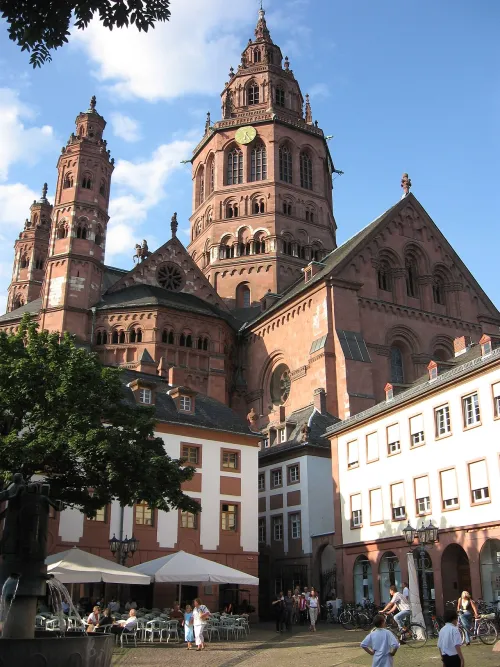
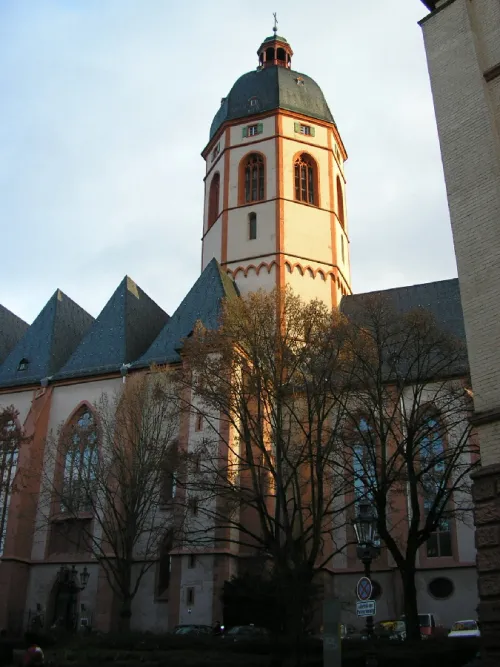
You start in front of a building that has stood here for a thousand years. Mainz Cathedral, the Dom, is Romanesque at its core, but centuries of later additions have layered other styles onto the outside, so it reads like a history book in stone. Officially it is the Hoher Dom zu Mainz, dedicated to Saint Martin of Tours; the eastern quire belongs to Saint Stephen. Look out for the statues of Saint Boniface and the Madonna on the grounds, and for the inner courtyard.
The man behind it is Archbishop Willigis. Under him Mainz flourished, and he became one of the most powerful politicians of his age, even acting as regent of the empire between 991 and 994. Shortly after taking office in 975 he ordered a new cathedral as part of his vision of Mainz as a “second Rome”. It was meant to replace two churches at once: the old cathedral and St. Alban's, the great abbey church where synods met and where bishops and nobles were buried, among them Fastrada, a wife of Charlemagne.
Willigis's church had a double chancel with two transepts, a three-aisled nave without vaults, since a vault on that scale was too difficult to build, and six towers. A cloister was enclosed in the complex, and a colonnade linked it to the small St. Mary's Church.
Go inside: it is free, and everyone gets something from it. The tombs and funerary monuments of the elector archbishops, the prince-bishops who ruled Mainz, line the interior, along with religious art spanning a millennium. Half an hour is enough.
Mainz's weekly market, the Wochenmarkt, is right here at the start. Then it's 620 m, about 9 minutes, to the Gutenberg Museum, passing the Naturhistorisches Museum Mainz on the way.