

Kurhaus Wiesbaden
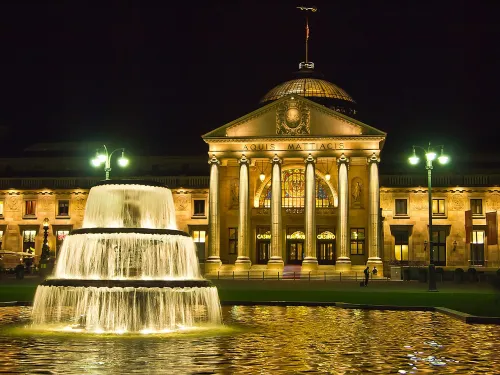
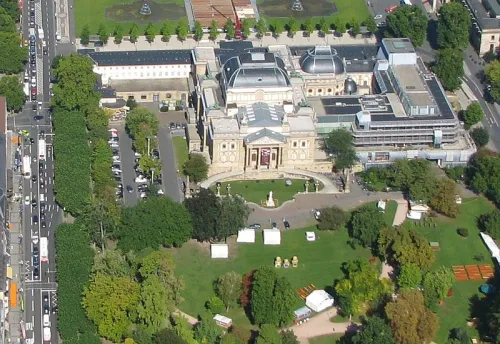
Start on the Bowling Green, the lawn with two fountains in front of the Kurhaus main entrance. British spa guests gave it that name, and it stuck. Along its north side runs the Kurhaus colonnade, 129 metres long and counted as the longest columned hall in Europe; along the south side the Theater colonnade leads to the Staatstheater. The young plane trees lining the square replaced the old ones when a car park was dug underneath in the mid 2000s.
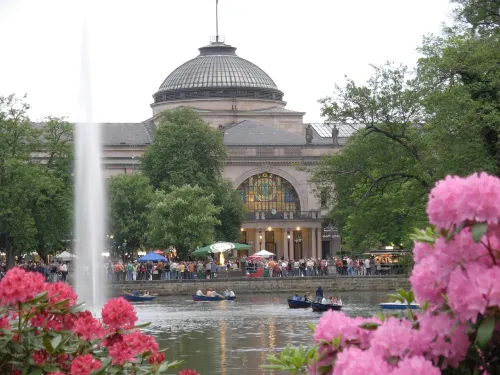
Kurhaus means cure house, and this was the social centre of the spa town. Today it is the city's convention centre, with a large and a smaller hall, a restaurant and the casino, the Spielbank. The Romans already knew the hot springs here, and the city's name goes back to Wisibada, the bathing place in the meadows.
The first spa house on this spot, built by Christian Zais in 1810, was a modest classical building with a columned portico, and Goethe praised it on one of his many visits. Then the upper classes came for the cure: 20,000 spa guests in 1840, ten times as many by 1910. A bigger, grander house was needed, and the rebuild reshaped the park behind it in 1907. Two columns of the old portico survived; you will meet them in a few minutes.
The casino was known for allowing the highest roulette stakes in Germany, at least as of 2005, and Fyodor Dostoyevsky is said to have found the inspiration for The Gambler at its tables. The foyer and the colonnades are free to walk into, and a few minutes in the colonnade are worth it even if you never place a bet.
Walk around the building into the green behind it: the Kurpark is 380 m, about 5 minutes away.