

Altpörtel
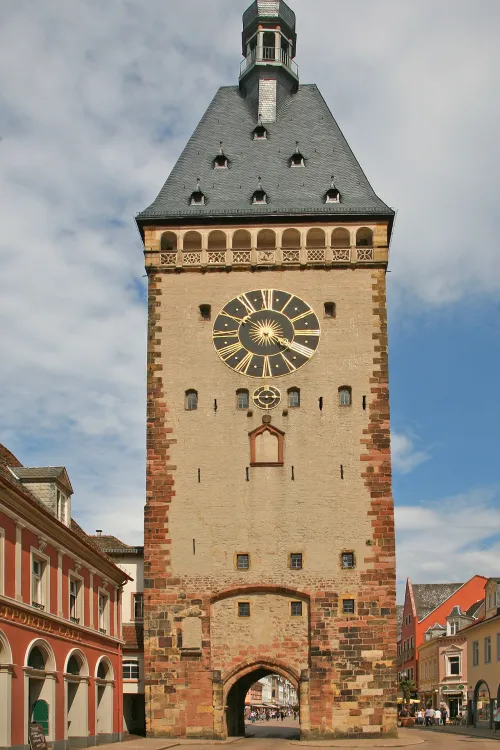
Start where emperors once entered the city. The Altpörtel is Speyer's medieval west gate, 55 metres tall and one of the largest and architecturally most significant city gates left in Germany. It was once one of 68 towers along the walls and gates, and it began life as an outer gate linking the old town with the suburb of St. Gilgenvorstadt.
Read it from the bottom up. The lower part dates from between 1230 and 1250, built on the ruins of an earlier tower. In 1511 the mayor had the upper part rebuilt, finished in 1514, and the steep roof, 20 metres high on its own, was added in 1708. Walk round to the outer, west face and you will see no windows at all, only two rows of embrasures: that side faced whoever was coming, so security came first.
By rights the tower should not be standing. In 1689, during the War of the Grand Alliance, French troops had already packed it with explosives. The prior of the nearby Carmelite monastery warned Marshal Duras that the falling stone could bring down the monastery's old walls and the marshal's own headquarters close by. When Duras replied that his men knew how to do it safely, the whole Carmelite community knelt before the soldiers and their burning torches and begged. After a few minutes the marshal told them to rise: “Stand up, children, the tower shall stand.” The gate survived; the city and its cathedral were left in rubble.
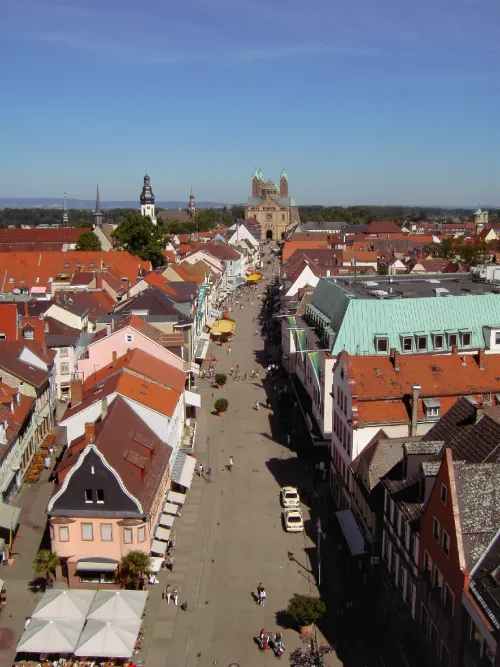
The gate also marked the end of the Via Triumphalis, the processional road from the cathedral along which the emperor and his court entered on great religious occasions. A visit inside costs a fee and runs only at set times, partly as guided tours; worth it if you want the gate from within, while the outside tells its story at any hour. From here it is 300 metres, about 4 minutes, into the lanes to the Purrmann-Haus.