Free Walking Tour Nara: Great Buddha to Kasuga

Eight stops through Nara's old temple quarter: a bronze Great Buddha, a garden that borrows the hills, lantern-lined shrine paths and a hall built for one ritual.

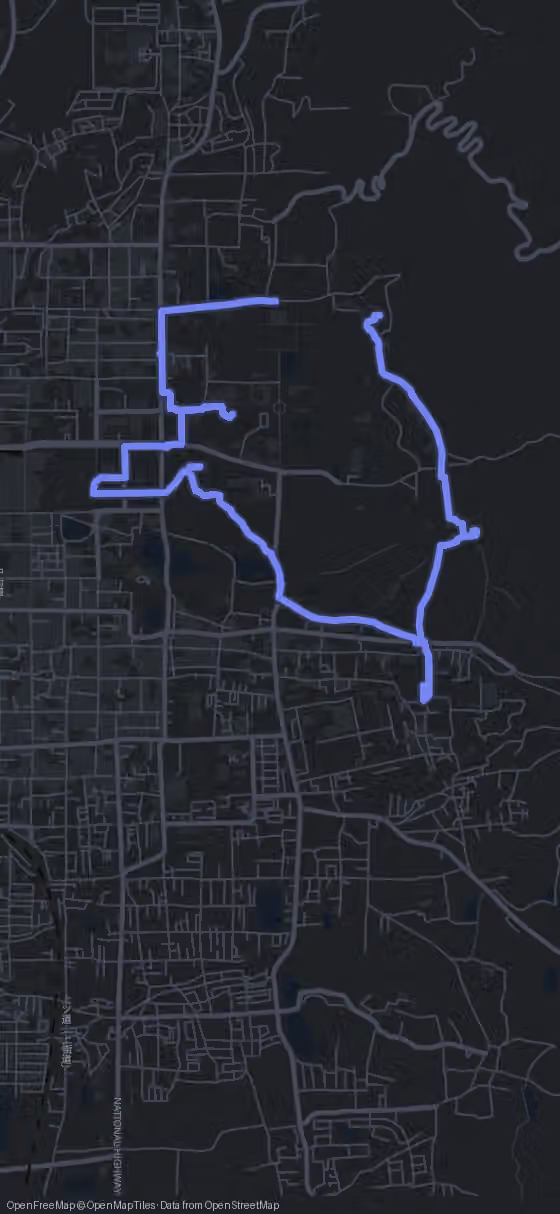
8 Stops 6.4 km ~1 h 30 min walking
Route map for the Nara walking tour
Stop 1 of 8
1.2 km·15 min
Todai-ji
Head south-west toward Isuien Garden
Konnichiwa, welcome to Nara. I'm Alex, and even a hole in a temple pillar carries a tradition about enlightenment.
Try this tour with Alex

The Route at a Glance

Eight stops lead from Todai-ji via Isuien Garden, Kofukuji National Treasure Hall, Kofukuji Temple, Nara National Museum, Shin-Yakushiji Temple and Kasuga Grand Shrine to Nigatsu-do Hall. The 6.4 km take 1 h 30 min of pure walking; with the interiors worth paying for, plan about seven hours.

The grounds of Kofukuji and Kasuga and all of Nigatsu-do are free; the Great Buddha Hall, the garden, the treasury, the museum and Shin-Yakushiji charge entry. Map and GPS route in your browser cost nothing, and the AI Tour Guide is optional.

Open free GPS & optional AI Tour Guide
View of Nara

The Route

Walking Map of Nara's Temple Quarter

8 stops 6.4 km 1 h 30 min walking
Tap to load interactive map

The 8 stops along this route

  1. Todai-ji in Nara, stop 1 on the self-guided walking tour
    1Todai-ji
  2. Isuien Garden in Nara, stop 2 on the self-guided walking tour
    2Isuien Garden
  3. Kofukuji National Treasure Hall in Nara, stop 3 on the self-guided walking tour
    3Kofukuji National Treasure Hall
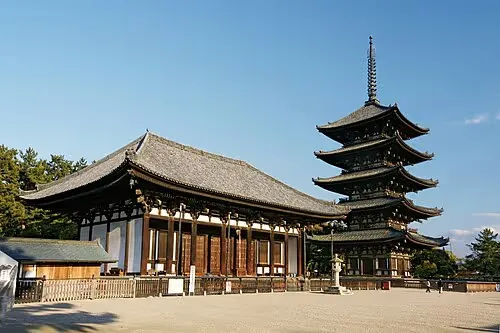
  4. Kofukuji Temple in Nara, stop 4 on the self-guided walking tour
    4Kofukuji Temple
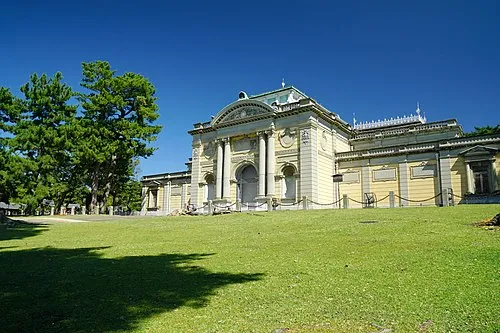
  5. Nara National Museum, stop 5 on the self-guided walking tour
    5Nara National Museum
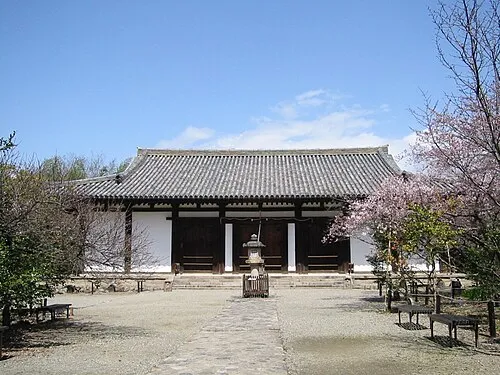
  6. Shin-Yakushiji Temple in Nara, stop 6 on the self-guided walking tour
    6Shin-Yakushiji Temple
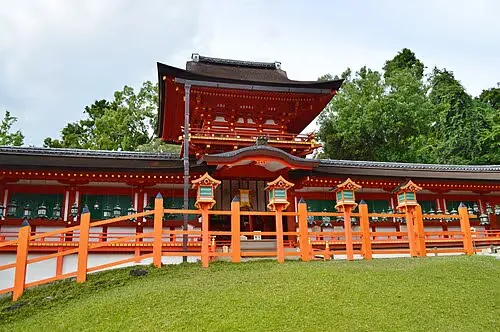
  7. Kasuga Grand Shrine in Nara, stop 7 on the self-guided walking tour
    7Kasuga Grand Shrine
  8. Nigatsu-do Hall in Nara, stop 8 on the self-guided walking tour
    8Nigatsu-do Hall
  9. That's the full route.

    Walk it with an AI Tour Guide talking you through every one of these streets.

    Start free in your browser
    You made it

Your Nara Walking Tour, from the Great Buddha to the Hill

  1. 1

    Todai-ji

    Todai-ji in Nara, stop 1 on the self-guided walking tour

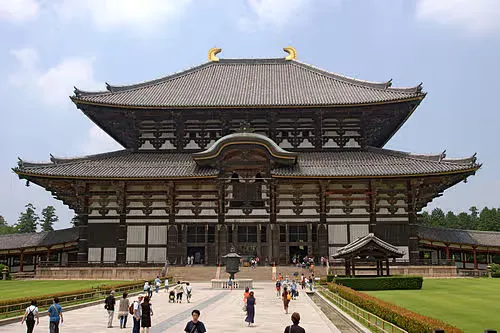
    Todai-ji, the 'Eastern Great Temple', was built to look like the temples of Tang dynasty China that Japan admired at the time, and it was once one of the powerful Seven Great Temples of Nara. Today it is the Japanese headquarters of the Kegon school of Buddhism and part of the UNESCO World Heritage Site 'Historic Monuments of Ancient Nara'. The building you came for is the Great Buddha Hall, the Daibutsuden, which houses the world's largest bronze statue of the Buddha Vairocana, known in Japan as the Daibutsu.

    The statue grew out of a crisis. During the Tenpyo era Japan was hit by a run of disasters and epidemics, and Emperor Shomu answered in 741 with an edict ordering temples in every province. In 743 he commissioned the Great Buddha itself. The temple was founded in 738 but only opened in 752, which tells you how large an undertaking it was.

    Almost nothing here is simply old. Minamoto Yoritomo started a reconstruction in 1181 and entrusted it to the monk Chogen, who rebuilt many structures in the fashion of China's Southern Song dynasty and strengthened the visible pillars. The Buddha was repaired after heavy damage in 1692, and the hall around it dates from 1709. By the late 19th century its huge roof was so heavy that the building nearly collapsed. A first restoration began in 1904 and was finished in 1913, and steel framing, begun in 1974 and completed in 1980, gave the hall its current form. So you are looking at an 8th-century vision inside an 18th-century hall held up by 20th-century steel.

    Is it worth the ticket? For nearly everyone, yes: if you go inside only one building today, make it this one, because the bronze Buddha is the one sight on this walk you cannot experience from outside. Give it about an hour. You come back to Todai-ji's grounds at the very end, at Nigatsu-do Hall, so there is no need to cover every corner now.

    Before you leave, take a good look at the roof of the great southern gate, the Nandaimon. It shows up again at the next stop, borrowed into a garden view. Isuien Garden is 1190 m away, about 16 minutes on foot.
    Hours
    Apr–Oct daily 7:30–17:30, Nov–Mar daily 8:00–17:00
    Price
    800 JPY adults / junior & senior high school, 400 JPY elementary
  2. 2

    Isuien Garden

    Isuien Garden in Nara, stop 2 on the self-guided walking tour

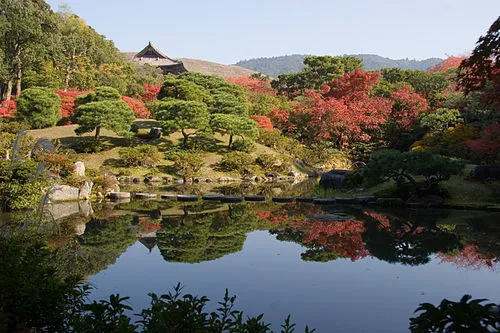
    Isuien is the only walking garden, kaiyushiki teien, in Nara: a garden made to be explored along a path rather than viewed from a single spot. It is really two gardens joined into one, each with its own pagoda, both preserved since the Meiji era and together covering about 13,500 square metres.

    The western garden is the older half. Its ground once belonged to Manishu-in, a minor temple within Kofukuji, and in 1670 it was bought by Kiyosumi Michikiyo, a wealthy tanner. He reshaped the garden from 1673, work that ran until 1681, and built two thatched family houses, Sanshu-tei and Teishu-ken. The name Sanshu-tei, 'house of the three wonders', came from Mokuan, a priest of Manpuku-ji in Uji. The west pool and the Hyoshin-tei house were designed by Kimura Seibei, a garden architect of the Urasenke school.

    The larger eastern garden followed in 1899, commissioned by the Nara businessman Seki Tojiro, who hired Horitoku, another Urasenke garden architect. In the central pond, find the two islands: one carries a crane, the other a tortoise, both symbols of long life in Japan.

    Then look past the garden. Using shakkei, 'borrowed landscape', the design pulls in the roof of Todai-ji's Nandaimon and the three hills over Nara, Wakakusa, Kasuga and Mikasa, framed by the trees of the Himuro shrine to the south and Todai-ji to the north. The line between garden and scenery seems to disappear, which is the whole point.

    In 1939 Jyunsaku Nakamura, a Nara merchant, bought both gardens and combined them as the setting for the Neiraku Museum and its traditional Japanese ceramics. This is the most expensive ticket on the route, so go in if gardens or ceramics are your thing and you want a calm 45 minutes after the Great Buddha; otherwise walk on without regret. The Kofukuji National Treasure Hall is 820 m away, about 12 minutes.

    Hours
    Wed–Mon 09:30–16:30 (last entry 16:00), Tue closed
    Price
    1,200 JPY adults, 500 JPY college / high school, 300 JPY junior high / elementary
  3. 3

    Kofukuji National Treasure Hall

    Kofukuji National Treasure Hall in Nara, stop 3 on the self-guided walking tour

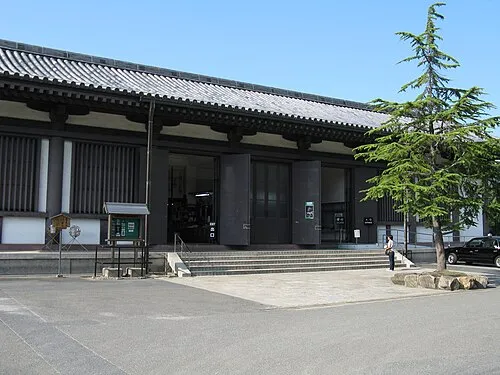
    Kofukuji was the temple of the Fujiwara clan, head temple of the Hosso school and one of the Seven Great Temples. From the Nara period into the Muromachi period, the clan's power kept arriving here in the form of buildings, statues and ritual objects. The National Treasure Hall keeps the most fragile and valuable part of that inheritance today, out of the weather and away from fire.

    Decide by appetite. If seeing Nara-period sculpture up close is one of the reasons you came to Japan, pay the entry and go in; 45 minutes is a good measure. If temple and clan names are already starting to blur, skip it and spend the money at the Nara National Museum, which tells a wider story with works from many temples and shrines of the area.

    One bit of arithmetic before you buy: entering both Kofukuji worship halls and this treasury separately costs more than the combination ticket for all three, so if the halls interest you, buy the combination. The temple grounds are just 70 m away, a one-minute walk.

    Hours
    Daily 9:00–17:00 (last entry 16:45)
    Price
    900 JPY adults / college, 800 JPY junior & senior high school, 500 JPY elementary
  4. 4

    Kofukuji Temple

    Kofukuji Temple in Nara, stop 4 on the self-guided walking tour

    Kofukuji did not begin in Nara. In 669 Kagami-no-Okimi, wife of Fujiwara no Kamatari, founded a temple in Yamashina, in today's Kyoto, praying for her sick husband to recover. In 672 it moved to Fujiwara-kyo, the first Japanese capital laid out on a grid copied from Chang'an, and in 710 it was taken apart a second time and rebuilt here, on the east side of the new capital Heijo-kyo, today's Nara. Kamatari's son Fujiwara no Fuhito named it after the Vimalakirti Sutra: Kofukuji, the Temple that Generates Blessings.

    The temple rose with the Fujiwara. When Fuhito's daughter married Emperor Shomu and became Empress Komyo, Kofukuji gained real influence over the imperial government, sometimes pressed home by aggressive means. Komyo was a devoted Buddhist. In 734 she completed the Saikondo in memory of her mother, and under her supervision the temple ran Japan's first medical dispensary and welfare institution, funded with 50 vassal households and rice from Iyo and Echizen provinces.

    That bond paid off. After the capital moved to Heian-kyo, Kyoto, many of the Seven Great Temples, Todai-ji among them, declined, while Kofukuji kept its standing thanks to the Fujiwara. It is still the national headquarters of the East Asian Yogacara school and part of the 'Historic Monuments of Ancient Nara'.

    The grounds are free, so linger as long as you like; the halls charge entry. On the 540 m, seven-minute walk to the Nara National Museum you pass the Five-Story Pagoda, which Empress Komyo ordered in 730 and which is now a National Treasure.

    Hours
    Grounds open 24/7; halls daily 9:00–17:00 (last entry 16:45)
    Price
    Free (grounds)
  5. 5

    Nara National Museum

    Nara National Museum, stop 5 on the self-guided walking tour

    Nara became Japan's capital in 710 and remained so until 784, and the Nara National Museum gathers the art of that world and the centuries after it. It is one of Japan's pre-eminent national art museums, known above all for Buddhist art: images, sculpture and altar articles, many of them belonging to temples and shrines in the Nara area.

    Look at the building before you go in. The original, designed by Katayama Tokuma, is a representative Western-style building of the Meiji period and has been an Important Cultural Property since 1969; Junzo Yoshimura later added a supplemental building. The institution is older than its name. A semi-governmental Nara exhibition company was set up in 1874 by the governor Fujii Chihiro, the museum was established in 1889 as the Imperial Museum of Nara, held its first exhibition in 1895, became the Imperial Household Museum of Nara in 1900 and has carried its present name since 1952.

    Among the pieces in its collection are the 12th-century Hell Scroll, the Jodo mandara-zu mandala from the 11th or 12th century and a 9th-century seated Buddha Yakushi. Displays change, so see what is on view when you arrive.

    If you only pay for one museum in Nara, make it this one: the ticket buys the broadest picture of the city's religious art, and 75 minutes lets you see it without rushing. Then comes the longest leg of the walk, 1720 m and about 25 minutes, out to Shin-Yakushiji Temple.

    Hours
    Tue–Sun 9:30–17:00 (last entry 16:30), Mon closed
    Price
    700 JPY adults, 350 JPY college students
  6. 6

    Shin-Yakushiji Temple

    Shin-Yakushiji Temple in Nara, stop 6 on the self-guided walking tour

    You met Empress Komyo at Kofukuji; here she is again. In March 747 she founded this temple, then called Koyaku-ji, praying for the recovery of her husband, Emperor Shomu, who suffered from an eye ailment. She had a large nine-bay main hall built and placed in it statues of the Seven Buddhas of Healing, figures thought to work against the evil spirits of dead political figures.

    At first it was a complete seven-structure temple covering around 200,000 square metres, with an east and a west pagoda, living quarters and more than 100 monks studying here. In 780, 33 years after its founding, a fire caused by a thunderbolt destroyed many of the buildings. The temple decayed through the Heian period and was revived in the Kamakura period.

    What survives is quieter but remarkable. The main hall, the Hon-do, is the only building left from the 8th century; everything else dates from the Kamakura period. The Hon-do, its principal image of the healing Buddha Yakushi Nyorai and eleven statues of the Twelve Heavenly Generals are all National Treasures. The temple belongs to the Kegon sect, like Todai-ji where you started.

    Give it about half an hour: this is the stop to choose if you want a lesser-known place where the statues, not the crowds, set the mood. From here it is 910 m, about 13 minutes, to Kasuga Grand Shrine.

    Hours
    Daily 9:00–17:00
    Price
    600 JPY adults / college, 350 JPY junior & senior high school, 150 JPY elementary
  7. 7

    Kasuga Grand Shrine

    Kasuga Grand Shrine in Nara, stop 7 on the self-guided walking tour

    Kasuga Grand Shrine is the Shinto partner to Kofukuji: the shrine of the Fujiwara family, established in 768 and rebuilt several times since. The path to it runs through a deer park where the deer roam freely; they are believed to be sacred messengers of the gods who dwell in the shrine and the mountains around it. More than three thousand stone lanterns line the way, and inside, many bronze lanterns hang.

    The deer have a reason to be here. According to legend, the shrine's first kami, Takemikazuchi, travelled from Kashima Jingu to protect Nara and rode a white deer to the top of Mount Mikasa in 768, the same hill Isuien Garden borrows for its view. Shrine and deer show up together in paintings from the Nanboku-cho period.

    Look closely at the buildings. The Kasuga-zukuri style of shrine architecture takes its name from the sanctuary here, and the torii is one of the oldest in Shinto, a model for the torii you see across much of Japan. The shrine and the Kasugayama Primeval Forest near it are part of the UNESCO World Heritage Site, and the Man'yo Botanical Garden lies next to the shrine.

    Four main kami are worshipped here, Ame-no-Koyane, Himegami, Futsunushi and Takemikazuchi, and they are often grouped as one combined deity, Kasuga Daimyojin, a way for worshippers to pray to several gods at once. The shrine won imperial favour in the Nara period through the Fujiwara and Empress Shotoku, and from 1871 it ranked among the first-class government-supported shrines, a status it kept until 1946.

    The grounds are free; 45 minutes gives you time for the lanterns and the deer. Nigatsu-do Hall is 1180 m away, about 16 minutes, back on Todai-ji ground.

    Hours
    Mar–Oct daily 6:30–17:30, Nov–Feb daily 7:00–17:00 (grounds); Special visit 9:00–16:00
    Price
    Free (grounds)
  8. 8

    Nigatsu-do Hall

    Nigatsu-do Hall in Nara, stop 8 on the self-guided walking tour

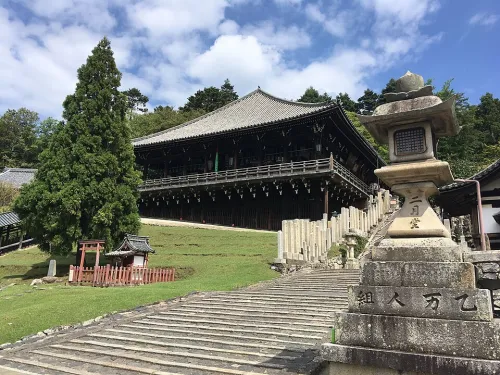
    The walk ends on the hill east of the Great Buddha Hall, at the top of a sloping path: Nigatsu-do Hall, a Todai-ji hall whose principal image is an eleven-headed Kannon, and a National Treasure. It is free and open at all hours. Just to the south stands the Hokke-do, better known as Sangatsu-do. This area, the Join or upper precinct, is older than the Great Buddha: predecessor temples of Todai-ji stood here, and excavations have found their remains along with roof tiles from the early 8th century.

    Nigatsu-do exists for one ritual. The Shuni-e, popularly called Omizutori, is said to have been held first in 752, the year of the Great Buddha's eye-opening, and it has continued ever since. Eleven specially chosen monks spend 14 days repenting before the Kannon and praying for the country and the happiness of all people; today it begins on 1 March. Six services a day are held, one of them around 1 a.m., with the monks chanting the name of Kannon over and over and reading out the names of gods from all over Japan and of people tied to the hall since ancient times. The building's unusual layout is shaped around this ritual, which is why it still feels medieval.

    Its history has a cruel twist. Nigatsu-do escaped the fires of war in 1180 and 1567 that destroyed most of Todai-ji's original buildings, then burned down by accident in 1667, on the 13th day of the second month, close to the end of the Shuni-e. It was rebuilt in 1669 with help from the shogunate, keeping the old size and form.

    Temple tradition tells how the ritual began. In 751 the monk Jitchu entered a dragon's cave at Kasagi and found it led to a heavenly court, where celestial beings performed repentance before a living eleven-headed Kannon. To bring the rite to the human world he needed a living Kannon, so he offered incense and flowers from the shore at Naniwa towards Kannon's paradise across the sea. After about 100 days a Kannon came floating over the water: a small bronze figure, warm like human skin.

    Jitchu was a real monk, and he wrote that he served the ritual every year for 70 years, starting in 752 and ending in 809. Do the sum yourself and you get 58. With no closing time to chase you, stay as long as you like; when you are ready, the GPS navigation can lead you back to where you started.

    Hours
    Open 24/7
    Price
    Free
Walking tour route map of Nara Route loaded
Todai-jiIsuien GardenKofukuji National Treasure HallKofukuji Temple+4
All 8 stops are already on the map.
You just press start.
AI Tour Guide

You know the route now. Walk it with a guide in your ear.

Press start wherever you are, even hundreds of kilometres from Nara, and the guide begins telling its stories right away. In the city, pick any of the 8 stops to start from: it leads you there, then talks with you the whole route, asking, listening, remembering, and shaping the tour around your answers.

8stops 6.4km 1 h 30 minwalking 13languages
▶Start the tour free

Free to start · Runs in your browser · No app, no download

Shorter Ways Through Nara

The full walk fills a day. If you only have a morning, an afternoon or a couple of hours, these cuts keep the stops in their natural order.

Morning: Great Buddha to Kofukuji

Stops: 1, 2, 3, 4

For a half day with the big names first. 29 minutes of walking in total. You pay entry at Todai-ji, Isuien Garden and the Treasure Hall; Kofukuji's grounds are free, so you can finish there without watching the clock.

Afternoon: museum, shrines and the hill

Stops: 5, 6, 7, 8

For anyone who already saw the Great Buddha or prefers quieter places. 54 minutes of walking, including the long leg out to Shin-Yakushiji. Entry at the museum and Shin-Yakushiji; Kasuga's grounds and Nigatsu-do are free, and you finish inside Todai-ji's upper precinct.

Kofukuji in two and a half hours

Stops: 3, 4, 5

For a short stay or a rainy spell. Only 8 minutes of walking between treasury, temple grounds and museum. Entry at the Treasure Hall and the museum.

How Long Does This Nara Tour Take with the Interiors?

Beyond the 1 h 30 min on foot, the time goes into the buildings. Count about an hour at Todai-ji, 45 minutes each at Isuien Garden, the Treasure Hall and Kasuga Grand Shrine, 75 minutes at the museum, half an hour at Shin-Yakushiji and 20 minutes each on Kofukuji's grounds and at Nigatsu-do Hall. That makes about 7 h 10 min, before any meal break you add.

Start at Todai-ji at 8:15 and you reach Isuien Garden at 9:31, the Treasure Hall at 10:28, Kofukuji's grounds at 11:14, the museum at 11:41, Shin-Yakushiji at 13:21, Kasuga Grand Shrine at 14:04 and Nigatsu-do Hall at 15:05.

The morning variant takes about 3 h 20 min, the afternoon variant about 3 h 45 min, and the Kofukuji cut about 2 h 30 min.

Before You Set Out in Nara

  • Start and finish: Todai-ji is the recommended start, but you can join at any stop. The walk ends at Nigatsu-do Hall, back within Todai-ji's grounds, and the GPS navigation can lead you from there to your starting point if you like.
  • Best days: Pick a day when both Isuien Garden and the Nara National Museum are open, since each has its own weekly closing day.
  • Start time: Around 8:15. Todai-ji is already open by then, and this start brings you to Isuien Garden just after it opens.
  • Entry costs: Five sights on the route charge admission: Todai-ji, Isuien Garden, the Treasure Hall, the museum and Shin-Yakushiji. Leave out Isuien Garden and the Treasure Hall and you pay only for Todai-ji, the museum and Shin-Yakushiji, which cuts the total considerably.
Walking tour route map of Nara
AI Tour Guide

Your guide is ready when you reach Todai-ji.

Press start and a voice AI Tour Guide takes it from here: leading the route through Nara, telling the stories, and turning your walk into a real back-and-forth conversation. No app or download is needed; it runs in your browser.

8stops 6.4km 1 h 30 minwalking 13languages
▶Start the tour free

Free to start · Runs in your browser · No app, no download

What the AI Tour Guide Adds on This Route

Nara's stories run across stops: Empress Komyo turns up at Kofukuji Temple and again at Shin-Yakushiji Temple, the Fujiwara at Kofukuji and Kasuga, Mount Mikasa in Isuien's view and in Kasuga's legend. The AI Tour Guide walks you through it as a conversation, notices which of those threads you care about and keeps following it from stop to stop, and you can interrupt whenever you like. Ask it what the Hosso school actually taught, or how the honji suijaku idea turns several gods into one Kasuga deity. You start with 100 free credits; after that, take this tour all-inclusive for €19.99 with no time limit, or pay €5 per hour.

A Real Conversation A voice AI Tour Guide greets you, leads the whole route, and tells the stories and facts as you walk, asking what you want to see and keeping a real conversation going. Not a recording you press play on.
Map Navigation Follow the route on the map and walk at your own pace. You choose where to start and when to move to the next stop.
Ask Anything Curious about a building you pass? Ask your AI Tour Guide on the spot and the conversation carries on.
13 Languages Switch language anytime. No separate tour needed.
Start free in your browser

Common Questions About Walking Nara

Is Shin-Yakushiji the same temple as Yakushi-ji?

No. Both venerate Yakushi Nyorai, the healing Buddha, but there is no other connection between them. The 'Shin' in Shin-Yakushiji is usually read as 'new', though here it is said to mean 'miraculous'.

When are the Shosoin treasures on show?

Properties kept in the Shosoin repository are exhibited at the Nara National Museum each year in the autumn. Check the museum's programme for this year's exhibition.

Does Kasuga Grand Shrine charge entry?

The grounds are free. There is also a special visit; ask at the shrine what it includes and costs.

Can I walk this route as a day trip?

Nara is 30 km from Osaka and 36 km from Kyoto. The full route with interiors takes about seven hours, so arrive in the morning; with less time, pick one of the shorter variants.

Is the tour really free?

Yes. The whole tour is free: the route, the interactive map and the navigation cost you nothing. Only the voice AI Tour Guide is optional and paid: you test it with 100 free credits, then you pay either €5 per hour or €19.99 for this whole tour, with no time limit. Admission to 5 of the 8 stops is not included: Todai-ji, Isuien Garden, Kofukuji National Treasure Hall, Nara National Museum and Shin-Yakushiji Temple charge their own entry fees.

Do I need to download an app?

No. Everything runs in your phone browser. Open the route and start walking, no download and no sign-up required.

Do I need to book the walking tour in advance?

No booking needed. This self-guided tour is available anytime. Open the route in your browser and start walking. The AI Tour Guide works instantly, no app, no reservation required.

What languages is the AI Tour Guide available in?

The AI Tour Guide speaks 13 languages, so you take the tour in your own language and can switch at any time.

Can I skip stops or change the route?

Yes. Skip any stop, spend extra time at places you like, or start the route from any point. It is your walk, you set the pace.
Image credits
▶ Start free in your browser Runs in your browser, no app, no download