Free Walking Tour Kyoto: Gion to Kiyomizu-dera

Start at the shrine that gave Gion its name, pass teahouse lanes and a widow's Zen temple, then climb a stone-paved lane to Kiyomizu-dera on Mount Otowa.

6 Stops 2.8 km ~43 min walking
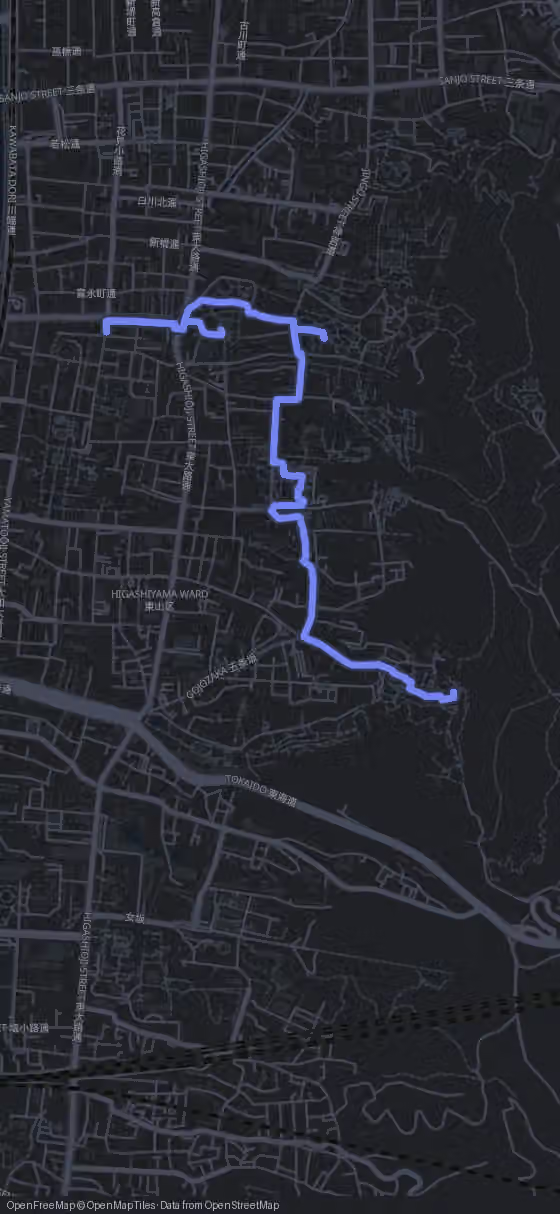
Route map for the Kyoto walking tour
Stop 1 of 6
400 m·5 min
Yasaka Shrine
Head west toward the Gion District
Welcome to Kyoto. I'm Alex, and the city's ancient beauty often survives through careful renewal.
Try this tour with Alex

Six Stops from Gion's Shrine to Kiyomizu-dera

The walk runs from Yasaka Shrine through the Gion District and Maruyama Park to Kodai-ji, along Ninenzaka Street and up to Kiyomizu-dera. It covers 2.8 km with 43 min of pure walking; with both temple visits, plan about four hours.

Four stops are free and always open. Kodai-ji and Kiyomizu-dera both charge admission. The route with map and GPS navigation runs free in your browser; the AI Tour Guide is optional.

Open free GPS & optional AI Tour Guide
This short shows highlights of the route. All 6 stops follow below.

The Route

Walking Map of Kyoto: From Gion Up to Mount Otowa

6 stops 2.8 km 43 min walking
Tap to load interactive map

The 6 stops along this route

  1. Yasaka Shrine in Kyoto, stop 1 on the self-guided walking tour
    1Yasaka Shrine
  2. Gion District in Kyoto, stop 2 on the self-guided walking tour
    2Gion District
  3. Maruyama Park in Kyoto, stop 3 on the self-guided walking tour
    3Maruyama Park
  4. Kodai-ji in Kyoto, stop 4 on the self-guided walking tour
    4Kodai-ji
  5. Ninenzaka Street in Kyoto, stop 5 on the self-guided walking tour
    5Ninenzaka Street
  6. Kiyomizu-dera in Kyoto, stop 6 on the self-guided walking tour
    6Kiyomizu-dera
  7. That's the full route.

    Walk it with an AI Tour Guide talking you through every one of these streets.

    Start free in your browser
    You made it

Your Kyoto Walking Tour Through Gion and Higashiyama

  1. 1

    Yasaka Shrine

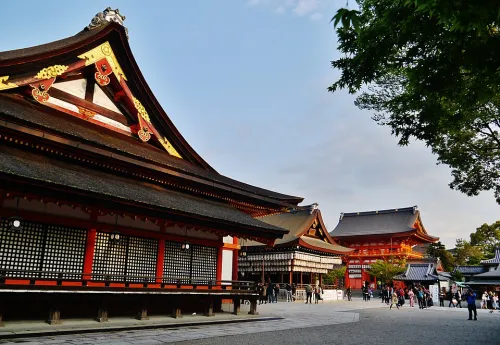
    Yasaka Shrine in Kyoto, stop 1 on the self-guided walking tour

    You begin at the east end of Shijō-dōri, where Yasaka Shrine spreads out as a group of buildings rather than a single hall: gates, a main hall and a stage. For most of its history it went by another name, Gion Shrine, and the whole neighbourhood you are about to walk through took its name from it.

    The main deity here is Susanoo, honoured in the tradition of the Gion faith. Look at how the shrine is arranged: his consort Kushinadahime is worshipped on the east side, and eight offspring deities, known together as the yahashira no mikogami, on the west. Among them are Ōtoshi no kami and Ukanomitama no kami, deities you will meet again at shrines all over Japan.

    Construction began in 656, and by the early Heian period the shrine enjoyed imperial patronage. In 994 Emperor Ichijō added Gion Shrine to the short list of shrines to which imperial messengers reported important events of the realm. The big break came with the Meiji Restoration, when the state forced Buddhism and Shinto apart: the shrine became Yasaka Shrine, and worship shifted from Gozu Tenno to Susanoo. Between 1871 and 1946 it stood in the first rank of government supported shrines.

    One story explains why this place matters so much to Kyoto. In 869 a terrible epidemic swept the country, and the Emperor ordered a ritual to calm the vengeful spirits blamed for it. Sixty-six pikes, one for each region of Japan at the time, were raised in a ceremony called goryo-e at Shinsenen, a lake at the Imperial Palace back then.

    The shrine is free and open day and night, so you can linger as long as you like. Gion grew up right in front of it to serve the shrine's visitors, and you reach its lanes after just 380 m, about 5 minutes on foot.
    Hours
    Open 24/7
    Price
    Free
  2. 2

    Gion District

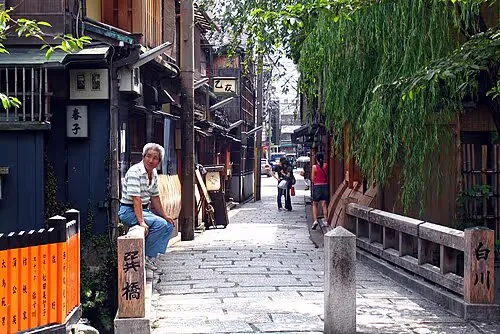
    Gion District in Kyoto, stop 2 on the self-guided walking tour

    The Gion District started out in the Sengoku period as an entertainment quarter for travellers and pilgrims visiting the shrine you just left. Over time it became one of the best-known geisha districts in Japan. Even the name has a story: Gion is the Japanese form, via Chinese, of Jetavana, a Buddhist term.

    Here you will hear a different word for geisha. Kyoto's women of the arts call themselves geiko, which means roughly "a woman of art", while geisha means "artist" or "person of the arts". Gion actually holds two hanamachi, or geisha districts: the larger Gion Kobu, which covers most of the area including the famous Hanamikoji street, and the smaller Gion Higashi in the northeast corner, centred on its rehearsal hall. They were one district until they split in 1881.

    Watch for the machiya, old wooden townhouses. Some of them work as ochaya, teahouses where geiko entertain guests with song, traditional dance, drinking games and conversation. The number of geisha has fallen sharply over the last century, yet the district is still known for keeping its traditional architecture and entertainment alive, and part of it is a national historical preservation district.

    Notice also what is missing overhead. Since 1986 the city has moved power lines underground and removed electric poles on streets like Hanamikoji and Nene no Michi, to bring back the historic look of the lanes. You may see geiko and maiko hurrying to parties or lessons; they are on their way to work, so give them room and ask before taking a photo.

    From Gion it is 710 m, about 11 minutes, to the green open space of Maruyama Park.

    Hours
    Always open
    Price
    Free
  3. 3

    Maruyama Park

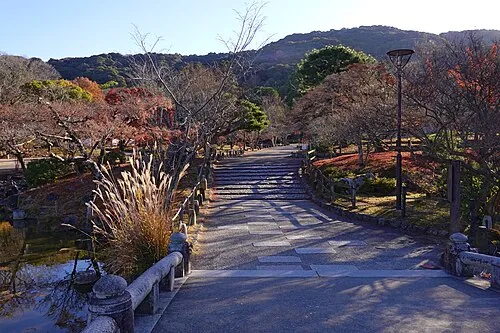
    Maruyama Park in Kyoto, stop 3 on the self-guided walking tour

    Maruyama Park is the oldest public park in Kyoto, opened in 1886. Its name comes from the temple Enzan'anyō-ji on the east side of the grounds, whose sub-temples once stood where you are walking now. The layout is the work of Ogawa Jibee, the leading garden designer of his day.

    Look for the Hyōtan-ike, the gourd pond, jokingly named for its shape and laid out in 1913 as a Japanese stroll garden. Nearby stands a memorial to Sakamoto Ryōma and Nakaoka Shintarō, two opponents of the Tokugawa shogunate who were attacked and killed in Kyoto in 1867. A further marker remembers the historian and poet Rai San'yō.

    The park's pride is its cherry trees: it is the only park in Kyoto honoured as a meisho, a celebrated place, for them. The star is a weeping cherry with a long formal name. The original tree, thought to be about 200 years old, died in 1947. Sano Tōemon, a garden master of the fifteenth generation, raised a new tree from its seed and gave it to the park in 1949; by 2014 it had grown to 12 m. At the end of April the blossoms are lit up in the evening, and you can stroll beneath them after dark.

    In the southwest corner stands the Chōrakukan, a villa built for the tobacco magnate Murai Kichibee and now used as a hotel. The park is free and always open, a good place to slow down before the temples.

    From here it is 650 m, about 9 minutes, to Kodai-ji, the first temple of the walk.

    Hours
    Open 24/7
    Price
    Free
  4. 4

    Kodai-ji

    Kodai-ji in Kyoto, stop 4 on the self-guided walking tour

    Kodai-ji is a temple born of grief and politics. After the warlord Toyotomi Hideyoshi died, his wife Kita no Mandokoro became a nun, and in 1603 Emperor Go-Yōzei gave her the dharma name Kōdai-in. She vowed to build a temple for Hideyoshi's soul, and Tokugawa Ieyasu, the man who would rule Japan after her husband, backed the project.

    The temple rose on the grounds of Unkō-ji, which had burned in the Ōnin War, and much of it was assembled from elsewhere. Buildings were moved from other Kyoto temples, and from Fushimi Castle came her palace with its front garden, the abbot's quarters and a tea house. Ieyasu put his own officials in charge of the work; one of the samurai, Hori Naomasa, mattered so much that his wooden statue sits in the Founder's Hall.

    Kodai-ji was consecrated in 1606 as a Sōtō temple and switched to the Rinzai school of Zen in July 1624, helped by her brother's ties to Kennin-ji. Kōdai-in died later that year, and her palace became the sub-temple Entoku-in. A fire on 9 February 1789 destroyed the small abbot's quarters and the refectory.

    Is it worth going inside? If you care about gardens, yes: the gardens were designed by Kobori Enshū and are a nationally designated Place of Scenic Beauty, and the precincts became a National Historic Site in 1966, which makes the admission fee worthwhile.

    Leaving the temple, it is only 310 m, about 4 minutes, to the stone paving of Ninenzaka Street.

    Hours
    Daily 09:00–17:30 (last admission 17:00); during special night illumination 17:00–22:00 (last admission 21:30)
    Price
    JPY 800 adult; JPY 400 student; group JPY 700; combined ticket JPY 1200
  5. 5

    Ninenzaka Street

    Ninenzaka Street in Kyoto, stop 5 on the self-guided walking tour

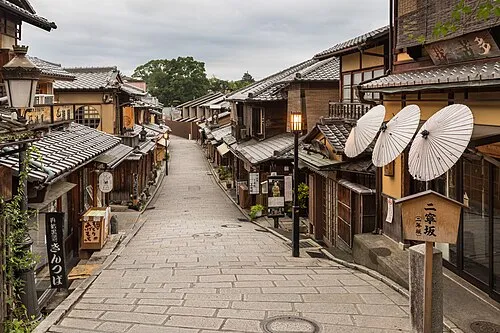
    Ninenzaka Street is an old stone-paved pedestrian lane, just 150 m long, lined with traditional buildings and small shops. It is one of the lanes of Higashiyama where you walk on paving rather than asphalt, and the wooden fronts on both sides make it feel like a step back in time.

    Take it slowly and look into the shops as you pass; this is the place on the route for browsing rather than sightseeing. It is free and open at any hour, and it is often visited together with Sannenzaka, a similar lane.

    From here the route climbs 780 m, about 13 minutes, to the final stop, Kiyomizu-dera on Mount Otowa.

    Hours
    Open 24/7
    Price
    Free
  6. 6

    Kiyomizu-dera

    Kiyomizu-dera in Kyoto, stop 6 on the self-guided walking tour

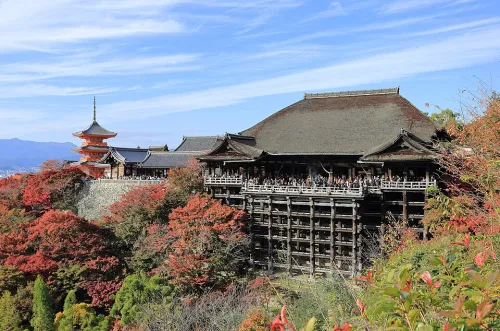
    Kiyomizu-dera, the Pure Water Monastery, sits on Mount Otowa and is one of the few temples in Kyoto older than the founding of the capital Heian-kyō, alongside Kōryū-ji and Kurama-dera. It belongs to the Kita-Hosso sect, and its main image is a hidden statue of the eleven-headed Kannon, kept out of sight as a hibutsu.

    It ranks among Japan's leading temples of Kannon worship, and pilgrims come all year: it is the 16th stop on the Saigoku Kannon Pilgrimage. The temple is part of the Historic Monuments of Ancient Kyoto UNESCO World Heritage Site, and since 1995 it has hosted the Kanji of the Year ceremony every 12 December, when a single character is chosen to sum up the year.

    Its beginnings are pure legend. In 778 a monk named Kenshin dreamed of a message that sent him north to Mount Otowa. There he found a golden stream, followed it to its source and met a white-robed ascetic, Gyōei Koji, who had been praying under a waterfall to the thousand-armed Kannon. The hermit was 200 years old, and he greeted Kenshin with the words: "I have waited many years for you to come."

    Plan a full hour here; this is the visit to save time for. Admission is charged, and you buy your ticket at the counter. The walk ends here, high above the lanes you have come up through.

    Hours
    Daily from 06:00, closing time varies seasonally
Walking tour route map of Kyoto Route loaded
Yasaka ShrineGion DistrictMaruyama ParkKodai-ji+2
All 6 stops are already on the map.
You just press start.
AI Tour Guide

Ready to walk from Yasaka Shrine to Kiyomizu-dera with a guide in your ear?

Press start wherever you are, even hundreds of kilometres from Kyoto, and the guide begins telling its stories right away. In the city, pick any of the 6 stops to start from: it leads you there, then talks with you the whole route, asking, listening, remembering, and shaping the tour around your answers.

6stops 2.8km 43 minwalking 13languages
▶Start the tour free

Free to start · Runs in your browser · No app, no download

Shorter Ways to Walk Gion and Higashiyama

The route splits neatly into a free shrine and park half and a temple half, so you can walk just one if time is short.

Gion and Maruyama Park, all free

Stops: 1, 2, 3

For an evening or a first short taste of Kyoto. You walk 16 minutes in total, pay no admission anywhere, and all three stops are open around the clock. Allow about an hour and a half.

The temple half

Stops: 4, 5, 6

For temple and garden lovers who want the Zen garden of Kodai-ji and the mountain temple of Kiyomizu-dera. Only 17 minutes of walking, with tickets at both temples. Allow a little over two hours, and start early enough in the day that Kodai-ji is still admitting visitors.

How Long Does This Kyoto Tour Take on Foot?

The 43 min of pure walking are spread over five short legs, the longest being the 780 m climb from Ninenzaka Street to Kiyomizu-dera. The real time goes into looking: about 20 minutes at Yasaka Shrine, half an hour in the Gion lanes, 20 minutes in Maruyama Park, roughly 45 minutes inside Kodai-ji, a quarter of an hour on Ninenzaka Street and an hour at Kiyomizu-dera. That adds up to just under four hours.

A sample day: start at Yasaka Shrine at 08:30 and you reach Kodai-ji at about 10:05 and Kiyomizu-dera at about 11:20, finishing around 12:20. If you skip both temple interiors, the full route still takes a little over two hours.

Before You Set Off from Yasaka Shrine

  • Start and finish: The recommended start is Yasaka Shrine, but you can join at any stop. The route ends at Kiyomizu-dera, not back at the start.
  • Best time of day: Kodai-ji and Kiyomizu-dera have set opening hours, so check them before you go, especially if you arrive late in the afternoon. Yasaka Shrine, the Gion District, Maruyama Park and Ninenzaka Street never close.
  • Costs: Kodai-ji charges admission, and so does Kiyomizu-dera; you pay at the ticket counter on arrival. Everything else on the route is free.
Walking tour route map of Kyoto
AI Tour Guide

Your guide is ready whenever you reach Yasaka Shrine.

Press start and a voice AI Tour Guide takes it from here: leading the route through Kyoto, telling the stories, and turning your walk into a real back-and-forth conversation. No app or download is needed; it runs in your browser.

6stops 2.8km 43 minwalking 13languages
▶Start the tour free

Free to start · Runs in your browser · No app, no download

What the AI Tour Guide Adds Between Gion and Kiyomizu-dera

On this walk the stories run deep: emperors and epidemics at Yasaka Shrine, a shogun's widow at Kodai-ji, a two-hundred-year-old hermit at Kiyomizu-dera. The AI Tour Guide picks up where the text stops, so you can ask how the founding legend of Kiyomizu-dera ends, or what happened to the rebels remembered in Maruyama Park, while it notices what grips you and steers the conversation there.

A Real Conversation A voice AI Tour Guide greets you, leads the whole route, and tells the stories and facts as you walk, asking what you want to see and keeping a real conversation going. Not a recording you press play on.
Map Navigation Follow the route on the map and walk at your own pace. You choose where to start and when to move to the next stop.
Ask Anything Curious about a building you pass? Ask your AI Tour Guide on the spot and the conversation carries on.
13 Languages Switch language anytime. No separate tour needed.
Start free in your browser

Common Questions About This Higashiyama Walk

Can I walk this route in the evening?

Yes, the first half works well after dark, since Yasaka Shrine, the Gion District and Maruyama Park are open around the clock. Kodai-ji normally closes before evening, but during its special night illumination it opens again after dark.

Are there discounts at Kodai-ji?

Yes. Students and groups pay less than the adult price, and a combined ticket is also sold; ask at the counter what it includes.

Can I combine this walk with a trip to Nara or Osaka?

Both are close: Nara lies about 36 km away and Osaka about 44 km. This route fills a morning, so it pairs well with a separate day for either city.

Is the tour really free?

Yes. The whole tour is free: the route, the interactive map and the navigation cost you nothing. Only the voice AI Tour Guide is optional and paid: you test it with 100 free credits, then you pay either €5 per hour or €19.99 for this whole tour, with no time limit. Admission to 2 of the 6 stops is not included: Kodai-ji and Kiyomizu-dera charge their own entry fees.

Do I need to download an app?

No. Everything runs in your phone browser. Open the route and start walking, no download and no sign-up required.

Do I need to book the walking tour in advance?

No booking needed. This self-guided tour is available anytime. Open the route in your browser and start walking. The AI Tour Guide works instantly, no app, no reservation required.

What languages is the AI Tour Guide available in?

The AI Tour Guide speaks 13 languages, so you take the tour in your own language and can switch at any time.

Can I skip stops or change the route?

Yes. Skip any stop, spend extra time at places you like, or start the route from any point. It is your walk, you set the pace.
Image credits
▶ Start free in your browser Runs in your browser, no app, no download