Free Walking Tour Osaka: Castle, Temple and Canal Lights

Start at Hideyoshi's castle, visit a temple founded by Prince Shotoku and Billiken's tower, then walk a 200-year-old market to the Glico Man on the Dotonbori canal.

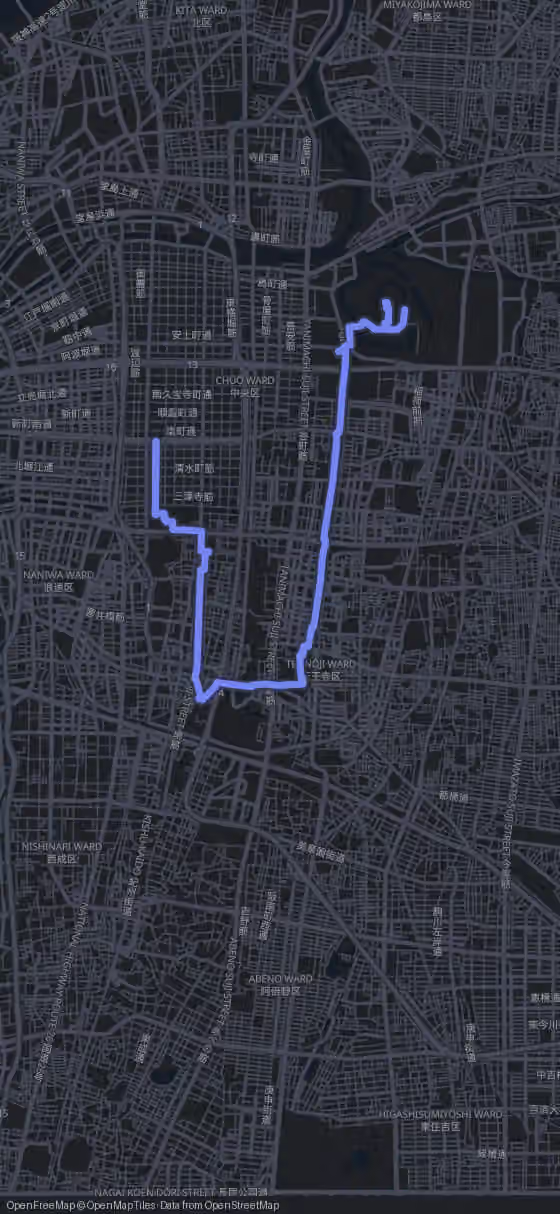
9 Stops 10.3 km ~2 h 25 min walking
Route map for the Osaka walking tour
Stop 1 of 9
670 m·8 min
Osaka Castle
Head north-west toward Osaka Castle Park
Welcome to Osaka. I'm Alex, and the city's great castle tower has lived more than one life.
Try this tour with Alex

This Osaka Route at a Glance

Nine stops lead from Osaka Castle and Osaka Castle Park past the Osaka Museum of History and Shitennoji Temple to Shinsekai & Tsutenkaku Tower, Kuromon Ichiba Market, Hozenji Yokocho, Shinsaibashi and Dotonbori. The route covers 10.3 km with 2 h 25 min of pure walking; with the visits worth making inside, plan just under eight hours.

The park, the market, Hozenji, Shinsaibashi and Dotonbori are free; the castle keep, the museum, the temple and the tower charge admission. Route, map and GPS navigation are free in your browser; the AI Tour Guide is optional.

Open free GPS & optional AI Tour Guide
This short shows highlights of the route. All 9 stops follow below.

The Route

Walking Map of Osaka: Castle to Canal

9 stops 10.3 km 2 h 25 min walking
Tap to load interactive map

The 9 stops along this route

  1. Osaka Castle, stop 1 on the self-guided walking tour
    1Osaka Castle
  2. Osaka Castle Park, stop 2 on the self-guided walking tour
    2Osaka Castle Park
  3. Osaka Museum of History, stop 3 on the self-guided walking tour
    3Osaka Museum of History
  4. Shitennoji Temple in Osaka, stop 4 on the self-guided walking tour
    4Shitennoji Temple
  5. Shinsekai & Tsutenkaku Tower in Osaka, stop 5 on the self-guided walking tour
    5Shinsekai & Tsutenkaku Tower
  6. Kuromon Ichiba Market in Osaka, stop 6 on the self-guided walking tour
    6Kuromon Ichiba Market
  7. Hozenji Yokocho in Osaka, stop 7 on the self-guided walking tour
    7Hozenji Yokocho
  8. Shinsaibashi in Osaka, stop 8 on the self-guided walking tour
    8Shinsaibashi
  9. Dotonbori in Osaka, stop 9 on the self-guided walking tour
    9Dotonbori
  10. That's the full route.

    Walk it with an AI Tour Guide talking you through every one of these streets.

    Start free in your browser
    You made it

Your Osaka Walking Tour, Stop by Stop, from Hideyoshi to the Glico Man

  1. 1

    Osaka Castle

    Osaka Castle, stop 1 on the self-guided walking tour

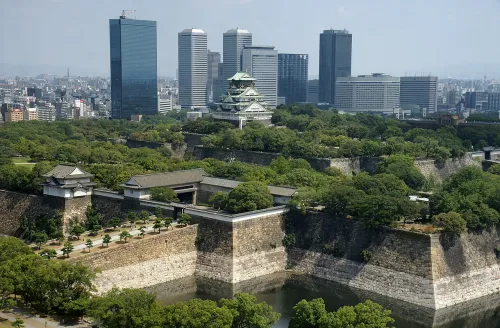
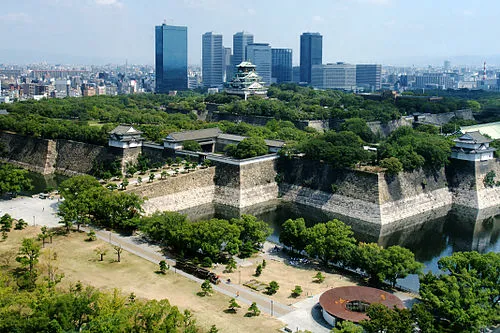
    Begin with the stone. Before you look up at the keep, look at what it stands on: two raised platforms of landfill held up by sheer walls of cut rock, built with a technique called burdock piling, each one rising straight out of a moat. Toyotomi Hideyoshi built the castle here in 1583, and it played a major role in the unification of Japan in the late sixteenth century.

    The defences come in layers. An inner moat runs inside the grounds, wet on one side and dry on the other, while the outer moat surrounds the whole castle in four water-filled sections, one for each cardinal direction. Two main checkpoints guarded it: the Otemon Gate and the Aoyamon Gate. Keep an eye on the walls for the megaliths, including the huge Octopus stone, which have no official protection but are hard to miss.

    Thirteen structures on the grounds are listed as Important Cultural Properties, among them the Otemon and Sakuramon gates, turrets such as Inui-yagura, Sengan and Tamon, the Kinmeisui Well, the Kinzo Storehouse and the Enshogura gunpowder magazine. Around the Otemon Gate, three sections of dobei, an old mud-and-plaster wall, each carry that status on their own.

    The keep rises five storeys on the outside and eight inside, set on a tall stone base meant to keep attackers at a distance. Going in costs admission, and the payoff is the view from the top across the Osaka Plain, from Osaka Bay to Mount Ikoma. If you love panoramas, it is worth it; if your day is tight, the walls, moats and gates outside tell much of the story for free.

    From the keep, a 680 m walk of about 10 minutes takes you into the wider green of Osaka Castle Park.
    Hours
    Daily: 09:00–18:00
    Price
    600 JPY
  2. 2

    Osaka Castle Park

    Osaka Castle Park, stop 2 on the self-guided walking tour

    The park looks peaceful, but few places in Osaka have changed hands so often. In the fifteenth century a militant temple, Ishiyama Hongan-ji, stood on this ground. Hideyoshi destroyed it in 1583 to build his castle. From 1870 until 1945 the Osaka Arsenal covered a large part of the area, and it was destroyed at the end of World War II.

    The park officially opened to the public in 1931, yet most of it still belonged to the Imperial Japanese Army. Only after the war were the military buildings cleared away and the land given over to the city as a public park. Today it is the second largest park in Osaka, lying south of the Okawa river.

    It is a living park, not just a castle setting. Osaka Castle Hall, sports fields, an open-air music theatre and an open-air concert hall share the grounds, and busking groups often perform along the paths. In spring, people come for the cherry and plum blossoms.

    The park is free and open around the clock, so take your time. From here it is 1080 m, about 16 minutes, to the Osaka Museum of History, where you will look back on the castle from high above.

    Hours
    Open 24/7
    Price
    Free
  3. 3

    Osaka Museum of History

    Osaka Museum of History, stop 3 on the self-guided walking tour

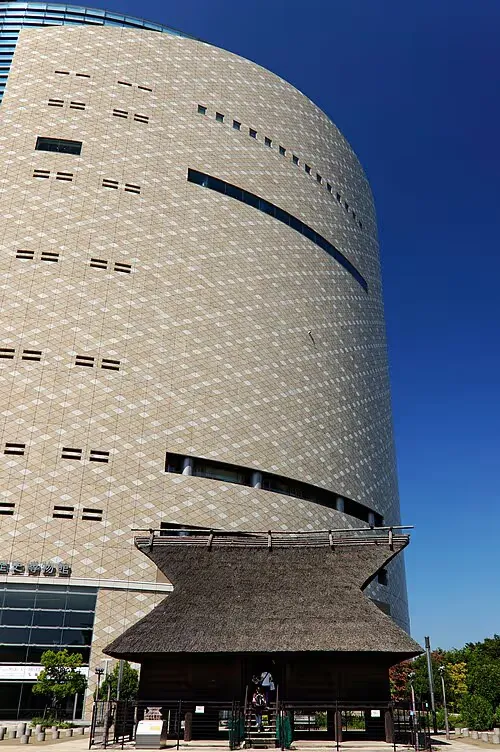
    Locals call it Rekihaku. The museum opened in this modern high-rise in 2001 and tells Japanese history through the lens of Osaka. The visit runs from the top down: you start on the 10th floor and work your way down to the 7th, or to the 6th when a special exhibition is on.

    The 10th floor makes a strong first impression. Part of the Daigokuden, the throne hall of the ancient Naniwa Palace, is rebuilt at full scale, with red-lacquered pillars 70 cm across and a crowd of life-size figures in historical dress, while gagaku court music plays. The 9th floor shows the river city laced with canals, from its building under Hideyoshi through the Edo period, with models at a scale of 1:20.

    The 8th floor explains how archaeology works, and the 7th brings you into everyday city life in the Taisho and Showa eras up to World War II. In the basement you can see the excavations made before the building went up, with traces of storehouses from the Asuka period, about 1,350 years ago. From a high point inside the building you also get a view across to the castle you just left.

    There are two ways through. The main circuit follows the full-size reconstructions, with videos where needed, and takes about an hour; the thorough version adds the models and display cases. Admission is charged, and it is worth it if you want the background to the castle and to the canals you will see at the end of the day.

    Next comes the longest leg of the route: 3560 m, about 50 minutes, to Shitennoji Temple.

    Hours
    9:30–17:00 (admission until 30 min before closing)
    Price
    600 JPY
  4. 4

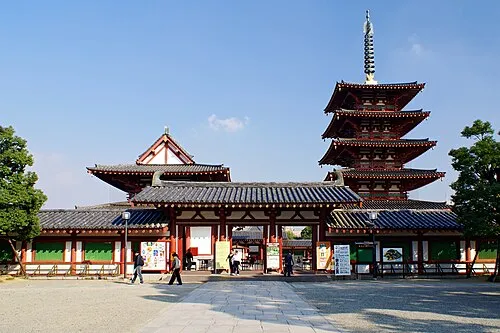
    Shitennoji Temple

    Shitennoji Temple in Osaka, stop 4 on the self-guided walking tour

    Shitennoji means Temple of the Four Heavenly Kings, and it is sometimes regarded as the first Buddhist and the oldest officially administered temple in Japan. In the sixth century, when Buddhism was not yet widespread here, Prince Shotoku, known for his deep faith, commissioned it as part of a national project to spread the new religion.

    To build it he brought in three carpenters from the Korean kingdom of Baekje. One of the people involved in that first construction later founded Kongo Gumi, a firm specialising in temples and shrines. It was the oldest company in the world until the Takamatsu Construction Group acquired it in 2004.

    Shotoku did not plan a temple alone. Around the walled compound of seven buildings he set up four institutions to help people live better: one for religion and education, one for welfare, a hospital and a pharmacy. Three of the four are known to have existed inside the temple in the Kamakura period. As you walk the grounds, think of it as a place of public care as much as of prayer.

    Be clear about what you are looking at: the buildings have been rebuilt several times, and most of what stands today dates from the last complete reconstruction in 1963. The founding idea is ancient; the timber is modern. Shortly after World War II the temple broke away from the Tendai sect and founded its own Wa sect. Admission is charged, and it pays off if Japan's early Buddhist history draws you in.

    From here it is 1080 m, about 15 minutes, to Tsutenkaku Tower, and on the way you walk into the Shinsekai district that surrounds it.

    Hours
    Apr–Sep: Daily 08:30–16:30 | Oct–Mar: Daily 08:30–16:00
    Price
    300 JPY
  5. 5

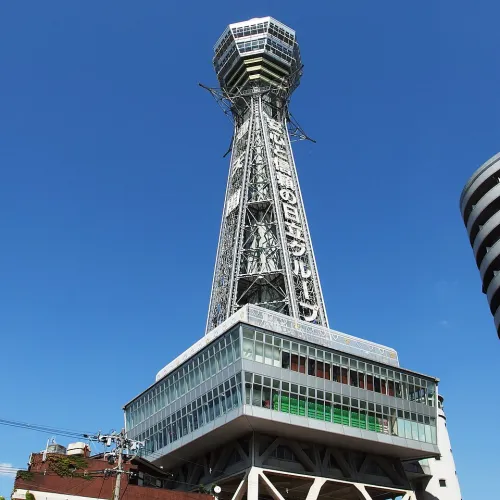
    Shinsekai & Tsutenkaku Tower

    Shinsekai & Tsutenkaku Tower in Osaka, stop 5 on the self-guided walking tour

    Tsutenkaku means Tower Reaching Heaven. It stands 108 m tall in the Shinsekai district, its main observation deck sits at 91 m, and it carries advertising for the Hitachi company. The tower you see is the second on this spot.

    The first went up in 1912, modelled on both the Eiffel Tower and the Arc de Triomphe and linked to the neighbouring Luna Park amusement park by an aerial cable car. At 64 m it was then the second tallest structure in Asia, and it quickly drew visitors from all over the region. A fire badly damaged it in 1943; instead of repairing it, the authorities took it apart and recycled the steel for the war effort. After the war, residents campaigned for a new tower, and Tachu Naito, known as Japan's Father of Towers, designed the eight-sided structure that opened in 1956.

    Look out for Billiken, the God of Happiness, enshrined on the fifth-floor observation deck. The American charm doll arrived in Japan around 1910 and stood in Luna Park, but when the park closed in 1923 the wooden statue disappeared. In 1979 a copy was carved from an old photograph and placed in the tower. Visitors drop a coin in his box and rub the soles of his feet to make a wish come true.

    The tower is also known for its lights. The neon changed every few years and was switched off during the oil crisis between 1974 and 1976; today LED lighting shows a new colour set every two months, pink for cherry blossom in March and April, for example.

    Going up costs admission and needs a time-slot reservation. Do it if you want Billiken and the view; otherwise the tower and its lighting are a fine sight from the street. Then walk 1570 m, about 22 minutes, to Kuromon Ichiba Market.

    Hours
    09:00–21:45 (main observation deck last entry 21:15; special outdoor deck last entry 21:35); entry by time-slot reservation
    Price
    1,500 JPY adults, 800 JPY children 5–14
  6. 6

    Kuromon Ichiba Market

    Kuromon Ichiba Market in Osaka, stop 6 on the self-guided walking tour

    Kuromon is a covered market street whose arcades run for about 580 m, laid out roughly in the shape of the katakana character キ. Around 150 shops line it, selling fresh fish, meat and vegetables and a wide range of other food, and together with markets such as Tsuruhashi it is known as one of Osaka's great food stores.

    The name means black gate. In the Edo period a temple called Enmyoji stood nearby with a black-lacquered gate, and in the early nineteenth century fishmongers began trading in front of it. At first people called it the Enmyoji market. In 1912 the Great Minami Fire burned the temple and its gate, and the temple moved away; the black gate survived only in the market's new name, used from the start of the Taisho era.

    The market burned again in the first great air raid on Osaka in March 1945. After the war it recovered quickly in makeshift barracks and earned nicknames like the Kitchen of Naniwa and the Stomach of Osaka, busiest of all at the end of the year. The 1960s were the heyday of its night stalls, and that was when the tent roofs were replaced with steel arcades. In the 2010s, restaurants and izakaya serving fresh seafood moved in.

    For a long time the stalls served neighbours. Today the market has a reputation for steep prices, for locals and foreign visitors alike, so check the price before you order. Walking through is free and worth it for the sight of the stalls alone. From here it is 690 m, about 10 minutes, to Hozenji Yokocho.

    Hours
    Daily: 09:00–18:00
    Price
    Free (entry)
  7. 7

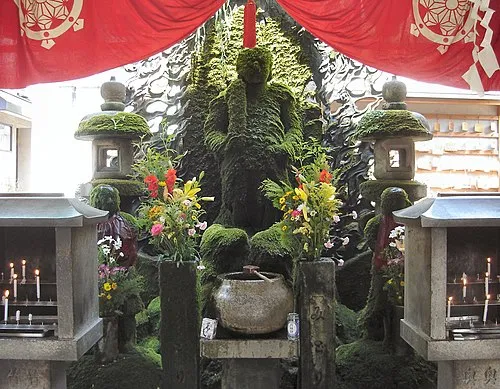
    Hozenji Yokocho

    Hozenji Yokocho in Osaka, stop 7 on the self-guided walking tour

    Hozenji is a temple of the Jodo school of Buddhism, with Amida Buddha as its principal image. It is best known for the Mizukake Fudo, whose name means water-splashing Fudo: a figure so completely covered in moss that hardly any stone shows through.

    Because the temple held a thousand-day nembutsu prayer, people nicknamed it Sennichi-dera, the Thousand-Day Temple, and the district name Sennichimae, meaning in front of the thousand days, comes from the area before its gate. Walk on through the lanes named after it; it is free and always open.

    From Hozenji, it is 900 m, about 12 minutes, to the arcades of Shinsaibashi.

    Hours
    Open 24/7
    Price
    Free (entry)
  8. 8

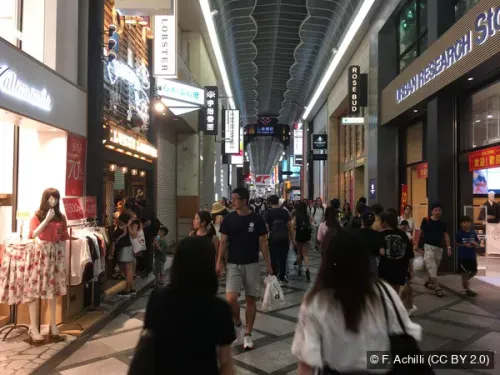
    Shinsaibashi

    Shinsaibashi in Osaka, stop 8 on the self-guided walking tour

    Shinsaibashi's covered shopping street has been busy for a long time. From around 1600 it was the road linking the theatres in today's Dotonbori with the Shinmachi pleasure quarter. By the mid-eighteenth century, when the kimono merchant Matsuya, today's Daimaru, opened a shop here, the area was already a shopping district.

    As Osaka grew, so did Shinsaibashi's fame. People spoke of Ginza in the east and Shinsaibashi in the west, and just as Tokyo had its Ginbura, the leisurely stroll along the Ginza, Osaka had its Shinbura. With the rise of Umeda its national fame has faded, but within Osaka it is still the shopping street with the strongest brand, and in fashion, having a shop here counts as a mark of status.

    Look out for Daimaru Shinsaibashi and Shinsaibashi PARCO as you walk. Entry is free; the shops set their own hours. The arcade leads you toward Ebisubashi bridge, and from here it is 710 m, about 10 minutes, to Dotonbori.

    Hours
    Shops typically 10:00–21:00; hours vary by store
    Price
    Free (entry)
  9. 9

    Dotonbori

    Dotonbori in Osaka, stop 9 on the self-guided walking tour

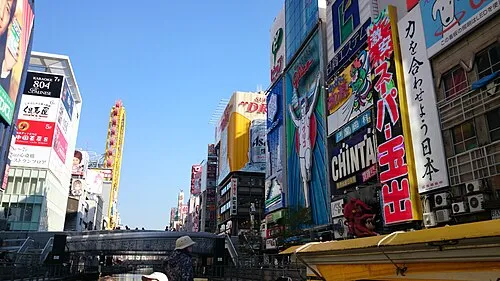
    Dotonbori runs along its canal from Dotonboribashi to Nipponbashi bridge in Namba. Once a theatre district, it is now a nightlife and entertainment area full of quirky charm and large illuminated signboards. Find the Glico Man, the runner crossing a finishing line on the confectioner Glico's billboard; within Japan he is often seen as the symbol of Osaka.

    The canal's story leads back to where you began. In 1612 Nariyasu Doton, who managed the local canals, started digging along what was then the southern edge of Osaka, joined by Yasui Jihe, Yasui Kuhe and Hirano Tojiro. Jihe died of illness, and Doton fell in the Siege of Osaka in summer 1615, fighting for Toyotomi Hideyori on the losing side. Kuhe and Tojiro finished the canal by September 1615, and Matsudaira Tadaaki, the new lord of Osaka Castle, named it after Doton anyway.

    Over time, the story changed. A fictional local merchant called Yasui Doton took the credit, said to have widened the little Umezu River at his own expense, and in 1915 a stone monument to him went up at the north end of Nipponbashi. In 1965 a court case over ownership of the canal, the Dotonbori Trial, used Yasui family records from the 1600s to rule that this Yasui Doton had never existed.

    Dotonbori is free and always open, so let the walk end here at your own pace. When the signboards are lit, the canal that began in the shadow of Hideyoshi's castle makes a fitting finish to the day.

    Hours
    Always open
    Price
    Free (entry)
Walking tour route map of Osaka Route loaded
Osaka CastleOsaka Castle ParkOsaka Museum of HistoryShitennoji Temple+5
All 9 stops are already on the map.
You just press start.
AI Tour Guide

You know the route now. Walk it with a guide in your ear.

Press start wherever you are, even hundreds of kilometres from Osaka, and the guide begins telling its stories right away. In the city, pick any of the 9 stops to start from: it leads you there, then talks with you the whole route, asking, listening, remembering, and shaping the tour around your answers.

9stops 10.3km 2 h 25 minwalking 13languages
▶Start the tour free

Free to start · Runs in your browser · No app, no download

Shorter Ways to Walk Osaka

Not every day has room for all nine stops. These three cuts follow the same order and work on their own.

Castle and history morning

Stops: 1, 2, 3

For history lovers with half a day. Only 26 minutes of walking between the castle, its park and the museum, so most of your time goes into the castle keep and the museum floors, both with admission.

From temple to neon

Stops: 4, 5, 6, 7, 8, 9

For anyone who wants the south of the city in one sweep: 1 h 9 min of walking from Shitennoji Temple through Shinsekai to the Dotonbori canal. Admission at the temple and, if you go up, at Tsutenkaku Tower.

Minami evening, all free

Stops: 6, 7, 8, 9

For a relaxed late afternoon into evening: 32 minutes of walking from Kuromon Ichiba Market past Hozenji and through the Shinsaibashi arcade to the lights of Dotonbori. No admission anywhere.

How Long Does This Osaka Tour Take on Foot?

Walking alone takes 2 h 25 min over 10.3 km. The longest leg is the 50 minutes from the museum to Shitennoji Temple; every other stretch takes 22 minutes or less. Add about an hour each for the castle keep and the museum's main circuit, around 40 minutes each for the temple and the tower, and shorter pauses at the park, the market, Hozenji, Shinsaibashi and Dotonbori, and you arrive at just under eight hours.

The castle and history morning fills about half a day once you include both interiors. The temple-to-neon stretch takes roughly three and a half hours with the temple and the tower. The free Minami evening needs about two hours if you browse the market and linger at the canal.

Before You Set Off from Osaka Castle

  • Start: Osaka Castle is the recommended start, but you can join the route at any stop and pick up the order from there.
  • Finish: The route ends on the Dotonbori canal, among the illuminated signboards.
  • Time of day: Start in the morning so the castle and the museum fall in the first half, and you reach Dotonbori when its signboards are lit.
  • Paid visits: The castle keep, the Osaka Museum of History, Shitennoji Temple and the Tsutenkaku observation decks charge admission. Everything else on the route is free to enter.
  • Tsutenkaku: Entry to the tower works by time-slot reservation, so book a slot that matches your arrival after the temple.
Walking tour route map of Osaka
AI Tour Guide

Your guide is ready when you are, from moat to canal.

Press start and a voice AI Tour Guide takes it from here: leading the route through Osaka, telling the stories, and turning your walk into a real back-and-forth conversation. No app or download is needed; it runs in your browser.

9stops 10.3km 2 h 25 minwalking 13languages
▶Start the tour free

Free to start · Runs in your browser · No app, no download

What the AI Tour Guide Adds Between Castle and Canal

This route runs from Hideyoshi's fortress to a canal finished in the year his family lost Osaka, and the AI Tour Guide carries that thread as a conversation. It greets you at the castle, tells the stories of each place, asks what interests you, remembers it and shapes the talk around it, so a curiosity about the Four Heavenly Kings or about life in the old Shinmachi quarter gets real room. You can interrupt at any time. You start with 100 free credits; after that, choose this tour all-inclusive for €19.99 with no time limit, or €5 per hour.

A Real Conversation A voice AI Tour Guide greets you, leads the whole route, and tells the stories and facts as you walk, asking what you want to see and keeping a real conversation going. Not a recording you press play on.
Map Navigation Follow the route on the map and walk at your own pace. You choose where to start and when to move to the next stop.
Ask Anything Curious about a building you pass? Ask your AI Tour Guide on the spot and the conversation carries on.
13 Languages Switch language anytime. No separate tour needed.
Start free in your browser

Common Questions about Walking Osaka

If I only pay for one visit, which should it be?

For views, the castle keep: its top looks across the Osaka Plain. For context, the museum's main circuit. For a bit of fun, Tsutenkaku with Billiken. All three charge admission.

Can I see Osaka Castle without paying?

Yes. The walls, moats and gates stand in Osaka Castle Park, which is free and always open. Only the keep charges admission.

Can I combine Osaka with a day in Kyoto or Nara?

This route fills a full day on its own. For another day, Kyoto is 44 km away and Nara 30 km, each with its own free walking route.

Is the tour really free?

Yes. The whole tour is free: the route, the interactive map and the navigation cost you nothing. Only the voice AI Tour Guide is optional and paid: you test it with 100 free credits, then you pay either €5 per hour or €19.99 for this whole tour, with no time limit. Admission to 3 of the 9 stops is not included: Osaka Castle, Osaka Museum of History and Shitennoji Temple charge their own entry fees.

Do I need to download an app?

No. Everything runs in your phone browser. Open the route and start walking, no download and no sign-up required.

Do I need to book the walking tour in advance?

No booking needed. This self-guided tour is available anytime. Open the route in your browser and start walking. The AI Tour Guide works instantly, no app, no reservation required.

What languages is the AI Tour Guide available in?

The AI Tour Guide speaks 13 languages, so you take the tour in your own language and can switch at any time.

Can I skip stops or change the route?

Yes. Skip any stop, spend extra time at places you like, or start the route from any point. It is your walk, you set the pace.
Image credits
▶ Start free in your browser Runs in your browser, no app, no download