Free Walking Tour Jena: Schiller, Haeckel and Stars

From the Market Square past Haeckel's jellyfish villa and Schiller's summer garden to the oldest large planetarium still running, 3.4 km on foot.

11 Stops 3.4 km ~47 min walking
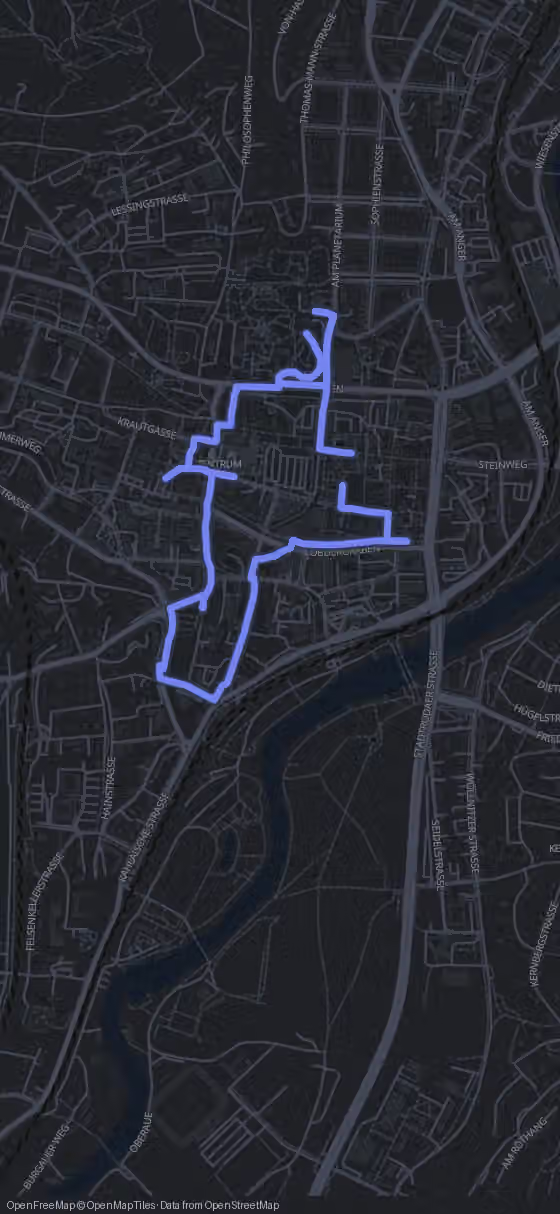
Route map for the Jena walking tour
Stop 1 of 11
260 m·3 min
Market Square
Head south-east toward the Romantikerhaus, one short block off the market.
Welcome to Jena. I'm Alex, and one object intended for Martin Luther's grave took an unexpected turn.
Try this tour with Alex

This Jena Route at a Glance

Eleven stops take you 3.4 km from the Market Square to the Stadtkirche St. Michael, with 47 minutes of pure walking. If you go into the museums and the garden that reward a visit, plan on about five hours; staying outside everywhere, a little over two.

The squares, the Johannistor, the university and the church are free, and so is the Ernst-Haeckel-Haus. The Phyletisches Museum, Schiller's Garden House, the JenTower platform, the Botanical Garden and the Zeiss-Planetarium charge admission. Route, map and GPS navigation run free in your browser; the AI Tour Guide is optional.

Open free GPS & optional AI Tour Guide
View of Jena

The Route

Walking Map of Jena from Hanfried to St. Michael

11 stops 3.4 km 47 min walking
Tap to load interactive map

The 11 stops along this route

  1. Market Square in Jena, stop 1 on the self-guided walking tour
    1Market Square
  2. Romantikerhaus in Jena, stop 2 on the self-guided walking tour
    2Romantikerhaus
  3. Phyletisches Museum in Jena, stop 3 on the self-guided walking tour
    3Phyletisches Museum
  4. Ernst-Haeckel-Haus in Jena, stop 4 on the self-guided walking tour
    4Ernst-Haeckel-Haus
  5. Schiller's Garden House in Jena, stop 5 on the self-guided walking tour
    5Schiller's Garden House
  6. JenTower in Jena, stop 6 on the self-guided walking tour
    6JenTower
  7. Friedrich Schiller University (main building) in Jena, stop 7 on the self-guided walking tour
    7Friedrich Schiller University (main building)
  8. Johannistor in Jena, stop 8 on the self-guided walking tour
    8Johannistor
  9. Botanical Garden in Jena, stop 9 on the self-guided walking tour
    9Botanical Garden
  10. Zeiss-Planetarium in Jena, stop 10 on the self-guided walking tour
    10Zeiss-Planetarium
  11. Stadtkirche St. Michael in Jena, stop 11 on the self-guided walking tour
    11Stadtkirche St. Michael
  12. That's the full route.

    Walk it with an AI Tour Guide talking you through every one of these streets.

    Start free in your browser
    You made it

Your Jena Walking Tour Stop by Stop: Poets, Evolution and Stars

  1. 1

    Market Square

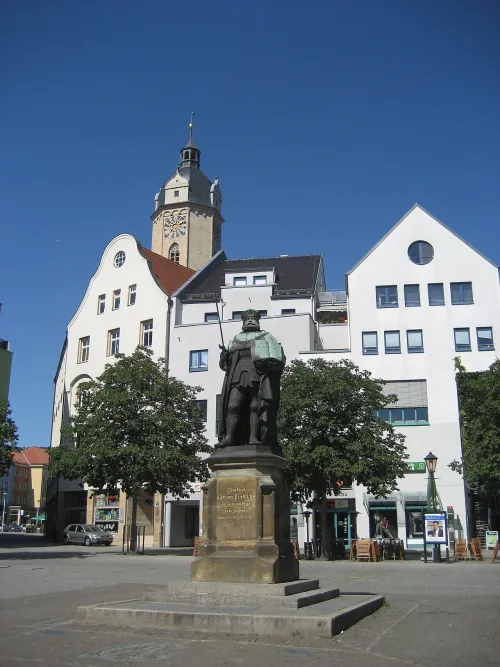
    Market Square in Jena, stop 1 on the self-guided walking tour

    You start on an enclosed square of about 5,000 square metres whose outline has never changed in all its history. Jena gained the right to mint coins as a market town around 1175/80, and the square has been its commercial heart ever since. Four days a week the weekly market fills it with regional food, and the pottery market, the spring market and the Christmas market return to it regularly.

    Look to the southwest side for the town hall, first mentioned in records in 1368 and one of the oldest surviving town halls in Germany. You recognise it by the baroque half-timbered tower and the steeply pointed hipped roofs. The hall construction of the ground floor still shows how people built here in the 14th century. Find the astronomical art clock from the 15th century: above its dial sits the Schnapphans, a figure counted among the ‘Seven Wonders’ of Jena.

    In the middle of the square stands the Hanfried monument. It honours John Frederick I of Saxony, the former ruler who led the Protestants in the Schmalkaldic War and set in motion the school that became today's Friedrich Schiller University. Keep him in mind; his story comes back later on the walk.

    On the north side, Paul Göhre put up a stately neo-Gothic house with a passage onto the market in 1907; today it holds the Stadtmuseum Göhre. Beyond it, roughly 50 m to the north, rises the Stadtkirche St. Michael, where the walk ends.

    From here it is only 260 m, about three minutes, to the Romantikerhaus; on market days you pass the stalls of the weekly market on the way.
    Hours
    24/7
    Price
    Free
  2. 2

    Romantikerhaus

    Romantikerhaus in Jena, stop 2 on the self-guided walking tour

    This modest house dates from around 1670, and you can be precise about it: the roof beams are of pine, spruce and fir felled in the winters of 1667/68 and 1668/69. When it was built it stood at the edge of town, right by the southeastern city wall. Today the town has grown around it, and it sits in the centre near the Red Tower.

    The Romantikerhaus is currently closed. Since October 2026 the museum has been shut for a complete overhaul of its permanent exhibition, funded by a federal programme for culturally significant institutions, and it is expected to reopen in early 2029. So enjoy it from outside and think about who lived here.

    From 1795 the philosopher Johann Gottlieb Fichte lived in this house, and it even had its own lecture hall where he taught. Strictly speaking, though, it is not the historic ‘Romantikerhaus’. That one stood at Leutragasse 5 and was home to the brothers August Wilhelm and Friedrich Schlegel, together with Caroline Schlegel and Dorothea Veit. It was destroyed in the bombing of Jena in 1945, and the Leutragasse itself disappeared when the JenTower and today's Eichplatz were built.

    Still, the building is a genuine witness to Jena around 1800, the moment when this small town was one of the centres of early Romanticism. It has been the city's museum of the Romantic era since 1999, survived serious damage in 2021 and reopened after restoration in 2022.

    Next comes the longest leg of the walk: 700 m, about ten minutes, to the Phyletisches Museum.

    Hours
    Tue–Sun 10:00–17:00, Mon closed
    Price
    5.00 EUR full, 3.00 EUR reduced
  3. 3

    Phyletisches Museum

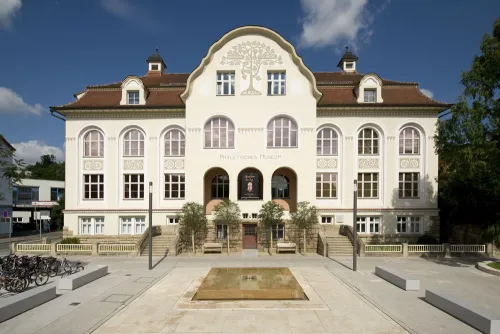
    Phyletisches Museum in Jena, stop 3 on the self-guided walking tour

    Take a moment outside first: this Art Nouveau building is a protected monument, designed by the architect Karl Dittmar from Ernst Haeckel's own ideas and sketches. Haeckel founded the museum, and the date of the foundation stone was no accident: 28 August 1907, Goethe's birthday. Paid for with money from the Carl Zeiss Foundation, the building was Haeckel's gift to the university on 30 July 1908 for its 350th anniversary.

    Oddly, it opened with nothing inside. The first permanent exhibition only arrived in 1912, put together by Ludwig Plate, who had followed Haeckel as director in 1909. From the start the idea was bigger than a natural history museum: it was meant to show how life developed. Tracing the family tree of living things and the theory of evolution, together with the meeting of art and nature, is still the core today.

    Inside, the evolution hall covers pigeon breeds, AIDS, cichlid fish and how amphibians develop from egg to adult, and further halls follow the family history of multicellular animals all the way to humans. Behind the scenes the collections hold more than 500,000 items reaching back to the 18th century, including original pieces from the time when Goethe ran the anatomical and zoological collection. Researchers still work with them, for example on the anatomy of dogs and the diversity of insects.

    Is it worth going in? If you have any interest in nature or in Haeckel, yes: the ticket is inexpensive, and about 17,000 people a year make the visit.

    Haeckel's own home is just 130 m away, two minutes on foot.

    Hours
    Tue–Fri 09:00–13:00 and 14:00–17:00, Sat–Sun and public holidays 10:00–16:00, Mon closed
    Price
    4.50 EUR full, 3.50 EUR reduced, family ticket 10.00 EUR
  4. 4

    Ernst-Haeckel-Haus

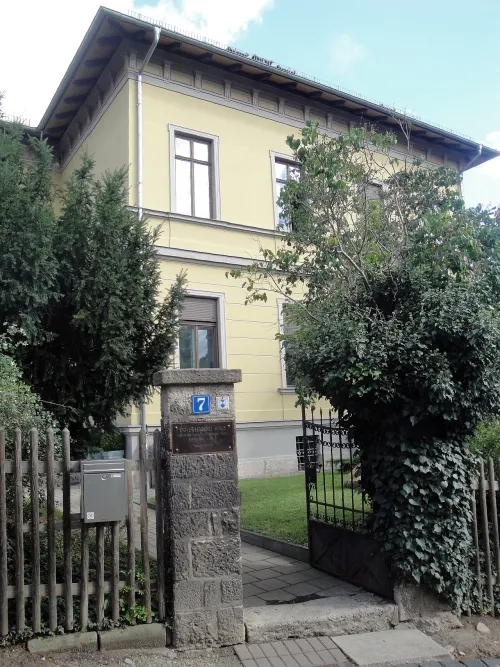
    Ernst-Haeckel-Haus in Jena, stop 4 on the self-guided walking tour

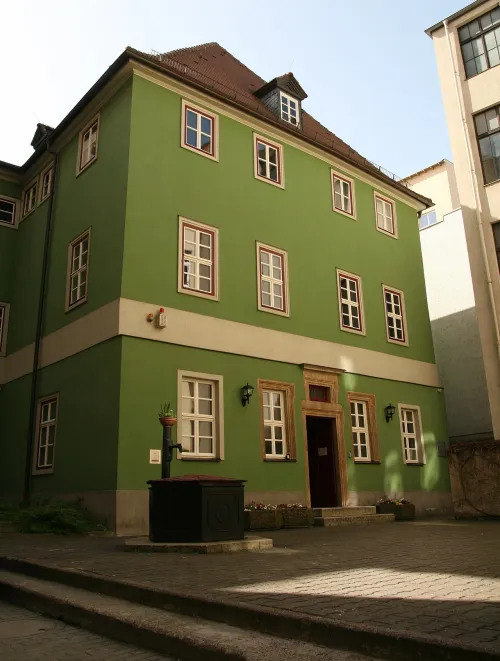
    Locals also call this house the Villa Medusa. Ernst Haeckel had it built in 1882 and 1883 in an Italianate style, close to the zoological institute that had just gone up. He lived here with his family until his death in 1919, at the age of 85, and worked here too.

    The nickname comes from the inside. Haeckel spent much of his career as a marine biologist and published richly illustrated books that present sea creatures as art, above all Kunstformen der Natur. He decorated his own home the same way: lamps and painted ceiling ornaments take their shapes directly from jellyfish, and some of them survive. In the dining room, his own drawing of a jellyfish from the waters off Sri Lanka became the ceiling decoration.

    Haeckel was already regarded as a historically important biologist during his lifetime, and the plan to keep his collections and archive together was made before he died. In 1920 the house became an archive and museum, one of the oldest institutes in Germany devoted to the history of science. Today it belongs to the university's Faculty of Biological Sciences and houses its chair for the history and philosophy of science along with Haeckel's papers.

    Getting inside takes planning, because the house opens to visitors only at limited times; admission is free. If it is closed when you pass, the villa is still worth a look from outside.

    From here it is 260 m, about four minutes, to Schiller's Garden House.

    Hours
    Thu 14:00–18:00 (during lecture periods)
    Price
    Free admission
  5. 5

    Schiller's Garden House

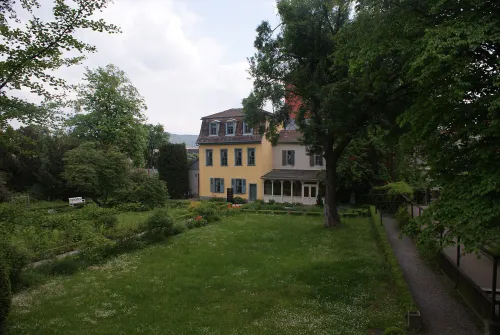
    Schiller's Garden House in Jena, stop 5 on the self-guided walking tour

    Friedrich Schiller spent ten years in Jena, from 1789 to 1799, the longest he ever stayed anywhere. Of all his homes here, this is the only one you can visit: the other surviving one, in the Zwätzengasse, is used by the university, and none of his rented flats in the centre kept their furnishings.

    Schiller bought the house, built around the middle of the 18th century, in March 1797 for 1,050 thalers as a second home with a garden. Back then it stood just outside the town gates, looking out over the Leutra stream and plenty of woodland and gardens. His family and friends, Goethe above all, urged him to buy it so that fresh air could mend his poor health. He put it in his own words: he had to take this step and buy a house and garden of his own, because otherwise he saw no way to get used to the open air he needed so badly. He paid for it with a loan and did part of the many alterations himself.

    In the summers of 1797, 1798 and 1799 he lived here with his wife Charlotte, their two small sons and three servants. On the ground floor he added a veranda and a children's room with a maid's chamber next door, from which Carl and his younger brother Ernst could look straight into the garden. Here he wrote parts of Wallenstein and Maria Stuart and many of his ballads. In 1799 the family moved to Weimar, though he only gave up the garden house for good in 1801.

    Going in costs a small fee, and it is worth it for anyone who knows Schiller's work or wants to see how a writer's family actually lived around 1800. The university runs it as a museum and a venue for talks and events.

    From the garden it is 350 m, about five minutes, to the JenTower.

    Local name
    Schillers Gartenhaus
    Hours
    Apr 1 – Oct 31: Tue–Sun 11:00–17:00; Nov 1 – Mar 31: Tue–Sat 11:00–17:00; public holidays closed
    Price
    3.50 EUR full, 2.00 EUR reduced
  6. 6

    JenTower

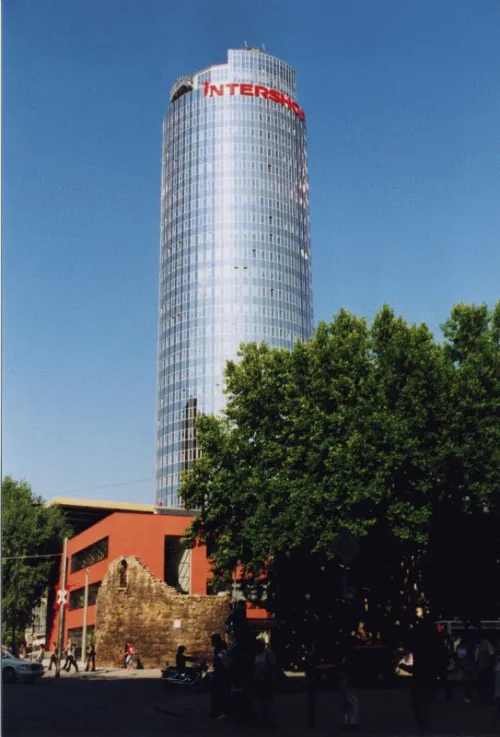
    JenTower in Jena, stop 6 on the self-guided walking tour

    Hardly a building in Jena has collected as many names. Officially it has been the JenTower since November 2004; before that it was the Intershop Tower, after its main tenant. Because the university used it until 1995, many still call it the University Tower, and you will also hear Cookie Roll, Henselmann Tower, the cheeky Phallus Jenensis, or simply ‘the tower’.

    Its architect, Hermann Henselmann, was one of the best known architects of East Germany. The idea of a single tower as an ‘urban crown’ goes back to Bruno Taut, city architect of Magdeburg in the 1920s. Work began in June 1969 in a residential and business quarter that the war had spared, the foundation stone followed on 30 April 1970, and the tower was finished on 2 October 1972 at its original height of 127 m. It is a round reinforced concrete shaft 33 m across, built with a sliding formwork method on a slab foundation 3.20 m thick. The price was high: the old Leutragasse, home of the original Romantikerhaus, vanished for it.

    Opposite stands Building 15, the first high-rise in Germany, raised to 43 m in 1915 to plans by Friedrich Pützer. In the late 1960s the state also planned a recreation centre for Zeiss workers next to the tower, which would have pushed out the historic Collegium Jenense. Protests by local people, especially the microbiologist Hans Knöll, and the poor finances of the Zeiss works stopped it.

    The viewing platform charges admission. After a morning at street level, it is the place to see the town you are walking through as a whole.

    The university's main building is 160 m away, about three minutes.

    Hours
    Daily 10:00–22:00
    Price
    Viewing platform: 6.00 EUR per person
  7. 7

    Friedrich Schiller University (main building)

    Friedrich Schiller University (main building) in Jena, stop 7 on the self-guided walking tour

    Here the Hanfried from the Market Square comes back into the story. In 1547, while he was held captive by Emperor Charles V, Elector John Frederick of Saxony first conceived a plan for a university in Jena. His three sons carried it out, obtained a charter from Emperor Ferdinand I, and on 2 February 1558 the university opened. It was named Salana after the river Saale and is counted among the ten oldest universities in Germany.

    Its great moment came around 1800, under Goethe's patron Duke Charles Augustus. Karl Leonhard Reinhold, Johann Gottlieb Fichte, Hegel, Schelling, Friedrich Schlegel and Friedrich Schiller all taught here, and Jena became the place where German idealism and early Romanticism took shape. That is why the university carries Schiller's name today, and why the Romantikerhaus and the garden house you have already seen belong to the same story.

    The university is linked to six Nobel Prize winners, most recently the Jena graduate Herbert Kroemer, who won the physics prize in 2000. Around 19,000 students were enrolled in 2014.

    The main building at Fürstengraben 1 is free to enter on weekdays during the daytime. A short look inside is enough to get a feel for the place unless you have a particular interest in university history.

    From here it is 230 m, about three minutes, to the Johannistor.

    Hours
    Main building (Fürstengraben 1) accessible during university hours, Mon–Fri daytime
    Price
    Free
  8. 8

    Johannistor

    Johannistor in Jena, stop 8 on the self-guided walking tour

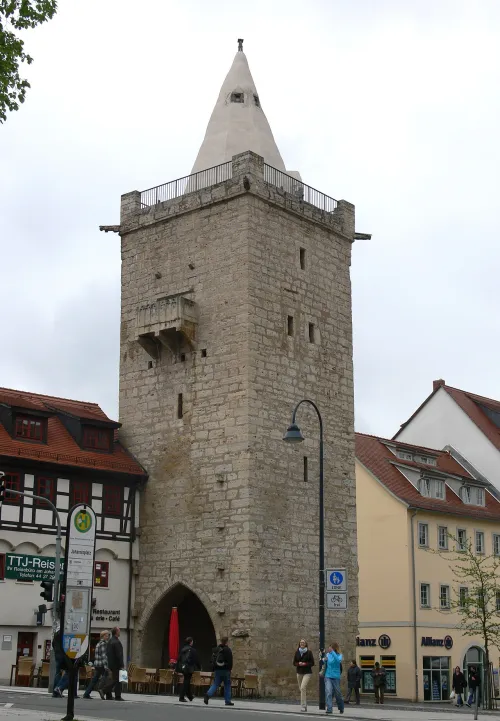
    This is the only city gate of Jena's fortifications that survives largely intact. A reconstructed wall-walk links it to the Pulverturm, and until June 1969, when the houses on the south side of Johannisstraße were demolished, it was the only western way into the old town. Outside it lay the Johannisvorstadt, one of Jena's four former suburbs.

    The tower is first mentioned in 1304 and was remodelled in late Gothic style in the 15th century. Look up for the oriel on its stone brackets: locals call it the Käsekorb, the cheese basket. You can also spot the remains of a stone canopy that once sheltered a figure of a saint. The tower stands 31.70 m tall on a square base of about 7.7 by 7.9 m, its stone cone roof alone measures 9.20 m, and the whole structure weighs 2,181 tonnes. A weather vane has always crowned the tip.

    In the Middle Ages the town watch was stationed here and kept an eye out for fires across the town. The only way in was a narrow door 7.75 m above the ground, reached from the wall-walk, and the inside is lit mostly by slit windows. Above the passage is a stone vault with an opening in the middle for pouring things down on attackers.

    The outer gate was removed in the early 19th century because of the growing traffic. The tower was restored in 1816 and most recently in a renovation completed in 2001. You see it free from outside at any hour; the interior is open only on guided tours.

    From the gate it is 400 m, about six minutes, to the Botanical Garden.

    Hours
    24/7
    Price
    Free (exterior; tower interior accessible only on guided tours)
  9. 9

    Botanical Garden

    Botanical Garden in Jena, stop 9 on the self-guided walking tour

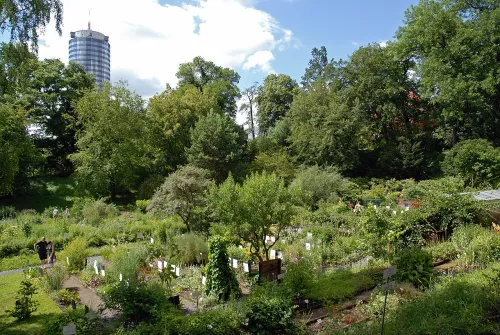
    The university's Botanical Garden covers 4.5 hectares at Fürstengraben 26 and is the second oldest in Germany. It began in 1586 as a hortus medicus, a garden of medicinal plants, six years after the one in Leipzig. In 1630 Professor Werner Rolfinck, who had studied in Padua, reorganised and greatly enlarged it, and by 1659 a catalogue listed more than 1,300 plants. The first heated greenhouse followed in 1674, and with it the first tropical plants.

    Goethe's link with the garden began in 1776. He helped organise Jena's botanical institute and for decades came here to study plants and to write poems. Even when the garden measured only 1.3 hectares, purchases in 1794 included box, savin juniper and thuja, followed a few years later by amaryllis, cacti and pelargoniums.

    Then came 1806 and the Battle of Jena-Auerstedt, which badly damaged the garden. Recovery was slow: in 1819 it held only about 50 potted plants in one greenhouse and some 200 plants outdoors. A new greenhouse in 1820 allowed an orangery, a palm house and a cold house, and after a thorough redesign in the late 1870s the garden counted 2,020 species from 85 families plus a medicinal garden.

    The garden charges admission, and the visit is worth it for plant lovers and anyone following Goethe through Jena.

    The Zeiss-Planetarium is 510 m away, about seven minutes.

    Local name
    Botanischer Garten Jena
    Hours
    Apr 1 – Oct 31: daily 10:00–19:00 (last admission 18:30); Nov 1 – Mar 31: daily 10:00–18:00 (last admission 17:30)
    Price
    5.00 EUR full, 3.00 EUR reduced, family ticket 13.00 EUR
  10. 10

    Zeiss-Planetarium

    Zeiss-Planetarium in Jena, stop 10 on the self-guided walking tour

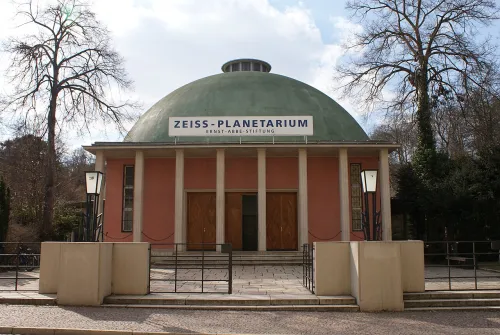
    Under this dome the night sky has been projected since 18 July 1926, making it the oldest large projection planetarium in the world still in operation. Stars and planets appear on the inside of a white dome, 25 m across, and the building counts among the historic landmarks of engineering in Germany. It stands in the former Princesses' Garden and was designed by the architects Schreiter & Schlag.

    The story starts with Oskar von Miller, founder of the Deutsches Museum in Munich, who in 1912 wanted a walk-in globe of the heavens with mechanical planets. In 1913 he turned to Carl Zeiss in Jena. The mechanical version proved too complicated, so in 1919 Walther Bauersfeld designed a device that projected the sky with light instead. The first one went to Munich in 1924.

    From late July 1924, about 80,000 people climbed onto the roof of the Zeiss works in Jena to watch trial shows in a temporary dome, and the press hailed it as the ‘Wonder of Jena’. Demand from other cities followed, and Zeiss built a permanent planetarium at home. Wuppertal-Barmen, Leipzig and Düsseldorf opened theirs first in 1926; Jena followed as the fourth in the world. The building was extended in 1984/85, and in 2024 it counted more than 170,000 visits.

    A show is the reason to go in. There are educational, family and music shows, so ask at the box office what is on that day.

    The last leg is 400 m, about six minutes, back into the old town to the Stadtkirche St. Michael.

    Local name
    Planetarium Jena
    Hours
    Box office: Tue–Thu 09:30–14:30 and 18:00–20:00, Fri 09:30–13:00 and 18:00–20:00, Sat 11:00–20:15, Sun 11:00–18:00, Mon closed (except holidays/school vacations); box office opens 30 min before each show
    Price
    Educational/family shows: 15,00 EUR full, 13,50 EUR reduced, family card (3 pers.) 36,00 EUR; Music shows: 16,00 EUR full, 14,50 EUR reduced, family card 39,00 EUR
  11. 11

    Stadtkirche St. Michael

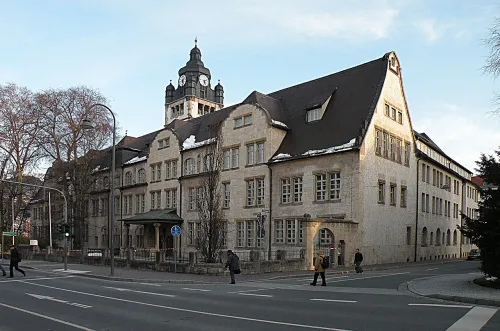
    Stadtkirche St. Michael in Jena, stop 11 on the self-guided walking tour

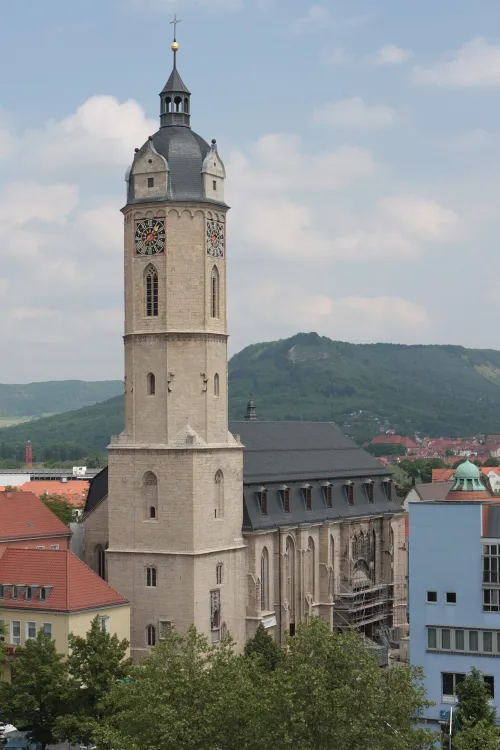
    For more than 750 years this Protestant church has been the centre of Jena's church life, and it still shapes the skyline of the town centre. It had two Romanesque predecessors, one of which belonged to a convent of nuns that stood to the north. Excavations found traces of a church from the 11th or early 12th century in a cemetery laid out as early as the 7th or 8th century; remains of it lie in the crypt beneath the choir.

    The present hall church went up from 1380, once the town hall on the Market Square was finished. In a first phase that ran until 1450 the builders completed the choir, its vaulting and the first part of the nave. Then work stopped for about 30 years. The second phase lasted from 1474 to 1557, just a year before the university was founded, and produced the rest of the nave and the tower. The town council ordered and paid for the tower, and it only legally belonged to the church from 1933.

    In the Second World War the church was badly destroyed along with the whole town centre. Until 1956 the interior was rebuilt under the Jena architect Hans Schlag, with octagonal pillars and star vaulting, while the tower and nave received simple roofs.

    Going in is free, and the rebuilt vaulting inside is worth a few quiet minutes before you finish.

    The Market Square where you started is only about 50 m away; if you like, the GPS navigation leads you back.

    Hours
    Tue–Sat 10:00–17:00, Sun–Mon 12:00–17:00
    Price
    Free admission
Walking tour route map of Jena Route loaded
Market SquareRomantikerhausPhyletisches MuseumErnst-Haeckel-Haus+7
All 11 stops are already on the map.
You just press start.
AI Tour Guide

You know the route now. Walk it with Haeckel's and Schiller's stories in your ear.

Press start wherever you are, even hundreds of kilometres from Jena, and the guide begins telling its stories right away. In the city, pick any of the 11 stops to start from: it leads you there, then talks with you the whole route, asking, listening, remembering, and shaping the tour around your answers.

11stops 3.4km 47 minwalking 13languages
▶Start the tour free

Free to start · Runs in your browser · No app, no download

Shorter Ways to Walk the Jena Route

The route splits neatly in two at the JenTower. Each half works on its own, and you can join the other half another day.

Haeckel and Schiller: the first half

Stops: 1, 2, 3, 4, 5

For anyone drawn to evolution, Romanticism and poets' homes. From the Market Square to Schiller's Garden House you walk 1,350 m in about 19 minutes. Paid entries are the Phyletisches Museum and Schiller's Garden House; the Ernst-Haeckel-Haus is free. With both museums, count on just over two hours.

Towers, gate, garden and stars: the second half

Stops: 6, 7, 8, 9, 10, 11

For views, medieval walls, plants and the planetarium. From the JenTower to the Stadtkirche St. Michael you cover 1,700 m in about 25 minutes. Paid entries are the JenTower platform, the Botanical Garden and, if you catch one, a planetarium show. Allow about two and a half hours, plus the length of a show.

How Long Does This Jena Tour Take with Museums and Planetarium?

The walking itself takes 47 minutes, and the longest leg is the ten minutes between the Romantikerhaus and the Phyletisches Museum; everything after that is a short hop. The real time goes into the doors you open.

Count about 45 minutes each for the Phyletisches Museum and the Botanical Garden, 40 for Schiller's Garden House, half an hour on the JenTower platform and a quarter of an hour on the Market Square. Add short looks elsewhere and you finish in just under five hours. A planetarium show comes on top of that. If you stay outside everywhere, you are done in a little over two hours.

Before You Set Off in Jena

  • Start and finish: The recommended start is the Market Square, and the walk ends at the Stadtkirche St. Michael, about 50 m from where you began. You can join at any stop; the GPS navigation in your browser leads you from stop to stop and, if you like, back to the start at the end.
  • Best day: Start at 10:00 and you reach the museums, the garden house, the tower and the garden while they are open; you finish at the church around 15:00.
  • Thursday for Haeckel: The Ernst-Haeckel-Haus opens only at limited times. If you want to see it, step into the Stadtkirche St. Michael first, then start at the Market Square in the early afternoon: you reach the Phyletisches Museum and the Haeckel villa while both are open. On this timing you see the church at the start rather than the end.
  • Costs: The route is free. Four sights charge admission (Phyletisches Museum, Schiller's Garden House, JenTower platform, Botanical Garden), and a planetarium show costs extra.
Walking tour route map of Jena
AI Tour Guide

Your guide is ready when you are, from the Market Square to the star dome.

Press start and a voice AI Tour Guide takes it from here: leading the route through Jena, telling the stories, and turning your walk into a real back-and-forth conversation. No app or download is needed; it runs in your browser.

11stops 3.4km 47 minwalking 13languages
▶Start the tour free

Free to start · Runs in your browser · No app, no download

What the AI Tour Guide Adds Between Haeckel and Schiller

On this walk the stories run into each other: the man on the Hanfried plinth dreamed up the university, Fichte lectured in the house that now carries the Romantics' name, Goethe turns up in the museum, the garden and Schiller's kitchen. The AI Tour Guide tells those threads as a conversation while you walk, asks what catches your interest and follows it, whether that is Haeckel's art, Schiller's loans or how Zeiss lenses put stars on a dome. You start with 100 free credits; after that you choose this tour all-inclusive for 19.99 € with no time limit, or 5 € per hour.

A Real Conversation A voice AI Tour Guide greets you, leads the whole route, and tells the stories and facts as you walk, asking what you want to see and keeping a real conversation going. Not a recording you press play on.
Map Navigation Follow the route on the map and walk at your own pace. You choose where to start and when to move to the next stop.
Ask Anything Curious about a building you pass? Ask your AI Tour Guide on the spot and the conversation carries on.
13 Languages Switch language anytime. No separate tour needed.
Start free in your browser

Common Questions About Walking Jena

Can I visit the Stadtmuseum Göhre on the Market Square?

Yes, it sits in the neo-Gothic house on the north side of the square, with its passage onto the market. It is not counted in the walking times, so add it as an extra; ask at the door for the current opening hours and admission.

Is the walk good with children?

Yes, and three sights offer family tickets: the Phyletisches Museum, the Botanical Garden and the Zeiss-Planetarium, where a family card for three covers educational and family shows.

Does the walk work in winter?

Yes. The route stays the same, but the Botanical Garden and Schiller's Garden House have shorter opening times in winter, so plan those two stops with a little more care.

Which towns pair well with Jena?

Weimar is 19 km away and is where Schiller moved after his Jena years. Naumburg lies 29 km off, and Erfurt 40 km, each with its own walking route.

Is the tour really free?

Yes. The whole tour is free: the route, the interactive map and the navigation cost you nothing. Only the voice AI Tour Guide is optional and paid: you test it with 100 free credits, then you pay either €5 per hour or €19.99 for this whole tour, with no time limit. Admission to 5 of the 11 stops is not included: Romantikerhaus, Phyletisches Museum, Schiller's Garden House, Botanical Garden and Zeiss-Planetarium charge their own entry fees.

Do I need to download an app?

No. Everything runs in your phone browser. Open the route and start walking, no download and no sign-up required.

Do I need to book the walking tour in advance?

No booking needed. This self-guided tour is available anytime. Open the route in your browser and start walking. The AI Tour Guide works instantly, no app, no reservation required.

What languages is the AI Tour Guide available in?

The AI Tour Guide speaks 13 languages, so you take the tour in your own language and can switch at any time.

Can I skip stops or change the route?

Yes. Skip any stop, spend extra time at places you like, or start the route from any point. It is your walk, you set the pace.
Image credits
▶ Start free in your browser Runs in your browser, no app, no download