Free Walking Tour Leipzig: Bach, Faust and 1989

Stand where Bach made music, find Faust under a glass roof and walk the streets of 1989, with a long detour out to where Napoleon's army was beaten.

11 Stops 10.3 km ~2 h 24 min walking
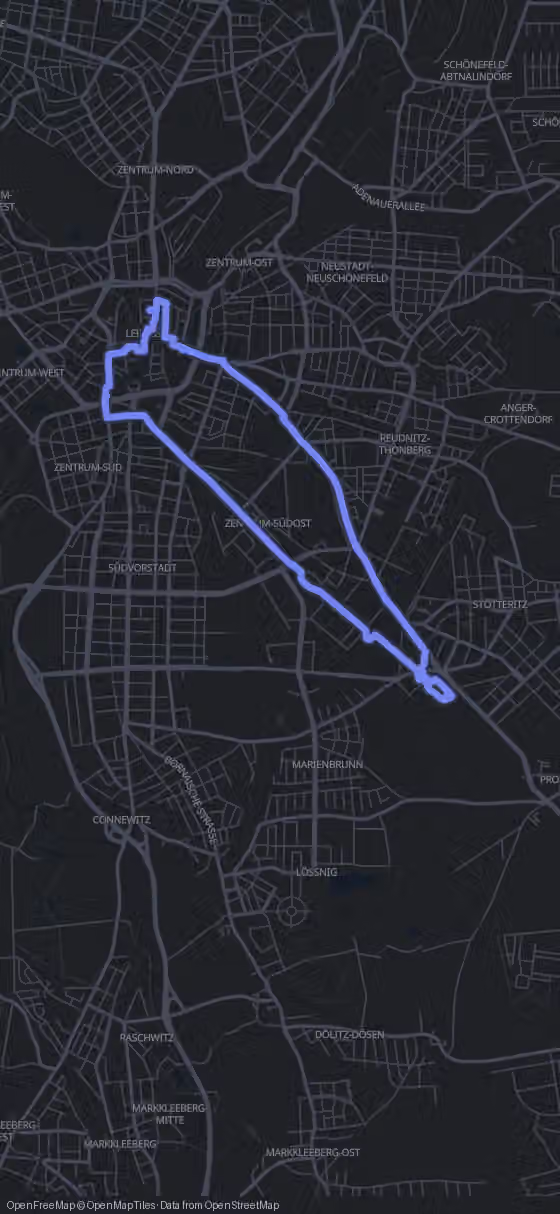
Route map for the Leipzig walking tour
Stop 1 of 11
110 m·1 min
Old Town Hall (Altes Rathaus)
Head south from the Markt toward the Mädlerpassage arcade
Welcome to Leipzig. I'm Alex, and one quiet weekly gathering here helped change an entire country.
Try this tour with Alex

What This Leipzig Walk Covers

The route links 11 stops, from the Old Town Hall (Altes Rathaus) through Bach's quarter and out to the Monument to the Battle of the Nations (Völkerschlachtdenkmal), ending back in the centre at the Naschmarkt. It covers 10.3 km with 2 h 24 min of pure walking; with the main interiors, plan around eight and a half hours.

Churches, squares and the arcade are free. Tickets apply at the Bach Museum, the monument and the two big art and culture museums. Route, map and GPS navigation run free in your browser; the AI Tour Guide is optional.

Open free GPS & optional AI Tour Guide
View of Leipzig

The Route

Walking Map of Leipzig from the Old Town Hall to the Naschmarkt

11 stops 10.3 km 2 h 24 min walking
Tap to load interactive map

The 11 stops along this route

  1. Old Town Hall (Altes Rathaus) in Leipzig, stop 1 on the self-guided walking tour
    1Old Town Hall (Altes Rathaus)
  2. Mädlerpassage in Leipzig, stop 2 on the self-guided walking tour
    2Mädlerpassage
  3. St. Thomas Church (Thomaskirche) in Leipzig, stop 3 on the self-guided walking tour
    3St. Thomas Church (Thomaskirche)
  4. Bach Museum in Leipzig, stop 4 on the self-guided walking tour
    4Bach Museum
  5. New Town Hall (Neues Rathaus) in Leipzig, stop 5 on the self-guided walking tour
    5New Town Hall (Neues Rathaus)
  6. Monument to the Battle of the Nations (Völkerschlachtdenkmal) in Leipzig, stop 6 on the self-guided walking tour
    6Monument to the Battle of the Nations (Völkerschlachtdenkmal)
  7. Grassi Museum in Leipzig, stop 7 on the self-guided walking tour
    7Grassi Museum
  8. Augustusplatz in Leipzig, stop 8 on the self-guided walking tour
    8Augustusplatz
  9. St. Nicholas Church (Nikolaikirche) in Leipzig, stop 9 on the self-guided walking tour
    9St. Nicholas Church (Nikolaikirche)
  10. Museum of Fine Arts (Museum der bildenden Künste) in Leipzig, stop 10 on the self-guided walking tour
    10Museum of Fine Arts (Museum der bildenden Künste)
  11. Naschmarkt in Leipzig, stop 11 on the self-guided walking tour
    11Naschmarkt
  12. That's the full route.

    Walk it with an AI Tour Guide talking you through every one of these streets.

    Start free in your browser
    You made it

Your Leipzig Walking Tour, Stop by Stop: From Bach to the Monday Demonstrations

  1. 1

    Old Town Hall (Altes Rathaus)

    Old Town Hall (Altes Rathaus) in Leipzig, stop 1 on the self-guided walking tour

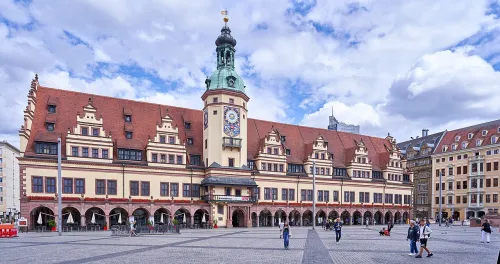
    You start on the Markt, where the Old Town Hall fills the entire east side of the square. It counts among the most important secular Renaissance buildings in Germany, and its beauty comes from length and proportion rather than height: two storeys stretched over more than 300 feet, lifted by a steep roof with a row of wall dormers, six on the market side and seven facing the Naschmarkt behind.

    Notice how few colours there are: just two, the warm reddish tone of Rochlitz porphyry and a matching ochre plaster. The long line is broken by the octagonal tower next to the main portal. The portal itself rests on two Ionic columns and is flanked by so-called gaff heads, carved faces said to represent the master builders. The stone arcade along the market is younger than it looks; it was added between 1906 and 1909. For all its symmetry, the building has a few surprises, so keep an eye out for details that do not mirror each other.

    Walk round to the south side to find the oldest piece: a stone mullion dated to 1230, saved from an earlier building, probably a tower house, and so more than three centuries older than the hall around it. Look out too for the box oriels on the gable ends, the decorated keystones and the many commemorative plaques. The mayor and city administration moved out in 1905, to the New Town Hall you will reach later.

    Inside, the permanent exhibition is free, while guided tours cost extra; give it half an hour if you like city history. A passage through the building leads to the Naschmarkt, but save that square for the finish. Instead walk 110 m, about a minute, past the Forum of Contemporary History to the Mädlerpassage.
    Hours
    Tue–Sun and holidays 10:00–18:00, Mon closed; 24.12 and 31.12 closed
    Price
    Free (permanent exhibition); guided tours chargeable
  2. 2

    Mädlerpassage

    Mädlerpassage in Leipzig, stop 2 on the self-guided walking tour

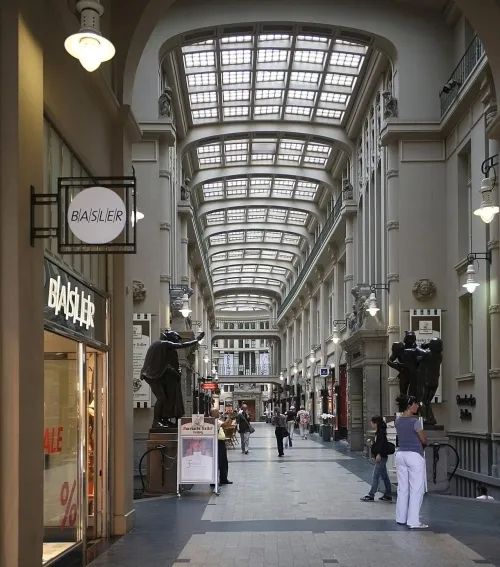
    Step in from Grimmaische Strasse and you are in the last completely preserved historic shopping arcade in central Leipzig with a glass roof running its full length. Its model was the Galleria Vittorio Emanuele II in Milan, and the family likeness shows: street facades drawn inside, a passage 6 or 7 m wide, and a glass roof on steel ribs about 13 m above your head, with two more floors rising above it.

    The first arm runs about 75 m to an octagonal rotunda some 12 m across, where the three arms meet in a T. That shape grew in stages. The long arm came first, then the stretch from the rotunda to Neumarkt turned the plan into an L. The third arm to Petersstrasse was only added in the 1960s, when the trade fair built its Messehaus am Markt. You can tell it apart easily: it is just one storey high and artificially lit. Long before any of this, between 1530 and 1911, the Auerbachs Hof complex stood on the site.

    In the first section is the way down to Auerbachs Keller, the historic wine cellar that Goethe wrote into Faust. Beside it stand two bronze groups by Mathieu Molitor: Faust and Mephistopheles on one side, the bewitched students on the other, a quotation in bronze from the cellar scene. Stand between them and you are in the middle of the play.

    Entry is free. More than 20 small shops and restaurants line the arcade, and the upper floors hold offices, the Sanftwut cabaret and an art room of 250 m². From here it is 260 m, three minutes, to St. Thomas Church.

    Hours
    Mon–Fri: 10:00–19:00 | Sat: 10:00–18:00 | Sun: Closed (Auerbachs Keller restaurant open daily)
    Price
    Free
  3. 3

    St. Thomas Church (Thomaskirche)

    St. Thomas Church (Thomaskirche) in Leipzig, stop 3 on the self-guided walking tour

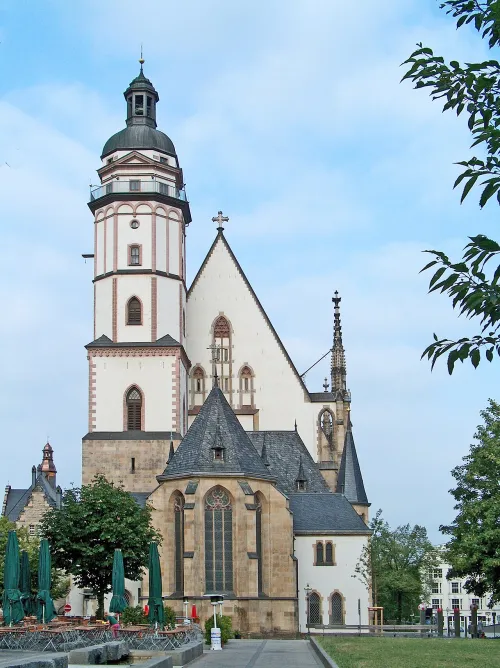
    This is Bach's church. Johann Sebastian Bach became Thomaskantor, the music director, in 1723 and held the post until his death in 1750, and he is buried here. Even if you only have a few minutes, go inside for his grave.

    From outside you see a late-Gothic hall church, paid for by the silver found in the Ore Mountains, which brought money into Leipzig. The Romanesque nave was torn down and the present hall raised in its place, consecrated by Thilo of Trotha, Bishop of Merseburg, on 10 April 1496. The tower was first built in 1537 and rebuilt in 1702. Allied incendiary bombs hit the church in 1943, yet it has kept its late-Gothic character.

    The story starts much earlier. A church has stood on this spot at least since the 12th century, and Romanesque foundations still lie under the choir. In the early 13th century it became the church of a new college of Augustinian canons founded by Margrave Dietrich of Meissen, a college that later formed the core of the University of Leipzig, founded in 1409. In 1217 the minnesinger Heinrich von Morungen gave the church a relic of St Thomas when he joined the canons, after a journey to India that is probably legend. During the Reformation the church became Lutheran, and Martin Luther himself preached here on Pentecost Sunday 1539.

    The church is also home to the Thomanerchor, an internationally known boys' choir that was probably founded in 1212. Entry is free and guided church tours cost a little extra. Check the hours before you come, as the church closes earlier on some days. The Bach Museum is just 70 m across the church square, a minute's walk.

    Hours
    Mon–Thu: 10:00–18:00 | Fri: 10:00–16:00 | Sat: 10:00–13:30, 16:30–18:00 | Sun: 11:30–17:30
    Price
    Free; guided church tours 3 EUR
  4. 4

    Bach Museum

    Bach Museum in Leipzig, stop 4 on the self-guided walking tour

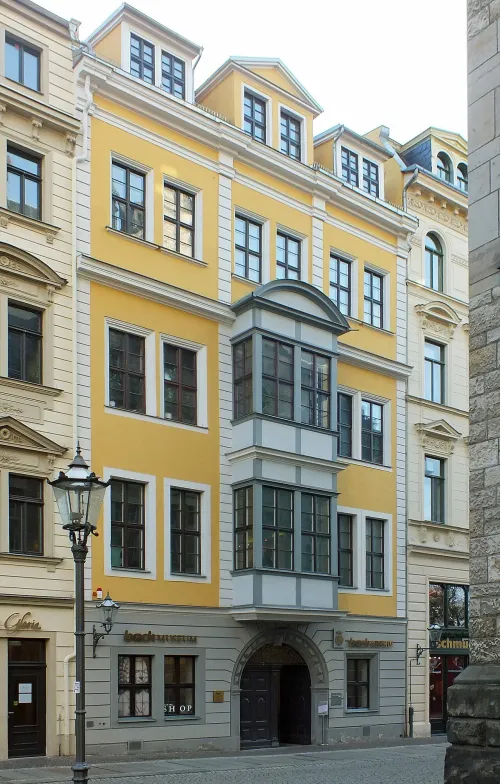
    Opposite the church stands the Bosehaus, a Baroque house on the Thomaskirchhof, home to the Bach Archive and its museum. The museum tells the life and work of Johann Sebastian Bach, and after standing at his grave it is the natural next step.

    Its beginnings were modest. The Bach Archive used to be at Gohlis Palace, and a first small Bach memorial opened in the entrance hall of the Bosehaus in 1973. After the house was renovated, the museum opened on the composer's 300th birthday, 21 March 1985. A second thorough rebuild ended in 2010 with a new extension holding a special exhibition room and a treasure room, plus a small pleasure garden; the exhibition area grew to 450 m².

    Twelve themed rooms cover Bach's life and work, his family, research into his music and more, designed to be multimedia and interactive. The highlight is the treasure chamber, where original Bach manuscripts are on show. The museum puts real weight on work with children and young people, which makes it a good stop for families.

    The museum charges admission, with reduced tickets available. Allow about an hour and a quarter if Bach means something to you; if not, the church outside may be enough. From here it is 440 m, six minutes, to the New Town Hall.

    Hours
    Mon: Closed | Tue–Sun: 10:00–18:00
    Price
    14 EUR adults, 9 EUR reduced, children under 18 free (free admission first Tuesday of each month)
  5. 5

    New Town Hall (Neues Rathaus)

    New Town Hall (Neues Rathaus) in Leipzig, stop 5 on the self-guided walking tour

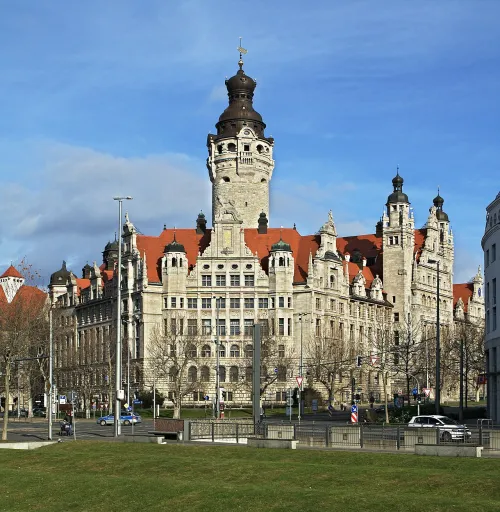
    Since 1905 the Leipzig city administration has worked from here, and the building does not do things by halves. Its main tower rises 114.8 m, the tallest town hall tower in Germany, beating Hamburg's previous record by eight feet. With 1,708 rooms it is also the largest town hall in the world by number of rooms.

    By the end of the 19th century the Old Town Hall was far too small for the booming city. In 1895 the Kingdom of Saxony granted Leipzig the site of the Pleissenburg, and the design competition came with a condition: the castle's Rapunzel tower silhouette had to survive. Hugo Licht, the city's building director, won in 1897 with the motto 'Arx nova surgit', a new castle emerges. The foundation stone was laid on 19 October 1899, and the tower you see stands on the base of the old Pleissenburg tower.

    The complex forms an irregular pentagon covering more than 10,000 m², built in light-grey shelly limestone from Main-Franconia in the style of historicism; the sculptor Georg Wrba shaped its decoration. On the southwest facade look for five statues: Crafts, Justice, Book Art, Science and Music. The clock carries the Latin MORS CERTA, HORA INCERTA, death is certain, its hour uncertain, which locals turned into 'the clock is sure to be wrong'. The female figure in the gable above it stands for Truth, and at night the clock glows blue. The building also holds a dark chapter: in the final days of the Third Reich it was the scene of numerous mass suicides.

    You can walk in for free on weekdays. Now comes the long leg: 4,260 m, 61 minutes, out to the Monument to the Battle of the Nations, passing the Bayerischer Bahnhof on the way.

    Hours
    Mon–Thu: 07:00–18:00 | Fri: 07:00–16:00 | Sat–Sun: Closed
    Price
    Free to enter; tower tours 5 EUR
  6. 6

    Monument to the Battle of the Nations (Völkerschlachtdenkmal)

    Monument to the Battle of the Nations (Völkerschlachtdenkmal) in Leipzig, stop 6 on the self-guided walking tour

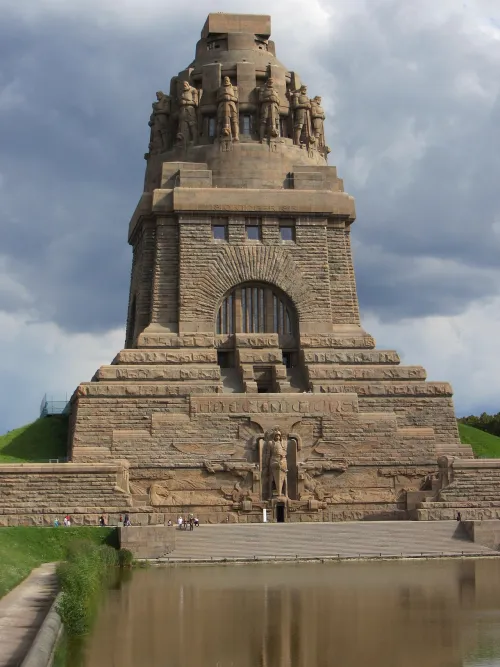
    After an hour on foot, the monument fills your view: 91 m of concrete faced with granite, completed in 1913 for the 100th anniversary of the Battle of Leipzig. It cost six million gold marks, paid mostly by donations and the city, and is widely regarded as one of the best examples of Wilhelmine architecture.

    The Battle of the Nations of 1813 ended in the defeat of Napoleon's French army, a crucial step towards the end of the War of the Sixth Coalition. The armies of Russia, Prussia, Austria and Sweden were led by Tsar Alexander I and Karl Philipp, Prince of Schwarzenberg. Germans fought on both sides: Napoleon's troops included conscripts from the left bank of the Rhine, which France had annexed, as well as soldiers from his German allies in the Confederation of the Rhine.

    The monument is said to stand where some of the bloodiest fighting took place, the spot from which Napoleon ordered his army to retreat. More than a century later it saw fighting again, when Nazi forces in Leipzig made their last stand here against US troops in the Second World War.

    The ticket includes the FORUM 1813 museum. At the top, a viewing platform looks out across the city and its surroundings. If the battle and its age interest you, the long walk is worth it; if your day is about Bach and 1989, skip it with one of the shorter versions. From here it is 3,410 m, 46 minutes, back towards the centre to the Grassi Museum.

    Hours
    Apr–Oct: Daily 10:00–18:00 | Nov–Mar: Daily 10:00–16:00
    Price
    12 EUR adults, 10 EUR reduced (includes FORUM 1813 museum)
  7. 7

    Grassi Museum

    Grassi Museum in Leipzig, stop 7 on the self-guided walking tour

    Three museums share this building: the Ethnography Museum, the Musical Instruments Museum and the Applied Arts Museum. It carries the name of Franz Dominic Grassi, a Leipzig businessman of Italian descent who left more than two million marks to the city when he died in 1880. His money also helped pay for the Mende Fountain, which you will meet shortly on Augustusplatz, and for an older Grassi Museum that now houses the municipal library.

    When that first building grew too small, a competition produced the one you see: New Objectivity and Art Deco, arranged around several courtyards, built in the late 1920s and finished in 1929, one of the few new museums of the Weimar years. It rose on the site of the old Johannis Hospital, and the urban planner Hubert Ritter meant it to be the starting point of an eastward expansion of the city. St John's Church also stood here until it was demolished in 1963.

    Bombs hit the museum hard in 1943, and tens of thousands of objects were lost. Rebuilding began in 1947 and the first exhibitions followed in 1954. After a full renovation it partly reopened in 2005, with the Applied Arts Museum following in 2007. Today it is one of around 20 'Cultural Lighthouses' of the former East Germany listed in the federal government's Blue Book.

    Special exhibitions charge admission, with reduced tickets available. Pick one collection rather than all three; after the Bach stops, the Musical Instruments Museum is the obvious choice. Augustusplatz is 610 m away, nine minutes on foot.

    Hours
    Mon: Closed | Tue: 10:00–18:00 | Wed: 10:00–20:00 | Thu–Sun: 10:00–18:00
    Price
    Special exhibition 10.00 EUR adults, 7.00 EUR reduced, under 18 free; first Wednesday of the month 3 EUR for the whole house
  8. 8

    Augustusplatz

    Augustusplatz in Leipzig, stop 8 on the self-guided walking tour

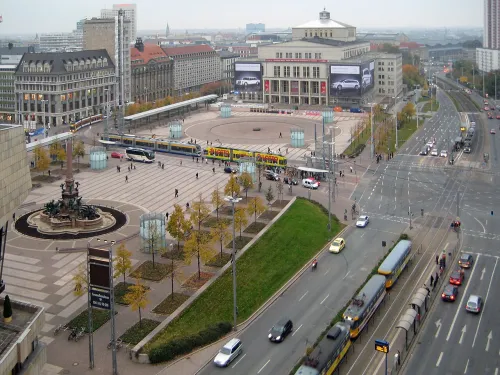
    Augustusplatz is the city's largest square and one of the largest in Europe, part of the inner ring road and a central hub for the trams. Look around: the opera house on the northern edge, the Neues Gewandhaus with the Mende Fountain on the south side, and on the western side, towards the old centre, the main buildings of the University of Leipzig with the City-Hochhaus.

    Its names tell Leipzig's 20th century. The square was laid out from 1785 as the square in front of the Grimma Gate, to designs by city architect Johann Carl Friedrich Dauthe, and named Augustusplatz in 1839 after Frederick Augustus, the first king of Saxony. The social-democratic city government renamed it Karl-Marx-Platz in 1928, a name so unpopular that newspapers and town plans ignored it. The Nazis changed it back in 1933, it became Karl-Marx-Platz again in 1953, and on the day of German reunification in 1990 it returned to Augustusplatz.

    Little of the old look survived. War damage and radical GDR planning left mostly concrete and steel from the 1960s onward. In May 1968 the bomb-damaged Augusteum and the barely damaged university church, the Paulinerkirche, were both blown up. And from 4 September 1989, this square belonged to the Monday demonstrations.

    The square is open at any hour and free. Walk 250 m, four minutes, to the church where those demonstrations began.

    Hours
    Open 24 hours
    Price
    Free
  9. 9

    St. Nicholas Church (Nikolaikirche)

    St. Nicholas Church (Nikolaikirche) in Leipzig, stop 9 on the self-guided walking tour

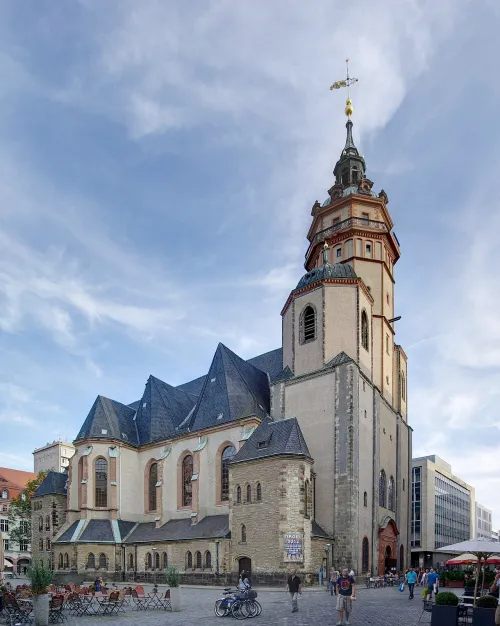
    In 1989 this church became the centre of the peaceful revolt against communist rule. People gathered here on Monday evenings, and from those gatherings grew spontaneous peaceful protests that carried on into 1991. The cabaret artist Bernd-Lutz Lange put it this way: 'There was no head of the revolution. The head was the Nikolaikirche and the body the centre of the city.'

    The building is far older than its fame. Construction began around 1165 in Romanesque style, with twin towers, and it was enlarged as a Gothic hall church in the early 16th century. The Baroque main tower followed in 1730, the portal in 1759. Named after Saint Nicholas, patron of travellers and merchants, it is one of the largest churches in Saxony by capacity, Protestant since 1539, and today the Catholic Church may use it too.

    Go inside for the Neoclassical interior, remodelled in the late 18th century by Johann Carl Friedrich Dauthe, the same architect who laid out Augustusplatz. Bach worked here as well: four of the five performances of his St John Passion, including the premiere on Good Friday 1724, took place in this church, along with many of his cantatas and oratorios. And on 3 July 1646 the philosopher and mathematician Gottfried Wilhelm Leibniz was baptised here.

    Entry is free; the audioguide and the tower excursion cost extra. Check the closing time so you do not leave it too late. The Museum of Fine Arts is 560 m away, seven minutes on foot.

    Hours
    Mon–Fri: 11:00–18:00 | Sat: 11:00–16:00 | Sun: 11:30–14:30
    Price
    Free; audioguide 3 EUR, tower excursion 5 EUR
  10. 10

    Museum of Fine Arts (Museum der bildenden Künste)

    Museum of Fine Arts (Museum der bildenden Künste) in Leipzig, stop 10 on the self-guided walking tour

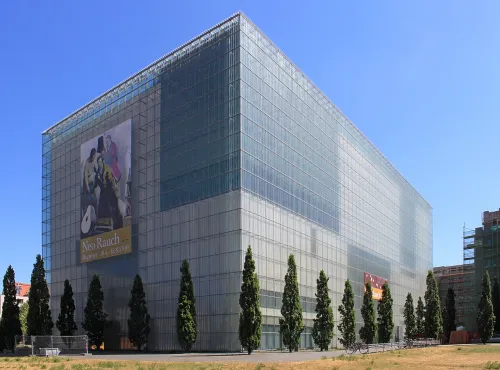
    The Museum of Fine Arts covers art from the late Middle Ages to modernity, and it began with private enthusiasm. Leipzig collectors founded an art association in 1837 with the aim of creating a museum, and on 10 December 1848 they opened a first municipal museum in a school on the Moritzbastei, with around a hundred donated works of what was then contemporary art.

    The collection grew through donors such as Maximilian Speck von Sternburg, Alfred Thieme and Adolf Heinrich Schletter. In 1853 the merchant Adolf Fer gave his collection on one condition: the city had to build a museum within five years. It opened on 18 December 1858, just before the deadline, on Augustusplatz, in Italian Renaissance style by Ludwig Lange, where the Gewandhaus stands today. Hugo Licht, later the architect of the New Town Hall, extended it in the 1880s.

    Then came the losses. In 1937 the Nazis confiscated 394 paintings and prints, mostly Expressionist, in their 'Degenerate art' campaign. On the night of 4 December 1943 a British air raid destroyed the building, though most of the collection had been moved to safety. A 61-year odyssey followed: the former Reichsbank on Petersstrasse in 1948, the former Reichsgericht in 1952, the Handelshof in 1997, always showing only part of the collection, until the city decided in the mid-1990s to give the museum its own building again.

    Special exhibitions charge admission, with reduced tickets available. Give it about an hour. From here it is 320 m, four minutes, to the Naschmarkt, passing the Museum of City History Leipzig.

    Hours
    Tue, Thu–Sun and holidays 10:00–18:00, Wed 12:00–20:00, Mon closed; 24.12 and 31.12 closed
    Price
    Special exhibition 12 EUR adults, 6 EUR reduced, 9 EUR group per person; evening ticket (1 hr before closing) half price; first Wednesday of the month 3 EUR; under 19 free
    Website
    mdbk.de ↗
  11. 11

    Naschmarkt

    Naschmarkt in Leipzig, stop 11 on the self-guided walking tour

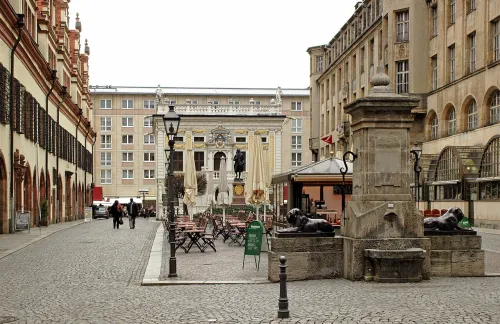
    You end right behind the Old Town Hall, on a narrow square 90 m long and about 20 m wide. Its name goes back to the fruit once sold here, which counted as a sweet treat; 'naschen' means to snack on sweets. In the warmer months it becomes an open-air restaurant, and before Christmas it hosts part of the Christmas market.

    At the north end stands the baroque Old Stock Exchange, and in the small green area in front of it a memorial to the young Johann Wolfgang von Goethe, the same Goethe whose Faust you met in the Mädlerpassage. At the south end, towards Grimmaische Strasse, is the Lion Fountain. Facing the Old Town Hall on the east side is the Handelshof, today the Steigenberger Grandhotel, with a passage through to Reichsstrasse.

    The square was created in 1556, when old buildings were cleared while the Old Town Hall was going up. Food was traded here, and the Neuberin theatre troupe performed here too. Until 1679 herring stalls sold salted fish, which earned it the nickname herring market. On 20 May 1593, in the Leipzig Calvinist riot, an angry crowd stormed and plundered the house of the Calvinist-minded merchant Adolph Weinhaus on this square.

    Afterwards the Old Stock Exchange rose here, already in use unfinished in 1679 and completed by 1687. A Hercules Fountain followed in 1688; around 1820 it was moved to the southern edge and redesigned with bronze lions after a design by Johann Gottfried Schadow. That is the Lion Fountain you see now, and the end of your walk, a few paces from where it began.

    Hours
    Open 24 hours
    Price
    Free
Walking tour route map of Leipzig Route loaded
Old Town Hall (Altes Rathaus)MädlerpassageSt. Thomas Church (Thomaskirche)Bach Museum+7
All 11 stops are already on the map.
You just press start.
AI Tour Guide

You've read the route. Now walk Leipzig with a guide in your ear.

Press start wherever you are, even hundreds of kilometres from Leipzig, and the guide begins telling its stories right away. In the city, pick any of the 11 stops to start from: it leads you there, then talks with you the whole route, asking, listening, remembering, and shaping the tour around your answers.

11stops 10.3km 2 h 24 minwalking 13languages
▶Start the tour free

Free to start · Runs in your browser · No app, no download

Shorter Ways Through Leipzig

Leave out the monument and the route falls into two compact halves, each easy to walk in a morning or an afternoon.

Bach and the Old Town

Stops: 1, 2, 3, 4, 5

For anyone with Bach on their list or only half a day to spare. 880 m and 11 minutes of walking from the Old Town Hall to the New Town Hall. Only the Bach Museum charges admission; everything else is free.

Revolution and Art in the East

Stops: 7, 8, 9, 10, 11

For museum lovers and anyone drawn to the story of 1989. 1.74 km and 24 minutes of walking from the Grassi Museum to the Naschmarkt. Augustusplatz, St. Nicholas Church and the Naschmarkt are free; the Grassi Museum and the Museum of Fine Arts charge for their special exhibitions.

How Long Does This Leipzig Tour Take on Foot?

The pure walking time is 2 h 24 min. Most of it, 7.67 km and 1 h 47 min, lies on the detour from the New Town Hall out to the monument and back in to the Grassi Museum; everywhere else the stops sit only minutes apart.

With the interiors that repay the time (the free exhibition in the Old Town Hall, St. Thomas Church, about 75 minutes in the Bach Museum, about 75 minutes at the monument, one collection at the Grassi, St. Nicholas Church and an hour in the Museum of Fine Arts), the full route takes around eight and a half hours. Treat it as a full day.

The Bach and Old Town half takes about three hours including the Bach Museum. The eastern half, with time in both museums, takes a little over two and a half hours.

Before You Set Off in Leipzig

  • Start and finish: Start at the Old Town Hall on the Markt for the recommended order, though you can join at any stop. The walk ends at the Naschmarkt, right behind the Old Town Hall, so you finish next to where you began.
  • Best day: A weekday in the middle of the week works best, as not every stop is open every day. Check the opening times of the places you care about most before you set off. Leaving the Old Town Hall at 10:00 brings you to St. Nicholas Church shortly after five.
  • Tickets: The route itself costs nothing. The Bach Museum, the monument and the special exhibitions at the Grassi Museum and the Museum of Fine Arts charge admission; the churches, squares, the arcade and the Old Town Hall exhibition are free.
Walking tour route map of Leipzig
AI Tour Guide

Your Leipzig guide is ready when you are.

Press start and a voice AI Tour Guide takes it from here: leading the route through Leipzig, telling the stories, and turning your walk into a real back-and-forth conversation. No app or download is needed; it runs in your browser.

11stops 10.3km 2 h 24 minwalking 13languages
▶Start the tour free

Free to start · Runs in your browser · No app, no download

What the AI Tour Guide Adds in Leipzig

This route jumps from Bach's grave to Napoleon's defeat to the candles of 1989, and the AI Tour Guide holds those threads together as a conversation: it greets you, tells the stories of each place, asks what caught your interest and leans into it. On the hour-long walk out to the monument you might ask how the armies were spread around the city in 1813, or what a working week looked like for Bach as Thomaskantor; interrupt whenever you like. You start with 100 free credits; after that, either this tour all-inclusive for €19.99 with no time limit, or €5 per hour.

A Real Conversation A voice AI Tour Guide greets you, leads the whole route, and tells the stories and facts as you walk, asking what you want to see and keeping a real conversation going. Not a recording you press play on.
Map Navigation Follow the route on the map and walk at your own pace. You choose where to start and when to move to the next stop.
Ask Anything Curious about a building you pass? Ask your AI Tour Guide on the spot and the conversation carries on.
13 Languages Switch language anytime. No separate tour needed.
Start free in your browser

Common Questions About Walking Leipzig

Is Auerbachs Keller open when the arcade shops are closed?

Yes. The Auerbachs Keller restaurant keeps its own hours, separate from the Mädlerpassage shops, so you can still see Faust and Mephistopheles at its entrance.

Can I go up the tower of the New Town Hall?

Yes, on guided tower tours, which cost a small fee. Check the opening days before you go, as the building is not open every day.

Are there discounts at the museums?

Yes. The Bach Museum, the Grassi Museum and the Museum of Fine Arts all offer reduced tickets, and young visitors go free at the Bach Museum, the Grassi special exhibitions and the Museum of Fine Arts.

Does the full route work in winter?

Yes, but watch the monument: it closes earlier in winter. With a 10:00 start at the Old Town Hall you reach it at around two in the afternoon, which still leaves time for the FORUM 1813 museum.

Which towns make a good second day from Leipzig?

Halle (Saale) is the closest. For Luther after his sermon in St. Thomas Church, go to Wittenberg; for Goethe after the Mädlerpassage and the Naschmarkt, Weimar. Dresden is the other big Saxon city.

Is the tour really free?

Yes. The whole tour is free: the route, the interactive map and the navigation cost you nothing. Only the voice AI Tour Guide is optional and paid: you test it with 100 free credits, then you pay either €5 per hour or €19.99 for this whole tour, with no time limit. Admission to 4 of the 11 stops is not included: Bach Museum, Monument to the Battle of the Nations (Völkerschlachtdenkmal), Grassi Museum and Museum of Fine Arts (Museum der bildenden Künste) charge their own entry fees.

Do I need to download an app?

No. Everything runs in your phone browser. Open the route and start walking, no download and no sign-up required.

Do I need to book the walking tour in advance?

No booking needed. This self-guided tour is available anytime. Open the route in your browser and start walking. The AI Tour Guide works instantly, no app, no reservation required.

What languages is the AI Tour Guide available in?

The AI Tour Guide speaks 13 languages, so you take the tour in your own language and can switch at any time.

Can I skip stops or change the route?

Yes. Skip any stop, spend extra time at places you like, or start the route from any point. It is your walk, you set the pace.
Image credits
▶ Start free in your browser Runs in your browser, no app, no download