Free Walking Tour Weimar: Goethe, Schiller and the Ilm

Walk from Goethe's front door to his tomb, past Schiller's house, the Bauhaus, Cranach's altarpiece and the park Goethe helped shape.

14 Stops 6.2 km ~1 h 26 min walking
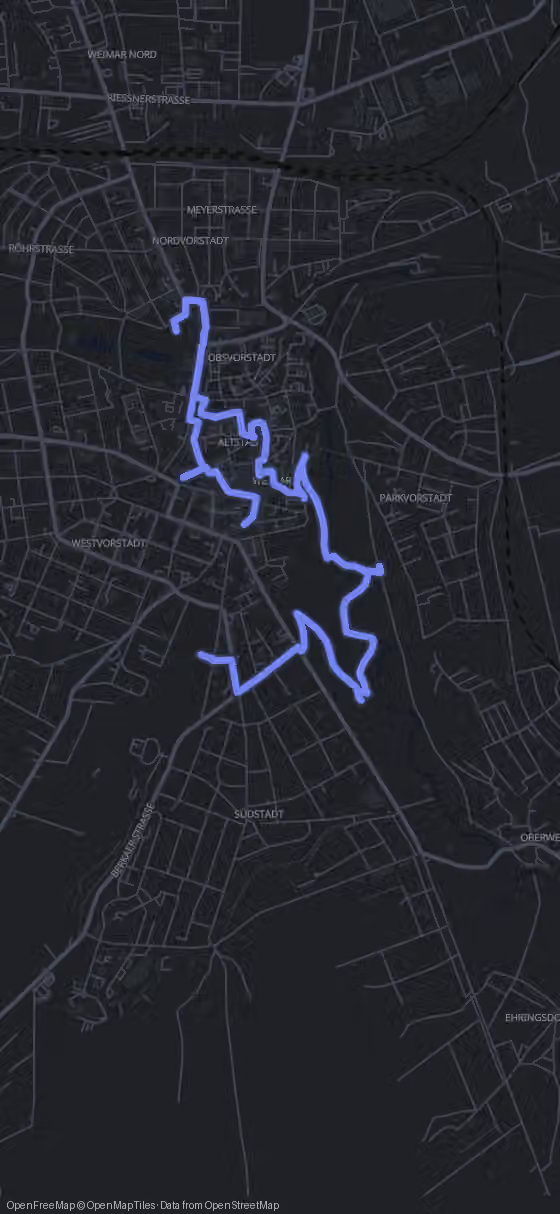
Route map for the Weimar walking tour
Stop 1 of 14
230 m·3 min
Goethe's House
Head north toward Schiller's Residence on Schillerstraße
Welcome to Weimar. I'm Alex, and this city of poets also gave its name to a chapter of German political history.
Try this tour with Alex

This Weimar Route at a Glance

14 stops lead from Goethe's House on Frauenplan to the Historic Cemetery & Grand Ducal Vault. The route covers 6.2 km with 1 h 26 min of pure walking; plan about three hours if you mostly stay outside, a full day with several interiors.

The Goethe-Schiller Monument, Herder Church (St. Peter and Paul), Market Square, Park an der Ilm and Roman House are free; the poets' houses and the museums charge admission. The GPS route runs free in your browser, and the AI Tour Guide is optional.

Open free GPS & optional AI Tour Guide
View of Weimar

The Route

Walking Map of Weimar's Old Town and Ilm Park

14 stops 6.2 km 1 h 26 min walking
Tap to load interactive map

The 14 stops along this route

  1. Goethe's House in Weimar, stop 1 on the self-guided walking tour
    1Goethe's House
  2. Schiller's Residence in Weimar, stop 2 on the self-guided walking tour
    2Schiller's Residence
  3. German National Theatre in Weimar, stop 3 on the self-guided walking tour
    3German National Theatre
  4. Goethe-Schiller Monument in Weimar, stop 4 on the self-guided walking tour
    4Goethe-Schiller Monument
  5. Bauhaus-Museum Weimar, stop 5 on the self-guided walking tour
    5Bauhaus-Museum Weimar
  6. Herder Church (St. Peter and Paul) in Weimar, stop 6 on the self-guided walking tour
    6Herder Church (St. Peter and Paul)
  7. Market Square in Weimar, stop 7 on the self-guided walking tour
    7Market Square
  8. Cranach House in Weimar, stop 8 on the self-guided walking tour
    8Cranach House
  9. Duchess Anna Amalia Library in Weimar, stop 9 on the self-guided walking tour
    9Duchess Anna Amalia Library
  10. Weimar City Palace, stop 10 on the self-guided walking tour
    10Weimar City Palace
  11. Goethe's Garden House in Weimar, stop 11 on the self-guided walking tour
    11Goethe's Garden House
  12. Park an der Ilm in Weimar, stop 12 on the self-guided walking tour
    12Park an der Ilm
  13. Roman House in Weimar, stop 13 on the self-guided walking tour
    13Roman House
  14. Historic Cemetery & Grand Ducal Vault in Weimar, stop 14 on the self-guided walking tour
    14Historic Cemetery & Grand Ducal Vault
  15. That's the full route.

    Walk it with an AI Tour Guide talking you through every one of these streets.

    Start free in your browser
    You made it

Your Weimar Walking Tour, Stop by Stop: Poets, Painters and Dukes

  1. 1

    Goethe's House

    Goethe's House in Weimar, stop 1 on the self-guided walking tour

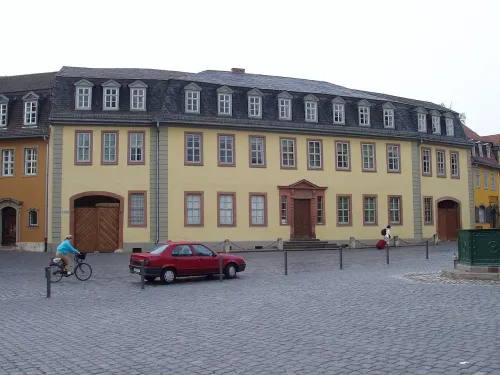
    Start on Frauenplan, in front of the house where Johann Wolfgang von Goethe lived for most of his Weimar life and where he died in 1832. Run today by the Klassik Stiftung Weimar, it has been part of the UNESCO World Heritage ensemble Classical Weimar since 1998. The baroque town house itself is older than its fame: it was built between 1707 and 1709 for Georg Caspar Helmershausen, a ducal official who also traded in stockings, and it seems to have been let to tenants almost from the start.

    Goethe arrived as a tenant in 1782, renting the western half, which included the rooms now called the Yellow Hall, the Juno Room and the Urbino Room. After his Italian journey he lived here again until 1789, then moved to a hunting lodge on Marienstraße so he could live with Christiane Vulpius, whom he only married in 1806. In 1792 Duke Carl August had the ducal treasury buy the house and handed it to Goethe as an official residence. The gift came in stages: by word in 1794, in writing in 1801, and formally on 12 January 1807.

    Between 1792 and 1795 the house was remodelled in classicist style, partly at the court's expense, with Goethe designing details after Italian models. Is it worth going in? If Goethe means anything to you, yes: his life runs through nearly every stop on this walk, and here you stand in the rooms he lived and worked in. The ticket also covers the Goethe National Museum, so give this visit real time; if you can only manage one interior today, make it this one.

    From Frauenplan it is 230 m, about 3 minutes, to the home of the friend whose name is always paired with his.
    Local name
    Goethes Wohnhaus
    Hours
    Tue–Sun 09:30–18:00 (summer), Tue–Sun 09:30–16:00 (winter), Mon closed
    Price
    Adults 14 EUR, reduced 10 EUR (Goethe National Museum with Goethe's residence)
  2. 2

    Schiller's Residence

    Schiller's Residence in Weimar, stop 2 on the self-guided walking tour

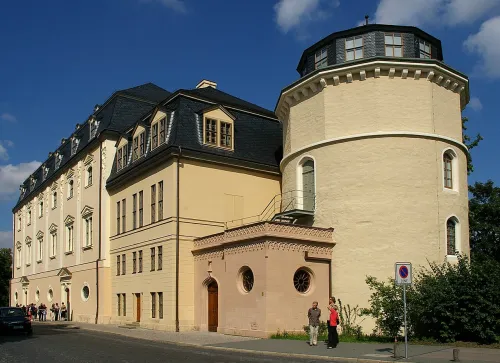
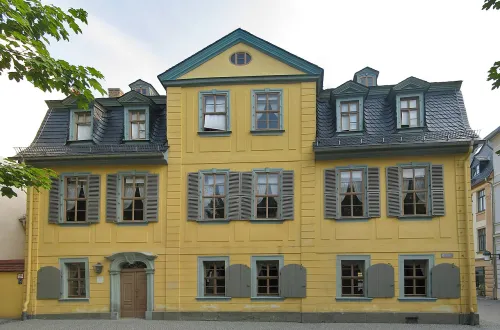
    Friedrich Schiller bought this house in March 1802 and moved in with his family on 29 April; he died here in 1805, so he had barely three years in it. Built in 1777 for the merchant Johann Christian Schmidt, it is the oldest building on the street, which was laid out as the Esplanade after the old town fortifications were taken down in the 1760s. The rear wing absorbed older outbuildings still known as the Münze, because the prince's mint once stood on this plot.

    Schiller had come from Jena in December 1799 and rented a flat in Windischengasse, but he could not find the quiet he needed to write there. When the English writer and translator Charles Mellish of Blyth offered him this house, Schiller borrowed the 4,200 Reichstaler to buy it and had it thoroughly rebuilt. His wife Charlotte and their daughters had their rooms on the first floor; Schiller lived and worked in the mansard rooms under the roof.

    Look at the colour before you go in. The yellow facade with blue-green trim matches the original paint; in Schiller's own years the house was grey with ochre details. Inside, the visit pays off if you want to compare the two friends: Goethe in a grand residence given by the duke, Schiller in a family home bought with borrowed money. With time for only one poet's house, pick the writer you know better.

    Then walk 280 m, about 4 minutes, to Theaterplatz, where the work of both men met on stage.

    Local name
    Schillerhaus Weimar
    Hours
    Tue–Sun 10:00–18:00 (summer), Tue–Sun 09:30–16:00 (winter), Mon closed
    Price
    Adults 10 EUR, reduced 7 EUR
  3. 3

    German National Theatre

    German National Theatre in Weimar, stop 3 on the self-guided walking tour

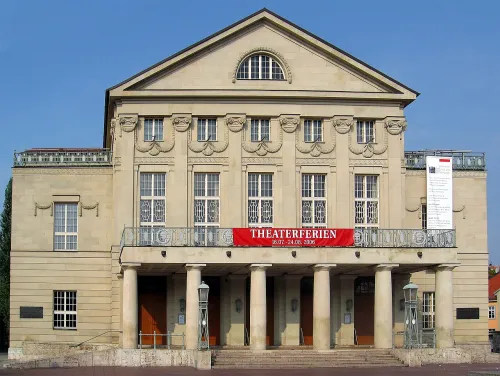
    The neoclassical Great House on Theaterplatz is the home stage of the Deutsches Nationaltheater und Staatskapelle Weimar, the city's leading theatre, which brings together music theatre, drama and the Staatskapelle orchestra and also plays several other stages around town. The building in front of you dates from 1906/1907, designed by Max Littmann as the Grand Ducal Court Theatre.

    The story of this square is older than the building. It was the Court Theatre that Goethe directed that saw the premieres and countless performances of Schiller's plays, and that is why the poets' monument was set up in front of it. Today the theatre belongs to the Free State of Thuringia and the city of Weimar, and since the 2025/26 season it has been led jointly by Valentin Schwarz, Dorian Dreher and Timon Jansen.

    There is no museum to visit here; the way inside is a performance. If you are staying overnight, an evening in the theatre is a good way to experience Weimar as a working stage rather than only a city of memorials.

    The monument stands just 60 m away, about a minute's walk, right in front of the theatre.

    Local name
    Nationaltheater Weimar
    Hours
    Theatre box office: Mon–Fri 10:00–18:00, Sat 11:00–18:00, Sundays and holidays closed. Evening box office opens 60 min before the performance.
    Price
    Depends on the performance, about 8–57 EUR by production, venue and category; discounts for students, pupils and people with severe disabilities
  4. 4

    Goethe-Schiller Monument

    Goethe-Schiller Monument in Weimar, stop 4 on the self-guided walking tour

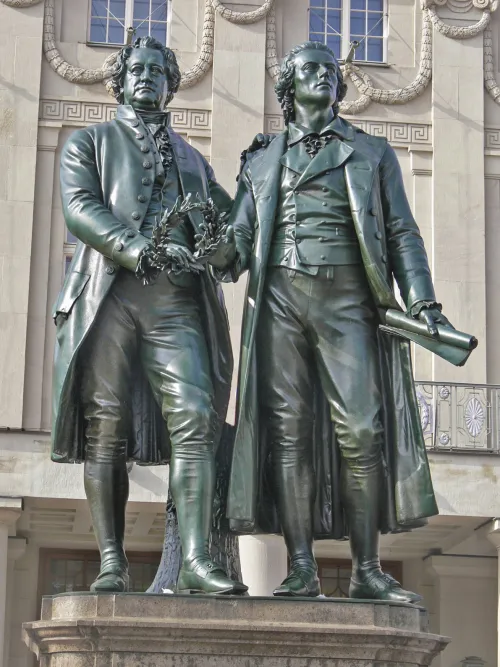
    Ernst Rietschel's bronze double statue from 1857 shows Goethe and Schiller side by side, well over life size and, on purpose, the same height, even though Goethe was nearly 20 cm shorter than his friend. Look at the gestures: Goethe rests his left hand lightly on Schiller's shoulder and holds a laurel wreath in his right, while Schiller reaches out toward it. Goethe wears formal court dress, Schiller ordinary clothes, a quiet comment on two very different lives.

    The two men shaped the literary movement known as Weimar Classicism, and their friendship and collaboration has been described as like no other known to literature or art. The monument was sponsored by Grand Duke Karl Alexander together with a citizens' commission, and it has been called one of the most famous and best loved monuments in Germany, the start of a whole cult of monuments.

    It travelled, too. German Americans commissioned four exact copies for San Francisco in 1901, Cleveland in 1907, Milwaukee in 1908 and Syracuse in 1911; 65,000 people came to the unveiling in Cleveland. A smaller fifth copy has stood since 2006 in Anting, a German-themed new town near Shanghai.

    Theaterplatz also links the poets to the next stop: in 1995 the Bauhaus collection was first shown in a former coach house on this square. Today it has its own building, 1010 m and about 14 minutes away; on the way you pass the Neues Museum Weimar.

    Local name
    Goethe-Schiller-Denkmal
    Hours
    Open 24/7
    Price
    Free
  5. 5

    Bauhaus-Museum Weimar

    Bauhaus-Museum Weimar, stop 5 on the self-guided walking tour

    Here the walk jumps into the 20th century. The State Bauhaus was founded in Weimar in 1919, and this museum of the Klassik Stiftung Weimar shows the city's own collections on where the school came from, what it made and how far its influence reached. The new building near the Weimarhallenpark opened in April 2019, after every possible site in central Weimar had been weighed, because the museum was expected to shape the city's planning for years.

    The heart of the collection is the Gropius Collection, the world's oldest collection of original Bauhaus works. In 2010 the Ludewig Collection added 1,500 objects of functional design from 1780 to the present, including important Bauhaus pieces, and together with the Bauhaus Archive in Berlin the Weimar holdings rank among the most important anywhere in size and quality. Look for work by teachers and students such as Walter Gropius, Johannes Itten, Lyonel Feininger, Gunta Stölzl and Marcel Breuer, and for pieces from the forerunner, Henry van de Velde's school of 1907.

    The museum charges admission, and it rewards anyone interested in design, architecture or everyday objects. If you came to Weimar purely for the classical poets, a look at the building from outside is enough and saves time for Goethe's House and the library.

    From here the route turns back into the old town: 1140 m, about 16 minutes, to Herder Church.

    Hours
    Mon: 10:00–18:00 | Tue: Closed | Wed–Sun: 10:00–18:00
    Price
    Adults 11 EUR, reduced 8 EUR
  6. 6

    Herder Church (St. Peter and Paul)

    Herder Church (St. Peter and Paul) in Weimar, stop 6 on the self-guided walking tour

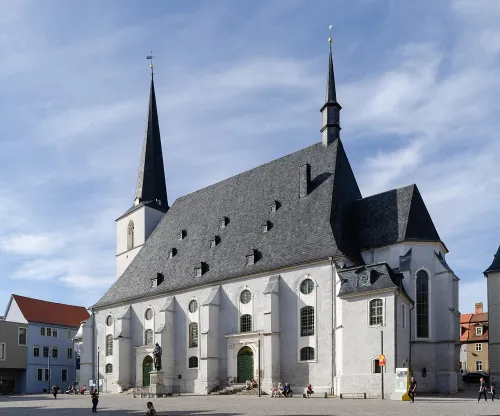
    St Peter and Paul is Weimar's town church, as opposed to the court chapel in the palace, and it is the most important church building in the city. Most people call it the Herderkirche after Johann Gottfried Herder, the theologian and philosopher who served here as general superintendent from 1776 until his death in 1803 and is buried inside. The square in front was named after him in 1850, when the Herder Memorial was set up.

    The first church on this spot was built between 1245 and 1249 and burned in 1299; only its foundations survive. A second church was badly damaged in the town fire of 1424, and the present late Gothic hall church went up between 1498 and 1500. Its choir became a burial place for the Ernestine branch of the House of Wettin, and Duchess Anna Amalia, who revered Herder, was laid to rest here in 1807. The church has been Lutheran since 1525, and Martin Luther himself preached in it.

    Music lovers should know that Johann Sebastian Bach often played the organ here and had two of his sons baptised in this church. The conductor John Eliot Gardiner suggests that Bach's festive cantatas were first heard here, among them his first Christmas cantata, Christen, ätzet diesen Tag, BWV 63, and BWV 31 for Easter Sunday 1715.

    Going in costs nothing, so step inside whatever your interests. Look for the three-winged altarpiece begun by Lucas Cranach the Elder and finished in 1555 by his son; you will soon stand in front of the house where it was started. Market Square is 260 m away, about 4 minutes on foot.

    Hours
    Mon–Sat 10:00–18:00, Sun & holidays 11:00–12:00 and 14:00–16:00 (summer: April to October); Mon–Sat 11:00–16:00, Sun & holidays 11:00–12:00 and 14:00–16:00 (winter: November to March)
    Price
    Free (visit); guided walks 4.00 EUR per person (pupils free)
    Website
    ekmd.de ↗
  7. 7

    Market Square

    Market Square in Weimar, stop 7 on the self-guided walking tour

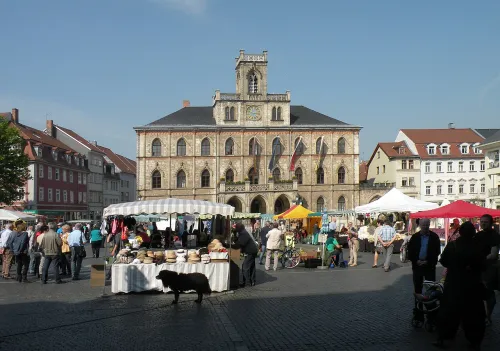
    Simply called the Markt, this almost square space of about 60 by 60 metres has been one of Weimar's key public places since around 1300. Before that, the area around today's Herderplatz was the centre; as the town grew, life and trade moved here. Look around: the town hall, the Renaissance row on the east side, listed as an ensemble in the UNESCO World Heritage, the former court pharmacy on the north side and the Gasthof Zum schwarzen Bären on the south side.

    The square took its character in the 16th century, when the town house and the double house on the east side were built; the left half of that double house is the Cranach House. On 9 February 1945 bombs hit the square, destroying much of the north side and the northern part of the east side. After the war the whole north side, including the town house, was cleared and left empty. Rebuilding of the town house with a faithful exterior began in 1968, and the north side followed from 1988, so part of what looks old here is younger than you might think.

    When no special event is on, a weekly market fills the square with food and goods stalls. The year brings the Easter market in spring, a flower market in May, a wine festival in August around Goethe's birthday and, every September, a pottery market with about 65 potters.

    The Cranach House is only 90 m away, a minute's walk across the square to the east side.

    Hours
    Open 24/7
    Price
    Free
  8. 8

    Cranach House

    Cranach House in Weimar, stop 8 on the self-guided walking tour

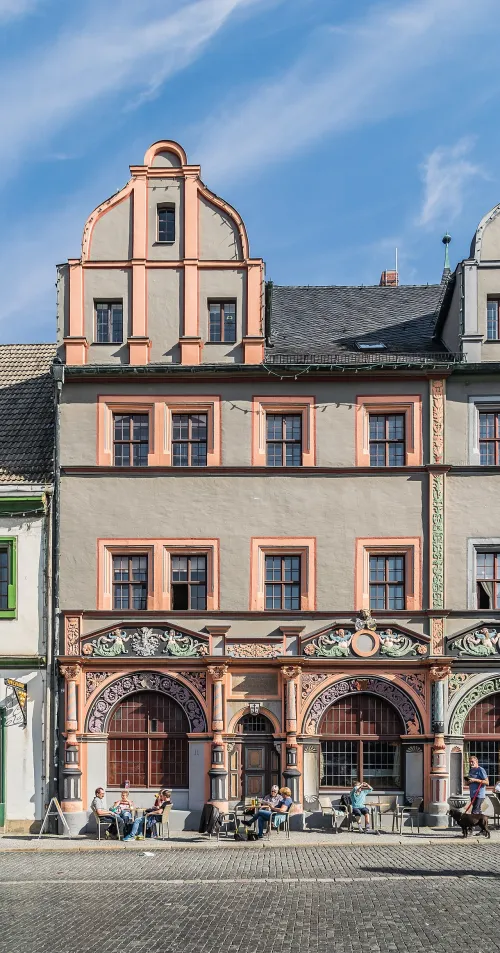
    Of the two almost identical Renaissance houses on the east side of the square, opposite the town hall, the left one, at Markt 11 and 12, is the Cranach House. Take a moment with the facade, richly decorated with columns, shell niches and round-arch ornaments. Above the right arch you will find the painter's coat of arms, a winged serpent.

    The house was built between 1547 and 1549 by the Renaissance master builder Nikolaus Gromann for the ducal chancellor Christian Brück, who was married to Barbara Cranach and so was the son-in-law of Lucas Cranach the Elder. The painter, one of the leading German artists of the Renaissance, came to Weimar in 1552, already 80 years old, and spent the last year of his life here. Even then he set up a workshop, took on two pupils and, in his studio under the roof, began the three-winged altarpiece you may just have seen in Herder Church; his son Lucas Cranach the Younger completed it in 1555.

    The building was badly damaged in the Second World War and later rebuilt true to the original. Its interior is not open to visitors: the Theater im Gewölbe in the vaulted cellar opens only for performances, and the Thuringian Dance Academy also uses the building. So this is a facade stop, and it is free.

    Gromann also built the next stop, the Green Castle of the Duchess Anna Amalia Library, just 180 m and about 2 minutes away.

    Local name
    Cranachhaus
    Hours
    Facade on the market square can be viewed from outside at any time; interior not open to the public (the theatre in the vaulted cellar opens only for performances)
    Price
    Free (exterior viewing); theatre in the vault depending on performances from 20.00-35.00 EUR (reduced 15.00-30.00 EUR)
  9. 9

    Duchess Anna Amalia Library

    Duchess Anna Amalia Library in Weimar, stop 9 on the self-guided walking tour

    The main building is the Green Castle, built between 1562 and 1565 by Nikolaus Gromann, the same architect as the Cranach House. The ducal library opened to the public in 1691, and in 1991, on its three hundredth anniversary, it was renamed after Duchess Anna Amalia. Today it is a public research library for literature and art history, focused on German literature of the Classical and late Romantic eras, and it is part of the UNESCO World Heritage site Classical Weimar.

    Its shelves were once stocked by the Weimar bookseller Hoffmann and, with titles from France and across Europe, by the Strasbourg publishers Bauer, Treuttel and Würtz. In 2004 a fire destroyed the main wing and a large part of the collection; restoring the volumes that were saved took until 2015. The library still holds over 1,000,000 items, including a Shakespeare collection of about 10,000 volumes and a 16th-century Bible connected to Martin Luther.

    Beneath the Platz der Demokratie, a new multi-level facility for some 1,000,000 books was begun in 2001 and opened in February 2005; it links the historic building with the reading areas in the rebuilt Red and Yellow Castle.

    Your ticket here is for the Rococo Hall, and it is worth it for book lovers and anyone drawn to Weimar's classical age, especially knowing how close the collection came to being lost. The Weimar City Palace is 190 m away, about 2 minutes.

    Local name
    Herzogin Anna Amalia Bibliothek
    Hours
    Mon: Closed | Tue–Sun: 09:30–18:00
    Price
    Adults 10 EUR, reduced 7 EUR (Rococo Hall)
  10. 10

    Weimar City Palace

    Weimar City Palace, stop 10 on the self-guided walking tour

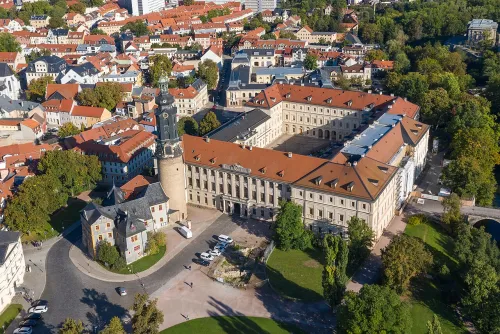
    The Stadtschloss, called so to set it apart from the other palaces in and around Weimar, stands at the north end of the Park an der Ilm. From the middle of the 16th century it was the residence of the dukes of Saxe-Weimar, later Saxe-Weimar and Eisenach, which from 1809 until the revolution of 1918 and 1919 was a grand duchy.

    Few buildings in town have burned as often. A medieval moated castle stood here by the end of the 10th century; after a fire in 1424 and again from the mid-16th century it was reshaped. After another fire in 1618, the Italian architects Giovanni Bonalino and Costantino de' Servi planned the rebuilding from 1619, and its palace church, completed in 1630, heard premieres of several works by Johann Sebastian Bach between 1708 and 1717. In the 1650s Johann Moritz Richter turned the design into a symmetrical Baroque palace with three wings open to the south. After the fire of 1774 that palace was replaced by today's Neoclassical building.

    Since 1923 the palace has housed the Schlossmuseum, focused on paintings of the 15th and 16th centuries and art connected with Weimar. Four rooms are dedicated to the poets who worked here: Goethe, Herder, Schiller and Christoph Martin Wieland. Go in if you enjoy old masters or want to see the court behind the poets; if you are short on time, save your energy for the park.

    From the palace you walk 720 m, about 10 minutes, into the park to Goethe's Garden House.

    Local name
    Weimarer Stadtschloss
    Hours
    Tue–Sun 10:00–18:00, Mon closed
    Price
    Adults 8 EUR, reduced 6 EUR
  11. 11

    Goethe's Garden House

    Goethe's Garden House in Weimar, stop 11 on the self-guided walking tour

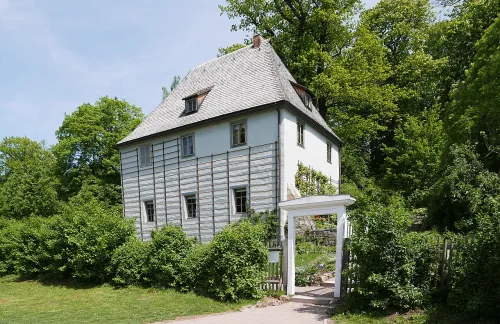
    This modest house at the foot of the Horn, on the eastern slope above the Ilm, was Goethe's first real home in Weimar and a place where he lived and worked. The Corona-Schröter-Weg runs past it. The house may be a 16th-century vintner's house from a time when wine growing mattered in Weimar; in Goethe's day the slope was more of an orchard and vegetable plot.

    When Goethe arrived in 1775 he took an interest in the plot, which was for sale and run down. Duke Carl August wanted to give it to his friend, and the contract of 22 April 1776 sold Goethe the garden on the Horn with its garden house and everything fixed to it. The 600 thaler were paid in two instalments by Friedrich Justin Bertuch out of the duke's own purse, though the duke thought it wiser for Goethe to appear as the buyer.

    Goethe threw himself into restoring the garden and made the house habitable again. In 1777 he added a wooden balcony on the south side, which decayed while he was in Italy and was later removed. He had trellises fixed to the walls: roses on the north and west, vines on the south and honeysuckle on the east. Near the house, look for the Stone of Good Fortune. Unlike today, the garden was also a working kitchen garden, and from here Goethe laid the groundwork for redesigning the Ilm park after the model of Wörlitz.

    Going in costs admission and suits anyone who wants to see the simpler side of Goethe after his grand house on Frauenplan. Then walk 260 m, about 4 minutes, deeper into the park.

    Local name
    Goethes Gartenhaus
    Hours
    Tue–Sun 10:00–18:00 (summer: 21 March to 1 November), winter closed, Mon closed
    Price
    Adults 8 EUR, reduced 6 EUR
  12. 12

    Park an der Ilm

    Park an der Ilm in Weimar, stop 12 on the self-guided walking tour

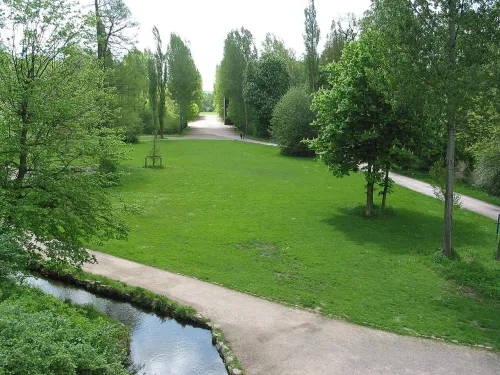
    The Park an der Ilm is a landscape park on both banks of the river, stretching for 1 km from the palace in the north to the suburb of Oberweimar in the south. It belongs to a much longer green corridor along the Ilm that also takes in the parks of Schloss Belvedere and Schloss Tiefurt. The park is divided into the Goethe-Park and the Dux-Garten, and it has changed so little that it still shows a park of its period.

    Work began in 1778, under Goethe's influence, turning a Baroque garden into an English landscape garden. The model was Wörlitz, which Goethe visited regularly from 1776 and which became the setting of his 1809 novel Elective Affinities. After special trees were planted from 1778, systematic work started in 1785, and the design was finished in 1823 with the Tempelherrenhaus. A suspension bridge followed in 1833. Between 1848 and 1852 the court gardener Eduard Petzold cut views toward Goethe's Garden House and the Roman House, so keep looking back across the meadows.

    Among the monuments, find the Shakespeare memorial by Otto Lessing from 1904, commissioned by the German Shakespeare Society, founded in Weimar in 1864, and busts of the poets Alexander Pushkin, Adam Mickiewicz, Sándor Petőfi and Louis Fürnberg. Most of the trees are local, but some come from abroad, especially North America.

    The park is free and open, so take it at your own pace. The Roman House is 560 m away, about 8 minutes on foot.

    Hours
    Open 24/7
    Price
    Free
  13. 13

    Roman House

    Roman House in Weimar, stop 13 on the self-guided walking tour

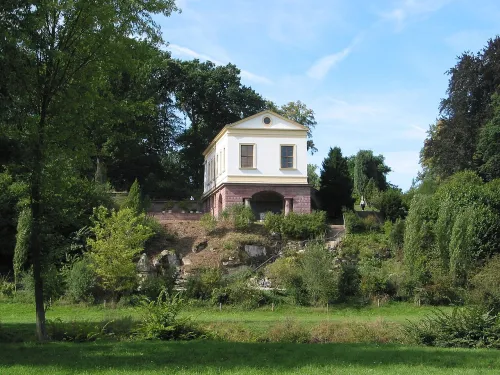
    Built between 1791 and 1798 as a garden house for Duke Carl August, the Roman House is one of the early classicist buildings in Germany, modelled on a Roman temple. Goethe brought the idea back from Italy and at first oversaw the building work himself. The designs came from the Hamburg architect Johann August Arens, the interiors from the Dresden architect Christian Friedrich Schuricht, with Johann Heinrich Meyer involved in decorating the rooms.

    It sits high on the western side of the park, with a wide view over the Ilm valley to the north and south. Look at the passage beneath the house with its Doric columns and the fountain, probably by Martin Gottlieb Klauer, who also made the wall decoration outside and inside. The group in the west gable, first made by Klauer after a design by Meyer, was replaced in 1819 by Peter Kaufmann.

    After Carl August died in 1828 the house was rarely lived in; from 1844 it went to the hereditary grand duke Carl Alexander, and after the last grand duke abdicated it passed to the state of Thuringia in 1922. Thoroughly restored after 1954, it is now a museum with a permanent exhibition on the history of the Ilm park. Since 2012 it has also shown four torsos of the Templar figures from the Tempelherrenhaus.

    Admission is free, so step inside: after the walk through the park, the exhibition explains what you have just seen. Then comes the longest leg of the route, 1250 m and about 18 minutes, to the Historic Cemetery.

    Local name
    Römisches Haus
    Hours
    Tue–Sun 10:00–18:00 (summer: 21 March to 1 November), winter closed, Mon closed
    Price
    Free (Admission free)
  14. 14

    Historic Cemetery & Grand Ducal Vault

    Historic Cemetery & Grand Ducal Vault in Weimar, stop 14 on the self-guided walking tour

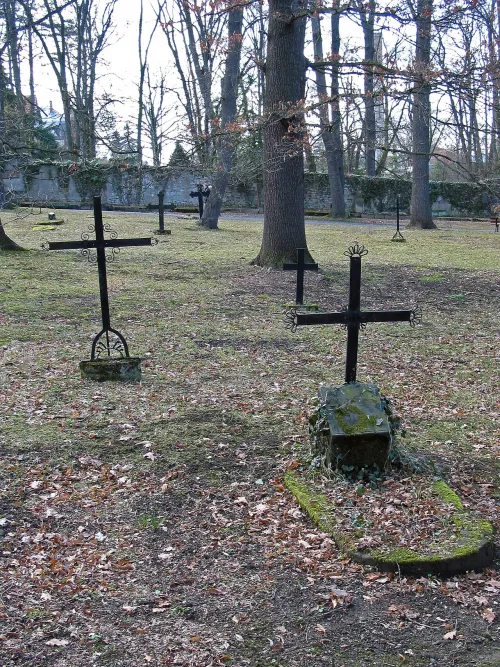
    When the old churchyard around the Jakobskirche ran out of space, a new cemetery was laid out between 1814 and 1818 beside the Posecksche Garten and consecrated on 20 March 1818. Today the oldest, park-like northern part with its old trees is called the Historic Cemetery, and it is one of the most visited cemeteries in Germany, with the graves of many well-known figures. To keep its character, there are no more burials north of the Ducal Vault.

    Through the main entrance, the neo-Romanesque building on your left was built in 1878 and 1879 as a funeral hall and turned in 1921 into a memorial hall for Weimar's dead of the First World War; the monumental figure inside, Heldenglaube, is by the Weimar sculptor Josef Heise. From the entrance a straight avenue of lime trees rises gently to the Ducal Vault and the Russian Orthodox Chapel, which together form the centre of the cemetery.

    The vault was the burial place of the grand ducal house of Saxe-Weimar-Eisenach alone, with two exceptions: Goethe and Schiller, laid here at Grand Duke Carl August's wish so that they would stay united with him in death. Their coffins are the reason most people come.

    The cemetery is free; the vault charges admission, and for anyone who started the day at Goethe's front door it is a fitting place to finish. If you want to return to Frauenplan, the GPS navigation leads you back.

    Local name
    Historischer Friedhof Weimar
    Hours
    Cemetery: daily 08:00–21:00 (March–Sept) resp. 08:00–18:00 (Oct–Feb); princely crypt: Wed–Mon 10:00–18:00 (summer: 21 March to 1 Nov), Tue and winter closed
    Price
    Cemetery free; Ducal Vault adults 7 EUR, reduced 5 EUR
Walking tour route map of Weimar Route loaded
Goethe's HouseSchiller's ResidenceGerman National TheatreGoethe-Schiller Monument+10
All 14 stops are already on the map.
You just press start.
AI Tour Guide

You know the route now. Walk it with a guide in your ear.

Press start wherever you are, even hundreds of kilometres from Weimar, and the guide begins telling its stories right away. In the city, pick any of the 14 stops to start from: it leads you there, then talks with you the whole route, asking, listening, remembering, and shaping the tour around your answers.

14stops 6.2km 1 h 26 minwalking 13languages
▶Start the tour free

Free to start · Runs in your browser · No app, no download

Shorter Ways to Walk Weimar

The route splits naturally at the Weimar City Palace, where the old town gives way to the park. Each half works on its own.

Old town and Bauhaus

Stops: 1, 2, 3, 4, 5, 6, 7, 8, 9, 10

For a day of houses and museums: 47 minutes of walking from Goethe's House to the Weimar City Palace. Goethe's House, Schiller's Residence, the Bauhaus-Museum Weimar, the library's Rococo Hall and the palace charge admission; the monument, Herder Church, Market Square and the Cranach House facade are free.

Ilm park and the poets' graves

Stops: 10, 11, 12, 13, 14

For a greener half day or a second morning: 40 minutes of walking from the palace through the park to the cemetery. The palace, Goethe's Garden House and the Ducal Vault charge admission; the park, the Roman House and the cemetery are free.

Goethe and Schiller in brief

Stops: 1, 2, 3, 4

If you only have a few hours: 8 minutes of walking between the two poets' homes, the theatre and their monument. The two houses charge admission; the theatre exterior and the monument are free.

How Long Does This Weimar Tour Take, With and Without Museums?

Pure walking time is 1 h 26 min over 6.2 km. The longer legs are the detour out to the Bauhaus-Museum Weimar and back into the old town, 14 and 16 minutes, the 10 minutes from the palace into the park and the final 18 minutes from the Roman House to the cemetery. Between Herder Church and the palace, stops are only a minute or two apart.

Staying mostly outside, with the free church, the Roman House and the cemetery, you need about three hours. Add Goethe's House, the library's Rococo Hall and the Ducal Vault and it becomes most of a day; with the Bauhaus museum and the palace museum as well, split the route over two half days.

The old town and Bauhaus half has 47 minutes of walking, the park and cemetery half 40 minutes, and the short Goethe and Schiller loop just 8 minutes, so its length depends almost entirely on the two houses.

Before You Set Off in Weimar

  • Start: Goethe's House on Frauenplan is the recommended start, but you can join the route at any stop.
  • End: The route ends at the Historic Cemetery & Grand Ducal Vault. If you like, the GPS navigation in your browser leads you from there back to the start.
  • Time of day: Start in the morning if you want to go inside several houses, since the interiors take time and the museums keep daytime hours. The park and the cemetery suit the later part of the day.
  • Admission: Goethe's House, Schiller's Residence, the Bauhaus-Museum Weimar, the library's Rococo Hall, the Weimar City Palace, Goethe's Garden House and the Ducal Vault charge admission. The German National Theatre is entered with a performance ticket; the Cranach House is seen from outside.
Walking tour route map of Weimar
AI Tour Guide

Your guide is ready when you reach Frauenplan.

Press start and a voice AI Tour Guide takes it from here: leading the route through Weimar, telling the stories, and turning your walk into a real back-and-forth conversation. No app or download is needed; it runs in your browser.

14stops 6.2km 1 h 26 minwalking 13languages
▶Start the tour free

Free to start · Runs in your browser · No app, no download

What the AI Tour Guide Adds in Weimar

On this route the AI Tour Guide greets you on Frauenplan and turns the walk into one long conversation about Weimar's poets, painters and dukes. It notices whether you lean toward Goethe, Bach or the Bauhaus and shapes the next stops around that, and it follows up on what the walk stirs up, such as what Schiller was working on in his study under the roof or how teaching at the Bauhaus actually worked. Route, map and GPS navigation stay free; the guide starts with 100 free credits, after which you choose this tour all-inclusive for €19.99 with no time limit, or €5 per hour.

A Real Conversation A voice AI Tour Guide greets you, leads the whole route, and tells the stories and facts as you walk, asking what you want to see and keeping a real conversation going. Not a recording you press play on.
Map Navigation Follow the route on the map and walk at your own pace. You choose where to start and when to move to the next stop.
Ask Anything Curious about a building you pass? Ask your AI Tour Guide on the spot and the conversation carries on.
13 Languages Switch language anytime. No separate tour needed.
Start free in your browser

Common Questions About Walking Weimar

Does the Goethe's House ticket include the Goethe National Museum?

Yes. One ticket covers Goethe's residence and the Goethe National Museum, so plan both as one visit.

Can I see a performance at the German National Theatre?

Yes. Prices depend on the production, the venue and the seat category, with discounts for students, pupils and people with severe disabilities. Buy at the theatre box office; on performance days an evening box office opens shortly before the show.

Does Herder Church offer guided visits?

Going in is free. The church also offers guided walks for a fee, and pupils join free.

Which towns combine well with Weimar?

Jena, where Schiller lived before moving to Weimar, is 19 km away, and Erfurt is 21 km away. Both have their own walking routes.

Is the tour really free?

Yes. The whole tour is free: the route, the interactive map and the navigation cost you nothing. Only the voice AI Tour Guide is optional and paid: you test it with 100 free credits, then you pay either €5 per hour or €19.99 for this whole tour, with no time limit. Admission to 6 of the 14 stops is not included: Goethe's House, Schiller's Residence, Bauhaus-Museum Weimar, Duchess Anna Amalia Library, Weimar City Palace and Goethe's Garden House charge their own entry fees.

Do I need to download an app?

No. Everything runs in your phone browser. Open the route and start walking, no download and no sign-up required.

Do I need to book the walking tour in advance?

No booking needed. This self-guided tour is available anytime. Open the route in your browser and start walking. The AI Tour Guide works instantly, no app, no reservation required.

What languages is the AI Tour Guide available in?

The AI Tour Guide speaks 13 languages, so you take the tour in your own language and can switch at any time.

Can I skip stops or change the route?

Yes. Skip any stop, spend extra time at places you like, or start the route from any point. It is your walk, you set the pace.
Image credits
▶ Start free in your browser Runs in your browser, no app, no download