Free Walking Tour Jerusalem: Mount of Olives to the Shuk

Start on the Mount of Olives, cross the Old City past sacred sites of three faiths, and end among the falafel stands of Mahane Yehuda.

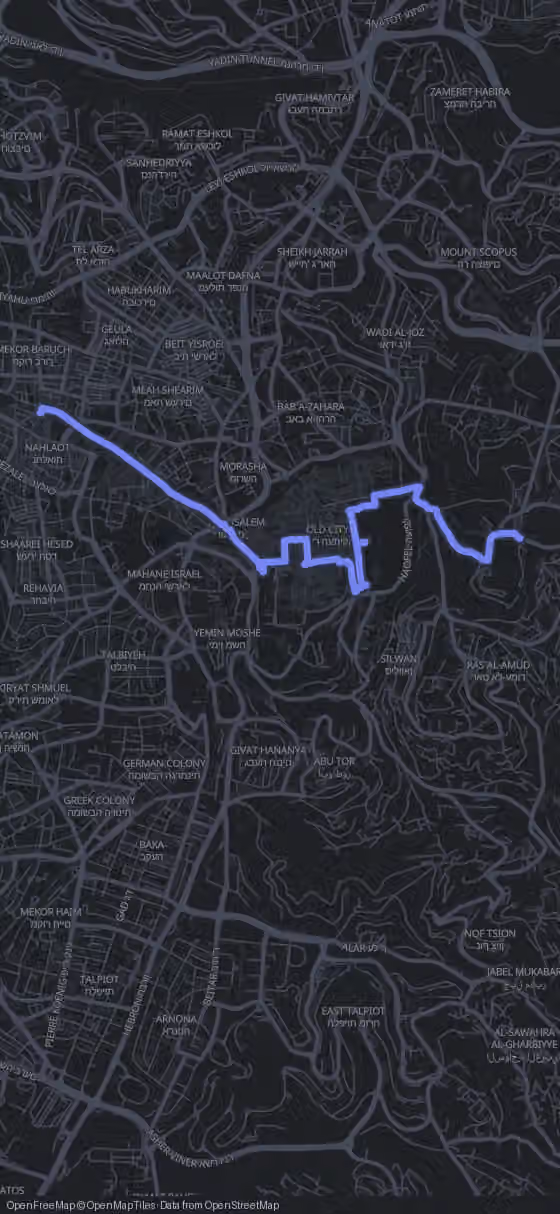
10 Stops 5.7 km ~1 h 29 min walking
Route map for the Jerusalem walking tour
Stop 1 of 10
1.6 km·20 min
Mount of Olives
Head west off the ridge toward the Via Dolorosa, downhill into the Old City.
Shalom, welcome to Jerusalem. I'm Alex, and some of this city's deepest meaning survives in its quietest corners.
Try this tour with Alex

What This Jerusalem Walk Covers

From the Mount of Olives across the Old City to Mahane Yehuda Market: 10 stops, 5.7 km, 1 h 29 min of pure walking. With the visits worth making inside, plan about seven hours, closer to eight if you stay to eat at the market.

Eight stops are free. Tickets are needed only for the Jerusalem Archaeological Park and the Tower of David Museum, and the Dome of the Rock is seen from outside, in set visiting windows for non-Muslim visitors. The GPS route runs free in your browser; the AI Tour Guide is optional.

Open free GPS & optional AI Tour Guide
View of Jerusalem

The Route

Walking Map of Jerusalem, from the Mount of Olives to the Shuk

10 stops 5.7 km 1 h 29 min walking
Tap to load interactive map

The 10 stops along this route

  1. Mount of Olives in Jerusalem, stop 1 on the self-guided walking tour
    1Mount of Olives
  2. Via Dolorosa in Jerusalem, stop 2 on the self-guided walking tour
    2Via Dolorosa
  3. Little Western Wall in Jerusalem, stop 3 on the self-guided walking tour
    3Little Western Wall
  4. Dome of the Rock in Jerusalem, stop 4 on the self-guided walking tour
    4Dome of the Rock
  5. Western Wall in Jerusalem, stop 5 on the self-guided walking tour
    5Western Wall
  6. Jerusalem Archaeological Park, stop 6 on the self-guided walking tour
    6Jerusalem Archaeological Park
  7. Old City Market in Jerusalem, stop 7 on the self-guided walking tour
    7Old City Market
  8. Church of the Holy Sepulchre in Jerusalem, stop 8 on the self-guided walking tour
    8Church of the Holy Sepulchre
  9. Tower of David Museum in Jerusalem, stop 9 on the self-guided walking tour
    9Tower of David Museum
  10. Mahane Yehuda Market in Jerusalem, stop 10 on the self-guided walking tour
    10Mahane Yehuda Market
  11. That's the full route.

    Walk it with an AI Tour Guide talking you through every one of these streets.

    Start free in your browser
    You made it

Your Jerusalem Walking Tour Through Three Faiths, Stop by Stop

  1. 1

    Mount of Olives

    Mount of Olives in Jerusalem, stop 1 on the self-guided walking tour

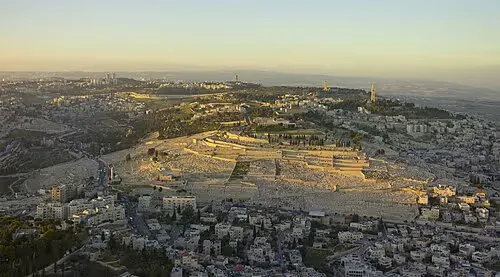
    You begin on a ridge that faces the Old City across the Kidron Valley. It takes its name from the olive groves that once covered its slopes. The western side, the one turned toward the city, has been a Jewish cemetery for over 3,000 years and holds about 150,000 graves, which makes it central to the tradition of Jewish burial.

    For Christians, the mount is bound up with several events in the life of Jesus told in the Gospels, and the Acts of the Apostles names it as the place from which he ascended to heaven. Because of its ties to both Jesus and Mary, people have worshipped here since ancient times, and it is still a major place of pilgrimage.

    The ridge has several summits, and each carries something different. The middle peak has a double top: on the western one stand the Chapel of the Ascension and At-Tur, a Palestinian former village that is now part of East Jerusalem; on the eastern one, the Russian Orthodox Convent of the Ascension and an Islamic maqam. The southern head holds the Church of the Pater Noster complex, the northern head the Viri Galilaei Church. The southern part of the mount was once the Silwan necropolis, linked to the elite of the ancient Kingdom of Judah.

    The mount is open around the clock and free, so take your time among the graves and churches before you leave. From here it is 1590 m and about 27 minutes on foot into the Old City and the Via Dolorosa.
    Hours
    Open 24/7
    Price
    Free
  2. 2

    Via Dolorosa

    Via Dolorosa in Jerusalem, stop 2 on the self-guided walking tour

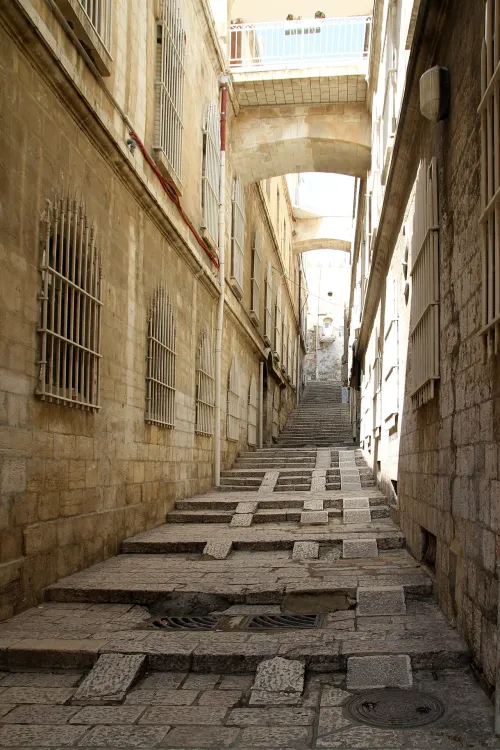
    The Via Dolorosa, Latin for “Sorrowful Way”, traces the path Jesus is believed to have taken, driven by Roman soldiers, to his crucifixion. It winds about 600 metres from the site of the former Antonia Fortress to the Church of the Holy Sepulchre. The line pilgrims follow today was fixed in the 18th century and replaced several earlier versions.

    Keep an eye out for the 14 Stations of the Cross. Nine are out in the streets; the last five are inside the Church of the Holy Sepulchre, which you reach later on this walk. So you meet the procession route here and pick up its ending again at the church.

    Look at the street itself too. The Via Dolorosa is not one street but a chain of segments, and one of them is what remains of an east-west road of Aelia Capitolina, the Roman city Hadrian built here. The Temple Mount blocked the usual central road, so his planners added an extra one further north. Had it run straight on to the west, it would have left a triangular block too narrow for standard buildings, so the western part was laid out further south. That is why the road still jogs today.

    The route is open at all hours and free. From here it is only 230 m, about 3 minutes, to a quiet alley with a very old wall: the Little Western Wall.

    Hours
    Open 24/7
    Price
    Free
  3. 3

    Little Western Wall

    Little Western Wall in Jerusalem, stop 3 on the self-guided walking tour

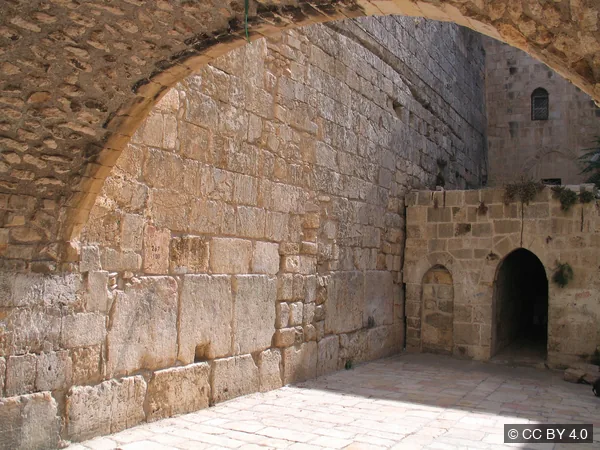
    This one is easy to miss: a narrow alley in the Muslim Quarter near the Iron Gate to the Temple Mount. The Little Western Wall, Kotel Katan in Hebrew, belongs to the same Herodian retaining wall as the famous Western Wall, and it almost exactly faces the Holy of Holies. Along the almost 500 m of that wall, only these two sections are not hidden behind houses.

    Look at the bottom of the wall. Only the two lowest courses of stone date from the Second Temple period, and unlike at the main wall they have not been worn smooth by the touch of millions of worshippers. There is no plaza here, just the alley. That gives you an idea of how the main wall looked before the Six-Day War of 1967, when the Moroccan Quarter was razed and the Western Wall Plaza created.

    The alley has a history of its own. It is Hosh ash-Shihabi, the courtyard of Ribat Kurd, a hospice for Muslim pilgrims founded in 1293 or 1296 by Sayf ad-Din Kurd al-Mansuri, a mamluk of Sultan Qalawun. The entrance portal and the passage are original; the rest of the building is later.

    Because this spot lies closer to the possible site of the Holy of Holies than the larger wall, Jews come here to pray, and it is far less crowded than the main wall. It is free and open at all hours. The Dome of the Rock is 130 m away, about 2 minutes on foot.

    Hours
    Open 24/7
    Price
    Free
  4. 4

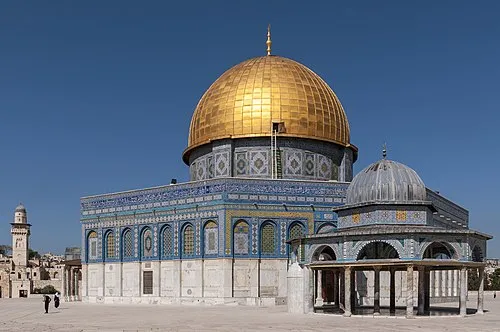
    Dome of the Rock

    Dome of the Rock in Jerusalem, stop 4 on the self-guided walking tour

    The octagonal shrine at the center of the Al-Aqsa mosque compound on the Temple Mount is the world's oldest surviving work of Islamic architecture. The Umayyad caliph Abd al-Malik had it built in the years 691 and 692, during the Second Fitna, and its inscriptions are the earliest known to proclaim Islam and the prophet Muhammad.

    It stands over the Foundation Stone, the Noble Rock. For Muslims, the Night Journey of Muhammad began from this rock. Christian and Jewish tradition see it as the place where Abraham was to sacrifice his son, and the shrine is believed to stand on the site of the Second Temple, which the Romans destroyed in 70 CE. In Judaism, that is where God created the world and Adam, and the place Jews turn toward in prayer.

    What you see draws on Byzantine models: the plan and the original mosaics were patterned on nearby churches and palaces, and the octagon may echo the Kathisma, a church built between 451 and 458 on the road to Bethlehem. Note the gently bulbous dome. The original collapsed in 1015 and was rebuilt in 1022 and 1023. The blue-and-white Iznik-style tiles outside are Ottoman additions; the gold-plated roof is modern, first gilded in a project finished in 1964 and again in the 1990s.

    The interior is closed to non-Muslims, so you see the shrine from outside, free of charge. Non-Muslim visitors can only come during limited visiting windows, so it pays to be here early in the day. From here it is 160 m, about 2 minutes, to the Western Wall.

    Hours
    Sun–Thu 7:30–10:30 & 13:30–14:30 (Summer) / 7:30–11:30 & 13:30–14:30 (Winter); Fri–Sat closed to non-Muslim visitors
    Price
    Free (exterior only; interior closed to non-Muslims)
  5. 5

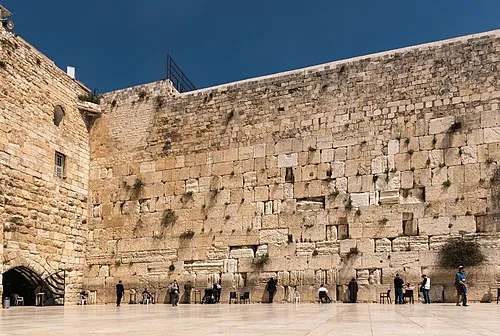
    Western Wall

    Western Wall in Jerusalem, stop 5 on the self-guided walking tour

    Here the retaining wall of the Temple Mount opens onto a wide plaza. Jews call it the Kotel, in the West it is the Wailing Wall, and in the Arab and Islamic world the Buraq Wall. In the narrow sense the name means this prayer section; in the broad sense it covers the whole 488-metre wall along the western side of the Temple Mount.

    Read the wall from the ground up. The very large blocks of the lower courses are Herodian; the medium-sized stones on top of them were added under the Umayyads; the small stones of the highest courses are more recent, many from the Ottoman period. Just over half of the wall's total height, including 17 courses hidden under street level, dates from the end of the Second Temple period, and the work is believed to have been begun by Herod the Great.

    The Temple Mount is a man-made platform: a natural, irregular hilltop extended again and again to carry an ever larger Temple compound. Because of the entry restrictions on the Temple Mount, this wall is the holiest place where Jews are permitted to pray outside the platform, since the presumed site of the Holy of Holies lies just behind it. The earliest text that may refer to Jewish worship at this spot dates from the 10th century. Compare the polished stones here with the rough ones you just saw at the Little Western Wall.

    The wall is open around the clock and free. It is an active place of prayer, so move quietly. The Jerusalem Archaeological Park is 220 m away, about 3 minutes.

    Hours
    Open 24/7
    Price
    Free admission
  6. 6

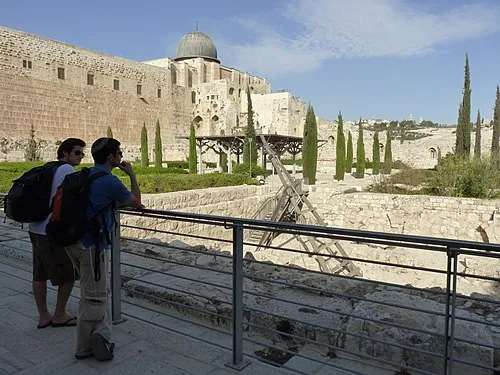
    Jerusalem Archaeological Park

    Jerusalem Archaeological Park, stop 6 on the self-guided walking tour

    South of the Western Wall Plaza, under the Dung Gate, lies the Jerusalem Archaeological Park, also called Ophel Garden. You enter through an underpass on the access road to the Western Wall. The park sits at the foot of the Temple Mount's Southern Wall in the northern Ophel, a biblical term for a raised part of the city where the administration sat. The ascent to the Temple led from the City of David through here.

    The ground holds finds from the Bronze Age, around 3,000 BC, to the Ottoman period in the early 20th century. With so many layers on top of each other, the excavators had to choose what to keep, so they split the park into three sections, each dug down to a single period. Beside the Western Wall you stand at Second Temple level, about 2,000 years ago; along the eastern half of the Southern Wall, at Byzantine level, about 1,500 years ago.

    The Davidson Center, the exhibition building, shows finds from the digs: stone weights, ossuaries and fragments of the decorative stonework of Herod's Temple Mount. It reopened in 2023 with interactive galleries. Look for a rare coin of Antigonus II Mattathias, the last Hasmonean king, bearing the earliest known image of the Temple menorah, minted 107 years before the Temple was destroyed.

    If the stones of the Western Wall made you curious, this is where they make sense; allow about an hour. The park charges an entry fee. From here it is 630 m, about 12 minutes, into the Old City Market.

    Hours
    Sun–Thu 10:00–17:00, Fri & Holiday Eves 09:00–14:00, Sat closed (last entry 40 min before closing)
    Price
    34 NIS adult, 18 NIS child (5-18) / soldier / senior
  7. 7

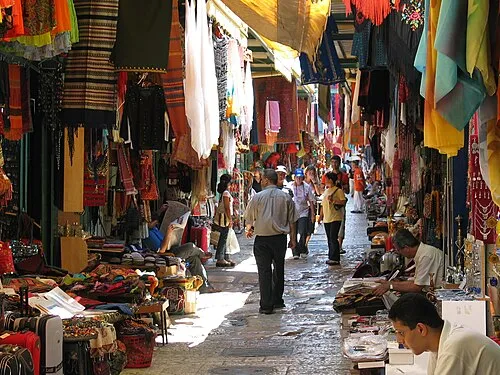
    Old City Market

    Old City Market in Jerusalem, stop 7 on the self-guided walking tour

    The Old City Market is not one hall but a system of long alleys running through the Old City, along the borders of the Christian, Muslim and Armenian Quarters. What is sold here ranges from food and sweets to clothes, furniture and electronics.

    It follows two main axes. The east-west one runs from Jaffa Gate along David Street and Chain Street to the Chain Gate of the Temple Mount. The north-south one starts at Damascus Gate and splits: one branch runs to the Western Wall Plaza, the other to David Street. In the Jewish Quarter it continues as the Cardo, now an arts bazaar; the Muristan in the Christian Quarter and the Cotton Merchants' Market beside the Temple Mount complete the picture. These axes preserve the street plan of Roman and Byzantine Jerusalem. Watch the floor: the many manhole covers mark the low ground between two hills that the east-west street follows.

    The Crusaders reshaped it. Queen Melisende of Jerusalem split the western half of the broad Cardo into three narrow parallel markets with vaulted roofs, now known as the spice market, the butchers' market and the goldsmiths' market. She gave part of the shop income to the convent of St. Anne, where her younger sister Agnes lived, and in places you can still find the letters SA carved into the vaults. Pilgrims of the time were less charmed: they described dark, dirty, smelly lanes, and locals called one of them the Market of Bad Cooking.

    Entry is free. From the 13th to the 19th century, much of the trade here was aimed at Christian pilgrims because the Church of the Holy Sepulchre is so close: 280 m, about 4 minutes on foot.

    Hours
    Daily: 09:00–18:00
    Price
    Free (entry)
  8. 8

    Church of the Holy Sepulchre

    Church of the Holy Sepulchre in Jerusalem, stop 8 on the self-guided walking tour

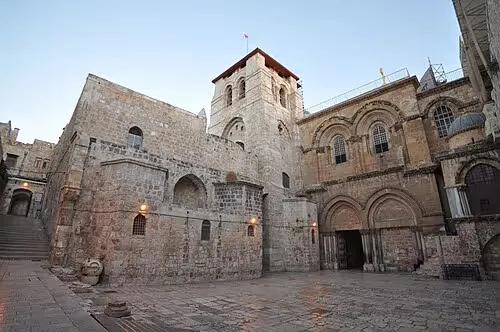
    This large church stands where most Christian traditions place the crucifixion, burial and resurrection of Jesus, and it is named after his empty tomb. It lies in the Christian Quarter at the end of the Via Dolorosa, and the last five Stations of the Cross are inside. Golgotha, the hill named in the New Testament, is enclosed within the building. Pilgrims from all over the world have come here since the 4th century.

    Much of what you see is the work of the Crusaders. After taking the city in 1099, they joined the scattered Byzantine buildings into one large Romanesque church, consecrated in 1149: the Rotunda over the tomb and the eastern church, the Catholicon, under a single roof. The entrance façade on the south side mixes Romanesque and early Gothic forms and once had two doors; one was later blocked.

    Golgotha, the place of the crucifixion, was built into the upper floor of the southern part of the church. At ground level in the entrance area the Crusader kings of Jerusalem were buried, among them Godfrey of Bouillon and Baldwin I. Look for the carved capitals and traces of Crusader wall paintings. Fires, earthquakes and later changes followed, but the Crusader building is still the core of the church.

    Going in is free and worthwhile for everyone, believer or not; allow about 45 minutes. The Tower of David Museum is 440 m away, about 7 minutes; on the way you pass the Greek Orthodox Church of St. John the Baptist.

    Hours
    Daily 05:00–20:45 (Apr–Sep) / 05:00–20:00 (Oct) / 04:00–19:00 (Nov–Feb) / 04:00–19:30 (Mar)
    Price
    Free admission
  9. 9

    Tower of David Museum

    Tower of David Museum in Jerusalem, stop 9 on the self-guided walking tour

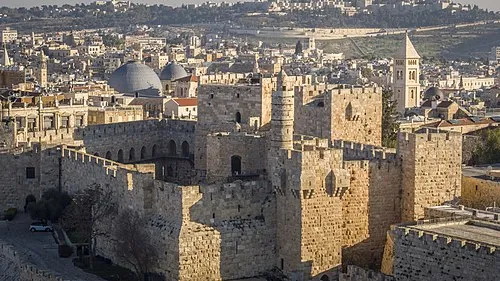
    The Tower of David, also called the Citadel, is an ancient fortress and a museum near Jaffa Gate. The citadel standing today is Mamluk and Ottoman, built on top of a series of older fortifications from the Hasmonean, Herodian, Byzantine and Early Muslim periods, which were destroyed again and again in the last decades of Crusader rule.

    The name is a mix-up with a long history. In the 5th century, Byzantine Christians believed this was King David's palace and named Herod's massive northeast tower after a line from the Song of Songs: “Thy neck is like the tower of David builded for an armoury, whereon there hang a thousand bucklers.” In the 19th century the name also attached itself to the 17th-century minaret on the opposite side, and since 1967 it officially means the whole citadel. In Arabic, the big Mamluk tower is the Burj al-Qal'a, the Citadel Tower, and in earlier centuries the site was called Mihrab Dawud, David's prayer place.

    The citadel is also a stage: it hosts concerts, craft shows and sound-and-light performances, and in the 1920s its art exhibitions gave a name to a whole period of Israeli art. Go in if you want to walk through the fortress itself and see the Herodian tower and the minaret up close; plan about 90 minutes.

    Entry is ticketed. Then you leave the Old City behind: 1980 m, about 29 minutes, to Mahane Yehuda Market.

    Hours
    Sun & Mon & Wed–Thu 09:00–17:00, Tue 09:00–20:00, Fri–Sat 09:00–15:00 (ticket office closes 1h before closing)
    Price
    55 NIS adult, 35 NIS child (5-18), 44 NIS student, 28 NIS Israeli senior
  10. 10

    Mahane Yehuda Market

    Mahane Yehuda Market in Jerusalem, stop 10 on the self-guided walking tour

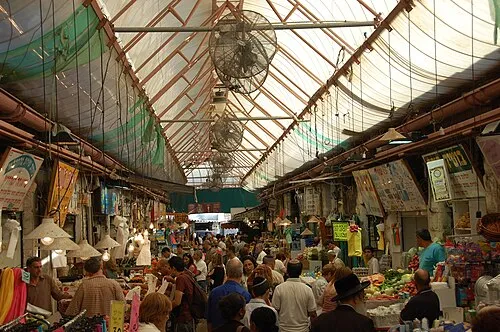
    After the stones and silence of the Old City, Mahane Yehuda, called simply “the Shuk”, is loud and alive. More than 250 vendors sell fruit and vegetables, baked goods, fish, meat and cheese, nuts, seeds and spices, wine, clothing, housewares and Judaica, and many of them call out their prices as you pass. Locals shop here as much as visitors do.

    This is where you eat. In and around the market there are stands for falafel, shawarma, kibbeh, kebab, shashlik and Jerusalem mixed grill, sweets like kanafeh, baklava, halva and zalabiya, juice bars, cafés and restaurants.

    Get your bearings with the two main streets: Eitz Chaim Street is the covered market, Mahane Yehuda Street the open-air one. The small streets crossing them were all named after fruits and nuts, such as Afarsek (Peach), Egoz (Walnut), Shaked (Almond) and Tapuach (Apple), until the city renamed Agas (Pear) Street after Yaakov Eliyahu Banai.

    The neighbourhood dates from 1887, when three partners founded it on the north side of Jaffa Road: Johannes Frutiger, a German Protestant who owned the largest bank in Ottoman Palestine, Shalom Konstrum and Joseph Navon, who named it after his brother Yehuda.

    Entry is free. On Thursdays and Fridays it fills with people shopping for Shabbat until a bugle on Friday afternoon announces the closing. This is where your walk ends.

    Hours
    Sun–Thu 08:00–19:00, Fri 08:00–15:00, Sat closed (evening restaurants/bars reopen after Shabbat)
    Price
    Free (entry)
Walking tour route map of Jerusalem Route loaded
Mount of OlivesVia DolorosaLittle Western WallDome of the Rock+6
All 10 stops are already on the map.
You just press start.
AI Tour Guide

You know the route now. Walk it from the Mount of Olives with a guide in your ear.

Press start wherever you are, even hundreds of kilometres from Jerusalem, and the guide begins telling its stories right away. In the city, pick any of the 10 stops to start from: it leads you there, then talks with you the whole route, asking, listening, remembering, and shaping the tour around your answers.

10stops 5.7km 1 h 29 minwalking 13languages
▶Start the tour free

Free to start · Runs in your browser · No app, no download

Shorter Ways Through Jerusalem

Not every day has room for the full walk. These three cuts keep the route in its order and use only its own stretches.

Sacred ground, all free

Stops: 1, 2, 3, 4, 5

For a morning focused on faith and history without a single ticket: from the Mount of Olives along the Via Dolorosa to the two sections of the Western Wall, with the Dome of the Rock in between. 34 minutes of walking, no entry fees. Go early on a day when the Dome of the Rock is open to non-Muslim visitors.

The Old City only

Stops: 2, 3, 4, 5, 6, 7, 8, 9

For anyone staying inside the walls: skip the ridge and the long walk to the market. Just 33 minutes of walking from the Via Dolorosa to the Tower of David Museum, with two tickets, the Jerusalem Archaeological Park and the Tower of David Museum.

Afternoon: church, citadel and shuk

Stops: 8, 9, 10

For a half day that ends with food: the Church of the Holy Sepulchre, the Tower of David Museum and Mahane Yehuda Market. 36 minutes of walking; only the Tower of David Museum charges entry.

How Long Does This Jerusalem Tour Take with Its Museums?

The pure walking time is 1 h 29 min over 5.7 km, and most of it sits in two stretches: the 27 minutes from the Mount of Olives into the Old City and the 29 minutes out to Mahane Yehuda. Between them, the Old City stops lie only minutes apart.

A realistic day: start at 8:00 on the Mount of Olives, reach the Via Dolorosa at 8:47 and the Little Western Wall around 9:10. At 9:22 you are at the Dome of the Rock, then the Western Wall at 9:54 and the Jerusalem Archaeological Park at 10:17. Give the park an hour, reach the Old City Market at 11:29 and the Church of the Holy Sepulchre at 12:03. After 45 minutes in the church you are at the Tower of David Museum at 12:55; with 90 minutes there, you arrive at Mahane Yehuda Market at about 14:54. That is about seven hours, and an hour of eating and browsing makes it eight.

The free sacred morning takes about two and a quarter hours, the Old City version just under six hours, and the afternoon with church, citadel and shuk about four hours.

Before You Set Out in Jerusalem

  • Start and finish: The recommended start is the Mount of Olives, but you can join at any stop. The walk ends at Mahane Yehuda Market on Jaffa Road.
  • Best day and time: A weekday, starting early. Not every stop is open every day, and the Dome of the Rock only admits non-Muslim visitors during limited windows.
  • Costs: Walking the route costs nothing. Only two stops charge admission: the Jerusalem Archaeological Park and the Tower of David Museum.
  • AI Tour Guide: Optional. You get 100 free credits to start; after that, either this tour all-inclusive for €19.99 with no time limit, or €5 per hour.
Walking tour route map of Jerusalem
AI Tour Guide

Your guide is ready at the Mount of Olives when you are.

Press start and a voice AI Tour Guide takes it from here: leading the route through Jerusalem, telling the stories, and turning your walk into a real back-and-forth conversation. No app or download is needed; it runs in your browser.

10stops 5.7km 1 h 29 minwalking 13languages
▶Start the tour free

Free to start · Runs in your browser · No app, no download

What the AI Tour Guide Adds Between the Wall and the Shuk

On this route, Jewish, Christian and Muslim history sit on the same few hundred metres, and every stone has more than one story. The AI Tour Guide walks you through them as a conversation: it greets you on the Mount of Olives, tells the story of each place, asks which thread pulls you in, whether Herod's builders, the Crusader kings or the Mamluk pilgrims, and remembers it for the next stop. Want to know why the Crusaders buried their kings at the church entrance, or what Melisende's sister Agnes did at St. Anne's? Just interrupt it and ask, and the talk turns that way.

A Real Conversation A voice AI Tour Guide greets you, leads the whole route, and tells the stories and facts as you walk, asking what you want to see and keeping a real conversation going. Not a recording you press play on.
Map Navigation Follow the route on the map and walk at your own pace. You choose where to start and when to move to the next stop.
Ask Anything Curious about a building you pass? Ask your AI Tour Guide on the spot and the conversation carries on.
13 Languages Switch language anytime. No separate tour needed.
Start free in your browser

Common Questions About Walking Jerusalem

Does Shabbat affect the walk?

Yes. Not every stop is open over Shabbat, so the full walk works best on another day. The outdoor stops, from the Mount of Olives along the Via Dolorosa to both sections of the Western Wall, are still there to see, and the restaurants and bars at the shuk reopen after Shabbat in the evening.

Is the Little Western Wall the closest point to the Holy of Holies?

No. It is closer than the main Western Wall, but there is a spot in the Western Wall Tunnel that directly faces the Holy of Holies.

Is Mahane Yehuda worth a return visit in the evening?

Yes, if you like nightlife. In recent years the shuk has become a place to go out, with restaurants, bars and live music once the stalls close.

Are there reduced tickets for the two museums?

Yes. At the Jerusalem Archaeological Park, children aged 5 and older, soldiers and seniors pay less. At the Tower of David Museum, there are reduced tickets for children, students and Israeli seniors.

Is the tour really free?

Yes. The whole tour is free: the route, the interactive map and the navigation cost you nothing. Only the voice AI Tour Guide is optional and paid: you test it with 100 free credits, then you pay either €5 per hour or €19.99 for this whole tour, with no time limit. Admission to 2 of the 10 stops is not included: Jerusalem Archaeological Park and Tower of David Museum charge their own entry fees.

Do I need to download an app?

No. Everything runs in your phone browser. Open the route and start walking, no download and no sign-up required.

Do I need to book the walking tour in advance?

No booking needed. This self-guided tour is available anytime. Open the route in your browser and start walking. The AI Tour Guide works instantly, no app, no reservation required.

What languages is the AI Tour Guide available in?

The AI Tour Guide speaks 13 languages, so you take the tour in your own language and can switch at any time.

Can I skip stops or change the route?

Yes. Skip any stop, spend extra time at places you like, or start the route from any point. It is your walk, you set the pace.
Image credits
▶ Start free in your browser Runs in your browser, no app, no download