Free Walking Tour Tel Aviv: Bauhaus to Old Jaffa

From a free Bauhaus collection through the Carmel Market and Rothschild Boulevard to the alleys of Old Jaffa: 6.7 km of Tel Aviv's story, one street at a time.

9 Stops 6.7 km ~1 h 35 min walking
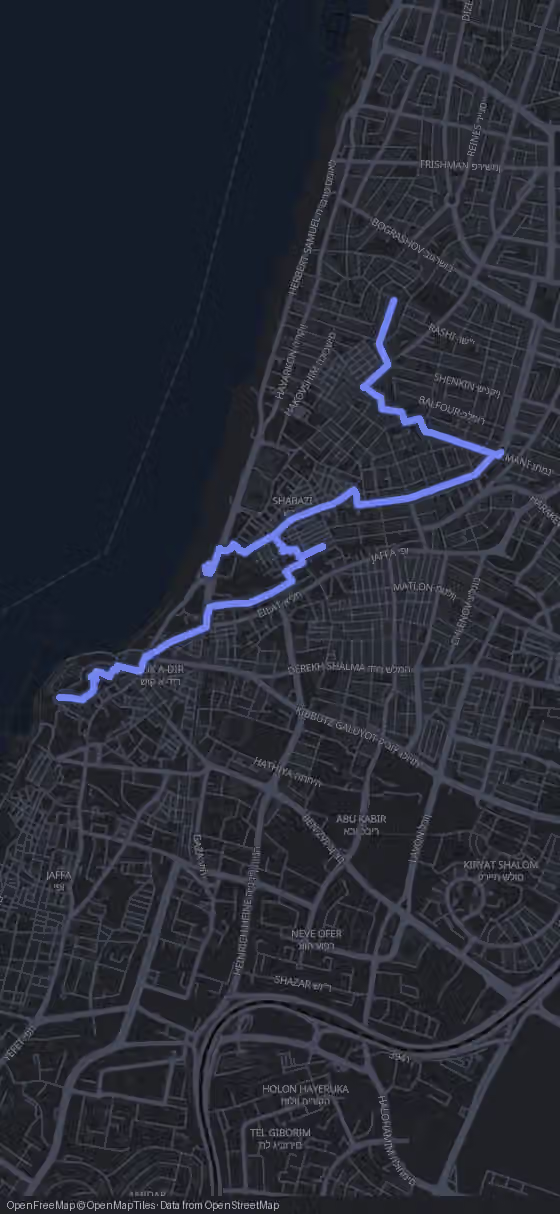
Route map for the Tel Aviv walking tour
Stop 1 of 9
560 m·7 min
Bauhaus Museum
Head south toward Carmel Market
Shalom, welcome to Tel Aviv. I'm Alex, and one short ceremony here changed the history of the region.
Try this tour with Alex

Nine Stops Across Tel Aviv at a Glance

Nine stops over 6.7 km: from the Bauhaus Museum through Carmel Market, Nahalat Binyamin Street, Rothschild Boulevard and Independence Hall to Neve Tzedek, the Nahum Gutman Museum, the Old City of Jaffa and the Ilana Goor Museum. Pure walking time is 1 h 35 min; with stops, plan about six hours.

Most of the walk is free. The Gutman and Ilana Goor museums charge entry, and Independence Hall was closed for renovation. The GPS route runs free in your browser; the AI Tour Guide is optional.

Open free GPS & optional AI Tour Guide
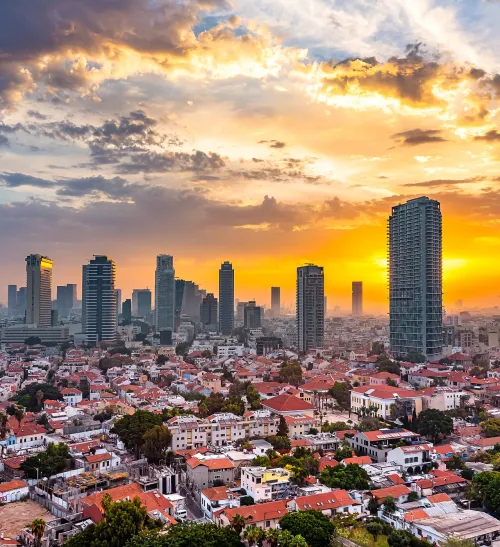
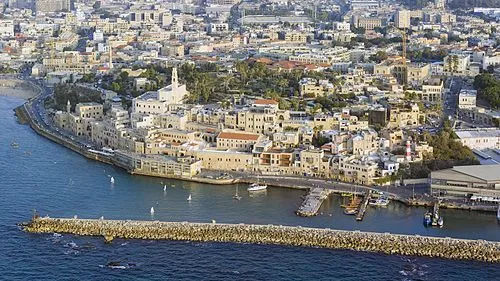
View of Tel Aviv

The Route

Walking Map of Tel Aviv: From the White City to Jaffa

9 stops 6.7 km 1 h 35 min walking
Tap to load interactive map

The 9 stops along this route

  1. Bauhaus Museum in Tel Aviv, stop 1 on the self-guided walking tour
    1Bauhaus Museum
  2. Carmel Market in Tel Aviv, stop 2 on the self-guided walking tour
    2Carmel Market
  3. Nahalat Binyamin Street in Tel Aviv, stop 3 on the self-guided walking tour
    3Nahalat Binyamin Street
  4. Rothschild Boulevard in Tel Aviv, stop 4 on the self-guided walking tour
    4Rothschild Boulevard
  5. Independence Hall in Tel Aviv, stop 5 on the self-guided walking tour
    5Independence Hall
  6. Neve Tzedek in Tel Aviv, stop 6 on the self-guided walking tour
    6Neve Tzedek
  7. Nahum Gutman Museum in Tel Aviv, stop 7 on the self-guided walking tour
    7Nahum Gutman Museum
  8. Old City of Jaffa in Tel Aviv, stop 8 on the self-guided walking tour
    8Old City of Jaffa
  9. Ilana Goor Museum in Tel Aviv, stop 9 on the self-guided walking tour
    9Ilana Goor Museum
  10. That's the full route.

    Walk it with an AI Tour Guide talking you through every one of these streets.

    Start free in your browser
    You made it

Stop by Stop Through Tel Aviv: Market, Boulevard and Old Port Hill

  1. 1

    Bauhaus Museum

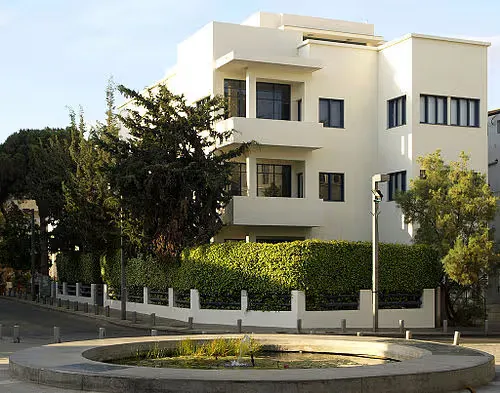
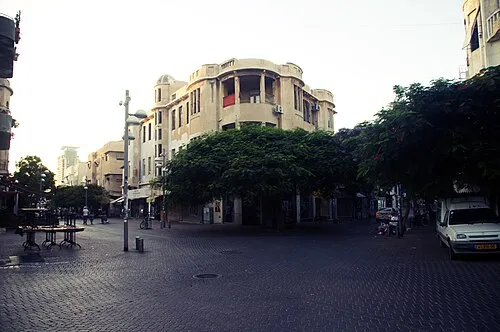
    Bauhaus Museum in Tel Aviv, stop 1 on the self-guided walking tour

    You begin small and free. The Bauhaus Museum fills just 120 square meters on the ground floor of a corner building at 21 Bialik Street and Idelson Street, and the building itself is part of the exhibit: architect Shlomo Gepstein designed it in 1934 in the International Style that would make Tel Aviv famous. Before you go in, look at the clean lines and the corner, then step inside to see where that thinking came from.

    The museum belongs to the Bauhaus Foundation Tel Aviv and has been open since 2008. Its founder is the American businessman, collector and patron Ronald Lauder, and most of what you see comes from his own collection. The rooms were designed by the architect and industrial designer Ron Arad, and they hold furniture, design objects and pieces from the estates of Bauhaus architects and designers who lived and worked in Tel Aviv. Look out for work by Mies van der Rohe, Marcel Breuer and Walter Gropius.

    Is it worth going in? Yes, for almost everyone: it is free, it is compact, and it gives you the vocabulary for the White City buildings you will pass all day. Design fans can linger; everyone else can see it in a short visit. If you want more context, the White City World Heritage Centre opened in 2019 in Beit Liebling at 29 Idelson Street, diagonally across the junction.

    From here it is 560 m, about 7 minutes, to the Carmel Market. You walk along Bialik Street and past Abrasha Park on the way.
    Hours
    Sun–Thu 10:00–20:00, Fri 10:00–14:30, Sat closed
    Price
    Free
  2. 2

    Carmel Market

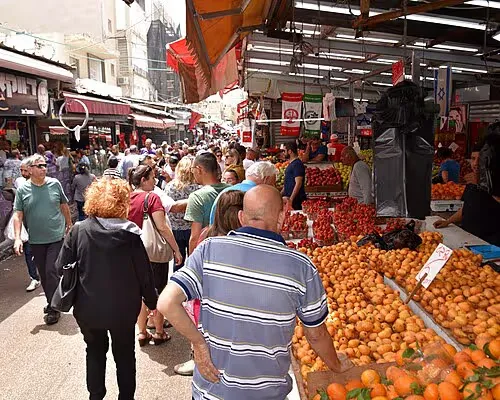
    Carmel Market in Tel Aviv, stop 2 on the self-guided walking tour

    The Carmel Market is the city's central market and the largest and best known in the Gush Dan area. It runs along HaCarmel Street, from Magen David Square toward the Carmelit terminal and Gan HaKovshim, and over the years it has spilled into side streets of Kerem HaTeimanim and Nahalat Binyamin. The southwestern part is also called the Gaza Market. Most stalls sell food, but you will also find clothes, haberdashery, household goods, flowers and plenty of places to eat on the spot.

    Its origin story is one of the best in the city. In 1913 Arthur Ruppin, head of the Palestine Office, was visiting Russia and urged Zionist Jews to buy land in the new Hebrew town. A group of wealthy Jews bought plots around HaCarmel Street for 1,000 rubles, not to move there but to leave the land to their children. Then came the October Revolution of 1917. They fled Russia and arrived with nothing but those plots between Allenby Street and Manshiya. People called them the Ruppin refugees.

    Unable to find a place in a labor market built on manual work, they wanted to trade fruit and vegetables instead. Despite plenty of opposition, Mayor Meir Dizengoff let them set up a small market along the street. It opened officially in 1920 as Shuk HaKerem and was renamed Carmel Market a few years later. The street itself once ran all the way to today's Rabin Square; in the 1930s most of it became King George Street.

    The market grew along the whole street and into the lanes of the Yemenite Quarter; HaGedera Street backs onto it and is full of food shops and restaurants. On 1 November 2004 a suicide bomber killed three civilians here, a reminder of the city's harder years. Entry is free; take your time and eat as you go. Nahalat Binyamin Street is only 140 m away, about 2 minutes.

    Hours
    Mon–Thu: 07:00–21:00 | Fri: 07:00–16:00 | Sat: Closed | Sun: 07:00–21:00
    Price
    Free (entry)
  3. 3

    Nahalat Binyamin Street

    Nahalat Binyamin Street in Tel Aviv, stop 3 on the self-guided walking tour

    Nahalat Binyamin begins at Magen David Square, where five streets meet: Allenby, King George and its continuation HaCarmel, Sheinkin and Nahalat Binyamin itself. From there it runs south, and its northern part is a pedestrian zone down to Gruzenberg Street. Together with the market and Rambam Street, it forms one of the largest car-free areas in the center of Tel Aviv.

    The name means the estate of Benjamin. Officially, Benjamin is the Hebrew name of Theodor Herzl, the founder of political Zionism. Local lore tells it differently: the founders asked for money from both the Jewish National Fund and from Baron Edmond de Rothschild, whose Hebrew name was also Benjamin, and the name kept both of them happy.

    The founders were not rich. While the wealthy families of Ahuzat Bayit started building in 1909 to escape crowded, unsanitary Jaffa, the Nahalat Binyamin Association was made up of tradesmen and clerks, craftsmen, shopkeepers, booksellers, a baker and a laundress, and they struggled to pay for the same dream. Today the street lives off its neighbors: the market, busy Allenby Street and the eateries of Kerem HaTeimanim. Since 1987 it has also hosted an arts-and-crafts fair, which is worth timing your walk around if you like handmade work.

    From here it is 820 m, about 12 minutes, to Rothschild Boulevard.

    Price
    Free
  4. 4

    Rothschild Boulevard

    Rothschild Boulevard in Tel Aviv, stop 4 on the self-guided walking tour

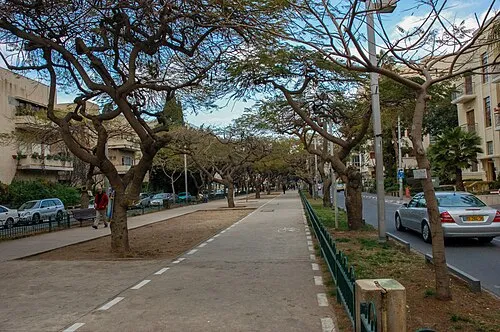
    Rothschild Boulevard is one of the oldest streets in Tel Aviv and today one of its most expensive. It starts at the edge of Neve Tzedek and runs north to the Habima Theatre, with a wide central strip shaded by ficus trees and lanes for walkers and cyclists. Soon after it was laid out, residents asked for it to be named after Baron Edmond de Rothschild, a major supporter of Jewish settlement.

    Look at the buildings as much as the trees. Many are in the Bauhaus or International Style and belong to the White City, Tel Aviv's UNESCO World Heritage Site. At the corner of Allenby Street, the Lederberg house of 1925 carries four large ceramic murals by Ze'ev Raban of the Bezalel school: a pioneer sowing and harvesting, a shepherd, and Jerusalem, with the verse from Jeremiah 31:4, "Again I will rebuild thee and thou shalt be rebuilt." At the corner of Herzl Street stands a house built in 1909 by the Eliavson family, one of the city's founding families; the French Institute bought and restored it in 2007.

    The boulevard you walk today is partly the result of a 1995 design competition. Architect Moti Bodek proposed using the existing avenues as a backbone of footpaths and bike lanes for leisure and sport, and restoring the historic kiosks along the way. It is also an arts district, with galleries such as Alon Segev Gallery, Rothschild49 Art Gallery and Sommer Contemporary Art. Everything here is free to enjoy.

    Independence Hall stands on the boulevard itself, 530 m or about 7 minutes further on.

    Price
    Free
  5. 5

    Independence Hall

    Independence Hall in Tel Aviv, stop 5 on the self-guided walking tour

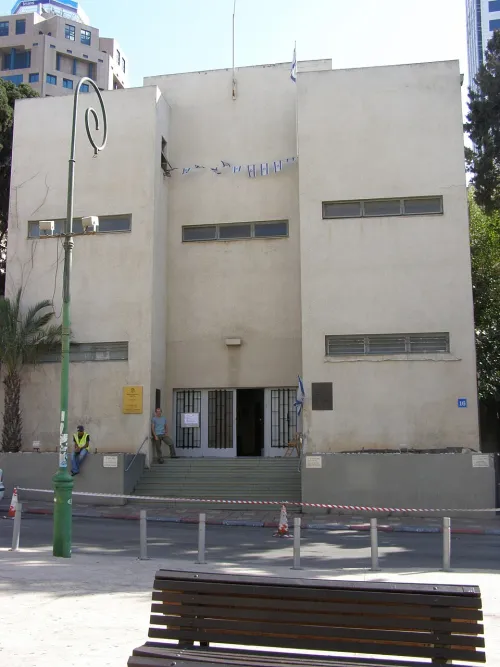
    This modest building is where Israel's Declaration of Independence was signed. It began as the home of Meir Dizengoff and his wife Zina, and its story is the story of Tel Aviv. Near this spot on 11 April 1909, 66 families gathered for a lottery of plots in a new Jewish neighborhood called Ahuzat Bayit. The Dizengoffs drew plot number 43 and built a simple, symmetrical house of kurkar stone.

    Meir Dizengoff led the neighborhood council, and in 1910 the residents, inspired by Herzl's novel Altneuland, voted unanimously to rename their neighborhood Tel Aviv. As it grew into a city, he became its first mayor. Zina hosted European-style salons in the house. Over the years Dizengoff added a rear wing, the room where the declaration would later be signed, and had architect Carl Rubin redesign the building in the International Style.

    After Zina's death, Dizengoff gave the house to the city in 1930 and asked for it to become a museum. It opened as the Tel Aviv Museum of Art in 1932 and stayed until 1971. In 1933 the museum hired art historian Dr. Karl Schwarz, who left his post as head of Berlin's first Jewish museum to take the job.

    Today it is a museum of the declaration and of the city's history, but renovations closed it to the public in 2024. Plan to see it from the outside unless you hear it has reopened. Then comes one of the longer legs: 1,540 m, about 21 minutes, to Neve Tzedek, the neighborhood where Rothschild Boulevard begins and where Jewish life outside Jaffa started.

  6. 6

    Neve Tzedek

    Neve Tzedek in Tel Aviv, stop 6 on the self-guided walking tour

    Neve Tzedek was the first Jewish neighborhood built outside the old port city of Jaffa, years before Ahuzat Bayit drew its lots. You will notice the scale at once: low buildings along narrow streets, the layout of the original quarter. Today those streets are lined with historic houses, artisan workshops, shops and cafes, and the neighborhood is free to wander at any hour.

    The name means Oasis of Justice, a phrase from the Book of Jeremiah where it is one of the names of God. Sephardi Jewish families looking for room outside overcrowded Jaffa founded it. The family of Aharon Chelouche, a landowner and businessman from Jaffa, moved here in 1883, and with Shimon Rokach, a Jerusalem pioneer of agriculture, he led a group of 48 families; about 50 more followed over the next years. The neighborhood was officially established in 1887, and others grew up around it: Neve Shalom in 1890, Yefe Nof in 1897 and Batei Feingold in 1904.

    In the early 20th century this was the cultural heart of young Tel Aviv. The future Nobel laureate Shmuel Yosef Agnon and the artist Nachum Gutman lived and worked here and wrote about it in their memoirs. After 1948 it took in new immigrants, then fell into neglect; by the 1970s it was slated for demolition. Public protest saved it, and since the 1990s it has turned bohemian and fashionable.

    Give yourself time to drift. The Nahum Gutman Museum is 980 m, about 14 minutes, from here, and it takes you inside one of the neighborhood's first houses.

    Hours
    Open 24/7
    Price
    Free
  7. 7

    Nahum Gutman Museum

    Nahum Gutman Museum in Tel Aviv, stop 7 on the self-guided walking tour

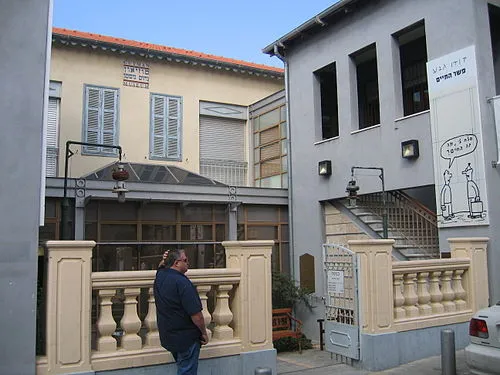
    The museum is housed in Beit HaSofrim, the Writers' House, built in 1887 by the Shulman family as one of the first buildings in Neve Tzedek. Between 1907 and 1914 it was the editorial office of the newspaper HaPoel HaTzair, edited by Yosef Haim Brenner. It earned its name because writers lived here too, among them Dvora Baron, Yosef Aharonovitz, Asher Barash and Yehuda Burla.

    The First World War ended that chapter. The house became an ordinary home and was abandoned altogether in the 1960s. In 1992, after it was added to Tel Aviv's conservation plan, architect Roni Seibert began a full restoration, and the museum opened in May 1998 with a collection donated by Gutman's family. Look for the room where his studio has been reconstructed with items brought from the original. A new wing named after Murray and Irene Fragment opened in 2009 with an extra gallery, an event hall and a shop.

    Gutman's work spans many periods, and the display changes every few months, so even a return visit shows something new. The museum also runs life-drawing workshops for professionals and amateurs. Entry is paid. Go in if you want to see the early city through the eyes of the artist who grew up in it; if you are short on time, you can save your museum budget for Jaffa.

    Next is the longest leg of the walk: 1,780 m, about 26 minutes, to the Old City of Jaffa. As you climb into the old town you reach Kikar Kdumim Square.

    Hours
    Mon: 10:00–19:00 | Tue–Wed: 10:00–15:00 | Thu: 10:00–19:00 | Fri: 10:00–14:00 | Sat: 10:00–15:00 | Sun: Closed
    Price
    35 ILS adults
  8. 8

    Old City of Jaffa

    Old City of Jaffa in Tel Aviv, stop 8 on the self-guided walking tour

    Old Jaffa is the oldest part of Tel Aviv-Jaffa and the place where the whole story started. It sits on a hill by the Mediterranean, the northern tip of a kurkar ridge that was fortified over the centuries and raised by layers of debris. Today its winding lanes hold art galleries, restaurants, theaters, museums and nightclubs, and the old town is free to explore.

    The 19th century hit it hard: the Napoleonic Wars and an earthquake in 1837 both left damage. The city wall, rebuilt early in the century, was torn down between 1878 and 1888 so the city could expand, and the center of trade and government moved east. The Old City stayed the cultural heart. In the same period the Christian community, especially the Greek Orthodox, grew quickly here, formed the wealthy and educated elite and became a force in the city's journalism.

    The darkest chapter came during the Arab revolt of 1936. The maze of houses, alleys and underground sewers let fighters escape British forces. The British barricaded the Old City and strewed access roads with glass shards and nails, and on 15 June 1936 the Royal Engineers blew up between 220 and 240 Arab-owned homes, cutting an open strip through the center and displacing about 6,000 people. Officially, the authorities called it a facelift.

    Walk the lanes slowly before heading to the last stop. The Ilana Goor Museum is 330 m away, about 5 minutes.

    Price
    Free
  9. 9

    Ilana Goor Museum

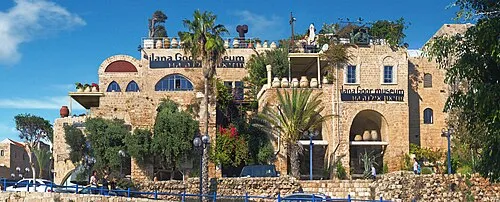
    Ilana Goor Museum in Tel Aviv, stop 9 on the self-guided walking tour

    You finish in a house from 1742 standing above the port. It was built by Jakob Zonana, one of the leaders of the Jewish community of Constantinople, and in the second half of the 19th century it housed a soap and perfume factory. After the Second World War it served many purposes, including a synagogue and a lodging house.

    In the 1970s artists discovered Old Jaffa and opened small studios and galleries here, and Ilana Goor was one of them. In 1983 she bought the run-down building, restored it and made it her home and studio; in September 1995 she opened it as a private museum. Goor was born in Tiberias; her grandfather Josef Sapir was a co-founder of the Bezalel school, the same circle as Ze'ev Raban, whose murals you saw on Rothschild Boulevard. She began sculpting in Los Angeles in the late 1960s and had her first exhibition there in 1972, at the California Museum of Science and Industry.

    Her collection has been called an artistic jungle, and the name fits. Spread over several floors and a roof terrace with a sea view, you find her own sculptures, unusual jewelry and futuristic retro furniture next to African and Oriental art, ancient artifacts, medieval sacred art and modern pieces: sculptures by Henry Moore, Alexander Archipenko and Diego Giacometti, pictures by Josef Albers and a chair by Frank Gehry.

    Entry is paid, and for anyone who likes art, design or simply old houses, it is a fitting end to the walk. Leave enough time to finish on the roof terrace, looking out over the sea that the whole story began beside.

    Hours
    Mon–Thu: 10:00–16:00 | Fri: 10:00–14:00 | Sat–Sun: 10:00–16:00
    Price
    45 ILS adults, 35 ILS Tel Aviv citizens, 25 ILS soldier/senior/student, 20 ILS child (5-17), 100 ILS family package (2 adults+3 children)
Walking tour route map of Tel Aviv Route loaded
Bauhaus MuseumCarmel MarketNahalat Binyamin StreetRothschild Boulevard+5
All 9 stops are already on the map.
You just press start.
AI Tour Guide

You've read the route. Now walk it with a guide in your ear.

Press start wherever you are, even hundreds of kilometres from Tel Aviv, and the guide begins telling its stories right away. In the city, pick any of the 9 stops to start from: it leads you there, then talks with you the whole route, asking, listening, remembering, and shaping the tour around your answers.

9stops 6.7km 1 h 35 minwalking 13languages
▶Start the tour free

Free to start · Runs in your browser · No app, no download

Shorter Ways to Walk Tel Aviv

Six hours is a full day. If you have less time or want a particular side of the city, these cuts keep the order of the route and drop the rest.

Market and boulevard morning

Stops: 1, 2, 3, 4, 5

For a first look at the city in about two hours. You go from the Bauhaus Museum through the Carmel Market and Nahalat Binyamin Street to Rothschild Boulevard and Independence Hall, with 28 minutes of pure walking. Everything on this stretch is free.

Neve Tzedek and Old Jaffa

Stops: 6, 7, 8, 9

For anyone drawn to the older, southern end of the city and to art. Pure walking is 45 minutes; with both museums inside, plan close to four hours. The Nahum Gutman Museum and the Ilana Goor Museum charge entry, Neve Tzedek and the Old City of Jaffa are free.

The free founding story

Stops: 1, 2, 3, 4, 5, 6

For a budget day that follows Tel Aviv from its first plots to its first neighborhood. You walk 49 minutes in total and finish in the lanes of Neve Tzedek after about three hours, without paying a single entry.

How Long Does This Tel Aviv Walk to Jaffa Take?

The 6.7 km take 1 h 35 min of pure walking. The first half is short hops between the market streets and the boulevard; the two longer legs come later, 21 minutes from Independence Hall to Neve Tzedek and 26 minutes from the Nahum Gutman Museum to the Old City of Jaffa.

Add time for what deserves it: a slow loop of the Carmel Market, a wander in Neve Tzedek, and above all the two paid museums. With both of them inside you are looking at about six hours; if you only see them from outside, a little over four hours is realistic. The shorter variants take about two, three and four hours.

Before You Set Off in Tel Aviv

  • Start: The Bauhaus Museum is the recommended start, but you can join at any stop and the GPS route picks up from there.
  • End: The walk ends at the Ilana Goor Museum in the Old City of Jaffa, not where it began.
  • Time of day: Start in the morning. The two paid museums sit at the end of the route, and a late start leaves little time for them.
  • Entry: The Nahum Gutman Museum and the Ilana Goor Museum charge entry. Independence Hall also does, but it was closed for renovation. Everything else, including the Bauhaus Museum, is free.
  • Navigation: Open the free GPS route in your browser; it leads you from stop to stop along the 6.7 km.
Walking tour route map of Tel Aviv
AI Tour Guide

Your guide is ready at whichever stop you start.

Press start and a voice AI Tour Guide takes it from here: leading the route through Tel Aviv, telling the stories, and turning your walk into a real back-and-forth conversation. No app or download is needed; it runs in your browser.

9stops 6.7km 1 h 35 minwalking 13languages
▶Start the tour free

Free to start · Runs in your browser · No app, no download

What the AI Tour Guide Adds Between the Market and Jaffa

On this route the stories stack up fast: Russian exiles, a land lottery, writers in a Neve Tzedek house, a soap factory turned studio. The AI Tour Guide tells them as a conversation, asks what you're drawn to and keeps going in that direction, so if Ze'ev Raban's murals grab you, the Bezalel thread comes back in Jaffa. Ask it what a stall in the Carmel Market is selling or which Agnon story to read after Neve Tzedek. You start with 100 free credits; after that you choose this tour all-inclusive for €19.99 with no time limit, or credits at €5 per hour.

A Real Conversation A voice AI Tour Guide greets you, leads the whole route, and tells the stories and facts as you walk, asking what you want to see and keeping a real conversation going. Not a recording you press play on.
Map Navigation Follow the route on the map and walk at your own pace. You choose where to start and when to move to the next stop.
Ask Anything Curious about a building you pass? Ask your AI Tour Guide on the spot and the conversation carries on.
13 Languages Switch language anytime. No separate tour needed.
Start free in your browser

Common Questions Before You Walk Tel Aviv

If I only have time for one paid museum, which should it be?

Pick the Nahum Gutman Museum if you want early Tel Aviv itself, seen through the eyes of an artist who grew up in Neve Tzedek. Pick the Ilana Goor Museum if you want a big, eclectic art collection in a historic house with a sea-view roof terrace.

Can I walk the route in reverse, from Jaffa to the Bauhaus Museum?

Yes. You can start at any stop and the GPS route leads you on from there. The recommended order runs from the White City south to Jaffa, so in reverse you finish in the market streets and on Bialik Street instead of on the hill above the sea.

Is Jerusalem a realistic day trip from Tel Aviv?

It is 54 km away, close enough for a separate day. There is a free walking route for Jerusalem that works the same way as this one.

What is the White City, and where do I see it on this walk?

It is the UNESCO World Heritage name for Tel Aviv's Bauhaus and International Style buildings. You see it most clearly on Rothschild Boulevard, and the White City World Heritage Centre in Beit Liebling stands diagonally across from the Bauhaus Museum.

Is the tour really free?

Yes. The whole tour is free: the route, the interactive map and the navigation cost you nothing. Only the voice AI Tour Guide is optional and paid: you test it with 100 free credits, then you pay either €5 per hour or €19.99 for this whole tour, with no time limit. Admission to 3 of the 9 stops is not included: Independence Hall, Nahum Gutman Museum and Ilana Goor Museum charge their own entry fees.

Do I need to download an app?

No. Everything runs in your phone browser. Open the route and start walking, no download and no sign-up required.

Do I need to book the walking tour in advance?

No booking needed. This self-guided tour is available anytime. Open the route in your browser and start walking. The AI Tour Guide works instantly, no app, no reservation required.

What languages is the AI Tour Guide available in?

The AI Tour Guide speaks 13 languages, so you take the tour in your own language and can switch at any time.

Can I skip stops or change the route?

Yes. Skip any stop, spend extra time at places you like, or start the route from any point. It is your walk, you set the pace.
Image credits
▶ Start free in your browser Runs in your browser, no app, no download