Free Walking Tour Salamanca: 8 Stops in the Golden City

From the baroque Plaza Mayor through Dominican cloisters, a lovers' garden and the cathedral to the old university quarter: 1.9 km of golden sandstone.

8 Stops 1.9 km ~26 min walking
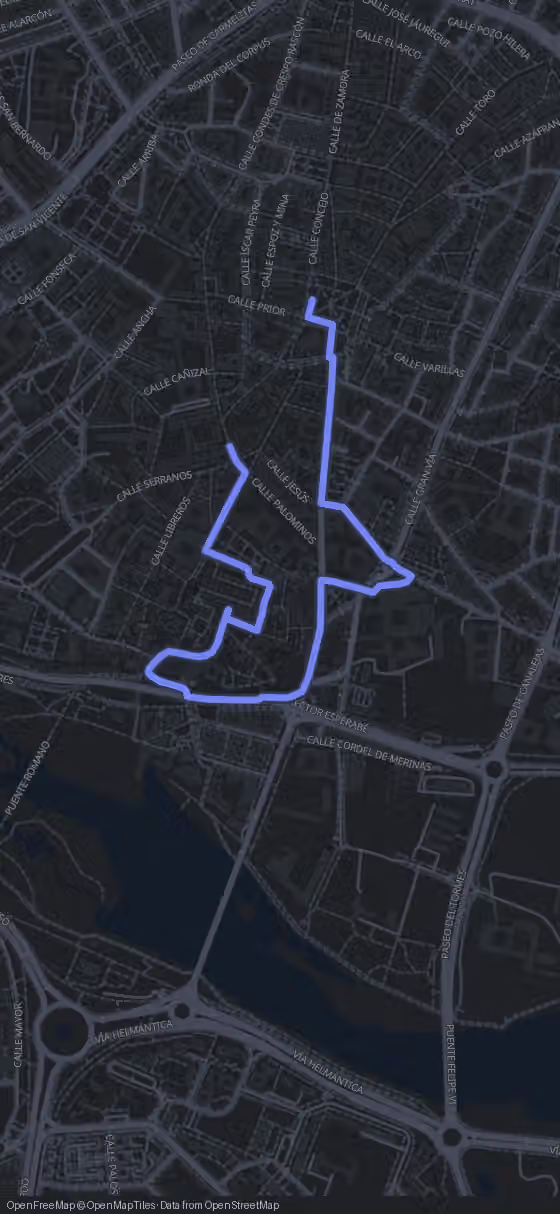
Route map for the Salamanca walking tour
Stop 1 of 8
590 m·7 min
Plaza Mayor
Head south toward Convento de San Esteban
Hola, welcome to Salamanca. I'm Alex, and centuries of stonework here still leave room for a modern signature.
Try this tour with Alex

What This Salamanca Route Covers

This free walking tour of Salamanca links 8 stops over 1.9 km, from the Plaza Mayor via the Convento de San Esteban, the Monastery of Las Dueñas, the Huerto de Calixto y Melibea, Salamanca Cathedral, the University of Salamanca and the Clerecía to the Casa de las Conchas. Pure walking time is 26 minutes; with the interiors worth seeing, plan about four and a half hours.

The square, the garden, the cathedral and the Casa de las Conchas are free; the two convents, the university and the Clerecía charge admission. Route, map and GPS navigation are free in your browser; the AI Tour Guide is optional.

Open free GPS & optional AI Tour Guide
View of Salamanca

The Route

Salamanca Walking Map: Plaza Mayor to Casa de las Conchas

8 stops 1.9 km 26 min walking
Tap to load interactive map

The 8 stops along this route

  1. Plaza Mayor in Salamanca, stop 1 on the self-guided walking tour
    1Plaza Mayor
  2. Convento de San Esteban in Salamanca, stop 2 on the self-guided walking tour
    2Convento de San Esteban
  3. Monastery of Las Dueñas in Salamanca, stop 3 on the self-guided walking tour
    3Monastery of Las Dueñas
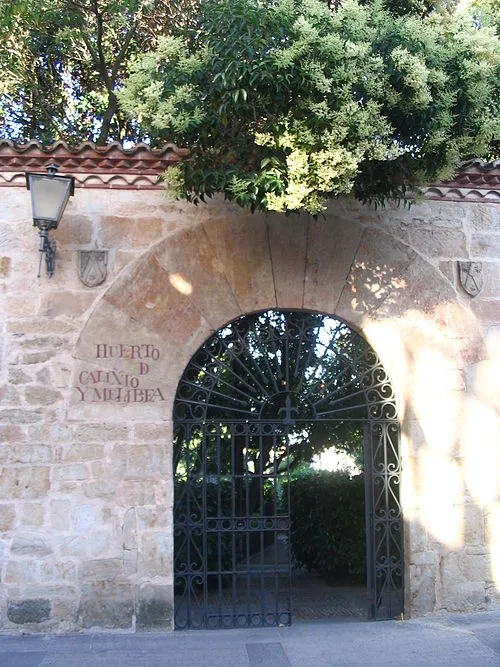
  4. Huerto de Calixto y Melibea in Salamanca, stop 4 on the self-guided walking tour
    4Huerto de Calixto y Melibea
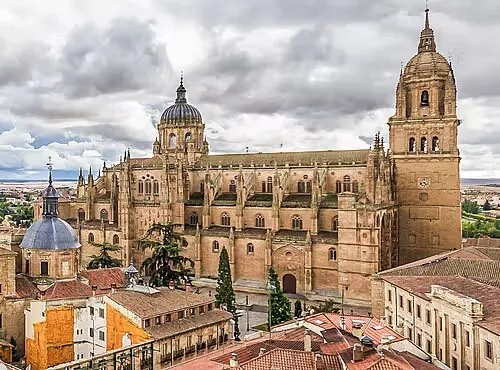
  5. Salamanca Cathedral, stop 5 on the self-guided walking tour
    5Salamanca Cathedral
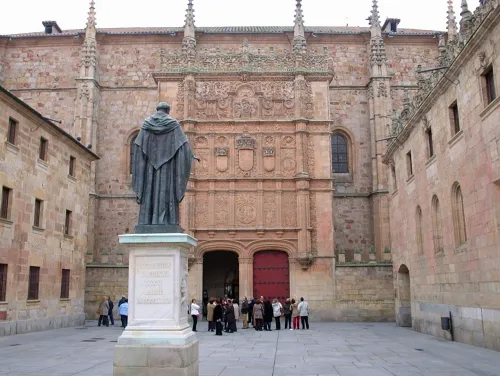
  6. University of Salamanca, stop 6 on the self-guided walking tour
    6University of Salamanca
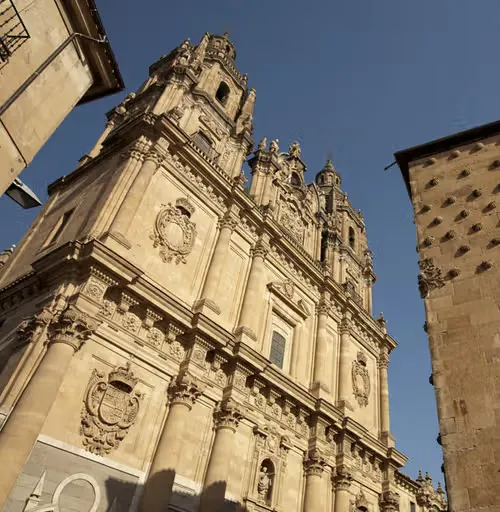
  7. Clerecía in Salamanca, stop 7 on the self-guided walking tour
    7Clerecía
  8. Casa de las Conchas in Salamanca, stop 8 on the self-guided walking tour
    8Casa de las Conchas
  9. That's the full route.

    Walk it with an AI Tour Guide talking you through every one of these streets.

    Start free in your browser
    You made it

Salamanca Walking Tour Stop by Stop: Convents, Cathedral, University

  1. 1

    Plaza Mayor

    Plaza Mayor in Salamanca, stop 1 on the self-guided walking tour

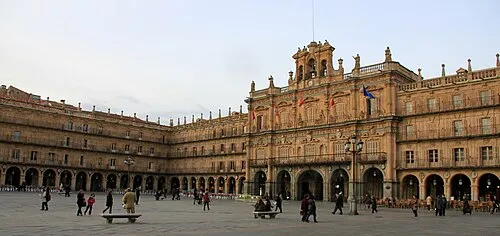
    Begin in the heart of Salamanca. The Plaza Mayor is built of sandstone that glows warm in the light, and that glow is why the city is called La Dorada, the Golden City. Take a slow turn and you'll notice it isn't a perfect square at all: it's irregular, and none of its facades is exactly the same height. Three floors rise above the ground level all round, except on the main front under the clock tower, El Reloj, where five larger openings sit on just two floors.

    The square was ordered by King Felipe V, and it was meant for bullfights. Bulls ran here until the middle of the 19th century, a full hundred years after the square was finished. The Churriguera family designed it in two phases: Alberto Churriguera directed the first between 1729 and 1735, his nephew Manuel de Larra Churriguera the second, from 1750 until completion in 1755. The City Hall was the work of Andrés García de Quiñones.

    In 1988 UNESCO declared the old city a World Heritage Site, and a plaque in the middle of the square marks it; look for it underfoot. Today the arcades around you are lined with restaurants, ice cream parlours, jewellers and souvenir shops, everywhere except in front of the City Hall. Six entrances lead out, among them Calle del Toro for shopping and Calle de Concejo for restaurants.

    Keep the name Churriguera in mind, because it turns up again inside your next stop. From here it is 600 m, about 8 minutes, to the Convento de San Esteban.
    Hours
    Open 24/7
    Price
    Free
  2. 2

    Convento de San Esteban

    Convento de San Esteban in Salamanca, stop 2 on the self-guided walking tour

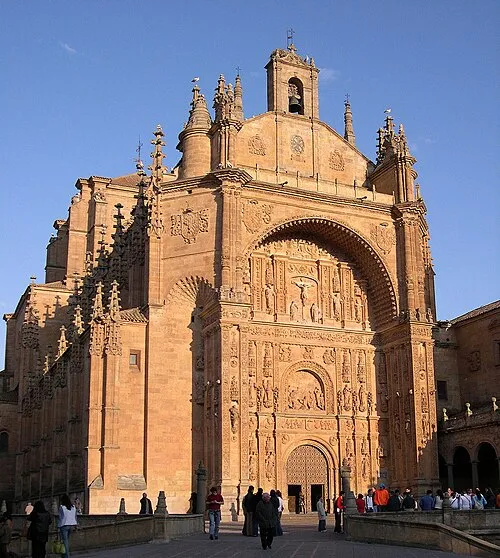
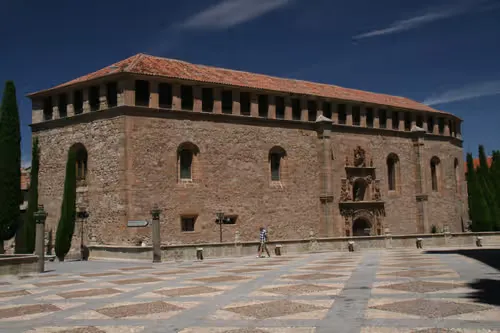
    Stop on the Plaza del Concilio de Trento before you go anywhere near the door. The facade has two parts set at a right angle: the front of the church and the portico leading into the convent. The church front is built like an altarpiece in stone, a triumphal arch under a half-barrel vault, and every surface beneath it is covered in the dense ornament of the Plateresque style. It is one of the finest examples of that style, and looking costs nothing.

    The Dominicans came to Salamanca in 1255 or 1256. Their first convent stood on this site and was torn down for the present one, begun in 1524 on the initiative of Cardinal Friar Juan Álvarez de Toledo. The plan was by Juan de Álava, and Rodrigo Gil de Hontañón took charge of the transept, the dome and the chancel. Work dragged on until 1610, which is why you'll find everything from late Gothic to Baroque here. The Baroque shows mostly inside, in the main altarpiece by José Benito de Churriguera.

    Tradition says Christopher Columbus stayed with the Dominicans when he came to argue before the university's geographers that the Indies could be reached by sailing west; strictly speaking, that was in the older convent. During the Counter-Reformation this house shaped the friars of the School of Salamanca, led by Francisco de Vitoria, and it gave help to Saint Teresa of Ávila and to Saint Ignatius of Loyola, who will meet you again at the Clerecía.

    Inside costs admission. It's worth it if church interiors and that Churriguera altarpiece appeal to you; if not, the facade alone repays the walk. The next stop is just 100 m away, about a minute: the Monastery of Las Dueñas.

    Hours
    Mon–Sun 10:00–13:30, 16:00–20:00
    Price
    4.75 EUR; reduced and groups 3.75 EUR; children under 10 free
  3. 3

    Monastery of Las Dueñas

    Monastery of Las Dueñas in Salamanca, stop 3 on the self-guided walking tour

    Start with the church portal, attributed to Juan de Álava, the same name behind San Esteban's plan. It's divided into three zones. At the bottom, two pairs of pilasters with richly carved capitals carry an entablature, and in the middle a round arch opens, crowded with arabesques and reliefs of animal and human heads. Take a moment to find a few of the faces.

    The convent goes back to 1419. A deed from that year records Juana Rodríguez giving her palace to Dominican sisters so they could found a convent for noble ladies, the dueñas who gave the place its name. The palace had been built by her first husband, a converted Jew who took the name Juan Sánchez de Sevilla, served King John I of Castile as treasurer and was the grandfather of Isaac Abrabanel. Later gifts, including from the Catholic Monarchs, paid for the church and cloister in the 16th century.

    The cloister is the reason to buy a ticket. Attributed to Rodrigo Gil de Hontañón, it carries extraordinary Plateresque sculpture, and for more than 400 years it lay inside the enclosure, unseen by outsiders. It has only been open to visitors since 1962. Look for traces of the old palace: a brick horseshoe doorway in Mudéjar style on the cloister's upper level, another door frame rediscovered in 1963 and displayed in a ground floor wing, and part of a carved artesonado ceiling. The church itself is Gothic, a single nave under ribbed vaults, with Baroque altars. The whole convent was listed as a protected monument in 1921.

    If you love stone carving, this small cloister is one of the best value tickets on the route. Then walk 340 m, about 4 minutes, down to the Huerto de Calixto y Melibea.

    Hours
    Mon–Sat 10:30–12:45 and 16:30–19:15 (30 March – 30 October); Mon–Sat 10:30–12:45 and 16:30–17:30 (26 October – 30 March); closed Sundays and public holidays
    Price
    3 EUR; groups 2 EUR
  4. 4

    Huerto de Calixto y Melibea

    Huerto de Calixto y Melibea in Salamanca, stop 4 on the self-guided walking tour

    After the convents, a garden. The Huerto de Calixto y Melibea covers 2,500 square metres on the slope of the old city wall, at the foot of the river Tormes, and it's free to enter. Its name and mood come from the Tragicomedy of Calisto and Melibea by Fernando de Rojas, first published in 1499, and the garden of its two lovers. That love story is why people treat this as Salamanca's romantic corner.

    The garden opened on 12 June 1981. On the same occasion Salamanca was twinned with Coimbra, as a plaque on the garden walls records. A second section, the Jardín del Visir, was added to the Huerto.

    Look at the plants, because several are unusual for this city. In 1991 a man from Granada living in Salamanca felt briefly carried off to a romantic Andalusian garden here, and he wanted to complete the effect. He donated a Canary Island date palm, a Washingtonia palm, a Cordyline, a bed of agapanthus and a plumbago, species never before seen in the city's public gardens. Later came hypericum, agaves, holm oaks, medlars and even a beech.

    This is the natural place for a breather on a bench. Then it is 370 m, about 6 minutes, up to Salamanca Cathedral; on the way you pass the Casa Lis, a museum.

    Price
    Free
  5. 5

    Salamanca Cathedral

    Salamanca Cathedral, stop 5 on the self-guided walking tour

    Locally this is the Catedral Nueva, the New Cathedral, and in size it is one of the largest in Spain. Its bell tower reaches 92 metres, also one of the tallest in the country. It is built of freestone from Villamayor, the stone that gives Salamanca its golden colour, and its long construction, finished only in 1733, mixes late Gothic, Plateresque and Baroque.

    Why a new cathedral at all? In the 15th century the city grew fast, pulled along by its university, and the old cathedral suddenly seemed "small, dark and low". King Ferdinand the Catholic backed the project and in 1509 sent the architects Antón Egas and Alonso Rodríguez to draw the design. After much debate the new church was laid out parallel to the old one, in Gothic style, with three naves and two rows of chapels. The plan originally called for an ambulatory with polygonal apses, but it was changed to the rectangular end you see now, which turns the interior into a hall.

    The old cathedral was meant to be demolished. Instead it stayed open for worship during the works, and when they ended the idea of tearing it down was dropped. The two now share a wall: the south wall of the new cathedral rests on the north wall of the old one, which had to be reinforced and lost part of its side nave. The new bell tower even stands on top of the old one.

    Entry to the cathedral is free, so go in, even if you only have a few minutes. From here it is 280 m, about 4 minutes, to the University of Salamanca.

    Local name
    Catedral Nueva de Salamanca
    Hours
    Mon–Sat 10:00–20:00 (last admission 19:15), Sun 10:00–18:00 (last admission 17:15)
    Price
    Free
  6. 6

    University of Salamanca

    University of Salamanca, stop 6 on the self-guided walking tour

    King Alfonso IX of León founded this university in 1218. It's the oldest university in the Hispanic world and the fourth oldest in the world still in continuous operation, and today more than 30,000 students from 50 nationalities study here. Learning in Salamanca is even older: a cathedral school existed by 1130, and the university grew out of it as a studium generale.

    Two documents made it official. A royal charter of Alfonso X, dated 8 May 1254, set rules for its organisation and money and called it a university for the first time. A year later a papal bull of Alexander IV confirmed the charter and gave its degrees recognition everywhere. Its reputation spread fast, summed up in two Latin sayings: Quod natura non dat, Salmantica non praestat, what nature does not give, Salamanca does not lend; and Multos et doctissimos Salmantica habet, Salamanca has many, and very learned, men.

    Under Ferdinand and Isabella the state needed trained administrators, and it found them here. Graduates of Salamanca, along with those of the newer University of Alcalá, filled the councils of the realm, eventually including the Consejo de Indias and the Casa de Contratación, the two highest bodies governing Spain's empire in the New World. Much of the colonial administration was run by men trained in these lecture halls.

    Visiting inside costs admission. It's a good choice if the history of learning draws you more than church art. Afterwards it's 190 m, about 3 minutes, to the Clerecía.

    Local name
    Universidad de Salamanca
    Hours
    Winter (16.10.-31.03.): Mon–Sat 10:00–19:00; Summer (01.04.-15.10.): Mon–Sat 10:00–20:00; Sun/Holidays 10:00–14:00
    Price
    4 EUR
    Website
    usal.es ↗
  7. 7

    Clerecía

    Clerecía in Salamanca, stop 7 on the self-guided walking tour

    Tip your head back for the facade, built in three sections. Down at street level, big Corinthian half-columns guard three doors, with the arms of Spain above the two side doors and, in the middle, a niche with Saint Ignatius of Loyola. The stone lion at his feet was added after the Jesuits were expelled and stands for Saint Mark. In the second section, two Baroque ovals flank a large central window, which had to be made smaller because of the weight of the sections above.

    The building was the Royal College of the Holy Spirit of the Jesuits. Work began in 1617 under the patronage of Margaret of Austria, wife of Philip III, apparently as amends to the order: its founder Ignatius had been imprisoned by the Inquisition in the Mocha tower of Salamanca's old cathedral. The general plan is by Juan Gómez de Mora, and the whole complex, college with its cloister and church, was finished only in 1754.

    In 1767 Charles III expelled the Jesuits from Spain, and the building went to the Royal Clergy of San Marcos; that is where the name Clerecía comes from. The college later became the diocesan Seminary of San Carlos, and since 1940 it has housed the Pontifical University of Salamanca, created by Pope Pius XII. In September 2012 regular worship in the church stopped so it could open to visitors; only weddings of alumni and people linked to the university still take place.

    Inside is ticketed and shown on guided tours in Spanish, and a combined ticket adds the towers. If you don't follow Spanish, the facade may be enough. Your last stop is right next door, about a minute away: the Casa de las Conchas.

    Hours
    March to October: Mon–Fri 10:30–12:45 and 17:00–18:30, Sat, Sun and holidays 10:30–13:30 and 17:00–19:15; November to February: Tue–Fri 10:30–12:45 and 16:00–17:20, Sat and holidays 10:30–13:30 and 16:00–17:20, Sun 10:30–13:30, closed Mondays; closed 24, 25 and 31 December and 1 January; visits by guided tour in Spanish
    Price
    4 EUR; groups 3 EUR; combined ticket church and towers 6 EUR (groups 5 EUR)
  8. 8

    Casa de las Conchas

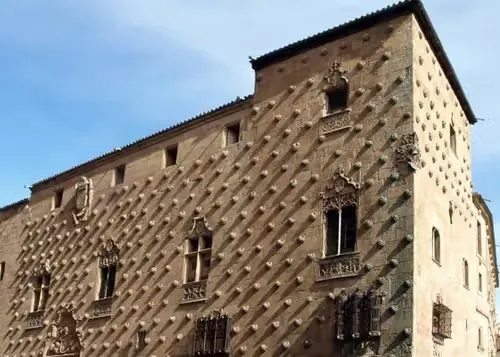
    Casa de las Conchas in Salamanca, stop 8 on the self-guided walking tour

    The Casa de las Conchas, the House of the Shells, is a city palace that blends late Gothic with the new Plateresque taste of the Renaissance. It was begun around 1493 and finished in 1517. Around 1701 the house was repaired and enlarged, and that's when the facade facing the Rúa appeared.

    It was built for Rodrigo Maldonado de Talavera: knight of the Order of Santiago, professor of law and rector of the university, member of the Royal Council of Castile. He also paid for the Talavera chapel in the cloister of the old cathedral. He died before the house was finished, and his son Rodrigo Arias Maldonado completed it that same year, the year he married Juana de Pimentel, a niece of the Duke of Benavente. Their son Pedro Maldonado Pimentel became a leader of the Comuneros revolt. The house stands for the new court nobility of an age when the Catholic Monarchs were ending the old power struggles.

    Its later life is full of surprises. It served as the university's prison, became a national monument in 1929, and in 1967 was leased to the city for a symbolic one gold peseta a year for ninety-nine years. After a long restoration it has been a public state library since 1993. In 1997 its owner handed it to the regional government of Andalusia as payment of taxes, and in 2005 Andalusia swapped it with the Spanish state, its owner today.

    Entry is free, so step into the courtyard with its mixtilinear arches and look up at the carved artesonado ceiling. This is the end of the route; if you want to return to the Plaza Mayor, the GPS navigation will take you back.

    Hours
    Mon–Fri: 09:00–21:00 | Sat: 09:00–14:00 | Sun: Closed
    Price
    Free
Walking tour route map of Salamanca Route loaded
Plaza MayorConvento de San EstebanMonastery of Las DueñasHuerto de Calixto y Melibea+4
All 8 stops are already on the map.
You just press start.
AI Tour Guide

You've read the route. Now walk Salamanca with a guide in your ear.

Press start wherever you are, even hundreds of kilometres from Salamanca, and the guide begins telling its stories right away. In the city, pick any of the 8 stops to start from: it leads you there, then talks with you the whole route, asking, listening, remembering, and shaping the tour around your answers.

8stops 1.9km 26 minwalking 13languages
▶Start the tour free

Free to start · Runs in your browser · No app, no download

Shorter Ways Through Salamanca

Not everyone has a full day or wants to pay for four interiors. These three cuts of the route keep the walking simple.

Free stops only

Stops: 1, 4, 5, 8

For anyone on a tight budget. You walk the whole route anyway, so the walking time stays at 26 minutes, and you see the convents, the university and the Clerecía from outside. Inside you visit only what costs nothing: the garden, the cathedral and the Casa de las Conchas. Allow about an hour and a half.

Square and monasteries

Stops: 1, 2, 3, 4

For a quiet morning with art and cloisters. From the Plaza Mayor to the garden it is 13 minutes on foot. Admission is charged at the Convento de San Esteban and the Monastery of Las Dueñas. Allow about two hours, then sit down among the palms.

Cathedral and university quarter

Stops: 5, 6, 7, 8

For history lovers short on time. Start at Salamanca Cathedral; only 8 minutes of walking take you to the Casa de las Conchas. The cathedral and the Casa de las Conchas are free, the University of Salamanca and the Clerecía charge admission. Allow about two and a half hours with all four interiors.

How Long This Salamanca Tour Takes, With and Without Interiors

The pure walking time is 26 minutes for 1.9 km, and no leg is longer than 600 m. What takes time are the interiors. If you see everything from outside and go into the free stops only, you'll be done in about an hour and a half.

With every interior that is worth it, count on about four and a half hours: roughly 40 minutes in the Convento de San Esteban, half an hour in Las Dueñas, three quarters of an hour each in the cathedral, the university and the Clerecía, and short pauses in the square, the garden and the Casa de las Conchas. The monastery cut takes about two hours, the cathedral and university quarter about two and a half.

Before You Set Off in Salamanca

  • Start and finish: The recommended start is the Plaza Mayor, the finish is the Casa de las Conchas. You can join the route at any stop, and on request the GPS navigation takes you from the last stop back to the start.
  • Tickets: Admission is charged at the Convento de San Esteban, the Monastery of Las Dueñas, the University of Salamanca and the Clerecía. Pay at the door; nothing needs booking.
  • Time of day: If you want to go inside, start in the morning and check the opening hours of the ticketed stops before you leave, since the convents and the Clerecía keep their own schedules.
  • Clerecía visits: The church is shown on guided visits in Spanish, so plan that stop around the next tour.
Walking tour route map of Salamanca
AI Tour Guide

Your Guide for Salamanca Is Ready When You Are

Press start and a voice AI Tour Guide takes it from here: leading the route through Salamanca, telling the stories, and turning your walk into a real back-and-forth conversation. No app or download is needed; it runs in your browser.

8stops 1.9km 26 minwalking 13languages
▶Start the tour free

Free to start · Runs in your browser · No app, no download

What the AI Tour Guide Adds in Salamanca

On this route the AI Tour Guide leads the walk as a conversation: it greets you at the Plaza Mayor, tells the stories of each place, asks what caught your eye and remembers it, so a soft spot for Plateresque carving or for the School of Salamanca shapes what comes next. Ask it what actually happens to Calisto and Melibea, or what Francisco de Vitoria argued, and interrupt whenever you like. You start with 100 free credits; after that, choose this tour all-inclusive for €19.99 with no time limit, or credits at €5 per hour.

A Real Conversation A voice AI Tour Guide greets you, leads the whole route, and tells the stories and facts as you walk, asking what you want to see and keeping a real conversation going. Not a recording you press play on.
Map Navigation Follow the route on the map and walk at your own pace. You choose where to start and when to move to the next stop.
Ask Anything Curious about a building you pass? Ask your AI Tour Guide on the spot and the conversation carries on.
13 Languages Switch language anytime. No separate tour needed.
Start free in your browser

Common Questions About Walking Salamanca

Can I visit the Clerecía in English?

Visits inside the church are guided tours in Spanish. If that doesn't suit you, the three-part facade is free to look at, and a combined ticket also opens the towers.

If I only pay for one interior, which should it be?

For sculpture, the cloister of the Monastery of Las Dueñas, closed to the public for four centuries. For history, the University of Salamanca. San Esteban suits anyone who wants to see the Churriguera altarpiece.

Can I see the Old Cathedral on this walk?

It isn't a stop of its own, but you stand right beside it at Salamanca Cathedral, because the new church was built against it.

Where can I go after Salamanca?

Ávila is the closest walled city for a day trip, and Segovia works for a longer day. Heading west, Coimbra is Salamanca's twin town.

Is the tour really free?

Yes. The whole tour is free: the route, the interactive map and the navigation cost you nothing. Only the voice AI Tour Guide is optional and paid: you test it with 100 free credits, then you pay either €5 per hour or €19.99 for this whole tour, with no time limit. Admission to 4 of the 8 stops is not included: Convento de San Esteban, Monastery of Las Dueñas, University of Salamanca and Clerecía charge their own entry fees.

Do I need to download an app?

No. Everything runs in your phone browser. Open the route and start walking, no download and no sign-up required.

Do I need to book the walking tour in advance?

No booking needed. This self-guided tour is available anytime. Open the route in your browser and start walking. The AI Tour Guide works instantly, no app, no reservation required.

What languages is the AI Tour Guide available in?

The AI Tour Guide speaks 13 languages, so you take the tour in your own language and can switch at any time.

Can I skip stops or change the route?

Yes. Skip any stop, spend extra time at places you like, or start the route from any point. It is your walk, you set the pace.
Image credits
▶ Start free in your browser Runs in your browser, no app, no download