Free Walking Tour Schaffhausen: Gates, Munot and Abbey

Thirteen stops on a 3.2 km loop: medieval gates, the round Munot Fortress, a river bath begun in 1870 and painted facades in the heart of the old town.

13 Stops 3.2 km ~47 min walking
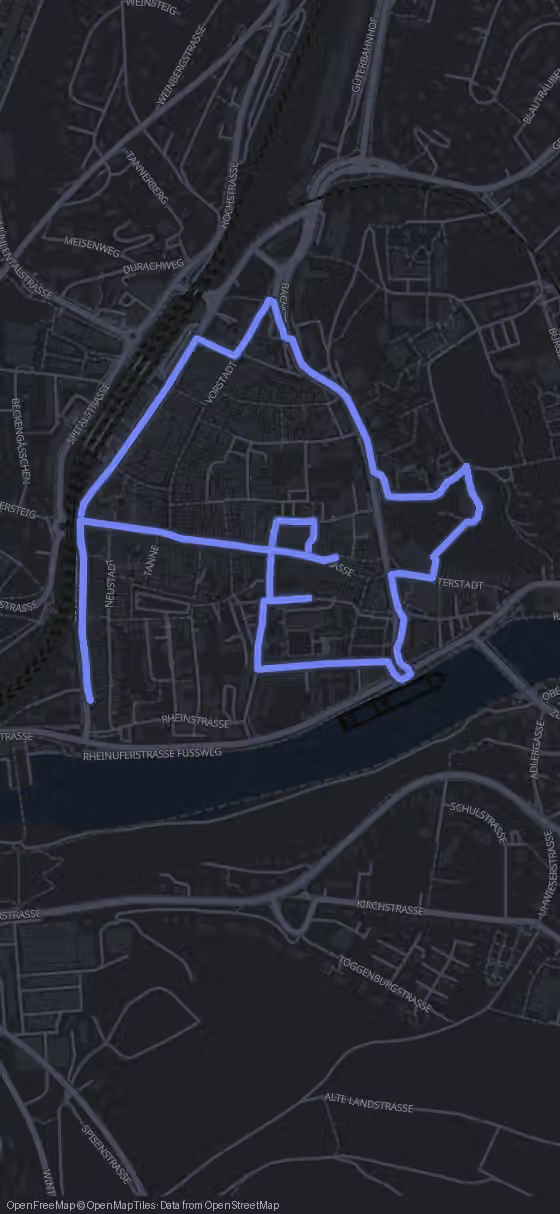
Route map for the Schaffhausen walking tour
Stop 1 of 13
490 m·6 min
Obertorturm
Head north-east up the lanes toward the Schwabentor, Schaffhausen's second medieval gate.
Grüezi, welcome to Schaffhausen. I'm Alex, and the city's trading wealth began where river journeys suddenly had to stop.
Try this tour with Alex

The Loop at a Glance

This loop links 13 stops in Schaffhausen, starting and ending at the Obertorturm. It covers 3.2 km with 47 min of pure walking; with time on the Munot Fortress and in the churches, plan on about two and a half hours.

Most stops are free. Entry costs at the All Saints Abbey Museum and, in season, at the Rhybadi; the Hallen für Neue Kunst are permanently closed. Route, map and GPS navigation are free in your browser, and the optional AI Tour Guide tells the stories as you walk.

Open free GPS & optional AI Tour Guide
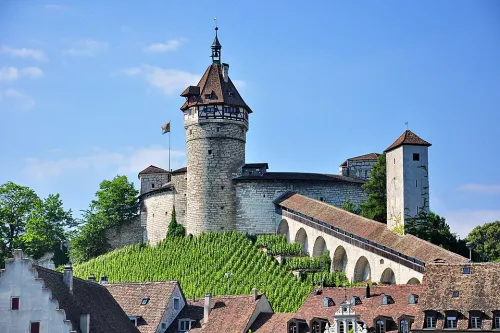
View of Schaffhausen

The Route

Walking Map of Schaffhausen: Gates, Fortress and River

13 stops 3.2 km 47 min walking
Tap to load interactive map

The 13 stops along this route

  1. Obertorturm in Schaffhausen, stop 1 on the self-guided walking tour
    1Obertorturm
  2. Schwabentor in Schaffhausen, stop 2 on the self-guided walking tour
    2Schwabentor
  3. Munot Fortress in Schaffhausen, stop 3 on the self-guided walking tour
    3Munot Fortress
  4. Rhybadi in Schaffhausen, stop 4 on the self-guided walking tour
    4Rhybadi
  5. 5Schillerglocke
  6. Hallen für Neue Kunst in Schaffhausen, stop 6 on the self-guided walking tour
    6Hallen für Neue Kunst
  7. All Saints Abbey Museum in Schaffhausen, stop 7 on the self-guided walking tour
    7All Saints Abbey Museum
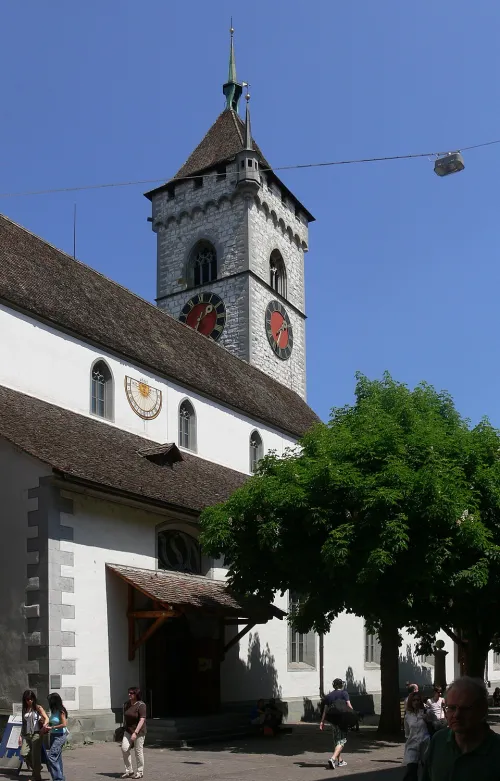
  8. Schaffhausen Minster, stop 8 on the self-guided walking tour
    8Schaffhausen Minster
  9. St. Johann Church in Schaffhausen, stop 9 on the self-guided walking tour
    9St. Johann Church
  10. Tellenbrunnen in Schaffhausen, stop 10 on the self-guided walking tour
    10Tellenbrunnen
  11. Saturday Market in Schaffhausen, stop 11 on the self-guided walking tour
    11Saturday Market
  12. Haus zum Ritter in Schaffhausen, stop 12 on the self-guided walking tour
    12Haus zum Ritter
  13. Diebsturm in Schaffhausen, stop 13 on the self-guided walking tour
    13Diebsturm
  14. That's the full loop.

    Walk it with an AI Tour Guide talking you through every one of these streets.

    Start free in your browser
    You made it

Stop by Stop Through Your Schaffhausen Walking Tour

  1. 1

    Obertorturm

    Obertorturm in Schaffhausen, stop 1 on the self-guided walking tour

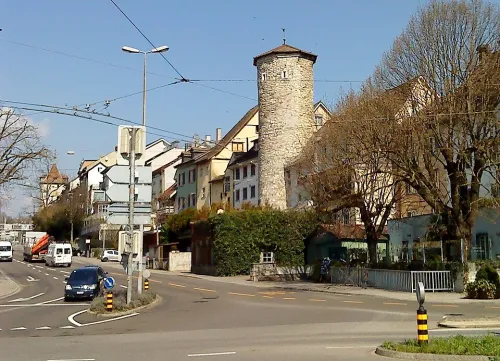
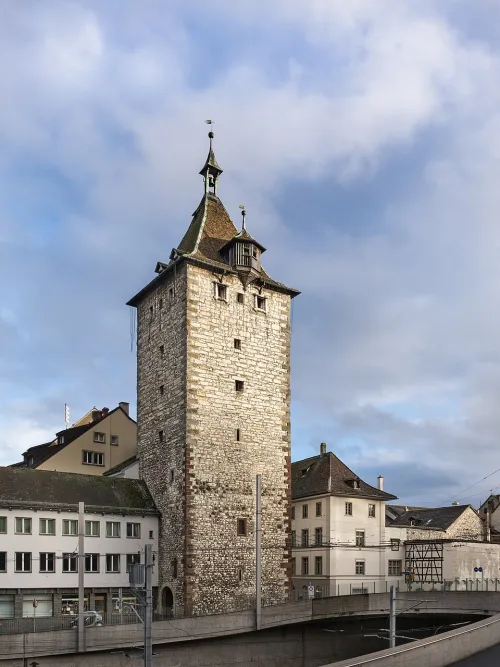
    You start at the Obertorturm, first recorded in 1273 as "zem obern tor" and the oldest surviving structure of Schaffhausen's town fortifications. It began as the residential tower of the noble Fridbolt family and guarded the western entrance to the town. Before you walk through, look at the corner stones: where their colour changes, you can read the tower's original height. In 1513 it was raised to the 47 metres you see today, and in the same year it gained a Romanesque double window on the south side of the first floor and two late Gothic oriels at the roof.

    Why put a fortified gate exactly here? Everything shipped on the Rhine between Lake Constance and Basel had to be unloaded in Schaffhausen, because the rapids and the Rhine Falls could not be navigated. The goods were loaded onto carts at the Schifflände, hauled along the Vordergasse and out towards the falls, and every one of those carts had to pass this gate. In 1461 the former mayor Hans Friedbold sold the tower to the town.

    From 1513 the tower served as a watch post. If fire broke out or armed troops approached, the watchman had to ring the alarm bell. That watch lasted for centuries and was only abolished in 1922. Much of the gate's defences disappeared earlier: the bulwark built on the west side in 1638/39, during the Thirty Years' War, was razed in 1845, and the pointed arch gateway itself was demolished in 1853.

    The tower you see is a 20th century adaptation inside an old shell. In 1934 the interior was rebuilt with ten floors and an attic, and a transformer station was installed; the pedestrian passage you can walk through dates from 1939/40. You see the Obertorturm from outside only. From here it is 480 m, about 6 min, to the Schwabentor, which once closed off the medieval town at its northern end.
    Hours
    Exterior view accessible 24/7
    Price
    Free
  2. 2

    Schwabentor

    Schwabentor in Schaffhausen, stop 2 on the self-guided walking tour

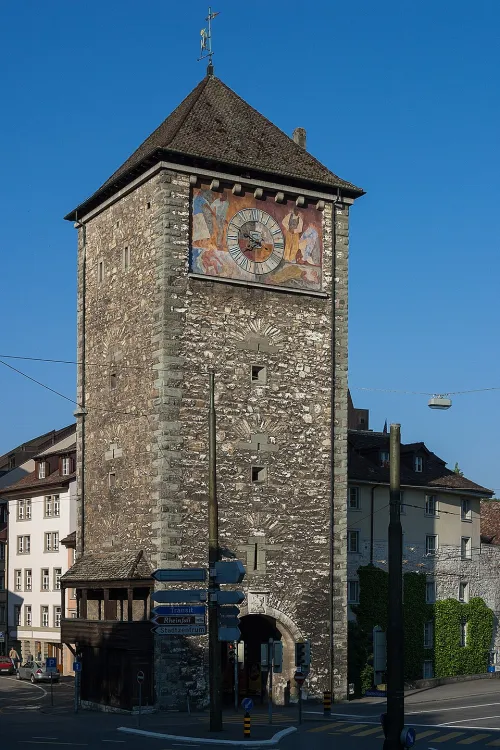
    The Schwabentor was first recorded in 1361 as the "Neuturm", the new tower. Facing Swabia, it formed the northern end of the medieval fortifications, and today it is your gateway into the Vorstadt. On its western side a piece of the old town wall survives, complete with its wall walk and the Finsterwaldturm as the corner tower, so this is a good place to picture how the walls once ran.

    Look up at the clock niches. The paintings there are by the artist Carl Roesch: on the south side "Kosmos", a man and a woman in the cosmic cycle between death and a demon, protected by an angel standing guard in flames; on the north side "Kreislauf", the four ages of life following the relentless turn of the clock hand. On top, a Schaffhausen ram by Richard Petraschke serves as the weather vane.

    All of this is younger than it looks. In 1932 a fire gutted the tower and destroyed its mansard roof with the little bell turret from 1782. The architect Wolfgang Müller redesigned the gate between 1933 and 1935, and since then a pyramid roof has covered it. Earlier centuries had wrapped the gate in ever larger outworks: a bulwark in 1555, then in 1607/08 a bigger outwork with two inner courtyards and two round towers, which were razed in 1867.

    Now walk through to the north side and find the keystone of the arch. Since 1935 it has carried the town's best known saying: "Lappi tue d'Augen uf", roughly "Fool, open your eyes!", under the figure of a farmer with a piglet under his arm, hemmed in by cars. The painter Arnold Oechslin was inspired by a Russian inscription at the gate of the Villa Charlottenfels in Schaffhausen. The town council picked his design from four proposals; it has no historical link to the gate, and the council justified it with the busy road junction just built in front of it.

    From the Schwabentor it is 600 m, about 10 min, to the Munot Fortress, the round stronghold you will already have glimpsed above the town.

    Hours
    24/7
    Price
    Free
  3. 3

    Munot Fortress

    Munot Fortress in Schaffhausen, stop 3 on the self-guided walking tour

    The Munot is a circular fortress on the Emmersberg and counts as Schaffhausen's landmark. It was built between 1564 and 1589 under the town master builder Heinrich Schwarz, probably with knowledge of Albrecht Dürer's writings on round fortifications, and partly by corvée labour, the unpaid work owed by townspeople. The blocks and rubble are local limestone, quarried here and in the surroundings. With its keep, the Munot is one of the few examples of the step from medieval castle to modern fortress.

    It was an enormous undertaking. The fortress cost the town 47,528 guilders, about what it would have cost to build 800 town houses. And soon after it was finished, people began to doubt whether it really matched the military technology of its day. In 1646, during the Thirty Years' War, the town considered adding ramparts and an outwork; Johann Georg Werdmüller drew up the plans, but the 165,627 guilders they would have cost were saved when the Peace of Westphalia was signed in 1648.

    The site is older than the round tower. From 1098 a fortification stood here called the "Annot" or "Unot", Middle High German for "without need", at first owned by a nobleman, probably a bailiff. The idea that the Romans had a watchtower here as part of their Rhine frontier is often repeated but not proven. In 1561 the old forward defence platform was torn down to make room for the new building.

    The Munot was used for defence only once, in 1799, as French troops retreated before the Austrians. The French had occupied town and fortress on 1 October 1798, and that November André Masséna arrived demanding quarters for wounded soldiers. Admission to the Munot is free, so going in costs you nothing but time, and for anyone interested in fortifications it is the place on this loop to linger.

    From here it is 400 m, about 7 min, to the Rhybadi on the Rhine; on the way you pass the Munot Rose Garden and the Naturmuseum Schaffhausen.

    Hours
    May–Sep daily 08:00–20:00; Oct–Apr daily 09:00–17:00
    Price
    Free admission
    Website
    munot.ch ↗
  4. 4

    Rhybadi

    Rhybadi in Schaffhausen, stop 4 on the self-guided walking tour

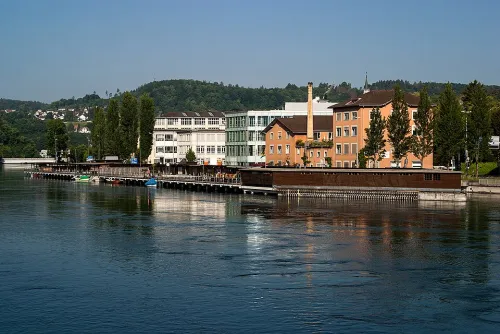
    The Rhybadi, officially the Rheinbadeanstalt, is a bathing establishment built right into the Rhine. Construction began in 1870 to plans by the town master builder Johann Gottfried Meyer. It is the largest surviving box bath in Switzerland, a wooden enclosure in the river about 185 metres long and 30 metres wide. Following the current it is divided into sections: the "Spitz" at the upstream end, then separate enclosures for men, for children and for women, and a second one for children.

    Its history starts with a quarrel. An earlier public bath, built around 1848/49, had to move because the waterworks company of the Moser dam wanted to erect an extra pier for its "Krafttelegraph", a system that transmitted power by cable. From 1868 the relocation turned into a political issue that filled the letters pages of the Schaffhauser Nachrichten. Various changes and renewals followed after 1870, among them the "Frauenbadi", the women's bath.

    Today the Rhybadi is protected as cultural property of regional importance and forms part of a townscape of national importance. Behind it stands the former Frey & Peyer cotton twisting mill, now used by the KV Schaffhausen, and the area also holds protected industrial buildings of the Kammgarn spinning mill and the IWC watch factory.

    Entry is charged in the bathing season. If you came for a swim, this is the moment; otherwise the view of the long timber structure from the bank is enough. From the Rhybadi it is only 140 m, about 2 min, inland to the Schillerglocke in the cloister of the former Allerheiligen monastery.

    Local name
    Rheinbad
    Hours
    Seasonal (approx. mid May to late Sep): May & Sep Sun–Thu 08:00–21:00, Fri–Sat 08:00–22:00 (from Sep 20: 10:00–18:00); Jun–Aug Sun–Thu 08:00–22:00, Fri–Sat 08:00–23:00; earlier closure possible during bad weather
    Price
    CHF 4 adults (18+), CHF 4 AHV/IV, CHF 2 children/youth (<18), 50% discount KulturLegi
  5. 5

    Schillerglocke

    A short walk inland and the mood changes completely: you are in the cloister courtyard of the former Allerheiligen monastery, where a bell cast in 1486 stands in the open air. It is called the Schillerglocke, after Friedrich Schiller's poem The Song of the Bell, published in 1799 and long a fixed part of the German literary canon.

    Do the arithmetic: the bell is more than three hundred years older than the poem it is named after. Someone decided the connection deserved a name, and the name stuck.

    One practical point that matters on this part of the loop: the courtyard is free and needs no museum ticket. The paid galleries of the abbey museum belong to the same monastic complex, and visitors often hesitate exactly at the line between free and ticketed. The bell is on the free side. From here it is 80 m, about 1 min, to the Hallen für Neue Kunst, passing the Kammgarn on the way.

    Hours
    Daily daytime accessible
    Price
    Free admission
  6. 6

    Hallen für Neue Kunst

    Hallen für Neue Kunst in Schaffhausen, stop 6 on the self-guided walking tour

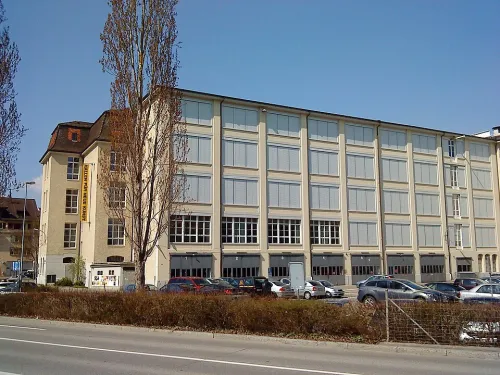
    The Hallen für Neue Kunst are permanently closed, so you see them from outside only, but the building has a story worth knowing. In 1982/83 the artist Urs Raussmüller turned 5,500 m² of a former textile factory on the Rhine bank into a museum for art made since 1965. His conviction was that new art needs time and space to unfold, so he aimed for a permanent home for large installations by American and European artists.

    At the centre stood Joseph Beuys's room sculpture Das Kapital Raum, made between 1970 and 1977 and first shown at the Venice Biennale in 1980. Beuys installed the two storey work here himself in 1984. Around it were architectural sculptures by Bruce Nauman and large groups of works from Minimal Art, Arte Povera, Land Art and Conceptual Art. Carl Andre's Cuts from 1967, measuring 9.35 by 13 metres and weighing about 18 tonnes, was rarely shown anywhere else because of its size. Mario Merz built a whole villaggio of igloos, vines and neon light, and Sol LeWitt contributed cube variations and wall drawings.

    The museum was privately run by the non-profit Raussmüller Collection, with financial support from the town and canton. From 2004 a court battle over who owned the Beuys installation dragged on; in 2014 it went against the museum. The halls closed at the start of that year, and in June the final closure and a partial move to Basel were announced. Between 2018 and 2024 the FATart Art Fair used the halls.

    From here it is just 60 m, about 1 min, to the All Saints Abbey Museum.

    Status
    Permanently closed
  7. 7

    All Saints Abbey Museum

    All Saints Abbey Museum in Schaffhausen, stop 7 on the self-guided walking tour

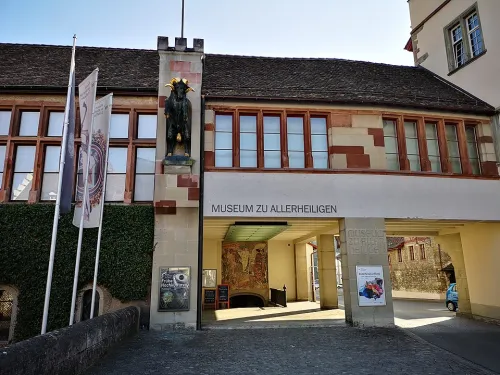
    The All Saints Abbey Museum, the Museum zu Allerheiligen, occupies the former Benedictine monastery of Allerheiligen. It brings archaeology, history, art and natural history together under one roof and is the most important museum of the region, as well as one of the largest in Switzerland by floor area. Several things you meet on this walk have their originals here, so a visit connects neatly with the rest of the loop.

    The wish for a museum arose in the mid 19th century; a plan for a new building at the Schwabentor was dropped around 1900. On 11 June 1919 the town council commissioned the architects Schäfer and Martin Risch to convert the monastery buildings instead. The idea was a universal museum giving a complete picture of Schaffhausen's culture, and at the same time a way to save the decaying abbey by making it part of the complex. The Swiss National Museum served as an important model. After seven years of building, the museum opened in 1928 with 42 rooms; in 1938 mayor Walther Bringolf opened the extensions by August Arter and Martin Risch. Karl Sulzberger led the museum as its first director until 1942.

    Then came the darkest day in its history. On 1 April 1944 American bombers mistakenly bombed Schaffhausen, and the museum was badly damaged. More than 70 works by old masters were destroyed, among them nine paintings by the Schaffhausen artist Tobias Stimmer. In a wave of Swiss solidarity, cantons, municipalities, companies and private donors gave paintings and artworks, and after two years of rebuilding the museum reopened on 18 May 1946.

    The museum charges entry. If you enjoy regional history and art, it is the one paid visit on this loop worth planning around; if your time is tight, the free cloister gives you a taste. From the museum it is 140 m, about 2 min, to the Schaffhausen Minster.

    Local name
    Museum zu Allerheiligen
    Hours
    Tue–Sun 11:00–17:00, last Thu of the month 11:00–20:00, Mon closed
    Price
    Permanent exhibition: CHF 12 adults (20+), CHF 9 reduced (AHV/students/groups), free under 20 and every 1st Saturday of the month; Special exhibition: CHF 15 / CHF 10
  8. 8

    Schaffhausen Minster

    Schaffhausen Minster, stop 8 on the self-guided walking tour

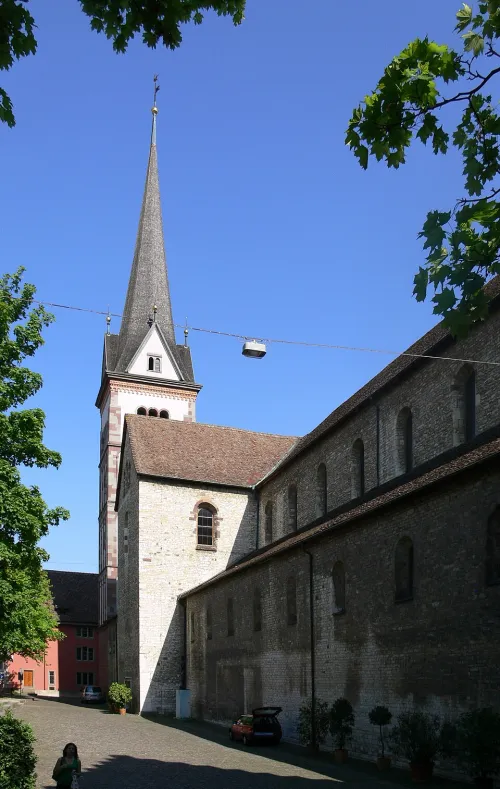
    The Minster is one of the two main churches of the old town and is still built into the large complex of the former Allerheiligen abbey. It began as the Romanesque basilica of the Benedictine monastery, completed in 1064 and rebuilt several times since. In 1524 it became the Reformed church of the city. Admission is free, and after the museum's history this is where you see the abbey's original purpose.

    The story begins with the Nellenburg counts. Around 1100 the growth of Schaffhausen was closely tied to this noble family, who recognised the value of the place for transferring goods on the Rhine and bypassing the Rhine Falls. Eberhard von Nellenburg founded the abbey and the basilica in 1049; Pope Leo IX consecrated it on 22 November. The church was dedicated to the Saviour, the Holy Cross, the Virgin Mary and All Saints, which is where the name Allerheiligen comes from.

    Allerheiligen replaced Reichenau as the family's burial place. Eberhard himself became a Benedictine monk here after 1075 and died in 1078 or 1079; he was buried in the crypt built for the family. His son Burkhard, loyal to the Pope during the Investiture Controversy, confirmed all the monastery's rights in 1080: it was placed directly under the Pope and received the family's vast estates, the free election of its abbot, the rights to coin and market, and the town of Schaffhausen itself. From then on the abbot was lord of the city.

    Burkhard stayed on as the monastery's bailiff and encouraged Abbot William to reform it on the model of Hirsau Abbey, with monks brought from there. From the Minster it is 210 m, about 3 min, to the St. Johann Church, the town's other main church.

    Local name
    Münster Schaffhausen
    Hours
    Daily 07:00–20:00 (subject to church services and concert preparations)
    Price
    Free admission
  9. 9

    St. Johann Church

    St. Johann Church in Schaffhausen, stop 9 on the self-guided walking tour

    St. Johann is the Protestant town church of Schaffhausen. Building began around the year 1000, and its last major renovation was completed in 1990. Admission is free, and seeing it right after the Minster makes sense, because the two churches shared the town's religious life for centuries.

    In the Middle Ages St. Johann was under the patronage of the Allerheiligen abbey. A people's priest appointed by the abbot, one or more assistants and up to 13 chaplains served here and in the church's branch chapels. Even before the Reformation, the main pastor of St. Johann was the town's highest cleric, the Antistes.

    When the Reformation took hold, the town took over all the monastery's property from the last abbot, Michael Eggenstorfer. The former abbey church, the Minster, became the town's second main church, but communion and baptisms remained reserved for St. Johann. From 1529 the Small Council elected all pastors and deacons here, and for almost three centuries from 1536 the two main pastors of St. Johann and the Minster, together with the hospital pastor, formed the "Dreier", the triumvirate that led the church under the council's supervision. Usually it was the pastor of St. Johann whom the council chose as Antistes.

    Only the cantonal constitution of 1876 and the church organisation of 1914 gave the church its independence and the parishes the full right to elect their pastors. From St. Johann it is 130 m, about 2 min, to the Tellenbrunnen.

    Hours
    Daily 07:00–20:00 (subject to church services and concert preparations)
    Price
    Free admission
  10. 10

    Tellenbrunnen

    Tellenbrunnen in Schaffhausen, stop 10 on the self-guided walking tour

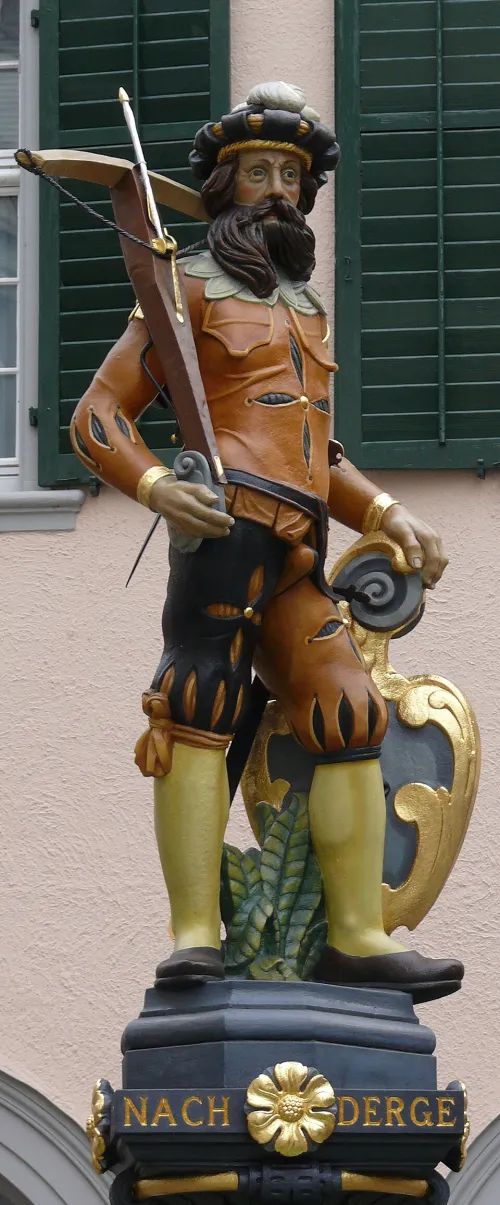
    The Tellenbrunnen stands where the Vordergasse and the Brunnengasse fork, right in front of the double house Wasserquelle and Zieglerburg. On the east side of its octagonal basin, each side 2.3 metres long, rises a column with a brightly painted figure. The basin carries the year 1632. The figure is supposed to be Wilhelm Tell, the Swiss national hero, and to symbolise the Swiss love of freedom.

    Modern research disagrees. The original statue is said to date from 1522 and now stands in the All Saints Abbey Museum. A photograph from 1901 shows the year 1682 on the base, and the second figure, probably made around then, is attributed to the sculptor Lorenz Schreiber.

    The historian Georg Kreis argues that neither figure is "a Tell in the sense of an individual". Neither the supposed 1522 figure, which is not even certain to come from this fountain, nor the one from 1682 was meant as Tell. Both are banner bearers of the kind often found on fountains, an impersonal figure for the Confederation's independence in military and legal matters. Only much later, because of the crossbow, did people connect him with Tell. Look at the figure with that in mind and decide for yourself.

    From the fountain it is 80 m, about 1 min, to the Fronwagplatz, home of the Saturday Market.

    Hours
    24/7
    Price
    Free
  11. 11

    Saturday Market

    Saturday Market in Schaffhausen, stop 11 on the self-guided walking tour

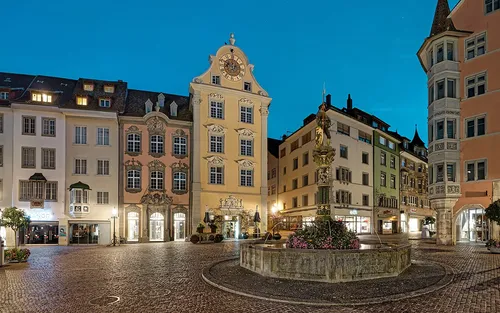
    The Saturday Market fills the Fronwagplatz, the centre of the medieval old town and the heart of today's pedestrian zone. In the Middle Ages the square was simply called "Am Markt", and browsing the stalls on market days is free. This is also where the old town's main axes meet: the Vordergasse leads east to the Schifflände on the Rhine, the Vorstadt runs north to the Schwabentor, and from the west the Oberstadt brings you in from the Obertor.

    On the narrow south side the Fronwagturm dominates the square. The great market scale once hung inside it; today it is in the All Saints Abbey Museum. In the gable you see the astronomical clock by Joachim Habrecht, father of Isaak Habrecht, made in 1564 and showing ten different astronomical functions. The small roof turret holds the bell from the chapel of Balm castle, and right next to the tower stands the guild house Herrenstube.

    Take a slow turn around the square. The Haus zur Taube dominates the west side at the corner of the Oberstadt, and the tower-like Turm am Ort marks the east side. Towards the Vordergasse lies the Haus zum Einhorn, towards the Vorstadt the Grosses Haus with the town archive. Two decorative fountains from the 16th century complete the picture: the Landsknechtbrunnen by the Fronwagturm and the Mohrenbrunnen at the northern end.

    Until the Hochrhein railway was built in the mid 19th century, the square was also a storage place for the goods carted around the Rhine Falls. From here it is 80 m, about 1 min, to the Haus zum Ritter on the Vordergasse.

    Local name
    Fronwagplatz
    Hours
    Saturday 07:00–12:00 (also Tuesday 07:00–11:00)
    Price
    Free entry
  12. 12

    Haus zum Ritter

    Haus zum Ritter in Schaffhausen, stop 12 on the self-guided walking tour

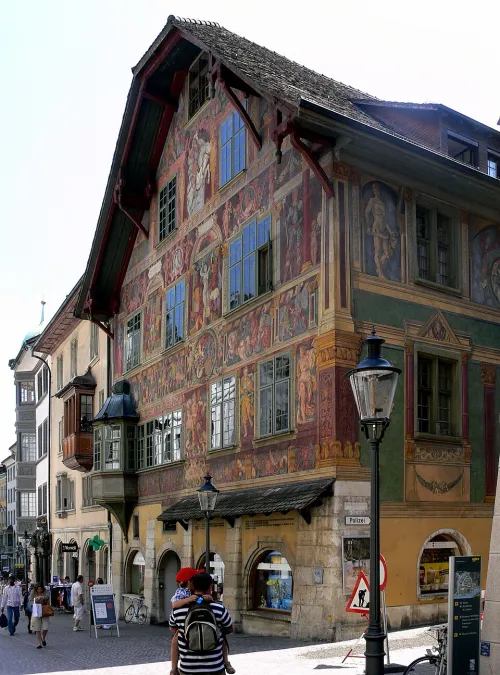
    The Haus zum Ritter at Vordergasse 65 is a town house built in 1492, famous for its painted facade. Read it from the middle: above the name plate "Zum Ritter" stands Virtus, flanked by a king for the state and a woman in a mitre for the church. All three look to the right towards Gloria with a sceptre and a globe at her feet, and on the far right stands Immortality. Above them you see the owners' coats of arms and a triumphal procession on either side.

    Higher up are two scenes from Homer's Odyssey. On the left Odysseus arrives at the sorceress Circe, who has turned his companions into pigs. On the right is the tree of the lotus eaters, whose fruit his companions eat, and the tree has the shape of a woman.

    The house name goes back to the early 14th century. In 1566 the knight Hans von Waldkirch added two upper floors, and tradition says the name comes from him. Tobias Stimmer painted the original frescoes between 1568 and 1570; they are considered the most important Renaissance frescoes north of the Alps. Over the following centuries they were painted over in oil and renovated again and again, until the renovation of 1918/19 by August Schmid and Christian Schmidt uncovered Stimmer's work. Saving it meant taking it off the wall: in 1935 the specialist Franco Steffanoni detached the frescoes, and since then they have been in the All Saints Abbey Museum.

    What you see today was repainted from the originals by Carl Roesch in 1938/39 and 1943, the same artist whose clock paintings you saw on the Schwabentor. The town expropriated the house in 1941, and the ground floor with its star vault now holds a pharmacy and perfumery. From here it is 530 m, about 7 min, to the Diebsturm.

    Hours
    24/7
    Price
    Free
  13. 13

    Diebsturm

    Diebsturm in Schaffhausen, stop 13 on the self-guided walking tour

    The Diebsturm, the thieves' tower, was one of two round towers in the western medieval town wall, both used as prisons for many years. Only this lower tower survives. Nobody knows exactly when it was built; it is first recorded in 1414 as the "nieder diepthurm". You find it at Neustadt 13, by the house "Zum Schleifstein", where a Gothic pointed arch door leads into it.

    For its full height of 20.7 metres, look at it from the Grabenstrasse, which got its name because it runs in the former town moat. The bare round tower stands on natural limestone bedrock and is built of limestone rubble, with walls 2 metres thick at the bottom and 1.25 metres at the top. It rises a fifth above the row of houses in the Neustadt, which were themselves once part of the wall. It has no windows, only narrow slits, turns into an even octagon near the cornice and ends in a pyramid roof 1.9 metres high, renewed in 1820.

    In 1942, during the Second World War, an air raid shelter was built inside. Since the war the tower has stood empty, and only birds nest in it. In 1954 the town bought it from Fritz Baldinger for 12,000 francs, and in 1995 the roof and part of the facade were restored.

    Its twin had a less lucky fate. The upper Diebsturm stood at Neustadt 33 until 19 February 1858, when the town council allowed its owner, the decorative painter Jakob Wüscher, to pull it down, on condition that it be demolished completely; a workshop took its place. From the Diebsturm it is 290 m, about 4 min, back to the Obertorturm, where the loop closes.

    Hours
    Exterior view accessible 24/7
    Price
    Free
Walking tour route map of Schaffhausen Route loaded
ObertorturmSchwabentorMunot FortressRhybadi+9
All 13 stops are already on the map.
You just press start.
AI Tour Guide

You know the route now. Walk it with a guide in your ear.

Press start wherever you are, even hundreds of kilometres from Schaffhausen, and the guide begins telling its stories right away. In the city, pick any of the 13 stops to start from: it leads you there, then talks with you the whole route, asking, listening, remembering, and shaping the tour around your answers.

13stops 3.2km 47 minwalking 13languages
▶Start the tour free

Free to start · Runs in your browser · No app, no download

Shorter Ways Through Schaffhausen

The full loop is easy to manage, but if your time is short, two sections stand well on their own.

The full loop

Stops: 1, 2, 3, 4, 5, 6, 7, 8, 9, 10, 11, 12, 13

For a first visit with half a day to spare: all 13 stops, 47 min of pure walking. Entry only applies if you go into the All Saints Abbey Museum or swim at the Rhybadi.

Gates and fortress

Stops: 1, 2, 3

For anyone who mostly wants walls and towers: from the Obertorturm via the Schwabentor up to the Munot Fortress, 16 min of walking in total. Everything on this section is free.

Abbey and old town core

Stops: 5, 6, 7, 8, 9, 10, 11, 12

For a compact hour or two in the centre: from the Schillerglocke through the abbey quarter, both main churches and the Fronwagplatz to the Haus zum Ritter, just 11 min of walking. Only the museum charges entry.

How Long Does the Schaffhausen Loop Take?

The 47 min of pure walking are spread unevenly. The longer legs come early, from the Obertorturm to the Schwabentor and on to the Munot Fortress, and late, from the Haus zum Ritter to the Diebsturm. Between the Rhybadi and the Haus zum Ritter, eight stops sit within 13 min of walking, so that stretch feels more like strolling from one courtyard to the next.

The time beyond walking goes mostly to three places: the Munot Fortress, the Minster and, if you choose it, the All Saints Abbey Museum. A proper museum visit easily adds an hour or more, so with it the loop turns into a half day. The gates and fortress section fits into about an hour with time on the Munot; the abbey and old town core takes an hour without the museum and around two with it.

Before You Set Off in Schaffhausen

  • Start and finish: The recommended start is the Obertorturm, and the loop brings you back there. You can join at any stop, for example at the Munot Fortress or on the Fronwagplatz, and follow the order from there.
  • Paid entry: Only the All Saints Abbey Museum and, in its bathing season, the Rhybadi charge entry. All other stops are free to see, the Munot and both churches included; the Hallen für Neue Kunst are permanently closed.
  • Choosing your day: Walk on a Saturday if you want the Fronwagplatz with market stalls. If the museum matters to you, check its current hours before you set out, and expect the churches to limit visits during services and concert preparations.
Walking tour route map of Schaffhausen
AI Tour Guide

Your guide is ready whenever you start walking.

Press start and a voice AI Tour Guide takes it from here: leading the route through Schaffhausen, telling the stories, and turning your walk into a real back-and-forth conversation. No app or download is needed; it runs in your browser.

13stops 3.2km 47 minwalking 13languages
▶Start the tour free

Free to start · Runs in your browser · No app, no download

What the AI Tour Guide Adds on This Walk

The free GPS navigation gets you from gate to fortress to fountain. The optional AI Tour Guide turns the walk into a conversation: it greets you at the Obertorturm, tells the stories of each place, asks what catches your interest, remembers it and shapes the rest of the walk around it. Wonder what a watchman's night on the Obertorturm was like, or how the town lived with the abbot as its lord? Just interrupt and ask. It leaves the route as it is. You start with 100 free credits; after that, choose this tour all-inclusive for €19.99 with no time limit, or credits at €5 per hour.

A Real Conversation A voice AI Tour Guide greets you, leads the whole route, and tells the stories and facts as you walk, asking what you want to see and keeping a real conversation going. Not a recording you press play on.
Map Navigation Follow the route on the map and walk at your own pace. You choose where to start and when to move to the next stop.
Ask Anything Curious about a building you pass? Ask your AI Tour Guide on the spot and the conversation carries on.
13 Languages Switch language anytime. No separate tour needed.
Start free in your browser

Common Questions Before You Go

Can I swim at the Rhybadi during the walk?

Yes, in the bathing season while the bath is open; entry is charged. Pack swimwear and a towel and treat it as a long break, since the loop continues just 2 min away at the Schillerglocke.

Can I go inside the Diebsturm?

No. The tower is hard to reach and has not been used since the end of the Second World War. You see it from the Neustadt and, at its full height, from the Grabenstrasse.

Does the loop include the Rhine Falls?

No. The walk stays in the old town and along the Rhine bank. The falls appear in its stories, though: they are why goods had to be unloaded here and carted through the Obertorturm and across the Fronwagplatz.

What could I combine with Schaffhausen on another day?

Stein am Rhein is 17 km away, Winterthur 23 km, Zurich 37 km and Constance 41 km, each with its own free walking route.

Is the tour really free?

Yes. The whole tour is free: the route, the interactive map and the navigation cost you nothing. Only the voice AI Tour Guide is optional and paid: you test it with 100 free credits, then you pay either €5 per hour or €19.99 for this whole tour, with no time limit. Admission to 2 of the 13 stops is not included: Rhybadi and All Saints Abbey Museum charge their own entry fees.

Do I need to download an app?

No. Everything runs in your phone browser. Open the route and start walking, no download and no sign-up required.

Do I need to book the walking tour in advance?

No booking needed. This self-guided tour is available anytime. Open the route in your browser and start walking. The AI Tour Guide works instantly, no app, no reservation required.

What languages is the AI Tour Guide available in?

The AI Tour Guide speaks 13 languages, so you take the tour in your own language and can switch at any time.

Can I skip stops or change the route?

Yes. Skip any stop, spend extra time at places you like, or start the route from any point. It is your walk, you set the pace.
Image credits
▶ Start free in your browser Runs in your browser, no app, no download