Free Walking Tour Vicenza: Palladio from Garden to Rotonda

Ten stops through Palladio's home town: his palaces, his last theatre and the Basilica in the old centre, then up Monte Berico and out to the villa La Rotonda.

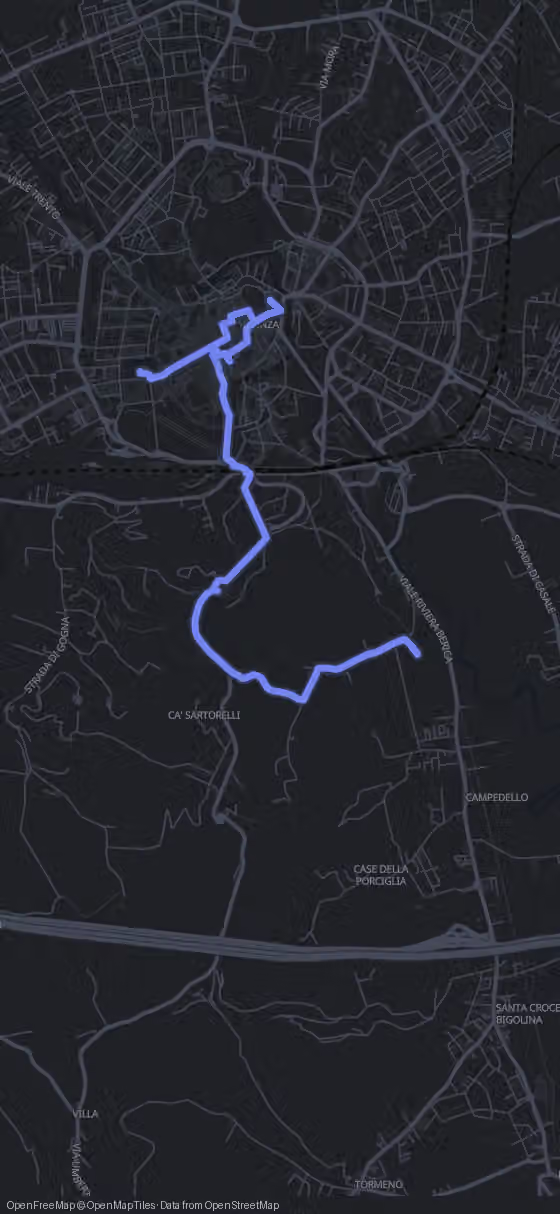
10 Stops 5.7 km ~1 h 27 min walking
Route map for the Vicenza walking tour
Stop 1 of 10
680 m·8 min
Giardino Salvi
Head north-east toward Palazzo Barbaran da Porto
Ciao, welcome to Vicenza. I'm Alex, and in Palladio's city, even a stage can persuade your eyes to believe a lie.
Try this tour with Alex

What This Route Through Vicenza Covers

Ten stops lead from Giardino Salvi by the old city walls through the historic centre to Villa Capra La Rotonda just outside Vicenza: 5.7 km with 1 h 27 min of pure walking, around four and a half hours with a few interiors.

On the way you pass Palazzo Barbaran da Porto, Chiesa di Santa Corona, Palazzo Chiericati, Teatro Olimpico, Piazza dei Signori, Basilica Palladiana, Corso Palladio and Monte Berico. Four stops are free, six charge admission. Map and GPS navigation from stop to stop are free in your browser; the AI Tour Guide is optional.

Open free GPS & optional AI Tour Guide
View of Vicenza

The Route

Walking Map of Vicenza: Garden, Palaces, Hill and Villa

10 stops 5.7 km 1 h 27 min walking
Tap to load interactive map

The 10 stops along this route

  1. Giardino Salvi in Vicenza, stop 1 on the self-guided walking tour
    1Giardino Salvi
  2. Palazzo Barbaran da Porto in Vicenza, stop 2 on the self-guided walking tour
    2Palazzo Barbaran da Porto
  3. Chiesa di Santa Corona in Vicenza, stop 3 on the self-guided walking tour
    3Chiesa di Santa Corona
  4. Palazzo Chiericati in Vicenza, stop 4 on the self-guided walking tour
    4Palazzo Chiericati
  5. Teatro Olimpico in Vicenza, stop 5 on the self-guided walking tour
    5Teatro Olimpico
  6. Piazza dei Signori in Vicenza, stop 6 on the self-guided walking tour
    6Piazza dei Signori
  7. Basilica Palladiana in Vicenza, stop 7 on the self-guided walking tour
    7Basilica Palladiana
  8. Corso Palladio in Vicenza, stop 8 on the self-guided walking tour
    8Corso Palladio
  9. Monte Berico in Vicenza, stop 9 on the self-guided walking tour
    9Monte Berico
  10. Villa Capra La Rotonda in Vicenza, stop 10 on the self-guided walking tour
    10Villa Capra La Rotonda
  11. That's the full route.

    Walk it with an AI Tour Guide talking you through every one of these streets.

    Start free in your browser
    You made it

Your Vicenza Walking Tour, Told Stop by Stop

  1. 1

    Giardino Salvi

    Giardino Salvi in Vicenza, stop 1 on the self-guided walking tour

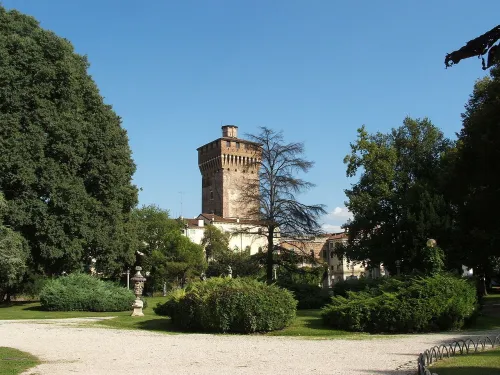
    You begin in a small garden: among Vicenza's public green spaces, Giardino Salvi is one of the least extensive, tucked against the old walls of Piazza Castello. Look for the statues and the two loggias in Palladian style. On the Loggia Valmarana you can read the date 1592 and the name of Leonardo Valmarana, the man who opened the garden that year.

    The story starts in the sixteenth century, when the Valmarana family bought the land and also took over the old Scaliger castle next door, which they turned into a palace. Giacomo Valmarana laid the garden out as a formal Italian parterre, the way the eighteenth-century Vicenza engraver Cristoforo Dall'Acqua later showed it. Along one side ran the Roggia Seriola, a water ditch crossed from the very beginning by a small wooden footbridge.

    Leonardo wanted the garden open to everyone, yet it was then closed for a couple of centuries. In the nineteenth century it was reshaped as an English landscape garden and belonged to the Salvi family. The last of them, Count Girolamo, left it to the charitable foundation he had created, and on 25 May 1907 the city bought its 12,000 square metres for 90,000 lire. The public came back in on 1 June 1909.

    Two later layers are still part of the picture: the pavilions of the former trade fair, built in 1947 between the ditch and the walls where Leonardo had put up greenhouses in 1583, and the collection rose garden added in the restoration completed in February 2009. Since the 2000s the garden often hosts Christmas markets. Entry is free, so linger as long as you like, then walk 680 m, about 9 minutes, to Palazzo Barbaran da Porto.
    Hours
    Daily: May–Sep 07:30–21:00, Oct–Apr 07:30–20:00
    Price
    Free
  2. 2

    Palazzo Barbaran da Porto

    Palazzo Barbaran da Porto in Vicenza, stop 2 on the self-guided walking tour

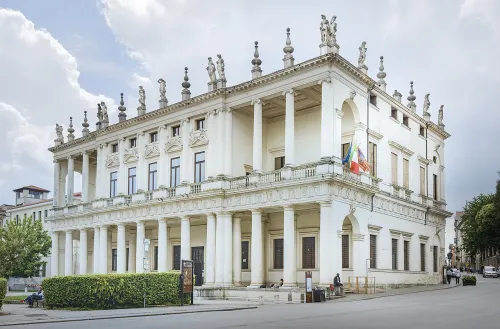
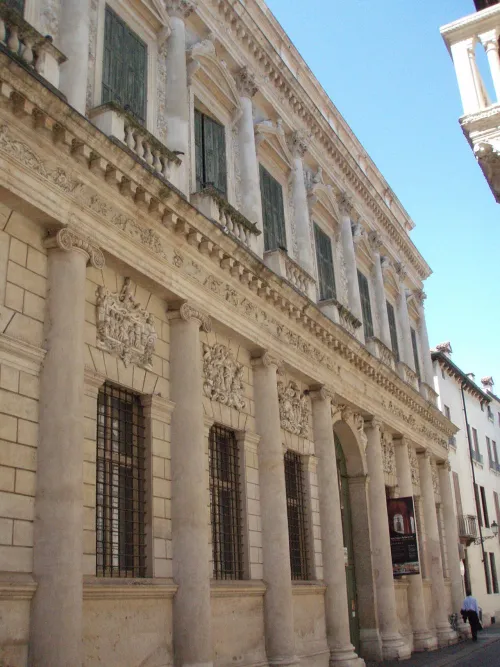
    Here you meet Andrea Palladio in a rare form: Palazzo Barbaran da Porto is the only great city palace he managed to build in its entirety. Designed in 1569 and built between 1570 and 1575, it was a lavish home for the Vicenza nobleman Montano Barbarano.

    Barbarano was a practical client. He asked Palladio to keep several family houses already standing on the plot, and once the design was settled he bought yet another house next door. Look at the entrance portal: it sits off centre, a direct result of that late purchase. At least three of Palladio's own drawings for the plan survive in London, all quite different from what was built, a record of how hard the puzzle was. Palladio turned the constraints into refined solutions and stitched the old houses into one building; on the ground floor a grand atrium with four columns joins the two original lots.

    The patron had another side. In his history of Vicenza from 1591, Iacopo Marzari describes Barbarano as a man of letters and an excellent musician, and the palace inventory of 1592 lists several flutes, a hint of the music once played in these rooms.

    After a restoration that lasted twenty years, the palace opened to the public in 1998, with exhibitions from March 1999. Today it houses the Palladio Museum and the international study centre for Palladio's architecture, and since 1994 it has been part of the UNESCO World Heritage Site of Vicenza and the Palladian villas. Admission is charged; go in if you want to understand Palladio's ideas before you see the rest of his buildings in town. From the door it is 240 m, 3 minutes, to the Chiesa di Santa Corona.

    Hours
    Wed–Sun 10:00–18:00, Mon–Tue closed (Tue open only by reservation for groups/schools)
    Price
    8 EUR full, 6 EUR reduced
  3. 3

    Chiesa di Santa Corona

    Chiesa di Santa Corona in Vicenza, stop 3 on the self-guided walking tour

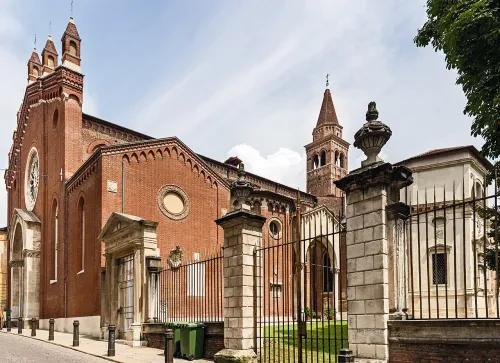
    Chiesa di Santa Corona is older than anything Palladio built, and it exists because of a single thorn. In October 1260 the city decided to raise a grand church for one thorn from Christ's crown, a gift from King Louis IX of France to the blessed Bartholomew of Breganze, then bishop of Vicenza.

    Bartholomew was a Dominican with big plans. After the tyrannical rule of Ezzelino III da Romano the free commune had been restored, and the bishop wanted his friars to fight the Cathar church rooted in the city, settle family feuds and curb usury. The site was chosen on purpose: the contrà del Collo, where the Cathar church and Ezzelino's stronghold, the Castrum Thealdum, had stood. The city bought land on the slope toward the Bacchiglione river, citizens gave houses and palaces, and work began in 1261. Modelled on the Cistercian abbeys of Lombardy and unusually large for its time, the church stood in its essentials within less than a decade.

    The triumph was short. In 1264 Padua took control of Vicenza, Bartholomew lost much of his influence and spent his last years in disappointment.

    Inside you find Renaissance paintings and the Valmarana Chapel designed by Palladio, while the cloisters of the former Dominican convent hold the Naturalistic Archaeological Museum. Admission is charged. It is worth it if you want to see Palladio at a small scale in a sacred setting, or if the medieval story has caught you. Palazzo Chiericati is only 160 m away, 2 minutes on foot.

    Hours
    Tue–Sun 10:00–18:00 (last entry 17:30), Mon closed
    Price
    4 EUR full, 2 EUR reduced
  4. 4

    Palazzo Chiericati

    Palazzo Chiericati in Vicenza, stop 4 on the self-guided walking tour

    Palazzo Chiericati faces Piazza Matteotti, once called Piazza d'Isola, and it stands slightly raised on a base borrowed from the temples of antiquity. That was practical as well as grand: the base protected the building from the floods that often hit this spot. Read the façade floor by floor: the ground floor opens in three loggias with Doric columns, the upper floor carries Ionic columns, and only its central section is closed.

    Palladio drew the plans in 1550 for Count Girolamo Chiericati. Building began in 1551 but stopped when the count died in 1557. His son Valerio paid only for the interiors, yet moved in as early as 1570 and lived here until his death in 1609, so the palace stood as an unfinished building site for almost a century. It was probably completed only around 1680, under the architect Carlo Borella.

    Why does it look so different from Palladio's palaces on narrow streets? Architectural historians point to the open square: a front facing a square demanded other solutions than a façade in a tight lane, and many of its ideas reappear in the Basilica. The design travelled far. In 1777 Carl von Gontard used parts of it as the model for the Noack House on the Old Market in Potsdam.

    Today the palace houses the city's art gallery; among its key works is Giambattista Pittoni's Diana and Actaeon from 1725. Admission is charged, and it suits you if you want paintings as well as architecture. The Teatro Olimpico is just 150 m away, 2 minutes on foot.

    Hours
    Tue–Sun 10:00–18:00 (last entry 17:30), Mon closed
    Price
    8 EUR full, 6 EUR reduced
  5. 5

    Teatro Olimpico

    Teatro Olimpico in Vicenza, stop 5 on the self-guided walking tour

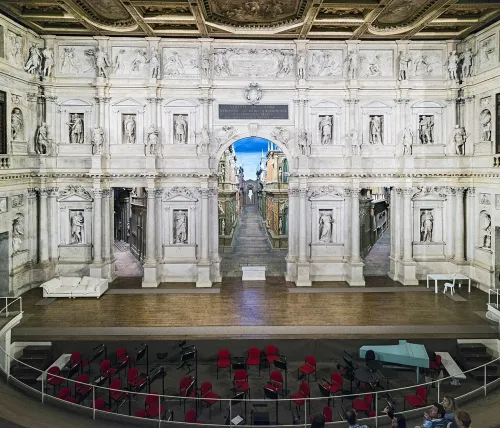
    The Teatro Olimpico was Palladio's last design. He had come back to his native Vicenza in 1579 after a lifetime of studying ancient Roman architecture, construction began in 1580, and he did not live to see the theatre finished.

    His knowledge of Roman theatres was deep. He had illustrated Daniele Barbaro's Italian translation of Vitruvius, including plans of Roman theatres and an elevation of the stage front of Vicenza's own ruined Roman theatre, the Teatro Berga, and his papers contain imagined reconstructions of the Roman theatres of Pola and Verona. He was also one of the founders of the Accademia Olimpica in 1555, the academy whose home this became, and he had already designed temporary theatres around town, the best known in the great hall of the Basilica Palladiana some seventeen years earlier.

    Inside, the stage is the reason to come. Behind the actors rises a full Roman-style stage front in wood and stucco made to look like marble. Through its openings you look down streets that seem to run to a distant horizon: a trompe-l'oeil set by Vincenzo Scamozzi, installed for the first performance in 1585 and the oldest surviving stage set in existence.

    Only three Renaissance theatres survive: this one, the Teatro all'antica in Sabbioneta and the Teatro Farnese in Parma, and the other two largely followed its model. The theatre still hosts performances several times a year. Admission is charged, and if you go inside only one building on this walk, make it this one, because the set can only be seen from the seats. Then walk 480 m, 7 minutes, to Piazza dei Signori.

    Hours
    Sep–Jun: Tue–Sun 09:00–17:00 (last entry 16:30); Jul–Aug: Tue–Sun 10:00–18:00 (last entry 17:30); Mon closed
    Price
    12 EUR full, 9 EUR reduced
  6. 6

    Piazza dei Signori

    Piazza dei Signori in Vicenza, stop 6 on the self-guided walking tour

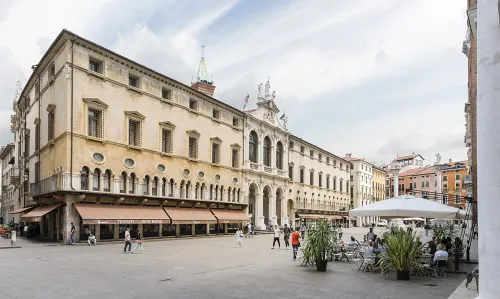
    Piazza dei Signori is Vicenza's main square, and it has been the city's meeting point for business and leisure for a very long time: it stands on the forum of Roman Vicetia and was a market place long before Palladio. Stand in the rectangle and get your bearings. Along one long side rise the Basilica Palladiana and the Torre Bissara; opposite stand the Loggia del Capitanio, also by Palladio, and the Palazzo del Monte di Pietà with the Church of San Vincenzo, while narrow lanes open onto the square.

    The name comes from the lords who lived here: the podestà and the captain, who represented the Republic of Venice in the city. In the Middle Ages the whole area was called the Perònio, perhaps after perones, the wooden and leather shoes sold at the market stalls. It was a cluster of small market squares for wine, small fish and grain, along with the town halls where the city was governed and justice was administered from the thirteenth century.

    At the short end stand two columns. The first went up in 1464, and in 1473, after Vicenza had given itself to Venice, it received the winged lion, symbol of the Republic. More than a century and a half later, in 1640, a second column with Christ the Redeemer joined it, a choice that was long debated and finally made in honour of the city and its citizens. Behind the columns lies the old grain market, including little Piazza Biade, still used for seasonal markets.

    The square is free and open at any hour. The Basilica Palladiana is only 100 m away, a minute's walk, and on the way you pass the Museo del Gioiello.

    Hours
    24/7
    Price
    Free
  7. 7

    Basilica Palladiana

    Basilica Palladiana in Vicenza, stop 7 on the self-guided walking tour

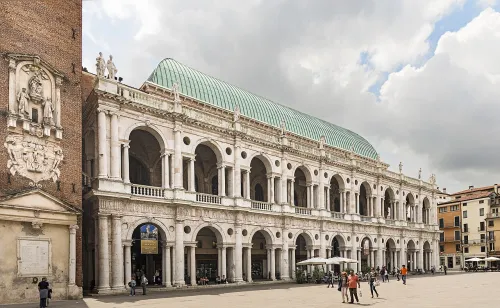
    What you see is a disguise. Behind Palladio's marble arches hides a fifteenth-century Gothic town hall, the Palazzo della Ragione, designed by Domenico da Venezia to join two older public palaces. It was the seat of government, with shops on the ground floor, and it carried a roof shaped like an upturned hull, inspired by the one built in 1306 for the town hall of the same name in Padua. The Gothic façade of red and yellowish Verona marble is still visible behind the later shell.

    Beside it the Torre Bissara rises 82 metres. It is recorded as early as 1172, was raised when the hall was built, received its pinnacle in 1444 and carries five bells tuned to E.

    Then came the crisis. Between 1481 and 1494 Tommaso Formenton wrapped the palace in a double order of columns, and just two years after completion the south-west corner collapsed. For decades Vicenza asked famous architects for plans, among them Jacopo Sansovino, Sebastiano Serlio, Michele Sanmicheli and Giulio Romano. In 1546 the Council of One Hundred chose instead a 40-year-old local man, Andrea Palladio, and work began in April 1549. He added a new outer shell of classical marble forms, a loggia and a portico that now hide the Gothic building.

    Study the loggia from the square: it shows one of the first examples of what became known as the Palladian window, and looking costs nothing. Inside, admission is charged; go in if you want to stand in the great hall where Palladio once set up his temporary theatre. From here Corso Palladio is 140 m away, 2 minutes on foot.

    Hours
    Tue–Sun 10:00–18:00 (last entry 17:30), Mon closed
    Price
    6 EUR full, 4 EUR reduced
  8. 8

    Corso Palladio

    Corso Palladio in Vicenza, stop 8 on the self-guided walking tour

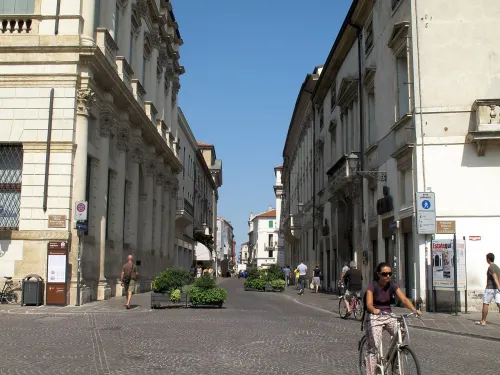
    Corso Palladio is Vicenza's main street, though it was named after the architect only after the Second World War. It runs for about 700 m across the historic core from west to east, from Porta Castello to Piazza Matteotti, where you stood in front of Palazzo Chiericati. Its line follows the decumanus maximus of Roman Vicenza, which was also the city stretch of the Via Postumia.

    For centuries people called it the strata major, the Strà grande or simply the Strà. In the Middle Ages it ran between the Porta Feliciana in the west and the Porta San Pietro by the bridge over the Bacchiglione, today's Ponte degli Angeli, and it kept linking the cities of the Venetian plain, Verona on one side and Padua on the other. Inns, taverns and carriage hire lined its edges.

    It was also where the city spoke to its people. At four fixed points the town crier had to read out government decrees and the sentences passed on criminals: at the San Pietro gate, at the square of Santa Corona, at the house of the Caldogno family at the start of today's contrà Porti, and at the corner of the red well, the crossing with today's Corso Fogazzaro.

    In the early nineteenth century the stretch from Piazza Castello to contrà San Faustino was the final run of the Palio, the horse race held on the day of the Holy Thorn, the relic you met at Santa Corona, and on Corpus Christi. The first section, as far as Corso Fogazzaro, was nicknamed corso ai Filippini after the church of San Filippo Neri. Walking the street is free. From here the longest leg so far begins: 1750 m, about 29 minutes, out of the centre to Monte Berico.

    Hours
    24/7
    Price
    Free
  9. 9

    Monte Berico

    Monte Berico in Vicenza, stop 9 on the self-guided walking tour

    Monte Berico is a hill just over 100 metres above sea level, the northernmost tip of the Colli Berici, close to the old town and overlooking it. On the summit stands the sanctuary of the Madonna di Monte Berico, patron of the city and the diocese. In front of it, Piazzale della Vittoria opens into a wide balcony with a view over the whole city, the northern part of the province and the Vicentine Prealps.

    Monte Berico is also the name of one of Vicenza's most elegant residential districts, built on the slopes in the first half of the twentieth century and made up almost entirely of villas and family houses.

    The hill's early history is hazy. Vicenza historians spoke of a small temple to Apollo and Diana guarding Roman Vicetia from its slopes, but there is not enough evidence to prove it. What is certain is that there were places of worship here in the Middle Ages. The Benedictine nuns of San Pietro owned a church dedicated to the saint high on the slope; in the fourteenth century it became the seat of the Knights of the Blessed Glorious Virgin, nicknamed the Cavalieri Gaudenti, and it was destroyed during the War of the League of Cambrai. At the western foot of the hill, around the end of the first millennium, stood the church, convent and hospice of San Giorgio.

    Visiting the sanctuary is free. Take your time at the balcony, then set off on the last and longest leg: 2000 m, about 32 minutes, to Villa Capra La Rotonda.

    Hours
    Solar time (winter): Mon–Sat 06:00–12:30 and 14:30–18:00, Sun 06:00–19:00; Daylight saving time (summer): Mon–Sat 06:00–12:30 and 14:30–19:00, Sun 06:00–20:00
    Price
    Free
  10. 10

    Villa Capra La Rotonda

    Villa Capra La Rotonda in Vicenza, stop 10 on the self-guided walking tour

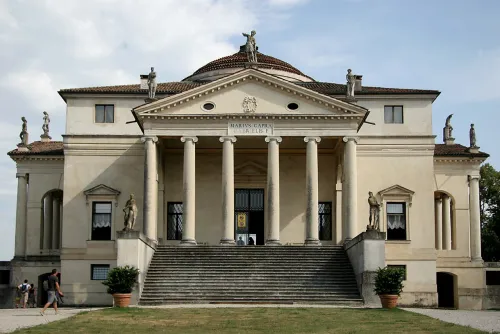
    You end at one of Palladio's best-known legacies to world architecture. Villa Capra La Rotonda sits on a hilltop just outside the city, and its idea is clear at first sight: a completely symmetrical square block with four façades, each with a projecting portico, all held within an imaginary circle that touches the corners and the centres of the porticoes.

    The client was Paolo Almerico, a cleric and nobleman who had served in the Vatican as referendario apostolico to Popes Pius IV and Pius V. When he retired in 1565 he came home to Vicenza and wanted a country house, and work began in 1567. Unlike many Palladian villas of the Veneto, it was not designed around a working farm; in today's terms the site was suburban, and Palladio himself classed the building as a palazzo rather than a villa. Its model was the Pantheon in Rome, and with the columns of its four porches it is often called a villa temple.

    The house was completed only in 1605 by the Capra brothers, who had bought it in 1592 and gave it one of its many names. Officially it is Villa Almerico Capra Valmarana; locally it is Villa Capra detta la Rotonda. It may have inspired a thousand later buildings, and together with Palladio's other works it belongs to the UNESCO World Heritage Site of Vicenza and the Palladian villas.

    The villa charges admission and keeps limited visiting days, so plan your arrival around them. Here the walk ends.

    Local name
    Villa Capra detta la Rotonda
    Hours
    Apr–Oct: Fri–Sun 10:00–13:00 and 15:00–18:00; mid-Mar and Nov to 8 Dec: Sat–Sun 10:00–12:30 and 14:30–17:00; Mon–Thu closed (ticket office closes 15 min before end)
    Price
    15 EUR full, 10 EUR reduced
Walking tour route map of Vicenza Route loaded
Giardino SalviPalazzo Barbaran da PortoChiesa di Santa CoronaPalazzo Chiericati+6
All 10 stops are already on the map.
You just press start.
AI Tour Guide

You just read the route through Palladio's Vicenza. Now walk it with a guide in your ear.

Press start wherever you are, even hundreds of kilometres from Vicenza, and the guide begins telling its stories right away. In the city, pick any of the 10 stops to start from: it leads you there, then talks with you the whole route, asking, listening, remembering, and shaping the tour around your answers.

10stops 5.7km 1 h 27 minwalking 13languages
▶Start the tour free

Free to start · Runs in your browser · No app, no download

Three Shorter Ways to Walk Vicenza

Not everyone wants the long legs out to the hill and the villa. These versions keep the same order and simply stop earlier or start later.

Palladio's core

Stops: 4, 5, 6, 7

For a short visit or a stopover. Palazzo Chiericati, Teatro Olimpico, Piazza dei Signori and Basilica Palladiana lie 730 m apart in total, about 10 minutes of walking. Three of the four charge admission; the square is free.

The old town walk

Stops: 1, 2, 3, 4, 5, 6, 7, 8

For a relaxed day in the centre without leaving town. From Giardino Salvi to Corso Palladio you cover 1.95 km in 26 minutes of pure walking. The garden, the square and the street are free; Palazzo Barbaran da Porto, Chiesa di Santa Corona, Palazzo Chiericati, Teatro Olimpico and Basilica Palladiana charge admission.

Old town and Monte Berico

Stops: 1, 2, 3, 4, 5, 6, 7, 8, 9

For those who want the view over the city but not the villa. The walk up the hill adds 29 minutes, for 3.7 km and 55 minutes of pure walking in total. The sanctuary is free, so this adds no ticket.

How Long Does This Vicenza Tour Take, With or Without La Rotonda?

The full route has 1 h 27 min of pure walking over 5.7 km, and just over an hour of that falls on the last two legs, out to Monte Berico and on to La Rotonda. In the centre the stops sit only a few minutes apart, so most of your time there goes into looking and visiting.

With the Teatro Olimpico, the Basilica Palladiana and La Rotonda visited inside and short pauses at the other stops, plan around four and a half hours. If you also want the Palladio Museum, Santa Corona and the art gallery in Palazzo Chiericati, the walk easily fills a whole day.

Palladio's core takes under two hours with the theatre and the Basilica inside. The old town walk with the same two interiors needs about two and a half hours, and adding Monte Berico brings it to about three hours.

Before You Set Off in Vicenza

  • Start: Giardino Salvi is the recommended start, but you can join the walk at any stop and follow the suggested order from there.
  • Finish: Villa Capra La Rotonda, just outside the city, at the end of the longest leg.
  • Time of day: Start in the morning if you want the full route with interiors, since the museums and the villa keep daytime visiting hours.
  • Tickets: Palazzo Barbaran da Porto, Chiesa di Santa Corona, Palazzo Chiericati, Teatro Olimpico, Basilica Palladiana and Villa Capra La Rotonda charge admission. Giardino Salvi, Piazza dei Signori, Corso Palladio and Monte Berico are free.
  • La Rotonda: The villa opens to visitors on far fewer days than the museums in town, so check its visiting times when you plan your day.
Walking tour route map of Vicenza
AI Tour Guide

Your guide to Palladio's Vicenza is ready when you are.

Press start and a voice AI Tour Guide takes it from here: leading the route through Vicenza, telling the stories, and turning your walk into a real back-and-forth conversation. No app or download is needed; it runs in your browser.

10stops 5.7km 1 h 27 minwalking 13languages
▶Start the tour free

Free to start · Runs in your browser · No app, no download

How the AI Tour Guide Walks Palladio's City With You

On this route the AI Tour Guide talks with you like a companion who knows Vicenza: it greets you, tells the stories of each place as you arrive, asks what you noticed and remembers whether palaces, paintings or medieval feuds hold your attention, then shapes the conversation around that. Cut in whenever you like, for example to ask what was left to finish at the theatre after Palladio died, or why Vicenza handed itself to Venice in the first place. Route, map and GPS navigation stay free; for the guide you start with 100 free credits, then choose this tour all-inclusive for €19.99 with no time limit, or credits at €5 per hour.

A Real Conversation A voice AI Tour Guide greets you, leads the whole route, and tells the stories and facts as you walk, asking what you want to see and keeping a real conversation going. Not a recording you press play on.
Map Navigation Follow the route on the map and walk at your own pace. You choose where to start and when to move to the next stop.
Ask Anything Curious about a building you pass? Ask your AI Tour Guide on the spot and the conversation carries on.
13 Languages Switch language anytime. No separate tour needed.
Start free in your browser

Common Questions About Walking Vicenza

Is Vicenza a good base for day trips to other cities?

Yes. Padua is 30 km away, Verona 44 km and Venice 63 km, and each has its own walking route.

Does the walk work on a day when the museums are closed?

Yes, as an outdoor walk. Giardino Salvi, Piazza dei Signori, Corso Palladio and Monte Berico are free, and the loggias of the Basilica Palladiana and Palazzo Chiericati are made to be read from the square.

Can I visit only Monte Berico and La Rotonda?

Yes. Start the GPS route at Monte Berico; from the sanctuary it is 2000 m, about 32 minutes on foot, to the villa.

Can I ask about buildings that are not stops, like the Loggia del Capitanio?

Yes. The AI Tour Guide picks up whatever catches your eye along the way, such as Palladio's Loggia del Capitanio facing the Basilica on Piazza dei Signori, and weaves it into the conversation.

Is the tour really free?

Yes. The whole tour is free: the route, the interactive map and the navigation cost you nothing. Only the voice AI Tour Guide is optional and paid: you test it with 100 free credits, then you pay either €5 per hour or €19.99 for this whole tour, with no time limit. Admission to 6 of the 10 stops is not included: Palazzo Barbaran da Porto, Chiesa di Santa Corona, Palazzo Chiericati, Teatro Olimpico, Basilica Palladiana and Villa Capra La Rotonda charge their own entry fees.

Do I need to download an app?

No. Everything runs in your phone browser. Open the route and start walking, no download and no sign-up required.

Do I need to book the walking tour in advance?

No booking needed. This self-guided tour is available anytime. Open the route in your browser and start walking. The AI Tour Guide works instantly, no app, no reservation required.

What languages is the AI Tour Guide available in?

The AI Tour Guide speaks 13 languages, so you take the tour in your own language and can switch at any time.

Can I skip stops or change the route?

Yes. Skip any stop, spend extra time at places you like, or start the route from any point. It is your walk, you set the pace.
Image credits
▶ Start free in your browser Runs in your browser, no app, no download