Free Walking Tour Görlitz: Old Town to the Neisse

Two market squares, a footbridge to Poland and a medieval copy of the Holy Sepulchre in Jerusalem: eleven stops through a town that grew rich on the Via Regia.

11 Stops 3.2 km ~45 min walking
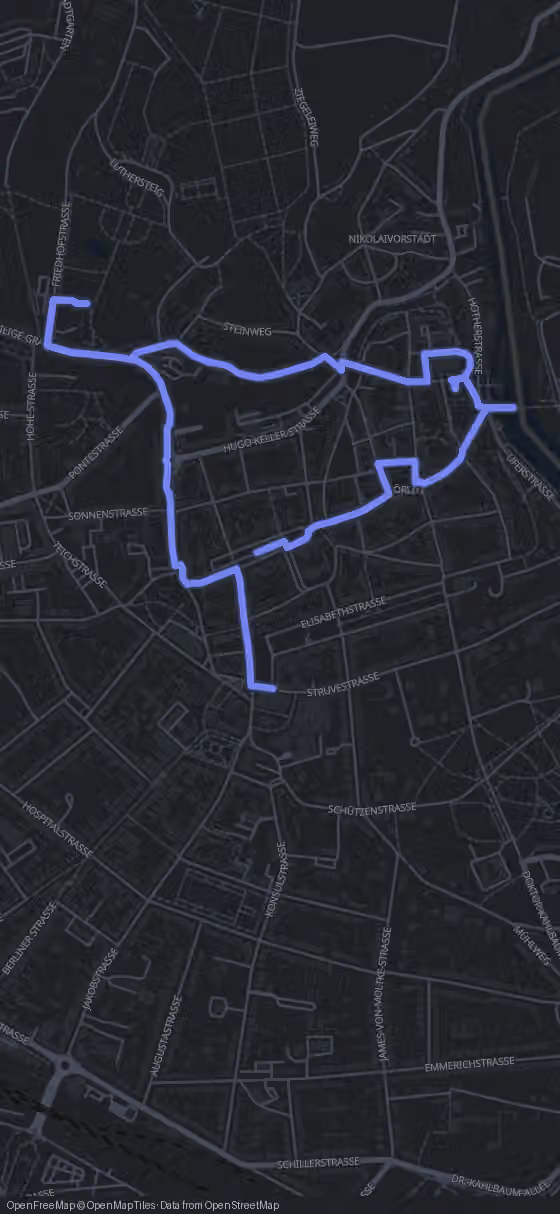
Route map for the Görlitz walking tour
Stop 1 of 11
110 m·1 min
Obermarkt
Head east toward Holy Trinity Church
Willkommen, welcome to Görlitz. I'm Alex, and this border city has learned how to reconnect what history divided.
Try this tour with Alex

The Route at a Glance

Eleven stops take you from the Obermarkt down through the Old Town to the Neisse, out to the Holy Sepulchre (Heiliges Grab) and on to the Görlitzer Kaufhaus (Jugendstil-Warenhaus). The route covers 3.2 km with 45 min of pure walking; allow about three hours, or about five with every museum.

The squares, the bridge and the two churches cost nothing. Entry is charged at the Schönhof (Silesian Museum), the Barockhaus (Neißstraße 30), the Holy Sepulchre and the Reichenbacher Turm. Route, map and GPS navigation run free in your browser; the AI Tour Guide is optional.

Open free GPS & optional AI Tour Guide
This short shows highlights of the route. All 11 stops follow below.

The Route

Walking Map of Görlitz: Squares, River and Tower

11 stops 3.2 km 45 min walking
Tap to load interactive map

The 11 stops along this route

  1. Obermarkt in Görlitz, stop 1 on the self-guided walking tour
    1Obermarkt
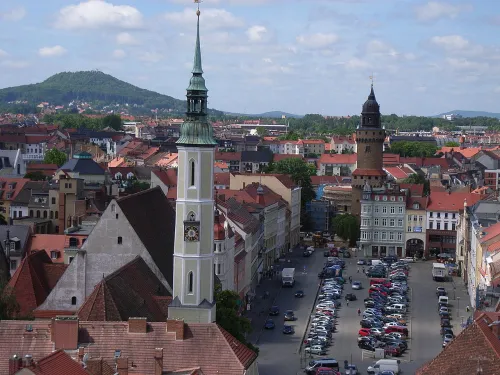
  2. Holy Trinity Church (Dreifaltigkeitskirche) in Görlitz, stop 2 on the self-guided walking tour
    2Holy Trinity Church (Dreifaltigkeitskirche)
  3. Schönhof (Silesian Museum) in Görlitz, stop 3 on the self-guided walking tour
    3Schönhof (Silesian Museum)
  4. Untermarkt in Görlitz, stop 4 on the self-guided walking tour
    4Untermarkt
  5. Barockhaus (Neißstraße 30) in Görlitz, stop 5 on the self-guided walking tour
    5Barockhaus (Neißstraße 30)
  6. Old Town Bridge (Altstadtbrücke) in Görlitz, stop 6 on the self-guided walking tour
    6Old Town Bridge (Altstadtbrücke)
  7. Waidhaus in Görlitz, stop 7 on the self-guided walking tour
    7Waidhaus
  8. St. Peter and Paul Church (Peterskirche) in Görlitz, stop 8 on the self-guided walking tour
    8St. Peter and Paul Church (Peterskirche)
  9. Holy Sepulchre (Heiliges Grab) in Görlitz, stop 9 on the self-guided walking tour
    9Holy Sepulchre (Heiliges Grab)
  10. Reichenbacher Turm in Görlitz, stop 10 on the self-guided walking tour
    10Reichenbacher Turm
  11. Görlitzer Kaufhaus (Jugendstil-Warenhaus), stop 11 on the self-guided walking tour
    11Görlitzer Kaufhaus (Jugendstil-Warenhaus)
  12. That's the full route.

    Walk it with an AI Tour Guide talking you through every one of these streets.

    Start free in your browser
    You made it

Your Görlitz Walking Tour from Obermarkt to the Art Nouveau Store, Stop by Stop

  1. 1

    Obermarkt

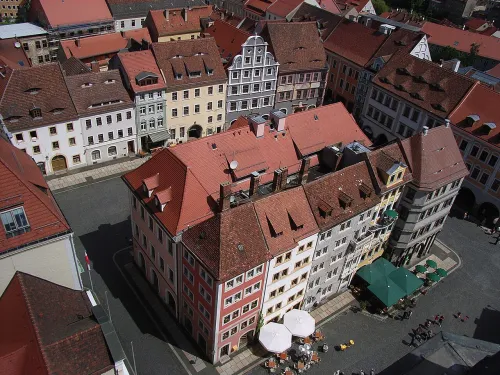
    Obermarkt in Görlitz, stop 1 on the self-guided walking tour

    Start on the largest square in the historic part of Görlitz. The Obermarkt was laid out around 1250 together with the Untermarkt, and Brüderstraße still links the two. Look at the facades around you: the lower square is mostly Renaissance, while up here Baroque and Wilhelminian houses set the tone. That mix is why the Obermarkt works as the gateway to the old town. The Reichenbacher Turm, the Kaisertrutz and the Holy Trinity Church all belong to this square.

    The name took a while to settle. In 1401 the eastern part was called Neumarkt and the western part Oberneumarkt; only by 1848, when the city began to expand, had Obermarkt stuck. Picture a long building in the middle of the square: the salt house, built according to the chronicles in 1407, reaching from about the corner of Steinstraße towards Brüderstraße. In 1535/36 it became a dance hall and a house for merchants and cloth, because until then the only dance hall in town, in the town hall, was reserved for high society. Its pointed gables were replaced by a hipped roof in 1767.

    In January 1451 a pulpit stood in front of that salt house for the Franciscan preacher John of Capistrano, who gave 15 sermons here. The Franciscans had their monastery in Görlitz from the 13th century until the Reformation, and their church is your next stop, just 100 m and a minute away on the same square.
    Hours
    Open 24/7
    Price
    Free
  2. 2

    Holy Trinity Church (Dreifaltigkeitskirche)

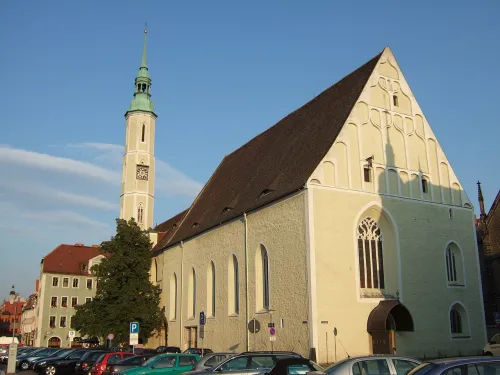
    Holy Trinity Church (Dreifaltigkeitskirche) in Görlitz, stop 2 on the self-guided walking tour

    The Holy Trinity Church began as the church of the Franciscan monastery, built from 1234 and finished by 1245. When the friars started, this spot still lay outside the town walls. Since Franciscans usually built inside the walls, the town may already have planned to grow this way, and the Obermarkt around you is the result. The land came from the noble Wirsynge family.

    On 21 August 1245 Bishop Konrad of Meissen consecrated the church to the Virgin Mary and Saint Francis of Assisi. From then on the church festival fell on the Monday after 18 August, and well into the 20th century that day also opened the Görlitz fair. The friars were well liked: in 1416, when their preacher was to be moved, the town council asked the order to let him stay.

    In 1458 the order set up a house of study here for eight or ten young friars, and it became known beyond its province. The library grew from 77 books in the mid-14th century to more than 300 by the late 15th century. After being moved out during the Second World War, it survives almost complete in the University Library of Wrocław. In 1564 the monastery became a grammar school, the church served as its school church and from 1712 as a parish church.

    Entry is free, so step inside even if you only have a few minutes. Then walk 170 m, about two minutes, down Brüderstraße to the Schönhof.

    Hours
    Mon–Sat 10:00–17:00, Sun & holidays 12:00–16:00
    Price
    Free
  3. 3

    Schönhof (Silesian Museum)

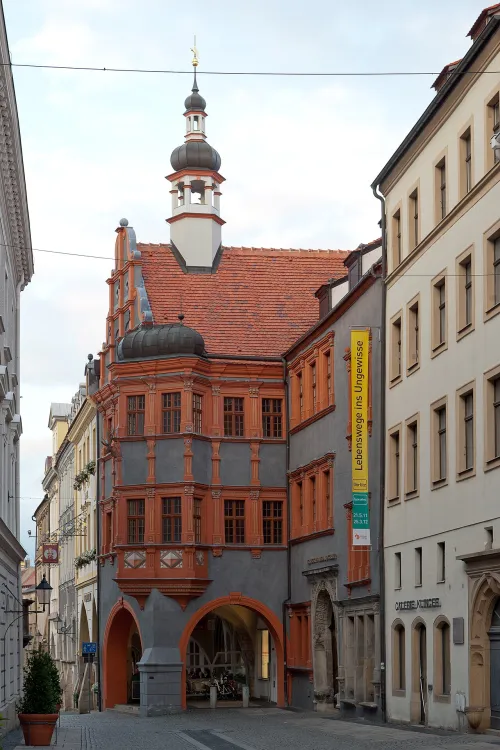
    Schönhof (Silesian Museum) in Görlitz, stop 3 on the self-guided walking tour

    Schönhof means 'beautiful court', and the house at Brüderstraße 8 is the oldest Renaissance building in Görlitz. After the town fire of 1525, Wendel Roskopf rebuilt it in 1526 on the surviving stone foundations. Inside, a central hall once rose through all floors, the typical Görlitz hall house. Over the centuries it was built over, but its walls can still be studied.

    The location explains its rank. Brüderstraße, the Untermarkt and the Obermarkt all lay on the Via Regia, the trade route that ran from Kyiv through Wrocław, Görlitz and Leipzig on to Santiago de Compostela. Under the staple right, every load arriving here was taxed at the town scales and had to be stored and offered for sale in the merchant houses. The Schönhof stands right beside those houses, directly opposite the court wing of the town hall.

    That is why the house served as a royal guesthouse from the 14th century: sovereigns who sat as the highest judges at the nearby court lodged here. Its story goes back to the 13th century, when Bohemian servants and wealthy families lived close together in several courtyards. Because it was joined to two other buildings, altered again and again for the nobility and badly hit in 1525, its building history is hard to untangle even for experts. Its value was recognised early, which saved it from major conversions and even demolition.

    Today the Silesian Museum fills the house. Go in if you want to see a Renaissance house from the inside and have about an hour. The Untermarkt is only 120 m away, a minute's walk.

    Hours
    Tue–Thu 10:00–17:00, Fri–Sun 10:00–18:00, Mon closed (January to March: Tue–Thu until 16:00, Fri–Sun until 17:00)
    Price
    8 EUR full, 6 EUR reduced
  4. 4

    Untermarkt

    Untermarkt in Görlitz, stop 4 on the self-guided walking tour

    This is the heart of historic Görlitz. Görlitz is first mentioned in 1071, when merchants settled around the Nikolai Church and along the Via Regia. Around 1200 the Untermarkt was created and the trade route led straight through it. Once the Obermarkt was laid out in 1250, the farmers sold their goods up there, while the craftsmen kept their stalls down here. Many of the town's Renaissance houses stand around this square.

    In the middle you see the Zeile, the Row: a block of houses that was rebuilt many times and once housed merchants and grocers, with goods on offer under the arcades. Its half-timbered northern part gave way in 1706 to the Börse, where merchants held their weekly meetings; today it is a hotel. Also look out for the Brauner Hirsch, the Brown Deer, first mentioned in 1403 and long one of the finest inns and breweries in town.

    The town hall has run the city and its courts since 1350 and spreads over several buildings from different periods. The lower, cube-shaped part of its tower dates from 1378; it was raised to its present height in the 16th century. Look up at the two clocks, added in 1584 by Bartholomäus Scultetus, with the lion of Bohemia above them in a Gothic arch. The mayor still sits on the second floor of the building next to the tower. The new town hall, begun in 1903, echoes 17th-century Görlitz houses and shows the confidence of a growing city.

    The Barockhaus is 90 m away on Neißstraße, one minute's walk.

    Hours
    Open 24/7
    Price
    Free
  5. 5

    Barockhaus (Neißstraße 30)

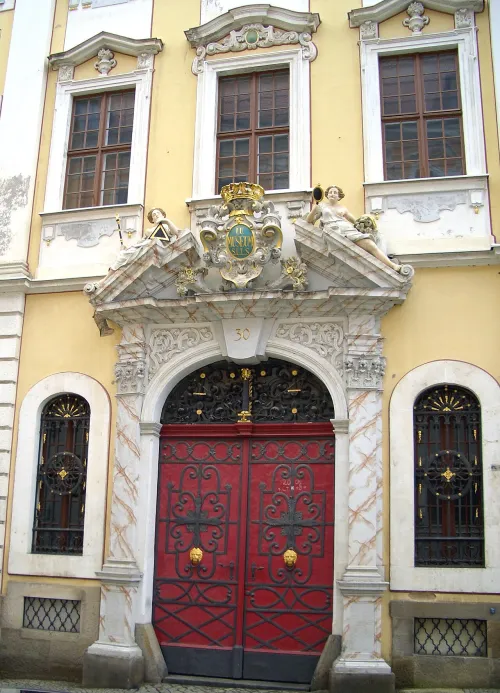
    Barockhaus (Neißstraße 30) in Görlitz, stop 5 on the self-guided walking tour

    In the Middle Ages and early modern period, this corner of the Untermarkt was a privileged address. Two important brewing yards stood here until the town fire of 1726. Between 1727 and 1729, the town master builder Samuel Suckert put up the present house to plans by Johann Friedrich Karcher, chief architect of Saxony. The client was Christian Ameiß, a rich linen and damask merchant from Zittau.

    The model was a Leipzig 'Durchhaus', a building you could drive through. Notice how the plan works: four wings around two courtyards, partly with open galleries, an entrance on Neißstraße and an exit to the street called Handwerk, so wagons with goods could pass straight through.

    In 1804 Karl Gottlob von Anton, co-founder in 1779 of the Upper Lusatian Society of Sciences, bought the house because the society had outgrown its rooms, and in 1807 he gave it to the society. Its library and collections have been kept here ever since. The Masonic lodge 'Zur Gekrönten Schlange', which von Anton led from 1804 to 1816, also used rooms on the second floor of the front house. In 1932 a graphic arts cabinet opened, bringing together several collections, among them the library of the jurist Johann Gottlieb Milich with about 7,000 volumes, 200 manuscripts and 500 coins. In 1945 the Soviet military administration dissolved the society.

    Since 1951 the house has been part of the city's Museum of Cultural History. Go in if you like old libraries and merchant houses, and allow about 45 minutes. Then follow Neißstraße 240 m, about three minutes, to the river.

    Hours
    Apr–Oct: Tue–Thu 10:00–17:00, Fri–Sun 10:00–18:00, Mon closed; Nov–Mar: Tue–Sun 10:00–16:00, Mon closed
    Price
    EUR 6 adult; EUR 4 reduced
  6. 6

    Old Town Bridge (Altstadtbrücke)

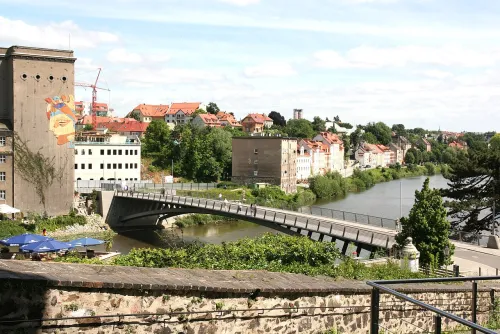
    Old Town Bridge (Altstadtbrücke) in Görlitz, stop 6 on the self-guided walking tour

    Coming from Neißstraße, you cross the street below St. Peter and Paul and step onto the bridge. A bridge is first recorded here in 1298. It was wooden and had to be renewed again and again: trade caravans wore it down, and fire, floods and war did the rest. Because it was the only river crossing in the area, a defensive tower, the Spittelturm, was built at its eastern end around 1470.

    The great fire of 12 June 1525 destroyed the bridge too. In 1536 Wendel Roskopf, the man behind the Schönhof, advised the town to replace it with one of stone. It was too expensive; in 1566 the bridge only got a roof.

    Its darkest chapter came at the very end of the Second World War, when the steel arch bridge of 1907 was blown up. The town was then split into a German and a Polish part, and for decades only the stone abutments on both banks recalled the crossing. In 2004 the new footbridge opened between Görlitz and Zgorzelec, an arch spanning about 80 m and meant as a symbol of Europe and a divided town growing back together.

    Look around: on the German side stands the Vierradenmühle, on the Polish side the Dreiradenmühle, and between the two mills the Neisse spills over a weir. Then walk 170 m, about three minutes, back and up the path from the riverbank to the plateau with the Waidhaus.

    Hours
    Open 24/7
    Price
    Free
  7. 7

    Waidhaus

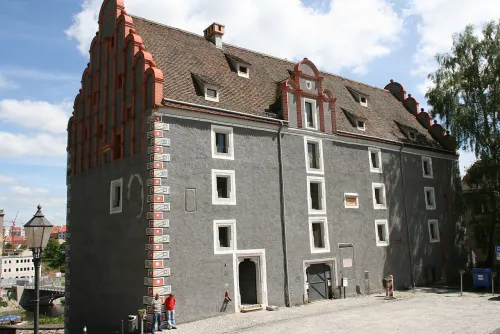
    Waidhaus in Görlitz, stop 7 on the self-guided walking tour

    This plain block is the oldest secular building in Görlitz. It stands on the plateau beside St. Peter and Paul, separated from the Hainwald buildings by a narrow preacher's lane, while the ground falls steeply to the Neisse behind it. Its name comes from woad, the plant dye that was stored here in the 16th century.

    Its origins go back to the 12th century, when it belonged to a courtyard serving the lord's castle, probably run by Bohemian servants. Newer research suggests it may also have been the home of a noble family, since it had its own tower. In the 14th century it was a brewing yard, and in the 15th century it changed hands often. Its best-known owner was mayor Bartholomäus Eberhard, after whom the property was long named; the city bought it from his heirs in 1425.

    The following year, during the Hussite Wars, the Eberhard tower was taken down. Soldiers from Erfurt moved into the courtyard in 1428, and in 1432 the Bohemian nobleman Johann von Michelsberg stayed here for more than three months. From 1447 to 1529 the house served as a school. In 1530 the school moved out to make room for woad, which until then had been stored and sold in private homes, and the building probably got its three extra floors in this period.

    Take it in from outside, then walk 140 m, two minutes, to the church next door.

    Hours
    Open 24/7
    Price
    Free
  8. 8

    St. Peter and Paul Church (Peterskirche)

    St. Peter and Paul Church (Peterskirche) in Görlitz, stop 8 on the self-guided walking tour

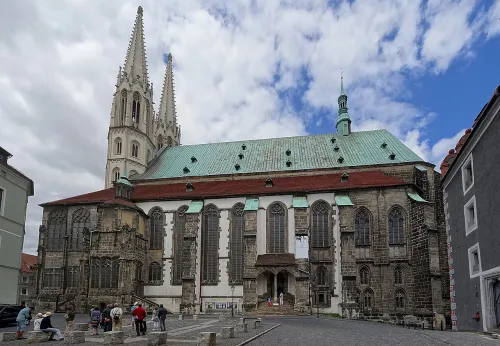
    With its copper roof and twin towers, St. Peter and Paul dominates the old town and is the town's landmark. It was once the main church of the town and its council. A basilica stood here by around 1230, and its west front is the only part that survives. The hall church you see was begun in the first decade of the 15th century.

    The foundation stone of the choir was laid in 1423 under Hans Knobloch and Hans Baumgarten. Building east towards the river required massive substructures, and so St George's Chapel, consecrated in 1457, became a crypt under the choir. From 1490 to 1497 Conrad Pflüger had the church vaulted, and the main work was finished.

    The town fire of 1691 destroyed the upper levels of the west front and the entire furnishings, including 36 altars and a sacrament house 20 m high. The roof was restored by 1712 and the church refitted in Baroque style. Two names connect the church to wider history: Gregor Richter, chief pastor from 1606 until his death in 1624, who fought the ideas of his own parishioner Jakob Böhme, and Christian Ludwig Boxberg, who became organist in 1702 and was known for his cantatas and the opera Sardanapalus.

    Entry is free, so go in. Then comes the longest leg: 1,010 m, about 14 minutes, to the Holy Sepulchre. You are not just changing places here. The Görlitz Jerusalem was conceived to stretch from the crypt of this church across the town to the Holy Sepulchre.

    Hours
    Mon–Sat 10:00–18:00, Sun & holidays 11:30–16:00
    Price
    Free
  9. 9

    Holy Sepulchre (Heiliges Grab)

    Holy Sepulchre (Heiliges Grab) in Görlitz, stop 9 on the self-guided walking tour

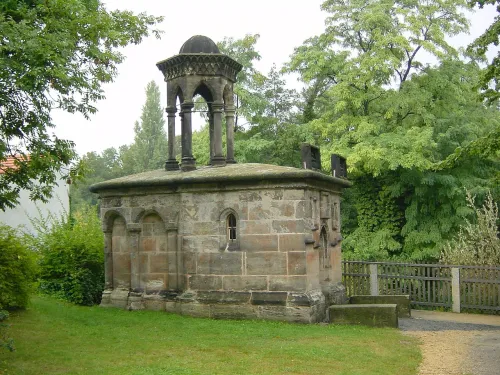
    Here, at the end of the Görlitz Jerusalem, stands a reduced copy of the Holy Sepulchre in Jerusalem as it looked in the High Middle Ages. No other replica in Germany matches its accuracy, and because it was built so early it became the model for many similar sites. It was set into the landscape on purpose: names such as the Disciples' Meadow, the Kidron Valley and the Mount of Olives show that the whole site was meant to be read as one religious work of art.

    The ensemble has three parts: the double Chapel of the Holy Cross, the copy of the Moorish Romanesque tomb itself, and the Chapel of the Anointing with a sculpture by Hans Olmützer. Even the date is disputed. In 1989 Görlitz celebrated 500 years, yet the building is dated to 1481 to 1489 by some and 1481 to 1504 by others.

    Behind it stands a story often told but not clearly proven by newer research. Georg Emmerich, son of a rich Görlitz merchant and later mayor, is said to have made Benigna Horschel, his neighbour's daughter, pregnant and then refused to marry her; there is even talk of rape. His pilgrimage to Jerusalem in 1465 was an act of faith but also brought him absolution: he was knighted there as a Knight of the Holy Sepulchre. Emmerich and Agnete Fingerin saw the original tomb on their journeys to the Holy Land.

    The ticket is cheap and the visit takes about half an hour, so it is well worth going in. From here walk 780 m, about 11 minutes, back to the old town wall and the Reichenbacher Turm.

    Hours
    Mon–Tue, Thu–Sun 10:00–16:00, Wed closed
    Price
    3 EUR full
  10. 10

    Reichenbacher Turm

    Reichenbacher Turm in Görlitz, stop 10 on the self-guided walking tour

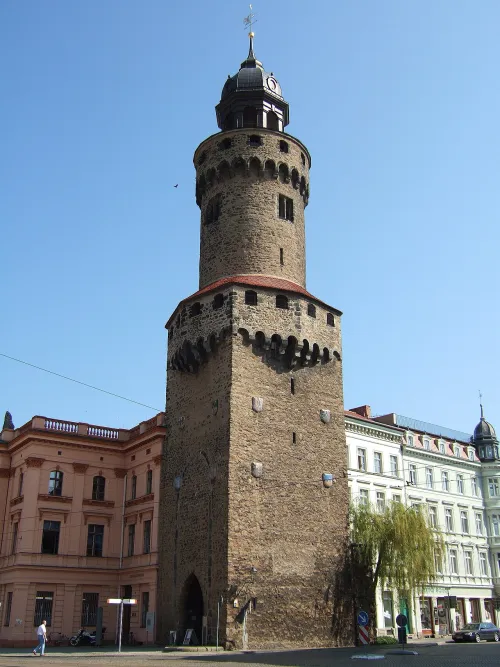
    At 51 m, the Reichenbacher Turm is the tallest of the three surviving watch and defence towers of Görlitz; the other two are the Nikolaiturm and the Dicker Turm. Only the town hall tower, at 63 m, rises higher. It guarded the western town gate and is first recorded in 1376, although its story may go back to the laying out of the Obermarkt in the 13th century.

    Read it from the bottom up. The square base largely dates from that early period. Above it comes an octagon with a lean-to roof, then a round upper tower, crowned by a circular wall walk with pointed arch friezes and the cap. The wall walk was added in 1485, and the Late Gothic spire was replaced in 1782 by the copper Baroque cap you see now. In 1521 two high walls joined the tower to the Kaisertrutz of 1490; the Reichenbach Gate sat in the northern one. The fortifications here were pulled down from 1862, and the passage for pedestrians through the tower dates only from 1869.

    Look for the twelve colourful coats of arms. During the restoration of 1936, eight steel anchors were set into the lower tower and hidden behind arms painted by the Görlitz artist Arno Henschel. The upper six show the lands Görlitz has belonged to: the Holy Roman Empire and Bohemia on the west side, Brandenburg and Prussia on the south, Silesia and Saxony on the east. The lower six show the towns of the Upper Lusatian Six Towns League.

    The last tower keeper moved out in 1904, and visitors were climbing it again by 1946. If you want to stand up on a medieval defence tower, buy a ticket. The final leg is 340 m, five minutes, past the Natural History Museum Görlitz to the Kaufhaus.

    Hours
    Apr–Oct: Tue–Thu 10:00–17:00, Fri–Sun 10:00–18:00, Mon closed; Nov–Mar: Tue–Sun 10:00–16:00, Mon closed
    Price
    5 EUR full, 3 EUR reduced
  11. 11

    Görlitzer Kaufhaus (Jugendstil-Warenhaus)

    Görlitzer Kaufhaus (Jugendstil-Warenhaus), stop 11 on the self-guided walking tour

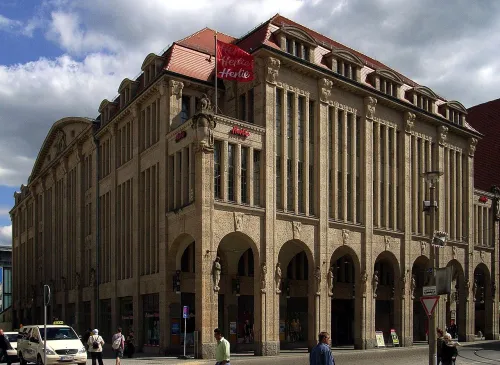
    You finish in front of one of the best preserved department stores from the early 20th century. In 1717 the Golden Ostrich inn stood on this site and later grew into a hotel. The city council wanted a department store here modelled on the Wertheim store on Leipziger Platz in Berlin, and the Potsdam architect Carl Schmanns drew up the plans.

    After the hotel was demolished in 1912, the building went up as a steel skeleton with an Art Nouveau facade closely following the model. After only nine months of building, it opened on 30 September 1913. Take a moment with the facade: it is the reason this stop is on the route.

    The owners changed with the times. Karstadt bought the store in 1929, was pushed out after the Second World War, and in 1950 the GDR took over and handed it to the state trading organisation HO. From 1958 it was part of the Centrum chain, and in 1984 HO restored the facade and interiors. After reunification it went back to Karstadt, was sold with a group of stores to a British investor in 2005 and was renamed Hertie in 2007. It closed as a department store on 15 August 2009; in 2013 a private investor came forward with plans to run it again as a full department store.

    This is where the walk ends. If you want to return to the Obermarkt, the GPS navigation can lead you back to the start.

    Hours
    Open 24/7
    Price
    Free
Walking tour route map of Görlitz Route loaded
ObermarktHoly Trinity Church (Dreifaltigkeitskirche)Schönhof (Silesian Museum)Untermarkt+7
All 11 stops are already on the map.
You just press start.
AI Tour Guide

You know the way now. Walk it with a guide in your ear.

Press start wherever you are, even hundreds of kilometres from Görlitz, and the guide begins telling its stories right away. In the city, pick any of the 11 stops to start from: it leads you there, then talks with you the whole route, asking, listening, remembering, and shaping the tour around your answers.

11stops 3.2km 45 minwalking 13languages
▶Start the tour free

Free to start · Runs in your browser · No app, no download

Shorter and Longer Ways Through Görlitz

The route splits naturally: a compact Old Town section down to the river, and two longer legs out to the Holy Sepulchre and back to the old town wall.

Old Town and river only

Stops: 1, 2, 3, 4, 5, 6, 7, 8

For a morning or a first look at Görlitz. You walk from the Obermarkt to St. Peter and Paul in 13 minutes of short hops and finish at the church. Entry only if you choose the Schönhof or the Barockhaus; the churches are free.

The full route

Stops: 1, 2, 3, 4, 5, 6, 7, 8, 9, 10, 11

For a full day with the history behind every square. All eleven stops with 45 minutes of walking, including the walk out to the Holy Sepulchre. Tickets apply at the Schönhof, the Barockhaus, the Holy Sepulchre and the Reichenbacher Turm, but you can pick only the ones that interest you.

Every stop, no tickets

Stops: 1, 2, 3, 4, 5, 6, 7, 8, 9, 10, 11

For a tight budget. Same 45 minutes of walking, but you go inside only the Holy Trinity Church and St. Peter and Paul and read the museums, the tower and the Holy Sepulchre from the outside.

How Long Does This Görlitz Tour Take with Museums?

The Old Town section is compact: from the Obermarkt to St. Peter and Paul you cover 1,030 m in hops of one to three minutes. The long legs come afterwards: 14 minutes out to the Holy Sepulchre, 11 minutes back to the Reichenbacher Turm and 5 more to the Kaufhaus.

With all four paid interiors, give the Schönhof about an hour, the Barockhaus about 45 minutes, and the Holy Sepulchre and the tower half an hour each. Starting at 10:00 you reach the Holy Sepulchre a little after 13:30 and finish at the Kaufhaus around 15:00.

The Old Town only version takes just under two hours without museums and about three and a half with the Schönhof and the Barockhaus. Walking every stop without tickets fits into about three hours.

Before You Set Off in Görlitz

  • Start and finish: Start at the Obermarkt; the order here is the recommended one, but you can join at any stop. The walk ends at the Görlitzer Kaufhaus, and the GPS navigation in your browser can lead you back to the start if you like.
  • Best day and time: Pick your day with care: the Schönhof, the Barockhaus, the Reichenbacher Turm and the Holy Sepulchre are not open every day of the week. Start in the morning, once museums and churches have opened, and plan to reach the Holy Sepulchre by early afternoon.
  • Costs: Walking the route is free, and so are the Holy Trinity Church and St. Peter and Paul. The Schönhof, the Barockhaus, the Holy Sepulchre and the Reichenbacher Turm charge for entry, and most of them offer reduced tickets.
Walking tour route map of Görlitz
AI Tour Guide

Your guide for Görlitz is ready when you are

Press start and a voice AI Tour Guide takes it from here: leading the route through Görlitz, telling the stories, and turning your walk into a real back-and-forth conversation. No app or download is needed; it runs in your browser.

11stops 3.2km 45 minwalking 13languages
▶Start the tour free

Free to start · Runs in your browser · No app, no download

What the AI Tour Guide Adds in Görlitz

Much of Görlitz lives in people and ideas the stops only touch on: Jakob Böhme, whose views the chief preacher of St. Peter and Paul fought, or the Upper Lusatian Six Towns League whose arms ring the Reichenbacher Turm. The AI Tour Guide leads the walk as a conversation, tells these stories as you go, asks what you'd like to hear more about and remembers it at later stops; you can interrupt it at any time. You start with 100 free credits; after that you choose either this tour all-inclusive for €19.99 with no time limit, or €5 per hour.

A Real Conversation A voice AI Tour Guide greets you, leads the whole route, and tells the stories and facts as you walk, asking what you want to see and keeping a real conversation going. Not a recording you press play on.
Map Navigation Follow the route on the map and walk at your own pace. You choose where to start and when to move to the next stop.
Ask Anything Curious about a building you pass? Ask your AI Tour Guide on the spot and the conversation carries on.
13 Languages Switch language anytime. No separate tour needed.
Start free in your browser

Common Questions About Görlitz

Can I walk across to Zgorzelec in Poland?

Yes. The Old Town Bridge is a footbridge opened in 2004 that links the Görlitz Old Town with Zgorzelec on the other bank of the Neisse. On the Polish side it lands on Ulica Wrocławska at the Postplatz, which is being rebuilt after its historical model. Cross, look around and come back the same way to continue to the Waidhaus.

Does the tour work in winter?

Yes, but several museums close earlier in winter, so it pays to start early. The outdoor stops are open around the clock.

Who gets the reduced tickets?

The Schönhof, the Barockhaus and the Reichenbacher Turm offer reduced prices. Ask at the ticket desk whether you qualify.

Which cities pair well with Görlitz?

Bautzen is 40 km away and Liberec 43 km across the Czech border. For a bigger city, Dresden is 88 km and Wrocław 143 km, the two ends of the old trade corridor that ran through Görlitz.

Is the tour really free?

Yes. The whole tour is free: the route, the interactive map and the navigation cost you nothing. Only the voice AI Tour Guide is optional and paid: you test it with 100 free credits, then you pay either €5 per hour or €19.99 for this whole tour, with no time limit. Admission to 4 of the 11 stops is not included: Schönhof (Silesian Museum), Barockhaus (Neißstraße 30), Holy Sepulchre (Heiliges Grab) and Reichenbacher Turm charge their own entry fees.

Do I need to download an app?

No. Everything runs in your phone browser. Open the route and start walking, no download and no sign-up required.

Do I need to book the walking tour in advance?

No booking needed. This self-guided tour is available anytime. Open the route in your browser and start walking. The AI Tour Guide works instantly, no app, no reservation required.

What languages is the AI Tour Guide available in?

The AI Tour Guide speaks 13 languages, so you take the tour in your own language and can switch at any time.

Can I skip stops or change the route?

Yes. Skip any stop, spend extra time at places you like, or start the route from any point. It is your walk, you set the pace.
Image credits
▶ Start free in your browser Runs in your browser, no app, no download