

Albrechtsburg
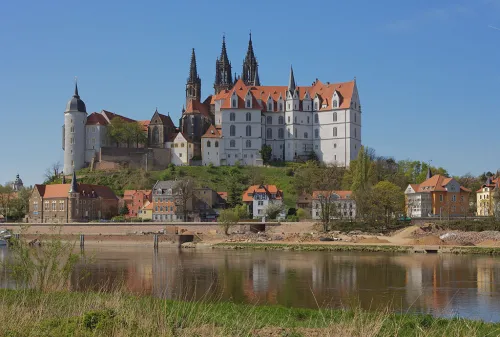
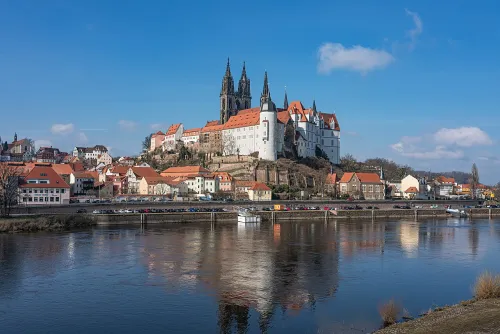
You start on the rock high above the Elbe, in front of the Late Gothic Albrechtsburg. The castle you see was begun in 1471 and largely built by about 1495, and it stands directly beside the cathedral. Before you go in, take in the site itself: this hilltop is where Meissen began.
In 929 King Henry I of Germany subdued the Slavic Glomacze at the Siege of Gana and built a fortress on this rock within their settlement area. It was called Misnia after a nearby creek, it became the nucleus of the town, and from 965 it was the seat of the Margraves of Meissen. In 1423 the margraves gained the Electorate of Saxony, when Frederick I became elector.
His grandsons Ernst and Albrecht ruled Saxony and Thuringia together and in 1471 commissioned the master builder Arnold von Westfalen to replace the old margravial castle with what is considered the first German palace. The irony: it never became the centre of the court. While building was still going on, the brothers divided their lands in 1485. Albrecht received the Margraviate of Meissen with the new castle, Ernst the Duchy of Saxony with Wittenberg and the electoral title. Only in 1676 was the building named Albrechtsburg, after one of its first lords.
Inside, look for the work of Duke Georg's era: after a pause from 1495, the upper northern rooms were only completed in 1521 by Jakob Heilmann. From then date the loop ribbed vault in the style of Benedikt Ried, who worked in Prague, and the fireplace in the room above. If architecture or Saxon history draws you, the interior is worth the admission; give it about 90 minutes.
The cathedral is just 200 m away, a three-minute walk across the hilltop.