Free Walking Tour Dresden: Old Town and Neustadt

Eight stops from the old market square to the Zwinger, with a detour to the playful courtyards of the Neustadt. Free GPS route, walked at your own pace.

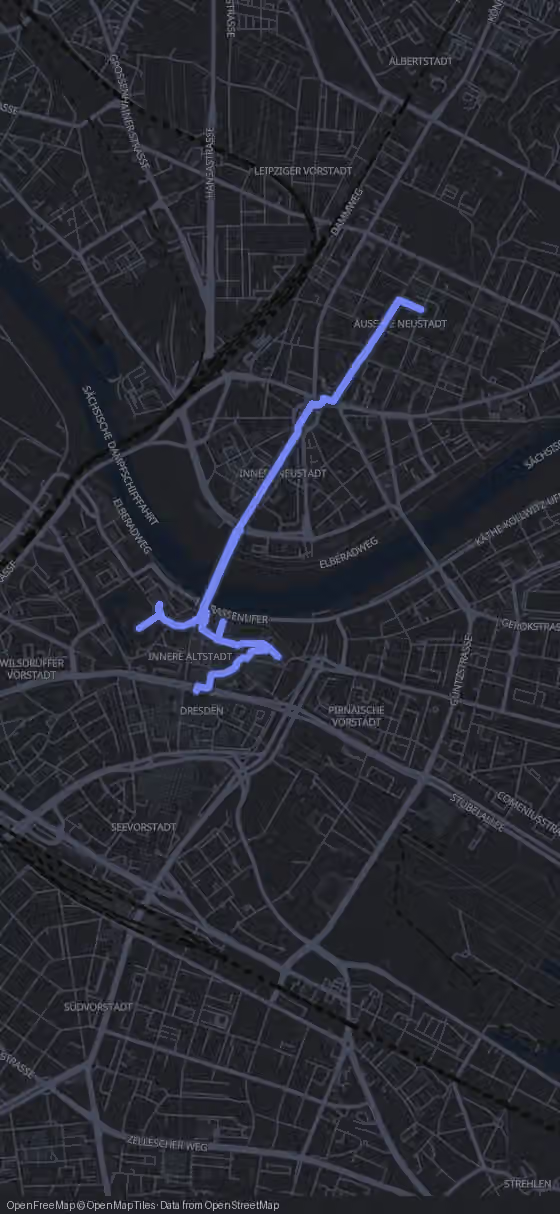
8 Stops 6.1 km ~1 h 23 min walking
Route map for the Dresden walking tour
Stop 1 of 8
360 m·4 min
Altmarkt
Head north-east toward the Frauenkirche
Welcome to Dresden. I'm Alex, and this rebuilt city lets its original stones show through.
Try this tour with Alex

Eight Stops, Two Faces of Dresden

Eight stops lead from Altmarkt past the Frauenkirche, the Albertinum and the Brühlsche Terrasse out to the Kunsthofpassage, then back to Dresden Castle (Residenzschloss), the Semperoper and the Zwinger. The route covers 6.1 km with 1 h 23 min of pure walking; plan about three and a quarter hours with short visits.

The squares, the terrace, the courtyards and the Frauenkirche cost nothing; the castle, the Albertinum, the Zwinger museums and Semperoper tours charge admission. The GPS route is free in your browser, and the AI Tour Guide comes along if you want it.

Open free GPS & optional AI Tour Guide
View of Dresden

The Route

Walking Map of Dresden: Old Town and Neustadt

8 stops 6.1 km 1 h 23 min walking
Tap to load interactive map

The 8 stops along this route

  1. Altmarkt in Dresden, stop 1 on the self-guided walking tour
    1Altmarkt
  2. Frauenkirche in Dresden, stop 2 on the self-guided walking tour
    2Frauenkirche
  3. Albertinum in Dresden, stop 3 on the self-guided walking tour
    3Albertinum
  4. Brühlsche Terrasse in Dresden, stop 4 on the self-guided walking tour
    4Brühlsche Terrasse
  5. Kunsthofpassage in Dresden, stop 5 on the self-guided walking tour
    5Kunsthofpassage
  6. Dresden Castle (Residenzschloss), stop 6 on the self-guided walking tour
    6Dresden Castle (Residenzschloss)
  7. Semperoper in Dresden, stop 7 on the self-guided walking tour
    7Semperoper
  8. Zwinger in Dresden, stop 8 on the self-guided walking tour
    8Zwinger
  9. That's the full route.

    Walk it with an AI Tour Guide talking you through every one of these streets.

    Start free in your browser
    You made it

Your Dresden Walking Tour in Eight Stops

  1. 1

    Altmarkt

    Altmarkt in Dresden, stop 1 on the self-guided walking tour

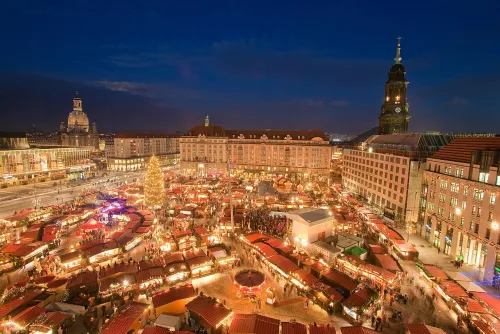
    You start on the oldest square in Dresden, a large rectangle of about 130 by 100 metres that was laid out on purpose when the town was founded. It shows up in records as circulus in 1370, as margt in 1400, as ring in 1410 and as forum in 1452. It only became the Altmarkt, the old market, after a first expansion of the city around 1550 created a newer market by the Frauenkirche, the Neumarkt.

    Look around and you read Dresden's twentieth century in the facades. Most of the historic buildings were destroyed in the Second World War; only the Kreuzkirche beside the square, for centuries the most important church in the city, was rebuilt. The west and east sides went up again in the 1950s in a style meant to continue the baroque cityscape, while the north side got something quite different: the modernist Kulturpalast, a freestanding block that broke with those plans. After 1990 two newer buildings closed the south side, and the paving and street furniture were redone by 2009.

    Small details tell of the medieval town. Until the eighteenth century an open channel of the Kaitzbach stream ran along the south and west sides, mainly to have water at hand for fighting fires, later also for trades and cleaning. A town hall is first mentioned here in 1380. And every year the square hosts the Striezelmarkt, held since 1434 and one of the oldest Christmas markets in the world.

    Spend ten minutes taking in the contrast between the rebuilt baroque lines and the Kulturpalast, then walk 350 metres, about five minutes, to the Neumarkt and the Frauenkirche.
    Price
    Free (square); Altmarkt-Galerie mall priced per shop
  2. 2

    Frauenkirche

    Frauenkirche in Dresden, stop 2 on the self-guided walking tour

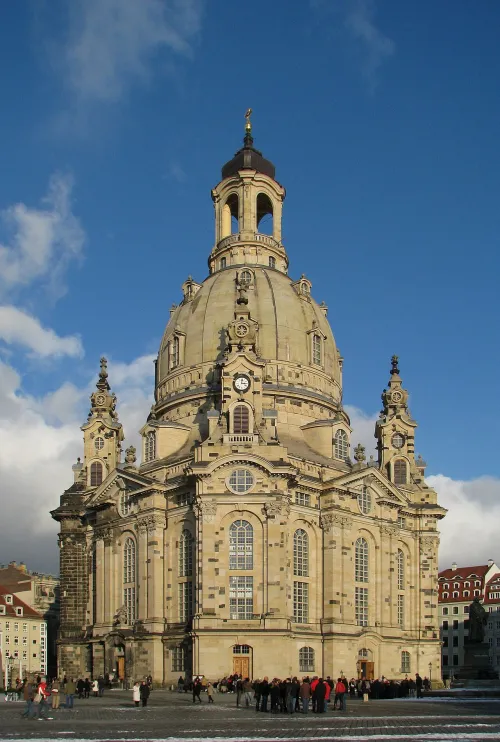
    The great stone dome in front of you belongs to the third church on this spot. The first, a Romanesque church of Our Lady, stood here from the eleventh century outside the city walls, surrounded by a graveyard; it became Protestant during the Reformation. In the eighteenth century it gave way to a much larger baroque church built for Lutheran worship. When the foundation stone was laid on 26 August 1726, a copy of the Augsburg Confession went inside it, and the building itself was a statement: the citizens of Dresden wanted to stay Protestant even though their ruler had converted to Catholicism. Its dome was one of the largest in Europe.

    In 1945 the church was destroyed in the bombing of Dresden. For almost half a century East German leaders left the ruins as a war memorial. After reunification the decision was made to rebuild, work began in 1994, the exterior was finished in 2004 and the interior in 2005. On 30 October 2005 the church was reconsecrated with services running into Reformation Day. The baroque buildings around the Neumarkt were reconstructed at the same time, and today the Frauenkirche also stands for reconciliation between former enemies.

    Going inside is free and worth it for everyone, even with little time: give it about twenty minutes. The climb to the dome is paid separately, and you can buy it on site.

    From the church it is only 220 metres, three minutes, to the Albertinum.

    Hours
    Church: Mon–Fri 10:00–11:30 and 13:00–17:30, Sat/Sun varying times (changes possible)
    Price
    Church free; dome ascent paid separately
  3. 3

    Albertinum

    Albertinum in Dresden, stop 3 on the self-guided walking tour

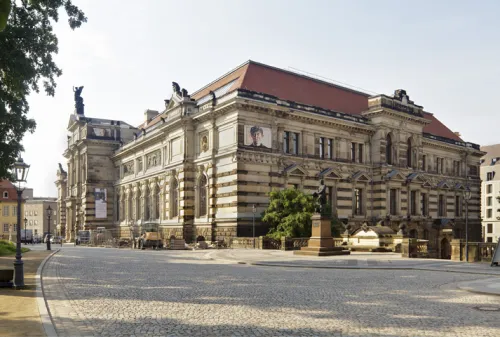
    This sandstone building in Renaissance Revival style stands on the Brühlsche Terrasse and carries the name of King Albert of Saxony, who reigned when it was built. Between 1884 and 1887 the regional master builder Carl Adolf Canzler extended an old armoury from 1559 to 1563 on the same site to house the royal collection of ancient and modern sculpture. The sculptures moved in in 1889 and have stayed ever since.

    The building was damaged in the bombing of 13 February 1945 and restored by 1953. From 1965 the New Masters Gallery filled the upper rooms, and for decades the Albertinum also sheltered the Green Vault and the coin cabinet, until they returned to the rebuilt castle in 2002 and 2004. The floods of 2002 forced a thorough renovation and a new flood-proof depository. After closing in 2006 it reopened on 20 June 2010 as a house of the modern, built for encounters between painting and sculpture. The big change is the roofed inner courtyard, an atrium nicknamed an ark for the art, and glass walls that let you look into the depositories.

    Inside you follow some 200 years of art from Romanticism to the present. If modern painting and sculpture are your thing, plan a separate ticketed visit and simply enjoy the facade on the walk.

    From here you walk 440 metres, about six minutes, along the terrace itself.

    Hours
    Tue–Sun 11:00–17:00, Mon closed
    Price
    14 EUR adults, 10.50 EUR reduced, 2 EUR pupils under 20, children until school entry free
  4. 4

    Brühlsche Terrasse

    Brühlsche Terrasse in Dresden, stop 4 on the self-guided walking tour

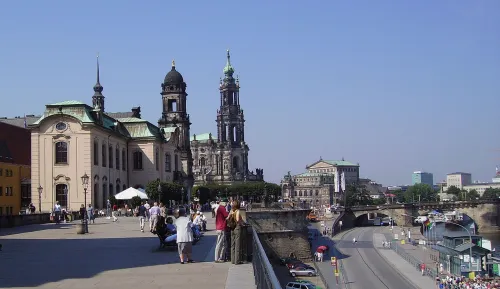
    Nicknamed the Balcony of Europe, the terrace runs high over the bank of the Elbe, north of the Neumarkt and the Frauenkirche. Its stone base was once part of the city fortifications, rebuilt after the Schmalkaldic War of 1546 and 1547 at the behest of Elector Maurice of Saxony and his successors Augustus and Christian.
    The name goes back to Count Heinrich von Brühl, minister to Elector Frederick Augustus II. From 1737 he had a city palace with a gallery, a library and gardens built up here, and in 1747 the elector gave him the whole terrace as a gift, a reward for introducing a new betterment tax. Ordinary citizens only got access in 1814: after the Saxon defeat at the Battle of Leipzig, the Russian military governor Prince Repnin-Volkonski opened it to the public. Brühl's palace was pulled down in 1900 to make way for the Saxon Ständehaus.

    In February 1945 the ensemble was completely destroyed. It has been rebuilt so faithfully that it looks very much as it did before. Take time to stroll; the terrace is open around the clock and free. Look for a curious detail near the monument to Johann Friedrich Böttger by the Bärenzwinger student club: a fingerprint pressed into a guard rail of the terrace garden.

    Now comes the longest leg of the route, 2400 metres or about 33 minutes, out to the Äußere Neustadt and the Kunsthofpassage.

    Hours
    Open 24/7
    Price
    Free
  5. 5

    Kunsthofpassage

    Kunsthofpassage in Dresden, stop 5 on the self-guided walking tour

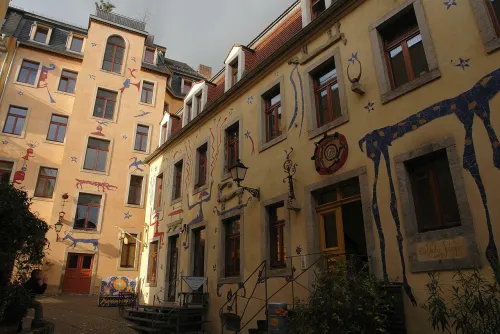
    After all that baroque, the Neustadt surprises you. The Kunsthofpassage is a chain of five small courtyards running from the house at Görlitzer Straße 25 through to Alaunstraße 70, completed in 2001. Several Dresden architecture firms designed it, and artists including Viola Schöpe, Annette Paul, André Tempel and Christoph Roßner shaped the facades. Each courtyard has its own name and theme, mixing art and architecture.

    In the Courtyard of the Elements, a blue facade is hung with a tangle of drainpipes standing for water, and a yellow one with aluminium sheets stands for light. Annette Paul, Christoph Roßner and André Tempel took their idea from the bizarre drainpipes they had seen in St. Petersburg. The Courtyard of Light grew out of a national competition in 1998, with the winning design chosen by vote; it has two stage platforms and projection surfaces for performances, and metal mirrors throw coloured reflections depending on where the sun stands.

    The Courtyard of the Animals is painted green and full of reliefs: a troop of monkeys leaps from window to window over the head of a giant giraffe, a crane keeps them company, the balconies are woven from rattan, and small creatures hide around the fountain. In the Courtyard of Mythical Creatures, Viola Schöpe covered the walls with fabulous beasts in sgraffito and mosaic.

    Entry is free, and the passage is open from early morning until late evening every day. Twenty minutes is enough to see all five courtyards. Then you head back to the Old Town: 2270 metres, about 31 minutes, to Dresden Castle.

    Hours
    Mon–Thu: 06:00–23:00 | Fri: 06:00–00:00 | Sat: 08:00–00:00 | Sun: 08:00–23:00
    Price
    0 EUR
  6. 6

    Dresden Castle (Residenzschloss)

    Dresden Castle (Residenzschloss), stop 6 on the self-guided walking tour

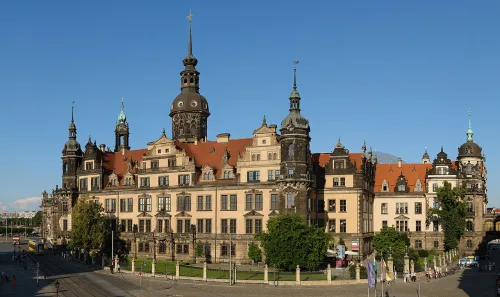
    Back in the Old Town you stand before one of the oldest buildings in Dresden. For almost 400 years this was the residence of the electors (1547 until 1806) and kings (1806 until 1918) of Saxony from the Albertine House of Wettin, who were also kings of Poland from 1697 until 1763. That long history is why the castle mixes styles from Baroque to Neo-Renaissance.

    It began around 1200 as a Romanesque keep. The Hausmannsturm tower followed in the early fifteenth century, and between 1468 and 1480 master builder Arnold von Westfalen turned the keep into a closed four-wing complex. A Saxon Renaissance addition came in the mid-sixteenth century. After a major fire in 1701, Augustus the Strong rebuilt much of it in baroque style and created the treasure rooms in the west wing: the Silver Room, the Heraldic Room and the Pretiosensaal between 1723 and 1726, then the Jewel Room, Ivory Room and Bronze Room by 1729. For the Wettins' 800th anniversary the castle was remodelled again between 1889 and 1901, and by 1914 it even had underfloor heating and electric light.

    Do not miss the outer wall of the Stallhof courtyard, which links the castle to the Johanneum. Here the 102-metre Procession of Princes by Wilhelm Walther shows the history of the Wettins. The painting faded so quickly that between 1904 and 1907 it was transferred onto about 23,000 porcelain tiles from Meissen. In 1945 most of the castle was reduced to a roofless shell, and three rooms of the Green Vault were destroyed.

    Today the castle is a museum complex with the Historic and New Green Vault, the coin cabinet, the prints and drawings collection and the armoury with its Turkish Chamber. If treasures and craftsmanship excite you, this is the museum to choose, with one house ticket for the collections. The Semperoper is just 200 metres away, about three minutes.

    Hours
    Mon, Wed–Sun 10:00–17:00, Tue closed; Grünes Gewölbe Fridays until 19:00
    Price
    18 EUR adults (house ticket), 13.50 EUR reduced, 2 EUR pupils under 20, children until school entry free, groups of 10+ 16 EUR
  7. 7

    Semperoper

    Semperoper in Dresden, stop 7 on the self-guided walking tour

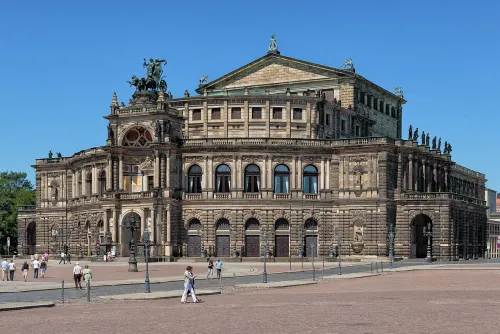
    On the Theaterplatz near the Elbe rises the home of the Saxon State Opera, the Staatskapelle Dresden orchestra and the Semperoper Ballet. Look up at the portal: a quadriga drawn by panthers carries a statue of Dionysos.

    The building you see is the second opera house on this site. Gottfried Semper designed the first, which opened on 13 April 1841 with an opera by Carl Maria von Weber and was counted among the most beautiful opera houses in Europe. In 1869 it burned down. The people of Dresden set about rebuilding straight away and insisted on Semper as architect, even though he was living in exile for his part in the Dresden uprising of May 1849. So his son Manfred Semper built the new house from his father's plans, while performances moved to the Gewerbehaussaal, opened in 1870. The new opera was completed in 1878 in Neo-Renaissance style, with an interior by artists of the time such as Johannes Schilling.

    Architects still argue about the style, which borrows from the early Renaissance, the Baroque and Greek classical revival with Corinthian columns; eclecticism is probably the fairest label. The house has a long history of premieres, including major works by Richard Wagner and Richard Strauss. You can see the interior on a guided tour even without an evening ticket, which is worth it for music and theatre lovers.

    The last leg is the shortest: 190 metres, about two minutes, to the Zwinger, passing the Old Masters Gallery on the way.

    Hours
    Box office (Theaterplatz 2): Mon–Fri 10:00–18:00, Sat 12:00–17:00, Sun and holidays closed; guided tour times vary
    Price
    themed guided tours 16.00 EUR, reduced 11.00 EUR; combined tours 28.00 EUR, reduced 19.00 EUR (with Kulturpalast) or 23.00 EUR (with Altstadt)
  8. 8

    Zwinger

    Zwinger in Dresden, stop 8 on the self-guided walking tour

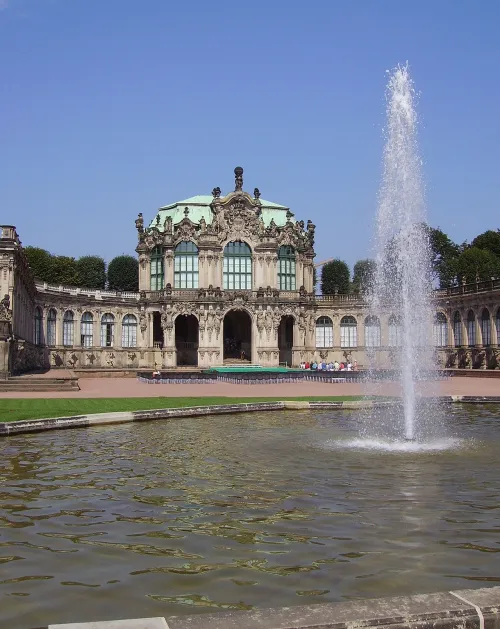
    You finish in a palatial complex with gardens that ranks, together with the Frauenkirche, as the most famous architectural monument of Dresden. Architect Matthäus Daniel Pöppelmann designed it, and building began in 1709 as an orangery, a garden and a stage for court festivities. The richly decorated pavilions and galleries lined with balustrades, figures and vases show the splendour of Augustus the Strong, Elector of Saxony and elected King of Poland.

    The name comes from the medieval term for the space between the outer and inner fortress walls, although the Zwinger never served that purpose. Augustus planned it as the forecourt of a new palace that would reach to the Elbe, so the river side was left open, closed only provisionally with a wall. After his death the palace plans were dropped and the Zwinger lost importance for more than a century, until Gottfried Semper closed it with the Semper Gallery, opened in 1855 and one of the major German museum projects of its time.

    The bombing of 13 and 14 February 1945 caused extensive destruction. Since the reconstruction of the 1950s and 1960s, the Old Masters Picture Gallery, the Porcelain Collection and the Mathematisch-Physikalischer Salon with its historic scientific instruments have been open to the public.

    Walking the courtyard and garden is free. For the collections you need a ticket; the Porcelain Collection and the Salon also have tickets of their own, a good choice if you only want one. Here the route ends; the GPS navigation can take you back to Altmarkt if you like.

    Hours
    Apr–Oct: Daily 06:00–22:00 | Nov–Mar: Daily 06:00–20:00
    Price
    Free (courtyard & garden); museums inside ticketed (16 EUR Hausticket Zwinger; Porzellansammlung & Math.-Phys. Salon 6 EUR each)
Walking tour route map of Dresden Route loaded
AltmarktFrauenkircheAlbertinumBrühlsche Terrasse+4
All 8 stops are already on the map.
You just press start.
AI Tour Guide

You know the route now. Walk it with a guide in your ear.

Press start wherever you are, even hundreds of kilometres from Dresden, and the guide begins telling its stories right away. In the city, pick any of the 8 stops to start from: it leads you there, then talks with you the whole route, asking, listening, remembering, and shaping the tour around your answers.

8stops 6.1km 1 h 23 minwalking 13languages
▶Start the tour free

Free to start · Runs in your browser · No app, no download

Shorter and Longer Ways Through Dresden

The full route works best if you want both the baroque Old Town and the modern Neustadt. If time or energy is short, or you want a long museum day, these versions fit better.

Compact Old Town, no Neustadt detour

Stops: 1, 2, 3, 4, 6, 7, 8

For a half day or tired feet. You skip the Kunsthofpassage and with it the two longest legs, 64 minutes of walking. From Altmarkt to the Brühlsche Terrasse you walk 14 minutes, from the castle via the Semperoper to the Zwinger another 5, plus the short link from the terrace to the castle, which lies in the same historic quarter. Without museum visits this takes about two hours; only the Frauenkirche interior is included for free.

The full route, outside only

Stops: 1, 2, 3, 4, 5, 6, 7, 8

For anyone on a tight budget who wants to see everything: all eight stops, 6.1 km and 1 h 23 min of walking, no tickets at all. You go into the Frauenkirche and the Kunsthofpassage courtyards, stroll the Zwinger courtyard and garden, and admire the castle, the Albertinum and the Semperoper from outside. Count on roughly three and a quarter hours.

Full route plus one great collection

Stops: 1, 2, 3, 4, 5, 6, 7, 8

For art and treasure lovers: walk the whole route and pick one house for a long visit, the Green Vault and armoury in the castle, the Zwinger collections or the Albertinum's modern art. Two hours inside turns the walk into a day of about five and a quarter hours.

How Long Does This Dresden Tour Take on Foot?

The 1 h 23 min of pure walking splits unevenly: the Old Town stops sit close together, with legs of two to six minutes, while the trip out to the Kunsthofpassage (2400 m, 33 min) and back to Dresden Castle (2270 m, 31 min) makes up 64 minutes of it. That detour is what earns the route its contrast, from baroque palaces to a courtyard covered in drainpipes and leaping monkeys.

With ten minutes on Altmarkt, about twenty five in the Frauenkirche, a quarter of an hour each on the terrace and in the Zwinger courtyard, twenty minutes in the courtyards of the Neustadt and short looks at the remaining facades, the full walk takes around three and a quarter hours. Add two hours if you go into one of the big museums. The compact Old Town version without the Neustadt fits into about two hours.

Before You Set Off in Dresden

  • Start and finish: The recommended start is Altmarkt, but you can join the route at any stop. It ends at the Zwinger; the GPS navigation in your browser can lead you back to the start if you like.
  • Best day and time: Start at Altmarkt at 10:00 and, after ten minutes on the square, you reach the Frauenkirche at about 10:15. A morning start leaves plenty of time for a museum visit later in the day.
  • Costs: The walk itself is free, and so are Altmarkt, the Frauenkirche, the Brühlsche Terrasse, the Kunsthofpassage and the Zwinger courtyard. Tickets are needed only for the museums and Semperoper tours. The AI Tour Guide starts with 100 free credits; after that you choose this tour all-inclusive for €19.99 with no time limit, or credits at €5 per hour.
Walking tour route map of Dresden
AI Tour Guide

Your guide is ready whenever you set off.

Press start and a voice AI Tour Guide takes it from here: leading the route through Dresden, telling the stories, and turning your walk into a real back-and-forth conversation. No app or download is needed; it runs in your browser.

8stops 6.1km 1 h 23 minwalking 13languages
▶Start the tour free

Free to start · Runs in your browser · No app, no download

What the AI Tour Guide Adds Between the Zwinger and the Neustadt

On this route the AI Tour Guide leads the walk as a conversation. It greets you on Altmarkt, tells the stories of each place as you arrive and uses the long legs to and from the Neustadt to keep talking, asking whether baroque splendour or modern art pulls you more and remembering it at the next stop. You can interrupt it anytime with what you are curious about, say which Wagner operas had their premieres in the Semperoper or what the Turkish Chamber in the castle holds, and it picks up the thread from there.

A Real Conversation A voice AI Tour Guide greets you, leads the whole route, and tells the stories and facts as you walk, asking what you want to see and keeping a real conversation going. Not a recording you press play on.
Map Navigation Follow the route on the map and walk at your own pace. You choose where to start and when to move to the next stop.
Ask Anything Curious about a building you pass? Ask your AI Tour Guide on the spot and the conversation carries on.
13 Languages Switch language anytime. No separate tour needed.
Start free in your browser

Common Questions About Walking Dresden

Can I see inside the Semperoper without an opera ticket?

Yes, on a guided tour. There are themed tours as well as combined tours that pair the opera with the Kulturpalast or the Old Town. Tour times vary, so check at the box office at Theaterplatz 2.

Is the Frauenkirche Dresden's cathedral?

No, although it is often called one. It is not the seat of a bishop; the church of the regional Lutheran bishop of Saxony is the Kreuzkirche, right next to Altmarkt.

Are there services in English at the Frauenkirche?

Once a month an Anglican Evensong is held in English, led by clergy from St. George's Anglican Church in Berlin.

Where can I go for a day trip from Dresden?

Meissen is only 22 km away and ties in neatly with the porcelain tiles on the castle's Procession of Princes. Further afield, Görlitz and Prague both have their own walking routes.

Is the tour really free?

Yes. The whole tour is free: the route, the interactive map and the navigation cost you nothing. Only the voice AI Tour Guide is optional and paid: you test it with 100 free credits, then you pay either €5 per hour or €19.99 for this whole tour, with no time limit. Admission to 2 of the 8 stops is not included: Albertinum and Dresden Castle (Residenzschloss) charge their own entry fees.

Do I need to download an app?

No. Everything runs in your phone browser. Open the route and start walking, no download and no sign-up required.

Do I need to book the walking tour in advance?

No booking needed. This self-guided tour is available anytime. Open the route in your browser and start walking. The AI Tour Guide works instantly, no app, no reservation required.

What languages is the AI Tour Guide available in?

The AI Tour Guide speaks 13 languages, so you take the tour in your own language and can switch at any time.

Can I skip stops or change the route?

Yes. Skip any stop, spend extra time at places you like, or start the route from any point. It is your walk, you set the pace.
Image credits
▶ Start free in your browser Runs in your browser, no app, no download