Free Walking Tour Magdeburg: Otto's City in 10 Stops

From Otto the Great's tomb to a Hundertwasser house and a cheeky bronze fountain: 8.8 km through more than a thousand years of Magdeburg.

10 Stops 8.8 km ~2 h walking
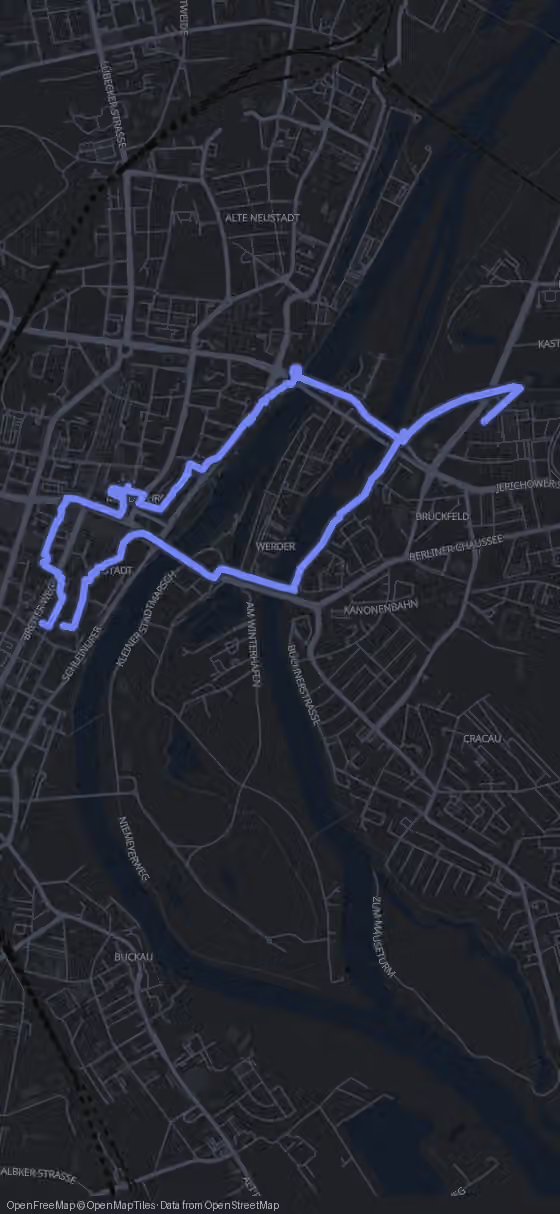
Route map for the Magdeburg walking tour
Stop 1 of 10
400 m·5 min
Magdeburg Cathedral
Head north-east from the cathedral toward the Monastery of Our Lady
Welcome to Magdeburg. I'm Alex, and one of this city's mayors once challenged teams of horses with empty air.
Try this tour with Alex

Your Route at a Glance

Ten stops over 8.8 km and 2 h of pure walking: you start at Magdeburg Cathedral, swing out to the Elbauenpark and finish at the Dommuseum Ottonianum, right opposite where you began. With the interiors worth seeing, plan about seven hours.

Magdeburg Cathedral, the squares, monuments and fountains cost nothing. Monastery of Our Lady, Elbauenpark, Lukasklause, Johanniskirche and the Dommuseum Ottonianum charge admission. Route, map and GPS navigation are free in your browser; the AI Tour Guide is optional.

Open free GPS & optional AI Tour Guide
This short shows highlights of the route. All 10 stops follow below.

The Route

Walking Map of Magdeburg: Cathedral, Elbauenpark and Old Town

10 stops 8.8 km 2 h walking
Tap to load interactive map

The 10 stops along this route

  1. Magdeburg Cathedral, stop 1 on the self-guided walking tour
    1Magdeburg Cathedral
  2. Monastery of Our Lady in Magdeburg, stop 2 on the self-guided walking tour
    2Monastery of Our Lady
  3. Elbauenpark in Magdeburg, stop 3 on the self-guided walking tour
    3Elbauenpark
  4. Lukasklause in Magdeburg, stop 4 on the self-guided walking tour
    4Lukasklause
  5. Johanniskirche in Magdeburg, stop 5 on the self-guided walking tour
    5Johanniskirche
  6. Otto von Guericke Monument in Magdeburg, stop 6 on the self-guided walking tour
    6Otto von Guericke Monument
  7. Alter Markt in Magdeburg, stop 7 on the self-guided walking tour
    7Alter Markt
  8. Faunenbrunnen in Magdeburg, stop 8 on the self-guided walking tour
    8Faunenbrunnen
  9. Green Citadel of Magdeburg, stop 9 on the self-guided walking tour
    9Green Citadel of Magdeburg
  10. Dommuseum Ottonianum in Magdeburg, stop 10 on the self-guided walking tour
    10Dommuseum Ottonianum
  11. That's the full route.

    Walk it with an AI Tour Guide talking you through every one of these streets.

    Start free in your browser
    You made it

Your Magdeburg Walking Tour from Cathedral to Dommuseum, Stop by Stop

  1. 1

    Magdeburg Cathedral

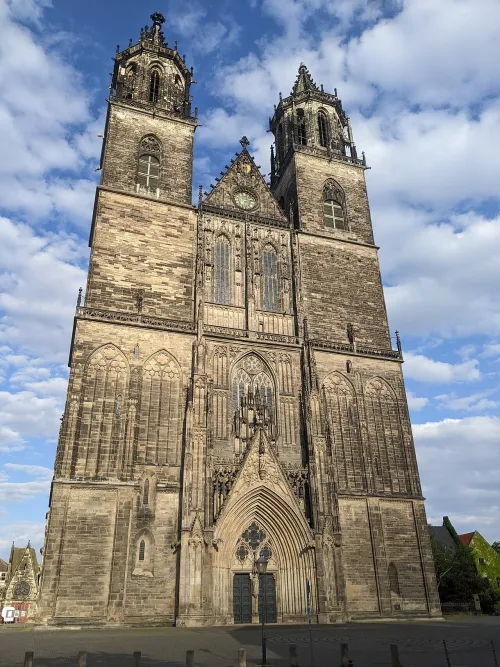
    Magdeburg Cathedral, stop 1 on the self-guided walking tour

    Look up first: two towers, the south one 99.25 m and the north one 100.98 m, make this one of the tallest cathedrals in eastern Germany and the landmark of the city. Officially it is the Cathedral of Saints Maurice and Catherine, and it counts as the oldest Gothic cathedral in the country. Building began in 1209 and went on for some three hundred years; the steeples were only finished in 1520.

    The story starts earlier. In 937 Otto I, later called the Great, founded an abbey dedicated to Saint Maurice on this spot. After his victory at Lechfeld in 955 he expanded it, and to underline his claim as heir to the Western Roman emperors he had ancient columns brought here. Many of those antique pieces were reused when the new church rose after 1209, so keep an eye out for stone far older than the Gothic walls around it.

    Inside lies the grave of Otto himself, and of his first wife Edith, Eadgyth in English, a granddaughter of Alfred the Great. She died in 946, and analysis of her bones has confirmed that she grew up in Wessex. Although the cathedral was looted more than once, it is still full of art from antiquity to the present day.

    Going in is free, donations welcome, so there is no reason to skip it. If you like detail, the guided cathedral tour is worth it, and there are tower tours as well. From here it is only 400 m and five minutes to the Monastery of Our Lady.
    Local name
    Magdeburger Dom
    Hours
    May–Sep daily 10:00–18:00 (Sun/church holidays from 11:30); Oct daily 10:00–17:00; Nov–Mar daily 10:00–16:00; Apr daily 10:00–17:00
    Price
    Free admission (donations welcome); guided cathedral tours 9 EUR adult, 6 EUR reduced; tower tours 9 EUR adult, 6 EUR reduced
  2. 2

    Monastery of Our Lady

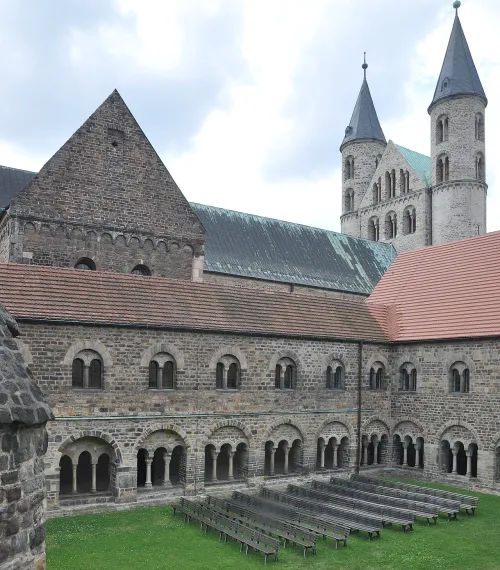
    Monastery of Our Lady in Magdeburg, stop 2 on the self-guided walking tour

    This is Romanesque Magdeburg: a monastery complex counted among the most important Romanesque ensembles in Germany, with church, cloister and convent buildings grouped close to the cathedral. Since 1977 the church has no longer been used for worship, and today the whole complex houses the city's art museum.

    Archbishop Gero founded a community of canons here around 1015. The supposed founding charter, by the way, is a later forgery. Archbishop Werner had a three-aisled basilica built from 1063, and was buried in it in 1078. The decisive turn came in 1129, when Archbishop Norbert of Xanten handed the house to the newly founded Premonstratensian order. It became something like the mother house of the order in the east, second only to Prémontré itself.

    Under Norbert and his successor the complex took the shape you see: the two-storey cloister, the summer and winter refectories, the chapter house, the west towers. In the church the columns were replaced by square piers so that a vault could be added later. Norbert was buried in front of the cross altar in 1134.

    The monastery museum charges admission, and it is an easy choice for families. Give the cloister time even if modern art is not your thing. Then comes the longest stretch of the day: 3,430 m and 46 minutes out to the Elbauenpark.

    Local name
    Kloster Unser Lieben Frauen
    Hours
    Tue–Fri 10:00–17:00, Sat–Sun 10:00–18:00, Mon closed
    Price
    8 EUR regular, 4 EUR reduced, children and youth under 18 free
  3. 3

    Elbauenpark

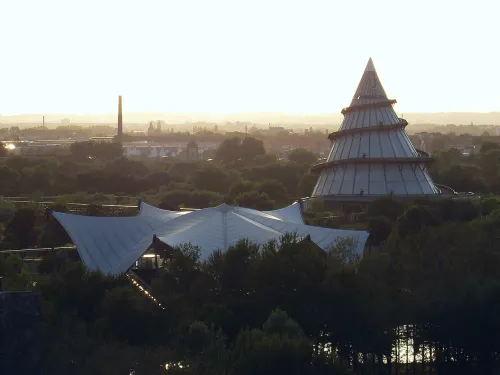
    Elbauenpark in Magdeburg, stop 3 on the self-guided walking tour

    After the stone of the old town, you arrive in roughly 100 hectares of green. The park has two parts, Kleiner Anger and Großer Anger, linked by a footbridge over the Herrenkrugstraße. It was laid out for the federal garden show of 1999, and it is hard to believe what lay here before.

    In the 1930s the Wehrmacht built barracks and shooting ramparts on this ground; after the Second World War Soviet forces used the barracks. Rubble from the bombed city was dumped here in a huge heap. Before the park could be built, every piece of explosive ordnance and countless tons of debris had to be cleared. Within a few years a former field of war rubble had become a garden. Until 2014 an elevated monorail ran 3 km through the park; it was taken down in early 2015.

    What to look for: the Millennium Tower with its exhibition on 6,000 years of human history, the butterfly house with 200 exotic butterflies, 14 theme gardens, a 400 m summer toboggan run, the lake stage with 1,600 seats and a play and project house for children up to 14, largely planned by children themselves.

    There is a day ticket and a cheaper Grünticket for the gardens alone. For half an hour of gardens the day ticket is a lot; if you have children or want the Millennium Tower, plan more time and the ticket pays off. Next you head back towards the city: 2,090 m and 29 minutes to the Lukasklause.

    Hours
    Sep–Oct daily 09:00–18:00; May–Aug daily 09:00–19:00; Apr daily 09:00–18:00; Mar daily 10:00–18:00; Nov–Feb daily 10:00–16:00
    Price
    Day ticket: 11 EUR adult, 7 EUR reduced, children up to 6 free; Grünticket: 6 EUR adult, 4 EUR reduced; winter (Nov-Feb): free admission
  4. 4

    Lukasklause

    Lukasklause in Magdeburg, stop 4 on the self-guided walking tour

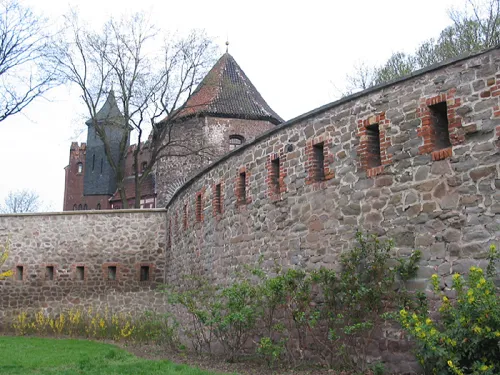
    An octagonal defence tower, partly medieval, late Gothic in form: the Lukasklause once secured the northeastern corner of the city wall. Today it stands 21.70 m tall, though it was originally higher. Its diameter is 11.42 m, and at ground level the walls are 1.42 m thick, which tells you what it was built for.

    Attached on its south side is a picturesque addition from 1902 and 1903, built in a historicising style with Gothic touches, half-timbered galleries and a round brick turret. Look closely at the turret for the small Art Nouveau grotesque faces. Around the tower you can still find pieces of Magdeburg's fortifications: remains of a round bastion called the Neues Werk, and parts of a fortress railway gate from 1851.

    The history is partly guesswork. In 1236 Archbishop Wilbrand of Käfernburg gave the city land so that the wall in the northeast could be completed, perhaps this very spot. The tower is first named as the Welscher Turm, some say in 1279, others only in 1440. A medieval chronicle also mentions a ship mill built next to it.

    The tower is a museum now, with paid admission and only a few opening days a week. For anyone curious about the fortified city it is a short, rewarding visit; otherwise the outside alone is worth the stop. From here it is 1,100 m and 15 minutes to the Johanniskirche.

    Hours
    Wed–Fri 11:00–15:00, Mon–Tue closed, Sat–Sun closed (except special events/tours by appointment)
    Price
    4 EUR adult, 3 EUR reduced, children (6-12) 2 EUR, under 6 free
  5. 5

    Johanniskirche

    Johanniskirche in Magdeburg, stop 5 on the self-guided walking tour

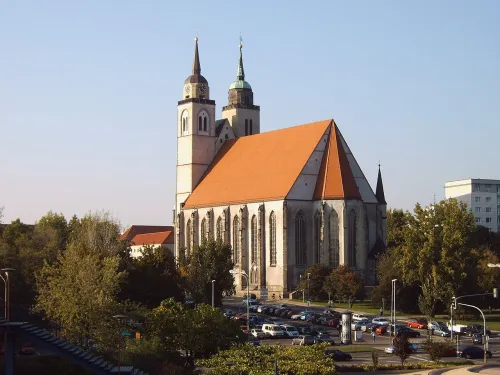
    The twin towers of the Johanniskirche rise behind the Old Town Hall, and the building has been the city's market church for most of its history. It is no longer a church: since 1999 it has served as Magdeburg's festival hall and concert venue, and from January to June 2014 even the state parliament of Saxony-Anhalt met here.

    A first parish church stood on this site between 936 and 941. In 941 King Otto I gave it to the monks of his Saint Maurice abbey, calling it a church of the people. By 1015 a chronicler named it the merchants' church, and in 1170 it passed to the Monastery of Our Lady. Fire shaped its story: damaged in 1188, burned down in 1207, rebuilt with towers completed by 1218 and the whole church, including a flat for the tower keeper, finished in 1238. A year later another great fire hit it.

    One odd detail: in 1301 a Cologne convent exhibited relics of the 11,000 virgins here, a sign of how important the market church had become.

    Go in. The ticket includes the tower ascent, which makes it one of the cheapest views on the route. On event days access can be limited. Just 210 m and three minutes on, Otto von Guericke sits waiting.

    Local name
    St.-Johannis-Kirche
    Hours
    Tue–Sun 10:00–17:00 (on non-event days; last tower ascent 16:00), Mon closed
    Price
    3 EUR regular, 2 EUR reduced (including tower ascent); 2 EUR tower-only on event prep days
    Website
    mvgm.de ↗
  6. 6

    Otto von Guericke Monument

    Otto von Guericke Monument in Magdeburg, stop 6 on the self-guided walking tour

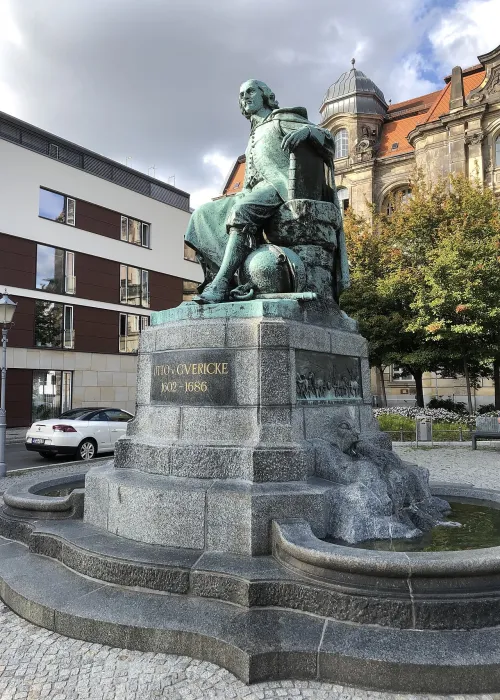
    A larger than life bronze man sits on the square Bei der Hauptwache: Otto von Guericke, scientist and mayor of Magdeburg, who lived from 1602 to 1686. Sculptor Carl Echtermeier created the neo-baroque statue, and it was unveiled in 1907. Walk round the back of the pedestal and you find his signature with a different year: C. ECHTERMEIER 1906.

    Each detail tells part of his story. At his left foot lie two large hemispheres, a reference to his famous Magdeburg hemispheres experiment demonstrating the vacuum. In his left hand he holds a book. And look at what he is sitting on: pieces of rubble. They stand for his years as mayor after the city was destroyed in 1631.

    The pedestal is worth a slow circuit. Water pours from mask-shaped spouts into basins on both sides, above them bronze reliefs and inscriptions. One relief shows the hemispheres experiment again, another, on the west side, shows Magdeburg as it looked before the destruction of 1631.

    There is nothing to pay and nothing to go into, so five or ten minutes are enough. The Alter Markt begins only 100 m away, a one-minute walk.

    Local name
    Otto-von-Guericke-Denkmal
    Hours
    24/7
    Price
    Free
  7. 7

    Alter Markt

    Alter Markt in Magdeburg, stop 7 on the self-guided walking tour

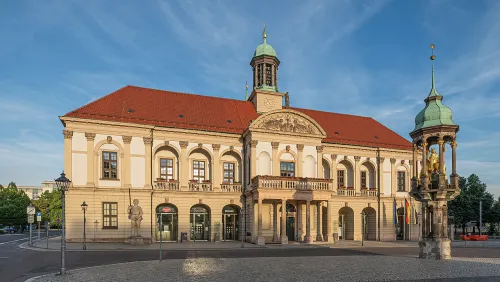
    This trapezoid square, sloping gently downhill, is where Magdeburg began as a trading town: the merchant settlement here is first mentioned in 965. From the 12th century its shape became the model for new markets founded under Magdeburg law, so in a sense you are standing in a template copied across a wide stretch of Europe.

    The baroque Old Town Hall fills one side, with the towers of the Johanniskirche rising behind it. In front of the town hall stand several monuments of historic origin: the Magdeburger Reiter, the Magdeburg Roland and the Hirschsäule. On the opposite side, look for the Eulenspiegel fountain.

    The buildings along the north and south sides tell a newer story. They are neoclassical blocks from the 1950s, the first phase of rebuilding in GDR times after the Second World War. Several old lanes vanished under them, with names like Schuhbrücke, Fettehennenstraße and Nadelöhrgasse, the needle's eye lane. The square is listed as a protected monument area.

    Take your time here; it costs nothing, and the monuments reward a close look. Then it is 950 m and 13 minutes through the old town to the Faunenbrunnen.

    Hours
    24/7
    Price
    Free
  8. 8

    Faunenbrunnen

    Faunenbrunnen in Magdeburg, stop 8 on the self-guided walking tour

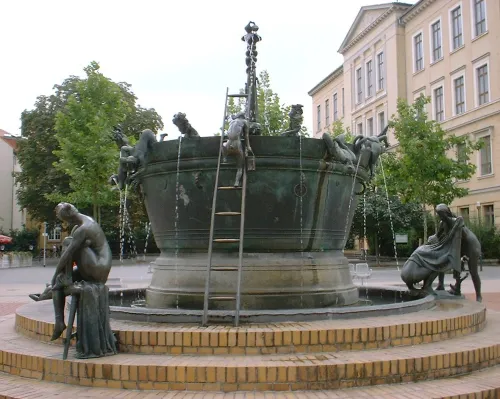
    In the middle of the Leiterstraße pedestrian zone stands a giant bronze pot surrounded by naked figures. Locals also call it the Teufelsbrunnen, the devil's fountain. The pot measures 3.2 m around and carries the city's coat of arms, with a water channel running round it.

    Now look at who is gathered here: two boys fighting, two women drying each other off, a woman on a stool and a young man looking pointedly the other way, plus a cat and a tortoise. And a dog relieving itself against the side of the pot. Some figures sit on the podium, others act out of the pot itself.

    Sculptor Heinrich Apel began work in 1976. His first working title was Ein Kessel Buntes, after a popular GDR television variety show of the same name. The pedestrian zone, rebuilt with prefabricated GDR blocks, was badly delayed, so the fountain was only cast in 1986, in a works of the Rostock diesel engine plant, with the figures made at the bell foundry in Lauchhammer. It opened with a fountain festival in June 1986, appeared on a GDR stamp in 1989 and was added to the state's list of monuments in 2024.

    A quick stop, free, and a good one if you are walking with children. The Green Citadel is only 210 m and three minutes away.

    Local name
    Faunbrunnen
    Hours
    24/7
    Price
    Free
  9. 9

    Green Citadel of Magdeburg

    Green Citadel of Magdeburg, stop 9 on the self-guided walking tour

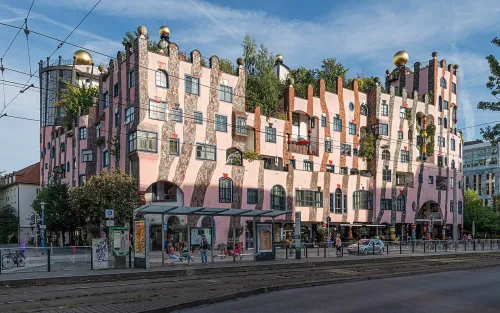
    Pink walls, wavy lines, trees on the roof, golden domes: the Green Citadel is the work of Friedensreich Hundertwasser and was one of the last projects he worked on before his death in 2000. It was completed in 2005 and cost about 27 million euros. If you like his style, you can find another of his buildings at the Hundertwasser school in Wittenberg.

    The site has layers. The Nikolaikirche stood here, used as an arsenal after 1810 and pulled down in 1959 along with surrounding buildings bombed in the war. In the 1970s a prefabricated apartment block went up. In 1995 Rolf Opitz, then head of a local housing cooperative, had the idea of asking Hundertwasser to transform the block. The artist agreed, but in the end a new building was chosen because it gave more freedom. The location was controversial.

    Today the house holds 53 apartments, practices and offices, a theatre, an art hotel and a kindergarten called FriedensReich. On the ground floor there are shops, a café and a restaurant, and at the information point you can see the original building model.

    The courtyards are free and open, so wander in regardless. The guided house and tower tour costs extra and runs at fixed times; it suits Hundertwasser fans who plan the day around it. The last leg is 290 m and four minutes to the Dommuseum Ottonianum.

    Local name
    Grüne Zitadelle von Magdeburg
    Hours
    Courtyards freely accessible; guided tours: Apr–Oct Mon–Thu 11:00/15:00/17:00, Fri 11:00/13:00/15:00/17:00, Sat–Sun hourly 11:00–17:00; Nov–Mar Mon–Thu 11:00/15:00, Fri–Sun 11:00/13:00/15:00
    Price
    Courtyards and exterior free; guided house & tower tour 12.50 EUR regular, 10.50 EUR reduced, 6.00 EUR children (6-12)
  10. 10

    Dommuseum Ottonianum

    Dommuseum Ottonianum in Magdeburg, stop 10 on the self-guided walking tour

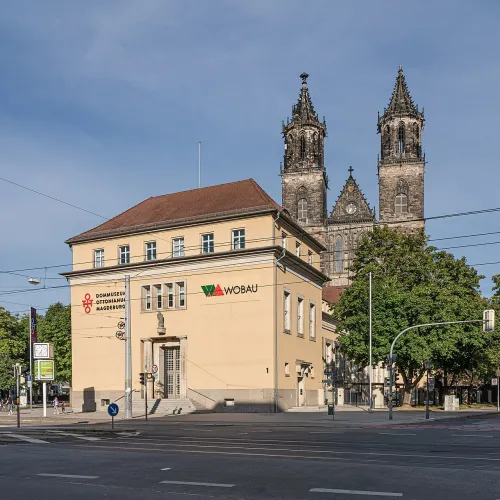
    You end where the day began, in a sense: the Dommuseum Ottonianum stands directly opposite the cathedral and tells its story. It opened on 4 November 2018 and grew out of the large excavations in and around the cathedral between 2001 and 2010.

    The museum is not arranged chronologically but around three themes: Emperor Otto the Great and Queen Editha, the archbishopric of Magdeburg, and the archaeology of the cathedral site. The highlights connect straight back to your first stop: Editha's lead coffin, Mediterranean textiles from her burial, precious grave goods of Archbishops Wichmann of Seeburg and Otto of Hessen, the walled tomb of a confidant of Otto the Great from 963, and ancient Roman building parts from Ottonian structures on the cathedral square.

    Films, listening stations and interactive media carry you through the history of the cathedral up to today, which makes it a good museum for people who do not usually enjoy museums.

    If you only go into one paid museum on this route and Otto is your reason for coming, make it this one. After it you are back at the cathedral square, the free route complete.

    Hours
    Tue–Sun 10:00–17:00, Mon closed (open 10:00–17:00 on public holidays that fall on Monday)
    Price
    7.50 EUR adults, 5.00 EUR reduced, children and youth under 18 free
Walking tour route map of Magdeburg Route loaded
Magdeburg CathedralMonastery of Our LadyElbauenparkLukasklause+6
All 10 stops are already on the map.
You just press start.
AI Tour Guide

You know the route now. Walk it with a guide in your ear.

Press start wherever you are, even hundreds of kilometres from Magdeburg, and the guide begins telling its stories right away. In the city, pick any of the 10 stops to start from: it leads you there, then talks with you the whole route, asking, listening, remembering, and shaping the tour around your answers.

10stops 8.8km 2 hwalking 13languages
▶Start the tour free

Free to start · Runs in your browser · No app, no download

Shorter Ways Through Magdeburg

The long leg out to the Elbauenpark and back takes up most of the walking. If you leave it out, the rest of the route shrinks to a compact old town walk.

Old town without the park

Stops: 4, 5, 6, 7, 8, 9, 10

For anyone who wants the medieval tower, the market and Hundertwasser but not the park. From the Lukasklause to the Dommuseum Ottonianum it is 2,860 m and 39 minutes on foot. Admission at the Lukasklause, the Johanniskirche and the Dommuseum. Since the Lukasklause keeps short opening hours, start there; the cathedral stands across from the end point, so you can add it at the finish.

Compact afternoon, also on weekends

Stops: 5, 6, 7, 8, 9, 10

Good when the Lukasklause is closed or you only have an afternoon. Johanniskirche to Dommuseum Ottonianum is 1,760 m and 24 minutes of walking. You pay only for the Johanniskirche with its tower and the Dommuseum.

Cathedral and monastery morning

Stops: 1, 2

For Romanesque and Gothic architecture without the long walk: 400 m and 5 minutes between Magdeburg Cathedral and the Monastery of Our Lady. The cathedral is free, the monastery museum charges admission.

How Long Does This Magdeburg Tour Take with the Museums?

The full route adds up to 2 h of pure walking, and the 46 minute leg from the Monastery of Our Lady out to the Elbauenpark is the longest single stretch. Everything after the park sits close together in the old town, where most legs take less than a quarter of an hour.

With the interiors that reward a visit, the day runs to about seven hours: start at the cathedral at 10:00, spend roughly 45 minutes there and in the monastery each, half an hour in the park and at the Lukasklause, 40 minutes in the Johanniskirche with its tower, and you reach the Dommuseum around 15:55. The old town variant without the park fits into three to four hours with its three museums, the compact afternoon into about two and a half.

Before You Set Off in Magdeburg

  • Start and finish: The recommended start is Magdeburg Cathedral, but you can join the route at any stop. It ends at the Dommuseum Ottonianum, directly opposite the cathedral, so you finish where you began.
  • Best day: Choose your day with care. The Lukasklause opens on only a few days a week, and the Monastery of Our Lady, the Johanniskirche and the Dommuseum share a weekly closing day.
  • Time of day: Start in the morning, once the cathedral has opened; on Sundays and church holidays it opens later. Reach the Lukasklause and the Johanniskirche early enough, especially if you want the tower.
  • Costs: The cathedral, the courtyards of the Green Citadel and all squares and monuments are free; the other stops charge admission.
Walking tour route map of Magdeburg
AI Tour Guide

Your guide is ready when you reach the cathedral.

Press start and a voice AI Tour Guide takes it from here: leading the route through Magdeburg, telling the stories, and turning your walk into a real back-and-forth conversation. No app or download is needed; it runs in your browser.

10stops 8.8km 2 hwalking 13languages
▶Start the tour free

Free to start · Runs in your browser · No app, no download

What the AI Tour Guide Adds Between Otto and Hundertwasser

On this route the stories hang together: Otto the Great founds the cathedral, gives away the merchants' church, and his queen's coffin turns up in the museum across the square. The AI Tour Guide follows those threads as a conversation, filling the long walk to the Elbauenpark, noticing whether you lean towards emperors, science or GDR art, and taking you further where the page stops. Ask it what actually happened when Guericke pulled his hemispheres apart, or who Norbert of Xanten was before he came to Magdeburg.

A Real Conversation A voice AI Tour Guide greets you, leads the whole route, and tells the stories and facts as you walk, asking what you want to see and keeping a real conversation going. Not a recording you press play on.
Map Navigation Follow the route on the map and walk at your own pace. You choose where to start and when to move to the next stop.
Ask Anything Curious about a building you pass? Ask your AI Tour Guide on the spot and the conversation carries on.
13 Languages Switch language anytime. No separate tour needed.
Start free in your browser

Common Questions About Magdeburg on Foot

Can I go up a tower in Magdeburg?

Yes, three ways. The Johanniskirche ticket includes the tower ascent, the cathedral runs tower tours, and the Green Citadel offers a guided house and tower tour.

What changes if I visit in winter?

Days are short in winter and several stops close earlier, so start early and do the walk out to the park in daylight.

What does the AI Tour Guide cost after the free credits?

You start with 100 free credits. After that you choose: this tour all-inclusive for €19.99 with no time limit, or credits at €5 per hour.

Where can I go on a day trip from Magdeburg?

Quedlinburg (51 km) and Halberstadt (48 km) continue the Ottonian and medieval story, Wernigerode lies 67 km away, and Dessau is 52 km off. Each has its own free walking route.

Is the tour really free?

Yes. The whole tour is free: the route, the interactive map and the navigation cost you nothing. Only the voice AI Tour Guide is optional and paid: you test it with 100 free credits, then you pay either €5 per hour or €19.99 for this whole tour, with no time limit. Admission to 5 of the 10 stops is not included: Monastery of Our Lady, Elbauenpark, Lukasklause, Johanniskirche and Dommuseum Ottonianum charge their own entry fees.

Do I need to download an app?

No. Everything runs in your phone browser. Open the route and start walking, no download and no sign-up required.

Do I need to book the walking tour in advance?

No booking needed. This self-guided tour is available anytime. Open the route in your browser and start walking. The AI Tour Guide works instantly, no app, no reservation required.

What languages is the AI Tour Guide available in?

The AI Tour Guide speaks 13 languages, so you take the tour in your own language and can switch at any time.

Can I skip stops or change the route?

Yes. Skip any stop, spend extra time at places you like, or start the route from any point. It is your walk, you set the pace.
Image credits
▶ Start free in your browser Runs in your browser, no app, no download