

Piazza Walther
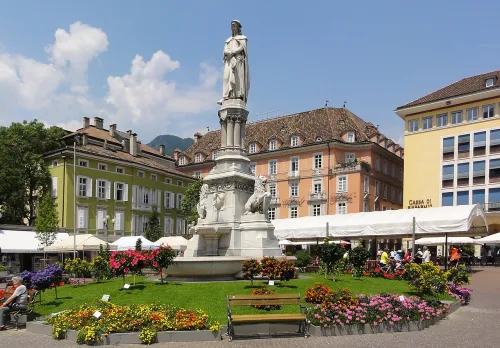
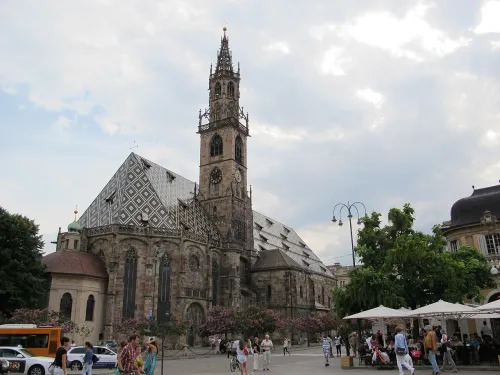
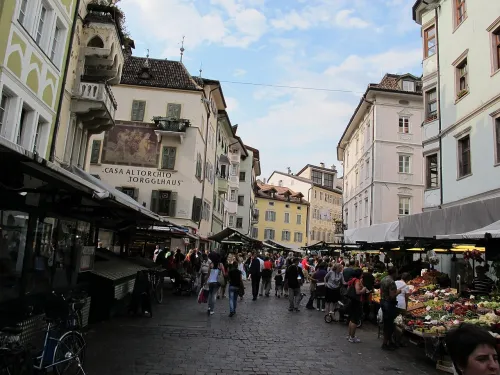
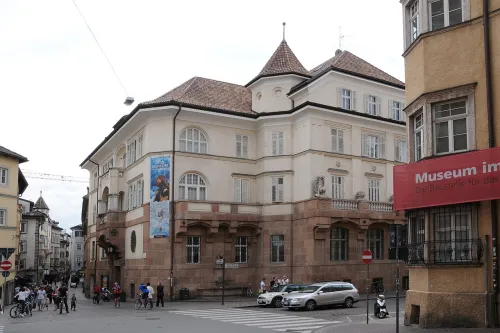
Bolzano likes to call Piazza Walther its drawing room, and standing in the middle of it you see why. The square is the city's social centre, and the man on the pedestal gave it its name: the medieval poet Walther von der Vogelweide, 3.30 m tall, carved by Heinrich Natter from Laas marble. Turn around slowly. The cathedral closes off one side; the Palais Menz, the Palais Campofranco and the Stadthotel, built in 1912/13 by the brothers Alois and Gustav Ludwig, frame the others; and facing them stands the Hotel Greif, once called the Schwarzer Greif. Behind the northern row of houses, the old town begins.
For most of its history this was not a square at all. In the Middle Ages it lay at the edge of town, outside the old city wall, and the views of Bolzano drawn by Ludwig Pfendter in 1607 and Matthäus Merian in 1649 show a walled vineyard here. In 1808 the Bavarian king Maximilian sold the estate to the town, which laid out a square, used it as a parade ground and named it Maximilianplatz. When Tyrol returned to Austria after the Congress of Vienna, it became Johannsplatz, after Archduke Johann.
The poet arrived on 15 September 1889, unveiled with a great festival. The statue was a statement by the German liberal citizens of the late Habsburg monarchy about their cultural identity, and the square soon took its name from him. From 1908 the Ritten railway ended here. Today the square hosts the Christmas market, the South Tyrol Jazz Festival and the BOclassic New Year's Eve race.
The cathedral is only 100 m away, a single minute on foot: you can see its walls from the statue.