Free Walking Tour Brussels: Grand-Place to Royal Quarter

From the Bourse to Manneken Pis by way of the Grand-Place, the Royal Quarter and the Sablon: 11 stops, 4.3 km, and a story behind every façade.

11 Stops 4.3 km ~1 h walking
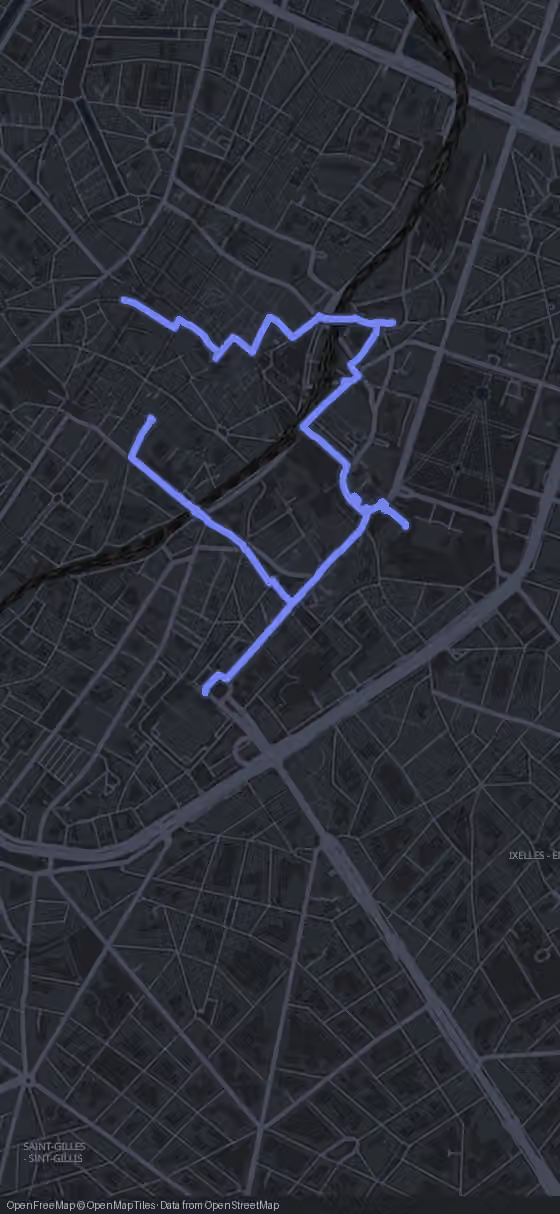
Route map for the Brussels walking tour
Stop 1 of 11
390 m·5 min
Bourse de Bruxelles
Head south-east toward the Grand-Place
Bonjour, welcome to Brussels. I'm Alex, and this city enjoys hiding bold claims behind elegant facades.
Try this tour with Alex

Brussels on Foot: The Route at a Glance

11 stops lead from the Bourse de Bruxelles through the Grand-Place and up into the Royal Quarter, ending at Manneken Pis. The route covers 4.3 km with 1 h of pure walking; allow about 2.5 hours outdoors only, closer to five with both museums.

Squares, churches, arcades and palace fronts are free. The Musical Instrument Museum and the Magritte Museum charge entry. Route, map and GPS navigation in your browser cost nothing; the AI Tour Guide is optional.

Open free GPS & optional AI Tour Guide
This short shows highlights of the route. All 11 stops follow below.

The Route

Brussels Walking Map: From the Bourse to Manneken Pis

11 stops 4.3 km 1 h walking
Tap to load interactive map

The 11 stops along this route

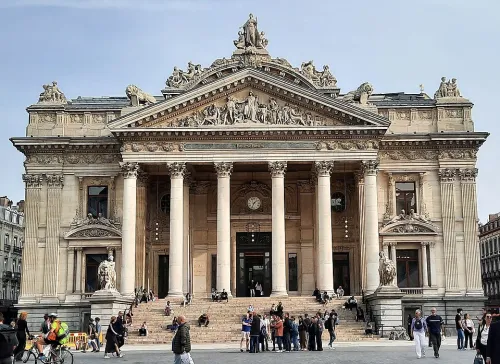
  1. Bourse de Bruxelles in Brussels, stop 1 on the self-guided walking tour
    1Bourse de Bruxelles
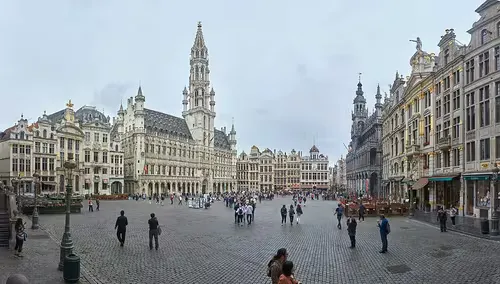
  2. Grand-Place in Brussels, stop 2 on the self-guided walking tour
    2Grand-Place
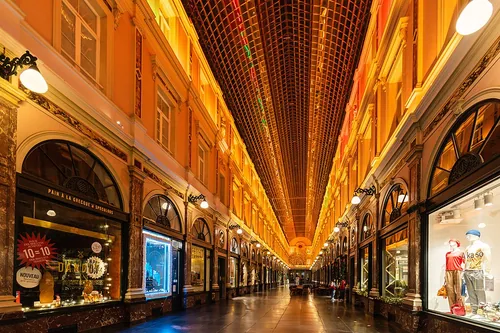
  3. Royal Galleries of Saint-Hubert in Brussels, stop 3 on the self-guided walking tour
    3Royal Galleries of Saint-Hubert
  4. Brussels Cathedral, stop 4 on the self-guided walking tour
    4Brussels Cathedral
  5. Mont des Arts in Brussels, stop 5 on the self-guided walking tour
    5Mont des Arts
  6. Musical Instrument Museum in Brussels, stop 6 on the self-guided walking tour
    6Musical Instrument Museum
  7. Magritte Museum in Brussels, stop 7 on the self-guided walking tour
    7Magritte Museum
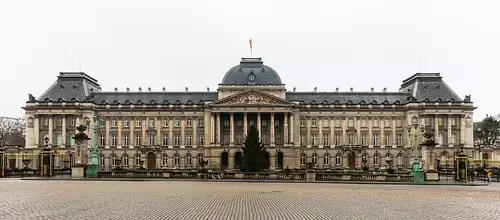
  8. Royal Palace of Brussels, stop 8 on the self-guided walking tour
    8Royal Palace of Brussels
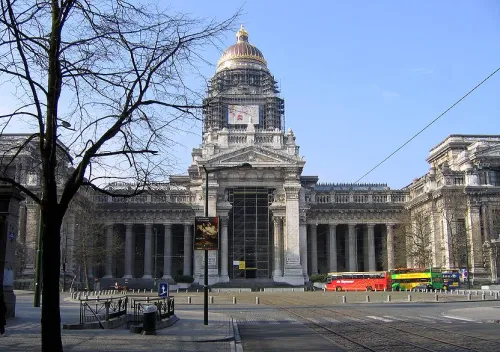
  9. Palais de Justice in Brussels, stop 9 on the self-guided walking tour
    9Palais de Justice
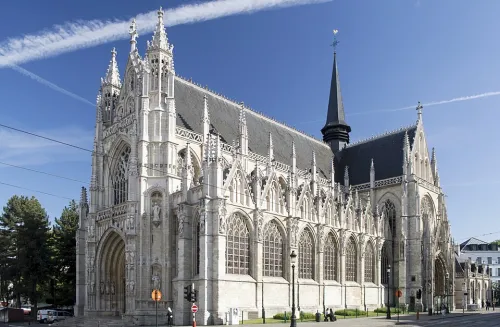
  10. Notre-Dame du Sablon in Brussels, stop 10 on the self-guided walking tour
    10Notre-Dame du Sablon
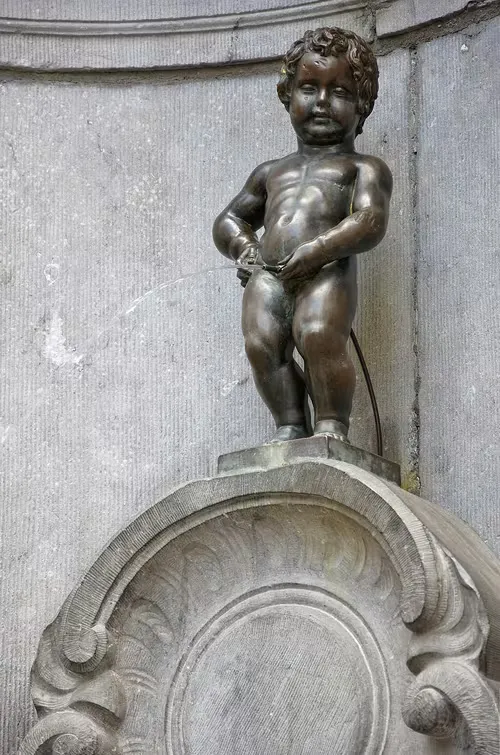
  11. Manneken Pis in Brussels, stop 11 on the self-guided walking tour
    11Manneken Pis
  12. That's the full route.

    Walk it with an AI Tour Guide talking you through every one of these streets.

    Start free in your browser
    You made it

Your Brussels Walking Tour Stop by Stop, Lower Town to Sablon

  1. 1

    Bourse de Bruxelles

    Bourse de Bruxelles in Brussels, stop 1 on the self-guided walking tour

    Start in front of the Bourse, the former stock exchange on Boulevard Anspach that gives the Place de la Bourse its name. Take in the façade: architect Léon-Pierre Suys mixed neo-Renaissance and Second Empire borrowings into one eclectic palace of money, begun in 1868 and finished in 1873. Admiring it from outside costs nothing, and it sets the tone for a city that likes its buildings grand and a little theatrical.

    The story starts with a river. The Senne used to flow through this part of town, and between 1867 and 1871 Brussels covered it over, for reasons of health as much as looks. A huge programme to beautify the centre followed. Suys proposed a series of grand boulevards on top of the buried river, with a new stock exchange as the heart of a fast-growing business district, and after several petitions the municipal council backed him.

    The exchange itself was older than its building. Napoleon created it by decree in 1801, and it moved through a string of cramped, unsanitary premises until merchants, riding Belgium's industrial boom from 1858 on, demanded something better. The palace went up on the site of the old Butter Market, which in turn had been built over a Franciscan convent; its remains have since been unearthed.

    Since 2023 the upper floors have housed the Belgian Beer World museum, so the old temple of trading now tells the story of Belgian beer. If that tempts you, ask at the entrance about tickets and times. From here it is 400 metres, about 5 minutes, to the Grand-Place.
    Local name
    Palais de la Bourse
    Price
    Free (exterior)
  2. 2

    Grand-Place

    Grand-Place in Brussels, stop 2 on the self-guided walking tour

    Walk onto the Grand-Place and turn slowly on the spot: the town hall with its tower, the Maison du Roi (Broodhuis in Dutch) facing it, and all around, the richly ornamented guild houses. Victor Hugo counted it among the most beautiful squares in the world, and UNESCO listed it as World Heritage in 1998. It is open day and night and free, so it is easy to come back after dark for a second look.

    This square has seen grim days. In 1523 the first Protestant martyrs, Henri Voes and Jean Van Eschen, were burned here by the Inquisition. Some forty years later the Counts of Egmont and Hornes, who had complained to Philip II about his policy in the Low Countries, were beheaded on the same cobbles. Their execution helped spark the armed revolt against Spanish rule, led by William of Orange.

    In August 1695, during the Nine Years' War, French troops under Marshal de Villeroy bombarded the city, and most of the houses here, some still built of wood, went up in flames. Only the town hall's façade and tower and a few stone walls survived, partly because the gunners used the tower as a landmark for aiming. The guilds rebuilt their houses in stone and spared no expense; the Brewers' guild house now holds the Brewers' Museum.

    What you see is also a restoration. The French Revolution stripped the square again, and the earliest photos show it without statues or gilding. From the mid 19th century Brussels rediscovered its heritage, and mayor Charles Buls pushed a major restoration at the turn of the 20th century. So some façades are a 19th century reading of the houses built after 1695 rather than exact copies.

    The Royal Galleries of Saint-Hubert are 280 metres away, a 4-minute walk.

    Hours
    Open 24/7
    Price
    Free
  3. 3

    Royal Galleries of Saint-Hubert

    Royal Galleries of Saint-Hubert in Brussels, stop 3 on the self-guided walking tour

    Under an arched glass roof on a delicate cast-iron frame, three arcades run one into the next: the King's Gallery, the Queen's Gallery and the Princes' Gallery. Glazed, arched shopfronts sit between pilasters with two upper floors above them, all in an Italianate style inspired by the Cinquecento. It is a free shopping arcade open around the clock, so walk its full length rather than just peeking in.

    Architect Jean-Pierre Cluysenaar designed and built the galleries in 1846 and 1847, before the famous arcades of the century elsewhere, such as the Galleria Vittorio Emanuele II in Milan and the Passage in Saint Petersburg. The long, street-like layout with twin, regular façades goes back to Vasari's courtyard of the Uffizi in Florence. Since 1986 the ensemble has been a protected monument.

    The name comes from a tiny lane that disappeared under the arcades, the old Rue Saint-Hubert, just 2 metres wide. It already existed in the 13th century as Bogart, 'Orchard Street', and was later nicknamed 'Mirror Lane'. It only became Saint-Hubert in 1685, after a tavern of that name that was popular with the stallholders of the nearby Marché aux Herbes.

    From the galleries to the cathedral it is 440 metres, about 7 minutes.

    Local name
    Galeries royales Saint-Hubert
    Hours
    Open 24/7
    Price
    Free (shopping arcade)
    Website
    grsh.be ↗
  4. 4

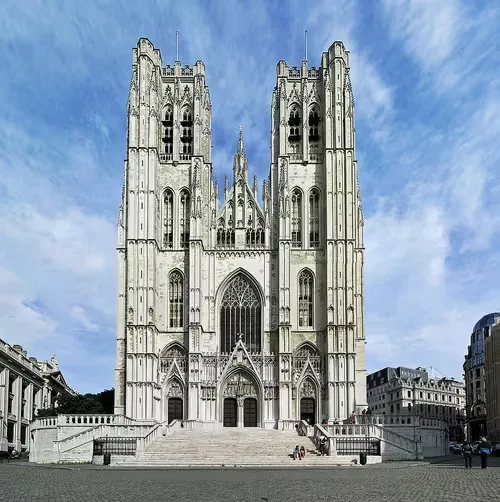
    Brussels Cathedral

    Brussels Cathedral, stop 4 on the self-guided walking tour

    Saint Michael and Saint Gudula are the patron saints of Brussels, and locals simply call this church St. Gudula. It stands on a large forecourt, the Parvis Sainte-Gudule, laid out in the mid 20th century after the North-South rail connection was built, and it is a major example of Brabantine Gothic.

    Historians believe a chapel to Saint Michael stood here as early as the 9th century, on the Treurenberg hill, the 'Mount of Sorrows'. It was the most important spot in early Brussels: the crossing of two trade routes, one from the County of Flanders to Cologne, the other from Antwerp to Mons and on to France. A Romanesque church was begun in the 11th century and by the 16th it had largely reached its present Gothic form. Late Gothic and Baroque chapels followed, and some of the aisle windows and other neo-Gothic details date from 19th century restoration work.

    It only became a cathedral in 1962, sharing the role with St. Rumbold's in Mechelen. As Belgium's national church and seat of the Primate it hosts royal weddings, state funerals and the Te Deum on Belgian National Day. Listen out, too: the church is known for its two pipe organs and its immense bells.

    Going in is free and well worth it for the nave and the glass. Extras cost money: the treasury, the Romanesque remains, the crypt by appointment and the tower. With this walk in hand you can skip the QR-code tour, and before paying for the tower, know that free views wait at the Mont des Arts and the Palais de Justice.

    The Mont des Arts is 530 metres away, about 7 minutes on foot.

    Local name
    Cathédrale Saints-Michel-et-Gudule
    Hours
    Mon–Fri 8:00–18:00, Sat 8:00–17:00, Sun 13:00–18:00
    Price
    Free (general entry); Treasury EUR 3, Romanesque remains EUR 2, Crypt EUR 4 (by appointment), Tower EUR 15, QR-code guided tour EUR 5-6
  5. 5

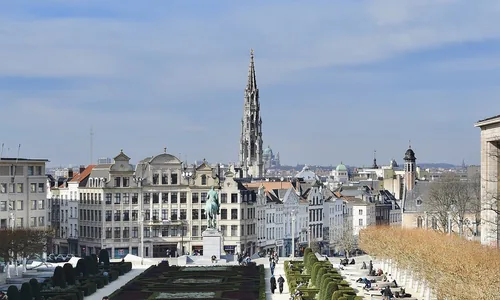
    Mont des Arts

    Mont des Arts in Brussels, stop 5 on the self-guided walking tour

    The Mont des Arts, the 'Hill of the Arts', brings together the Royal Library of Belgium (KBR), the National Archives, the Square convention centre and a public garden by landscape architect René Pechère. Stand at the top of the garden for the postcard view over the old town to the town hall tower. It costs nothing and is open at any hour; the KBR also has a roof terrace.

    King Leopold II launched the project in the late 19th century to give the city's cultural institutions a home. A first version by landscape architect Pierre Vacherot opened in 1910. Architects Maurice Houyoux and Jules Ghobert then reworked the whole site, starting in 1956 and finishing in 1969, and that is the layout you walk through today.

    This slope had other lives before. Jews lived here until the 14th century. Later it was the crowded Saint-Roch quarter, built around the vanished Rue des Trois-Têtes and the old Place du Palais, where Brussels' first courthouse stood. From the 15th into the 18th century the hill above was called Montagne de la Cour, 'Hill of the Court', after the Palace of Coudenberg, seat of the Dukes of Brabant and famous all over Europe, until fire destroyed it in 1731. Keep that palace in mind: its ghost runs through the next three stops.

    The Musical Instrument Museum is 210 metres on, about 4 minutes.

    Hours
    Open 24/7
    Price
    Free
  6. 6

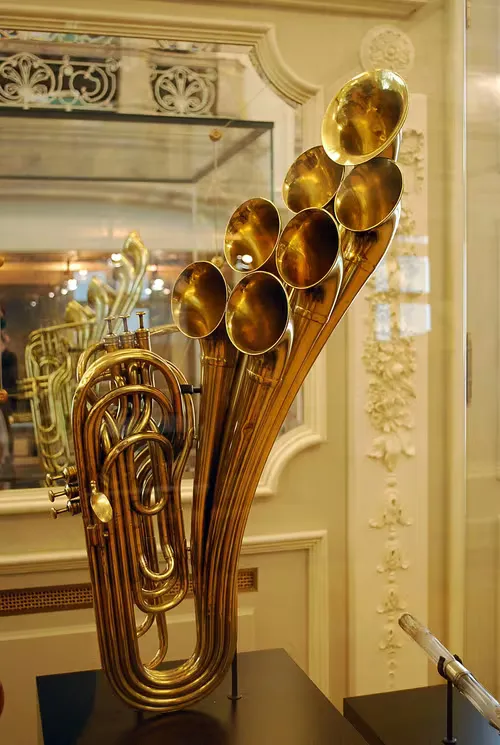
    Musical Instrument Museum

    Musical Instrument Museum in Brussels, stop 6 on the self-guided walking tour

    Look up at the Art Nouveau façade of iron and glass: this was the Old England department store, built in 1899 by Paul Saintenoy, and it joins an 18th century neoclassical building by Barnabé Guimard. Since 2000 both have housed the Musical Instrument Museum, part of the Royal Museums of Art and History, with a collection of close to 10,000 instruments that is known well beyond Belgium.

    The collection began in 1877 as a teaching tool at the Royal Conservatory, so students could see and hear early instruments. Its core was a hundred Indian instruments that Raja Sourindro Mohun Tagore gave to King Leopold II in 1876, plus the collection of musicologist François-Joseph Fétis, the conservatory's first director. The first curator, Victor-Charles Mahillon, grew it through philanthropists, learned amateurs and Belgian diplomats who brought instruments home from abroad. By his death in 1924 it held 3,177 original instruments, and his way of classifying them became the basis of the Hornbostel-Sachs system that experts still use.

    Go in if you care about music, design or simply objects with a story; plan about an hour. The museum charges admission. Even without a ticket, you can ride the Art Nouveau lift up to the rooftop terrace for the view.

    The Magritte Museum is directly across the street: 60 metres, 1 minute.

    Local name
    Musée des instruments de musique
    Hours
    Closed Mon; Tue–Fri 9:30–17:00; Sat–Sun/holidays 10:00–17:00 (last entry 16:15, ticket desk closes 16:00); Dec 24 & 31 early close 15:00
    Price
    EUR 18 full, EUR 14 seniors 65+/groups 15+, EUR 7 ages 18-25/unemployed, EUR 1.25 Article 27, free for 0-17, Belgian teachers, EU disability card holders
    Website
    mim.be ↗
  7. 7

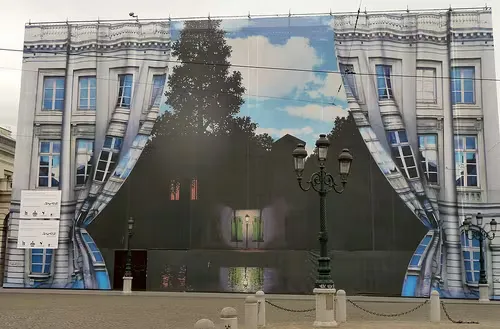
    Magritte Museum

    Magritte Museum in Brussels, stop 7 on the self-guided walking tour

    The Magritte Museum is devoted to the surrealist René Magritte and belongs to the Royal Museums of Fine Arts of Belgium. It occupies the Hôtel du Lotto, also called Hôtel Altenloh, a five-level neoclassical townhouse on the Place Royale from the late 18th century. It was part of the ensemble built after the Coudenberg palace burned down in 1731.

    The building has had several lives. The Place Royale saw fighting during the Belgian Revolution, and on 21 July 1831 Prince Leopold of Saxe-Coburg was sworn in here as King of the Belgians. The house then served travellers as a hotel for over a century, was sold to a jeweller in the early 20th century, and in 1951 the façades and porticoes around the square were protected from any change. The Royal Museums of Fine Arts moved in during 1962, the interior was rebuilt in the 1980s, and in 2007 the plans for a museum devoted entirely to Magritte took shape.

    If surrealism speaks to you, this is the place to slow down; give it more than an hour. The museum charges admission, and a combined ticket with the Old Masters Museum is available.

    The Royal Palace is 170 metres away, a 2-minute walk.

    Hours
    Tue–Fri 10:00–17:00; Sat–Sun 11:00–18:00; ticket office closes 16:30 on weekdays and 17:30 at weekends; closed Mondays, 1 January, 1 May, 1 and 11 November and 25 December; closes 15:00 on 24 and 31 December
    Price
    13 EUR; seniors 65+ 10 EUR; ages 18–25 5 EUR; under 18 free; combined ticket with the Old Masters Museum 20 EUR
  8. 8

    Royal Palace of Brussels

    Royal Palace of Brussels, stop 8 on the self-guided walking tour

    This is the official palace of the King and Queen of the Belgians, though nobody in the royal family lives here: they live at the Royal Palace of Laeken in northern Brussels. Here the King works as head of state, grants audiences and handles affairs of state. The building also holds the offices of the court, the State Rooms for large receptions and apartments for foreign heads of state on official visits.

    The ground has royal roots. The first building on the Coudenberg hill went up between the late 11th and early 12th century and probably looked like a fortified castle within the city walls. It was home to the Dukes of Brabant, who also stayed in Leuven and at Tervuren Castle, and it grew into the Coudenberg palace you met at the Mont des Arts. The core of the present building dates from the end of the 18th century; the long façade in front of you was only built after 1900, on the initiative of King Leopold II.

    The palace faces Brussels Park across the long Place des Palais. The interior opens to visitors only in summer, free of charge. The rest of the year you see it from outside, which takes ten minutes.

    The longest leg of the walk follows: 900 metres, about 13 minutes, to the Palais de Justice. On the way you pass the Royal Museums of Fine Arts of Belgium and cross the Sablon district.

    Local name
    Palais royal de Bruxelles
    Hours
    Open to visitors only in summer (2026: 3 Jul–16 Aug)
    Price
    Free
  9. 9

    Palais de Justice

    Palais de Justice in Brussels, stop 9 on the self-guided walking tour

    You will feel the size before you understand it. With a ground surface of 26,006 square metres, the Palais de Justice is reputed to be the largest building constructed in the 19th century. Architect Joseph Poelaert designed it in an eclectic style of Greco-Roman inspiration; work began in 1866 and was completed in 1883, and construction, land and furnishings together cost around 50 million Belgian francs. It remains the country's most important court building, home to the Court of Cassation, the Court of Assizes, the Court of Appeal and the Brussels bar.

    The site has a dark past. It sits on the Galgenberg, the 'Gallows Mount' between the upper and lower town, where convicted criminals were hanged in the Middle Ages. The earlier courthouse stood elsewhere, on the old Place du Palais in the Sablon area.

    Don't be surprised by the scaffolding. The dome was destroyed in the Second World War and rebuilt higher than the original, and renovation has been going on since 1984. Some of the scaffolding from that time still hangs on the building and is due to come down by 2035.

    Walk out onto the Place Poelaert for one of the best free views of the city. The Poelaert elevators link the square with the lower town, and from the panorama you can see as far as the Koekelberg Basilica and the Atomium. The building itself is free to enter.

    Notre-Dame du Sablon is 430 metres away, about 6 minutes.

    Local name
    Palais de justice de Bruxelles
    Hours
    Mon–Fri: 08:00–16:00 | Sat–Sun: Closed
    Price
    Free
  10. 10

    Notre-Dame du Sablon

    Notre-Dame du Sablon in Brussels, stop 10 on the self-guided walking tour

    Its full name is the Church of Our Lady of Victories at the Sablon. Built in the 15th century and supported by the nobility and wealthy citizens, it shows a late Brabantine Gothic exterior and a richly decorated interior with two Baroque chapels; the neo-Gothic details came in the 19th century. Across the street lies the Square du Petit Sablon. The church has been a protected monument since 1936.

    It began with crossbows. In the early 13th century Henry I, Duke of Brabant, recognised the Noble Serment of Crossbowmen as a guild and let them use the Sablon, a patch of sandy clay outside the city walls, as their training ground. In 1304 the guild of St. John's Hospital gave the crossbowmen an adjoining plot, and they built a modest chapel to Our Lady there.

    Then came the legend that made the chapel famous. A devout local woman, Beatrijs Soetkens, had a vision in which the Virgin told her to steal the miraculous statue of Our Lady on the Little Stick from Antwerp and bring it to the crossbowmen's chapel. She did, and after a series of miraculous events reached Brussels by boat in 1348. The statue was solemnly placed in the chapel and venerated as the guild's patron.

    Go inside: it is free, and the Baroque chapels reward a quiet ten minutes.

    The last leg goes back down to the lower town: 870 metres, about 11 minutes, to Manneken Pis, passing La Fleur en Papier Doré on the way.

    Hours
    Mon–Fri 10:00–18:00, Sat–Sun 9:00–18:00
    Price
    Free
  11. 11

    Manneken Pis

    Manneken Pis in Brussels, stop 11 on the self-guided walking tour

    Prepare to be surprised by how small he is: the bronze boy relieving himself into the basin measures just 55.5 cm. You find him on the corner of Rue du Chêne and the pedestrian Rue de l'Étuve, free to see at any hour, usually with a crowd of phones in front of him.

    He is older than he looks. A fountain figure here is recorded as early as the mid 15th century, and the sculptor Jérôme Duquesnoy the Elder redesigned it and set it up in 1619. The blue stone niche in rocaille style dates from 1770. The statue has been stolen or damaged again and again, so since 1965 a replica stands here and the original is kept in the Brussels City Museum.

    Brussels loves to dress him up. His wardrobe runs to around a thousand costumes, and since 2017 they have been shown in their own museum, GardeRobe MannekenPis, on the same street. The self-mocking humour is very Brussels, what locals call zwanze. Even the name has a twist: in the old Brussels dialect a manneke is a small man, while a menneke is a little boy, and the statue was first called Menneke Pis.

    Here the walk ends. The Grand-Place is about five minutes away if you want a last look, and the GPS navigation in your browser leads you back to the Bourse on request.

    Hours
    Open 24/7
    Price
    Free
Walking tour route map of Brussels Route loaded
Bourse de BruxellesGrand-PlaceRoyal Galleries of Saint-HubertBrussels Cathedral+7
All 11 stops are already on the map.
You just press start.
AI Tour Guide

You Know the Route Now. Walk It With a Guide in Your Ear

Press start wherever you are, even hundreds of kilometres from Brussels, and the guide begins telling its stories right away. In the city, pick any of the 11 stops to start from: it leads you there, then talks with you the whole route, asking, listening, remembering, and shaping the tour around your answers.

11stops 4.3km 1 hwalking 13languages
▶Start the tour free

Free to start · Runs in your browser · No app, no download

Shorter Ways to Walk Brussels

Short on time or only after one side of the city? These three sections of the route each work on their own.

Lower town in about an hour

Stops: 1, 2, 3, 4

For a first afternoon or a short layover: the Bourse, the Grand-Place, the glass-roofed galleries and the cathedral, with 16 minutes of walking in total. Everything is free; only the cathedral's treasury, crypt and tower cost extra.

Royal Quarter for art and music lovers

Stops: 5, 6, 7, 8

For a museum half day: Mont des Arts, both museums facing each other, then the Royal Palace, with just 7 minutes of walking. Entry to the two museums is the cost here; plan around three hours if you go into both.

Upper town down to Manneken Pis

Stops: 8, 9, 10, 11

For walkers who want views and quieter churches: from the Royal Palace past the Palais de Justice and the Sablon church down to Manneken Pis. 30 minutes of walking, all free.

How Long This Brussels Walk Takes, With and Without Museums

The pure walking time is 1 h. Most legs take a few minutes; the two longer ones are from the Royal Palace to the Palais de Justice (13 minutes) and from the Sablon church down to Manneken Pis (11 minutes). If you only look from outside and step into the free churches and the galleries, the whole walk takes about 2.5 hours.

The museums change the day. Give the Musical Instrument Museum about an hour and the Magritte Museum a little more, and with a lunch break the full route becomes a five-hour day. The lower town section fits into an hour, the Royal Quarter with both museums into about three hours, and the stretch from the Royal Palace to Manneken Pis into roughly an hour and a half.

Before You Set Off in Brussels

  • Start and finish: The recommended start is the Bourse de Bruxelles, and the walk ends at Manneken Pis. You can join at any stop; if you want to return to the start, the GPS navigation in your browser leads you back to the Bourse.
  • Best day and time: Plan the day around the interiors: start in the morning so you reach the museums well before their ticket desks close.
  • Costs: Everything outdoors is free, and so are the churches. The two museums are the real entry fees. The GPS route is free; the AI Tour Guide comes with 100 free credits, then either €19.99 for this tour all-inclusive with no time limit or €5 per hour.

Food and Breaks on the Way Through Brussels

Brussels feeds you well once you step away from the obvious terraces. These are the places worth a stop for waffles, mussels, fries and a beer.

Liège waffle at Maison DandoyAt Rue au Beurre 31 you get a Liège waffle or a Brussels waffle with cream at a fair price. Belgians eat the Liège waffle warm and plain, without the mountain of toppings.
Moules-frites in Sainte-CatherineThe fish quarter around Sainte-Catherine and Rue de Flandre serves honest Brussels brasserie food: mussels by the kilo are the classic order, and the lunchtime menu du jour is cheaper. Mussels are fresh from July through March.
A beer at A la Mort SubiteOpened in 1928 with an Art Nouveau hall, it pours beers at fair prices, and it beats any terrace on the square. Delirium Cafe is another option at similar prices.
Golden BarA quick beer here comes cheaper, since you are not paying for the view of the square. (Just off the Grand-Place)
Fries at Maison AntoineIf you head out to Place Jourdan, Maison Antoine has been frying since 1948; a small portion with sauce is cheap. Neighbouring bars let you eat them with your beer.

Brussels Tourist Traps to Sidestep on This Walk

  • Rue des Bouchers: Waiters wave you in with lure prices on mussels, then add fries, sauces and sides, sometimes from a different menu at the table. Chez Léon and Aux Armes de Bruxelles are the exceptions, though not cheap. Wherever you eat, check the bill for extras you didn't order. (Beside the Royal Galleries of Saint-Hubert)
  • Topping waffles: Stands advertise a cheap waffle, then charge extra for every topping, so the price adds up fast. A street stand away from the hotspots charges far less. (Grand-Place and around Manneken Pis)
  • Souvenirs and snacks next to Manneken Pis: The shops right by the statue sell overpriced, mediocre food and souvenirs. Walk three minutes towards the Grand-Place or deeper into the streets for better value, and keep an eye on your pockets in the crowd. (Manneken Pis)
Walking tour route map of Brussels
AI Tour Guide

Your Guide Is Ready Whenever You Reach the Bourse

Press start and a voice AI Tour Guide takes it from here: leading the route through Brussels, telling the stories, and turning your walk into a real back-and-forth conversation. No app or download is needed; it runs in your browser.

11stops 4.3km 1 hwalking 13languages
▶Start the tour free

Free to start · Runs in your browser · No app, no download

What the AI Tour Guide Adds Between the Bourse and the Sablon

On this walk the AI Tour Guide leads the conversation and ties the threads together as you go: the buried river under the boulevards, the lost Coudenberg palace that still shapes the Royal Quarter. It notices whether you linger at guild houses or museum fronts and tells more of what holds you. Ask what a particular guild emblem on the Grand-Place stands for or what kind of man Magritte was, and cut in whenever something catches your eye.

A Real Conversation A voice AI Tour Guide greets you, leads the whole route, and tells the stories and facts as you walk, asking what you want to see and keeping a real conversation going. Not a recording you press play on.
Map Navigation Follow the route on the map and walk at your own pace. You choose where to start and when to move to the next stop.
Ask Anything Curious about a building you pass? Ask your AI Tour Guide on the spot and the conversation carries on.
13 Languages Switch language anytime. No separate tour needed.
Start free in your browser

Common Questions Before Walking Brussels

How do I get from Brussels Airport into the centre?

The train to Brussels-Central takes 17 minutes and drops you closer to the Grand-Place; its fare includes the Diabolo airport supplement. Bus 12 is cheaper and takes about 30 minutes. Only take a taxi from the official rank and with the meter running.

Do I need a public transport pass in Brussels?

Not for this walk, which is entirely on foot. For other trips, tap a contactless bank card or phone: a ride includes 60 minutes of transfers and is cheaper than paper. A 24-hour ticket only pays off from four rides.

Where should I buy Belgian chocolate?

Skip the boxes in the Grand-Place shop windows. Neuhaus is pricier, Marcolini and Wittamer even more so, while Leonidas is the cheaper brand many Belgians buy for everyday. For a taste of the top end, try a single Marcolini 'Coeur'.

Which day trips combine well with Brussels?

Mechelen is only 22 km away, Antwerp 42 km, Ghent 50 km and Bruges 89 km. Each has its own free walking route you can follow the same way.

Is the tour really free?

Yes. The whole tour is free: the route, the interactive map and the navigation cost you nothing. Only the voice AI Tour Guide is optional and paid: you test it with 100 free credits, then you pay either €5 per hour or €19.99 for this whole tour, with no time limit. Admission to 2 of the 11 stops is not included: Musical Instrument Museum and Magritte Museum charge their own entry fees.

Do I need to download an app?

No. Everything runs in your phone browser. Open the route and start walking, no download and no sign-up required.

Do I need to book the walking tour in advance?

No booking needed. This self-guided tour is available anytime. Open the route in your browser and start walking. The AI Tour Guide works instantly, no app, no reservation required.

What languages is the AI Tour Guide available in?

The AI Tour Guide speaks 13 languages, so you take the tour in your own language and can switch at any time.

Can I skip stops or change the route?

Yes. Skip any stop, spend extra time at places you like, or start the route from any point. It is your walk, you set the pace.
Image credits
▶ Start free in your browser Runs in your browser, no app, no download